
-
Heat and a city’s thirst
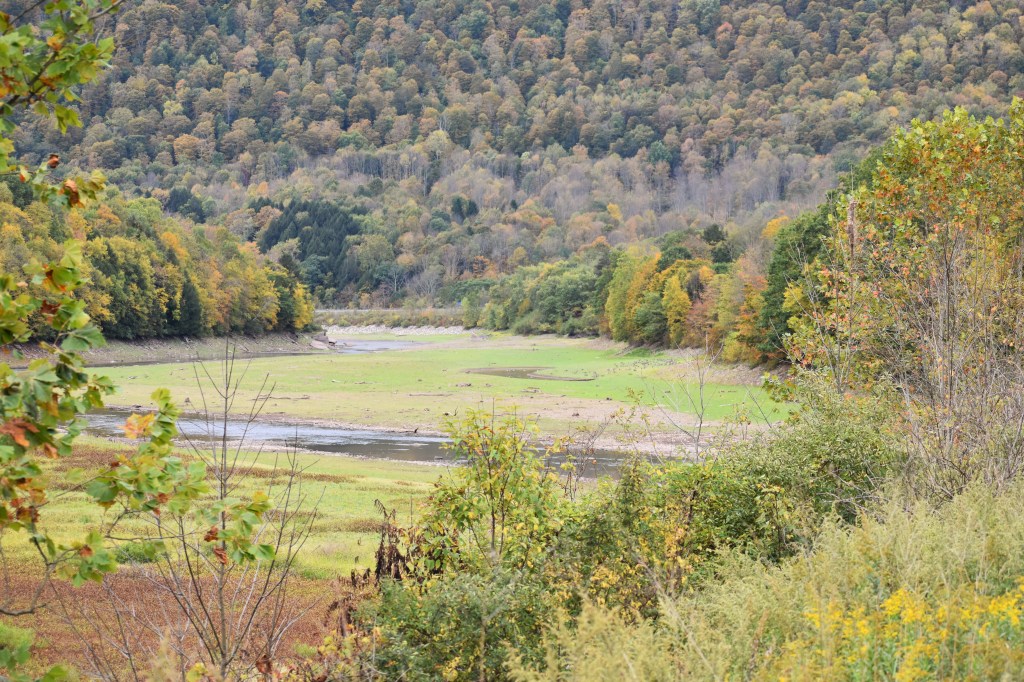
Cannonsville Reservoir September 2019 They have named her Fay, now a tropical storm, and she appears poised to bring our Catskills some much needed relief. We can only hope that her rains linger and moderate in their intensity, so her gift of rainfall has the most beneficial effect. The effects of heat stress and drought upon our rivers have been very real this summer. The rain is vital, as is a change from this extended run of hot sunny weather. Was it just last month we laughed at a morning high of 34 degrees?
The lull in fishing has me contemplating the mysteries of wild trout and reservoir releases.
Just yesterday I spent an afternoon stalking a quiet pool on one of our tailwaters. I have worked my way upstream as the summer has progressed, and this day I was searching the upper portion of the pool, where deeper, cooler water prevailed. There was little activity, on a perfect breezy afternoon there was very little sign of activity from the trout, despite what should have been excellent conditions: a warm wind, plenty of shade, depth and cover, perfect for terrestrials.
At first I wondered if the late start to the season had retarded the typical explosion of insect life. Our last snowfall came on May 9th, and there were a handful of very cold nights in June. I pondered these things as I fished. Near the end of my hunting area, I laid a beetle gently along the bank, placed perfectly in a tight band of shade. My reaction was nearly a second sight experience.
I almost saw the slightest ripple in the surface, at least I think I did. No ring, and no sign of the fly itself, but some sixth sense encouraged me to tighten. I felt weight, tightened a bit more and felt more resistance, then more. It took a moment for me to be sure that I was indeed hooked to a trout, and a good one at that. As I urged him away from the bank he finally reacted to my pressure, though his fight remained sluggish and uninspired.
I landed him rather quickly, the tip of the old Granger easily protecting the 6X tippet against his gentle struggles. The trout was a brown, a fine specimen pushing 21 inches, with wonderful color and the characteristic heft of a well-fed wild fish. He had taken the fly deep in his mouth so, to prevent any further stress, I quickly cut the tippet and released him. He disappeared promptly.
I was shocked by the experience, and curious. I immediately dropped my thermometer into the river where I landed the fish, recording a pleasant 64 degrees, in full sunlight in knee deep water. Fishermen have been schooled that 55 to 65 degrees Fahrenheit is the ideal temperature range for trout feeding and activity, so why I pondered was this large fish so reluctant to feed and so meek and sluggish when hooked? Could it be that our tailwater trout have so fully adapted to the artificially cold environment of the tailwater rivers that the traditionally accepted upper range of “ideal” water temperatures is too warm for them?
I was within perhaps 50 yards of the small riffle that dumps into the pool I angled, and even at low flow it was certainly enough to oxygenate the top of the pool I believed. I waded a bit further upstream and my surprise increased markedly when I saw trout crowded all over the bottom before me. They were lying in water nearly thigh deep, in full sunlight, and there were trout of all sizes, far too close to one another. This was a clear sign of stress, stress in what I believe was reasonably well oxygenated 64 degree water. I stopped fishing and walked out.
This experience has given me a whole new perspective on the health of our Delaware River fishery. For decades New York City held back releases out of Cannonsville and all of their Catskill reservoirs, maintaining that was the City’s vital drinking water. That their archaic transmission network is a marvel of disrepair, wasting millions of gallons of that precious water daily, is immaterial to them.
Once they decided to build a power generation station at Cannonsville however, they changed their tune, saying the City didn’t need that water. Still they are stingy with thermal bank volume and releases when temperatures in the mainstem Delaware River push high into the seventies. Stingy with the water they “don’t need”: hmmm? Meanwhile the East Branch, Neversink and the rest of the tailwater rivers are starved for water on a regular basis.
The wild trout fisheries in the Upper Delaware River watersheds are the best in the East, even when subjected to such mistreatment. Progress has been made towards conserving this resource, but it has taken decades to get where we are now; still far short of where we would like to be. American Rivers has named the Delaware their River of the Year for 2020, trumpeting the conservation success from the mountains to the sea. Imagine what this river, this fishery might become if we ever receive adequate flows of cold, pure water.
No comments on Heat and a city’s thirst
-
Experiments with terrestrials
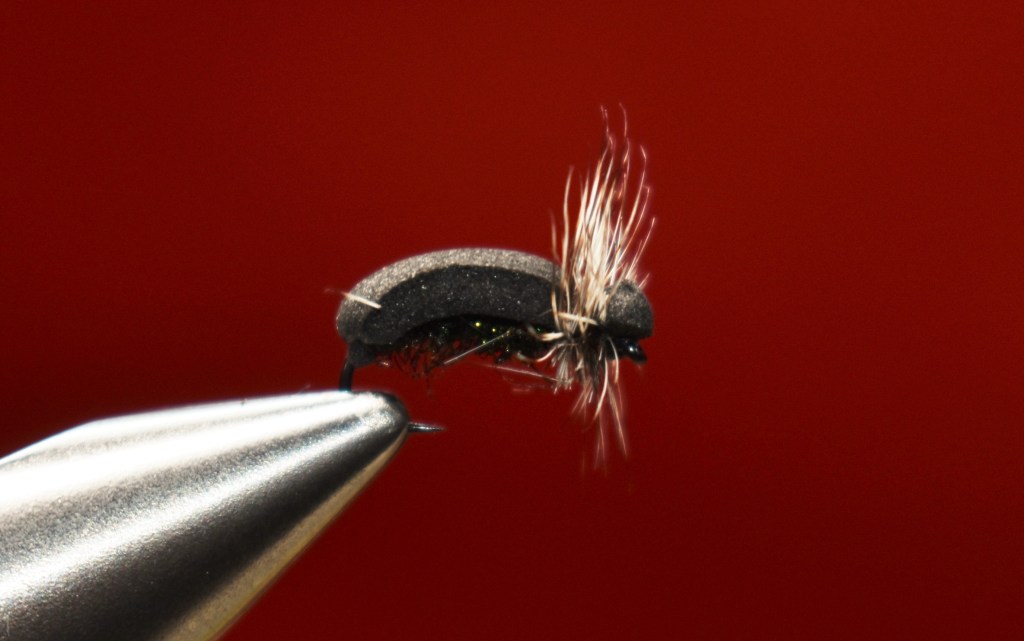
The Grizzly Beetle My experiments with new terrestrial patterns began last December and is continuing weekly. While I have had excellent success with some of my tried and true spring creek flies, some have been consistently ignored by our Catskill mountain trout, thus, new flies are required.
An example is my long time standard foam beetle, the fly that accounted for one of the two largest spring creek trout of my lifetime, a preposterous wild rainbow in excess of ten pounds. That size 18 beetle was a proven killer. Simply tied with lightweight closed cell Larva Lace foam strips, peacock herl and a couple of turns of black hackle, it was a go to summer fly for years. In the Catskills I would be hard pressed to recall a single trout that has taken one. I varied sizes and configurations with no success.
Experience tells me that trout in different environments often require different stimuli. I reasoned that perhaps the density of my beetles needed to increase to make more of a plop on the water, Catskill trout being used to significantly more current and more sound impulses on our larger, faster flowing rivers. With that my recent patterns have used a higher density 1/8″ sheet foam, and I have worked toward creating a bit of movement in the fly.
The first successes early in this summer season have come with the fly I called The Grizzly Beetle, pictured above. The fly has fooled one brown well over twenty inches which escaped late in the fight, and brought one twenty inch brown and a couple of smaller fish to net. It is early, and terrestrials in general have not brought consistent responses yet, but this fly’s initial performance is encouraging.
I was looking hard at a webby grizzly saddle hackle feather when I first tied the pattern, thinking that a webby dry fly hackle would provide a touch of the movement sought, and that the grizzly would also improve visibility of the fly for the angler. The pattern has earned a place in my terrestrial box this summer since it has produced when others have not.
The Grizzly Beetle
Hook: TMC 102Y size 15 or 17
Thread: Black 6/0 or 8/0
Body: 1/8″ thick high density closed cell sheet foam, cut in a strip approximately 1/4″ wide
Underbody: Black peacock Ice Dub, dubbed thickly on the rear two thirds of the hook shank
Hackle: Rather webby dry fly saddle hackle in dark grizzly, slightly oversize (14 hackle for a 15 hook) clipped into a broad vee on the bottom
Tying sequence: Taper 1/8th inch of the end of the foam strip and tie it in about a third of the way down the hook bend, then dub the underbody over the tied in foam and 2/3rds the way up the hook shank. Pull the foam over and tie it down at the end of the dubbing. Gently pull the foam strip toward the eye and tie down over it to make a bed for the hackle. Pull the foam out in front of the hook eye, lay the edge of your scissor blade against the front of the eye and cut, leaving a small foam head. Tie in and wrap the hackle, tie it off and then whip finish under the foam head.
I have relied upon the TMC 102Y hook’s wide gap and Sproat bend for decades for my terrestrials, as it’s set back point improves hooking with wide bodied flies like beetles and crickets. I love the black color particularly for the black terrestrial patterns. I think it visually blends into the fly better and is less noticeable to the trout, an important advantage for flies fished in calm, clear, often shallow water where the fish get a long time to study their food.
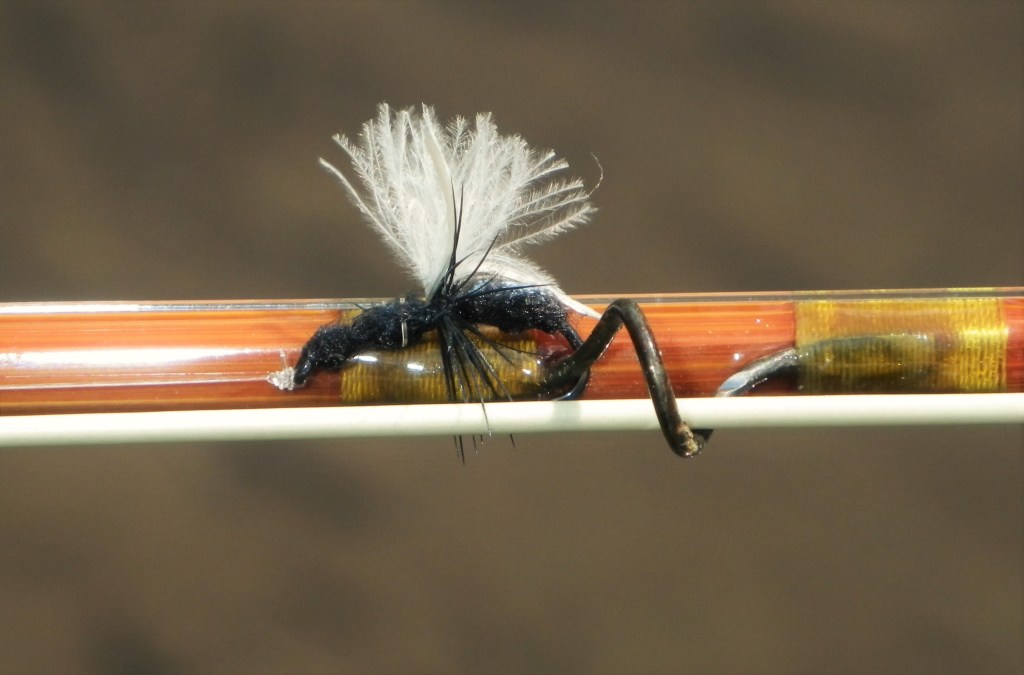
The TMC 102Y: You have to imagine the position of the hook point hiding behind the fly line. It sits behind the hackle tips, ready to hook the trout that delicately sips this little CDC ant, and the black provides some camoflage! I can offer some observations that may be helpful when assessing the readiness of the trout to consider terrestrials. Of course trout sipping very gently in open water, particularly where there are shaded edges are prime targets for smaller ant patterns, from size 16 down to size 22. When you see this behavior and do not see any sign of flying midges or tiny mayflies, ants are near the top of the probability scale.
When fishing with beetles, crickets or large carpenter ants, it is not uncommon to see a slight wake as shallow water trout move to investigate the fly. If you see a few such wakes and get neither takes nor splashy refusals, chances are the trout have not been seeing a lot of terrestrials yet and are not feeding on them when available. I have found that trout that want them will take them if the presentation is sound. That means a soft, accurate cast that doesn’t splash down line or leader, allowing the fly to settle with at most a gentle plop like a natural falling from overhead vegetation. Your drift must be absolutely drag free, and stay that way throughout the time it is in proximity to the fish.
Summer fly fishing is the perfect game for lighter rods and lines. A two, three or four weight bamboo rod is perfection for this fishing. If you are strictly a graphite fly rodder, stay away from the stiffest fast action rods. Older medium action graphite rods in these lighter line weights are better tools for the finesse casting and presentations required. Older Orvis Superfines, Loomis or Winston IM6’s and Thomas & Thomas Paradigm and LPS rods will all do a nice job. If you don’t own one, perhaps a friend has a forgotten rod or two tucked away you can borrow.
Terrestrial fishing is not a game for the poor fly caster. Work on your skills if you need to. The rewards of this game, well played, can be amazing!
-
Meanderings on dry land
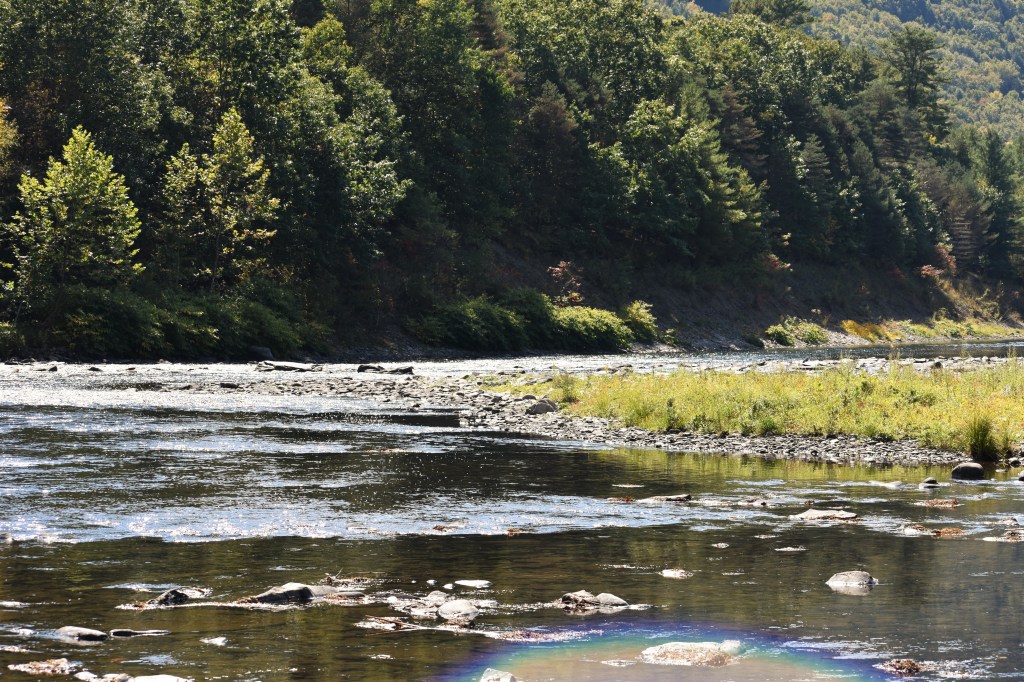
A heartbreaking view of Cadosia Riff from last September: I fear we are headed there again. Though I waded cool deep water yesterday morning, it soon became too hot to fish; even for me. Ninety-four degrees in Hancock around one in the afternoon is not the Catskill summer weather that brings so many wonderful memories.
We need rain terribly lest we repeat last summer’s drought, and worse. It felt like we would get some relief in early evening. The rain clouds massed and my porch thermometer dropped from 94 down to 86 with a beautiful wind to drive the cooling air. Sadly they moved on toward the southeast, where their gift was not so well received. New York City, Jersey and Eastern Pennsylvania all but washed away in powerful storms. Would that some of that rain had fallen here rather than continue its travel, adding to the destruction further to the southeast.
Heat and warm rivers have chased me early in the day, and I have had to fill my afternoons with tackle tinkering; winter stuff.
Last year I tried one of Scientific Anglers’ new Amplitude fly lines, the smooth trout taper. I bought it for a graphite rod but, with the description touting the suppleness and compatibility with bamboo, I decided I should give it a whirl with some time on my hands. I spooled it on a Bougle` and, after fishing it two or three times, I can tell you it will never leave that reel; not until the core is showing and I am forced to buy a new one. This is a wonderful flyline for fishing bamboo on our Catskill rivers, or any waters that demand delicacy as well as distance and control.
I am still tinkering with terrestrials, though the trout are not yet responding to them as they did last summer. Checking the notes in my tying log I find that it was late July when the great terrestrial fishing began, so perhaps the extended high heat of late June and early July has me rushing things. I tied a foam bodied Carpenter ant, complete with wiggly legs, a fly I believe should catch it’s share of summer bruisers.
Wandering about the house in yesterday afternoon’s heat I thought it a perfect day to take a drive and go wandering about the fly shops, though I dare not venture anywhere that people have congregated. More reports have been released, with experts admitting that the Coronavirus is airborne, that it “floats around in the air” waiting for its next victim. You cannot fish when you’re dead, so I am left to my own devices.
Even in Pennsylvania’s limestone country, the worst heat waves kept me from the streams. The heat and a hot wind made perfect conditions for terrestrial fishing, but when that wind refused to blow the head high grasses of the water meadows roasted anglers like an oven. The West Branch was once a refuge on such days. Standing in waist deep 48 degree water takes the edge right off a ninety degree afternoon. The crowds were large at times in those years, at least in places, but now they are far heavier, and come with the addition of a sinister threat.
I keep thinking of the joys of the lightest tackle. There is a two weight rod and reel behind me, leaning against the armoire in a travel case, and my Dennis Menscer 3 weight bamboo is in reach of my right hand. My little Galvan 2.5 Standard reel is spooled with an unfished 3 weight line, ready to offer its smooth, matchless drag with the subtle strength of Tonkin cane against the charge of a wide bodied brown trout, deceived by some minute creation of feathers and fur.
I fished that 6’8″ gem on the West Branch once, and tied into eighteen inches of Delaware rainbow that objected to the size twenty hook he found in my sulfur. I had a CFO mounted that day, with its simple spring and pawl clicker, and that bow made joyous music as he cavorted on his way down to Hancock. I landed him, but not without some joyously tense moments!
Oh how I wish I had owned such a rod when the limestone fishing was grand! I still have the little graphites I used back then, six and a half footers for two, three and four weight lines. By the time I was able to acquire a proper seven foot four weight cane rod, the best of the Cumberland Valley’s spring creek fishing had succumbed to pressure and development.
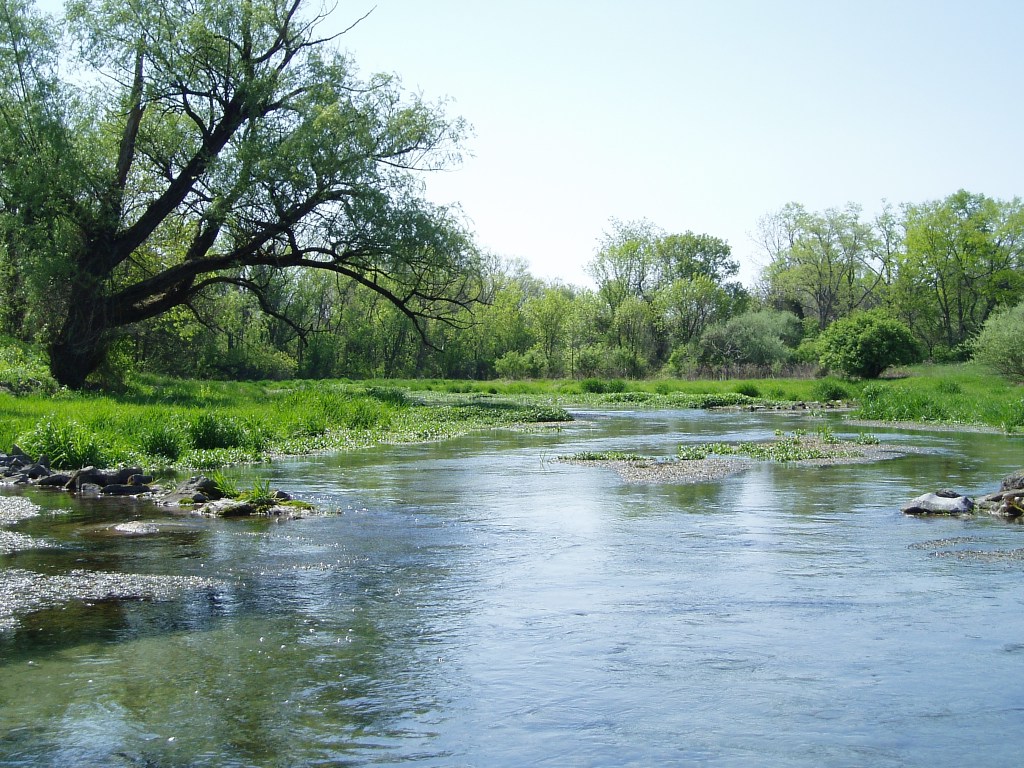
Big Spring’s Willow Pool in summer, before the decline I have always dreamed of fishing the western spring creeks, both the more intimate streams like Armstrong’s Nelson’s and DePuy’s, as well as the larger rivers like Idaho’s Silver Creek. I managed a couple of days on the Henry’s Fork’s Railroad Ranch water fourteen years ago, in a season the great Mike Lawson described as a “down year”. I have always wanted to return, to spend a month learning and savoring the fishing on those amazing waters.
While I’m daydreaming and wishing, I cannot help but wish to take a walk back through time to angle old Ed Hewitt’s water on the storied Neversink, and to drink a toast to the West Kill with Art Flick at it’s namesake tavern. What I wouldn’t give to share one more day with my departed friend Ed Shenk in the meadows of the fair LeTort!
Dreaming aside I must decide upon today’s course. Might I find a spot away from the crowds to stand in the frigid flows of the West Branch? Might today be the day to stalk forgotten waters? I will see, yes, I will see…
-
Transitions
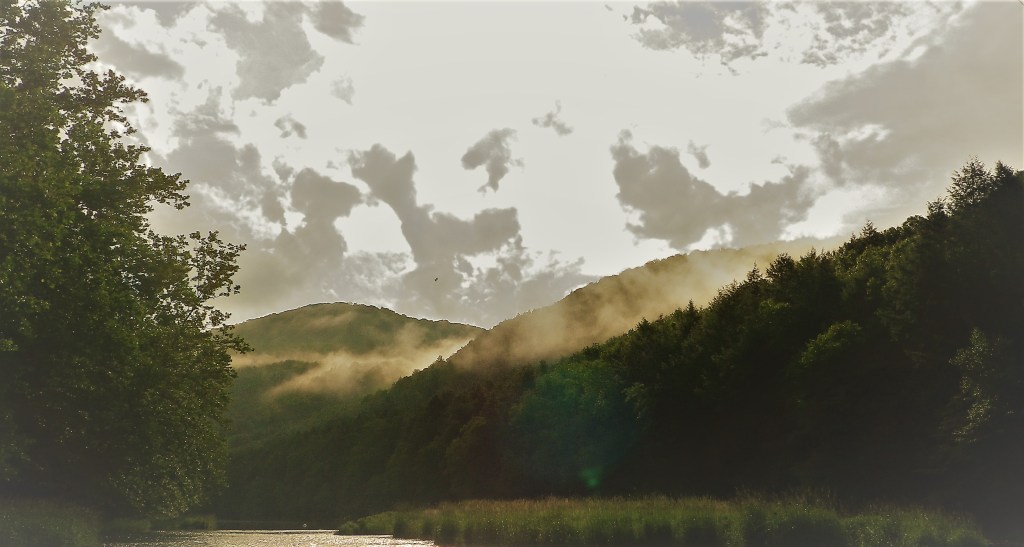
The Glory of a Catskill Mountain Morning One of the truths of nature, of rivers, is that they are always in transition. My morning forays have been beautiful and productive, but they are changing. Rivers are warming again, and there seems little hope in sight for another lovely rainy day.
Thunderstorms are hit and miss; that is why we find them in our daily forecasts throughout the summer. Some are so brief that their moisture evaporates before it even enters the soil. I can tell by the brown grass in my yard after two or three of them. A big one will certainly wet the landscape, but in the mountain forests that envelop our rivers so much of that rainfall becomes runoff when the rainfall intensity is high and the slopes are steep.
I have enjoyed my walks with the eagles, my visits from the deer, and the electricity felt through the throbbing arch of bamboo when one of our trophy wild trout has sampled my fly to make it a truly special morning. Yet changes are inevitable.
The sparse hatches have dwindled of late, and there has been little surface food to interest the trout, even in the coolest flows of the day. I have taken trout on terrestrials, but they seem not yet to be looking for them.
My fishing had quieted enough that I threw caution to the wind and travelled to the West Branch to celebrate an old tradition: fishing the summer sulfur hatch on the first of July. Many summers found me at West Branch Angler, haunting the frigid flows of the upper river by midday. The fishing has paled in recent years, with more pressure and fewer rising trout to play the game. With the flows near 500 cfs one would think the drift boats would be parked as mine is, yet many still insist on adding to the disarray on a few short miles of a heavily crowded river.
When I waded in on Wednesday there were three anglers in sight, none of them within 100 yards. I was pleasantly surprised. My mood changed when a boat drifted down to anchor a cast’s length above me. A “guide” certainly, as I recognized the Baxter House decal on his bow. Gone are the days when the river guides were known for the utmost courtesy.
By the time the hatch had brought a few sporadic rises, the water around me began to fill with wading anglers too, each intruding into my shrinking casting range, oblivious to the continuing threat of the virus, and certainly oblivious to the concept of sportsmanship that once formed a code among fly fishers. One even asked if his intrusion was “too close”, then stepped away a full stride when I told him that yes it most certainly was.
I stayed, but I fished with too much intensity to reap the benefits of solace and peace I look for on the river. I caught a few trout, nature seeming to provide a bit of justice, as plenty of trout rose directly in front of me and not it seems in front of those who crowded me from both sides, or the enterprising fool who waded in directly behind me and began to cast toward my boots.
I knew better than to go, even during mid week, for the crowds are worse this year than ever before, but I felt nostalgic for an old tradition. It only took a couple of hours before the pressure of being surrounded by the possibly infected got to me. The chap behind me looked perturbed when I turned to exit.
Transitions. Folks seem to have adopted the attitude that, since they are tired of the virus and the various governments have “re-opened”, they will simply pretend like nothing is wrong and do what they will. Too much of society finds no use for things like common sense and concern for our fellow man, particularly when they don’t align with their wants and desires. I pray more will learn the folly of their thinking without even greater tragedy than we have already endured.
-
Searching
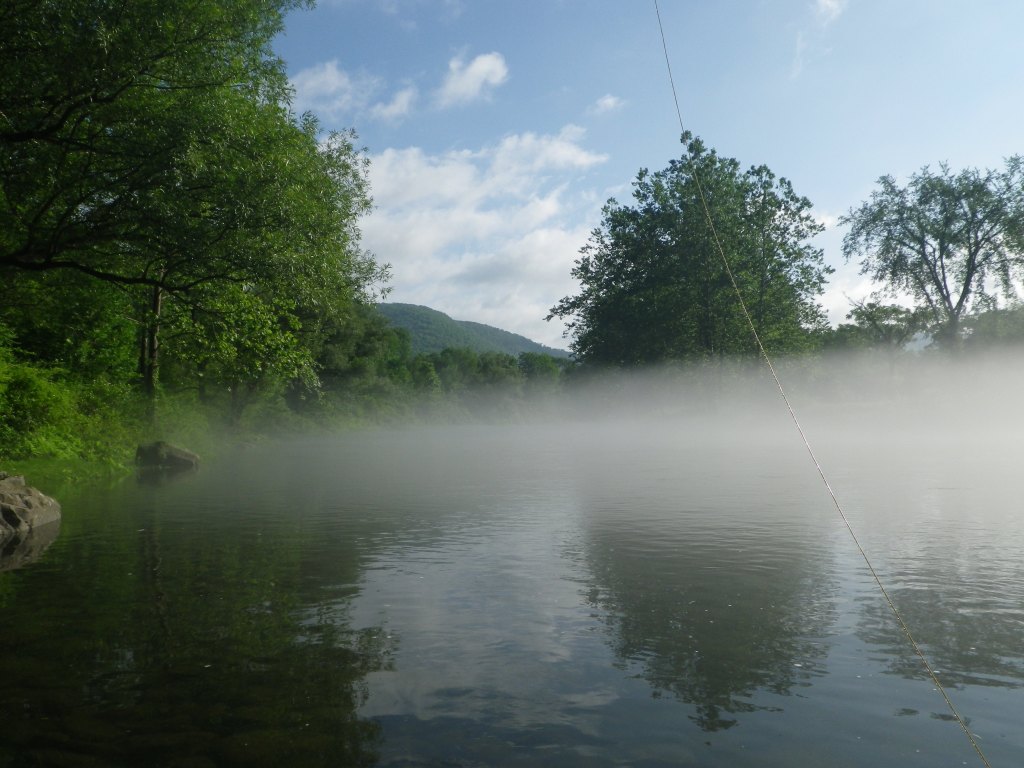
Mist Rising It was a lovely soft, rainy morning and my anticipation was high: this was the morning for a good olive hatch! All the signs were good, the mist on the river rising to meet the clouds that were nestled low against the mountain slopes, and olives had been around recently, even on some bright, warm mornings. Unfortunately for this angler, no one told the mayflies this was a perfect morning.
I had expected the tiny olives, and hoped for some cornutes to really finish off the hatch, but what I got was nothing. Each time some stray bit of food caused a small trout to make a single rise I readied myself anew, certain that the hatch was starting, but it was not to be. Such is fishing.
Before I surrendered to the obvious, and the looming storm clouds, I tied on a new beetle pattern and made some casts in flat water. Due to the rain, I carried an 8 foot Winston graphite, as opposed to my preferred bamboo, and the same four weight fly line I had fished a day ago on my Menscer cane rod seemed to land on the water like a brick. The rod companies have been touting “line speed” and “power” for so long they have forgotten all about presentation.
A well designed bamboo rod will make wonderfully long casts in the hands of a good fly caster, just as a well designed graphite rod will do, and it does it without that excess energy and all of that line speed. That energy has to be expended somewhere, and it gets expended upon the surface of the water. Fishing bamboo in this low water for weeks now, I had forgotten to adjust my casting.
I was thinking while I should have been sleeping, that it is time to get a two weight rod and line ready for the next rainy day. The trouble is, my long range two weight also generates “line speed”, though the excess is less with a two weight line and therefore easier to control. There is a solution available.
Friend and rodmaker Dennis Menscer debuted his 8 foot two weight bamboo masterpiece at the opening of the 2019 trout season. He had developed the taper after requests from loyal customers, and brought a rod along to the Catskill Cane Revival in Roscoe. I own one of Dennis’ three weight rods, a 6′ 8″ small stream delight, but I told him I had always considered a three weight to be the lightest practical bamboo trout rod.
When I cast the new two weight, I expected it to be too soft, even after Dennis laughed about the customer that ordered the first of these rods fishing for schoolie stripers with it, and catching a lot of them. For those unaware, schoolie striped bass are fish between 18″ and 24″ that fight with the typical strength of saltwater gamefish. On Maryland’s Chesapeake Bay I fished for schoolies with a stout 9′ 6 weight graphite fly rod, and they were all I could handle on that tackle.
Executed in an 8 foot, two piece format, Menscer’s two weight taper performs more like some four weights, thought it does it with the delicacy of a two weight line! I believe he has designed and crafted the ultimate light line Catskill flyrod for low water summer fishing.
For now I will leave that four weight graphite in it’s tube when stalking low water. It is still a time for searching. Though mayflies continue to be sparse, only some of the trout have been receptive to terrestrials. Others remain ambivalent. My experiments with fly patterns continues, and there have been some encouraging results. Two days ago I watched from close range after a short cast to a minor sip on the surface. A fine brown trout sampled the beetle softly with barely a disturbance on the flat water. The white wink of his opening mouth was clearly visible in the flat, crystalline water. I paused, set slowly, and battled a lovely 20 inch brown trout to the net on my 7’6″ Menscer.
Successes are welcome of course, though I still hope to devise a pattern that will tempt the Uncatchable Trout, strip away just enough of his caution to elicit a take as opposed to the usual follows until drag inevitably ensues. It is good to have a goal.
-
Almost
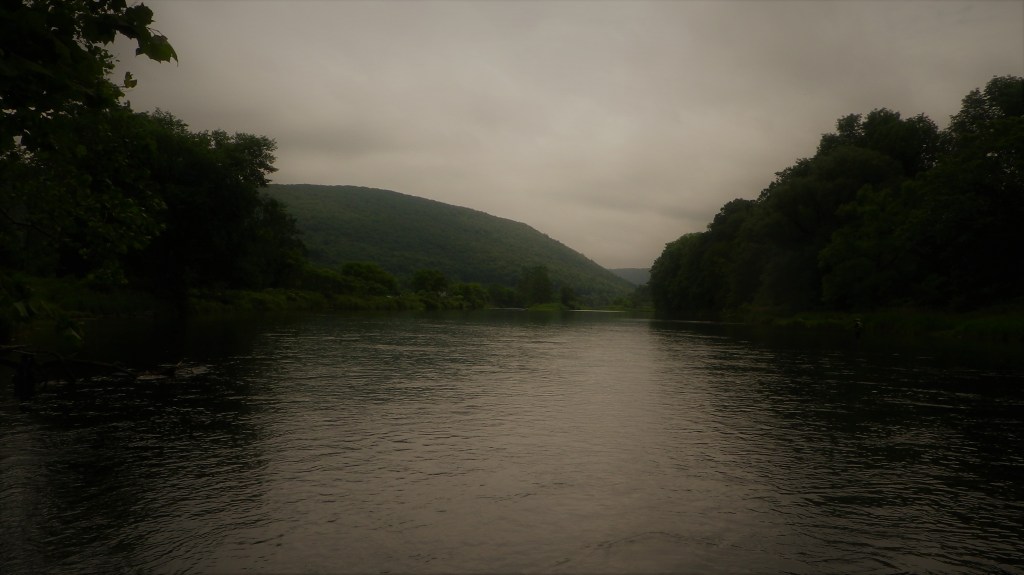
Clouds, welcome visitors to our overheated rivers Yesterday’s rain offered a bit of help to our rivers, the clouds even moreso, keeping the sun from beating down on skinny water and heating it up. I don’t usually fish weekends, but when I saw how much the waters had cooled I figured I would get out there this morning until the thunderstorms chased me home.
The river was pleasantly cool, and the clouds and mist hung low, close to the slopes around me. I had a great feeling that there would be some insect activity and trout feeding. I saw a few mayflies I hadn’t seen in a couple of weeks, but the only risers were little guys. I caught three trout, and I didn’t need a net for any of them.
I was flustered that the cool recharge had so little effect upon the fishing, still wondering if I should have been there during yesterday’s rain. Even the midgets had finished rising, so I took a long walk in hopes of finding one good fish to stalk. There was nothing doing anywhere, and I nearly headed out, when I decided to tie on my new beetle and toss it to a couple of neglected river banks.
Another best laid plan that failed to bring success, but I kept going, determined to find one good trout to eat that beetle.
I was prospecting a bank that has been good to me this year, when I noticed a slight disturbance on the surface. I stopped my drift before the fly dragged through that spot, then shot a long, gentle cast toward the disturbance. It was a long drift, but I reacted on time when I saw a nose pop out in the vicinity of my beetle. Whoa Nellie!
I pulled up solid, putting a fearful bow in my four weight Cumberland Queen bamboo. The Bougle’ spun hard as that trout cut across and downstream with the beautiful scream echoing off the mountainside. The big fish paused when he got to my backing, and I got three cranks before he ripped into the Dacron. I had the rod in the sky to keep the angle of pull as high as I could, lest he rub my fly out on the rocks. I began to regain backing, then fly line, and then he accelerated toward me and the line went sickeningly slack.
The hook was perfect, and I sighed to acknowledge another case of “the fly was in the wrong part of his mouth”. There’s nothing to be done about that I know, but that doesn’t help my disappointment in the moment.
-
The Trout Aren’t Always Rising
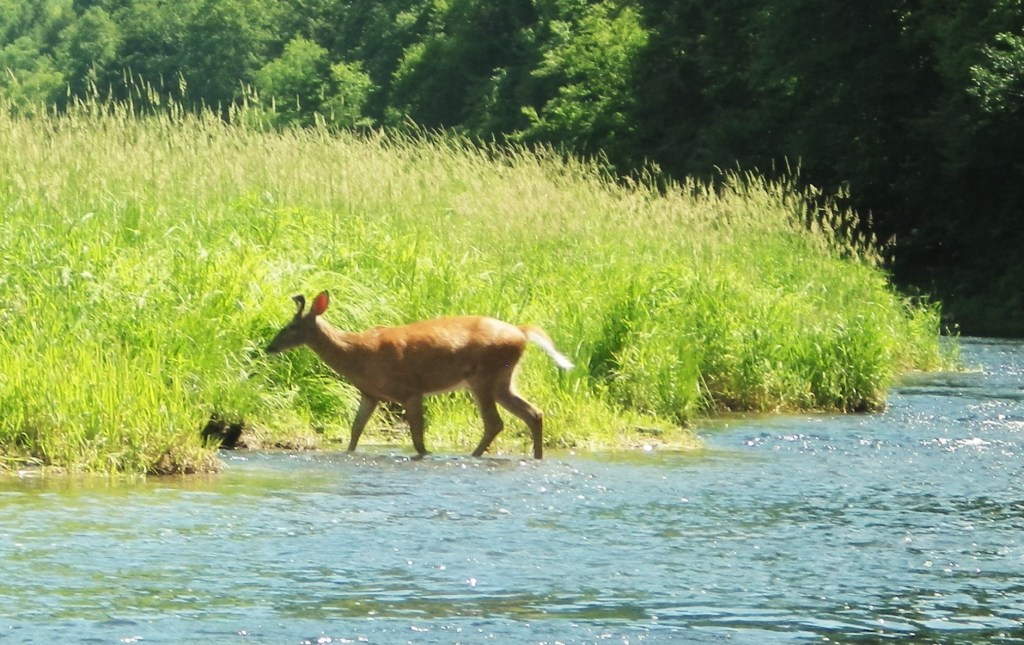
Footsteps in the water behind me…glad he wasn’t a bear! The other side of summer angling isn’t talked about so much; the days when the flies don’t bob along the currents and the trout don’t find a reason to rise. I have friends that never understood that there is more to fishing than fish.
I find a certain perfection in the wild places and moments like I shared with my young friend above. “Bucky” appeared behind me while I concentrated on an uncatchable trout, one of those that chooses a lie where the currents defy an effective presentation from any available angle. He crossed the river and wandered into the grass while I turned and snapped the photo. When I heard more soft wet footsteps, I turned again to see his little girlfriend had been in that grass waiting for his visit. Priceless moments.
That uncatchable trout provided me with diversion on a day when nothing much happened to get the trout excited. Perhaps it was too gorgeous, golden sunshine in brilliant blue skies with the mountains circling and eagles calling from the heights. That trout seems content to wait out the longest float I can offer him, expecting drag regardless of pattern. He moves around unseen in his little sanctuary so I can never be sure just where he is. If I manage a ten foot float, he dimples a dozen feet below me. Sometimes its good to have an uncatchable trout to rely on.
Few of these wild trout are fully attuned to terrestrials just yet, surprising with the paucity of mayflies and caddis available. Once again an unusual season unfolds. At times I think such variety of events are the usual. No two seasons are alike!
The great drakes did not appear for me this year, though I took one spectacular fish on an experimental fly when a few advance scouts graced the water. One morning I touched a single coffin fly in early morning: a kiss goodbye? Likewise the waters I haunt have been barren of isonychia this season, another favorite hatch. Each season in my memory seems to have a featured fly, an insect that was dominant and particularly prolific. Hendricksons, Blue Quills, olives, sulfurs or shad fly caddis for early spring, or drakes and isonychia for the finale; it seems impossible to predict which will come to the forefront each spring.
I have always imagined that each are most important somewhere, that some riffle on some river offers up a multitude of insects that seem sparse elsewhere. I wonder if, particularly on the tailwaters, man’s manipulations of current, temperature and flow tend to move concentrated populations around from year to year. Perhaps we should all search downstream for our favorite bug after a high water year. Of course Nature makes the puzzle far more intriguing than that. “Downstream” may be too warm or too cold for too long and alter the schedule, fooling us again. There is no prediction, simply adaptation I believe.
It is supposed to be raining in two hours they say, a one hundred percent chance. I pray they are correct this time, for conditions are trying for trout and insect alike. The Beaverkill has warmed high into the seventies all week, and the wide Delaware even moreso, the powers that control Cannonsville being content to keep releases down and watch the temperatures soar.Their feigned attempts at thermal bank releases were laughable. A few hours of a 150 cfs pulse will not cool a mighty river like the Delaware. Blessed rain and cool nights are needed; plenty of both.
Cadosia Riffle, Late summer 2019 May snowfalls, and June heat waves; not at all a predictable year. I pray that July will bring us the best of our Catskill summer: cool nights, frequent rainfall, and seventy-five degree afternoons in the sunshine.
-
A Little of This, A Little of That
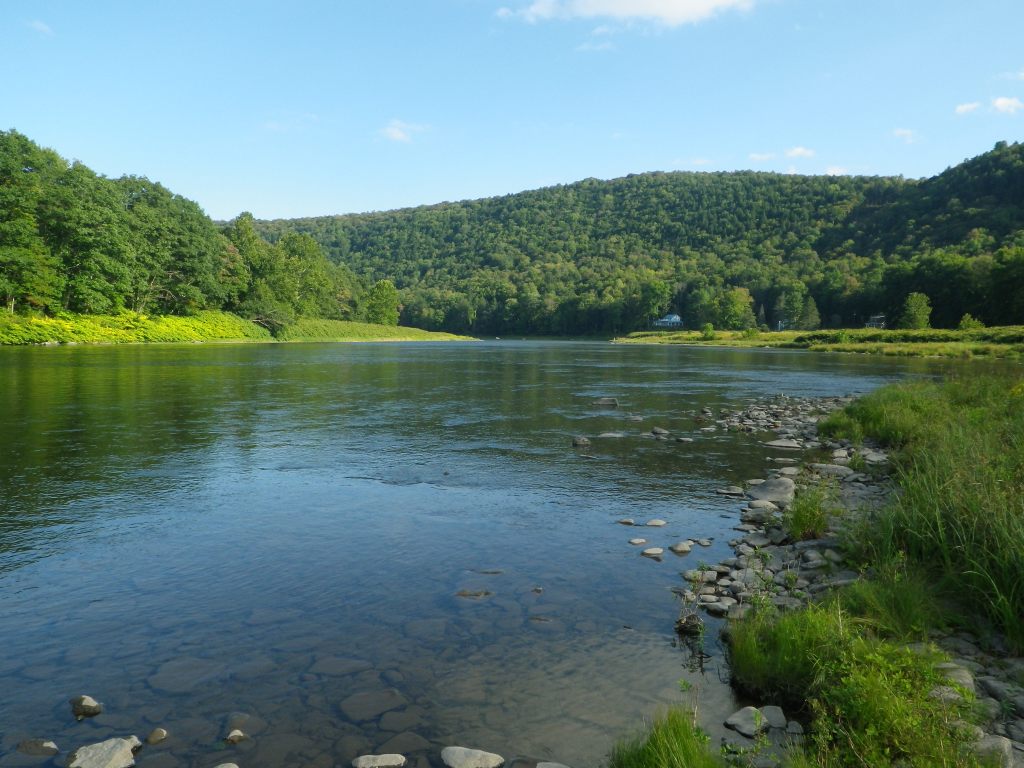
Summertime, and the livin’ is easy… If you read a lot of fly fishing books, I expect you have noticed the common theme of meeting the hatches for great fishing. Some of those tomes make it seem quite a simple matter to consult a hatch chart for river X and then show up with a handful of the classic fly pattern to match the hatch du jour. I guess if you are really lucky it could happen that way for you, maybe once or twice in a lifetime.
In the real world, Mother Nature throws us curves. The hatch that’s supposed to be in full swing usually isn’t, either winding down because they were hot and heavy last week, or there’s nothing but a few advance scouts because the main hatch won’t really come off for another week or so. That is more like a typical spring on our Catskill rivers. And then there’s summer…
Hot weather and a lack of rain changes things, and usually most of the main mayfly hatches are finished for the season once summer rolls around. I love summer time in the Catskills, and it is not for the big hatches. What you usually get in the summer is a little of this, and a little of that.
This morning was lovely. We actually had what the weather man would call a shower, though let me be clear that I think “a dampening” is a more accurate description. It was brief, but the cloud cover and that smidgen of rainfall left a new freshness in the air. It was cooler, and it’s stayed a bit cooler throughout the day, though there was plenty of sunshine on the river when I sidled down her bank at a quarter to eight.
I watched a while, seeing very few tan caddis flying about, then eased into the river and tied one of my T.P. Caddis to the 5X. There were no rises, and I had no intention of fishing the water with that fly, but there was a lie close by that I have some history with. When I fished that reach last summer I had my fly taken away when not too much was happening.
I figured it wouldn’t hurt the rest of the pool if I made a couple of casts to that particular lie to see if my old nemesis was home and thinking about breakfast. I made three casts, starting above the lie, twitching the fly and picking it up before it ran out of slack and dragged. At least that’s what I did with the first two casts.
I shouldn’t have been as surprised when that big boy set my Hardy spinning and rocketed out of the water three times with the reel screaming all the way. The small spurt riseform should have told me that my old friend was a Delaware rainbow. I think the folks at Hardy ought to make a sizeable conservation donation to benefit the Delaware River and its wild rainbows, as there’s nothing like a bow to light up the atmosphere with that special kind of music that Hardy reels are known for!
He was something! My old Granger was bent dangerously then he was out of the water again, twice, before rushing downstream to make the clicker sizzle again. When he decided to come back upstream I was reeling frantically to try to keep up. I barely made it. A Delaware bow with shoulders, and a lot of piss and vinegar, he measured twenty-two inches in the net. Made my day with three casts!
The caddis I had seen didn’t stay around, and it was a while before I began to see a rise here and there. I had a different fly on by then, a smaller CDC caddis, at least until I saw a dark mayfly wriggle to the surface while I was trying to pinpoint one of those risers. Cornutas; I had seen a lone spinner last week so I knew a few had been around. I dug out the comparadun I had tried that morning and started working down to cover the rise.
The next “little rise” turned out to be a little fish, but that ten inch brownie put a bend in the Granger as best he could. After landing small fry, another good fish showed, but he wasn’t interested in that comparadun. The cornuta hatch lasted maybe ten minutes, then things went very quiet for half an hour.
I switched the deer hair comparadun for one of the T.P. Duns I had tied last week, hoping that more than the single spinner I had picked up would show up on this beautiful stretch of river. A spurt rise got me thinking bow again and I covered it with a long downstream cast, backing up the rod tip before dropping it quickly to put plenty of slack in the leader. He came for the fly and I got a look at his broad side as he turned and went down to the rock he had been holding on, confident I had him until he promptly unhooked himself.
The hatching duns subsided again, and I busied myself by wading carefully up and back down chasing a few one-time risers. I changed flies, and was changing back when a trout rose fairly close by. While I finished my knot he continued working my way, until my twenty foot cast put the T.P. Dun in his sights. Hookset, scream, backing! In one great rush he was 150 feet downstream, and there was no doubt in my mind that I had another tiger of a rainbow by the tail. Reeling, reeling, the 2 7/8″ diameter Hardy Perfect sounds wonderful and looks nice on the Granger, but man that’s a lot of turns to get all that line and backing back on the spool!
When I got my “rainbow” in close quarters, he displayed the gorgeous gold and bronze of a brown trout. Fooled again. He measured all of twenty inches when I finally coaxed him into the mesh. I let myself linger as the last here and there rises led me wandering about the pool some more, changing to 6X and a size 20 olive when I spied some tiny wings on the surface, but the sparse activity soon dwindled to nothing.
A great morning, and two very memorable trout that took my breath away! I tip my glass of single malt to salute them, giving thanks for a Granger Special that’s several years my senior, and three little ten minute hatches of cornutas. I think I’d better ties some more of those flies.
-
Summer Heat & Skinny Water

Enough to wet my toes perhaps Saturday was the first day of summer and it certainly feels like it. Gone are those deliciously chilly mornings that graced the last days of springtime. A stream thermometer is as vital as your fly rod right now, for there is a lot of warm water flowing in our rivers, water too warm for trout and insects.
I visited a reach I enjoy this morning, wary of even the morning water temperature, though I found it close to perfect at 62 degrees. A few hours on, things will deteriorate as the sun bakes the stones on the river bottom and pushes the skinny flow to seventy degrees or more.
Putting my old Granger together I was treated to a bald eagle and her youngster sky dancing o’er the meadow. Quite a sight to behold. By the time I had the rod together and laid aside that I might retrieve my camera, they had glided away. The memory remains.
Where I found plenty of sipping brown trout last week, today there was very little activity. I spotted just a few tiny duns on the glassy surface, and knotted a size 22 olive T.P. Dun to my tippet. Every once in awhile a very soft dimple would appear, so soft I felt sure the trout were small ones. They didn’t seem to want that 22, nor the ant that was medicine last time, so I tried the same little dun in a size 20 and fooled a foot long brown with the larger fly.
The big fish that were active last week were no where to be found, and as the morning progressed the only other wiggle in my rod was a faint one, courtesy of a brown half the size of the first. I surmised that the weekend’s high temperatures had put the larger trout in a dormant mood and resigned myself to the fact that the fishing wasn’t going to meet my expectations this day.
I was walking the bank slowly, appreciating the beauty of the river as I ambled through the head high grass. Yes, it truly is summer now I thought, and there will be many quiet days like this. I was nearly lost in my reverie when I saw the bulge in the skinny water flat across the river.
It took me a few minutes to find a position, wading hopelessly slowly lest I push water across the flat and send my quarry to cover. Along the way I watched three or four more bulges, each in a different location. Multiple trout? No, it seemed clear that I had a cruiser to deal with. The rules of the game were simply laid: cast quickly and softly only when he rises, as he won’t stay there for more than a few seconds. After a number of attempts he began to try my patience.
I knew that a second cast to his riseform was the kiss of death, as it would be too likely to line him as he moved unseen. Rise, cast… and wait. Habit caused me to break the rules, rushing a second cast after a particularly heavy bulge, and the fish went quiet for a time. I was nearly convinced I had put him down when a bulge appeared just downstream, and my short reach cast brought the bulge to my fly!
He was a marvelous brownie, full of himself even in that skinny water, bringing the little Hardy to full song over and over as I let the deep bend in the Granger cushion my frail 6X tippet. I didn’t expect to find a twenty-one inch brown cruising in a calf deep flat sipping tiny olive duns, but I’m glad I did!
With that fine fellow revived and on his way, my attention turned to the fan of soft current upstream. My heart rate quickened as there were three or four good fish moving about and taking the olive duns.
If my first approach was tedious, this one was positively agonizing, as I had to cover forty yards upstream on an uneven bottom without pushing any water toward those trout. I could have sworn it took an hour, watching those big fish feeding happily and fighting the urge to throw a long, early cast their way.
There appeared to be four, but they were moving around enough to keep me guessing. I checked the tippet and the fly, dried it a bit, and made a quick, gentle cast when a riseform appeared nearby. I tightened easily, slowly, when the fly vanished in a ring but one quick jerk of his head and the tippet gave way. The last inch was roughened, raked across his teeth no doubt, so I cut it back and ran my fingers all the way up to be sure.
I dug in my shirt pocket for the little stash of this morning’s freshly tied flies and knotted another size 20 olive fast. I took a shot each time a rise appeared and finally connected once again. This fish had the fly in a better place and he rocketed out of the water at the bite of the steel, then ran hard downstream. When he turned I was reeling, the rod tip high with a wicked bend down through the mid-section. The Perfect protested loudly each time he streaked away, but the supple cane tired him and brought him to the mesh at last. I grinned at the measurement: twenty-one inches again!
The last of the group had moved upstream with the commotion, and he soon ceased making those exciting bulges and rings. He, or another, slid down and near to the far bank, where he sipped daintily in the slack water side of a seam. I could muster no float to deceive him.
The sparse hatch had ended, and I stopped for a moment to reflect upon the fine fishing I had enjoyed during the last weeks of spring. I scanned the mirror of the river upstream and down, and started out for home.
-
My case for the CDC Ant

Love ’em when they have that chewed look! Ant patterns are extremely popular terrestrial flies, perhaps the most popular of all, since they occur most everywhere there are trout by the trillions. There aren’t that many fly patterns yet, but there are certainly a lot of them. The last thing fly fishers need is another fly box in their vests, one stuffed with a plethora of ant patterns. I give my nod to the simple CDC ant.
I have gotten to the point that I like to tie my ants a bit more anatomically correct. Ants have three bumps: the larger gaster, and two smaller bums at their midsection and head. Certainly a lot of trout have been caught on the good old two bump ant with a hackle at the middle. I tied and used them for years, but I have had them refused more often by truly picky fish than the three bump version.
The CDC ant I tie has a couple of advantages. The first is versatility. Adding CDC puff wings allows this fly to perform as a winged ant when there are flights of flying ants on the water. The CDC winged ant catches selective trout very effectively when the naturals are not winged adults as well. This cuts the number of patterns you have to carry in half. The second advantage is visibility on the water. One important note: keep the CDC dry to keep it visible! A drying patch and some brush-on powdered floatant are necessary accessories for fishing CDC trout flies.
Just yesterday I was treated to some fine and far off fishing where my little CDC ant was the ticket. Trying to see and follow a standard ant at 60 feet or more is a guessing game, but that little tuft of CDC gives even older eyes a clear target. Seeing my fly clearly always helps with my timing, particularly when I know I’m casting to a big fish. Poor visibility tends to make me strike too quickly when my anticipation is high, then hesitate too long, over compensating the next time I think a trout has my fly.
Delicate fishing with small, low profile flies requires patience and precise timing. The trout will tend to rise slowly to small bugs in flat, clear water. When you see the take, pause half a breath, then lift gently and smoothly. We all need to control the little boy deep inside, to reign in our excitement a bit when fishing is at its best. If we didn’t let him come out sometimes, we wouldn’t be fishing in the first place.
-
A Fine Summer Morning
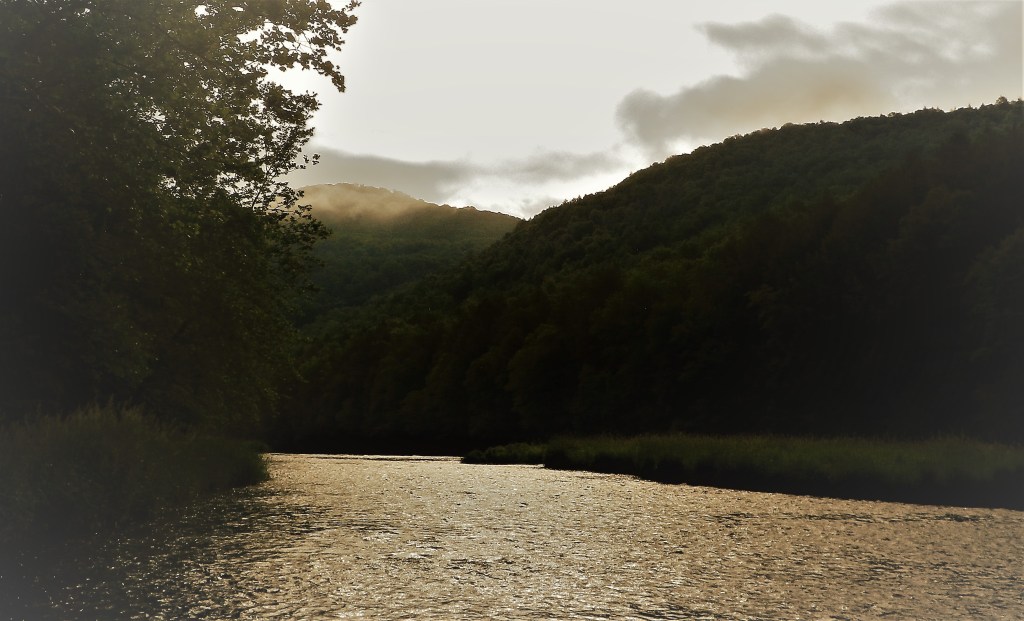
Summer Morn The river was quiet when I walked downstream to greet the day, though the birds offered their music to lighten the mood. The water of course is low and clear, and small riffles barely make enough ripples in the water to earn their name.
I carried my “new” four weight, a Granger 8040 that I have owned for several years. I took it out the other day and found that the rod and I are much happier when its matched with a four weight line! Most Granger fans consider the 8040 to be a five weight, and it may be the favorite model of a majority of Granger owners. It wasn’t my favorite with a five, that honor falls to the 8642, but as a four weight the rod is wonderful! It would be a morning for small flies and delicacy.
It wasn’t long before I spied a sipping rise across the river, and began my slow stalk into casting position. The trout was dimpling very delicately in flat water, yet there was nothing visible on the surface. I knotted a size 17 CDC ant to my tippet, checked the knot and tippet twice, then brought the old Granger into play.
My first cast passed him, as he seemed to have slid to the far side to intercept something. I pulled two feet more line from the little Hardy Perfect, then picked up soundlessly and false cast away from the fish, delivering the fly a touch closer while throwing the line in a big upstream reach. The white tuft of CDC let me track it until he dimpled beneath it and sucked it in.
Small flies and sipping rises require patience, a fraction of a moment’s pause before tightening. Too quick and too hard leaves the angler scowling and the trout put down. I paused just right. The gentle hookset unnerved the brown for a moment, and he shook his head slowly back and forth as if trying to determine just what was pulling on him. He figured it out quickly, taking line as the Hardy’s chorus joined the birds in salute to the morn.

A recovering 19″ brown ponders whether the ant he just ate was a prudent menu choice. After catching another half his size on the ant, I began to see a change in the riseforms. They were still soft sips, but just a bit of nose was visible. I watched and found wings in the drift, tiny upright wings. I figured the little fellows were either olives or tiny summer blue quills, and dug out a size 22 olive cripple: half biot and half dubbed body, with a comparadun style wing of Trigger Point fibers. My buddy John had mentioned that his hometown friends had tied comparaduns with this synthetic winging last summer. I had tied some small sulfurs to try it and they proved effective, and much easier to tie than the standard deer hair wing on small flies. Visibility and durability are a big plusses for the T.P. duns too.
I was seeing enough of a bulge on this fish’s gentle rise that I expected a good trout. He took some time, sliding from side to side out of his lane every time my fly was in it. We connected at last and I got a spirited fight from the best fish of the day: a fine 20 inch brownie. I smiled to myself and counted another 20-20 fish, the late Lee Wulff having proposed the mark for taking a trout 20″ or longer on a size 20 or smaller fly.
Being Lee Wulff he later expanded on the concept by landing a 20 pound Atlantic Salmon on an admittedly larger fly, though tied on a diminutive size 20 hook. My best, a 25″ West Branch brown, taken on a size 20 CDC ant pales in comparison to that.
The next several risers proved to be smaller fish, browns between ten inches and a foot long, all eager to show their stuff as they bucked against the slender tip of that classic cane rod. Eventually the sparse appearance of tiny duns subsided, and the riseforms changed back to the softer sips they started with. I went back to the ant of course, landing another good brownie of eighteen inches and a few in the foot long class.
By ten the action was pretty well over, though a couple of fish would vex me for another hour. They had seen my ant too many times by then, and they weren’t falling for it. For good measure they nixed a Griffith’s Gnat, a miniscule sulfur spinner, a larger ant and a beetle.
I nearly landed trout number ten, another good one, until my preoccupation with getting him on the reel caused me to lose tension during my frantic reeling. I was watching the slack in fear of a tangle when I heard him jump and looked up to see only his reentry splash and a limp line. Time for a break.
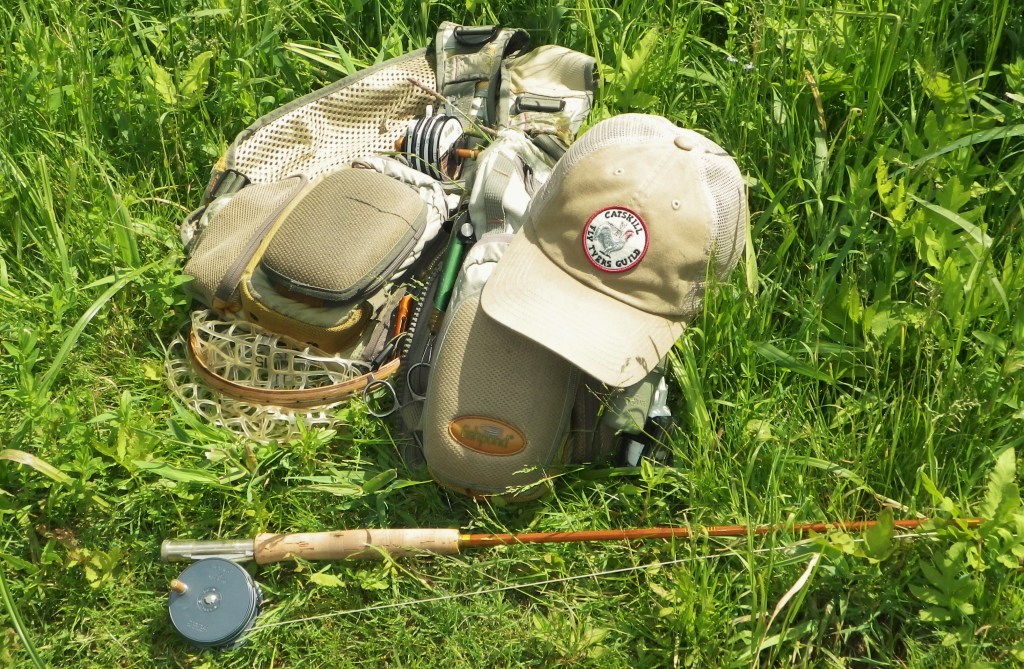
The 8040 Granger Special of indeterminate age, though certainly older than I, a working man’s rod… I hesitated in leaving the river, walking upstream then finally back down in hope of finding another soft rise. The breeze had risen, and that can signal more ants and other terrestrials on the water, but if they were there no trout rose to partake.
It had been an extremely pleasant morning, “pretty fishing” as Marinaro dubbed it in the Cumberland Valley, practiced far from his beloved Letort in the glory of the Catskills. Classic tackle on classic water, and the gift of solitude that allowed me to savor every moment.
-
Summer Patterns & Four Weights
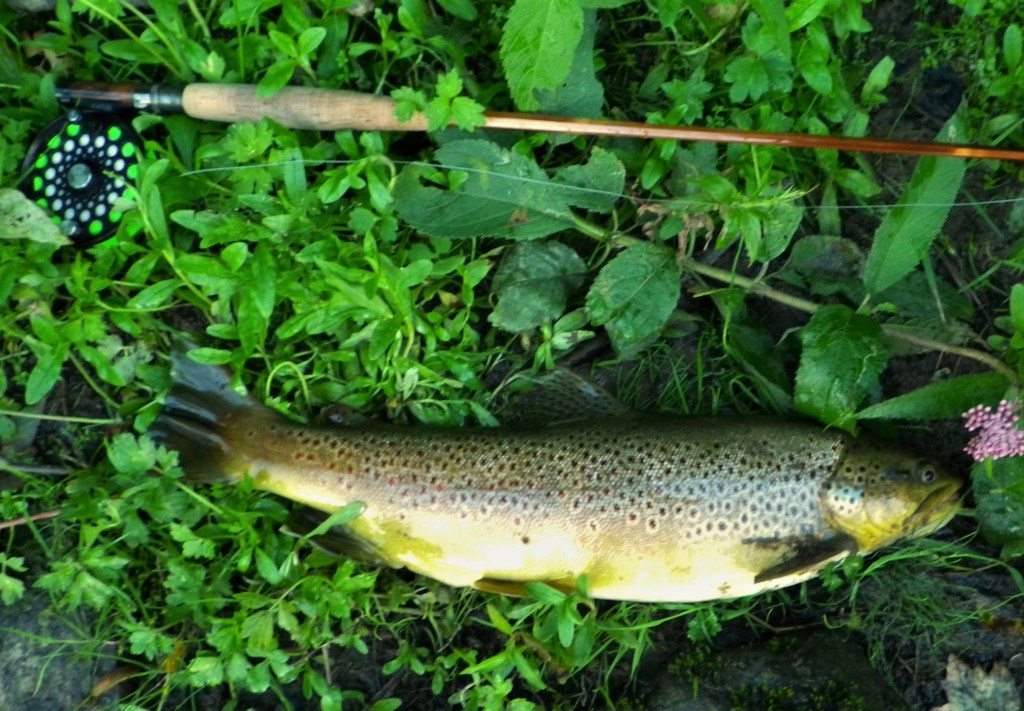
The Cumberland Queen 8 foot for #4 Warm sunshine and high skies illuminating each pebble on the river bottom in low, gin clear water. Sounds like summer time. It feels like it and fishes like it too.
Fly hatches have become sparse again, and there is a terrestrial box tucked in a vest pocket. If you find a trout rising, it can be really tough to figure out what he’s rising to, as there hasn’t been much in evidence these past few days. When I reach for a rod to carry for the day’s fishing, I choose a four weight like my Cumberland Queen. And though there are still boxes of spring mayflies in my vest, I have started prowling my summer haunts.
The Queen and I took a walk to one of those haunts yesterday morning, only to find an angler in the pool I had planned to fish. I left him alone and tried my second choice. There were caddis in the air, the same black ones I found on the Delaware Monday night, and I hoped the pattern I had tied for a possible return engagement there would temp some low water browns in the bright sun of morning.
The first trout I put that fly over ate it readily, but that cursed spool of 5X tippet came back to haunt me again. The trout kept my fly as soon as I tightened; and he wasn’t a big one. I checked the tippet a few inches above the break and it broke on a gentle pull. Another try a few inches further down the line held, so I tied on another fly and hoped for better luck.
There was a trout at the edge of some shade where the fast water started to slow along the bank. My cast looked good, but drag was easy to come by casting across the fast current. The trout popped the fly and I tightened upon air. A miss, perhaps a splashy refusal, regardless the result was the same.
The rest of my morning centered upon a big fish tucked into a bank side hide, that seemed as interested in playing with me as I was with him. The missed fish on that caddis? Perhaps, but that take was his last out on the edge of fast water and slow. He spent the rest of the morning giving me fits back in the nearly motionless water tighter to the bank.
He would appear to follow every relatively long float I could muster until it began to drag, then refuse the fly. Just to keep me honest, he continued to sip various tidbits back in there, every once in awhile walloping something hard. I finally tipped my hat to him in early afternoon and headed out.
I made that walk early this morning, finding a touch of natural beauty sweetened with solitude. I waited a while until the caddis became active and I saw a small trout take a swipe at one of them, then eased into the river and cast my black caddis to known holding lies. Fishing the water may be a cure for impatience, but it’s never a cure for a fishless day, not on this river.
As the morning warmed I went looking for yesterday’s nemesis, and I may indeed have found him. If this was the same fish, he wasn’t in his shady lie this time, he was out in a deeper channel pounding something. The only visible insect life was the caddis, which he stoutly refused to touch. I don’t know just how long I worked on the trout, but the glimpse I got of him on his second rise made the time worthwhile. I tried every fly I thought might intertest him, everything that had been hatching lately or was due to show soon, and he ignored them all, eventually retiring from the game.
I waited, and sure enough there was a hard rise downstream. I put the caddis on him quickly and got a solid take from a good fish, who started the Hardy talking right away. He was a nice brown, a hard fighter, but he wasn’t the big boy I spent all that time on. He was a chunky 18 inch fish though, and I was glad to slip him into my net on this second tough morning.
My next conquest was half his size, and I had to wait a little while again before another fish showed on the surface. That one was a long poke downstream, but the Queen was more than equal to the task. The fish screamed away at my hookset and I was really impressed until I got that foot long brownie in the net and saw the fly stuck in the top of his head. I guess it hurt enough to make him fight like a fish twice his size.
With no more activity to the south, I walked back north and looked to see if Mr. Shady was back in his lie. No sign of him, or anyone else for that matter, until I heard a solid thunk from downstream. Fish were up, several of them, all of a sudden. I cast to the first ones in range as I eased down and they promptly stopped rising.
I was thinking a hatch must be getting started, though I didn’t see anything besides a caddis or two. I tried a sulfur. No. Then began to scan the water in the bubble line I was standing in. Nothing but bubbles there, no sign of an insect of any kind, but those fish were rising hard when they rose. I scratched my head and went through the litany of patterns as I had earlier in the morning, with the same result.
Whatever had those fish feeding, it didn’t last very long. My opportunity was nearly spent when I considered the lone fish that was making softer rises, and dug out my sulfur box. I had one spent dun imitation left, and I tied it on, checking that hateful tippet three times. I could have sworn I heard that familiar chorus of Hallelujah when that trout tipped up and sucked in my little CDC spent dun.
There was music, for the little Hardy Perfect was in full song as that trout blitzed downstream. This was not a foot long trout with the hook in his head, this was the kind of trout I was looking for. He turned and charged upstream and had me reeling as if my life depended on it. He dug for the bottom and I raised the rod high, the supple cane bowing heavily as he bucked and raced away again. It was a hell of a fight, and I was glad to be the victor when I finally led that grown up brown into the net. He measured twenty-one inches, a trout with shoulders, and was none the worse for wear, darting away as soon as I lowered him into the flow.
The battle seemed to have put all the remaining risers down for the count. The run and the pool below were quiet, the bright water twinkling in the high sun. I exhaled and gave it a moment before I started north.
-
Initiation
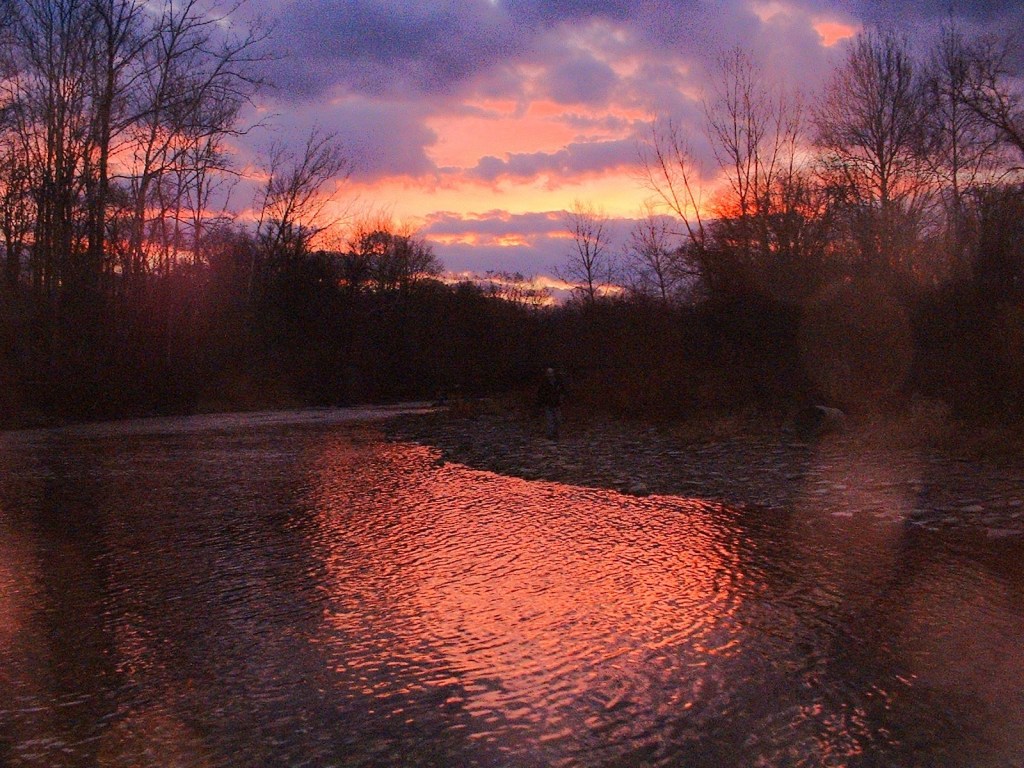
First Light Though I was up at first light, I honestly wasn’t on the river quite that early, certainly not on a thirty-eight degree morning in mid-June! The plan was to spend an early morning on the river, fishing apart once again with my friend John. We each brought along a special rod this morning, his particularly so as it is the new four weight bamboo, the second rod he has built.
John is one of the most accomplished and artistic craftsmen I have ever known. When he told me two years ago that he was taking the bamboo rodmaking class at the Catskill Fly Fishing Center, I knew immediately that he would emerge with a truly fine cane rod. His first effort was terrific, his rod better and more carefully made then several of the rods I have handled from professional builders.
For the second season, John wanted to build a four weight, preferably and eight footer, and he spent a lot of time deciding upon the taper. That can be tough when you don’t have access to all the various rods being considered, to cast and form an opinion of their tapers. I suggested he contact another friend, Tom Smithwick, a rodmaker I have known for many years; the man I call The Taper Wizard.
The rod I got to cast this morning is beautiful and very light in hand. Tom described it as an old F.E. Thomas taper that he had “tweaked as much as I thought might make it better”. I was casting leisurely after fishing this morning, and continuing to pull line from the reel. After unrolling a long, perfect loop and dropping the fly gently to the surface I looked down at the reel. Five turns of fly line remained on the arbor. I idly asked John if that was a full length fly line. It was. The four weight that felt like a feather in my hand had just laid out roughly 90 feet of line and leader: no double haul, no punch on the power stroke, just a very light touch and…wow! John has outdone himself with this one.
It was a gorgeous sunwashed morning, with the chill in the air diminishing enough to make it feel very comfortable. For two and a half hours we watched a myriad of solitary insects drift down the pool largely unmolested. Eventually, each of us had our patience rewarded by one good opportunity, and we both missed it. I saw my fish coming under the surface, squaring off under my fly and pointing straight toward me. I believe I pulled the fly off the water a microsecond before he actually was able to eat it.
I carried my Thomas & Thomas Hendrickson, a dream rod that serendipitously ended up in my hands. This was the fourth trip for me trying to initiate the rod with it’s first trout. I never saw a single trout rise during the first three. After loosing a luck fish that grabbed my sunken fly when I started to pick it up, and then missing my only true rise to my fly, I was beginning to think my lucky rod wasn’t.
I laughed it off with a grimace and turned to John “fishing still makes us little boys again”, I said. “Just can’t always control that excitement.” He acknowledged the thought with cheer.
It was nearing the time to go when my fish decided to try for breakfast again. I offered the same sulfur several times, but he wasn’t coming to that fly again. Not even after I added three and a half feet of brand new tippet to give it a better drift. Hardheaded sometimes, I admit, though I finally changed the pattern for a smaller sulfur cripple.
My first cast may have caught his eye, but the second actually brought him up to take the fly. This time I actually allowed him to eat it and turn back down before I tightened. He was a good brown, and put a nice bend in my bamboo. Standing in deeper water, I took my time with him, until I could bring him to the net.
A twenty inch brown trout is a fitting initiation for a bamboo fly rod; one any rod would be proud of. A special rod is a talisman, and its good magic when that rod’s first trout is a big one; even better if it takes some trials to secure. Serendipity put that longed for rod in my hands, just as it brought that brown up to feed again, giving me a second chance: good magic, strong magic!
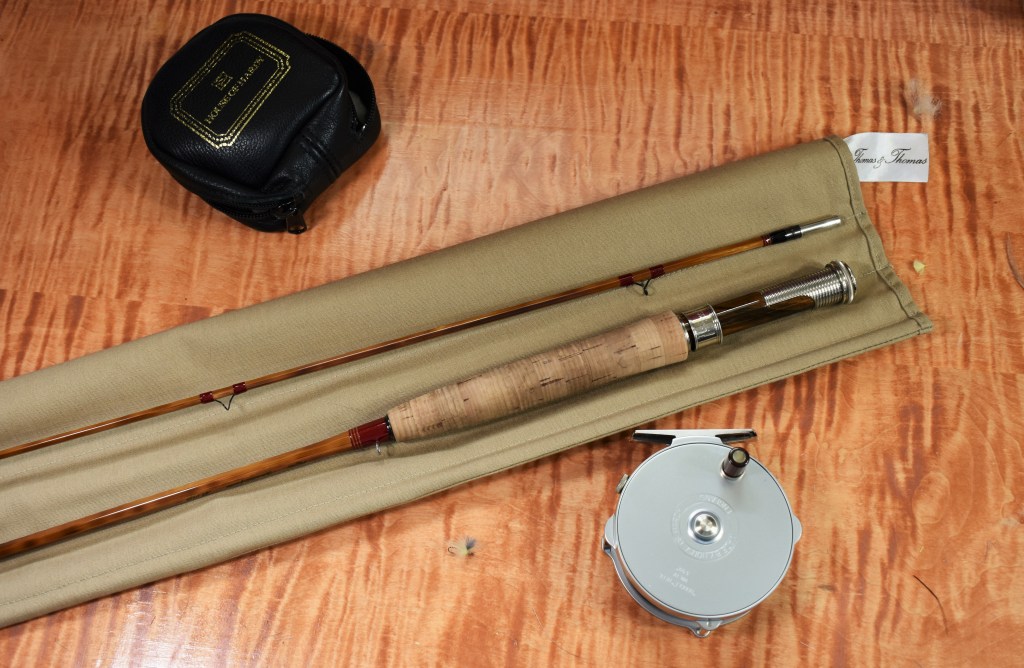
Talismans…
Search
Archives
- September 2026 (3)
- August 2026 (14)
- July 2026 (15)
- June 2026 (13)
- May 2026 (6)
- April 2026 (12)
- March 2026 (10)
- February 2026 (9)
- January 2026 (14)
- December 2025 (14)
- November 2025 (10)
- October 2025 (10)
- September 2025 (9)
- August 2025 (10)
- July 2025 (10)
- June 2025 (8)
- May 2025 (12)
- April 2025 (12)
- March 2025 (9)
- February 2025 (10)
- January 2025 (15)
- December 2024 (12)
- November 2024 (13)
- October 2024 (12)
- September 2024 (10)
- August 2024 (12)
- July 2024 (10)
- June 2024 (12)
- May 2024 (11)
- April 2024 (14)
- March 2024 (11)
- February 2024 (13)
- January 2024 (14)
- December 2023 (16)
- November 2023 (11)
- October 2023 (11)
- September 2023 (8)
- August 2023 (10)
- July 2023 (9)
- June 2023 (12)
- May 2023 (13)
- April 2023 (13)
- March 2023 (14)
- February 2023 (15)
- January 2023 (15)
- December 2022 (13)
- November 2022 (5)
- October 2022 (10)
- September 2022 (10)
- August 2022 (8)
- July 2022 (9)
- June 2022 (10)
- May 2022 (10)
- April 2022 (13)
- March 2022 (14)
- February 2022 (13)
- January 2022 (13)
- December 2021 (10)
- November 2021 (9)
- October 2021 (7)
- September 2021 (9)
- August 2021 (12)
- July 2021 (11)
- June 2021 (12)
- May 2021 (15)
- April 2021 (16)
- March 2021 (14)
- February 2021 (14)
- January 2021 (12)
- December 2020 (11)
- November 2020 (13)
- October 2020 (14)
- September 2020 (13)
- August 2020 (14)
- July 2020 (13)
- June 2020 (16)
- May 2020 (16)
- April 2020 (18)
- March 2020 (13)
- February 2020 (11)
- January 2020 (8)
- December 2019 (6)
 Bright Waters Catskill