I awoke to a world of white yesterday morning, and now we have a Winter Weather Advisory in place for tonight. Spring did begin nearly a month ago, I am certain I saw it written right there on my calendar! My solace must come from the bench it seems.
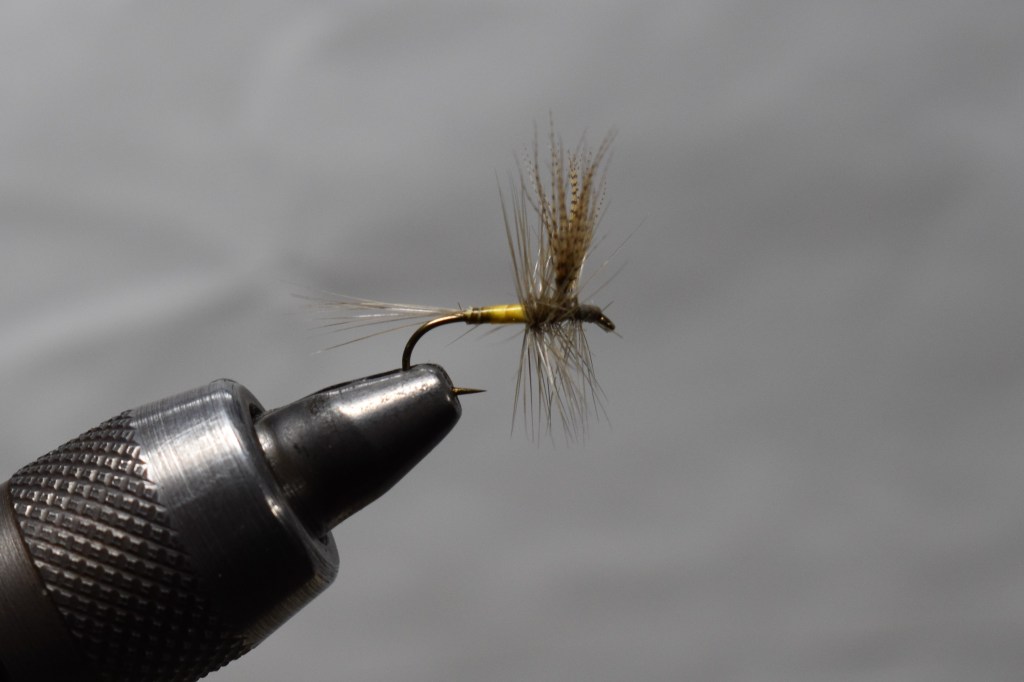
I have written various times of my 100-Year Drake, a fly inspired by the original flies of Theodore Gordon, and influenced by the late Phil Chase. Memory tells me that I began playing with this concept years ago, using first a sparse conventionally wrapped hackle as per Gordon’s ties, and then a thorax hackling technique in the style of Vincent Marinaro. Yes, the springs of the Cumberland Valley will always run deep in me.
I came across Justin Askins’ book and Mr. Chase’s “The 100-Year Fly” perhaps 8 years ago, finding the parachute hackle to be the most suitable. To that point my fly bodies had been dubbed, the majority using the bleed through technique learned from Pat Schuler, Delaware Guide of legend and gentleman angler. I still tie versions of the fly this way, though by 2014 I had tried the turkey biot body shown in the photo above. I have used biots in cream, pale yellow and the pale, yellowish green I found labelled “Green Drake”. The Green Drake biots are most common coming from my bench now, though experiments are always ongoing.
Ephemera guttulata stuck in its shuck
I have planned to make another simple video to share my tying technique for the fly. It is somewhat different from that recounted by Mr. Chase and, I feel somewhat easier to tie. Chase’s chapter in “The Legendary Neversink” describes a fly tied to imitate the Hendrickson, where my investigations have concentrated on the Green Drake.
The hatch of Ephemera guttulata is the highlight of our Catskill angling season, and I believe it is the most difficult mayfly to imitate. Much of my own fishing occurs on flat, clear water, and the flies can be quite active, adding greatly to the difficulty of imitation. Movement attracts trout, if you have fished more than a handful of days you have witnessed this.
The Drake is the most popular hatch in the East, and thus the fishing pressure for its duration is increasingly heavy. Our wild trout see thousands of imitations, fished well and fished poorly, and so are continually educated by anglers. As the hatch proceeds, the larger browns get much tougher to deceive. This fly has solved the puzzle on trout that refused or ignored a variety of other proven imitations.
The style of tie lends itself particularly well to our larger mayflies: Coffin Flies and all of the “drakes”, isonychia, March Browns, etc. If you tie them, reserve them for the trout who refuse your usual patterns. There’s no point in hurrying to wise them up to another style of fly!
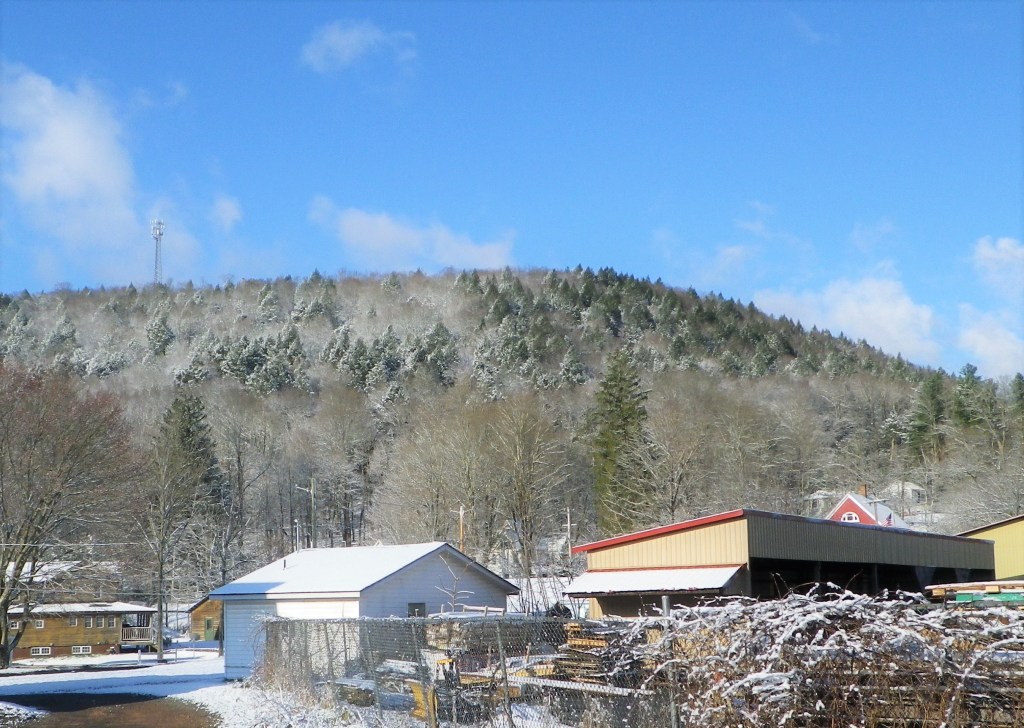
The morning sunshine lit up Point Mountain this morning to begin another beautiful Catskill spring day! For those less familiar with our geography, Point Mountain divides the last mile or so of the East Branch from the West Branch of the Delaware River. At its southern terminus the rivers meet in Hancock’s Junction Pool and the Mainstem as we know it begins.
This is April, nearly a month into spring, and yes, those are buds beneath the snow on my crabapple trees. A turn toward colder weather continues, with the river temperatures now stuck in the lower forties for a week. We were close to the fisherman’s spring, but now so far away. The rivers are high from rainfall and reservoir releases, so there is no wading to brave the colder winter-like water, not that rising trout could be expected anyway.
I am no newcomer to the reluctance of spring. For twenty-five years I travelled to these rivers on good forecasts, at times watching the warmth of sunshine and the looked for hatches vanish upon my arrival. The world of the fly fisherman is as ephemeral as the nature of the aquatic insects upon whom our foundation rests.
I read a lot through the winter, and I smile each time I come to a story of wonderful fishing amidst a blizzard-like spring storm. I have shivered on many river banks, waiting; and those storied foul weather hatches still elude me. Is it any wonder I love sunshine?
The tales are the same, with always the Quill Gordons or the Hendricksons the stars! I recall one April on the West Branch, back before the last run of great floods that changed our rivers. The weather had turned cold and raw, but the hatch had begun under better skies, and the flies continued. The surface of the river was literally crawling with life for three hours, a fly alighted on every square inch of water as far as the eye could see, and yet no trout rose to enjoy the feast. The water temperature had dropped quickly from the mid fifties to a somber 48 degrees. I watched a lone angler steadily nymphing the riffle that fed the pool while the rest of us stood and stared. He hooked up once in that three hour span, with the river bottom, and broke off his fly.
Patience: an easier thing to cultivate now in the throes of retirement than during those years of working and traveling for brief respite upon the rivers of my heart.
I fondle a few cherished bamboo rods, take a couple out in the yard to cast; try a new flyline just to see if it will be the one. The soul needs nourishment from the rivers, needs to be involved in the ritual of the angler’s spring. My fly tying output has slowed dramatically. There comes a point I find when I simply must be fishing for my mind to be inspired to seek the vise, the feathers, fur and steel.
If I sit back and close my eyes I can feel the sunshine on my shoulders. I smell the varnish as I draw my rod from its tube, assemble the joints and place the reel into its seat. Threading the line through the snakes, I hear that telltale plop and look up to see the fading ring of an early riser. My fingers tremble a bit as I hurry to straighten the leader and knot a fly to the tippet. I take a full breath of the mountain air and exhale, capturing that golden moment when anticipation meets fulfillment!
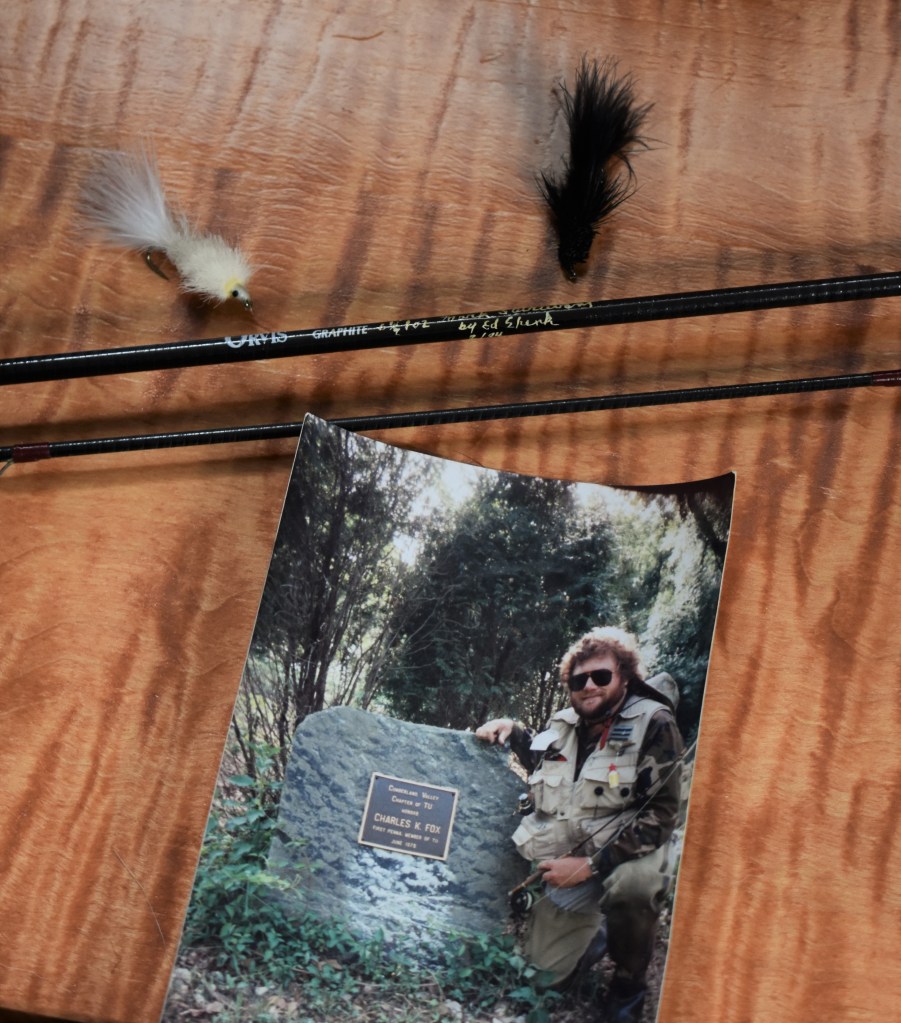
A Shenk White Minnow and Shenk Sculpin from my vise, the 6 1/2′ One Ounce rod Ed built for me many years ago, and a photo from our first trip together on the Letort
My weekend fly tying consisted of a little personal salute to my lost friend, as I felt compelled to tie a few of his sculpins and minnows. I was lucky to have sat down at Ed Shenk’s tying desk, side by side while he taught me to tie his famous trout flies. Those flies have accounted for some of my most memorable days on the limestone springs of the Cumberland Valley.
My best Falling Spring brown attacked a black Shenk Sculpin in March 2010, a seventy degree day in the earliest spring I can remember. I had spent my morning trying to get a local tire shop to fix the monitoring sytem they had fouled up, missing the chance for my planned trip to fish the blue winged olive hatch on another Pennsylvania limestoner 90 minutes away. The decision to walk the meadows of Falling Spring was at best a consolation.
The fishery had declined even then, and I knew there would be no dry fly action. I trudged grumpily along the path, thinking to myself there were barely any trout left in that reach. I glanced to my right and stopped dead, spying two huge browns finning side by side in a sunny pocket, and finished my thought “except those two”.
The size 8 Shenk Sculpin was tied securely to my 4X tippet, but the cluster of trees I was standing in presented numerous casting problems. I waitied until the pair backed down into a slightly deeper spot in the shade, then maneuvered cautiously where I could aim my backcast between branches and shoot a diagonal cast to the opposite bank.
Despite my excitement, my hand was steady, and the sculpin dropped perfectly to the bottom an inch from the far bank. I let it swing down and toward the trout and twitched it once, then twice. One of the great browns seized it and turned downstream, and I stripped hard and brought the 4 weight rod up into a throbbing arc. The trout churned the placid surface to a froth, then dove toward a root ball and tree trunk sunk in the silty bottom.
I couldn’t stop him, and he shot under the trunk and bolted downstream, my little CFO screaming with the speed of his run, and my fly line sawing against the underside of the tree. I palmed the reel and eventually stopped the run, but the fish had 60 feet of my fly line dragged under that tree, and then bagan thrashing the surface. I knew I would lose him at any moment, but I didn’t.
I fought him like that for an eternity, then gradually began to draw him back upstream, gaining line a couple of feet at a time. Finally back in the hole, I executed a tactic I still can’t believe. The brown was darting and head shaking a few feet from the root ball. When he paused with his head upstream I swept the rod as low as I could, started his head under the root ball, and urged him under and back into the little pool where our fight began.
With no net I stepped off the bank and sunk to my badly arthritic knee in the muck, the trout still thrashing and darting about on a few feet of line. Subdued at last, I pulled him against my sunken thigh to get both hands on him. I slipped the barbless hook from his mouth and measured him along the rod: a broad flanked, beautifully wild brown trout just over 25 inches long!
The Gentle Falling Spring and the Pool of Leviathans
Another evening years earlier, I had headed out to Falling Spring after supper, taking an old friend for a walk. I built only one flyrod, a 6′ 6″ 3 weight on the G. Loomis IM6 blank my mentor recommended. It is the rod in the old photo that begins this post.
I hadn’t used the little 3 weight in a long while, and decided to refresh our acquaintance. Of course the fly was my favorite dry, a size 16 Letort Cricket. A newcomer to the Valley had purchased the McKenzie Meadow on Falling Spring, putting horses in the meadow between the stream and the road. He had thoughtfully fenced the horses off the fragile stream banks, aware of Falling Spring Greenway’s improvements completed years earlier. Those fences made fishing and casting a bit tricky though.
I had negotiated my way into the water from the nearby bridge and had made a few casts, exploring the lower part of the pool, when I noticed a tiny sipping rise next to a branch sticking up through the thick bed of water weeds along the upstream bank. I flicked the backcast high to clear the bridge abutment and shot a little cast toward the rise, dropping the Cricket with a gentle plop a foot above my stick marker.
The rise to my fly was harder, and I pulled back into weight and power! That little rod doubled over and I battled to keep the fish away from that branch and whatever balance of it might lurk below. The fish dove first into one weed bed and then another, and it was all I could do to force his head up quickly to prevent him from burrying deep enough to break the 5X tippet.
The trout had been hooked in the deepest part of a very shallow reach of stream, and he was reluctant to run upstream into barely a foot of water. My body, now fully blocking a downstream retreat under the bridge, thwarted his other escape, so his only tactic was power: burrowing headlong into every weed bed, slapping the tippet with his tail, and rolling and thrashing the quiet stream into a cauldron!
The splashing and commotion attracted the attention of the new landowner, relaxing at the top of the hill in his yard, though I was unaware of the audience. My attention was fully fixed upon the bucking rod!
Eventually the trout gathered a face full of weeds, taking advantage of the momentary calm, I released my pressure on the fish, eased him closer and slipped my net beneath him. That beautiful dark bronze and golden brown trout taped a bit more than 23 inches, my best Falling Spring fish on the dry fly!
There are many other victories tallied with credit to the teachings of the Master and his magic trout flies: memories for another day.
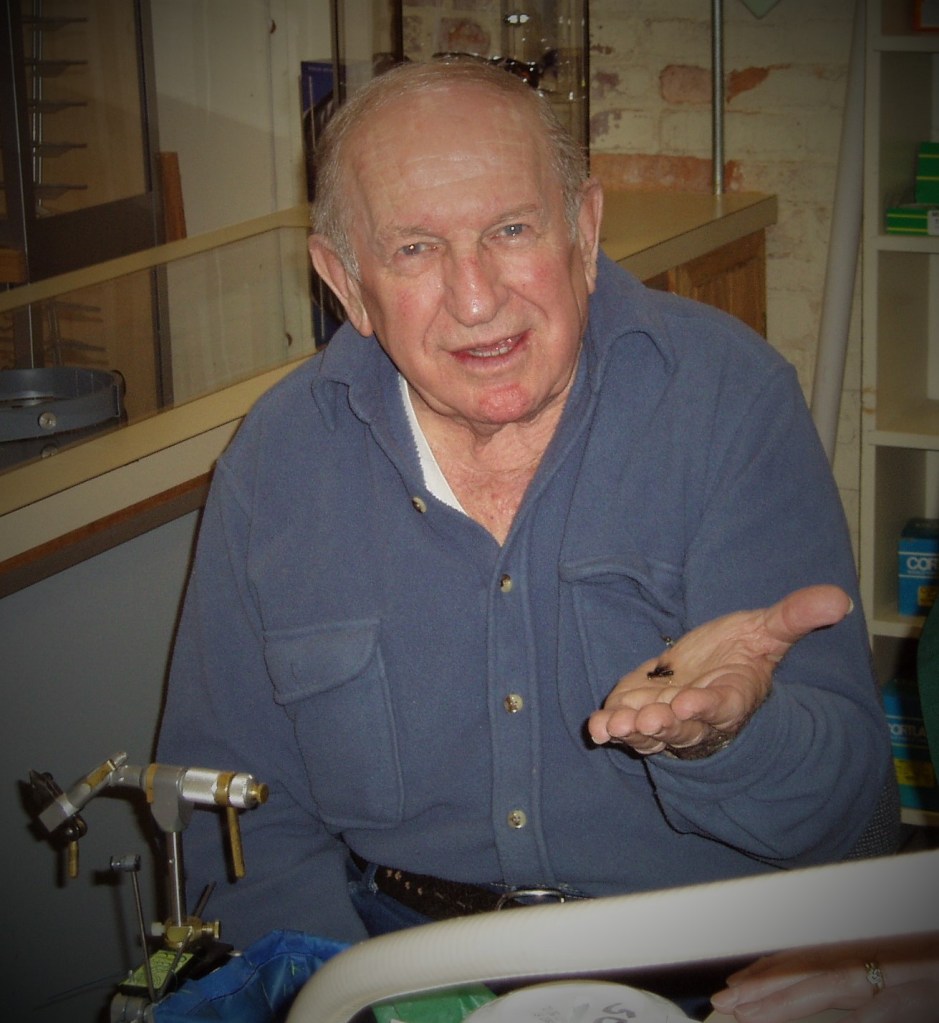
Ed Shenk with a Letort Cricket fresh from the vise
I learned late last night of the passing of a fly fishing legend and a friend, the great Ed Shenk.
I met Ed in September of 1991 when my passion for learning all I could about fly fishing led me to the fly fishing school he taught with Joe Humphreys and the late Norm Shires at Allenberry on the Yellow Breeches. His warmth and down to earth manner made it easy to get aquainted, and I was mesmerized watching him work his Shenk Sculpin with his trademark short fly rod, and pull some of the larger browns from the heavily fished waters of the Yellow Breeches.
Ed was the acknowledged Master of the Letort, and his stories of fishing those hallowed waters for more than 50 years enthralled me. I was to learn a great deal from him at the fishing school and for years thereafter.
Not long ago I shared a memory of my first day fishing on the Letort with The Master, and the letter he sent to me later that summer, when he had caught the 7 1/2 pound brown that had come for my Shenk Sculpin that bright May morning. Ed became the Master because he loved small streams and the Letort most of all. His passion for the stream and her trout led him to learn, experiment and innovate, and ultimately to share the expertise he aquired with all of us.
The opening lines of his wonderful book, “Ed Shenk’s Fly Rod Trouting” tells everything: “My love affair with little trout streams began over fifty years ago in the Cumberland Valley, and the fair Letort was my first love”.
From the beginning Ed Shenk was a friend and mentor in my quest to solve the exquisite puzzles of trout and the fly. When I took the plunge and opened a small fly shop in the Cumberland Valley, Ed was supportive and helpful, doing an in-store program for me to put me on the map. Ed only tied flies for one shop at that point, as he had tied commercially for Harry Murray’s Fly Shop in Virginia for decades, but he tied flies for me to sell at Falling Spring Outfitters.
The student and The Master
Though he was entranced with the beauty of the Valley’s little limestone streams, he ventured West to bring his skills and passion to the finest rivers of the American West, and success followed him. Later in life he wandered north for several summers to angle for Atlantic Salmon, taking fish even when the waters were low and the salmon dour. I remember teasing him, asking if he fished them with his favorite 6 foot Thomas & Thomas bamboo flyrod. He gruffly answered that he had deferred somewhat to the size of the rivers, fishing an eight footer.
He always wrote and spoke with greatest excitement when he recounted his fishing trips to Argentina. He was a friend and guest of the great Argentine angler Bebe Anchorena, for whom he had long tied the Hewitt Skater Spiders that Bebe used to great effect upon Patagonia’s monster browns and rainbows. Ed caught many trophy browns and rainbows on these South American adventures, recounting that his best fly was a size 14 Letort Cricket.
Shenk innovated the Cumberland Valley’s most enduring fly patterns, solving the challenge of the largest Letort browns’ fondness for terrestrials with the Letort Hopper and Letort Cricket. Recognizing the importance of movement in fly patterns he popularized the fur dubbing loop technique for fly bodies, innovating by trimming the fur to shape to form the Shenk Cressbug, White Minnow and the legendary Shenk Skulpin. He authored articles for the popular flyfishing and sporting magazines for decades, sharing his knowledge with anglers everywhere.
On October 6, 2012 Ed Shenk was honored for his lifetime achievements in the sport of fly fishing, fly tying and educating fellow anglers by beong inducted into the Fly Fishing Hall of Fame by the Catskill Fly Fishing Center and Museum in Livingston Manor, New York. I was privaledged to be there and honor my friend and mentor in person.
Fly Fishing Hall of Famers 2012
Angling has lost a true legend, but one who leaves a legacy among the thousands of fly fishers and tiers whom he touched and enriched.
I take heart, knowing that once again he may gather with the other greats among the Letort Regulars and angle his first love, the fair Letort forever. I can picture them: Shenk, Fox, Marinaro, Koch and Schwiebert, sitting in the shade by Fox’s old fishing hut, discussing the trials presented by the huge trout sipping minutia amid the weed-filled pools.
Tuesday’s warm sunshine got me moving and I removed the tarp and tie downs to find my drift boat underneath. It passed the winter well so I got out the oars and oarlocks and got her ready for the rivers. I awoke Wednesday morning to a much better forecast than expected so I decided to make the first solo float of 2020.
I had fished for three days, enjoying the sunshine, but finding no activity on the part of the trout. There was plenty of activity among fishermen, and it was hard to relax looking over my shoulder to avoid someone walking up on me. Most of the guys I have seen on the rivers have been in groups, far too close together under the dire circumstances.
Drifting down the middle West Branch I found myself utterly alone.
I heard a report saying that some little olives and some early blue quills had been sighted, and a few fish had even been taken on top in recent days, though I didn’t get myself too fired up with anticipation. The first week of April is too early to expect any significant surface activity.
The West Branch is the coldest river right now, peaking at 48 degrees on Tuesday while the other nearby rivers surpassed the magic number of 50 degrees. Its the time of year when that tailwater is going to be colder due to a higher release. It can be a couple of degrees warmer in the winter if they are releasing, but once the sun and warmer air starts to warm the rivers the West Branch lags behind.
Even the fifty degree rivers hadn’t been producing a lot of insect activity until three o’clock, though the little flights of mayflies I found failed to bring any trout up for a snack. At three o’clock yesterday I was sitting in my boat in prime water with Mother Nature trading little periods of sunshine with dark clouds and wind.
I had drifted well down the river by four and had anchored at another familiar rock. The sun was out again and I sat there awhile just enjoying the solitude. Eventually I decided to put my 6 weight rod together and rig up a small streamer. There were some submerged rocks along the shoreline and I figured maybe I would get an answer if I knocked. The wind blowing hard straight into my back caused that idea to be short lived.
I was slipping the streamer back into the hook keeper when I saw a funny little disturbance downstream of my landmark rock: fish? I picked up my dry fly rod and got ready to make a cast when an honest to God trout rose just above that rock. I’d like to tell you he ate my fly and gave a thrilling battle but I can’t. The wind stayed relentless and toyed with my presentation enough that my friend didn’t see what he liked I guess, so he demurred.
When I pulled anchor I scanned the downstream bank with a new resolve, but no more rises showed. I continued my drift and stop pace, quickly running out of river. I anchored at the last place I had hoped for some fishing when I saw a little teacup sized ring right on the bank. Still the downstream wind persisted, leaving perhaps a foot wide strip of calm water right next to the river bank. I could see some tiny wings floating down that edge, olives most likely, but I stayed with the chartreuse winged Adams Poster I had been using to try and maintain visibility in the windswept surface.
I worked on that fish for half an hour I guess until he finally sipped my fly. I tightened and felt some weight and a slow wiggle, then got my fly back early. I was amazed when that fish rose again not two minutes after I hooked him. I changed to a size 20 olive parachute and worked on him some more, but he obviously wasn’t going to make another mistake.
Solitude is a big dividend on our trout rivers today, especially those as popular as the West Branch Delaware. I was satisfied that I got to enjoy a very rare day alone on the river, and I even had a little bit of fishing.
The weather is going to throw us a few more curves, there is even snow in tomorrow’s forecast. I don’t know when I might get out again, though I do know that every day that passes brings me closer to that first good hatch and rise of the season; whenever it comes.
Sunshine graced the Catskills today and it drew me out to the river. I had been holed up for a while like many of us, and it was good to breathe fresh mountain air once again. Driving along I noticed cars parked along the rivers in twos and threes, making me wonder if those anglers are taking the warnings to stay away from others seriously.
I did find a pool to myself eventually, an open reach where the wind could reek havoc throughout the afternoon. It did a fine job.
There were a few little olives about, and later some small stoneflies, but there was no surface activity despite a good, wadeable flow and warming water. Around three I dunked my stream thermometer to see if the river had warmed appreciably from the overnight low in the forties. At last I read the magic number: 50 degrees!
I swung a soft hackle pheasant tail, and blind cast a stonefly just to keep my mind from wandering, but I saw no sign of a trout. I spent four hours simply being in the river, something a good friend would have complained about had he been there, but considering the alternatives looming in our world, I enjoyed my day.
The highlight was the little thrill I felt when I spied what looked like a good sized mayfly. There were a couple of those sightings, too far away to be certain, particularly considering my overpowering sense of wishful thinking. Finally one drifted past a short cast away. The attitude on the surface, upturned abdomen, and the tall reclining wing sealed the deal: that bug was absolutely a size 12 or 14 mayfly dun! The advanced guard of the Quill Gordons has made an appearance.
There is another nice day forecast for tomorrow, though sadly the weather is going to go sour for the rest of the week. Highs in the forties are expected and five days of rain. Any significant rainfall will cause the Delaware reservoirs to spill and that will be the end of nice wadeable flows for a while. Both are sitting at 99.6% capacity today. The drift boat outside lets me deal with high water, but there’s nothing I can do about the low temperatures and clouds. It may be a long time before the water temperature rises to that magic 50 degree mark again.
It was nice to get out with a favorite bamboo rod in my hands. I carried my Dennis Menscer 8 footer, a five weight hollowbuilt rod that is pleasurable to cast. Dennis closely guards his hollow building method, so I can’t explain how the rod does what it does, but it is very crisp and noticeably lighter than my other two piece 8 footer. That is a treat I don’t allow myself when I have to fish from the boat. There’s just too much going on with rowing and bouncing through white water to be comfortable with a fine cane fly rod aboard.
Sitting on the porch this evening grilling supper I couldn’t help but think about tomorrow, and wonder. If tonite’s low gets down in the thirties as its forecast to do, tomorrow’s sunshine will have to start all over to try and get the river back to 50 degrees. If though it stays in the mid forties, well then, there might just be enough of those early Quills to raise a trout or two…
There have been any number of times I have been asked that question by passing anglers, many with incredulous looks upon their faces, rooted in their belief that bamboo is delicate and that such rods are relics too dainty to survive.
Then there are the guys that don’t believe that anyone can cast more than ten feet with a classic rod. “How do you reach rising fish on a big river like the Delaware?” they say. Many of those encounters have involved sports in passing drift boats, and I have chuckled at the looks on some of their faces when, after they passed, I resumed my fishing and laid the fly out over a rising trout seventy odd feet away.
I honestly believe that bamboo can make you a better caster, if you give it the chance. The modern marketing machine that dominates popular fly fishing preaches the supposed virtues of fast action, to be surpassed only by ultra-fast action rods. They are generally so stiff that novice anglers have little hope of learning to cast them competently.
The key to casting, once the basic mechanics have been demonstrated, is learning to feel the rod loading. That is absolutely necessary to develop a sense of timing. A bamboo rod provides a lot of feedback to the caster, and doesn’t require a lot of rapid movements. A typical modern fast action rod doesn’t hardly load at all on a short cast, the kind beginners should be trying. The rod tip deflects an inch or two and does it in a microsecond. There is no loading for the initiate to feel. Why do you think the industry is marketing so many half to full line weight heavy fly lines?
Bamboo is a highly resilient material, and thus is very durable when handled as it was designed to be handled. That’s why you see a lot of 50 to 80 year old cane rods still being fished regularly by enthusiasts.
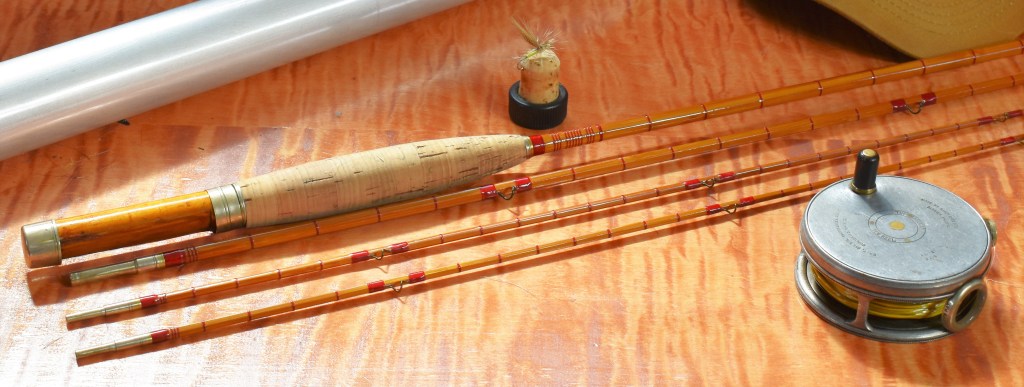
The Thomas Dirigo pictured here is a favorite classic rod of mine. It was meticulously restored by Dennis Menscer and fishes beautifully. F.E. Thomas rods were know for their fine delicate tips, one of the attributes that made them a caster’s rod. My rod is a classic 8-foot three piece for a five weight line, and it has shown an affinity for Rio’s recently introduced Light Line DT5 floating line.
I took it fishing on the West Branch when I first bought it, and landed wild browns of 19 and 18 inches in fast water. It handled both superbly, but the real test came a couple of months later.
Picture a wide deep tailout, whose glassy surface belies the strong current rushing toward the riffle downstream. It is a place where a careless step will let that current take your feet out from under you in a snap. I was fishing that tailout when a new player appeared. Downstream, against the far bank, there was a heavy bulge in the surface and the telltale sipping rise of a fine brown trout. Some of these fish show themselves very briefly, as the river is very heavily fished. Knowing this, I turned and made my cast without pausing to wade closer.
My target wasn’t close by any means, and I stripped most of the flyline from the reel. My cast was about 75 feet, down and sharply across stream, finishing with a kick and a reach upstream to lay the tiny fly just above the rise. I didn’t overpower the rod, I simply let my timing adjust to the amount of line in the air each time I gently hauled and released a few feet of line fore and aft, until I made my presentation; easy to do with the smooth, progressive action of that classic Thomas dry fly rod!
That brownie liked my cast too, for the bulge came again, followed by the little sip that removed my size 20 sulfur from the surface! I had a little luck just then, as the fish flashed toward midriver when I struck, probably planning to bury his head in the water weeds. I led him right along the line he started on, keeping the rod low and to the side with the tip pointing his way. That maneuver uses the mid section and butt of the rod to pressure the fish rather than the delicate tip.
Getting that fish out in the middle of the river saved the day. I got most of my fly line back on the reel, until he turned downstream and bore straight toward a protruding snag. I kept the rod low and pointed toward him and palmed that CFO reel for all I was worth, the scream of the spring and pawl click adding to my excitement. Somehow it was enough to turn him, just a few feet short of that snag.
We began a back and forth game as he ran upriver toward me, giving me backing and line only to turn and run it right back off the reel, using that strong current to add to his speed and power. We must have played that over three or four times until he started to tire. He stayed downstream that last time and started bulling toward the bottom. I feared he would eventually get his head in a weedbed and end the game, so, while he wasn’t running, I slowly walked down to him reeling all the way.
The great fish was beaten but there was still the problem of getting him to the net in that strong, slick current. What you cannot do with a classic bamboo, or any rod for that matter, is hold it high and put a tight bend in the very tip while netting. It took patience, a scarce commodity when the trout of the season is close at hand on a worn tippet and a size 20 fly, but I finally got him into the net!
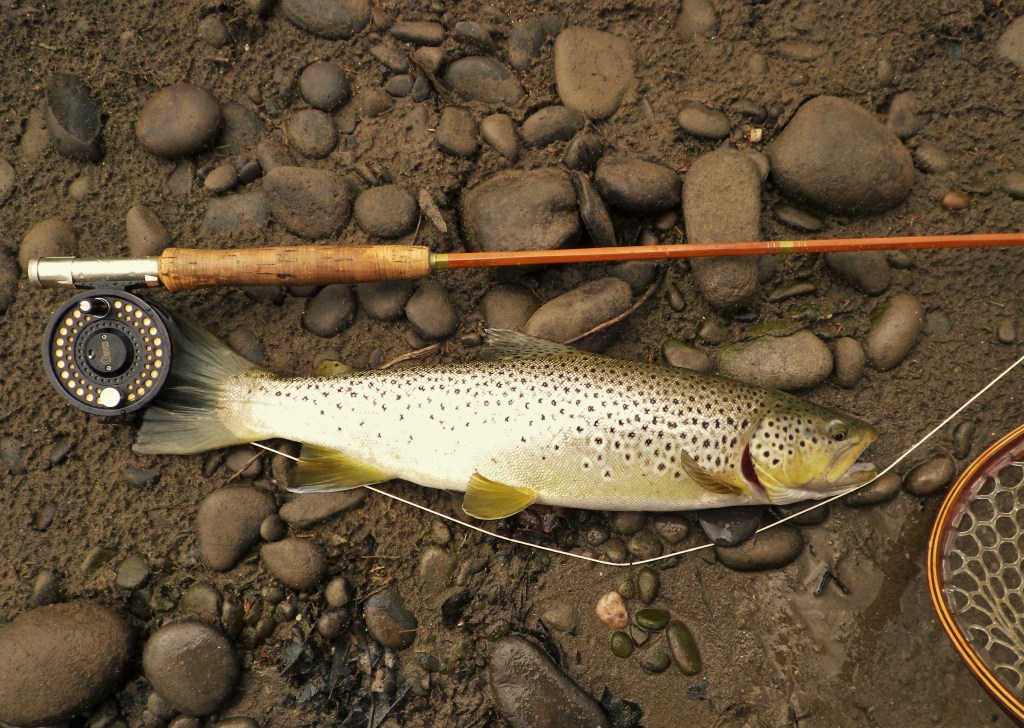
He was gorgeous, and I was honestly shaking as I slipped the fly out of his jaw and taped his 24 inch length! I turned and held him, facing into the current that had nearly defeated me, until he gently slid from my grasp and settled to the bottom, finning softly. I watched him there, my heart still racing, finally touching his tail with my toe and smiling as he shot away. I lifted the 100-year old Thomas to the heavens and admired that classic fine rod tip, it’s golden varnish and bright red silk intermediate wraps gleaming in the summer sun; and still arrow straight!
Sitting here thinking about days gone by and I had this photo on my wallpaper screen. There was a run of years in the beginning of this decade when Mike Saylor and I enjoyed an annual trip to Pat Schuler’s Glenmorangie Lodge. We had some great fishing during those trips, and a wonderful time! Pat was one of the first professional guides on the Upper Delaware River and knows the river like no one else, and he is a terrific guy. The photo comes from my little routine during my stays at Pat’s lodge.
During my working years I was always an early riser, getting up well before daybreak and breakfast. Pat would be sure the coffee pot was set to have fresh brew by five o’clock, so I could pour myself a mug and sit downstairs to tie flies as the mountains awakened. The lodge featured had a beautifully equipped tying desk that looked out the window upon this view. I sat there many mornings with the window opened: sipping coffee, tying flies, and listening to the wild turkey’s yelping and gobbling! Little moments can be as precious as the big ones!
The past has always held an interest for me, particularly as it relates to angling. I have confessed to my love of fishing with tackle older than I am. It always makes me wonder about the history of the particular rod or reel I have in hand.
That started with my grandfather’s old Horrocks – Ibbotson “Hudson” fly rod. I had the old cane rod restored to fishable condition when my Uncle Al passed it on to me. It is a cherished memento of the angling history of my family, though it would hold no value for another. H-I was one of the big, mass production companies that turned out thousands upon thousands of fishing rods back in those days. The rods were split bamboo, but certainly not the classic rods that gentlemen collect these days.
Pap’s 9-foot Hudson has a fairly typical soft wet fly action, and I have a pristine older Medalist reel that seems right at home snugged up in its chrome reelseat. A vintage DT6F line that came on that reel works out just fine. The H-I is a working man’s rod, and I am a working man as was my father and grandfather before me.
As I grew more enthralled with fly fishing and its history, my interest in older tackle gradually increased. Unfortunately, that all happened in a time when collectability put the vast majority of the classic bamboo flyrods and English reels financially out of reach for a working man like myself. I think that may be why I was attracted to Granger rods.
I learned about them slowly at first, beginning with a misstep that could have been costly, but for the kindness and good nature of some folks in the bamboo fraternity. Guys like Michael Sinclair and Dana Gray helped educate me via the Classic Flyrod Forum, and Michael’s wonderful book “Goodwin Granger: The Rod Man From Denver” exposed me to the entire history of Granger fly rods.
Grangers were working man’s fly rods, but they were brilliant designs made to extremely high quality standards. An 8-foot Granger was a great rod whether you bought the least expensive grade rod for ten dollars, or the elite Registered grade for fifty. The more I read about Goodwin Granger and his company, the more I admired the man and his legacy.
I have a few Granger rods these days, mostly Granger “Specials”. They aren’t the high grade models that were relatively scarce and thus prized by some collectors. The Special grade rods were one of the most popular and both the Goodwin Granger Company and later Wright & McGill made a lot of them. In my mind, they are the quintessential working man’s bamboo flyrod, and they sure do cast and fish beautifully!
I like to fish a reel that compliments my older rods, though there are times I can be caught with a modern disc drag reel on one of my bigger Grangers. You do need some backing capacity on the Upper Delaware. That Pflueger Medalist suits the 9-footers pretty well though, as it was one of the most popular working man’s fly reels for a long time.
My first Granger “Special”: a 9050 with an over 20″ Delaware Brownie
I would dearly love to have a vintage 3″ Hardy St. George reel to match my shorter and lighter Granger rods, but the collectors seem to keep the prices for those well up in the stratosphere. I have a couple of older Hardy made Orvis CFO reels that do the job for now. CFO’s are considered classics by a fair number of fly fishers, but they are not exactly vintage, the CFO having been introduced in 1971.
The Hardy’s have always been the mark of quality when it comes to fly reels, but back in the Golden Age they weren’t unobtainable. I can picture a guy like myself back in the forties or fifties, saving a quarter here and a dollar there for several years until he had squirreled away enough for a real Hardy to adorn his Granger Special.
I think the thing that makes all old Hardy’s so dear is that there have been a lot of reels and a lot of variations of those reels made over their long history. Collectors tend to prize reels that were manufactured in very small numbers, and a particularly scare variation of a popular reel like a St. George or a Perfect can bring astronomical prices. Take that fact and dilute it in the pool of popular knowledge and a ton of people end up believing that used Hardy reels are worth a fortune. If you have ever seen a well-used, five year old graphite fly rod listed on an internet auction site as a “vintage fly rod” with an asking price higher than its original retail, then you understand my logic.
I am not a collector, so I haven’t made a study of classic rods or reels, though I read a lot because of my interest. My observations are from the point of view of a guy who likes to fish with the older fly tackle he has.
There is something about that telltale scream of a Hardy spring and pawl click fly reel when a nice trout takes your fly and heads for the next pool. The sound is both exciting and very recognizable. I was fishing one of our Catskill rivers one day last summer and hooked an 18 inch brown that took off and spun a bunch of line off my reel, a Hardy LRH. Later on, another angler who had been fishing upstream walked past me on the bank and said “That was an LRH, wasn’t it? I love those reels”. That just doesn’t happen when you’re fishing a modern fly reel.







 Bright Waters Catskill