Don’t Believe It!

Awakening…

Our weather forecast says to beware this morning, there will be thunderstorms! Rain in the Catskills? Preposterous! Don’t believe it!

I missed a morning’s fishing last week because I was foolish enough to believe such a forecast. Missed the afternoon too, as it would cloud up and tease us from time to time, even adding a roll of thunder or two for effect, but we received no rainfall. Not that I am advocating fishing when thunder calls, for I am not. A flash or a rumble is all that’s required to get me off the water as quickly as possible. I don’t mess with lightning.

Clouds and silence though are another matter, and that was the predominating condition for that day. I’ll be heading out to the river this morning. If Mark Luck intervenes, I could very well be chased off the river by some of those flashes and rumbles, but it won’t rain, at least not appreciably. I was thoroughly wetted one day last week, though a mile down the road from the riverside parking area I drove back into bright, hot sunshine and dry countryside.

I just checked the NYC Reservoir system status and totaled the rainfall for May, June and July at 9.16 inches, nearly three inches below the historic average. That is a 25% deficit, and the effects are compounded by the hotter than normal temperatures that continue unabated. I think back to a couple of glorious days in mid-June, shivering on a 38 degree Sunday morning as John and I both introduced some new bamboo to the river. What I wouldn’t give for August to begin with a week of mornings like that!

Right now I am debating the relative merits of fishing the four weight Cumberland Queen versus the shorter Garrison with the number three line. Minimizing disturbance to the water is paramount! The longer four weight will handle a longer leader, but the three weight certainly isn’t limited to a short one, and will land with more delicacy. Perhaps the pain in my wrist will dictate my choice. A morning’s fishing with the longer rod means fewer casting strokes, less wear and tear. It is nearly August, and that wrist has powered a lot of casts. If the cooler weather and rainfall I pray for arrives, my dry fly season will last into October.

John called last night, talking of grouse and whitetails and the hunting season that arrives as dry fly season wanes. He has been busy at his cabin this summer, setting stands and trimming trails, opening up bits of forest to foster the thickets favored by the grouse we both enjoy. We talked of fishing too of course, thinking ahead to a morning on the river, fishing apart, as we have come to call it in this year of the pandemic.

High summer, always a season when I pause and think of autumn leaves and crisp mornings. Perhaps my shot column will find a bird or two this year! I can picture myself late in winter, tying flies with feathers plucked from that first Catskill bird, feel the take of the trout to that same fly swung through a gentle run as steam rises from the river on another winter’s morn. But wait, no need to rush the season, for we know not how many remain.

Cold water and warm sunshine, a gentle cast and a quiver on the surface of the pool…cherish each moment.

Tying Tricos

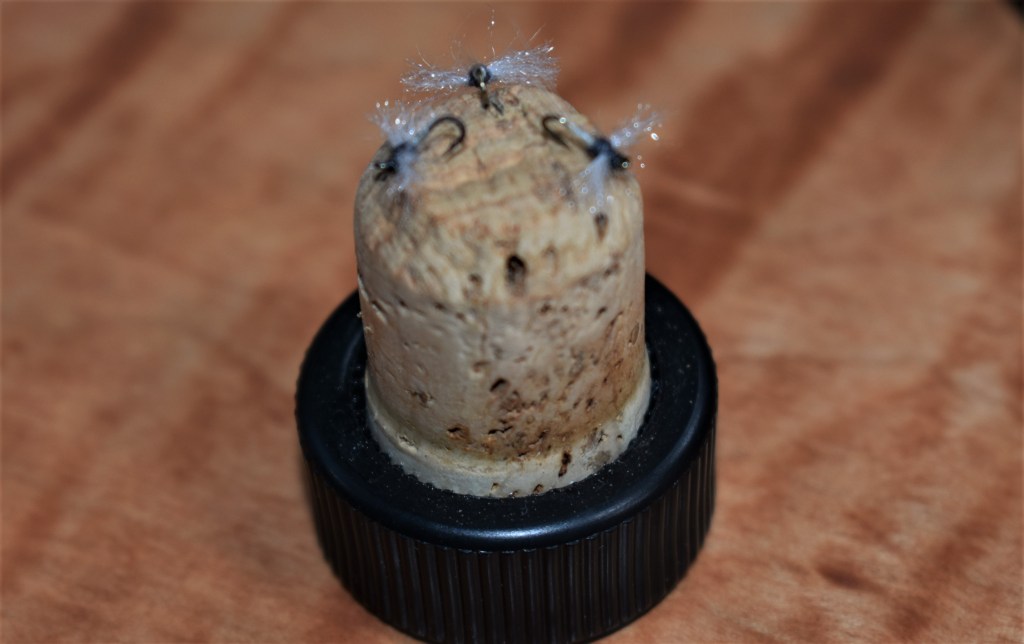
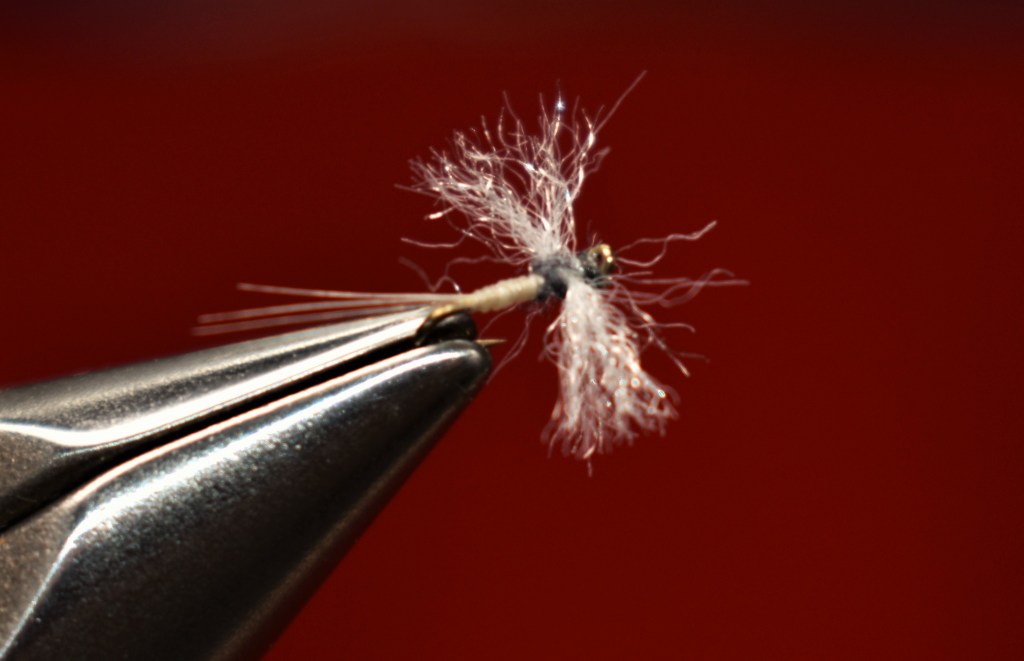
A Female Trico Spinner, Size 24

I picked a morning when my eyes were clear, and my fingers relatively pain free, as tying any size 24 dry fly requires good vision and dexterity. Lashing a wisp of Antron to the hook shank demands the most delicate thread control when the flies are this tiny. Magnification makes the wings look more substantial than they are, while in truth only about one third of one strand of the multi-strand yarn is required.

Three on a cork!

If seeing clearly to tie these little darlings seems difficult, imagine trying to follow them fifty feet away, awash in the surface glare amid thousands of seeds and bubbles and (hopefully) the real thing! That is just the beginning of the challenge of fishing the trico hatch.

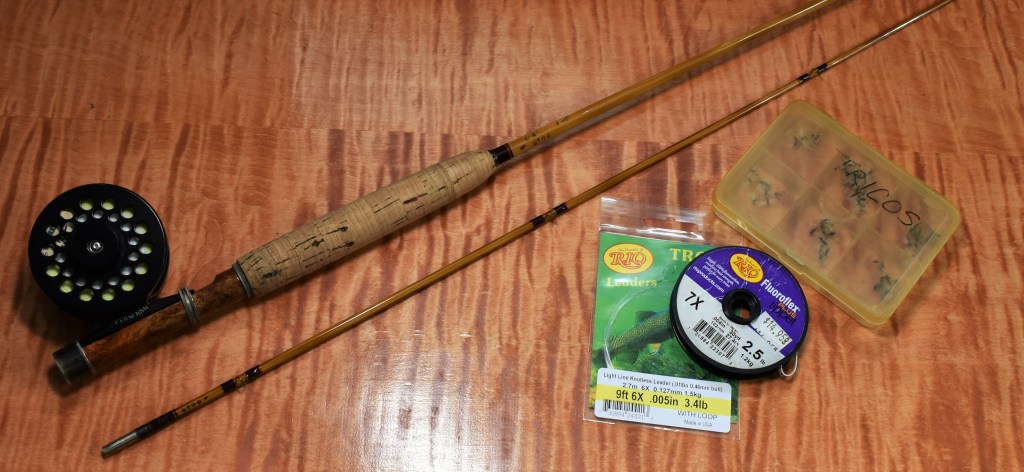
Light two and three weight rods get the call for this hatch, supple rods that flex gently and freely under load, both to cast the long, light leaders and protect the tiny hooks and the finest of tippets. My 7X fluorocarbon tests at 2.5 pounds, on a good day, and before I tie a knot in it. I don’t have access to a micro scale to test it, but I would expect significantly less than two pounds of strength for fishing, provided I don’t nick it with a bit of rough skin on my fingers while tying that knot.

Of course a size 24 fly doesn’t have a lot of hook gap available to catch a trout’s lip either. I have always tied my tricos on the hook the venerable George Harvey recommended. George was one of the first fly fishers to match this hatch on the Pennsylvania limestoners many decades ago. The Tiemco 500U is an upturned eye dry fly hook with a 2X short shank, that is, the size 22 hook I use has the shank length of a size 24, with the gap of the larger 22. The upturned eye also helps with hooking a fish, as it is completely out of the way of the hook point.

I fished the hatch on Falling Spring almost daily each summer during my fly shop years in Chambersburg. If memory serves the largest trout I ever caught on a trico spinner was a wild rainbow of sixteen or seventeen inches. I would truly enjoy the challenge of landing a twenty inch Catskill brown on one of these miniscule spinners, though the greatest challenge might be finding one taking tricos to fish to. As I wrote the other day, I have not found the clouds of spinners habitual to the species on these rivers. With such tiny mayflies, a significant density of spinners is usually necessary to interest the trout, particularly the larger ones.

Were it not for the public health crisis, I might be tempted to visit the streams around State College, Pennsylvania to refresh my trico fishing skill set. To my knowledge, many of these limestoners still offer a relatively heavy hatch and spinner fall. The key I believe is habitat. The limestone streams tend toward an abundance of the very fine silt tricorythodes inhabits, while our Catskill rivers and their greater fluctuations in flow tend toward coarser silts.

Aquatic weed growth has been on the upswing these past two seasons on the West Branch. Should the weed beds continue to expand and not succumb to high seasonal flows, they could trap more of the finer silts and foster more significant deposits capable of supporting better trico populations. It would be fun to spend mid-mornings on the West, pitting our skills against the fly some have called “the white curse”. Big West Branch browns eat plenty of size 22 and 24 olives, so I have no doubt they would feast upon a heavy trico spinner fall.

Light two and three weight rods, long fine leaders and 7X tippets are the standard tools of the trade.

A good spinner fall is something every dry fly fisherman should experience. The number of flies can be astounding, and the trout will feed on them with metronomic timing and efficiency. The better the fall, the more trout up and rising, and the harder it is to catch one. It can be hard to ignore a pod of trout rising every few seconds, but picking out a straggler out of the main drift can make your morning. Often the larger trout will position themselves away from the fray, in soft, shallow water where they can lift and take spinners at their leisure. With fewer flies to choose from, a straggler is more likely to be deceived into taking your fly, but only if you fish perfectly!

My best Falling Spring spinner fall trout was a straggler, nosing out from an undercut bank to sip tricos away from the main current. His habit made for a tricky float, but I met the challenge that morning.

Memories

Foggy River Secrets

I finally got to watch the new movie about an old friend yesterday afternoon. “Live The Stream: The Joe Humphreys Story” followed Joe for four seasons, travelling around Central Pennsylvania and out to Arkansas for his quest for a twenty pound brown trout. The film is marvelously done, and it makes clear the amazing energy Joe retains every day at 91.

He still teaches fly fishing throughout the season, and doesn’t stop for the winter. If he’s not doing classes and seminars at one of the fly fishing shows when the snow flies, he’s out climbing his favorite ridge to his deer stand, or fishing Spring Creek near his Centre County home. Joe Humphreys truly embodies the title of this documentary; he lives the stream every day.

The film brought back a flood of memories for me. It is hard to imagine that it was 29 years ago that I first met Joe at one of his Allenberry Fly Fishing Schools on the Yellow Breeches Creek. “Hump” and Ed Shenk teamed with the late Norm Shires, presenting quality fly fishing schools for Orvis for years. They continued forward when Orvis’ corporate policies changed, focusing their schools at their Manchester, Vermont headquarters. Joe’s on stream Allenberry programs were always head and shoulders above the Vermont based Orvis school, and easily among the best in the country.

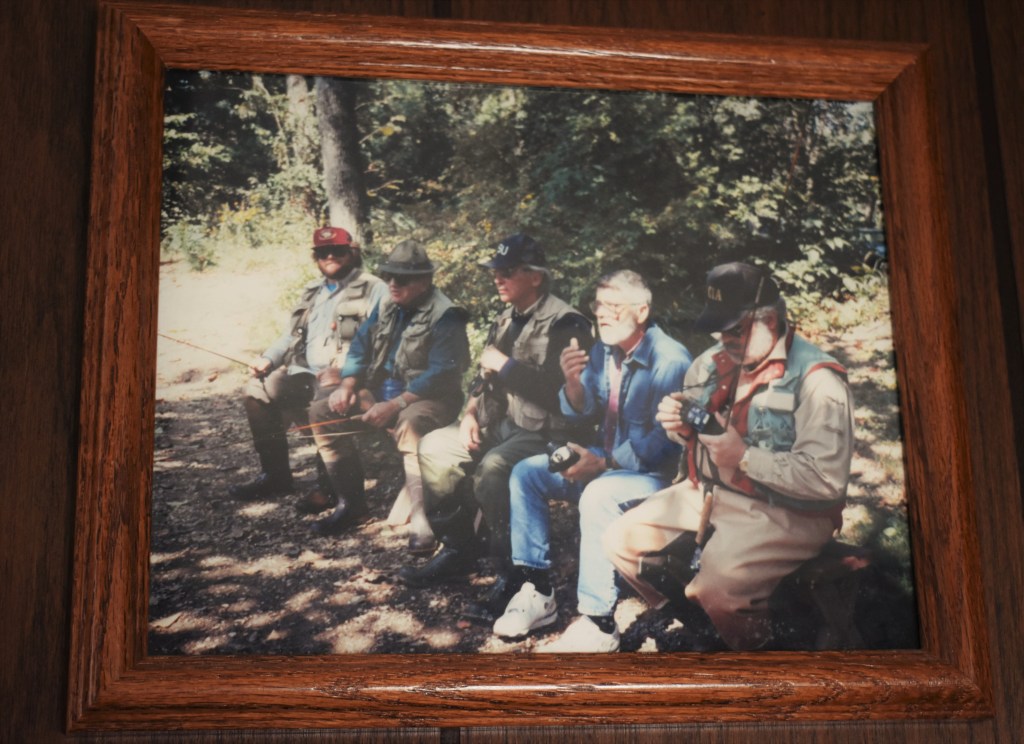
L. to R. Much younger versions of Yours Truly, the late Ed Shenk and Joe Humphreys; Allenberry, September 1991

I learned a great deal about fishing and life from Joe and Ed over the years. Both kindly travelled to my fledgling fly shop to give presentations to help me get the business going. Though this was their livelihood, neither charged me a fee for their services.

It was always a lesson when either of these gentlemen fished behind a student, invariably catching several trout where the eager students had taken none. They would pause with each trout and point out the details we all missed: why they cast where they did, how they manipulated their tackle to ensure a natural drift, so that the students learned how and why those trout were caught by the masters.

If you have a streaming device, you can watch the movie for free right now on Tubi, or order a DVD version from Amazon. I highly recommend this beautiful film, as it chronicles an amazing gentleman who has spent his life helping others enjoy the gift of fly fishing. Joe Humphreys is a National treasure.

Those memories of my Cumberland Valley days still haunted me this morning, as I stalked the river with my terrestrial box. I am sure that I caught more dry fly limestone trout on terrestrials than on any mayfly or caddis pattern I owned, and its fun to relive those flies and tactics here, on the rivers of my heart.

My little 7 1/2 foot Garrison 206 got the nod this morning, lined with a three weight double taper. The rod is a modern replica crafted by Jim Downes of Coburn, PA; originals, if they can be found, costing the equivalent of my net worth. Downsie’s Garrison is a gem, equally adept with a three or four weight line, and capable of pinpoint accuracy.

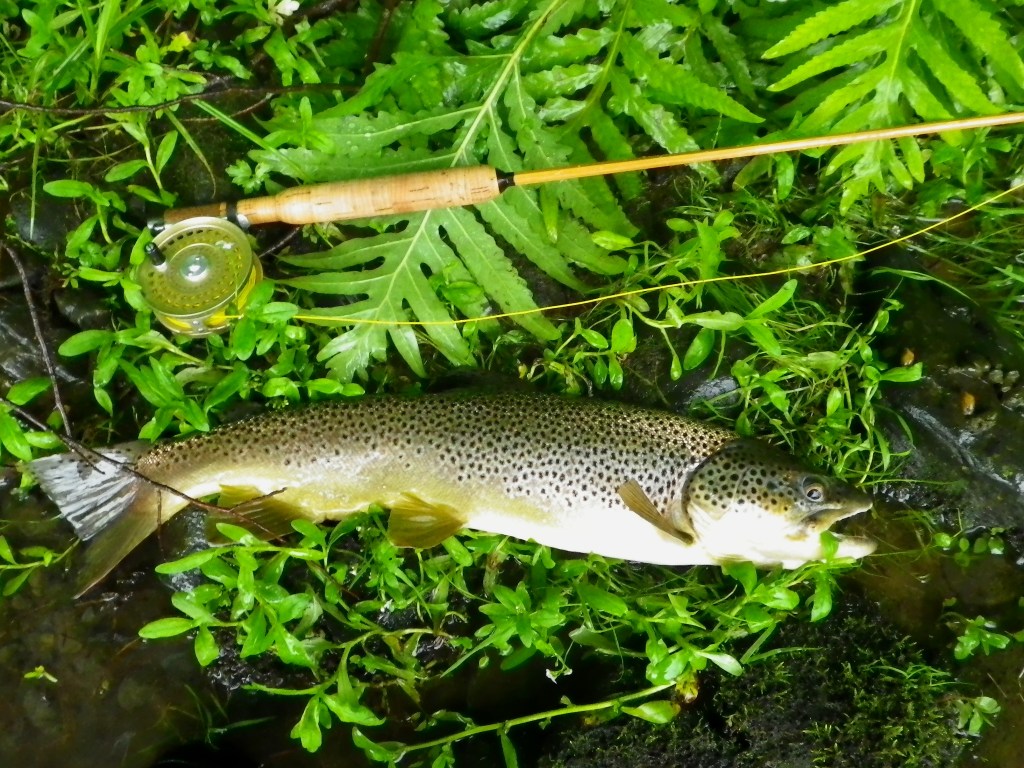
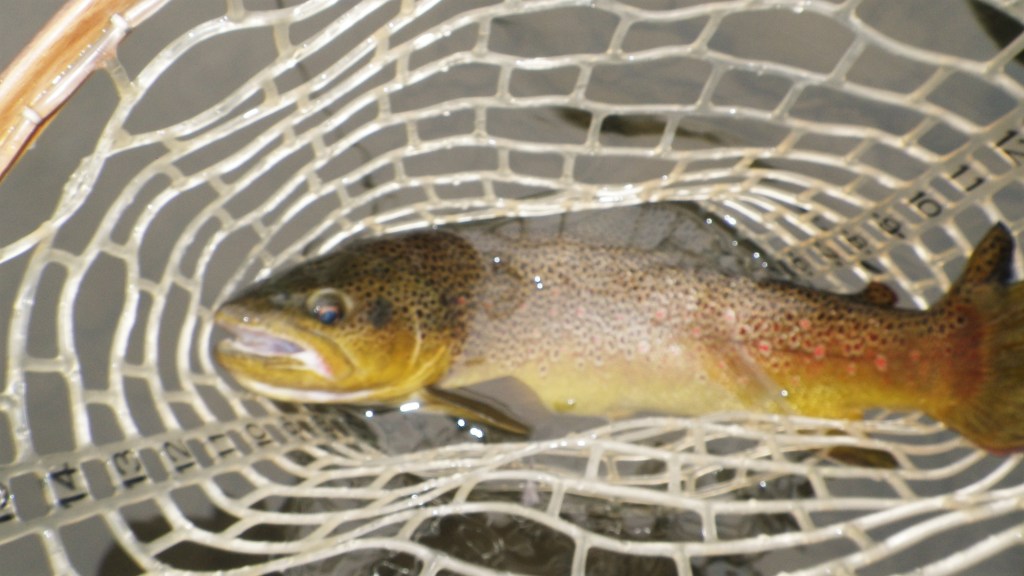
The river had fallen since my last visit, and my beetle would barely drift along the banks and the cover while the main current slowly eroded my slack. I dropped the rod tip a bit quicker than normal in compensation, and the extra float was enough to fool a beautifully colored brown of nineteen inches. He doubled over the Garrison as the golden cane absorbed his struggles all the way to the waiting net.

I was not so lucky with a couple of his brethren. One came ever so slowly for the fly as my arm was rising for the pickup, which took it away from him at the moment of truth. Another popped the fly when it finally exhausted it’s dozen feet of drag-free drift tight to the river bank. I enjoyed the morning immensely, having missed my chance to fish yesterday, foolishly believing the weather forecasts that screamed thunderstorms by ten AM. We got no rain of course; dark clouds, wind and a bit of mist to be sure, but none of the rain we so desperately need.

The crowds of visitors are already massing for their weekend in the Catskills, so I must surrender the rivers to the throng. Baseball returns tonight, or at least a reasonable facsimile, with my home team playing in Boston’s deserted ballpark. I’ve missed it.

And the heat keeps coming…

A Quiet Sunset

I had truly hoped, and even expected, that our run of hot, dry weather would have passed into memory by now. Sadly it has not. Our trout fishing remains restricted to the upper reaches of the tailwaters, and the crowds make those places inhospitable under the best of conditions, and positively scary in this pandemic age.

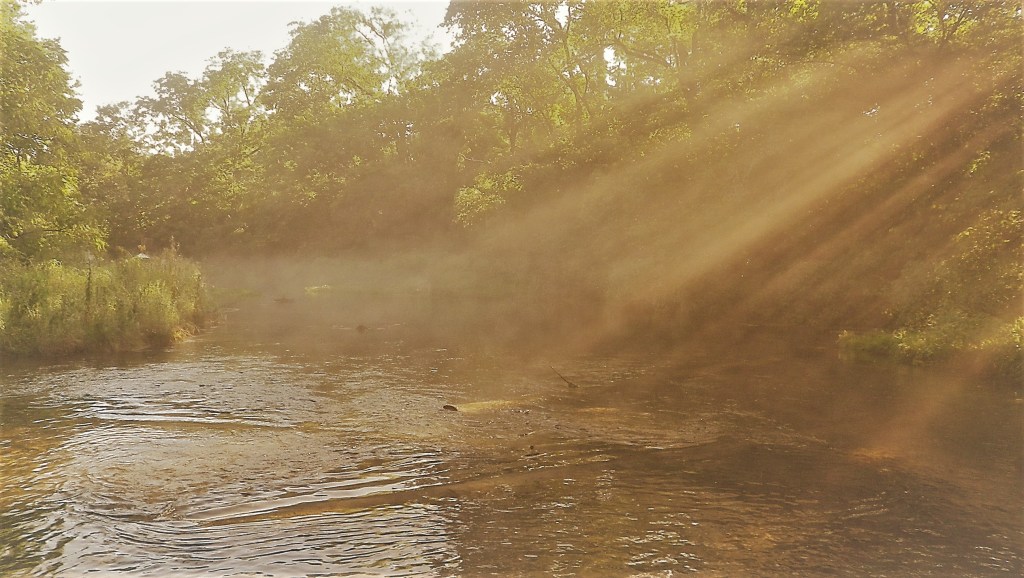
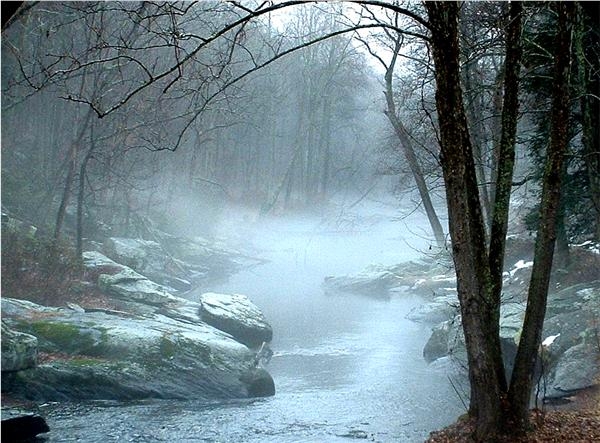
I stole a pleasant morning yesterday, wading the open water of the lower West Branch alone. The river was cool, the mists blowing here and there in the soft morning breezes. I carried my Dream Catcher four weight, enough rod to provide some reach, while still presenting flies delicately. The plan was to find a few early risers snacking on whatever the drift might carry, but not all plans come to fruition.

The bubble lines at the bottom of the big riffle I prospected seemed barren, for I have no doubt that plenty of trout resided there. None of last night’s spinners, no hapless ants or beetles drifting half sunken among the foam, not a thing in evidence to bring a trout to the surface. I am quite certain the trout were there. I have caught them in every season of the year in that water.

Still it was a beautiful morning, and I was happy as I continued my search. Eventually I spotted a sipping rise far down on the wide expanse of the pool, and made the long, slow, careful walk downstream.

I never did discover what that trout was eating, for my own examinations of the drift turned up nothing but bubbles and bits of weed. I tried every small seasonal pattern I carried: little olives, trico spinners, various ants of both crawling and flying varieties, a tiny thread and CDC nothing sure to interest a trout; all to no avail.

Deep in the game, a second trout rose upstream between us. The olive tied to my tippet at that moment proved perfectly interesting to him, as he took it on the second cast. The foot long wild brown put a nice little bend in my bamboo rod and I was pleased to enjoy his struggles until I could slide my hand down the leader and twist the tiny hook free.

As midday arrived a few more trout began to rise in my vicinity. I suspected there were a few tricos hiding between the bubbles, and a better inspection confirmed my suspicions. It has been years since I seriously fished the trico spinner fall.

During the pleasant years in Chambersburg I would rise early and walk the banks of the Falling Spring each summer morning before opening the fly shop. If the morning was calm and sunny, as most of them were in summer, there would be tricos on the water sometime between seven and eight. Most of the duns hatch at night, though on my earlier visits I would often find a few still taking wing after daylight.

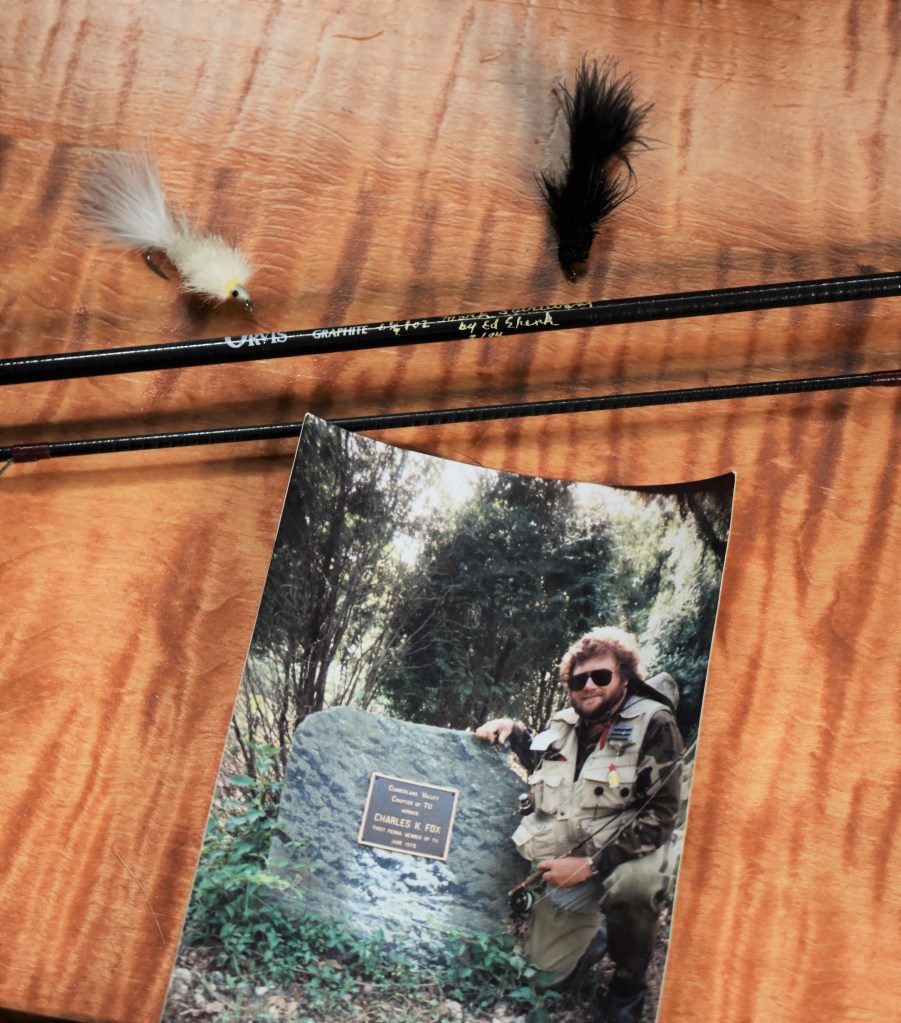
I tied a simple little dun pattern using dun gray thread for the body, hackle tail, two turns of pale dun hackle and a wisp of CDC. My tackle was light, one of two 6′ 6″ rods usually getting the nod: the Orvis 2 weight crafted by Ed Shenk, or the 3 weight Loomis I had built myself when I first fished with Ed on the Letort early in my Cumberland Valley oddysey.

The lightest rods, a small CFO reel and leaders twice the length of the rod finished with 7X tippets were standard equipment for trico fishing, the flies sparsely tied on size 24 hooks! So many mornings over so many years!

A few times each summer I would run into the late Ed Koch and Chambersburg angler John Newcomer along the stream. There was always a cherry greeting from this duo, and we would stand and talk for a few moments before resuming our fishing. One particularly frustrating morning we commiserated on our lack of luck. “Do you know what they’re doing”? asked Ed. I replied that they seemed to hang at the surface without actually taking the fly. “Yes, they’re taking”, he said, “but they’re not closing their mouths!” This wisdom gleaned from fishing as a duo, one watching from upstream while the other fished.

On my Monday day off from the fly shop, I would travel a bit, fishing tricos on Spring Creek, Yellow Creek or the Little Juniata. I still remember hooking a brute of a brown, sight fishing one morning on Spring Creek. He kissed the surface, I tightened, and the tiny hook came instantly free. I cast again and again, and he took twice more, but I couldn’t prick him! Looking at the fly in disbelief I found a perfect little trico spinner on a hook shank. Bend and point had broken off on the first take.

The Falling Spring at Edwards

I was somewhat unprepared for serious trico fishing yesterday. I rarely carry 7X tippet anymore, and the four weight proved to be a bigger gun than required. Fishing size 24 spinners on 6X didn’t bring many trout to hand on Falling Spring, and it brought none to hand on the West Branch Delaware this day. A three weight rod is more than enough stick, and a two is better.

My ace in the hole used to be Ed Shenk’s Double Trico pattern: two spinners tied on a size 18 hook. The spring creek spinner falls were usually heavy, and when trout were feeding studiously on the spinners they encountered masses of them bunched together. The double took them readily! Yesterday’s spinners on the wide waters of the West Branch were sparse, and the double got no interest from the three or four trout that fed upon them.

In truth, the only heavy cloud of spinners I ever saw in the Catskills was nearly twenty years ago on the East Branch, on waters now posted. At first sight I assumed the cloud to be fog, common on summer mornings on these tailwaters. They were tricos though, thousands of them, and the spinners fell heavily for nearly two hours while I waited for the game to begin. Not a single trout rose to the feast. Strange that the only places on these Catskill rivers where I have found fish eating tricos, there were invariably very few in the drift.

The optimist in me wants to tie some fresh patterns, dig out a spool of 7X tippet, and rig a new leader on my two weight rod. Perhaps I should, though I won’t expect to find any sizeable trout sipping those minute spinners. I have caught some good ones here on 22 olives and terrestrials, enough to know that big Catskill trout willingly eat small, though finding fish over ten or twelve inches eating tricos would come as a major surprise.

Still fly fishers are optimists, certain that each new fly will take the trout of a lifetime as we pluck it from the vise!

Lessons In Cane

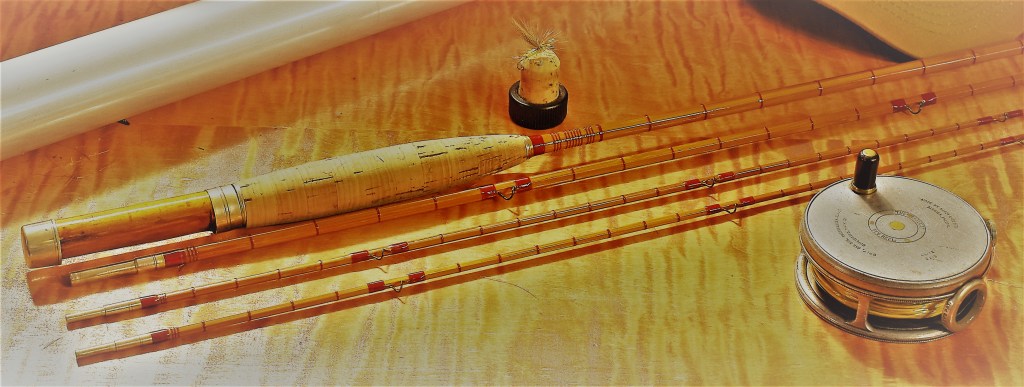
My Jim Downes Garrison 206 and Friend

Summer fishing seems to leave me with a lot of time on my hands. My forays to the rivers are shorter at this season, whether seeking cooler water in early morning, or timing the sun angle on a forested reach of river. Fishing for two or three hours leaves a lot of the day to amuse myself otherwise, a more difficult task in these days of Covid isolation. Fiddling with tackle is one way to kill a little time, and sometimes it can be quite productive!

I had been thinking about the relative usefulness of a longer three weight rod. I fished my D. W. Menscer 6′ 8″ gem the other morning and really enjoyed it. That rod is so versatile, performing admirably at distance, as well as pinpointing casts in tight quarters. The only caveat to the joy and practicality of fishing a short rod on bigger waters is the necessity for more false casts, more strokes, to get the line in the air and extended for longer casts. This extra effort is minimal on small waters, but can become significant when there is a lot of water to be covered. Picture the difference in fishing the shady pockets on a quarter mile of a 20′ wide stream versus that same outing on a good sized river. With my carpal tunnel and arthritis in my casting hand, extra rod work comes at a price: wear and tear and pain.

Browsing used rod lists and corresponding with rodmakers gives me some enjoyment, but there is the practicality issue. A three weight bamboo rod is definitely a specialty rod. Do I need one bad enough to trade another rod I enjoy to acquire a new three?

At one point while pondering this thought, a bolt of lightning hit: what about the Garrison? I have a lovely 7’6″ two piece rod built as a close reproduction of the venerable Garrison 206 from the Coburn, PA bench of rodmaker Jim Downes. That rod is a full working four weight that I fish with a Cortland Sylk WF4F line, and it is extremely accurate. What if…

It only took me a moment to take the rod and an old CFO with a DT3F line out to the yard. That rod casts the three weight line like it was made for it. The Garrison taper responds to a more relaxed casting rhythm thus its slower and gentler on my compromised anatomy too. Voila, a new rod!

I have written before about the rewards to be gained by casting bamboo rods with several different fly lines. Cane seems more adaptable to different weights and tapers of fly lines, and of course every caster is different. Taking some down time to play around with lines and rods can reveal some amazing performance attributes you might never have discovered, even in a favorite rod.

I won’t stop daydreaming about tackle; its a long, hot summer. After two discoveries in my own rod rack though, I’ll be spending more hot afternoons in the yard with a box full of reels!

Snap!

A 23 inch wild brown trout, the last fish for my beloved 8040 Granger?

It was a typical misty Catskill summer morning, a bit cooler, with a welcome 58 degrees in Hancock at five o’clock. The mist hung along the sides of the mountains, the strong July sun still unable to burn it off as I waded the river at eight. I had swung a wet fly further up at the top of the riffle to no avail, gladly knotting up a new 5X tippet and changing to a dry fly as the sun began to dispel the gloom.

The rushing riffle and the rocks along the bank made me reach for the Halo Isonychia on the fly patch inside my vest. Iso’s are popular with the trout all summer and, though they are an afternoon hatch that I hadn’t seen on the water this season, I simply had a feeling that my big, juicy comparadun might tempt a lurking brownie looking for leftovers.

I worked the foam lines thoroughly with a downstream drift, then turned and made the long casts upstream and across to try the bankside run from a new angle. Trying hard to follow even a size 10 dry fly in a myriad of bubbles and foam, I saw just a little bump in the ruffled surface and knew it was my fly. As the Granger bent into a heavy arch the Bougle` sang its hymn to the morning as a heavy trout streaked full tilt into the rushing current. He didn’t stop until my backing was spinning from the reel, then turned the tables abruptly, heading back down and slightly toward me as I wound the reel frantically. Failing to get slack with that tactic, he turned again and headed toward me, forcing me to abandon the reel and strip armfuls of line as fast as I could.

There are many things on the front of a fishing vest ideal to tangle a fly line, a lesson learned the hard way more than once in my life. Despite my haste, I managed to dump all of that line, nearly an entire fly line, to my right in slack water. He took some back more than once, but the net was in his future.

A gorgeous fish, dark backed and deeply golden on his flank, the crimson spots twinkling with flame, twenty-three inches from nose to tail. I slipped the fly from his jaw and pushed the net deeply into the water while fumbling one handed for my camera. I lifted the net, snapped the photos, hung the camera strap from my teeth and sent him on his way.

The cool morning air and the excitement of that hard running brown had me energized, and I worked my way on down the riffle in search of his twin. Perhaps twenty minutes later I turned upstream once again and cast the longer line to cover that same water from an up and across stream angle. The sun, now peeking around the mountainside was in my eyes and I squinted trying to follow the fly. Half an hour after I released that fine brown trout I thought another tiny disturbance could be a take. I lifted the rod, heard and felt a gentle snap, and my rod tip fell to the water.

I couldn’t believe the turn in my luck as I grabbed for the trailing line and rescued the tip, a clean break in the precious cane, beneath the silk at the ferrule. The Granger had lasted more years than I but, at least for that tip section, that brown was to be it’s final trout.

Back in Hancock I pulled off the road and dialed Dennis Menscer, catching him in the shop and working on new varnish for another rod tip of mine. He asked if I had ESP, but I told him sadly no, that I am afraid I had more work for him.

Studying the broken end, Dennis showed me a tiny crack and the discolored cane that betrayed the presence of old moisture. My trophy brown had not weakened my rod; water and time had done that job.

Dennis will make two new tips, and the rod will hopefully battle trout for another sixty to seventy years. The remaining original tip I will likely preserve, fishing the new ones. This is not a collectors rod. It is a fisherman’s rod, a working man’s rod in its day, and a fine casting fish fighting tool deftly crafted by men long dead. It has endured, and it will continue.

A Quiet Reach of Water

A Deserted River of the Past

I was back to my early morning fishing routine today, seemingly the only way to find a quiet reach of water to myself. I hoped for a few trout willing to sample the drift, taking whatever morsels of food the currents might offer. There was little to find on the surface, at least to my eyes, but here and there a smallish fish would sip something. I figured an ant or beetle would be gratefully accepted, but I was wrong. Whatever minute bit of insect life there was in the drift, those little trout seemed unbelievably selective to it.

It has probably been fifteen years since I fished the particular pool I chose this morning. I can recall another July morning when a sparse hatch of little olive mayflies got some trout rising. I had caught several of them, browns from 12 to 15 inches long, in the clear, cold flats after daybreak. I have no recollection of the flow on that long ago morning, other than that it was low, summer flow.

I worked slowly upriver, stopping to spend plenty of time at the big willows arching out from the bank, and well out into the river. It seemed there had to be a good brown somewhere back in that shade, a brown waiting for the intermittent breeze to deliver some ants, or beetles for breakfast. I worked them all very thoroughly without so much as a brief wake to intimate a follow.

I was prepared for the difficult conditions, armed with the 6′ 8″ three weight bamboo rod crafted by my friend Dennis Menscer. I’d found this rod second hand in a Catskill fly shop several seasons back, straight as an arrow though a little worse for wear. Dennis had reseated the ferrules and given the rod a fresh coat of varnish so that the flamed cane glistened like new.

I’ve been telling myself the rod is short for the rivers I fish these days, that it is a tool for the small streams I no longer fish. With a new old Orvis weight forward line I can put my fly on the money from sixty feet, sixty-five if there’s no breeze to contend with; not the kind of casting one does on a small stream. If memory serves, Dennis based the taper on the F. E. Thomas Fairy, though I feel certain he improved it just a bit. It is lithe and smooth, and quick with the short casts it seems intended for, but the brief swelled butt firms it up and gives it the authority to reach out.

I had taken another short rod out recently and found that my timing was completely out of kilter. On Catskill rivers one of my eight footers generally gets the job. In my Cumberland Valley past, I fished six and a half and seven foot rods the majority of the time and thought nothing of it. My timing was geared to the shorter sticks and was automatic. The seven footer I fished a week ago felt awkward until I’d fooled with it for half an hour and adjusted my timing.

This morning the 6’8″ felt natural from the start. I have re-learned my old habits I guess.

After a few hours I waded past all those glorious old trees that weren’t harboring the big browns I’d imagined and worked my way closer to the riffle that feeds the pool. I stood and waited, thinking that a few of those little olives ought to come percolating off that riff any minute. The rise surprised me. It was a soft rise from a decent trout, not the splashy little sips of fingerlings I had seen this morning. I offered the CDC ant that graced my tippet a number of times, but the fish wasn’t having it.

Those olives crept back into my consciousness, and I clipped the ant from the tippet and knotted a size 20 T.P. Dun to replace it. The trout rose again and the little rod laid the line out a good sixty feet, down and across stream with a reach to ensure the drift. The fish intercepted it confidently but gently, like he’d waited all morning for it.

There’s nothing like playing a nice trout on a small cane rod. That shorty came alive as he bucked and ran. I wasn’t worried about the fine 6X tippet, as the lithe bamboo absorbed each of his tricks as he sought his freedom. A seventeen inch brownie is enough fish to give you a jolt on a light three weight, and I loved every moment until the net brought him to me.

That brown was my trout for the day, as there was no hatch to follow. I waited, and did see a couple of mayflies come bobbing down the riff, but one or two flies don’t bring many trout up to feed. I thanked the river for the lovely bright morning and the solitude, and turned to begin the half hour walk downstream.

Dreaming in cane

Take a walk back in time, visit Maine and stop in to talk with old Fred Thomas and sample his wares!

The heat wave has curtailed my fishing a bit, though I am still haunting the Catskill rivers, the hours spent there are fewer and more precious. Left to my own daydreaming I’d love to have a pocketful of cash and take a tour of the grand rod shops of the 1930’s!

A trip to Maine would certainly be in order. Fishing the brook trout there and browsing the F.E. Thomas shop would make for a delightful holiday. Yes, Fred that 8 foot Special for a four is perfect, and the seven and a half Browntone for a five!

Closer to home I’d stop at the eastern threshold to the Catskills, visit Leonard where it all began. Their 50 DF would be a perfect three piece. Of course I would take a couple of days to hang around Jim Payne’s shop. Perhaps these three would suit me Jim, the 98 the 100 and the 102. May I try that Hardy St. George to see how it balances please!

I’d even suffer the City to browse at Abercrombie & Fitch’s and Mills’ establishments. Why each of those rods I’d acquired should have the perfect reel. A love for classic tackle is infectious and all consuming at times.

How I would simply love us to be free of the threat of this virus that I might enjoy the shops and people I know in this time. Dennis Menscer’s rod shop is just across Point Mountain from my desk and I have so many thoughts and questions for him. A few seasons back he experimented with a pentagonal rod and had me take it for an afternoon on the West Branch. I am intrigued by pents, and I enjoyed the rod, and would love to spend more time with it now that summer is here.

I haven’t set foot in either of the classic fly shops in Roscoe or Livingston Manor for months. I miss browsing, sharing stories and ideas, and finding a bit of tackle or tying material to add to my larder.

There are many friends I hoped to fish with this season. Mike and Andy and Tom looked to make the trip to Hancock where I might just put them in front of a big wild brown or two. I know John has done some work to improve the hunting at his cabin, and I’d hoped to be there to add my labor to the cause; and of course we never get to fish together enough. As this year has unfolded, it is as likely to share a day astream with these friends as to walk back in time to the Golden Age.

Daydreams: visions of light line cane rods and golden afternoons with friends…

Heat and a city’s thirst

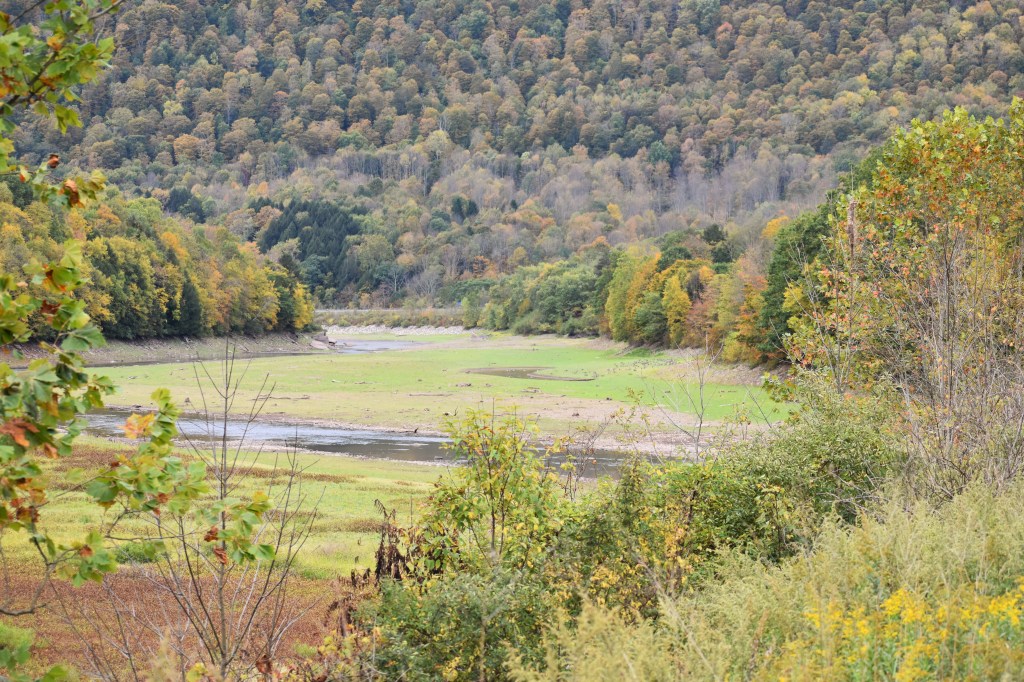
Cannonsville Reservoir September 2019

They have named her Fay, now a tropical storm, and she appears poised to bring our Catskills some much needed relief. We can only hope that her rains linger and moderate in their intensity, so her gift of rainfall has the most beneficial effect. The effects of heat stress and drought upon our rivers have been very real this summer. The rain is vital, as is a change from this extended run of hot sunny weather. Was it just last month we laughed at a morning high of 34 degrees?

The lull in fishing has me contemplating the mysteries of wild trout and reservoir releases.

Just yesterday I spent an afternoon stalking a quiet pool on one of our tailwaters. I have worked my way upstream as the summer has progressed, and this day I was searching the upper portion of the pool, where deeper, cooler water prevailed. There was little activity, on a perfect breezy afternoon there was very little sign of activity from the trout, despite what should have been excellent conditions: a warm wind, plenty of shade, depth and cover, perfect for terrestrials.

At first I wondered if the late start to the season had retarded the typical explosion of insect life. Our last snowfall came on May 9th, and there were a handful of very cold nights in June. I pondered these things as I fished. Near the end of my hunting area, I laid a beetle gently along the bank, placed perfectly in a tight band of shade. My reaction was nearly a second sight experience.

I almost saw the slightest ripple in the surface, at least I think I did. No ring, and no sign of the fly itself, but some sixth sense encouraged me to tighten. I felt weight, tightened a bit more and felt more resistance, then more. It took a moment for me to be sure that I was indeed hooked to a trout, and a good one at that. As I urged him away from the bank he finally reacted to my pressure, though his fight remained sluggish and uninspired.

I landed him rather quickly, the tip of the old Granger easily protecting the 6X tippet against his gentle struggles. The trout was a brown, a fine specimen pushing 21 inches, with wonderful color and the characteristic heft of a well-fed wild fish. He had taken the fly deep in his mouth so, to prevent any further stress, I quickly cut the tippet and released him. He disappeared promptly.

I was shocked by the experience, and curious. I immediately dropped my thermometer into the river where I landed the fish, recording a pleasant 64 degrees, in full sunlight in knee deep water. Fishermen have been schooled that 55 to 65 degrees Fahrenheit is the ideal temperature range for trout feeding and activity, so why I pondered was this large fish so reluctant to feed and so meek and sluggish when hooked? Could it be that our tailwater trout have so fully adapted to the artificially cold environment of the tailwater rivers that the traditionally accepted upper range of “ideal” water temperatures is too warm for them?

I was within perhaps 50 yards of the small riffle that dumps into the pool I angled, and even at low flow it was certainly enough to oxygenate the top of the pool I believed. I waded a bit further upstream and my surprise increased markedly when I saw trout crowded all over the bottom before me. They were lying in water nearly thigh deep, in full sunlight, and there were trout of all sizes, far too close to one another. This was a clear sign of stress, stress in what I believe was reasonably well oxygenated 64 degree water. I stopped fishing and walked out.

This experience has given me a whole new perspective on the health of our Delaware River fishery. For decades New York City held back releases out of Cannonsville and all of their Catskill reservoirs, maintaining that was the City’s vital drinking water. That their archaic transmission network is a marvel of disrepair, wasting millions of gallons of that precious water daily, is immaterial to them.

Once they decided to build a power generation station at Cannonsville however, they changed their tune, saying the City didn’t need that water. Still they are stingy with thermal bank volume and releases when temperatures in the mainstem Delaware River push high into the seventies. Stingy with the water they “don’t need”: hmmm? Meanwhile the East Branch, Neversink and the rest of the tailwater rivers are starved for water on a regular basis.

The wild trout fisheries in the Upper Delaware River watersheds are the best in the East, even when subjected to such mistreatment. Progress has been made towards conserving this resource, but it has taken decades to get where we are now; still far short of where we would like to be. American Rivers has named the Delaware their River of the Year for 2020, trumpeting the conservation success from the mountains to the sea. Imagine what this river, this fishery might become if we ever receive adequate flows of cold, pure water.

Experiments with terrestrials

The Grizzly Beetle

My experiments with new terrestrial patterns began last December and is continuing weekly. While I have had excellent success with some of my tried and true spring creek flies, some have been consistently ignored by our Catskill mountain trout, thus, new flies are required.

An example is my long time standard foam beetle, the fly that accounted for one of the two largest spring creek trout of my lifetime, a preposterous wild rainbow in excess of ten pounds. That size 18 beetle was a proven killer. Simply tied with lightweight closed cell Larva Lace foam strips, peacock herl and a couple of turns of black hackle, it was a go to summer fly for years. In the Catskills I would be hard pressed to recall a single trout that has taken one. I varied sizes and configurations with no success.

Experience tells me that trout in different environments often require different stimuli. I reasoned that perhaps the density of my beetles needed to increase to make more of a plop on the water, Catskill trout being used to significantly more current and more sound impulses on our larger, faster flowing rivers. With that my recent patterns have used a higher density 1/8″ sheet foam, and I have worked toward creating a bit of movement in the fly.

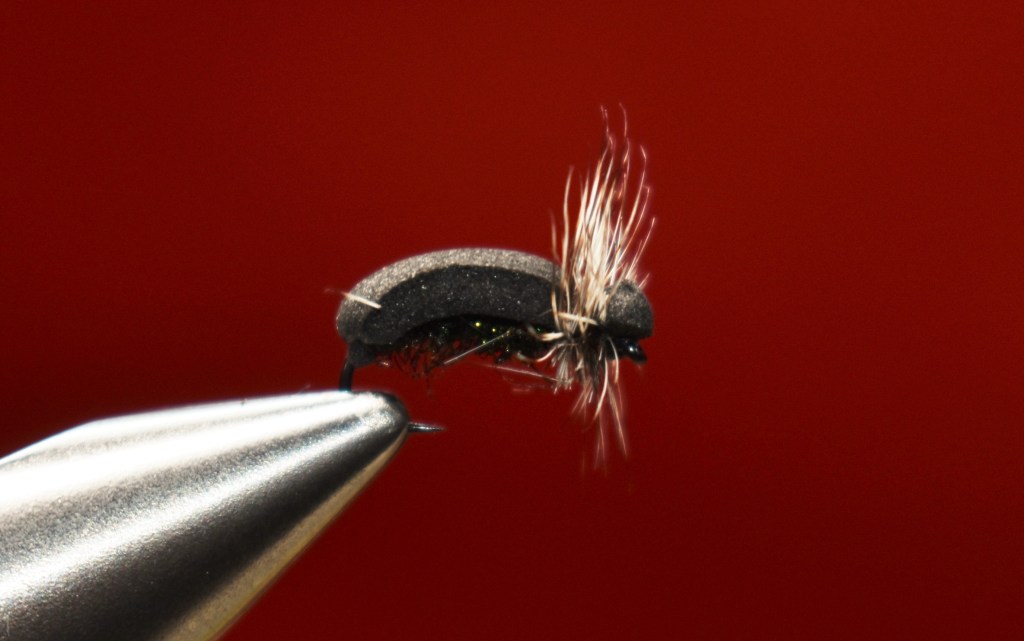
The first successes early in this summer season have come with the fly I called The Grizzly Beetle, pictured above. The fly has fooled one brown well over twenty inches which escaped late in the fight, and brought one twenty inch brown and a couple of smaller fish to net. It is early, and terrestrials in general have not brought consistent responses yet, but this fly’s initial performance is encouraging.

I was looking hard at a webby grizzly saddle hackle feather when I first tied the pattern, thinking that a webby dry fly hackle would provide a touch of the movement sought, and that the grizzly would also improve visibility of the fly for the angler. The pattern has earned a place in my terrestrial box this summer since it has produced when others have not.

The Grizzly Beetle

Hook: TMC 102Y size 15 or 17

Thread: Black 6/0 or 8/0

Body: 1/8″ thick high density closed cell sheet foam, cut in a strip approximately 1/4″ wide

Underbody: Black peacock Ice Dub, dubbed thickly on the rear two thirds of the hook shank

Hackle: Rather webby dry fly saddle hackle in dark grizzly, slightly oversize (14 hackle for a 15 hook) clipped into a broad vee on the bottom

Tying sequence: Taper 1/8th inch of the end of the foam strip and tie it in about a third of the way down the hook bend, then dub the underbody over the tied in foam and 2/3rds the way up the hook shank. Pull the foam over and tie it down at the end of the dubbing. Gently pull the foam strip toward the eye and tie down over it to make a bed for the hackle. Pull the foam out in front of the hook eye, lay the edge of your scissor blade against the front of the eye and cut, leaving a small foam head. Tie in and wrap the hackle, tie it off and then whip finish under the foam head.

I have relied upon the TMC 102Y hook’s wide gap and Sproat bend for decades for my terrestrials, as it’s set back point improves hooking with wide bodied flies like beetles and crickets. I love the black color particularly for the black terrestrial patterns. I think it visually blends into the fly better and is less noticeable to the trout, an important advantage for flies fished in calm, clear, often shallow water where the fish get a long time to study their food.

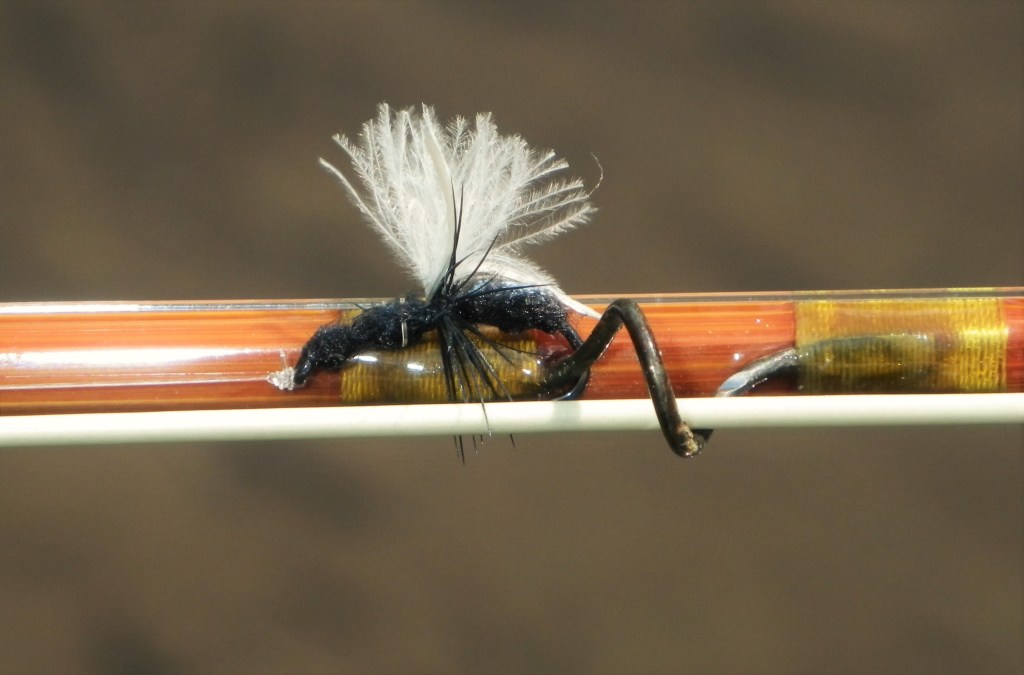
The TMC 102Y: You have to imagine the position of the hook point hiding behind the fly line. It sits behind the hackle tips, ready to hook the trout that delicately sips this little CDC ant, and the black provides some camoflage!

I can offer some observations that may be helpful when assessing the readiness of the trout to consider terrestrials. Of course trout sipping very gently in open water, particularly where there are shaded edges are prime targets for smaller ant patterns, from size 16 down to size 22. When you see this behavior and do not see any sign of flying midges or tiny mayflies, ants are near the top of the probability scale.

When fishing with beetles, crickets or large carpenter ants, it is not uncommon to see a slight wake as shallow water trout move to investigate the fly. If you see a few such wakes and get neither takes nor splashy refusals, chances are the trout have not been seeing a lot of terrestrials yet and are not feeding on them when available. I have found that trout that want them will take them if the presentation is sound. That means a soft, accurate cast that doesn’t splash down line or leader, allowing the fly to settle with at most a gentle plop like a natural falling from overhead vegetation. Your drift must be absolutely drag free, and stay that way throughout the time it is in proximity to the fish.

Summer fly fishing is the perfect game for lighter rods and lines. A two, three or four weight bamboo rod is perfection for this fishing. If you are strictly a graphite fly rodder, stay away from the stiffest fast action rods. Older medium action graphite rods in these lighter line weights are better tools for the finesse casting and presentations required. Older Orvis Superfines, Loomis or Winston IM6’s and Thomas & Thomas Paradigm and LPS rods will all do a nice job. If you don’t own one, perhaps a friend has a forgotten rod or two tucked away you can borrow.

Terrestrial fishing is not a game for the poor fly caster. Work on your skills if you need to. The rewards of this game, well played, can be amazing!