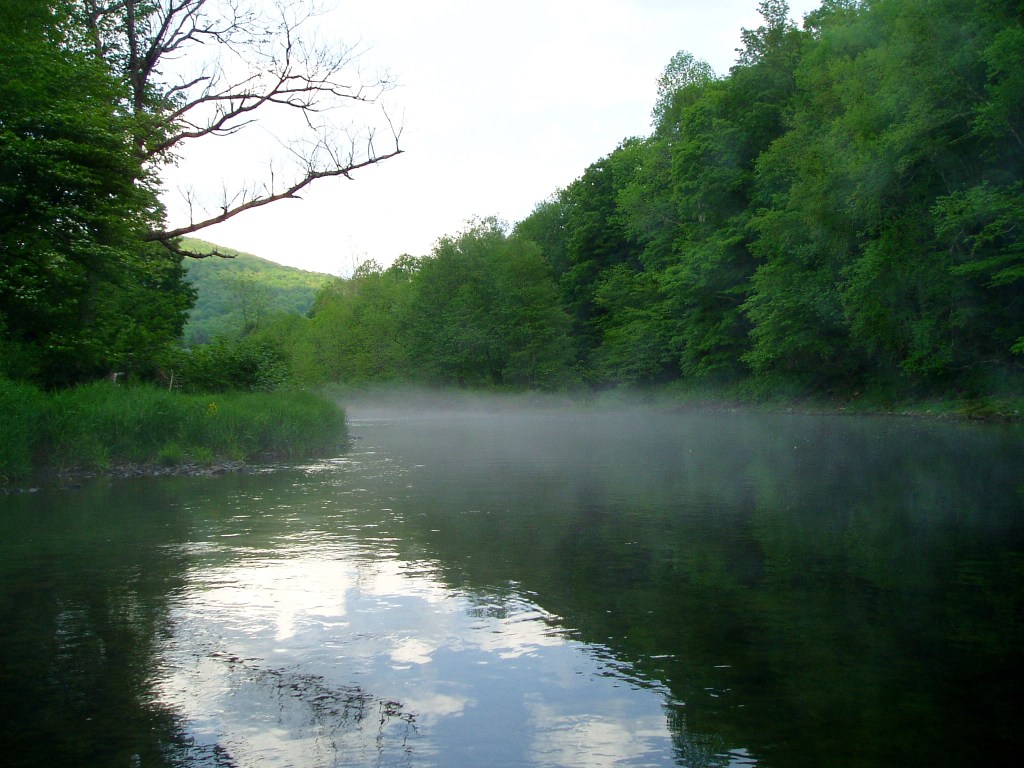
Evening Mist gathers on the West Branch as I wander in search of the rise…
I can feel it in the air and see it in the angle of sunlight: summer is waning, and her departure may be quick! This week promises afternoons in the mid-eighties, perchance a last gasp of summer’s warmth before the weekend brings a major drop in temperature. I won’t miss the heat, not after struggling through six weeks of it this year, though I will miss the promise of summer mornings along the river.
I threatened a week ago to haunt the banks at evening once again. I tried, once, finding the water still too warm on the wide Delaware, but I have not returned. The summer mornings still seduce me, tricos and terrestrials tease with the grand question: might I manage a twenty inch brown on a size 24 spinner? I handled a fine bronze flanked specimen of nineteen inches on a size 22 olive just the other day, but sweet as it was that is not the goal.
This game intrigues one to ponder the difficult, the whimsical, and the fleeting chances Nature provides. I have only once cast to a twenty inch trout that was taking trico spinners. There was a gremlin in the mix and I pricked him, breaking the bend from my tiny hook! I didn’t know, with my exasperation rising as he took three more times while I failed to hook him. I recall my laughter as I finally checked the fly: a perfect 24 spinner on a hook without a bend. Perhaps this last week of warmth will offer another chance.
Decades ago, summers filled with tricos and terrestrials were my balm, and it takes me back to younger days to recall those adventures.
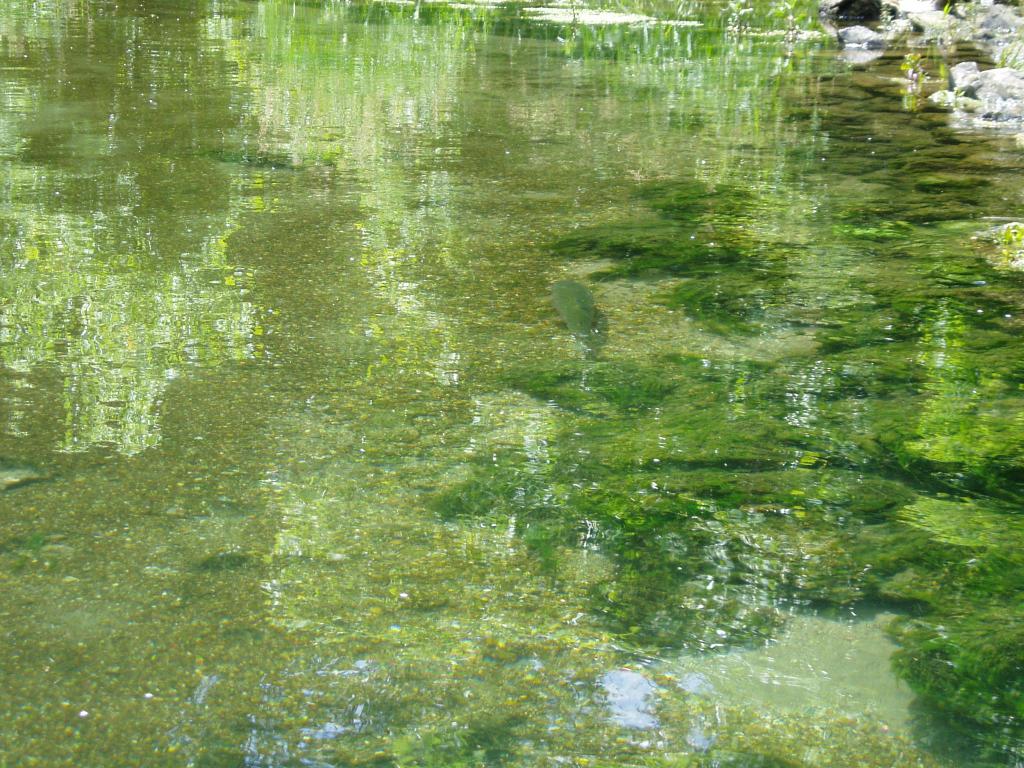
Sight Fishing:A truly massive Big Spring rainbow hovers beside the sheltering weeds. He took my drifted fly but the hook pulled free before I could tame himand bring him to hand. Memory floods with battles won and lost!
All trials with the heat aside, it has been another wonderful summer. New waters have become close friends, and some old favorites have proved nearly barren. Perhaps autumn will again offer the grace of Indian Summer days along the rivers of my heart. There is always a sadness as the season draws closer to its end. That special golden afternoon light touches a chord in my soul, and the notes are both melancholy and sweet. It has been so since boyhood.
I didn’t want to do it, really I didn’t. I was tired, dog tired after a long day on the river. Sitting in the sunshine on my porch last evening I nearly fell asleep while the burgers were grilling. Man that sun felt good! The sunshine, a cold Summer Ale, and that lovely September light making the landscape glow; it was almost a perfect scenario to take a little nap, except I didn’t want to burn dinner. The last thing I wanted to do was to tie flies, flies I can’t even see!
I got caught again, caught on a roller coaster sort of day when I thought I was prepared. The sun came out bright yesterday, and the tricos fired up early. The trout got right into their routine. I offered an assortment of frauds but they happily fed on naturals and ignored them, until suddenly they were done. I finally caught a smallish fish on a beetle, as if that was going to save face after my tricos were ignored for an hour.
Some weather passed over the mountains and we got a few clouds, and then I began to see soft rises around the pool. I stared at the water, seeing nothing, then tried an ant, then a small beetle, then stared some more. The rises were regular, and there were a lot of them, and I still couldn’t see anything but bits of plant matter in the film. One little bubble encrusted blob seemed to move, but it washed through my grasping fingers. I thought I had seen a tinge of green.
Digging through the minimal selection of flies in my chest pack, I came up with a size 22 CDC olive and knotted it to the 6X tippet. The trout were cruising somewhat in the deep, flat water, so I did my best to make quick casts with Downsie’s Garrison four weight, trying to put that tiny fly in front of each cruiser. Eventually a trout and I synched up and he sucked it in.
I made that slow, calm gently tightening hookset that tiny flies require, something that’s hard to do after a couple of hours of being snubbed by feeding trout, and the gentle arch of the bamboo absorbed his surprised reaction. It was a nice fish, eighteen inches once I had enjoyed his runs and the notes of the old Hardy and led him into the net, that tiny speck of a fly tight in the side of his lip. One firm twist and he was ready to go.
There isn’t a heck of a lot of CDC in the wing of a fly that size, and once it gets full of fish slime its tough to keep it floating, particularly when you’re making a lot of downstream casts and stripping it back upstream, soaking it thoroughly each time. It was time to retire that fly.
I had tied a couple of size 22 Flick olives, pretty, dainty little flies with rusty dun hackles and olive 14/0 thread for the body. Art Flick is a Catskill legend: fly tier, author and cataloguer of hatches, guide, tavern owner and grouse hunter extraordinaire. He knew that there was no reason to sweat it out trying to build a lot of parts into a dry fly tied on a size 20 or smaller hook. His BWO pattern used a few hackle fibers for a tail, a lightly dubbed body, and a few turns of stiff cock’s hackle over the thorax to represent the wings and legs and to keep it afloat. Simplicity as art!
Even with relatively good daylight, I had to strain to find that little fly when it landed on the surface, a task that proved fruitless out past forty feet. When you can’t see your fly and track it right into the ring of a trout’s rise, the guessing game begins, and there are penalties when you guess wrong. Tighten up to a rise when you’re guessing, and you might hook that trout, but you might spook it and end the game.
I tracked that little fly right into a rise and tightened, happy to feel the lithe rod throbbing with life, and brought another eighteen inch brownie to the net. A little bit of breeze started, just to make the game more difficult, lest I have too much fun. The Red Gods seem committed to the idea that fly fishers shouldn’t be allowed to have too much fun. Still, I was able to fool an even better trout with that little Flick olive. That heavy nineteen incher gave a fine account of himself against the bend of the Garrison and the smooth old Hardy spring and pawl, and I was happy to admire him for a moment as I twisted the fly free, then sent him on his way.
My little invisible “hatch” ended when the wind decided to blow a bit harder, or at least the trout stopped rising to it, so I waited awhile for the next change. Things calmed down nicely in a few minutes and I began to see a few more rises upstream. I figured the wind should have loosed some terrestrials from their hold on the native vegetation, and the rises I saw supported my conclusion; some soft, some noticeably harder. Back to the Grizzly Beetle.
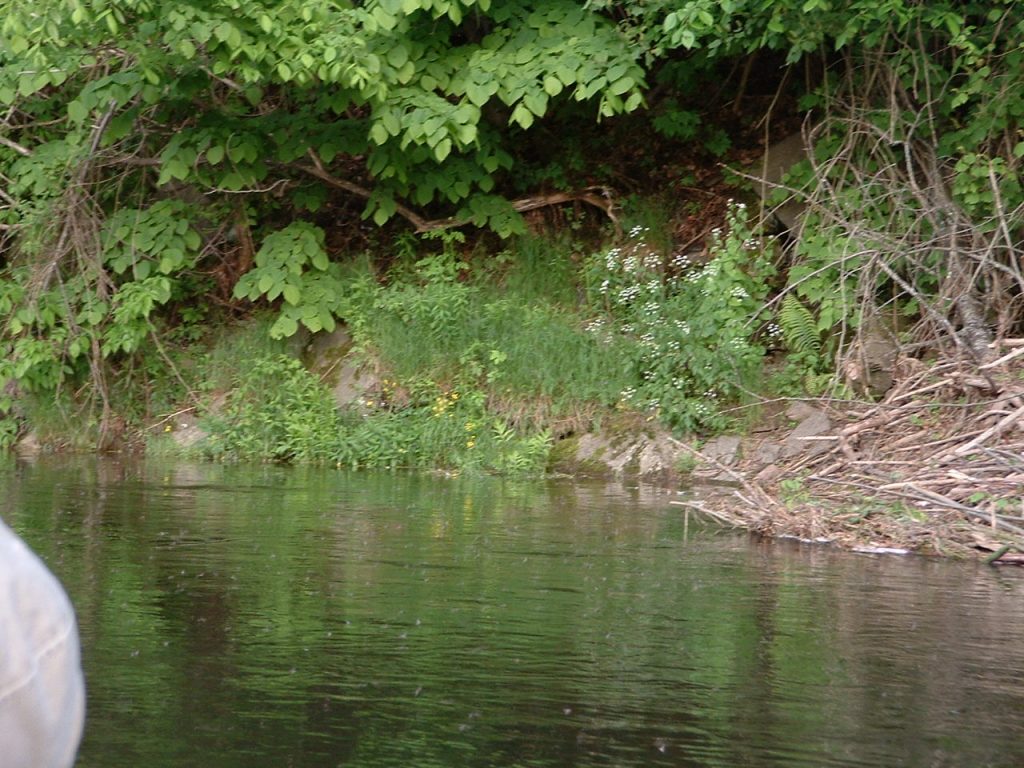
That subtle rise tight to the bank on the left just might be a big boy! The largest trout don’t always make the biggest rings and bulges. All of those little out of focus specks on the water are mayflies!
I love bank feeders, and I started looking hard for one. The picture above shows how hard they can be to spot, and it was taken at close range during a heavy hatch. A bank feeder sampling a hatch usually rises fairly regularly, not so those taking terrestrials. Ants, beetles, flies, etc. don’t show up in numbers, there is no steady parade past a trout’s holding lie. He has to be in the mood to take one when all the vagaries of nature come together and deliver one to his doorstep.
I didn’t spot any bank feeders. The rises I saw after the wind subsided were hit and miss rises, typical of terrestrial feeding trout in open water. They appear when they appear, when a morsel floats by close enough to draw the fish’s intertest, and you fish them by covering the area where you spot a rise. You have to concentrate, because you are casting to moving fish, and they aren’t always where you expect them to be. Sometimes you will see a trout turn and follow a fly downstream, looking it over. If it looks edible and floats clean, he just might take it. If it starts to drag, he’ll either blow up on it without taking, or simply turn away. I had a few of each of those adventures played out over the next hour.
The cloud cover became heavier as the afternoon progressed, and after the terrestrial bite ceased, it became beautifully calm. The pool morphed into a dark mirror as the slate colored clouds blanketed the sky, and those soft rises started up once again.
Within a few minutes there were a lot of fish rising, this time generally staying put rather than cruising. That told me there was a lot of something on the water. Naturally I tied the Flick olive back on and started casting, and naturally it was summarily ignored. Time to stare at the water again, and stare, and stare. The dark sky made it even harder to see them, but eventually I saw something and pinched it with a quick dip of my fingers. Flying ants, tiny black flying ants, and with more than a dozen trout rising steadily, there had to be a lot of them.
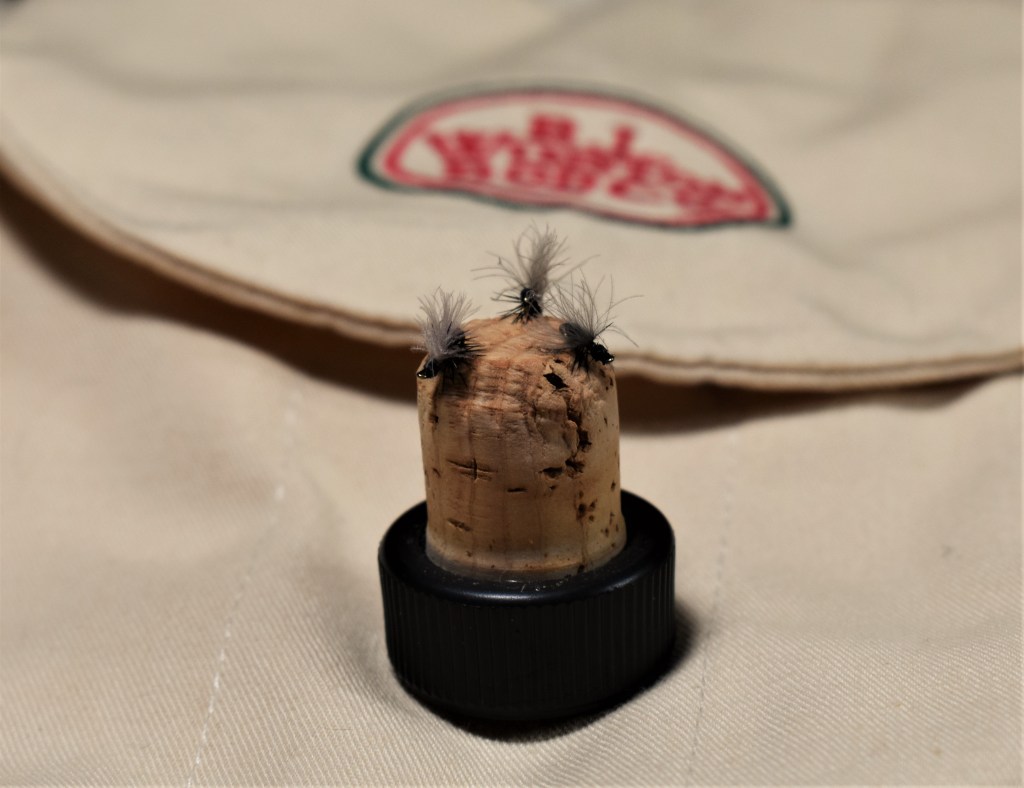
Not long ago I recalled the story of running into an ant fall on the river several years ago. The ants were a size 22 and my smallest imitations were size 20. The trout clearly recognized the “right” size from the wrong size that day. Of course I tied some size 22 flying ants and keep them with me all summer. This afternoon, my size 22 flying ants looked just a little bigger than the naturals, better imitated with a size 24. Like I said, I didn’t want to tie any size 24 ants last night. I was tired and I knew that if I tied them I would likely carry them around for five years before I saw another ant fall. I also knew that if I didn’t tie them, I would run into another fall today.
Gateway to the Delawareon a September afternoon, a dozen years ago
September already; ah but it seems it was just budding springtime! Three weeks of summer remain, though the cool, stormy skies and rushing winds on the river this morning certainly reminded me of autumn.
The fishing too seems to be in transition, as the late morning’s hot sun has been replaced by clouds and chilly winds this week, so too the risers to trico spinners have been few and far between. The terrestrials have not drawn the interest they have been for these many weeks either, so the trout and their stalkers wait for autumn hatches not yet ready to appear.
Perhaps it is time to switch tactics once again, to forsake the mornings and haunt the rivers later, as afternoon becomes evening. Caddis should begin to appear, and the bright little Hebe mayflies with their speckled wings. Olives too, as they seem to have deserted the river this summer. Fishing tailwaters bends us to man’s manipulation of the flows and thus the temperature, which has a lot to do with what flies we see. The rivers have cooled significantly, but not enough for the freestoners to be friendly trout habitat, just yet. It will take more rainfall, and more chilly nights to revive them.
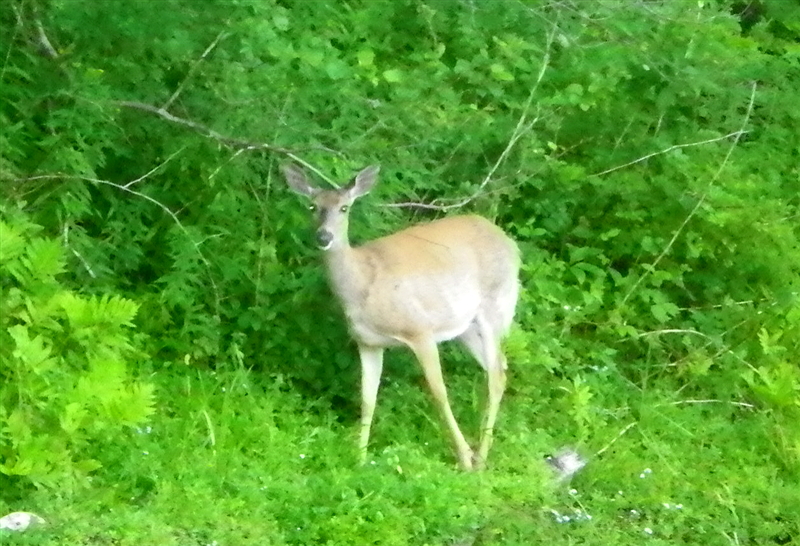
One of those morning breezes caught my line yesterday, foiling my attempt to cast under an overhanging branch. I heard a derisive snort behind me and assumed I had a critic. Turning, I smiled to find a fawn munching steadily on the bank side vegetation and snorting between overstuffed mouthfuls.
It was a day of reluctant sippers and splashy refusals. The tricos were thin, there and gone so quickly, only a couple trout rose to them. With so few spinners on the water, the fish shied from the double they had accepted willingly last week. Finally changing to a size 24 single spinner, I was fast to one of those shy trout on the first cast. The sixteen inch brown flexed the seven foot bamboo fully as he thrashed about.
I’d taken a seventeen inch fish with the Grizzly Beetle early, and once the sparse tricos disappeared I went back to it. These wild browns were reticent though, following each drift several feet below their lies until the fly dragged, then popping it just before my pickup. The rises were few, the naturals certainly less active on a cool cloudy morning. Many trout take terrestrials readily when they are onthem, but are less responsive when few naturals are finding their way into the drift.
Standing on the river bank this morning I was musing about just how long it has been since I witnessed a hatch; not the one bug, two bug and finished kind, but an actual parade of hatching duns bouncing down the river with good fish eating them. I had to check my log as it has been more than two months since I stalked a pair of twenty-one inch browns sipping little olive duns as they rode the current slick before me (I got them both).
It has been a great summer, and I have taken many wonderful fish with a mix of dry flies, heavily favoring the terrestrials. But there’s a simple perfection in fishing a mayfly hatch that’s been missing.
I wonder if the Isonychia will show up this month, as I never encountered them during June? I’d love to see enough flow in the river to drop the boat in and float a few miles. I had a nice system last summer, getting on a parallel line down a riffle with the oars beneath my knees, casting toward the bank with a big, juicy Halo Isonychia. Things got interesting when a little bubble at my fly turned into a big, heavy brown trout streaking down river as I stomped on the anchor release while frantically clearing the fly line strewn across the floor of the boat!
Autumn brings the last dry fly fishing of the year, and it is always fleeting. You enjoy each moment you find with pleasant weather and rising trout, for you never know when the cold front that will end it all will blow through and turn Indian Summer into winter in the blink of an eye. Precious days, precious hours, every one of them lived to their fullest; the seasons of an angler are built upon them.

 Bright Waters Catskill