It has been three weeks since I last waded a river, three weeks since my soul has been soothed, my spirit replenished. It seems that winter has become serious about reigning in that spirit, to the contrary of any prior uplifting forecasts.
It is beautiful in the mountains this morning, with snow clustered heavily upon the arms of the forest. I cannot be certain how much fell until after sunrise, when I’ll don boots and take it to task with the shovel, though half a foot at least has transformed our landscape.
The next two days tempt me, as they are the only days in a coming week promised to rise above freezing. The West Branch has the warmest flow, though still in the thirties, but wading is a precarious thing right now. Though I cannot guess their reasoning, NYC has increased the dam release substantially since the dawn of the New Year. Below Hale Eddy, where the border waters are open for fishing, the river flows at more than 900 cfs, not excessive for summer fishing, but enough to increase the dangers of wading in January. A slip, a dunking that’s invigorating in July, can be deadly now.
Temptation tests my judgement.
Clearing the driveway will have to suffice for my exercise today. A pair of older books have been added to my library, with hope for another, so I can continue to fish the rivers of the Golden Age. Polishing bamboo rods is always an option, though the rods fished often this past season have already been cared for. What I wouldn’t give for the opportunity to visit a fly shop, to talk fishing with like-minded souls for a time!
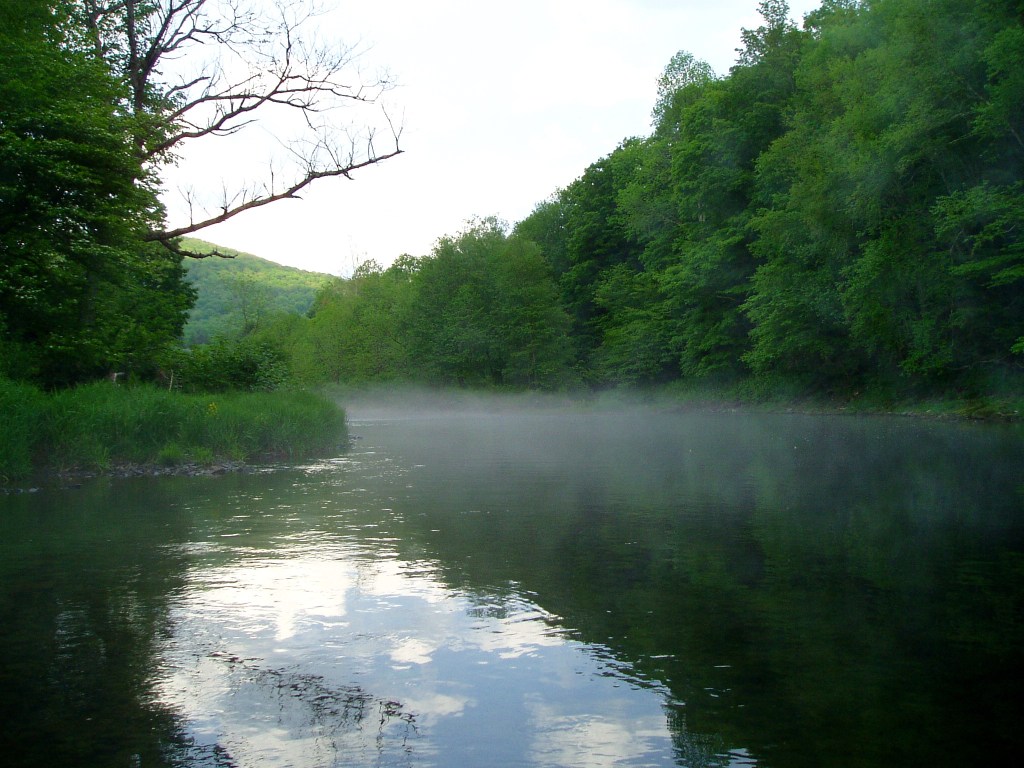
Evening approaches, the last rays of the sun light the ridgetops, and I sit and scan the surface. The simple beauty of the mountains and bright water delights. The mist rises in the cooling air and I wonder aloud: will the hatch come? Soft moments. The anticipation rises as the sun sets. So many evenings, yet never enough!
I began the New Year as I finished the old, by tying a few flies to while away another winter day. I had been thinking about an old technique and lit upon the spark of a new idea.
Over the years I have tied a variety of caddis flies with Antron yarn spun in a dubbing loop, and they have always taken fish for me. I have also tied more CDC dry flies than I can count over thirty years. These, even the ugliest of them from my first experiments, have always been proven fish catchers. I am not sure why it took me all these years to combine the two.
Thanks to the kindness of a stranger, I have a box full of sparkle yarns in a myriad of colors and types. Another fly tier had hunted down a large selection of knitting yarns based upon the writings of the late, great Gary LaFontaine, and he was generous to share them with me. Some of these were the original yarns Gary had used to imitate the gas bubbles of emerging caddis he discovered during his groundbreaking research. Thanks to LaFontaine’s writing, Antron yarn has become a staple for fly tiers for thirty years, and countless trout have found themselves temporarily swimming in landing nets.
Most fly tiers are familiar with the spooled yarn available in fly shops, and various other trilobal materials packaged in hanks, but the original knitting yarns are not nearly as common these days. All of these materials are effective, but the original yarns are softer, with finer filaments, and are worth the effort required to possess them. I decided to tie a new emerging caddis, using the softer yarns for increased movement, matched by the wonderful movement of CDC feathers in the wing.
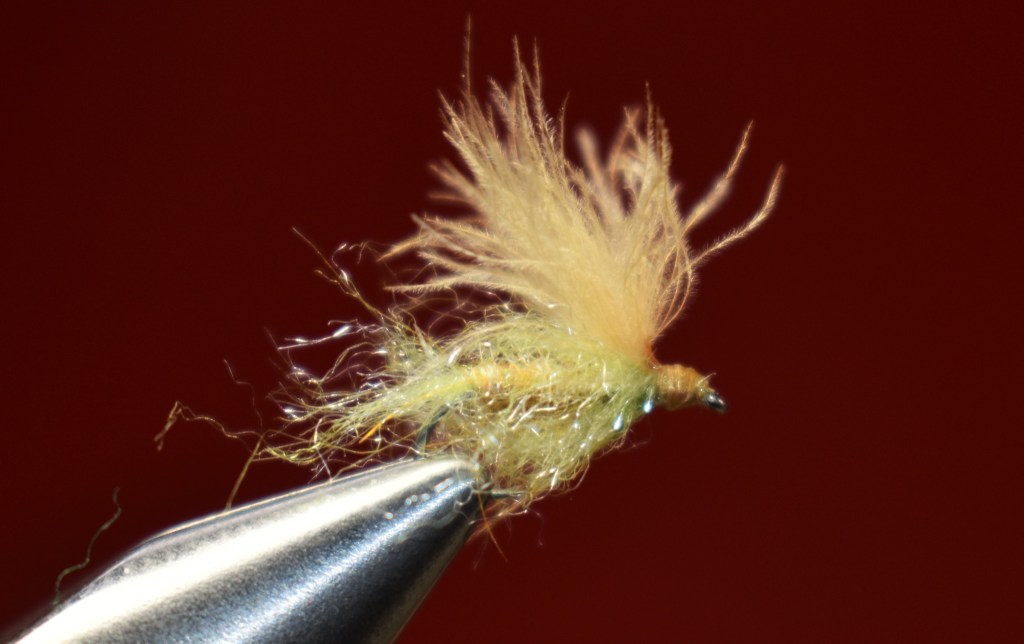
One of the most prolific caddisflies on the Delaware system is the Shad Fly or Apple Caddis, so that was to be my first pattern. Some of these caddis display a uniquely mixed body coloration, so I have prepared a custom caramel apple dubbing blend to match this ubiquitous little bug. That blend would be complimented by the appropriate yarn, Jeweltones yarn in the Kiwi color, a four strand twisted yarn. Adding a pale tan CDC puff for the wing and a few wood duck flank fibers for legs completed my ingredient list.
The yarn is simply prepared by separating the four stands at the end of a piece of yarn and fraying each of them with a dubbing needle. One frayed strand is used for the trailing shuck, and two or three for the thorax. The abdomen is loosely dubbed with my blended dubbing up to mid shank, then a small dubbing loop is formed and the short fibers of yarn (about 1/4 inch) are placed in the loop, spread out a bit for sparseness, spun, and wrapped forward to form the thorax. The beard style wood duck hackle and the CDC wing complete the fly. It’s best to use your dubbing needle to loosen the free ends of the yarn fibers after wrapping the thorax. Movement in the current is the key!
I tie my Shad Flies in sizes 16 and 18, and though I won’t get the chance to test this little guy until May, I just know the trout are going to like it. I have taken a lot of truly memorable trout fishing that hatch.
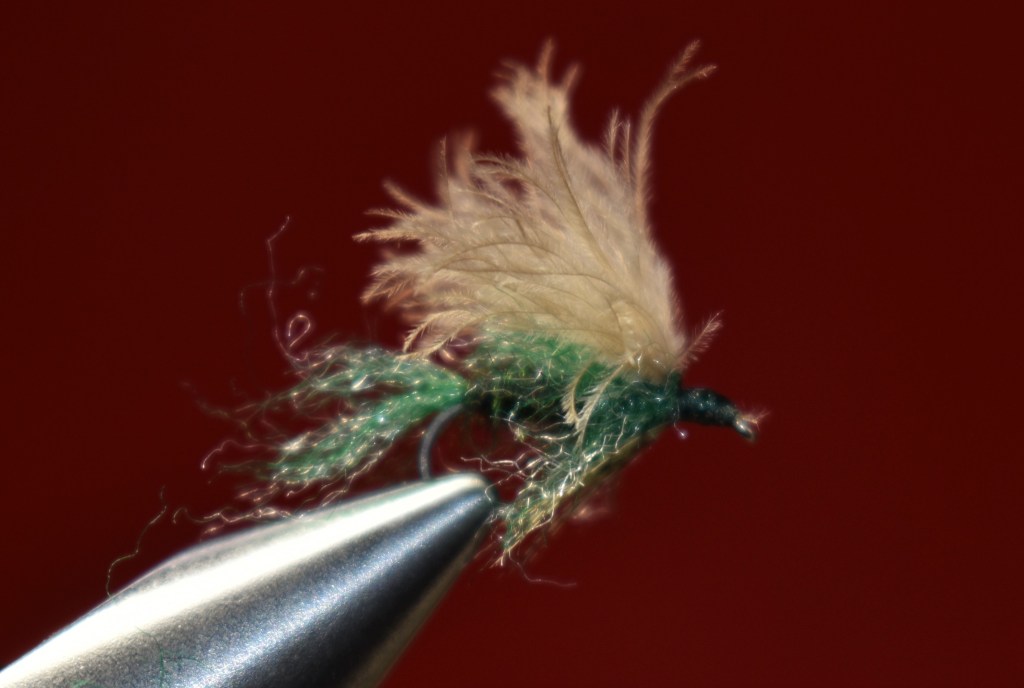
One day, one new fly. Well, actually two, as I tied a Grannom variation as well. I bet the trout back in my old Pennsylvania stomping grounds would really go for that one. The Little Juniata River has a tremendous Grannom hatch just after the middle of April; I think its the best hatch on that stream. I fondly recall a thirty-five fish day when I finally reeled up and walked away around five in the evening, with plenty of nice browns still actively rising!
Should you want to try that pattern, the yarn you need is Jeweltones Emerald, and the abdomen is a blend of black squirrel, chopped up yarn and a little black muskrat. A dark natural dun Trout Hunter CDC puff is my choice for the wing.
Emerging Caddis, Grannom
If anyone tries it for the Little J, I’d love to hear about it. As much as I miss that water, there’s just no way to pry me out of the Catskills come April.


 Bright Waters Catskill