Autumn Torrent – Beaverkill River, Delaware County, New York
Rain fell again overnight, just enough to delay the rivers’ falling back to wadable flows a bit. It has been a strong water year, enough so that there is hope that some measure of our groundwater reserve has been replenished. I took my shotgun for a walk the other day, up along the headwaters of the Beaverkill, and marveled at all of the sparkling rivulets of water coursing down the mountainsides.
I have seen two such years during my full time residence in the Catskills: 2018 and 2021. We had flood flows on Tuesday along many of the regions rivers, but they receded quickly from dangerous levels. Flows are still strong, and carry the color of sediment. It is my hope that the rains brought only good things to the spawning tributaries, clean flows and oxygen, and the result of this ample water year is a full and healthy crop of trout fry wriggling in the gravel come spring. I hope fervently that the streams retain good flows throughout the coming winter, a boon to all stream life!
The weather forecasters are speaking of a warmer, wet winter, and I pray all our rivers and streams will remain free of deadly anchor ice. Much of that is Nature’s will, though the great city to our southeast must play it’s part too. May they use the extra rainfall wisely to maintain strong winter flows in the tailwater rivers of the Delaware, unlike last year.
Driving through the mountains I was blessed to find much of autumn’s fire still aloft on the slopes. Though this last nor`easter brought the heavy rains, we did not get the damaging winds that would have stripped the trees of their beauty. So indeed we have a little more time to enjoy the season as November comes knocking.
November! It doesn’t seem possible, though indeed the angler’s season has vanished once again. The dry fly rods have been wiped down and put away until spring, or at least until the interminable ache of winter drives me to take them out, wiggle and polish them, and remember…
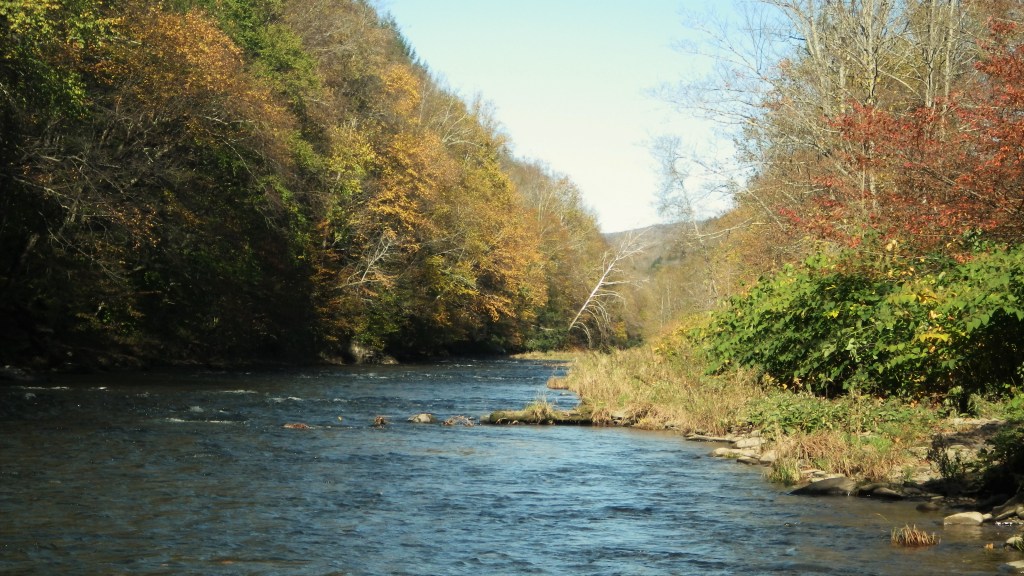
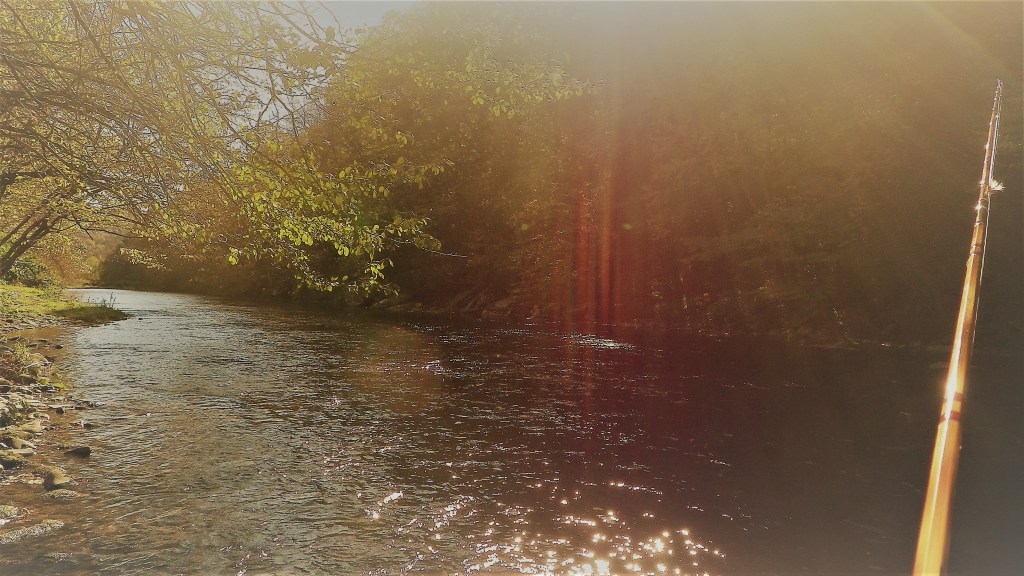
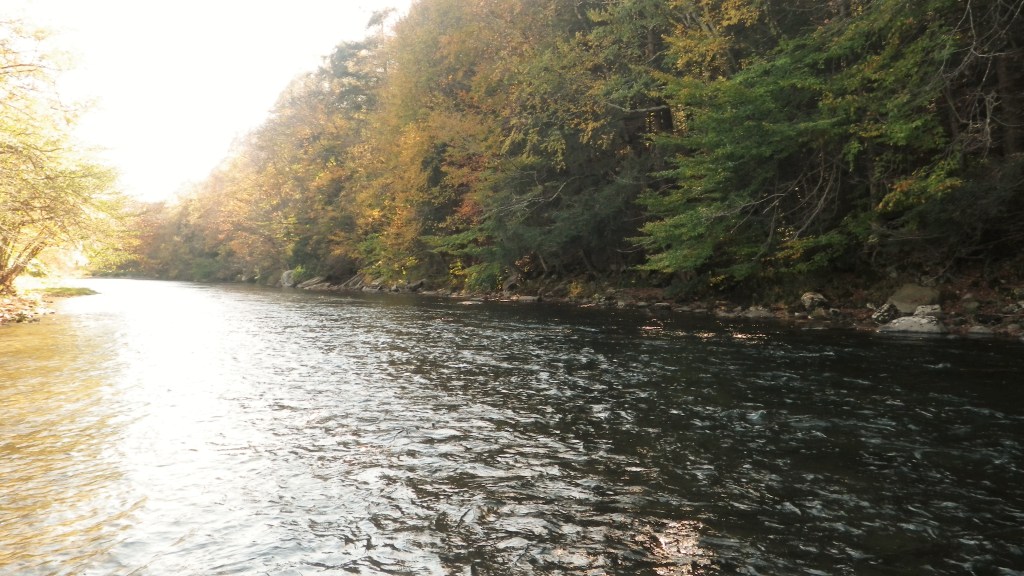
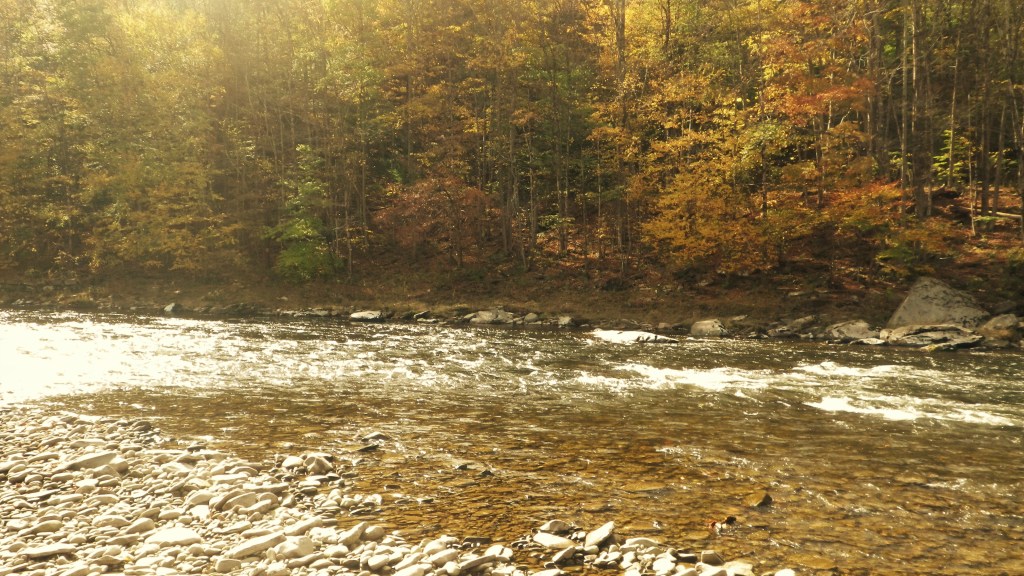
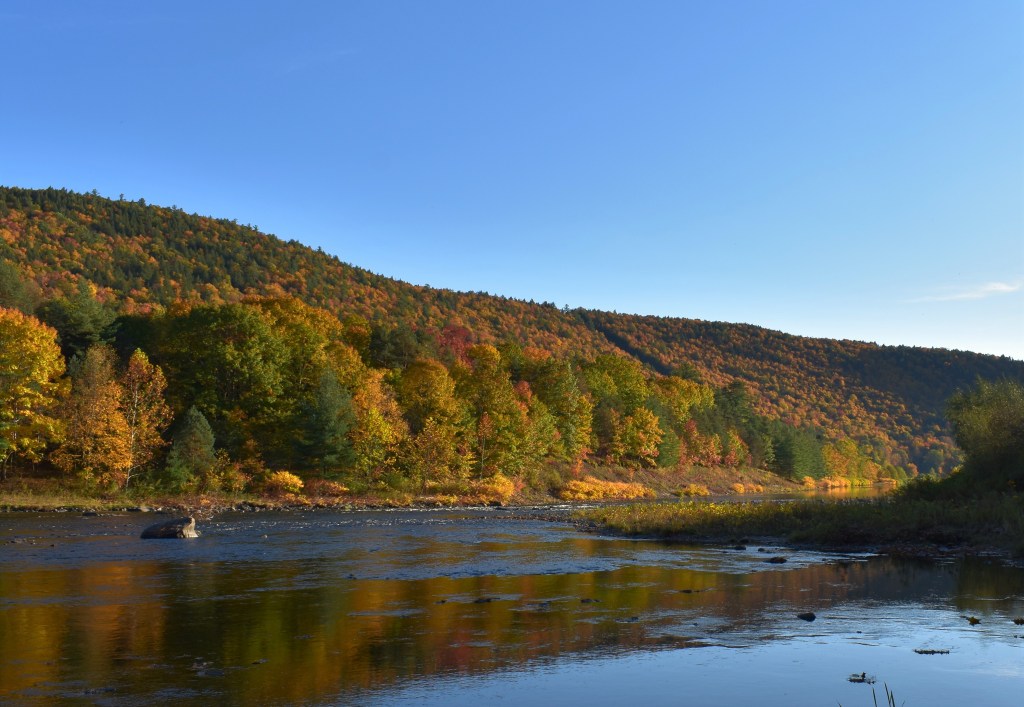
Friday, October15th: An 80 degree afternoon, golden light upon the riverscape, and the fire of autumn colors grace the mountainsides.
The rain is falling hard here in Crooked Eddy. They call it Invest 94L, this first nor`easter of the season. I know it as the end of our spare autumn dry fly season, my most solemn day of the year. The Catskills can expect two to three inches of rain today, and enough wind to strip the color from the mountainsides, leaving a soaked and sullen landscape. More rain will follow as the week progresses.
I have made the best of this bright October. The weather was pleasant, the panorama of the mountains as gorgeous as ever, but wadable days upon the rivers were fewer than hoped for. I longed for the low, cool flows of Octobers past, and fine brown trout sipping small ants and tiny mayflies and caddis, finding little of that. I never expect heavy hatches come autumn, but there was very little available this year.
I enjoyed a record year, despite long periods of high, roily water, and I am thankful; though the end inevitably comes and leaves me longing for one more golden afternoon!
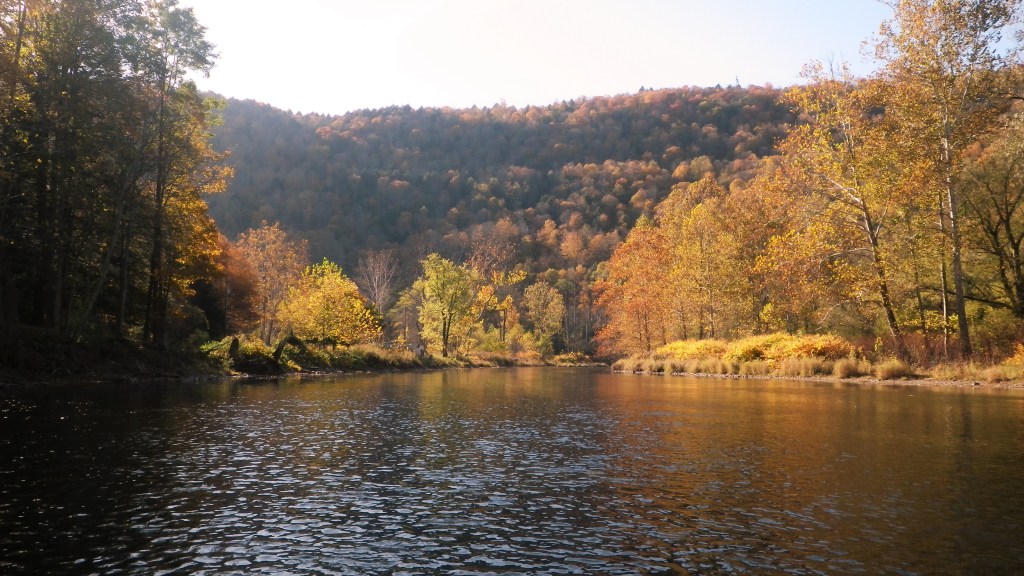
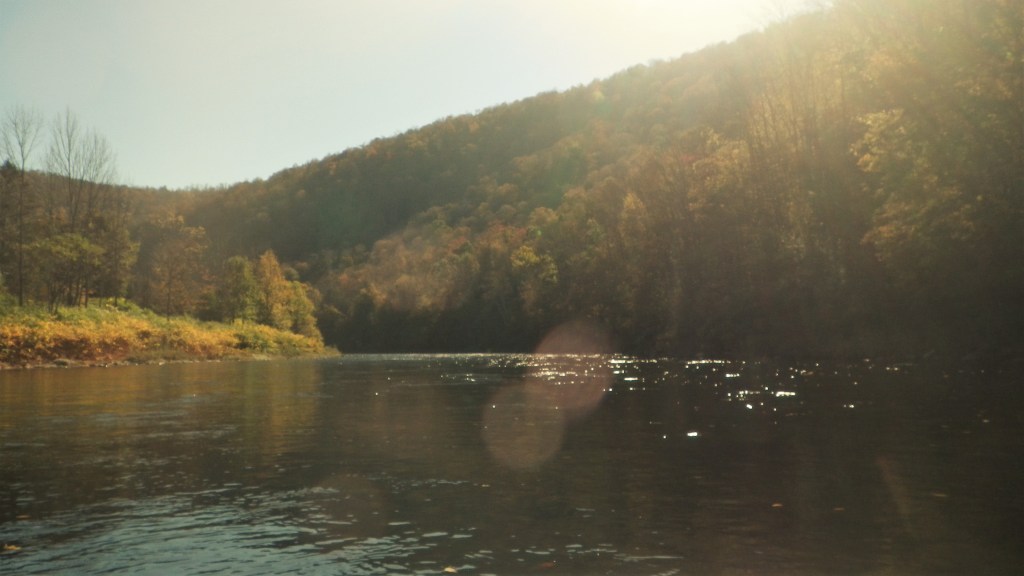
The glory of another golden October afternoon.
Stormy days are often fly tying days, but there is no reason to tie the dry flies that inspire me today. There is a bag in the corner holding feathers from a chukar partridge, my first bird with the 101, my first bird ably flushed and retrieved by JA’s wonderful Lab Finley. I thank them both for their work, their friendship and companionship. JA and I enjoyed many good days upon the rivers this year, a shot in the arm freeing us from the fear of doom. I look back upon those days and smile; may there be many more!
Finn offers my first chukar to her master. Their bond is deep, and united by hunting, as they share a deep love for the field and each other!
There are some interesting soft hackle feathers in that little bag, and soft hackles figure prominently in my winter fishing. They say La Nina can be expected to bring us a wet, mild winter, and there will be more water open to fishing for the off season now, so perhaps I will open that bag and tie a few soft hackles as my acceptance of the change of seasons.
We sat around a campfire on a warm, bright morning just yesterday, sipping coffee and talking of trout and cane rods and flies; four of us enchanted by the rivers and the wild. Our host spoke of finding dry fly fishing in November and December, while I confessed to having no such luck over my three winters in the Catskills. Perhaps I simply want it too much, crave it too deeply in my soul! It can be that way sometimes. We crave something too fervently and it continues to elude us.
It is high time to spend more of my days in the mountains. The vanishing leaves will make the birds more visible, though they will adapt their tactics and perhaps be even more difficult for the hunter. As if those gray ghosts of the forest have anything to fear from a solo hunter! Not this one anyway. I am still looking for my first Catskill Ruffed grouse!
I did not grow up as a wingshooter. The men in our family were deer hunters, and the magic and mystery of archery captured my soul in my early teens. As a boy there were infrequent coveys of quail. We would look for them, once a covey startled us in a particular field corner, but they rarely showed up in those same places on future hunting days. My primary bird hunting involved the fast flying mourning doves, legally game birds in southern climes, and a supreme challenge for the shotgunner.
These days my archery tackle hangs on a rack beneath the window to my right. When I hunt deer now I walk with rifle in hand, as I walk the shotgun during bird season. I was not dealt a full serving of the hunter’s luck, a fact I long ago accepted, but I do enjoy my walks in the woods.
The same force drives me to walk the rivers in winter. I do swing some soft hackles, though I do not stand for hours in the chilled current making hundreds of casts. A few casual casts are enough to soothe my want. Should I at last encounter that holy grail, the rising trout in winter, I can guarantee my attitude will change abruptly. The leader will be instantly remade, and that little box of dry flies that always hides within my vest will magically appear. Just as it was decades ago on the limestone springs, where the grail was often a reality.
I fondly recall the great Ed Shenk telling me that he had encountered sulfur mayflies hatching on the LeTort in every month of the year, and I always carried a few, just in case I happened upon so magic an event.
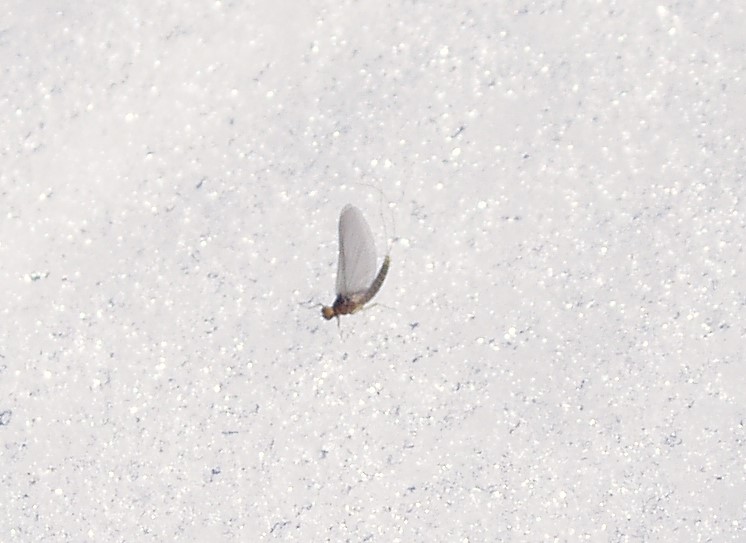
A limestone spring in winter……and Blue-winged olives in the snow!
The rain is pounding the metal roof now, and I can almost hear the flow down the gravel drive. The rivers rose yesterday from half an inch of overnight rain. Three inches at this rate will likely bring a few to flood stage. I am guessing it will be at least a week into November before I can walk a river bank. The drift boat sits idle, and it will remain so until spring, for there is no dry fly fishing to make it worth the pain of rowing. I won’t cover it just yet, for one never knows if Nature has a bit of magic left, one moment more before winter. Wishful thinking? Yes, very much so, but it helps in the realization of what lies before me. April is five months away.
“Upstream the boisterous waters bubble down between the stones to coast in foam-flecked slicks and gentle glides along the banks, with now and then an underwater thrust that shifts the currents till they join in joyous union with the calmer waters of the Pig Pen Pool.” Dana Storrs Lamb “Where the Pools Are Bright and Deep” Winchester Press 1973
I was perusing my Catskill recreation map in search of possible grouse covers that I might discover, when my eyes fell upon a small notation along the Beaverkill not far above the junction. There in tiny letters I read the name: “Pig Pen Pool”. Those few small words brought an instant connection to the past, the Golden Age, where my heart permanently resides along bright waters.
The late Dana Lamb is one of my favorite writers, and I instantly recalled his story of the Pig Pen Pool, knowing that I had to visit the place. Lamb lived the Golden Age as an angler and sportsman, and one of the finest most heartfelt writers who has graced us with his memories. Lamb authored nine little books, most in small, limited editions. In them he shared experiences from classic trout streams and the great Atlantic Salmon rivers, grouse coverts and salt marshes.
We are three weeks into October. The winds and rains have inevitably battered our formerly glorious autumn colors, and our Catskill brown trout are more involved with spawning than with the pursuit of the fly, yet I was drawn to Roscoe on Monday afternoon, cane rod in hand, to pay homage to the past, and the words of a fellow gentleman angler. Though the pig pen itself has been replaced by a large grassy field, I found the relentless currents still “bubbling down between the stones”, meandering between sunlight and shadow on down into the boulder shrouded heart of the Pig Pen Pool.
I had fished the riffles and runs through the upstream reach Lamb so vividly described, probing the deep, shaded pockets along the mountain’s bank in a relentless wind. It was a warm day, at least for the moments suspended between the autumn gusts, and I felt that any trout interested in a meal would take up station among those pockets, either in sunlight or shade. I made each cast with a special thrill, and enjoyed great success, though no trout betrayed their presence. My reward was a walk back in time.
Walking down to the pool itself, I watched Lamb’s words come alive, watching in reverence as the bright waters “joined in joyous union”, and picturing the nearly two-foot trout his companion battled in it’s depths. I wished to fish this special place, but somehow I could not bring myself to cast my line there, not at least on this first visit to the shrine. Instead I stood entranced for a while, then finally remembered the camera at my side and snapped a few photos for the memory.
“Where the river rubs against a steeply slanting wooded hill the rocks and rhododendron offer shaded shelter in the water’s dark green depths. Down there, beside the cooling crystal springs that stir the snow white pebbles and the sand, the great elusive stream-bred beauties lie; longed for, unreachable and seldom seen.” Dana Storrs Lamb, “Where the Pools Are Bright and Deep, Winchester Press 1973.
Reading through his books, it is clear that Dana Lamb enjoyed a long association with the Beaverkill, and though this book, his seventh, was published late in life, I feel certain the images the story conveys share a lifetime’s worth of beauty and memory. He could easily have fished this pool a century ago, as a young man just coming of age, returning often as change raced through the Catskills. As he wished fervently, The Pig Pen Pool continues. May it always be so!
It has been a very pleasant week. Warm weather, comfortable evenings, what we used to call Indian Summer when I was a kid. Our afternoons have been in the seventies all week, and yesterday, wow, a gorgeously sun drenched eighty degrees!
Its funny how eighty can feel hot, even stifling in August, and just so perfect in October. Standing in an ice cold river certainly adds to the comfort factor, but even later, sitting on the porch with a cold Molson, the warm air simply envelops you and feels absolutely wonderful. It occurred to me that would probably be the very last eighty degree evening I would enjoy for seven or eight months.
I arose before sunrise this morning to find sixty-five degrees here in Crooked Eddy, the morning of the change. Tomorrow morning’s low temperature will be twenty degrees colder; Monday’s high thirty degrees short of yesterday’s lofty glow. And yes, there is more rain coming.
I tried wading in high water yesterday for a while, finding a hodgepodge of insects in the drift, and a few small scattered trout rising. There is a subtlety to rise forms. It takes a good deal of experience to read them accurately, for the clues vary constantly with water depth and current speed. Very large trout can rise with just the slightest disturbance in flat water, but there are clues to what lies beneath. Hydrodynamics are as immutable as all the laws of physics: a body displaces water, and a moving body will displace at least some of that water in it’s direction of motion. Sometimes that little swell in the surface film is so subtle as to be overlooked, and sometimes it isn’t there. When you can be certain of the absence of displacement, you can be pretty certain that you are watching little fish, though as with everything in Nature, there are exceptions.
I spent a little time yesterday picking and choosing which of those scattered rise forms might be worth a cast or two, figuring that a pound brown trout would be a suitable foe under difficult late season conditions. Never got one of those trout to take, most refusing to even hold their positions for an approach, but I was enjoying the day so why not indulge a bit.
When it was time to go I waded out thinking about my next stop. I pulled off along another river and watched one particular piece of water: nothing doing there. I drove on checking out several other places, finding the Friday afternoon crowd of visitors had arrived. There was a single truck parked at one of the pools I had in mind, so I pulled in and walked down to the water. There was no sign of human habitation, so I went fishing. Once out in the river, I began to look for rises, and I noticed an angler standing in the shade well upstream watching the riffle.
I spotted a dimpling rise three quarters of the way across and began to work my way out, tying one of my trusty size 20 olives to my tippet. Once I had worked my way into position, I still faced several very difficult currents, but there simply wasn’t any better position I could get into. I started working that trout when he rose a couple more times, but he didn’t seem to care for my comparadun. I switched over to a hackled pattern that gave the appearance of a smaller fly and managed to get him to suck it in, or so I thought. There was no one home when I lifted.
About this time my hackles got prickly and I turned to see that other angler had come down from the head of the pool and was slipping down the bank behind me. Some guys simply cannot understand that other anglers do not necessarily want company. He had chosen one end of the river, so I had chosen the other, leaving him to his water. He did pass me by a reasonable distance before he waded out into the river, but the effect was still the same: he cut me off from my intended fishing, which was working downstream through the tail of the pool. Thanks, pal.
I had seen one rise way over along the bank. Though it was just a soft dimple like the fish who refused my olive was making, there was that little swell that I recognized from across the river, I knew that was a better fish, and I also knew that my best plan would be to fish for the riser out in the current first. After the refusal, that bank fish sampled something again. I waited, and eventually he took another, this time several feet downstream and a bit closer to the bank. Meanwhile the refuser dimpled again and I wasted a few casts on him to pass the time, always keeping my eye on that better fish.
After about fifteen or twenty minutes, I had watched that bank fish rise maybe four times, enough to confirm that he was moving around in a triangular area of slower water perhaps ten feet long. That pocket was created by a sizeable rock a foot or so off the bank that caught the heavy current and directed it out toward the middle of the river. This was a very rocky area, a boulder field on the deep side of the river, so there was a lot of strong, fast current between me and that trout in the triangle, a difficult casting scenario if ever there was one. I cut back my leader and knotted three and a half feet of 6X fluorocarbon, then replaced the fly. I had studied the situation, and moved a few steps deeper to put myself where I could cast at a sharp downstream angle to defeat most of those intermingled currents; slack would have to defeat the rest of them.
At last I made a pitch with the olive, something I could see to check my drift. It alighted near the top of the triangle and floated perfectly for about half the length of the triangle, then those wonderful currents pulled the slack out of my tippet and skated it away. I changed the fly, figuring that my trout may have seen that skating display, though he had risen around the middle of the triangle prior to my cast. I waited, he moved downstream and rose again in the wide bottom of the triangle. I directed this cast further down the pocket, knowing I could only expect about four or five feet of drag-free drift. The fly dropped in the middle of the triangle and drifted perfectly down to it’s bottom without a take.
I didn’t check my watch, but I probably spent half an hour or so in this wait and cast mode. That trout wasn’t rising often, and he kept cruising up and down in that triangular pocket along the bank. The olive went untouched, as did an ant I offered him, so I thought that a different small terrestrial might turn the tide my way. I opened my vest’s fly pocket and dug around, finding a little size 19 Grizzly Beetle that made me smile. The trout came up again, two thirds of the way down the pocket from the rock, and I laid the little beetle in there. The drift looked clean, but he didn’t take. I picked it up gently and cast again, placing the fly a bit closer to the race of current that formed my side of the triangle, dumping some extra slack in the leader to ensure the drift. Game!
He was surprised when his snack pulled back at him, as was my “neighbor” standing down river when the ratchetting of my Hardy drew his attention to the bow in my rod. The trout stayed in the heavy current, dangerously close to a big, sharp edged boulder that would make short work of that 6X tippet, but my trusty Paradigm allowed me to keep a measure of control, finally leading him to the net after a spirited exchange. My bank sipper turned out to be a deep, buttery eighteen inch male with his spawning kype already formed. I twisted the beetle free with my forceps and slipped him back in the flow. I hope he fathers a bunch of strong, challenging wild trout for years to come!
I backed carefully out of my somewhat precarious casting position, and the angler downstream asked if it was a good fish. “Yes, it was a nice fish” I answered. With no other rising trout in sight, I backed into shallower water and decided to fish the short section of river bank upstream on my way back to the walking path. The 6X was removed, and I knotted my cricket to the remaining 5X, figuring that a choice meaty terrestrial just might tempt a trout that wasn’t snacking just yet. Working upstream and back to the middle of the river, I spied one nice bubble at the edge of a sizeable rock that brought an instant grin.
A cast, a take, and a screaming reel: a perfect way to end a gorgeous Indian Summer day!
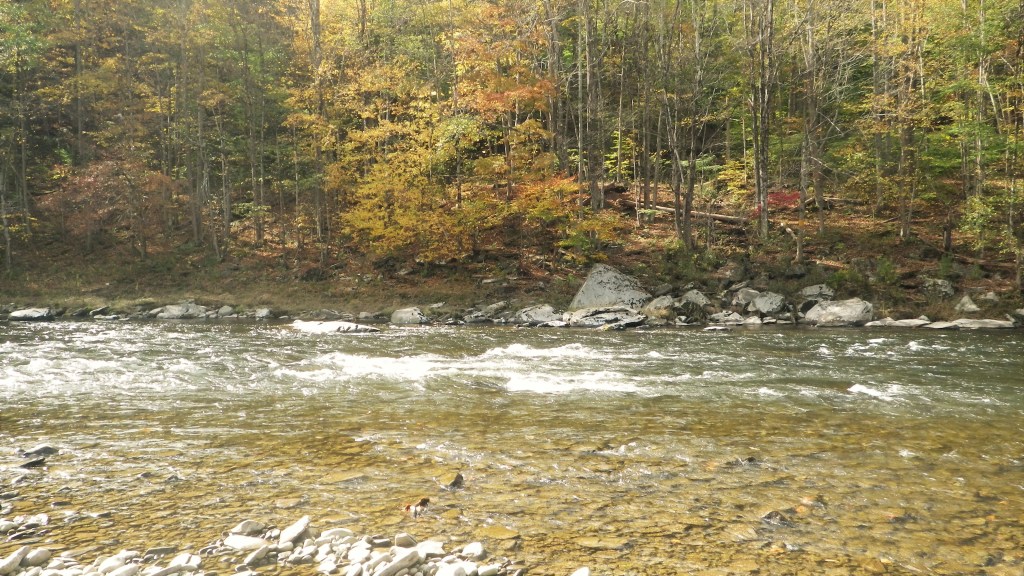
Rivers are still receding very, very gradually, as here on a bright, gorgeous October afternoon. Dry fly fishing still lingers, teases, though few flies seem to be hatching.
I have managed to find a couple of nice trout this week, what may indeed be my last taste of dry fly fishing for the season. Our rivers remain at much higher flows than expected for mid- October, and what fishing I have located has offered a lesson in the magic of currents.
On Monday I spied a lone ring in deep water and, upon closer inspection, found a fine trout cruising around in a pocket of quick, intricate currents, sipping tiny mayflies of the blue winged olive persuasion. The currents were in a word, insurmountable on their own. Was that enough to set the stage for a wonderful challenge? No. Was the wind blowing and swirling perchance? Of course it was!
This was not the first time I have amused myself for a few hours trying an impossible trout.
At intervals I would relax for a moment and scan the wide expanse of water within clear vision. Not once did I detect even the slightest evidence of another feeding fish. I do love a challenge, but I would have easily conceded in this instance and moved on to another riser if there was any hope of one.
I had decided that this fish was not going to be taken under the existing conditions half an hour into our engagement, but he was persistent and I took that as a slight glimmer of hope, for I have caught impossible fish a time or two. Not this one though.
I realize that the currents in a receding river change constantly, though when one recedes as gradually as our Catskill rivers have this month, the change is extremely slight during the course of any given afternoon. The winds of course are another variable, and there is no predicting whether these myriad swirls in direction and changes in velocity might come together with one suitable cast in one golden moment, and send my tiny dry fly right down the pipe on a perfect drift. Some intrinsic faith in serendipity helps to keep me amused when fishing is at its toughest.
Tuesday dawned as Monday had, with a thick gray mist of cloud cover. Here in Hancock it is normal for our morning humidity be be at or near one hundred percent, even in the winter. Life at the confluence of rivers begins with misty mornings on a very regular basis. By late morning the sun had burned of that haze and lit the autumn colors of the mountainsides, making the bright, clear water truly sparkle. I cannot help but be thankful for days like this.
The winds were weaker and more regular, and calm conditions add to the feeling that fishing is going to be better. The currents had calmed somewhat too. I wasn’t in position long before I spotted that first little ring, yes, right back there in the cauldron of tricky currents that had so completely befuddled my best efforts the day before.
These were new currents, the river’s flow had dropped something like eight percent from the day before. Would that be enough to make those bedeviling current tongues more tractable? I hoped that it would.
My trout performed as he had on Monday, moving about the “cauldron” and sipping an insect here and one there. The rise forms varied constantly, everything from subsurface stirrings to the occasional nose above the surface take, bringing doubt as to whether he was taking just the sparse olive mays, or sampling various tidbits from the drift. I was perhaps fifteen minutes into the game when he tipped his nose up and let my little olive comparadun slide into his mouth.
I cannot be sure whether my timing was off by a critical microsecond or two or if the tippet hit his lip and caused him to begin to reject the fly he had just inhaled. He sort of twitched his nose as I was coming tight and my fly caught nothing. The refusal is a very hollow victory. It tells you there was something right about your fly, but that one or more other things were wrong.
We continued the game for some time after that, complete with fly changes, and perhaps another late refusal when my tiny spinner ducked out of sight and then back millimeters before the rise came.
Different flies, the same original fly, nothing changed the odds in my favor. I had made subtle shifts in position for a couple of hours of fishing, still convinced that a downstream presentation was the only suitable approach. Monday’s flow had made it the only possible approach, and I had steadfastly stayed the course. Perhaps I was wrong, too set in my ways, and I considered that the flow had been reduced so I could not assume a different approach was impossible this afternoon.
I eased out of my casting position, backed into shallower water and downstream, working back into the deeper water to the side of that trout’s feeding ground. I wasn’t able to wade into that side attack zone twenty-four hours earlier, but this time I could, and I did.
The trout had taken a break as well, and when the rises resumed, he too had relocated slightly, lining himself up in a direct thread of current. There was a little flurry of mayflies bouncing down that thread of current, and he had decided to take advantage of serendipity, as did I.
I had knotted the original little olive comparadun to a new tippet after my relocation, and went to work to find the perfect drift. Within fifteen minutes we had both found a rhythm and finally completed our engagement: I cast, he rose and accepted my fly, and I tightened exactly on time and was rewarded with a hard pull down toward the rocky bottom of that cauldron.
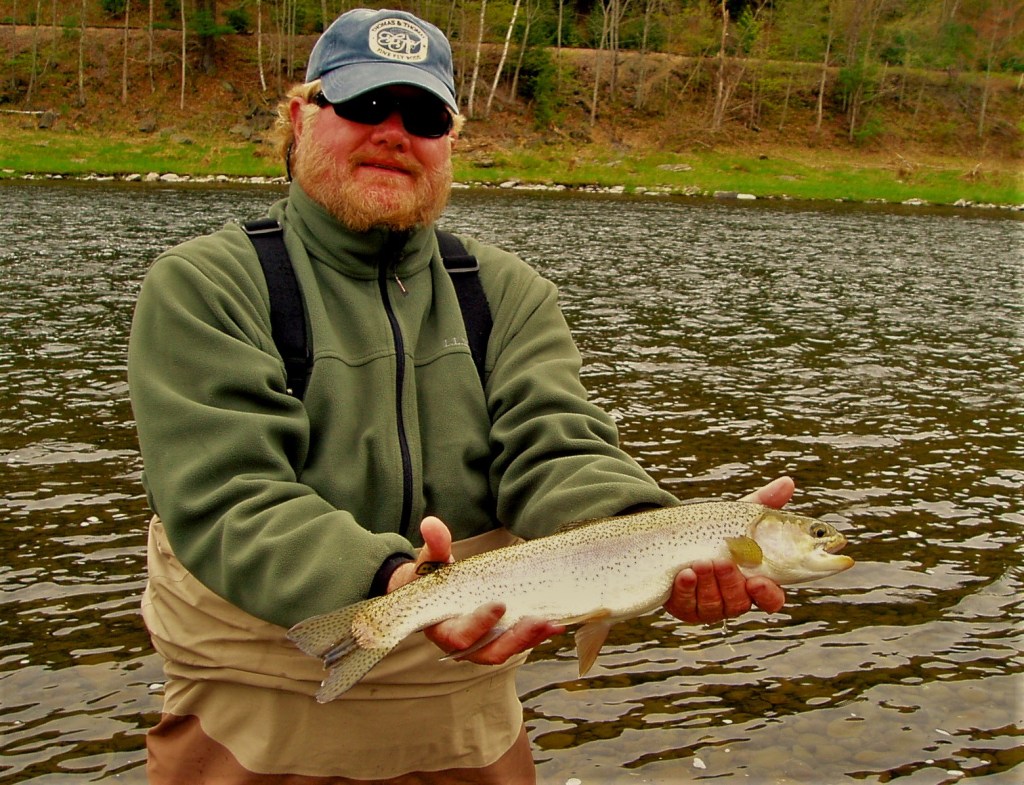
Like all wild trout, he used the currents to his advantage, and I used the fly rod and my experience to mine. Dipping the net to slide him into it, I marveled at his heft and his deep autumn coloring. This was a nice wild brown trout, a quality fish to be sure, though he wasn’t in danger of pushing that coveted twenty inch mark. Well earned to be sure, and well appreciated.
Of course I scanned that wide expanse of water before retiring for the day, but it seems that my friend was once again the only game in town.
At last an opportunity to wade bright water! Though the forecast promised clouds alone, the sun shone brightly in the bluest of skies: a welcoming!
I found my favorite little stretch of the river quiet and walked alone by the path, stepping in where the clear, cold flow bubbled over the black stones, eager to fish. This tiny run holds great memories for me, battles won and lost, amid the wonder of new water and the glory that is spring. The variety of holding water in this brief environment convinces me that trout should always be present.
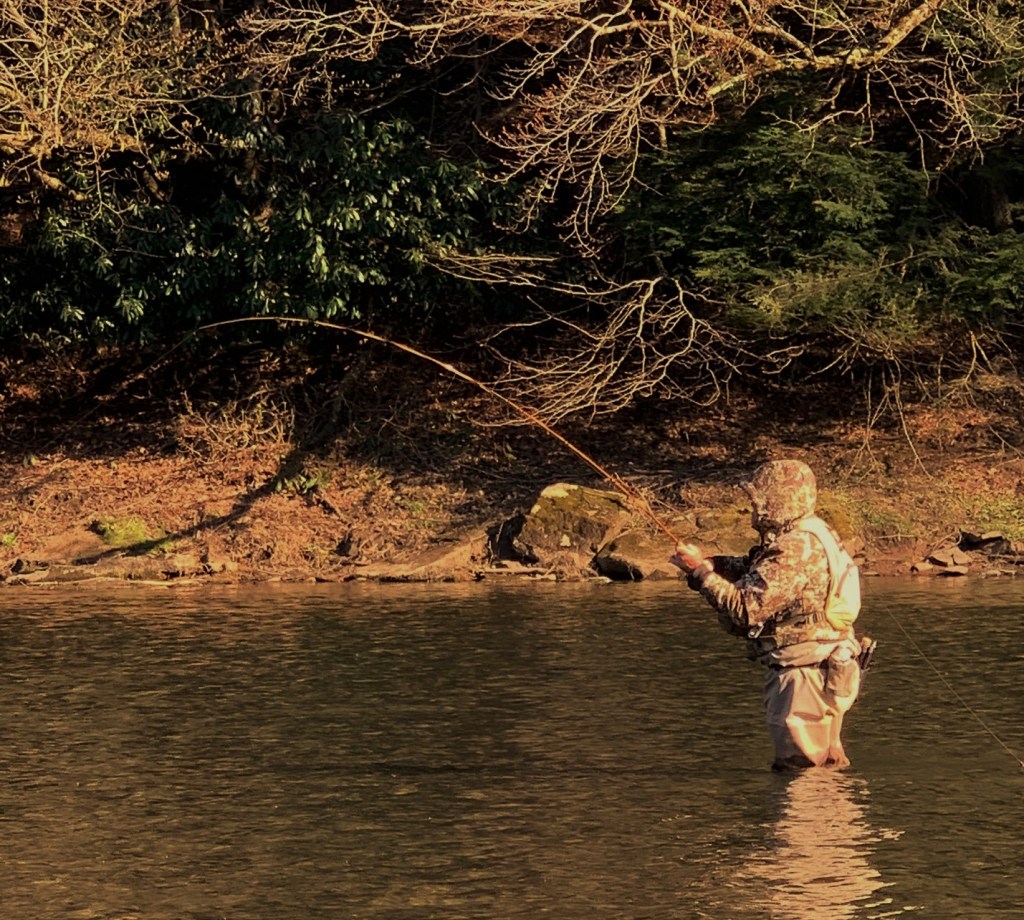
There was no hatch to bring trout to the surface, not that I expected one, and I knotted my cricket to probe the various holding lies before me. I worked upstream slowly, thoroughly, joyfully embraced by my surroundings: alone on bright water with bamboo and the dry fly. As I moved up I began to make a few casts to the side and down, drifting the black fly through the same areas I had covered from below. With the different angle, the cricket floated back deeper in the shade, less than six inches from a pocket in the bank and I found a response! So often this is a game of inches.
The brown pulled hard in the fast water when I drew him from his hide, the old rod bending into a deep, wide arch. I enjoyed every moment of him.
In the net at last I admired his dark coloring, a product of shade and those black stones. Not a big fish, perhaps sixteen inches, but as welcome after my long hiatus as any trout I ever encountered.
I worked carefully through the pool upstream, sorting through each bit of cover and shade, though it seemed that brownie was as alone there as I. One angler, one trout, joined on a perfect afternoon. The dry fly season continues…
That seems to be the sign posted at the entrance to October, at least for me. Twenty-one inches of rain during July, August and September wasn’t enough it seems, and so the rivers remain high, too much so for the wading angler.
I have spent some time in the mountains, chasing the ruffed grouse that have denied me a shot. I even had a great afternoon hunt with JA and Finley! I have to say, that sweet girl worked hard and put up some birds for us, but the ruff is legendary for it’s ability to avoid the clear lanes through the forest where a hunter’s shot column might intercept their escape. The early season is the most beautiful time to be in the mountains, but all the leaves make it doubly hard to swing true on our most regal game bird!
There is great joy in watching a good dog work though. Her efforts clearly show how much she loves it. Excitement all but boils over when she sees the guns and the orange caps upon our heads, but she gets right down to business as soon as we pass the eaves of the forest. Hunting close, coursing through the cover, JA rarely uses his whistle to direct her. Thank you Finn.
There is no doubt as to why the rivers have been slow to return to wadable levels: the mountain slopes are literally dripping, as if all the ground was one great spring head. And so I wait while this last month of the dry fly season withers.
As long as our Catskill summers last, I still regret their passing. Would that this glorious season lingered for half the year! And yet, October has always been my favorite.
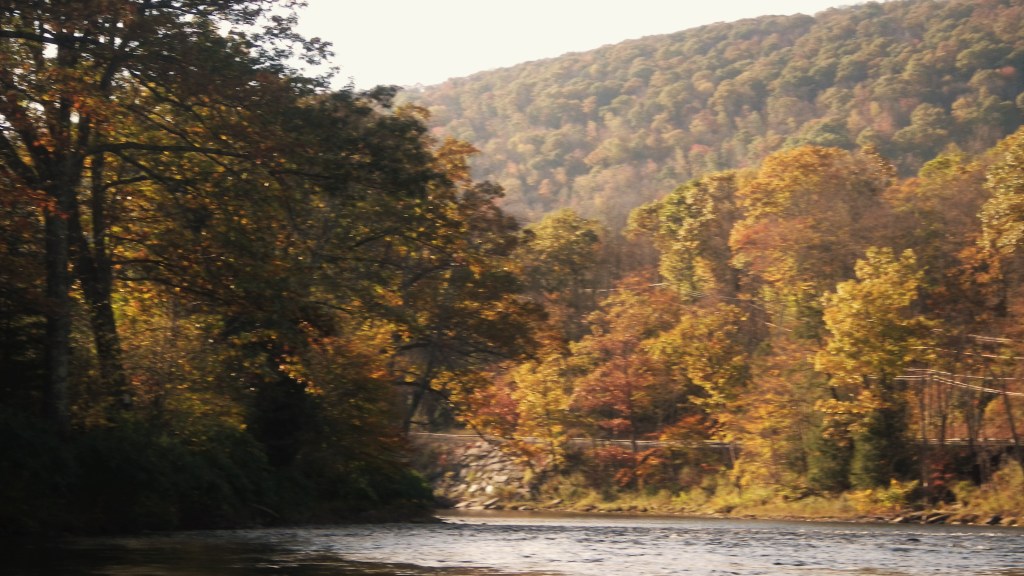
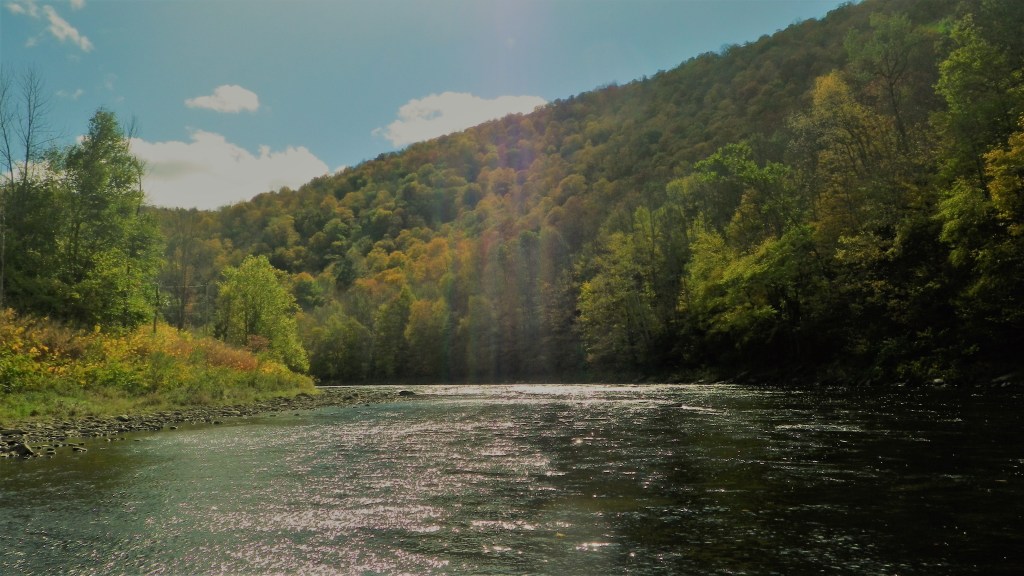
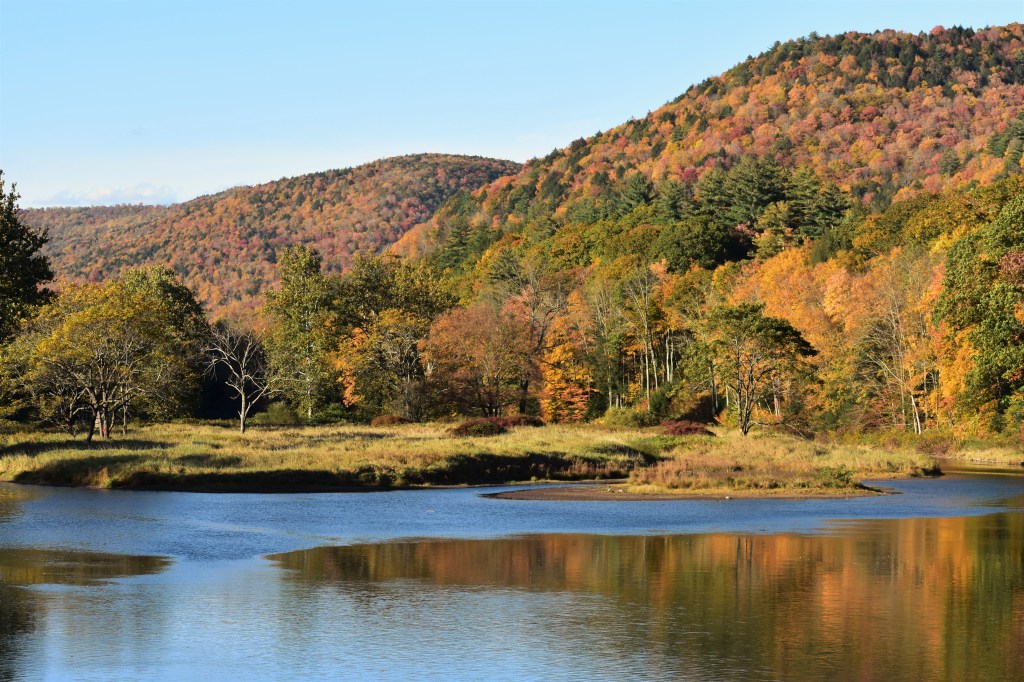
A river’s gateway at October low water, when the afternoon sunlight washes it’s color wheel across the mountain sides.
Each morning I peruse the stream gages, hoping that a day has arrived when I can pack my waders, a reel and an old cane rod and depart. It seems an interminable amount of time has passed since my morning vigil brought good news.
It is warm this afternoon, and I can picture myself wading in the sunlight… the Beaverkill, perhaps the Delaware, scanning the wide river for signs of a rise. The sun is warm on my shoulders, as I spy a gentle disturbance along a shaded stretch of bank. The approach is calculated. I work into position, all the while keeping an eye toward the surface for some hint of the bit of food that caused that resting trout to stir.
The cast is long and smooth in the still air, and the loop unrolls to lay the fly delicately above my target. I have no need to see the fly. A rise, any rise will mark success.
The ring is gentle, there for just a moment then gone, but I raise the rod confidently and feel the power as a great fish churns the shallows to a boiling tempest! The fight covers the entire flat, my reel screaming with each run into my backing, but at last he is mine!






 Bright Waters Catskill