
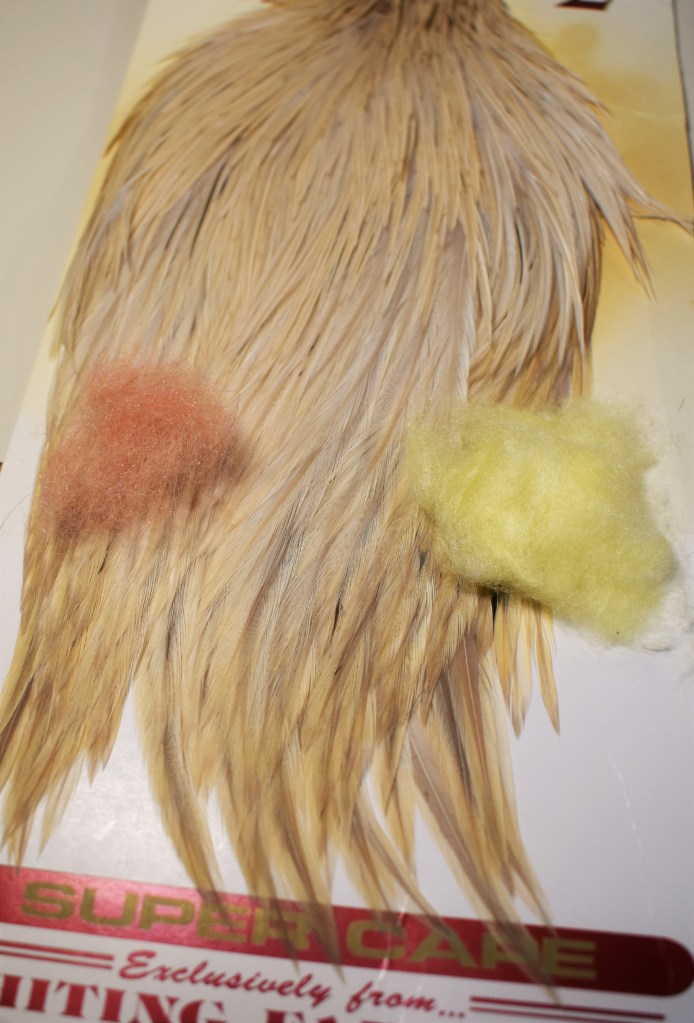
Well into my winter reading, I found another bit of inspiration that lured me to my tying desk this morning. Yesterday I began working through Mike Valla’s wonderful “Tying Catskill-Style Dry Flies” (HeadWater Books, 2009) and enjoying the result of his passion and research. His treatment of an iconic old English pattern, the Tup’s Indispensable, included his own blend of dubbing materials to recreate the alchemy of the old fly’s secret ingredients. Considering Valla’s rendition got me thinking about one of my blends and how that might be the perfect platform to craft my own Tup’s.
Fresh off my read of Theodore Gordon’s writings, I recalled his fashioning the fly when provided with a sample of the originator’s mixture, which had got me to remembering the pattern’s inclusion in various writings from the Cumberland Valley sages: Fox, Shenk and Marinaro. All recommended the Tup’s as an excellent fly for the sulfur hatch, the predominate mayfly in the Valley’s limestone springs.
I once puzzled as to where I might find the revealed secret material, the highly translucent wool from the testicles of the male sheep (a tup in the British countryman’s vernacular), long ago abandoning any search for the stuff. Valla’s research led him to a creamy pink color with a touch of dark orange, and armed with that color I determined just what to do.
My Flick inspired pink Hendrickson dubbing is a blend of cream and light reddish fur from the skin of a Red Fox, enhanced with a special pink Antron dubbing. The Pink Enhanced Hendricksons I tied for the past two seasons have proven to be very attractive to our Catskill trout, and I was sure a bit of that blend could be easily modified to craft my own Tup’s with the addition of a touch of dark orange Antron and some more of the cream-colored fox fur.
My tie of the Tup’s Indispensable has borrowed from Mike Valla’s research. He credited the originator, Mr. R.S. Austin, with sometimes tying the fly with a tag of yellow silk. I also followed the teaching of my Cumberland Valley mentor, the late Ed Shenk, by wrapping the hackle over a dubbed thorax. Ed tied his Shenk Sulfur Dun wingless in this manor, and it is the first sulfur pattern I learned to tie more than thirty years ago.
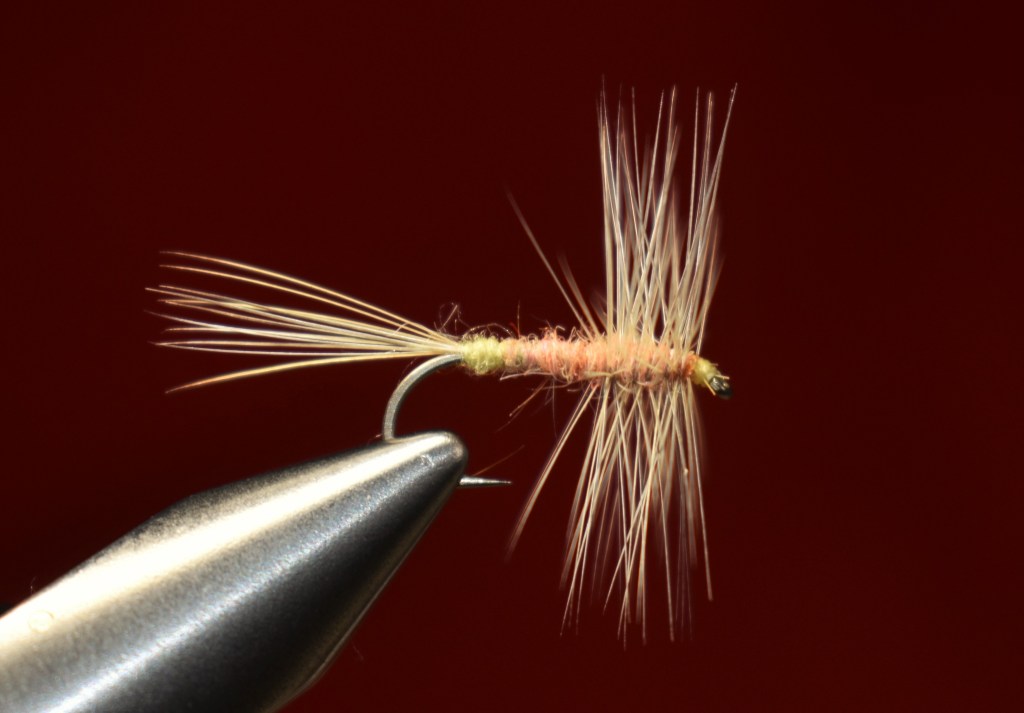
I can picture the soft colors of May and feel the tingle of anticipation as I knot my little size 16 Tup’s to a 5X tippet. The lovely yellow mays are drifting quietly on the surface and, at intervals, a soft broad ring forms on the glassy surface where a trout has gently taken one of them. My old cane rod flexes smoothly, and my Tup’s is the next in that same line of drift…
 Bright Waters Catskill
Your choices of reading material (Gordon, Valla) are suspiciously like mine! They have taught me a lot. So has yet another one of your posts. Thanks.
LikeLike
Nice!
I have been paging through my well thumbed copy of The Art of Tying the Wet fly and Fishing the Flymph
by Leisenring and Hidy. Got any old primrose silk buttonhole twist in your stash?
LikeLike