
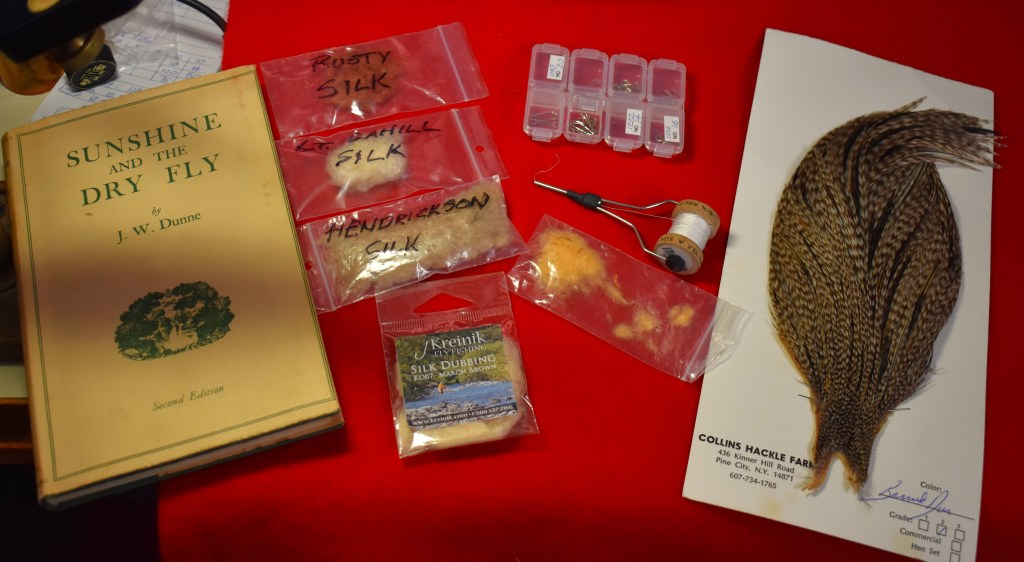
Throughout my own journey as a fly tier, I have sought to present an image of life to the trout. Natural mayflies have several qualities of note, their translucence and blends of coloration ranking at the top of the ladder in my opinion. Very early on it was impressed upon me to work toward mimicking these visible traits, and I quickly became enamored with blending dubbing materials to achieve that goal. The furs of foxes and beavers and muskrats, both natural and dyed, were combined with Gary LaFontaine’s miracle Antron carpet fiber to create flies with the blends of colors I found in the mayflies I captured at stream side. Sweetened with the reflectivity and affinity for holding minute air bubbles provided by a small amount of the synthetic yarn, I was overjoyed to find my flies combined the appearance of not only the natural coloration but gave a hint of the translucency of the natural flies as well. To this day, my tying bench houses four dispenser boxes and dozens of small zip lock bags filled with dubbing blends to match the hatches I have encountered in more than three decades of trout fishing.
Fishing the clear, still pools of our Catskill rivers, I have experimented more with capturing the elusive translucency of the naturals, as I find our wild brown trout growing ever more challenging. One avenue that showed promise involved wrapping an underbody of pearl tinsel before applying my blended dubbing to my 100-Year Drake imitations. I am convinced that larger dry flies are more likely to arouse suspicion in a taking fish and hoped this method might increase the translucency enough to enhance that image of life that I seek. A pair of these special duns were placed in my fly box to be used only under appropriate circumstances.
I encountered a large brownie a few seasons ago that took selectivity to the extreme. Green Drakes were on the water sparsely, and this fellow had chosen the perfect lie in the most populated line of drift, where he passed on most of the natural duns coming down to him. I expected that movement was the trigger for this trout, but close observation showed no discernable movement in the naturals he selected. I fished him carefully with several flies, including two that had seduced three other browns that day which exceeded twenty inches. He remained unimpressed. There was mixed sunlight and overcast that afternoon, and I decided to try my experimental drake with the pearl tinsel underbody. I believe I showed it to him twice. He drifted up to that second presentation and sucked in my fly as he had his special naturals, gave me a hell of a good battle, and stretched the tape to twenty-two inches. Although the dubbing blends I had used for a dozen years had taken many fine trout during the Green Drake hatch, that fish convinced me there is always room for improvement!

My quest for heightened translucency began to focus on pure silk dubbing during my first full season here in the Catskills. The formula for my experiments involved blending various silks for color, using pure white tying silk to construct my flies, and tying them on Daiichi’s Crystal Finish hooks which I had used sparingly since the Falling Spring Outfitters days. The patterns spawned from those experiments, my Translucence Series flies have brought substantial success, and I have tied and fished them more each season.
At one point, my friend JA suggested I check out a blog by British author Robert Smith called “The Sliding Stream”, after reading a post on fishing bamboo rods in England. I liked Mr. Smith’s blog and later found his post on an early twentieth century British author named J. W. Dunne. Dunne had undertaken substantial work in regard to imitating English chalk stream mayflies a century ago, producing a thought-provoking volume entitled “Sunshine and the Dry Fly” in 1924. I was interested in what Smith had to say about him and added the title to my want list.
This week I received a copy of the 1950 second edition of “Sunshine and the Dry Fly” from England, finally enjoying the chance to learn of Dunne’s inquiries and methods in detail. As a chalk stream angler, he was influenced to great extent by Frederick Halford, the same authority on English dry fly fishing who corresponded with our Theodore Gordon. Based upon his own observations, Dunne took Halford to task regarding many of his prescribed chalk stream fly patterns which he found poorly imitated the coloration and translucency of the natural mayflies. Dunne did not embark upon this quest to one-up Halford, expressing that disagreeing with the great man was not his purpose since Halford had been “his guide” as he learned of the mysteries of trout and fly.
Dunne found it necessary to paint the shanks of his dry fly hooks with white enamel to prevent his carefully chosen and blended colors from darkening when the flies were oiled or wetted. He preferred synthetic “silks” for their handling and consistency of color, blending various strands of different color to achieve his blended copy of the hues of the natural flies. His bodies were wrapped with these blended strands rather than dubbed, and he studied the naturals and imitations when lighted from above by natural sunlight of varying intensity. I found his work terribly interesting, marveling that we two anglers followed such similar paths a century apart.
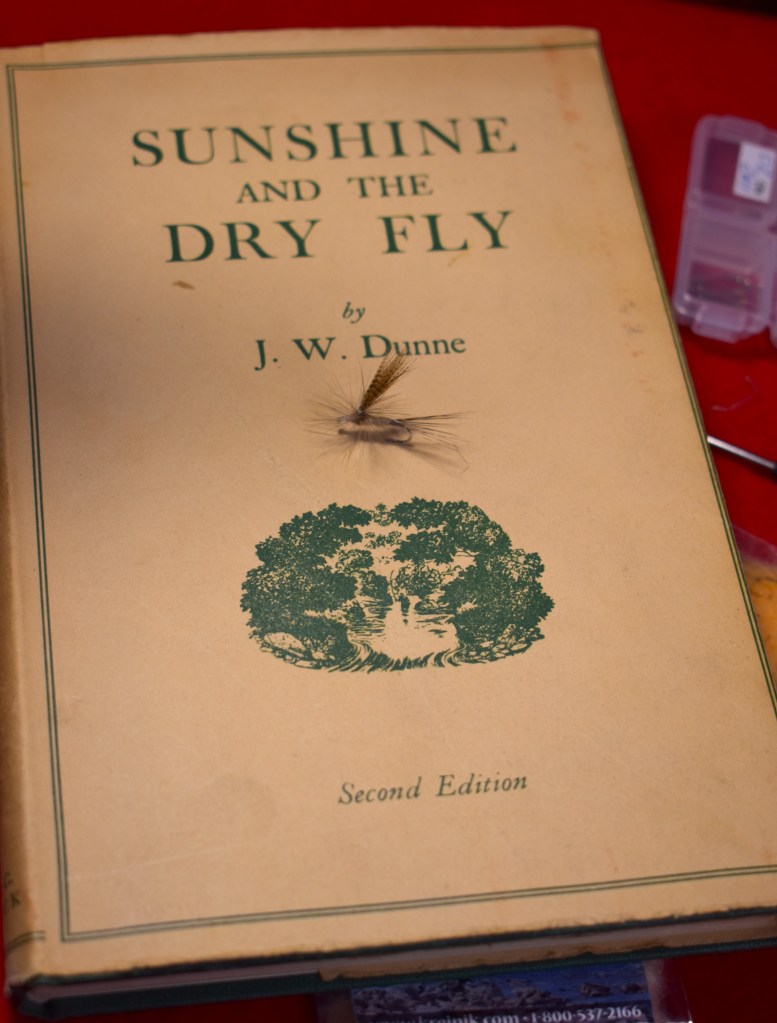
I feel fortunate to be able to acquire this little book and learn of Mr. Dunne’s work as I do to read and observe the work of Theodore Gordon and other Catskill dry fly pioneers. The history and literature of fly fishing are tremendous resources for the fullest enjoyment of our fly tying and fishing!
 Bright Waters Catskill
This is an outstanding post! An amateur can learn a lot from one like this.
LikeLike