

We always think we have enough layers, and I was certain of it this time. UA Cold gear top and bottom, poly fleece hoodies and fleece lined chinos, insulated jacket and waders – certainly enough to stay comfortable on a 52 degree day. On the drive home my vehicle thermometer recorded 54 degrees, so the day was warmer than expected to boot, but I was as cold as the grave.
I will admit there was an inner glow.
Trout hunting is my favorite activity, so a cold spring day that featured olives, Blue Quills and Hendricksons in regular doses fits right in with my plans.

I arrived at my destination early to find flies on the water. A trout or two rose in front of me as I selected a dry fly and checked my leader. The chill of the river took care of the warmth gained from my hike almost immediately, but my concentration was focused on finding just the right rise forms as the afternoon played out.
The flies came in fits and starts, first some Quills, followed closely by early Hendricksons. So closely in fact that I had to cut off my Blue Quill after half a dozen casts and affix a Hendrickson. Let the hunt begin.
I started working to those riseforms I liked the looks of that appeared closest to my position, and it wasn’t long before I had an energetic taker. That trout ran, pulled and twisted with everything he had! There is a subtle difference between strength on the end of your line, and power. When he finally gave up enough for me to get him in the net, that fifteen-inch brownie still had some vigor remaining. Clean, cold, well aerated water and plenty of bugs to eat brings out the best in our Catskill wild trout and makes them fight like they are much larger than they are. Later on, I would meet his twin.
After working the nearby rises, reduced by all of the cavorting that first fish had done in their midst, I began to reach out to the most promising, solitary bulges in the current. I got fooled by one of those subtle riseforms though, and brought a feisty ten incher to hand as a result. Time to get more serious…
I eased out into the run as I watched a soft rise downstream, convinced this was no ten-incher playing masquerade. Studying riseforms may not be an exact science, but it works far more often than it doesn’t when hunting good fish.
That one turned out to be exactly what I believed it to be, with that electric feeling of power as the little Hardy began to wail!
As the afternoon flowed by, the mayflies continued in variable little spurts of activity. During what passed for a brief shower, the surface was suddenly filled with tiny olives, allowing just enough time to change flies and make a few casts before the sun peeked out and calmed all activity for a while. When the clouds covered the brightness, the Hendricksons returned to the drift.
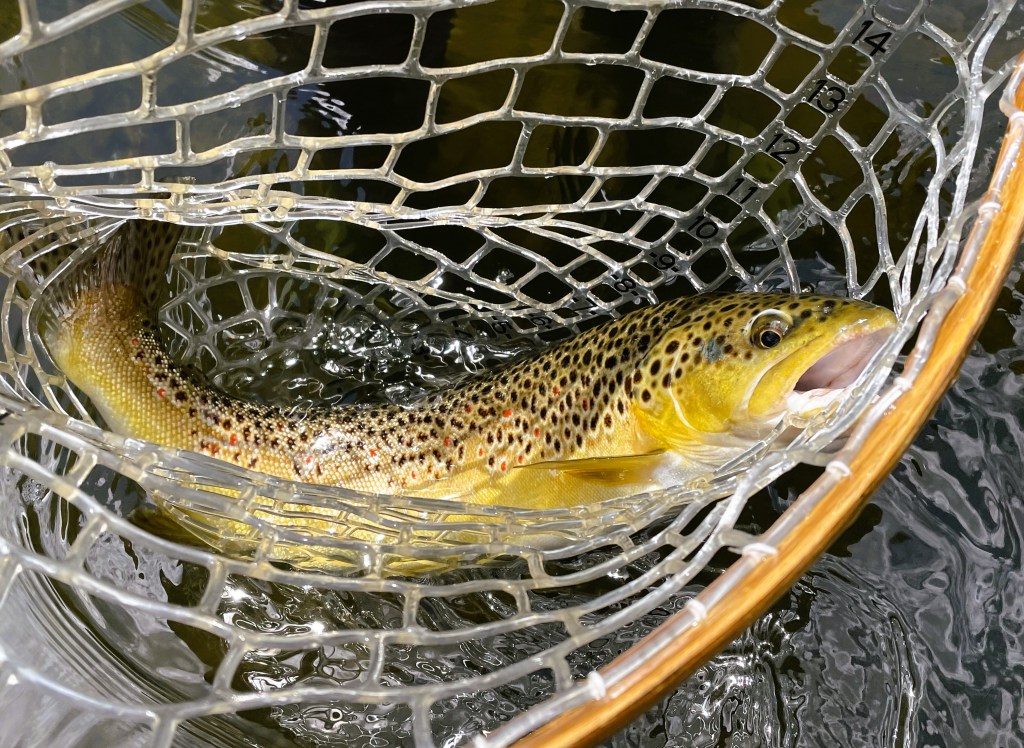
The largest brown of the day took one of them: speed, power, electricity – everything you could want. It took a serious effort to get him into the net, flanks heaving and quivering with the life of the river. Beautiful!
And then there was, the unobtainable. I had seen the rise from a distance, judged the river’s flow and the depth for an approach, and worked as close as possible. It was a long cast, out near the limits of my capabilities with the tackle in hand, and it had to deliver a soft, seamless presentation in that protected flatwater. I got my fly boxes wet again, trying to get those last few inches. Though mostly rising with a big, soft ring, he rolled a bit once or twice, just to make it absolutely clear that he was the king, and he wasn’t leaving the palace.
There was one pitch: my fly alighted way out there, right next to a drifting dun. My eyes picked them both up simultaneously, and they drifted side by side. I felt confident that I was tracking my fly, so much so that I stayed my hand when he rolled and the other vanished, watched it drift on past the disturbance. When I began to retrieve my line for another cast, the fly I had been watching didn’t move.
With the post-hatch calm settling around me, I began my hike out. In the tailout of a pool I saw the rings, Hendrickson duns were still on the water there. Perhaps my 100-Year Dun will have a chance at some redemption I thought.
It is mentally difficult to stalk a wide, shallow flat tailout in the waning moments of a hatch. Haste pushes water and ends the game, too much time, and the duns may be exhausted and the rises stop. There looked to be multiple trout at work, moving though, so impossible to tell how many. Two at least I figured, though irrelevant, as the chance would be for only one.
I made it into casting position, checked the tippet and the knot, then waited for a trout to settle down, to rise in the same position for a second time. One cast, then two. A pause to see where that cruiser wants to rise next. Cast three, and quiet again. Swing the fly well out from their taking area and wait. I fished them carefully for a few minutes, checking my own urgency. It will happen if you let it, if it is meant to…
The fly landed gently and drifted four feet before it disappeared in that wide, soft ring. As the rod bowed deeply he exploded into the air, the reel shrieking. Boring hard for the nearest tipping sheering cover, I laid the rod down and turned him just short of disaster. It was a long, hard fight, though eventually the magic turned it my way. He was bronze and golden, iridescent even in the muted light, as I slipped the fly from his jaw and cradled him back into the peace and beauty of the river.
Walking out got the blood flowing in parts of my legs at least, and the smile warmed me along with that inner glow. A good day, yes, a very good day. Cold? Well, yes, I guess it was.
 Bright Waters Catskill