

It is the sixteenth day of May here in Crooked Eddy and my porch thermometer reads 34 degrees. Though I am still running the furnace overnight, and paying the ever-growing gas bill it brings, such mornings are a blessing for our freestone rivers. The forecast high for Hancock, New York today is 76. The sunshine that affects that forty-two degree rise works on the flowing waters too, so the cold nights are buffer and balm. I have been told a significant run of dry weather is expected, and the evening chill will remain most welcome.
I fished yesterday at a place I have not visited for a while, one that tends to awaken for the season in the middle of May. Most of that fishing involved three hours of sitting on a riverbank and scanning the windswept reaches of the river for some sign of the mayflies I anticipate at this season. Though our hatches seem to be just about level with an early to normal spring progression, I saw nothing but a handful of the inexplicably tiny shadfly caddis, and nary a rise.
I walked out around half past two, stretched my legs and ate a snack with a fresh, cold bottle of water, then decided to take another look at the river. Walking back down, I stopped at an overlook and saw something completely unexpected, a trout’s rise. I backed away, cut down river through the bushes, and emerged below a fallen tree. The rise had been upstream of the obstruction, so my plan was to stalk up close to it to allow an upstream cast, one that would be short enough I would have some chance if this turned out to be a big bruiser of a trout determined to dive into the fallen tree.
When I reached that position, I cast a shad caddis to no avail, even after the rise was repeated. It was at that point that I witnessed another unexpected development. Just after the second rise, a bug tumbled through the roily surface film: it was a Hendrickson.
I clipped my caddis and selected a well-used A.I Hendrickson 100-Year Dun from my vest, one of the flies that had treated me so well during this year’s hatch, more than two weeks ago. You can guess the rest: a couple of casts, a rise to the fly, and a hooked trout. Brought to hand, I displayed my trophy across the width of my palm, four inches of quivering, wild brownie! I couldn’t help but chuckle to myself. After all, I had spotted the rise, stalked into position, identified the hatch, and made the perfect presentation to ensure success, exactly as planned. This would not be a fishless day, at least not technically.
I walked back upstream, taking a last look at the river as the winds swirled, still laughing to myself about my “luck” at finding a rising fish to save a fishless day. I was enjoying my final moments on the river when I saw a rise at the tail of a broad pool. A trout seemed to be gliding about the tailout, picking off stray Hendricksons before they tumbled over the lip of the pool; or were there two? It can be hard to tell when trout are moving about like that, but there seemed to be a difference in the rise forms, one much bolder than the other.
That particular location is not back cast friendly, so I had no choice but to ease into the water and try to get closer to the rises while wading away from them. Luckily the river level was low enough that I was able to ease into a reasonable casting position without swimming. I was carrying a rod with a double tapered five line, a re-creation of a Payne 102H that is as close as I will ever get to owning a rod by the man considered the greatest bamboo rodmaker of all time. I did get to cast the real thing last year, though not side by side with my copy, and I finally can say that it’s feel and casting ability seem favorably close to the real thing. I Have always liked that rod, and I knew it well enough to be confident it would shoot the DT line so that I could cast the long line required with the shorter back cast available.
I made several attempts to put my fly in the path of that moving target and, at the end of one lovely long drift down the glide, he bulged the flat surface and took it cleanly. The fish shot away toward the far bank and vaulted into the air, leaving me to feather all of the slack line retrieved during the drift in a hurry. When he turned though, still short of my being able to get him on the reel, he came at me rapidly. More wild stripping and hand control succeeded, and I finally got him on the reel where he could strike up that classic, vintage Hardy chorus.
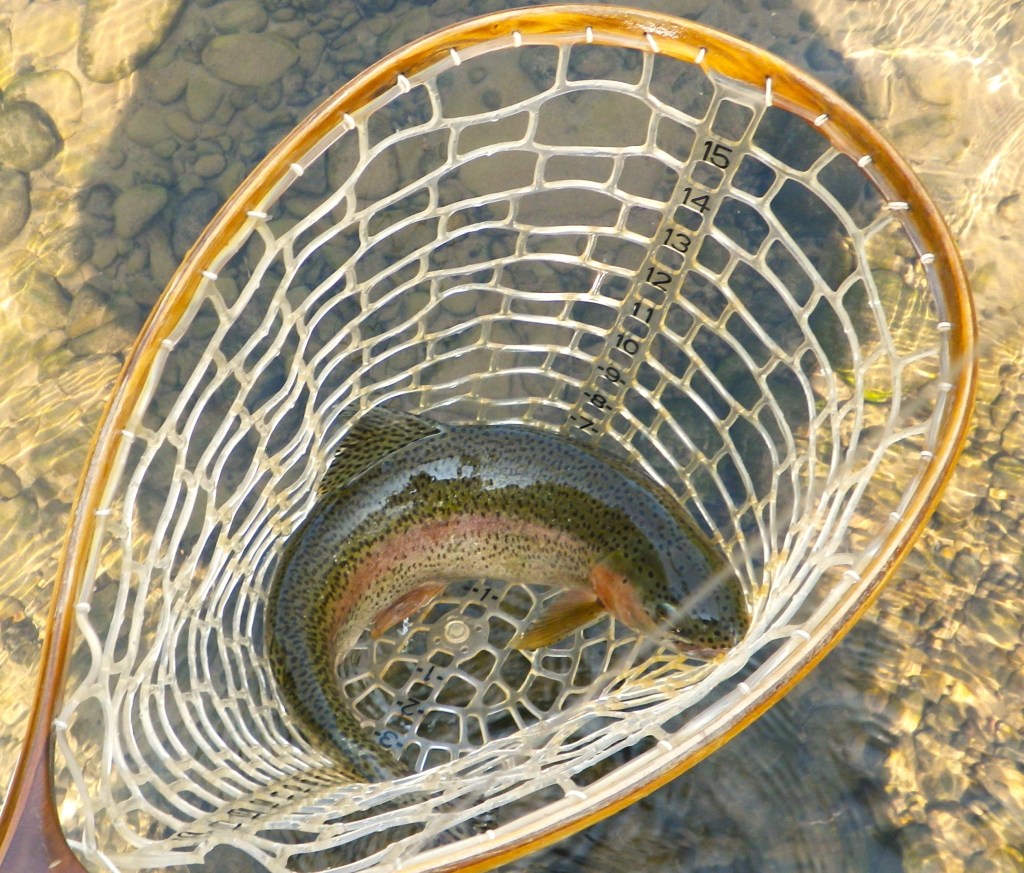
Your average Delaware rainbow is a hard fighting fish, and this fellow was well above average, but I brought him to net thanks to the grace of split bamboo. Twenty-one inches measured, with a wide flank that gave him plenty of purchase against the current in a fight, I dared lift him from the water for only a quick snapshot in the net, then sent him on his way.
As I enjoyed the grin on my windburned face and stood watching that glide across the tailout, the other rise appeared again; so there are two of them feeding.
There weren’t a lot of flies out there, but every once in a while that second roving trout would find one, just as he eventually found my A.I. Hendrickson. Though smaller than that spectacular bow, this one still gave his all against the pull of my arc of cane. Though I had suspected another rainbow, this was a brown trout, not big, but a quality fish of about seventeen inches. I slipped the A.I. from his mandible gently and offered my thanks as he shot away.
Sometimes, patience is rewarded.
 Bright Waters Catskill