

This fourth week of May is closing out in fine style. In fact, one could say it has been vintage Catskills. I have enjoyed a couple of days fishing with two good friends, the trout and the elements cooperating to show us a good time.
Mike Saylor and I were expecting calmer winds yesterday afternoon, as well as more crowded fishing conditions. We found the tables turned though, having the selected reach of the West Branch nearly to ourselves and the winds strong and steady straight downstream. Mother Nature insists we pay our dues sometimes.
The caddis hatch that provided my friends and I with some nice technical dry fly fishing was quite sparse yesterday. Coupled with the wind rippled surface conditions, that meant that the few trout that did show themselves weren’t rising regularly. In fact, most seemed to be taking just subsurface.
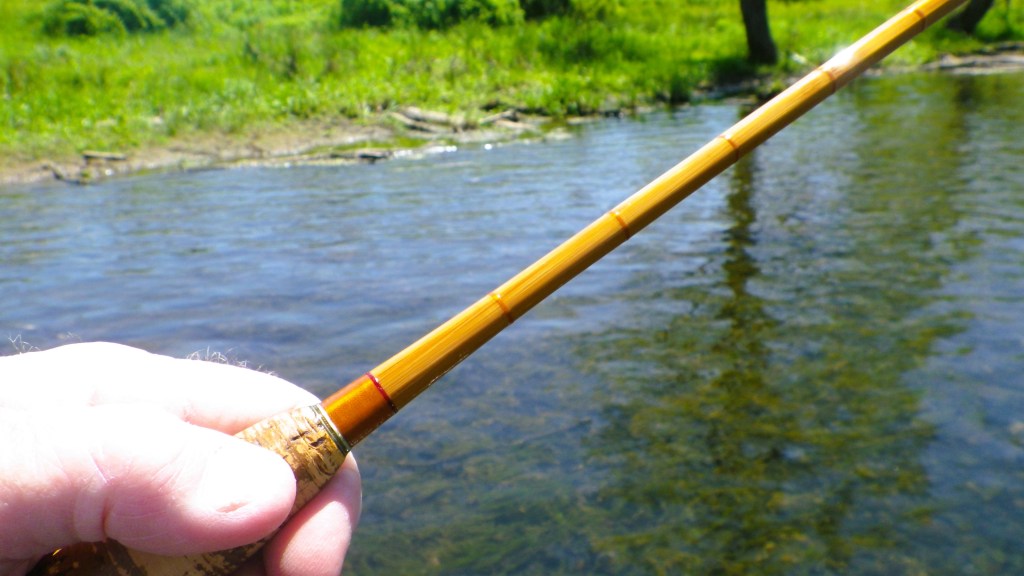
Expecting calm winds of course, I had chosen to make this a vintage bamboo day. Armed with a classic old Catskill rod and one of my oldest Hardy Perfects.
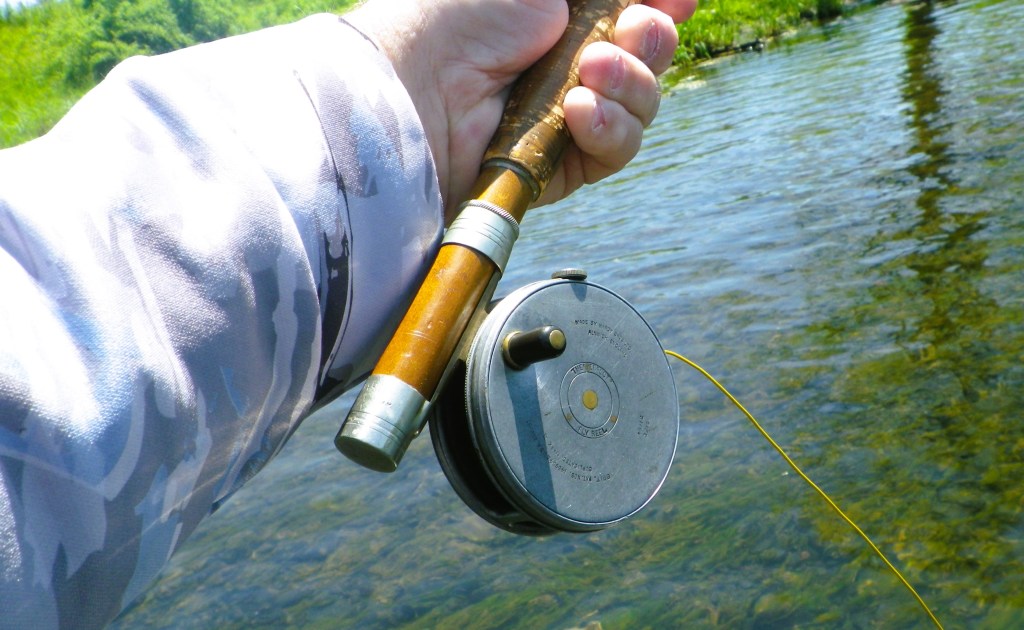
Some will maintain that you can’t fish such tackle in windy conditions, that you need stiff, frighteningly unforgiving graphite rods and overweighted fly lines. Hogwash! Did anglers stop fishing in the 1930’s and 1940’s when the wind blew? Of course, they didn’t. One of the wonderful subtleties of bamboo is it’s sense of touch and control!
Fishing the flats we had chosen required some longer casts and using the tackle to take best advantage of that control. I find it best to fish with the wind under these circumstances, that on this day meant approaching the trout from upstream and across. Contrary to the modern, more power theory, I slow down my rhythm and allow an extra tenth of a second or so for my back cast. The wind helped to drive the downstream cast, and all that was required to put the slack that wind removed from my leader back into play was a very subtle reverse twitch of the rod tip inches before the fly touched down.
Regardless of how nicely that classic tackle performed under tough conditions, the trout were particularly difficult with just a handful of windblown and waterlogged caddis to interest them. The fact is, I didn’t take a fish on my go to caddis pattern that had been golden on the previous days.
The saving grace was the fairly short duration hatch of Hendricksons. Since the trout weren’t rising regularly, I changed my tactics and covered more river, stalking slowly. Before I noticed any mayflies on the water, I spotted a single heavy rise across the river. As the afternoon warmed, the winds grew stronger, gusting at intervals; the Red Gods hard at work to stifle our efforts.
When I reached a casting position above that heavy riseform I had stalked, I tried my caddis, since I still had not seen a mayfly. If that trout was still holding in that lie, he wasn’t having any caddisflies. I figured he might have blasted an early mayfly, so I knotted a worn, well used A.I Hendrickson to my 5X tippet. I smoothed some floatant into the shaggy fur blend body and worked the bunched-up hackle fibers around the base of the canted wing so the fly would sit correctly on the water. Satisfied that the fly had one more fish in it, I waited for the gusts to calm a bit.
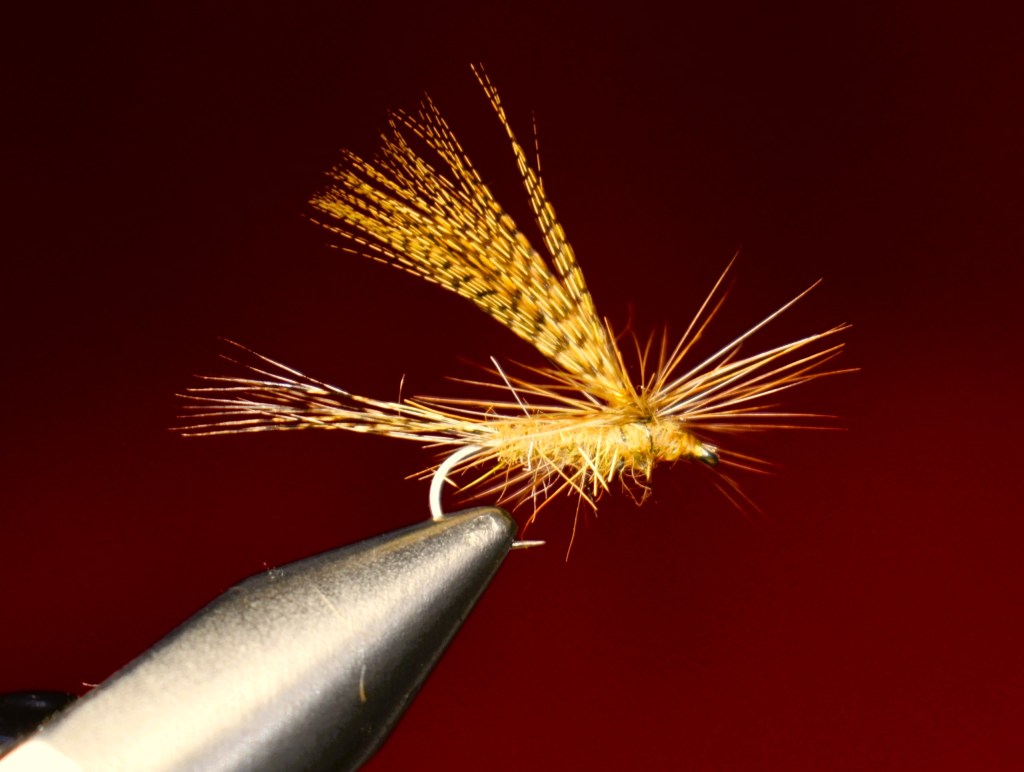
I made one cast, between the gusts, and placed the fly in the perfect line of drift, parallel to a bubble line of current trailing from a submerged rock. The trout took it, I raised that lovely old rod, and all hell broke loose!
That fish made a hard surge and took off downstream trying to spool my ninety-year-old Perfect! God I love that sound, but I began to wonder if he was going to stop. My mind flashed: Rainbow? If he is he’s headed all the way down to Hancock! Damn, fish! He took a breath and I lowered the rod, pointed it at him to use the butt to apply pressure. I got three or four turns of the reel handle and he was off again.
I kept fighting him like that, the rod down low to the water and pointed his way until he checked his run, and then I’d reel when he grudgingly came my way. Sometimes he would just pull and turn his flank into the current, so I would roll the reel up to even the strain on the eighty-year-old bamboo. It was a long battle, the cold, oxygenated water had that trout at his best, and he gave it all. When I finally got a look at him, I was surprised he wasn’t three feet long with all the power he had displayed.
In the meshes at last, he lined up to the 12 and 8 marks on the net bag, twenty inches on the nose. He was a brownie, fat and thick bodied from gills to tail, and I slipped him right back into that cold flow once I twisted the Hendrickson from his lip. Yea, vintage Catskills!
 Bright Waters Catskill