
Angling for the wild trout of the Catskills is always a challenge. Their beauty and wildness, and that challenge, are what make the experience magical!
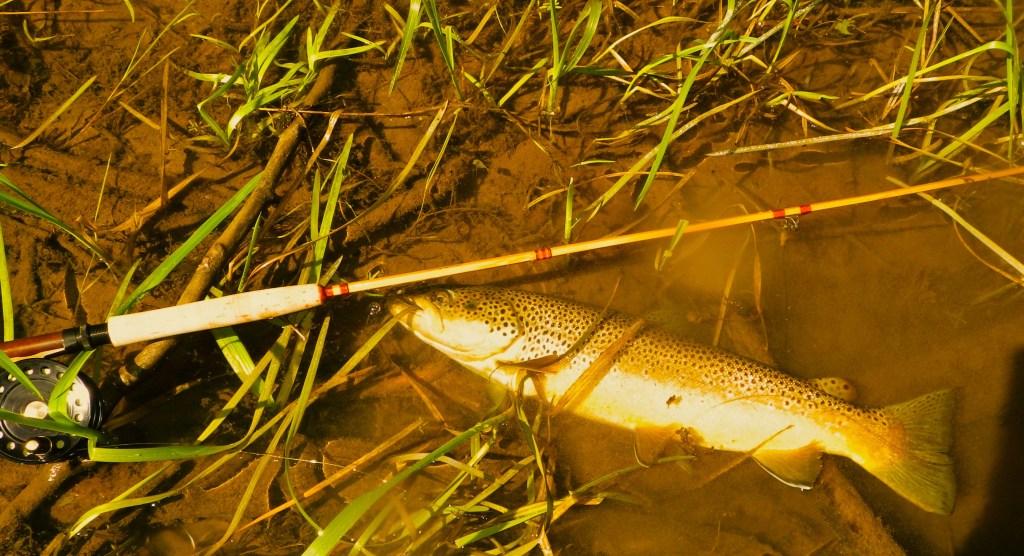
There are trout that truly demand you earn the right to fool them with a dry fly. I earned two, well, let’s call it two and a half yesterday, on a hot, sunny, and overly weedy reach of river. The fish I will call the best of the day demanded perfection, accepting nothing less.
He was situated along the riverbank immediately below a submerged branch with current bubbling over and around the remaining twigs. In a foot wide swath of flowing water, there were three very distinct bands of current: bubbling fast, a smooth quick glide path, and ultra slow, turning back upon itself. The trout was not feeding. At best he was taking in a very occasional snack from the procession of sulfur duns dancing down those three bands of current. He took some of them in the middle band of flow, the glide path, and one or two from that far band, the one turning back upon itself and swirling slowly.
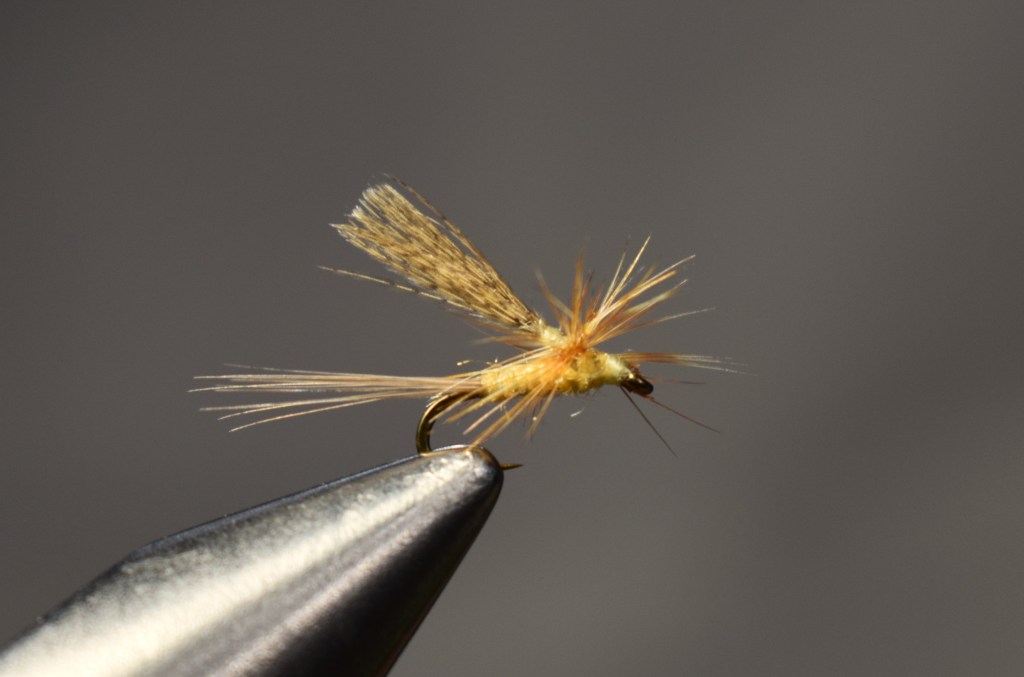
I felt very confident that I had the right fly, for my little Classic Sulfur 100-Year Dun has proven itself time and again. Throughout this tenuous game, I never changed the fly.
Now, no sunny summer day here in the Catskills would be complete without a befuddling breeze. This one was intermittent, but fully capable of playing with the fly and tippet as they reached their target.
I played this game at something on the order of fifty feet, knowing better than to approach too closely. The distance helps keep the fish from spooking, but it allows more time for the breeze to screw with the cast. I consider that a necessary evil, since we all know we cannot catch a trout that isn’t there.
I did not time our engagement, nor did I count casts, but there were a lot of beautiful floats that landed an inch or two short and bounced down that nearest bubbly band of current. None of those ever got a look from Mr. Brown. There were also a good number of casts that danced down the seam between the near and middle bands, and those too proved fruitless. The only snacks this guy entertained had to slip down that glide path unencumbered, and such perfection of float seemed the unachievable goal.
This is a game where a step or two can make a difference, little adjustments of casting position to deal with the breeze or the currents between angler and quarry. I made a lot of those little adjustments too. It can be wonderfully difficult to lay a dry fly on a four-inch-wide band of quick gliding current fifty feet away with the perfect amount of slack in leader and tippet to allow two or three feet of perfect drift before the fast water between whisks the fly away. Without the wavering breeze, I would have managed it with fewer casts, but the result may not have been quite as sweet!
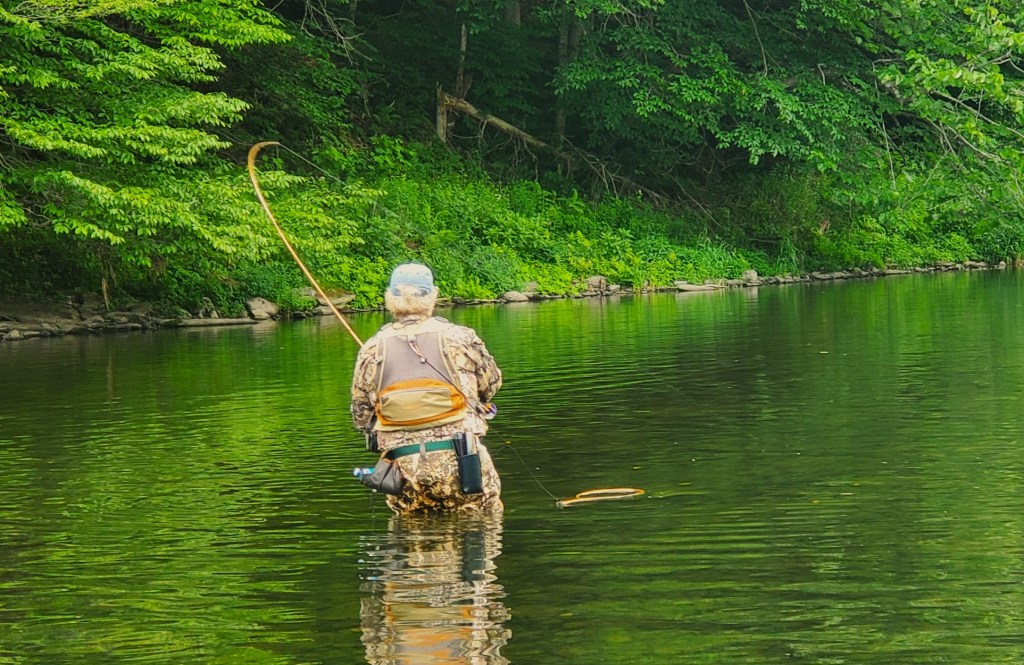
Yes, he took the fly, my Sweetgrass Pent coiled into a deep arch, and I swung him away from the remains of that tree branch. It was one of those slugfests, head shaking, darting and diving for masses of the weeds we know affectionately as “green slime”, and making short, powerful runs countered by the resilience and life of cane. Like all trout over twenty inches in length, this brown made me earn the privilege.
I found another opponent after half an hour or so of stalking down the river, this one likewise hanging close to cover and snacking on the occasional sulfur. No, check that. After a few moments of study, it became clear there were two, one a bit upstream of the other and rising more frequently in the same location. The second held below the first, and he was rising far less frequently and moving around. I recognized that I could show my fly to both of them on a single cast, at least with the right extended drift.
I know it seems greedy to try to fish two fish at the same time, and apparently the Red Gods agree. That is how I managed my half-a-trout for the day.
I made a number of casts, with long, beautiful drifts, and I was justifiably proud. The mover below was impressed, as he ate that little 100-Year Dun and lost his composure completely, rocketing out of the water no less than three times between runs and trips through the thickest beds of green slime he could find. It is hard to judge the size of a trout in the air sixty feet away, but I feel pretty confident that this guy was larger than the one I had already measured in the net. I will never know since the green slime performed even better than the fish and I.
I have long experience with the green slime. It is a tremendously effective hook disgorger contrived by the Red Gods to humble fly fishermen. As the trout runs back and forth through water choked with beds of green slime, the stuff collects on the leader in large gobs. Eventually, those gobs of slime slide down the leader to plaster themselves against the trout’s mouth, and the tiny fly hook. If the trout turns just right into the current, the mass of slime whisks the hook right out of the trout’s jaw. The angler lands a great big glob of slime! Inside, he finds his little dry fly which he spends five minutes pulling slime off of before washing it in the current. The smaller the fly, the more effective the disgorger effect. I could tell you stories of size twenty dries and absolute freight train trout, but I won’t.
I continued stalking down the river once I cleaned off my fly and regained my composure, but I didn’t find another fish on the fin. Eventually though, I saw another rise back upriver; the first in line of the pair I dared to fish to with a single cast.
I have failed to mention that, though there was never a heavy hatch of sulfurs, there were three different sizes of the little yellow mayflies: 16, 18 and 20. I had managed to interest my trout-and-a-half with my size 18 fly, but this trout wouldn’t buy it any more the second time we engaged than he did on the first. Did I change to another size? No, I did not.
I cut off my sulfur and dug a size 15 Grizzly Beetle from my chest pack, knotting it securely to my tippet. He took it on my second cast. This was another good, strong brownie who didn’t appreciate the hook included with his delectable terrestrial snack, and he let me know it. I luckily kept him away from the worst of the slime beds and finally scooped him and his medium sized glob of slime into my net.
I fished another hour or two after that little victory, still regretting the big one that got away, the high flyer that slimed me. I saw one trout rise twice a long way down river, but he wasn’t interested in a bug wearing a hook.
A hot, breezy day, a quintessential Catskill summer day, and yea, two and a half big trout to show for it. Well, the half-a- trout did show himself in the air, right?
 Bright Waters Catskill