

Last night I shared a special dry fly with my friends of the Catskill Fly Tyers Guild, a simple little dry fly I call the CDX. Sharing a favorite fly pattern isn’t generally a big deal, though in a way, this one was, for time has proven it to be one of the best designs I have ever created.
This fly came about some fifteen years ago, and I had kept it a secret, known only to three of my best and most trusted friends. I had liked Craig Matthews well known X Caddis for some time. It is a simple and effective dry fly that sits low on the surface. I used to tie mine with a thinner trailing shuck than the original, something I did most of the time when I used a shuck on any dry fly. I figured that, if the X-Caddis was a good fly, then maybe I could make a caddis pattern that was even better.
Readers here know that I have used CDC feathers throughout my thirty some years as a fly tyer. I didn’t start because it became popular. I started using it the first time I laid eyes on these wispy little feathers because their appearance screamed movement. Real insects move, and our heavily pressured wild trout have learned that lesson well. I set out to design a versatile caddis fly that moved in the currents and moved in the wind.
I wanted to take advantage of the materials used to make my caddis look alive, and I began with the X-Caddis’ trailing shuck. A trailing shuck is great for an emerging insect, but I didn’t want my new caddis to be limited to hatch conditions. I also think that a lot of tyers use far too much material when they add a trailing shuck to a fly. I wanted movement and the sparkle of light reflections, so I used a very small number of Antron yarn fibers and teased them with a pull across my scissors blade. That frays and crinkles the fibers of the yarn giving me a wild and very sparse “bubble tail” – movement, air bubbles and sparkle equal life!
I have a group of dubbing blends that I have prepared over the years to match the caddisflies I have encountered. My general formula calls for a rough fur with short spiky guard hairs, and squirrel is my favorite. I add a small amount of compatibly colored Antron dubbing and then some of the yarn itself, cut very short, say 1/16th of an inch long. I choose and blend various colors to match the insect, ending up with a rough, spiky, sparkly body. These blends were perfect for the new CDX.
Paramount in getting the movement I was after were the wings, and there is no better choice than CDC oiler puffs. If I can get those in a little larger size for caddis in sizes sixteen and up, I am a very happy fly tyer. The puffs have a curvature along their length, and tying in a pair of them side by side with the tips curving away from one another makes an ideal moving caddis wing.
I finished my prototype with a couple of turns of barred dry fly hackle. CDC will get wetted eventually during fishing, and a touch of hackle for a collar provides some floatation as well as a light pattern for the insect’s legs. Once tied, I set out to find out if my new design fished as good as I planned.

I learned that I had something special when I tied a Shadfly CDX to my tippet here in the Catskills. It did not matter whether the trout were taking hatching flies, egg laying flies, or spent caddis, they eagerly accepted the CDX. Many big Catskill browns have fallen for this simple fly, trout that ignored or refused other usually effective caddis patterns.
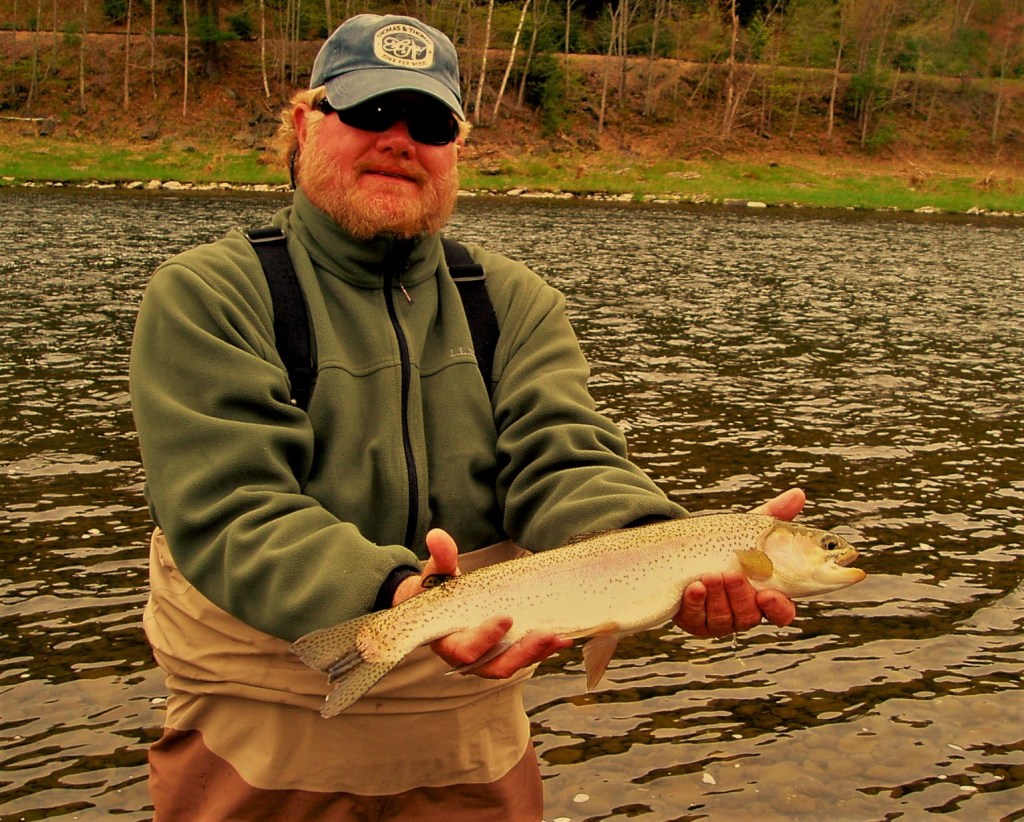
On the first day of summer 2013, I was fishing limestone home waters on Big Spring south of Newville, Pennsylvania. I carried my seven-and-a-half-foot DreamCatcher bamboo rod with a size 18 tan CDX when I saw the rainbow pictured above lying in a deep pocket of crystal-clear water. The trout wasn’t rising, though there were a few small tan caddis flying around. This fish rose and sucked in my CDX on the second cast igniting the fight of my angling life!
It is rare today for me to fish any other caddis pattern during the season. I choose an appropriate CDX to match the flies I observe or the species that is active at that time of year, and I fish it with unfailing confidence. So that is why the fly has been a well-guarded secret for so many years.
You can fish the CDX in flats, riffles or runs, no matter what the caddisflies are doing. If there is a trout out there who is willing to rise to a caddisfly, he’s going to eat a well-presented CDX. I do tie a few of mine with a little extra hackle, three or four turns instead of only two, reserving these for the heaviest water.
During more than three decades of fishing Pennsylvania limestone spring creeks and beautiful Catskill freestoners and tailwaters, I have too often witnessed wild trout taking selectivity to it’s outer limits, taking only the natural caddis or mayflies that moved within their window. Movement within the fly and an optical simulation of movement and thus life are our best weapons when we engage these super-select spotted warriors!
 Bright Waters Catskill