
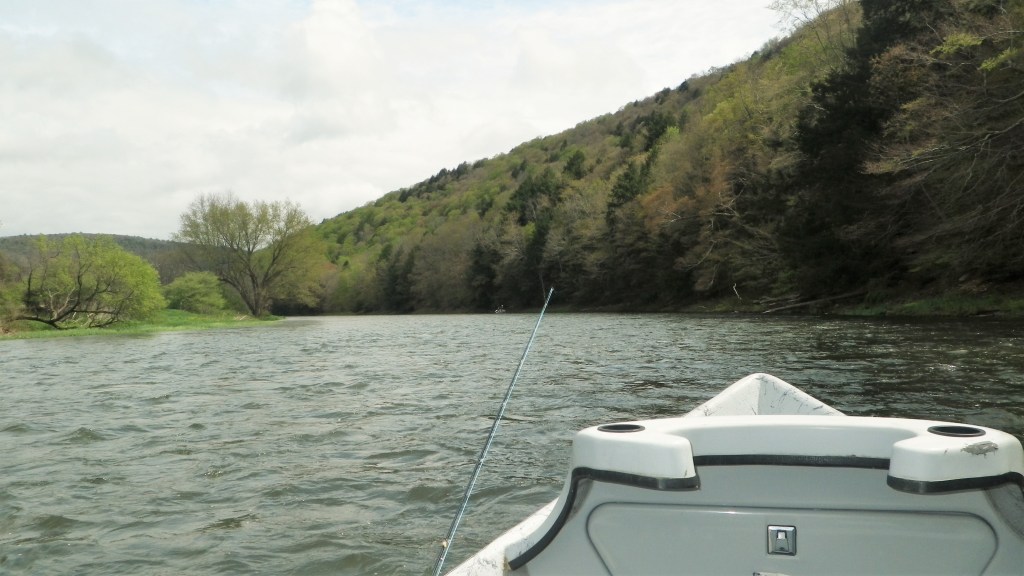
I had heard some testimony over the weekend, people I trusted had fished to hatching Hendricksons on the West Branch last week, despite the cold wind and water. Though I resigned myself to making the first solo float of the season to start the week, the heavy frost and Crooked Eddy’s twenty-six-degree air temperature did not fill me with hope.
I put in a bit later than normal, due to the morning chill, and was surprised to find tiny olives on the water as I began my drift just past eleven. I passed two rising fish during my first mile and a half, the sneaky kind that don’t betray their presence until the boat is next to them, leaving no time to set up and anchor. Those olives would persist more or less throughout the day.
The sun was bright and worked it’s magic on the frost, though I kept my insulated jacket on until mid-afternoon. Here and there I passed another rise, none with sufficient advance warning to set up and fish. What the day failed to offer in fishing, it made up for with the beauty of cobalt blue skies and that sunshine.
There are a couple of places where I expect to find some Hendricksons when I float this river in April, though I tend to find a bevy of drift boats in those same environs. With the downstream winds picking up, some of those areas were too exposed, making it impossible to see any mayflies that might be on the water. I stopped and waited dutifully at each, finding signs of neither mayflies nor old Salmo trutta. I came upon my last, best place with nary a boat in sight. I could scarcely believe it.
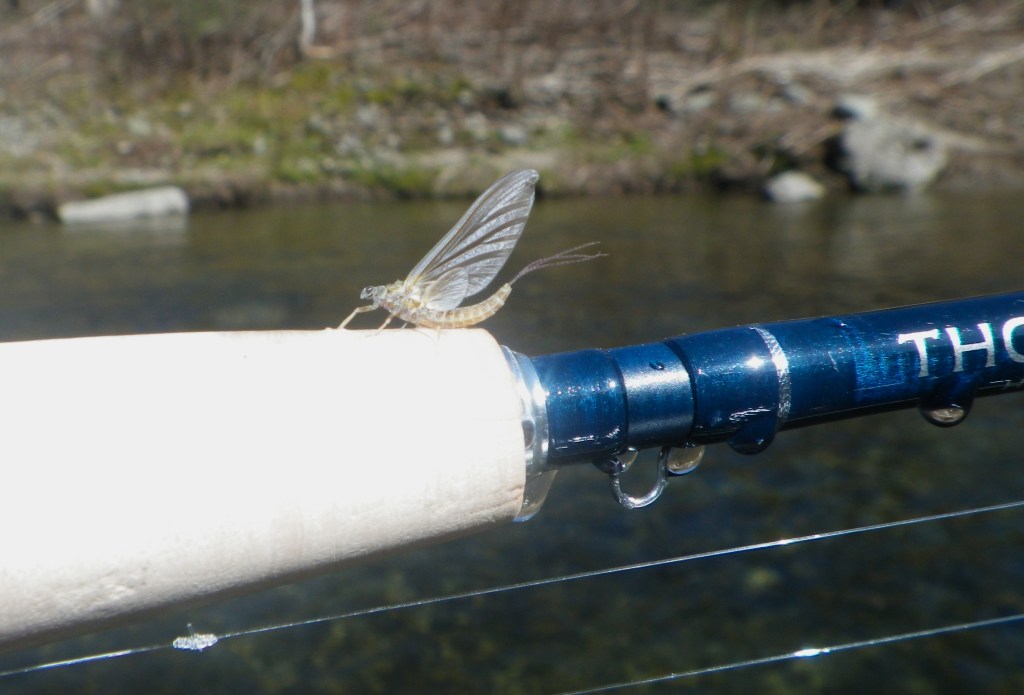
I anchored up at the tail of the riffle and waited, tying one of my size 16 CDC emergers to the 5X tippet. I had tied a handful of these, as well as some CDC sparkle duns with my A.I. Hendrickson dubbing blend, figuring the scraggly body would help the CDC wing mimic a live and struggling dun fighting to emerge amid the cold water and wind. The little fly would prove to be a very good choice!
I had spotted a fish that rose a couple of times tight to the bank, and I eased the anchor off the bottom to let the Hyde slide down current into casting range. When settled into position, I noticed the first larger duns beginning to mix with those ubiquitous olives in the drift lane. The A.I. Emerger looked alive to that brownie, and he bored out into the windblown current as I gave him the steel.
I had forgotten just how hard it can be to coax a good trout to the net from a drift boat, particularly one anchored in strong current. Playing and netting from the boat is ideally a two-man affair. I got him in there eventually, a heavy bodied eighteen incher, my first trout of 2024.
I had to slide down current once more when I spied a couple of suspicious swirls just out of casting range. With a little patience, they evolved into two distinct riseforms. Both of these fish were moving, not far, just sliding around a bankside pocket with a little wooden cover among the rocks. I fluffed the emerger’s wing and started working to the outside fish. It took a few casts to synch my presentation with his movement, before he sucked my floundering fly into his mouth.
Trout number two was even more determined to avoid getting into my boat, though my old Thomas & Thomas won out in the end. At nineteen inches, he would be the best of the day. I stayed put after boating this one, as another had risen not far below that sunken limb.
The emerger had lost some CDC fibers, but I fluffed it up enough to try for number three. The Red Gods seemed to have decided I was having too much fun, so they cranked the wind another notch, adding some gusts timed with some of my back casts. Accuracy and presentation suffer under such conditions, but I kept after that last riser until he too made war to avoid the net. He lost that fight just like his brethren, and I hefted aboard another solid brownie of about the same size.
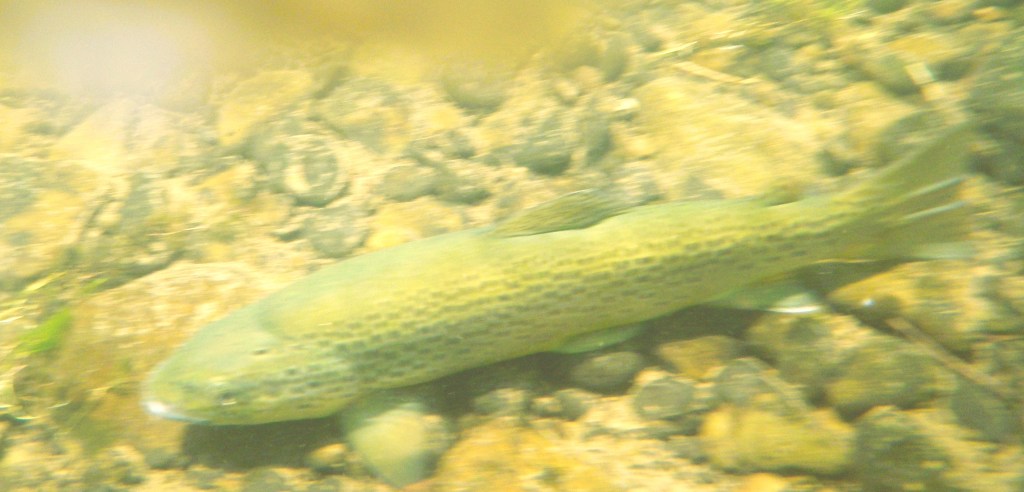
The hatch wasn’t heavy, and it didn’t last as those epic West Branch Hendrickson emergences that haunt my memory did. The next few miles failed to show me any feeders, until I rolled into my traditional last stop. A solid trout rose hard to take a straggling dun, and then the Red Gods put the fans on high. I waited until things calmed down briefly, spotted a sip and offered the Century Dun I had tied on while the wind blew. The fish took the fly quietly, then headed for deeper water in a rush. I netted him a bit easier due to the slower, shallower water I had anchored in. All of these browns looked to be within about an inch of one another, a lovely quartet of hard fighting wild trout to finally get me on the board in 2024!
 Bright Waters Catskill