

Lightning from a cobalt blue sky? Yes, when the magic of bright water and the spirits found in vintage fly tackle are stirred in the same pot!
It is raining now in Crooked Eddy, the downpour gaining strength as I write. Perhaps the thunderstorms predicted for this May morning have spun from that same brew.
I was on my feet early yesterday, shaved and showered and off to the doctor for my regular checkup. Still old, still breathing, and thank God still fishing. Since it was a gloriously bright morning, I decided to wander over to the Beaver Kill early. I was thinking caddis once again, having tied another half-dozen to add to the box. I found the river ultimately quiet, even it’s heavy runs looked more the gentle glide. I didn’t see a bug. I did walk several hundred yards of riffled water, sure I would find some little enclave of active insects and the vision of a riser, but it was not to be.
I wandered a bit, settling on another river and readying the Leonard and my Hardy St. George for the hoped-for goal of a rising trout or two. There is something I like about fishing tackle with a history, even though I am not privy to the details. My Leonard is a Model 66H, pre-fire to those interested, a rod that dates from the same span of the fifties as I. The St. George is a decade older; the stern hand of experience to keep the youngsters settled down when the games afoot.
I found a very small number of the little shad caddis though it took a while for any corresponding sign of life from the underside of the film. Wild trout are not showy in low water under bright skies. The little trout will make a quick pop and take a caddisfly that is dancing right above his living room, but the older, wiser gentlemen and ladies of the pool remain subdued. Patience, as always, became the order of the day.
I was hoping for some sort of a hatch, spinner fall, anything to change the game as I wiled away the long hours of midday. I had gambled that a few straggling mayflies might appear and give me one chance, and thus that magical repetitive nature of lightning came into play.
My prayers were answered then by the Lady herself, and I found something far more interesting than the once or twice risers scattered about the pool. One very good fish cruising his sanctuary, a lair apart where the mystical currents helped him detect any fraud, established himself in my consciousness and I set about the game in earnest.
My foe was the epitome of the selective trout, and with live and spent caddis and a few small mayflies thrown in, he chose carefully. The challenge with a cruiser is doubled, no, perhaps I should say the challenge is squared in the mathematical sense. He sips an unseen morsel, and the angler casts. When he sips again, he is invariably in a different location, and the cast must be adjusted for new tricks of the currents, always with the knowledge that he likely moved as soon as he took that last insect, and he might have come closer. Line him, even most gently with a bit of leader, and he is gone forever!
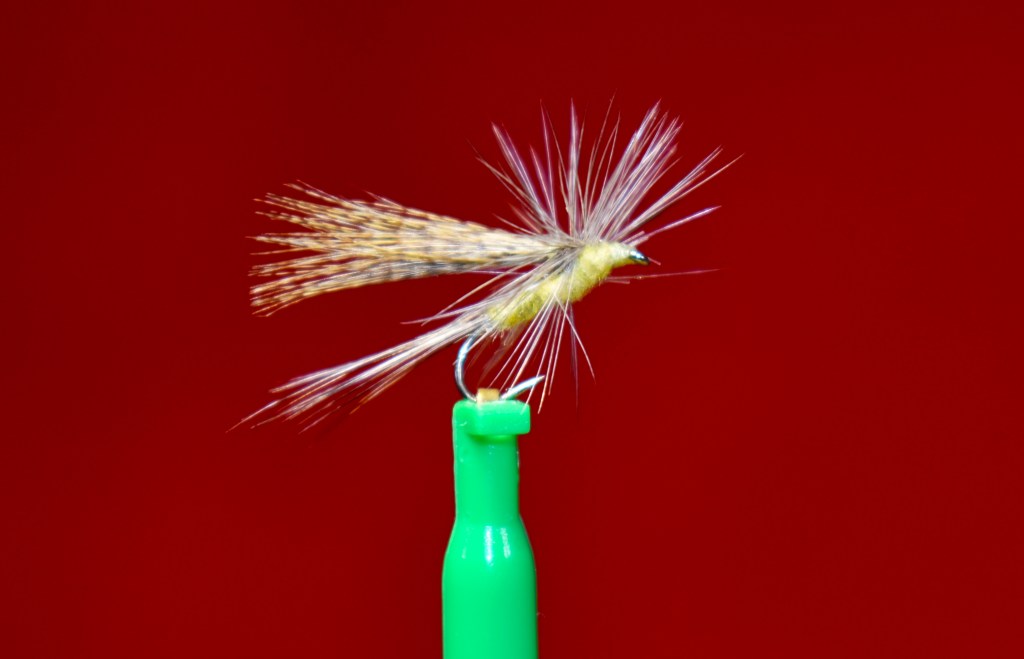
So, this is the game we played. Once I saw enough of the somber-toned Lady H mayflies, my choice of fly was set, and I knotted a fresh 5X tippet and size 16 100-Year Dun.
We had played the game for an hour or thereabouts, the trout casually filling his belly, and I seemingly casting delicately with the old Leonard to somewhere he wasn’t. The tension increases with each cast, each fruitless drift, for the risk of ruination mounts. My thanks to the smoothness of that classic old rod, for it allowed me to put nothing but fly and leader near him as softly as air, so the game could continue.
Patience, and the grace of the Lady, finally turned the game in my favor. Though the hatch wasn’t heavy, there was that little pulse of flies Nature often provides; enough duns to quicken the pace of the feeding fish and cause him to choose a preferred spot to take best advantage. Moving still, but restricted now to a much narrower lane, my cast places my Lady before him once, twice, and a third time…
The lightning struck me as I raised that ancient fly rod and felt the power of my foe, stripping line as fast as possible while he compounded his error by coming out and away from the cover that would have defeated me. Turning, he darted away and coaxed a lovely tune from that long silent 1940’s Hardy.
Wading deep, surrounded by boulders, and tied to a bolt of lightning by a spiderweb, those sensations are the reasons we become anglers for life! I rejoiced with each musical run, turned each rush for cover, and thought I had him once. As I raised the net, he used my own momentum to launch himself back out of the bag and start away anew! He bored hard for the snag that would smash my leader and win his freedom, and I brought every bit of power that rod possessed into one menacing arch. He boiled inches short of freedom and turned.
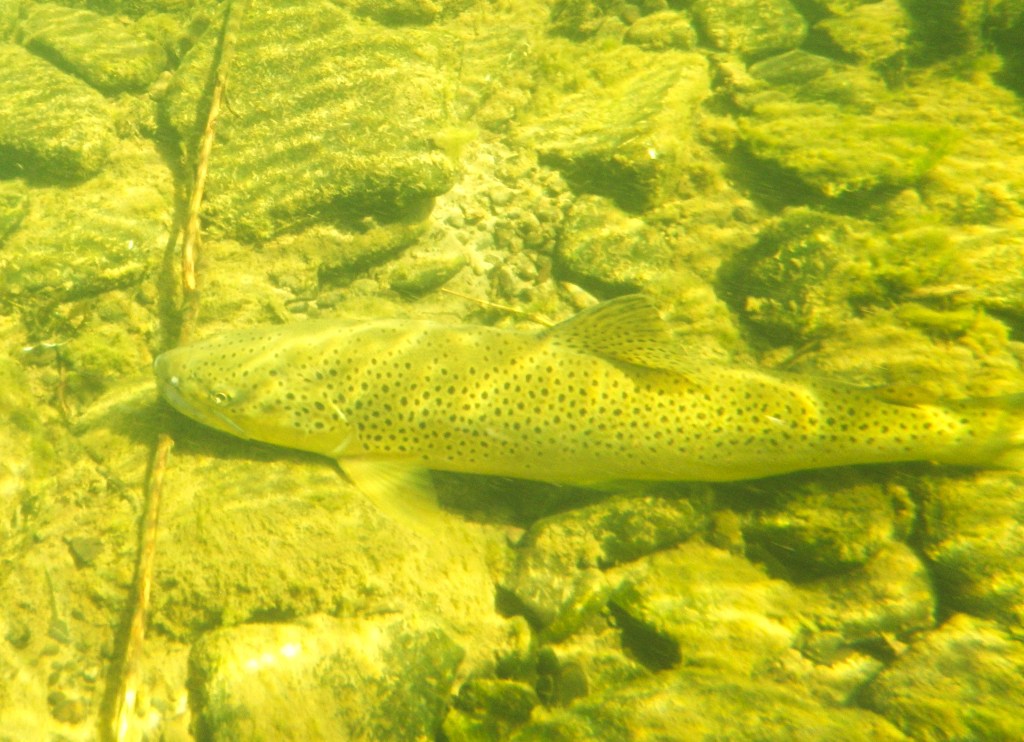
When I drew him close that second time, I made sure he was ready, and netted him securely. The bag sagged with his weight, keeping his flank in the water as I twisted the little fly free. Twenty-five inches lined up along the measuring scale of the net, heavy bodied and gloriously colored, I estimated him to weigh in the six-pound range. I thought of the camera, but the fight had been hard, and low flows in wide pools don’t have the highest oxygen levels even when the water is perfectly cold. I turned him back instead, and he set himself behind a rock there at my feet.
Watching my steps, I backed away in that hip deep water and took out my camera. Submerging it, I chanced my guessed alignment would capture him as he finned slowly there, recovering. I can’t see anything through the little viewfinder when the camera is under water, so I changed my alignment and took a second shot.
After watching him for a few moments, I touched him lightly with my staff, smiling as he darted off toward his sanctuary. I thought then about doing the same.
 Bright Waters Catskill