
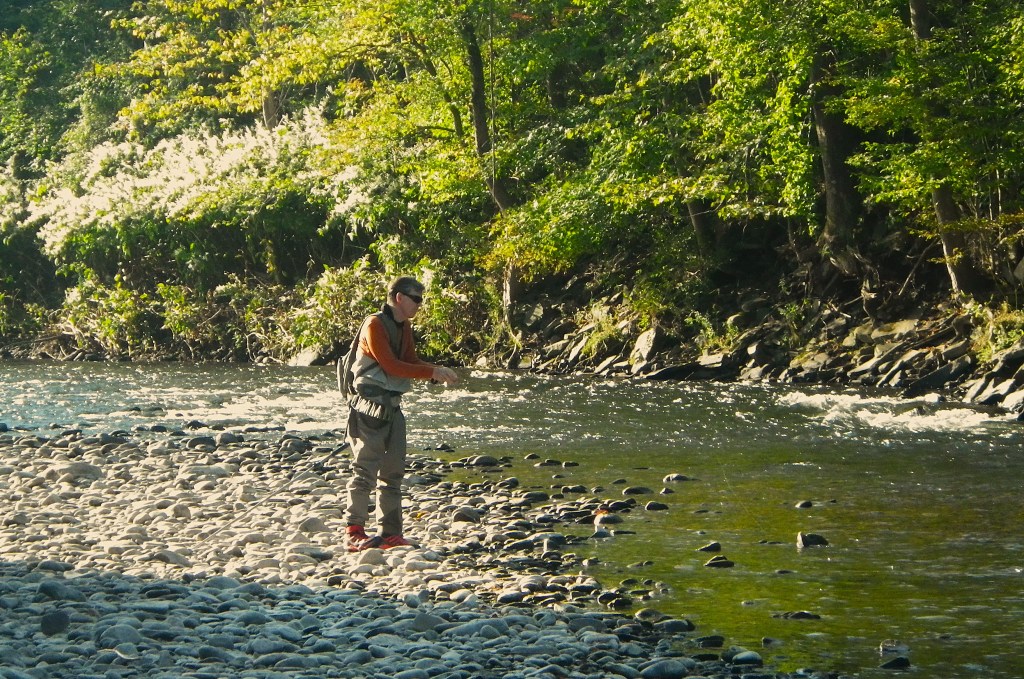
There is nothing so frustrating for a fishing guide as failing to find a taking fish for his “sport”, particularly when that sport is such a fine angler and personable gentleman as Dr. Peer Doering-Arges. NYC disrupted the tailwaters with high releases on Wednesday morning, with Peer arriving that evening. The freestone rivers had warmed after the post-Debby cool down and are frighteningly skinny. As so often occurs in early September, fishing conditions are relatively poor.
Peer’s first visit to the Catskills is tied to a presentation he will be giving at the 30th Catskill Rodmakers Gathering tomorrow morning, and it was necessary to fit in our fishing within his available hours. The rivers, insects and trout failed to cooperate, but we did enjoy each other’s company.
The good doctor has found, tested, used, distributed and is marketing a new species of bamboo for rodmakers. Commonly called Lo o (low-oh) in it’s native Vietnam, Bambusa procera has some interesting properties to recommend it to rodmakers. The culms are larger, typically yielding 16 strips rather than the 10 split from a culm of Arundinaria amabilis, China’s tea stick or Tonkin cane. The nodes are spaced much farther apart too, making it possible to build a nodeless multi piece fly rod without removing nodes and splicing sections. The lack of nodes means reduced work for the maker, as there is no sanding, filing, pressing or staggering of nodes required, and the nodeless strips are much simpler to straighten. Having briefly tried my hand at planing bamboo strips, I believe that will be a somewhat easier and smoother process working a nodeless strip of Lo o.
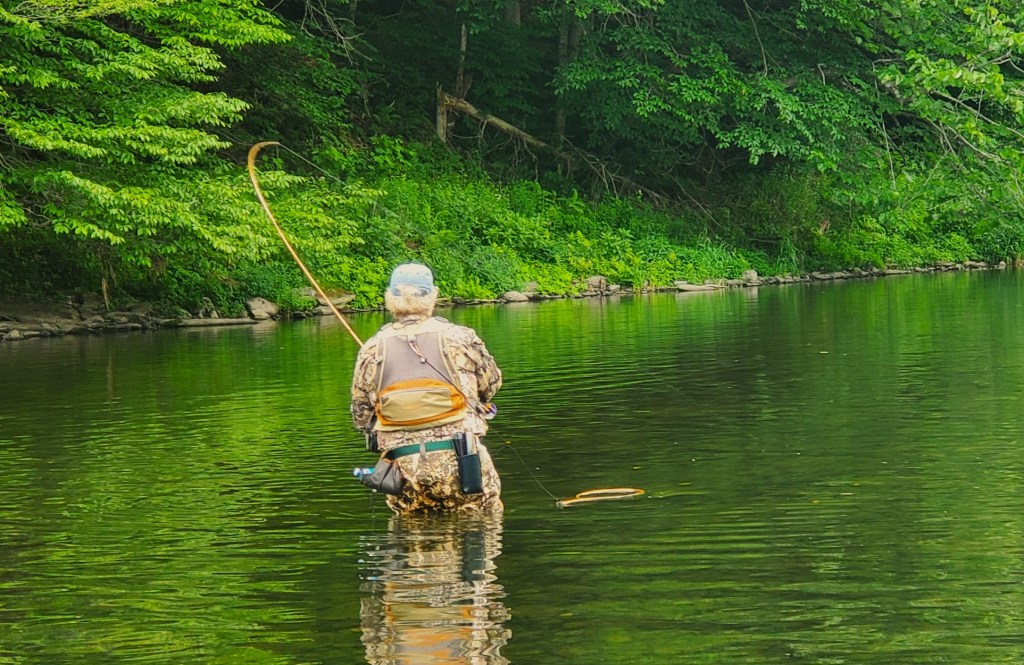
Peer fished a 7-foot three weight Lo o rod yesterday on the Beaver Kill, giving me a chance to cast it on the water. It is light, responsive and casts smoothly and accurately. My friend Tom Smithwick made two identical rods for comparison, also 7-foot rods for number three lines. Tapers, fiberglass ferrules, reel seats and guides are identical, though one rod is made with Tonkin cane and the other Lo o.
The Lo o is noticeably lighter, and the reduced mass is felt in casting the rods side by side. Tom suggests a maker could increase his taper dimension by roughly 4% to create a blank with similar mass and feel. “Or you can simply speed up your power stroke a bit”, he adds.
After casting their rods, I know I would be quite pleased with a 7′ 9″, 3 piece Lo o bamboo rod for a number five line to put through it’s paces during a long Catskill dry fly season!
I hope to catch Peer’s full presentation tomorrow, and there’s a chance we may get a few more hours together on the river before he heads on to his next destination. I would love to find him a couple of our quality-sized wild brownies willing to rise and put a full arch in that new bamboo!
 Bright Waters Catskill