

Watching the weather, for winter seeks to steal a prime opportunity to continue my rod crafting journey! Life and winter weather has altered my schedule more than once already, so I hope today will be the charm. The strips must be beveled, wrapped in binding cord and then heat treated to maximize the resiliency and burnish the color of the Lo o bamboo. If all may be accomplished today, then planing may begin during the next session!
Sixty-six days remain in winter’s allotment, just more than two months until the hope for spring becomes palpable.
I have been studying and questioning during the last few weeks, while waiting for another hands-on session with the cane. I corresponded with my friends Tom Whittle, the designer of the rod taper I will build, and Tom Smithwick, asking about their methods for heat treating bamboo. Through the Classic Flyrod Forum, I also corresponded with two rod makers in Europe who have made rods with Lo o bamboo. Each uses different equipment for their heat-treating ovens, and there is some variation in time and temperature, though fifteen minutes seems to be close to the mark for all. My friend Peer is the man who has studied and marketed this new material, and his apparatus are the most sophisticated, allowing him to monitor the moisture content of the bamboo during the two hours he typically heat-treats his Lo o strips. Peer suggested I maintain a temperature of 356 degrees Fahrenheit for a minimum of fifteen minutes. I will pay close attention to the temperature fluctuations of the heat-treating oven I use, and I expect to treat for about twenty minutes, adjusting that time empirically if the oven varies below 356F.
Friday January 31st with blowing rain in the Catskills. The new beveler seems not to like staying in alignment, cutting one side of the strip more than the other. After various attempts, we retire it and work with the older one-sided beveler. One pass and flip the strip for the other side. A longer operation, but it works just fine! With a couple of hours of work, 26 strips of Lo o bamboo are beveled to 60 degrees, all but the two spares bundled into octagonal sections which will be bound with string and then heat treated tomorrow.
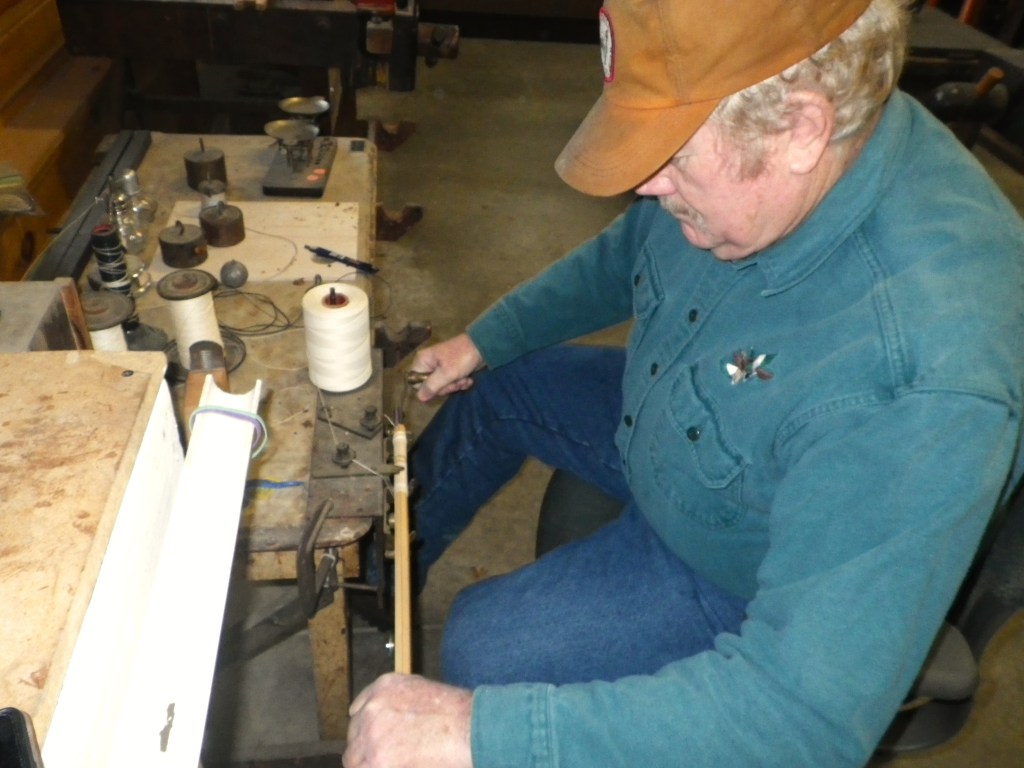
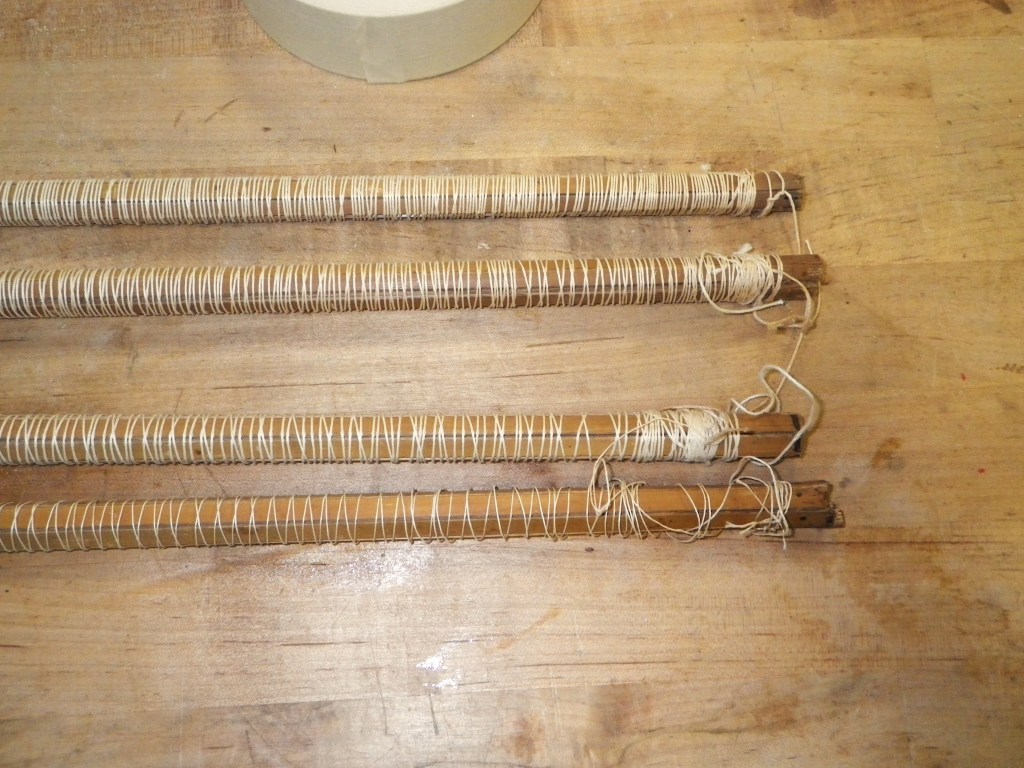
February begins, and I sit down to bind the strips that will become my four rod sections, butt, mid-section and two tips, prior to heat treating them. A cold day, and the steam felt welcome as I removed the end piece of the heat-treating oven to turn the four bound sections end for end. The oven heats unevenly over it’s length, so turning them four times helps to obtain more even treatment. I make some small adjustments in the regimen, continually monitoring and adjusting the thermostat. In the end, the fragrant bamboo sections emerge a warm golden brown, with just a trace of steam as they are removed for the last time…
It is the second day of February, and it is five degrees here in Crooked Eddy. I am headed back to the rod shop today, still basking in the glow of this significant step in my personal history, gratefully realized within the confines of the living history of American fly fishing here in the Catskills. This morning the preparatory work lies behind, and the in-depth crafting of a bamboo fly rod will truly begin.
Today I will fix a beveled, heat-treated strip of cane in the planing form and begin the longest mile of the process: hand planing twenty-four strips to the complex taper designed by my friend Tom Whittle. This work will test the endurance of my old hands, my arthritic neck and shoulder. Pain will determine how much I will accomplish each day of hand-planing the bamboo.
Set up and adjustment take some time, learning to set the planing form and read the depth gage before I am ready to begin the heart of my journey. First, I add 0.020″ to the finished taper dimensions of my butt strips. Planing for the first time will be a learning experience, much of it tactile, so it makes sense to plane the strips down to this oversize dimension as a beginning. Once the butt is done, I will move on to the mid-section and tips, planing them oversize as well.
The Lo o bamboo planes smoothly, there being no nodes to vary the resistance. As I work my way down a few thousandths of an inch at a stroke, the curls come off in long spirals. Two passes with the plane and then turn the strip…
Despite the smoothness of the plane passes, it seems easy to get a tiny nick in the strip, something I do not feel occur as the stroke is made. The Lo o tends to ravel in thin strings, and JA considers my dilemma, noting that this bamboo is much stringier than Tonkin. I will contact my friends Tom and Peer and ask them about this, and if there is a solution to the problem, or if this is simply my lack of experience.
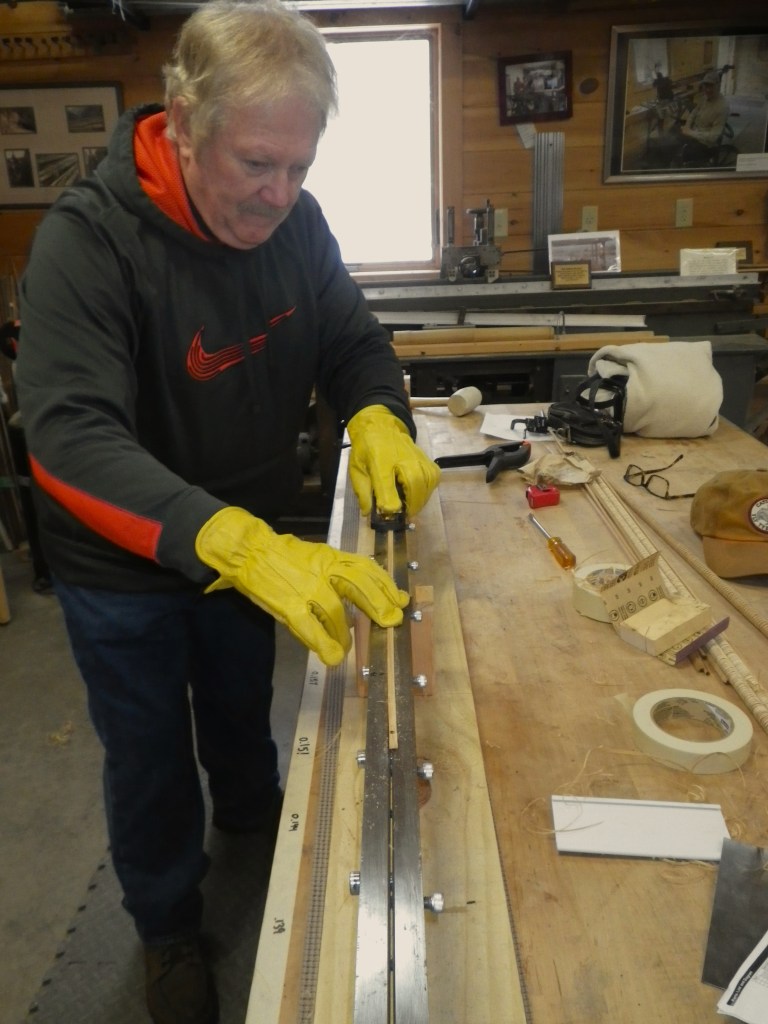
Planing to the 0.020″ oversize dimension now makes a great deal of sense, for it allows me to investigate my difficulty and find a solution. Mistakes are inevitable, the opportunity to learn from and repair them sublime!
Today I planed four strips of the two dozen required for my three-piece, two tip flyrod. This will be a long journey…
 Bright Waters Catskill