
Indeed, that is the single question that taunts fly fishers and fly tyers. Many have theorized for answers for at least the past couple of centuries, and many believe we have found those answers. The catch is, and always will be that none of us know!
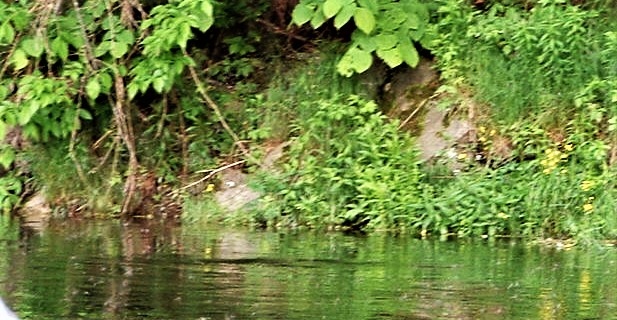
I wish I had had a steady platform to take that photo, for it’s sharpness of focus and minute detail suffers from the motion of the drift boat in the current. Those little grayish blurs are tiny olive mayflies you see, perhaps size 20 or 22. There is just enough clarity to tell that some are sitting tall with their wings upright, while others are in various postures, some struggling to remain afloat, others possibly crippled by incomplete emergence. There is no way to tell though, which one sparked the soft, dimpling rise of a large wild brown trout there in the margins of the West Branch Delaware.
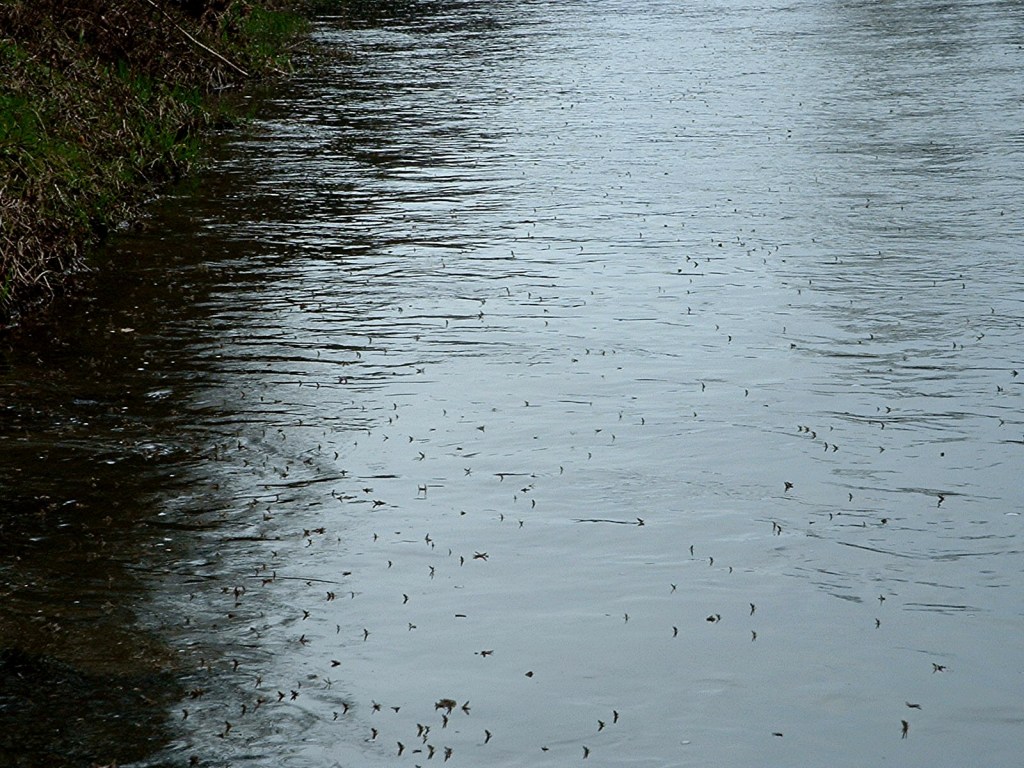
The second shot is older, and the camera of lesser quality, but I was wading and thus standing steadily along the riverbank. The Hendricksons are considerably larger mayflies too, a size 14, thus it is easier to see that most are floating with their wings upright, but a few are partially submerged and or struggling. These flies are drifting right along the bank. Out further, where the currents are stronger, faster and more variable, there were considerably more flies struggling with their emergence and drift.
The fairly conventional wisdom of selectivity as to which specimens the trout choose to take is based upon logical thinking: the flies that are encumbered or incompletely emerged are more likely to be taken for the trout sense that they cannot escape. I have touched on the recent book of two English chalk stream anglers, Peter Hayes and Don Stazicker who have performed a great deal of work with high speed photography and videography to prove that theory. As much as their body of work supports that conventional belief, even they cannot know what motivates the trout, and that is right at the heart of the magic we seek to immerse ourselves in when we wade into bright water with a fly rod in hand!
Consider the scene of that second photo above, taken on a darker, damp afternoon on the West Branch Delaware. The density of the flies on the water is obvious, and that density continued up and downstream and fully across the river as far as I could see. Thousands of mayflies, whether physically encumbered or not were staying on the surface for long, long drifts of fifty feet or more. No trout rose to meet them. Would not logical thinking demand that such abundance coupled with atmospheric conditions keeping flies drifting upon the surface, produce widespread feeding?
The subsurface fishers were not catching any trout on this afternoon either, and there were plenty of anglers plying various methods. Have you ever spent a day on the West Branch Delaware during the Hendrickson hatch? Solitude is not part of the occasion I assure you. The trout were simply not feeding. Puzzles like this remain, and I for one am very happy that they do, for challenge is the very essence of the game!
Too much emphasis is placed upon the idea of catching every trout in the brook. When was the last time you viewed an advertisement for any fly or tackle item that failed to promise you would “catch more fish”? I fear that mentality causes thousands who try fly fishing to abandon it without ever appreciating the challenge and the magic of bright water.
When I owned and operated a fly shop years ago, I often had a number of opening day trout fishers stop in looking for bait and spinning lures. Among them there were several who loved to brag about catching their limit of trout as quickly as possible and going home early. The saddest thing to me was to hear them teach their kids that this was the goal of trout fishing. I see fly fishers that seem to think the same way these days, and it saddens me.
If you are a newcomer to fly fishing, I hope whoever starts you along the path instructs you in the value of patience and observation and teaches you to appreciate the magic and wonder that is the essence of any activity in Nature. If you happen to walk the opposite bank, and have rushed along every river you have visited and spent a fortune on each new tackle item which claimed to be the answer, I hope that you stop and consider that fishing is not a competition, it is a meditation.
 Bright Waters Catskill
I guess I am an old-timer now too, into my 60’s, but when I go fishing I like to walk and wander the stream for the entire day. Whether I catch one or 25, or even zero, the journey is the always the goal.
LikeLike
Amen!
LikeLike