
-
As Tough As They Get
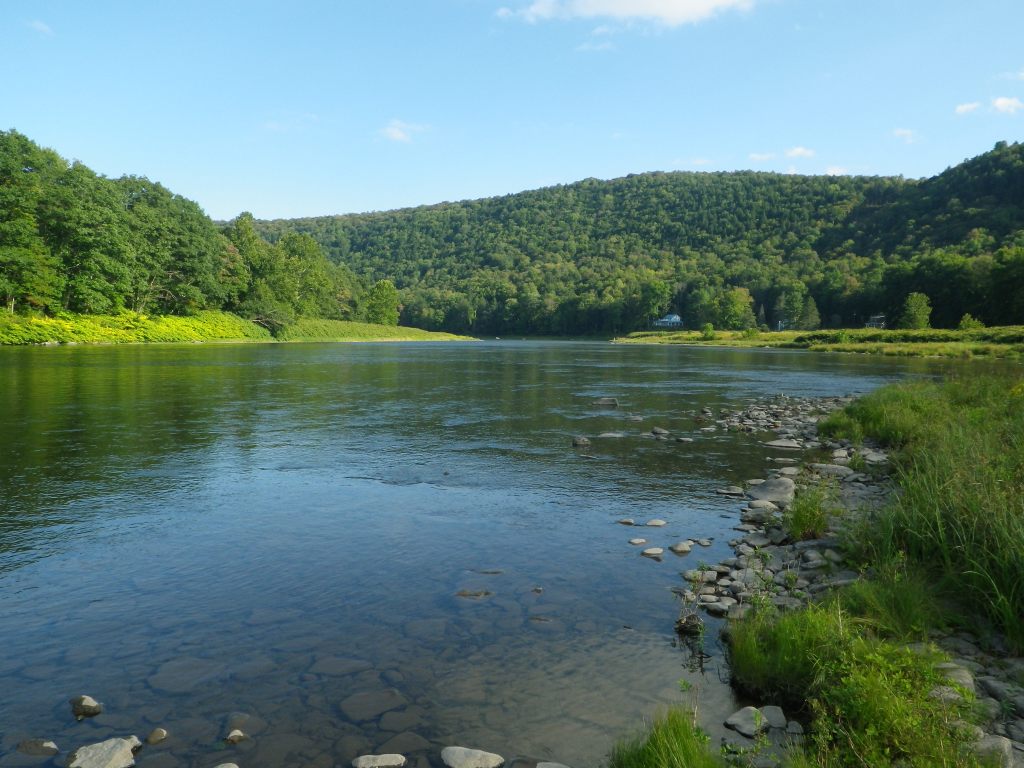
The wide open low water flats of summer. We are still blessed with cool nights and cold water releases, and as such are enjoying a very different kind of August. I have gone back to grabbing a sweatshirt and pants when I arise near five o’clock these recent mornings, and closing the bedroom window overnight. Hot weather is due to return though, and soon we may look back wistfully at these heady days and chilly nights of high summer.
I stalked a favorite summer reach of river yesterday morning, expecting to find some trout sipping tricos. There were none, in fact there seemed to be little or nothing drifting on the misty surface of the water. I took to casting a big terrestrial fly to cover, figuring if the trout weren’t cruising to sample the drift, they would be hunkered down in ambush. I didn’t move a fish.
I lingered half the day, figuring the cooler nights had delayed the trico spinnerfall. The science available tells us that the mating flights occur when the air temperature reaches 69 degrees, and when the sun burned through the haze nigh on eleven AM, I figured the next hour would reveal whether weeks of high flows had displaced the tiny silt dwellers and spoiled that phase of my summer fishing. No tricos appeared, nor anything to bring the trout up and accessible to the dry fly.
I stopped at another pool, planning to spend a couple of hours hunting, and got taken away. There were rises, not many, and nothing grand, just the soft little disturbances of cruising trout taking tiny flies. On occasion, a small mayfly could be seen at a distance, and eventually I was almost able to pluck one from the surface. The wings were typical of a blue winged olive, but the current whisked it from my tentative grasp before I could decipher the body color. Fishing gently with a three weight line, a rising trout seemed to be good for one cast, it’s rises ceasing once that first dry drifted overhead.
Uncatchable trout catch my interest, and there were one or two bulges encountered that led me to believe some larger fish were about, so I remained in the moment and played their game. Though the time slipped away, I wasn’t really cognizant of it, absorbed as I was in solving the riddle of these moving, sipping ghosts beneath the clear water. When a lighter fly or two was added to the drift, a size 20 sulfur was tried and ignored. There simply weren’t many bugs, and the trout I didn’t get a chance to cast to seemed to be good for only one or two rises.
Eventually, one fish broke the mold, rising perhaps half a dozen times while I tried for him. Observation suggested a change, and the 16 ant I replaced the tiny mayfly with was taken on the third drift. The foot long brownie went ballistic with the tug of the rod, and fought it for all he was worth. Still fighting as I brought him to hand, I admired his color and amazing spirit, testament to his wildness, as I picked him up by the fly and twisted it free.
I convinced myself to work the banks for a while after exhausting the opportunities for the ghosting risers in that long line of current, but there was no response to my efforts. I awoke from my reverie when a large creamy colored mayfly fluttered past my staring eyes. There were rises once again, though not to the big, juicy moving mayflies that attracted my attention. Tiny sulfurs had wiggled to the surface, too few to position the trout for methodical fishing, but enough to cause a few to cruise about looking for a light snack.
Immersed in the magic of difficult trout, I let the remainder of the afternoon slip away. The cruisers thwarted my best approach, for they held position for at best two rises, in a pool that demands the slowest, quietest movements. There was one that drew my attention for a while, moving within a table top area just beneath the canopy of a leaning tree, where shade disguised his form. Alternating the tiniest disturbances with more focused rises, I was convinced this was a significantly larger fish. I honestly don’t even recall the fly he finally accepted, captivated as I was by the fervor of the game. I tightened and he frothed the surface with a flurry of head shakes, coming toward me so I could feel only the vibration and not the weight. His performance reminded me of the way a big largemouth bass will poke his head out and shake violently to dislodge a surface plug, and it proved just as effective. Was this the big brown I hoped for? I will never know.
The sulfurs dwindled, and some of the riseforms took on the soft gentle appearance of trout sipping spent flies in the film. One last fly change I promised myself, noticing briefly how the sun lit the riverscape: beautiful. The well worn number twenty rusty spinner I plucked from my fly patch drew the honor.
One trout had held his lie, sipping something unseen from the film while the last of the sulfurs floated by. He had ignored an ant and a couple of different beetles, allowing three or four casts before ceasing, then rising again while my casts were directed elsewhere. The 6X tippet curled in a ball upon the faster current, the gentlest kick of the hand and wrist dropping the fly inches downstream, so the little spinner might drift along the slower seam while the current unraveled the ball of yarn. At the take, another foot long brownie came unglued, darting and twisting against the pull of the rod. I let him have his head, he had been as hard won as any trout twice his size, as tough as they come.
Twisting the fly free with the tip of my forceps, I sent him back to the soothing liquid flow. I looked around, captivated by the beauty and the solitude; the scene took my breath, with golden sunlight gracing everything around me.
Five o’clock, fathoming the significance of the number brought surprise, and I turned to walk slowly toward the river bank and home.
 No comments on As Tough As They Get
-
Catskill Summer Days
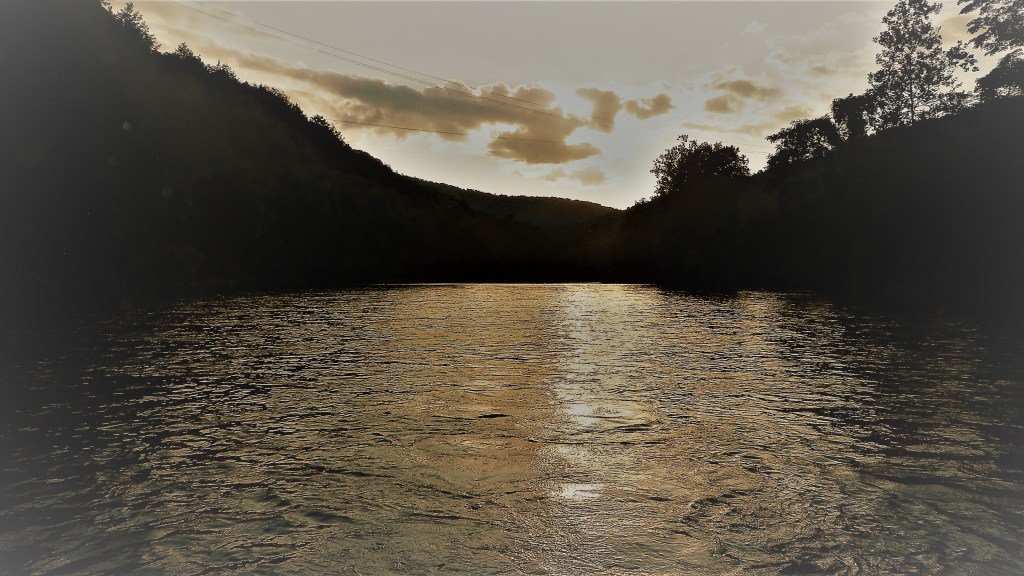
Catskill Summer Glow Time to catch up on the blog, a few moments while the sunrise warms the mountains: August 3rd, and it is forty-seven degrees this morning in Crooked Eddy.
Nature’s two greatest gifts to a summertime mountain trout river are rainfall and cold nights. We have been blessed with both. Of course I am under the opinion that a mountain trout river is one of Nature’s greatest gifts to man!
The Catskill watersheds received just over nine inches of rainfall for the month of July, so much of it that there was no fishing on my calendar for a couple of weeks. Flows are nice and wadable now, and water temperatures very nice on both freestone rivers and tailwaters. Summer is good.
I have been out hunting trout, my favorite activity at any time of year, though the winter months are largely spent dreaming about it.
Perhaps as a result of all the high water, though more likely I believe due to last winter’s low river flows and extended freezing periods, hatches have been as unpredictable as ever. The early mayflies were plentiful, while those from mid May forward have not been. My theory, and that is all any of us have, is that the nymphs had a lot more time in the gravel to grow and mature, and were thus better equipped to survive a difficult winter and the anchor ice I feel certain was a factor. Significant warm weather in March also gave them a chance to catch up on their growth and development before April’s hatching time.
I have seen a lot of fry this season, whether trout fry or baitfish fry I cannot say, and the high water introduces other food organisms into the drift. Nature’s compensations perhaps. The wild trout of our Catskill rivers are heavy and robust, so they have certainly eaten something. Not their own next generation, I hope.
As a dry fly fisherman, I missed the intensity of the hatches through May and June, and the abundance of the tiny sulfurs we associate with July on the tailwaters. High waters brought a great deal of pressure to our rivers. Have you noticed all the drift boats filled with guys with oversize fly rods, big game reels and fighting butts, heaving saltwater sized streamers at the river banks like metronomes?
I often fished streamers back in the Cumberland Valley, but I learned from a very different school of angling. We fished size 8 and 10 Shenk Sculpins and White Minnows with stealth, casting carefully to pinpoint targets with the same light trout rods we used for dry flies. We twitched and drifted those flies, letting the current carry them beneath undercut banks and weedy edges, quietly walking them right into leviathan’s living room. Finesse, and an understanding of how big trout hunted and ambushed prey brought the big boys to the net. I honestly don’t care for the brute force technique that seems to be the rage, driven by an industry that wants only to sell. I don’t like catching a big summer brownie and finding his mouth torn up from some two or three hook monstrosity yanked about with a heavy rod. To each his own I guess, but I wish they would consider the health of the resource.
All of that pressure seems to have made the trout scarce in some areas. They still reside there, but not in their favored lies and cover. You can only invade a man’s home so many times before he picks up and moves.
My style of fishing, of hunting trout, isn’t a numbers game. On any given day I am searching for a big brown or rainbow that I can entice with the dry fly. On a productive day I take one, sometimes two in that hallowed twenty inch and over class. You notice I didn’t say “on a good day”, for they are all good days when I get to be on bright waters fishing. There are certainly any number of good days when I don’t catch a trout.
Yesterday was an excellent day, for I spent it on bright water with my friend JA. We managed a few fish, and got some good laughs at some of their antics. I caught two, the first a sprightly fellow all of five inches long who decided that a terrestrial dragging downstream before my pickup was an interesting meal. That one got laughs throughout the day. I’ll get to the second one in a minute.
Both of us love to catch trout, but more importantly, both of us take the full measure of the day and enjoy it fully, whether trout are part of the equation or not. Simply spending time on these beautiful rivers is enough of a reward to keep us coming back. Yesterday was a wonderful day without trout number two.
As we scanned the river upon our arrival, I pointed out one heavy rise a hundred yards away. We headed in that direction and played with some mid-river sippers while a handful of trico spinners blew around in the stiffening breeze. When we got to the area where that one big, showy rise had been, we each fished the area in turn. All was quiet, and we moved along. As morning melted into afternoon, I caught that five incher. A while later JA tied into a trout, telling me he had his five incher on a dragging fly, or something like that, with a chuckle in his voice. That fish jumped out of the water and I could clearly see that it wasn’t five inches at all, so I hollered something like “wooo, that one’s nine or ten”, and we both enjoyed a laugh.
JA picked up a blue winged olive that came drifting by, and I waded over to take a look, just as a couple of rises appeared. We each waded back to our casting positions and a trout rose right in front of me. I tied on a size 16 olive that was handy and cast to him. The fly, which I knew was a size larger than the mayfly we had just examined, was ignored. I cut it off and dug out a size 18, which was also ignored, and then I saw one really nice rise way over in the shade: the white wink of a big mouth opening to sip something from the dark surface.
Olive to the rescue? Well, no. A few casts later there was another rise further over, so I lengthened my cast, letting the smooth arch of the old Thomas & Thomas bamboo lay that little olive down fifty feet out. The cast was repeated a couple of times with no response, so I reeled in my line and reached for the fly at the end of my tippet. We had been talking back and forth the whole time and I sort of narrated the events with the big mouth wink and my subsequent failure to interest it with an imitation of the fly that was on the water. JA said “time for the cricket” in a questioning tone, and I replied that I was tying it on now.
My first cast landed where that white wink rise had come, and my fly floated down unmolested. I pulled more line from the CFO and let the bamboo sing as it sent the larger fly over close to the bank. It was eaten heartily and the thrashing was audible as the lithe cane throbbed in a big, full arching bend!
JA heard the reel and the splashes and casually asked me if this one was “ten”. I answered just as matter-of- factly as I could in the heat of battle: “no, more like two times ten”. Finally vanquished several minutes later, I admired a gorgeously colored twenty-one inch Catskill brownie before slipping it back into the current.
Another “good fish” recovers from his battle with vintage bamboo.
-
A Perfect Summer Day
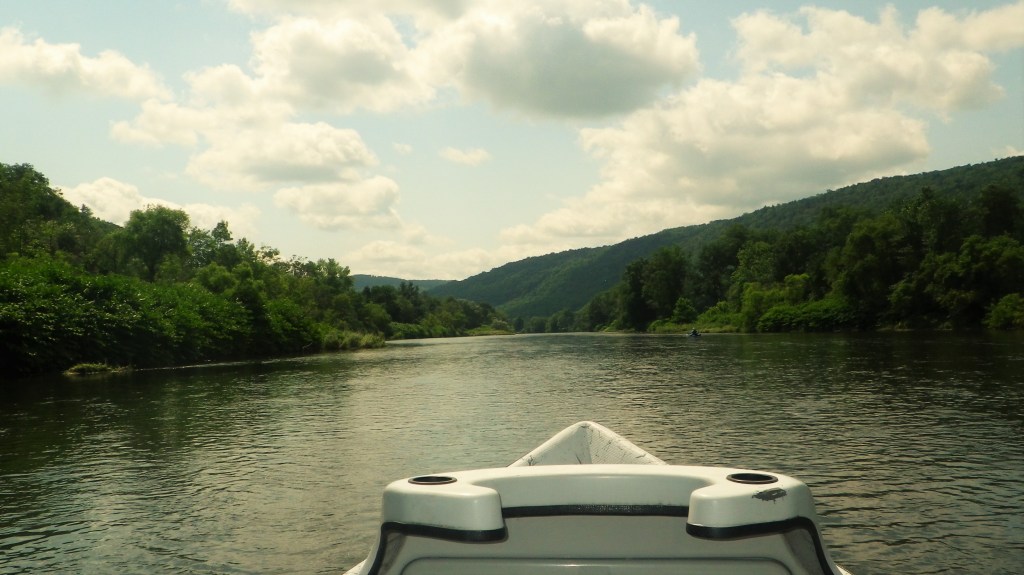
A Perfect Summer Day as viewed from the cockpit of my old Hyde drift boat. Seventy couple degrees for the high, with sunshine, even some breeze, (though only when we had rising fish), and the perfect company of a good friend. I had been trying to get one of my best friends into the boat while the cool high flows were maintained, though life seems to make timing difficult some times. With a load of unexpected work dealing with storm damage, JA was able to come up on one of the last floatable days for a tour of the West Branch. Many river guides float daily at low water, under 600 cfs, but I find it less than enjoyable to drag a boat across gravel flats in an attempt to avoid other boats and waders. I don’t have their every day familiarity with the river bed, so I prefer to be out there when there is enough water to actually float.
Last week a near maximum cold water release and some spillway overflow found me floating high with the river at 2,200 cfs. The cold water got more mayflies hatching and the trout feeding further down river. We pulled anchor and set out yesterday on a vastly different West Branch. Flowing at only 785 cfs, there was a lot of shallow water demanding extra care in boat handling.
It was a beautiful day from start to finish: highs in the low seventies, plenty of sunshine, with a few passing clouds to give the sky some character. The company was as perfect as the weather.
We hadn’t gone far when we spotted a trout rising in a shallow flat, where none had shown themselves last week. The reduced flow made it easy for them to hold and feed happily. We were not too many miles from the dam, and it had been cool overnight, so the water was cold enough to encourage a few tiny sulfur mayflies to hatch by late morning. The fish were tough in bright sun and clear water, but we found some success. The day melted away much faster, as we enjoyed good conversation between productive stops.
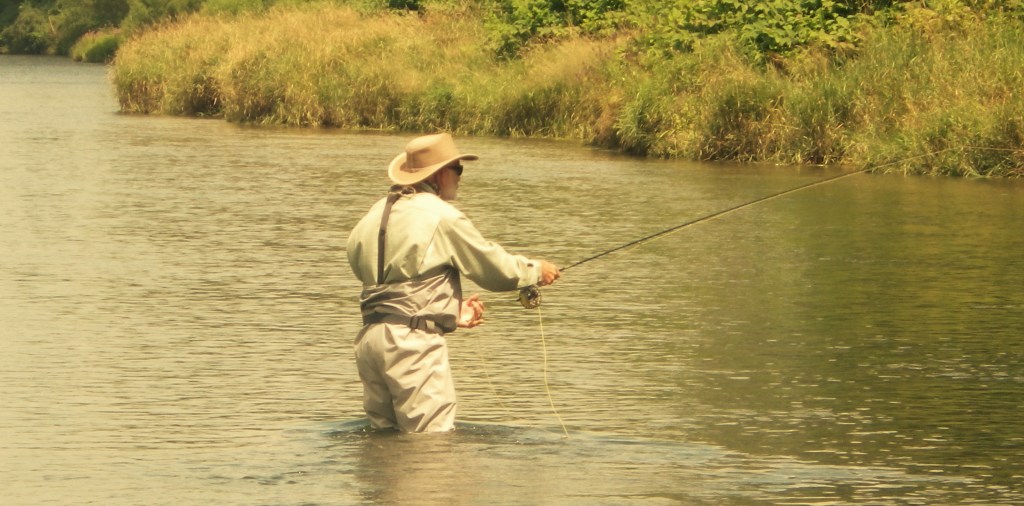
JA working a plump, bank feeding brown. We had the flat to ourselves for a very brief time, as drift boats gathered above us when they saw us working to a handful of feeding trout. We drifted and talked of flies and designs, kidding one another about our own approaches to solving Nature’s puzzle of the day. Come mid-afternoon, we found another group of risers, this time with no sulfurs, nor any other visible bug in sight. It was my turn at the rod and I did my best: a size 20 Rusty Spinner, an ant and beetles large and small, a size 20 summer Blue Quill and a 22 olive emerger that I could barely see. One fish nosed that one and didn’t eat, refusing to return after I struck and whisked the fly away, distracted at just the wrong moment. Generally, those trout fed happily and disdained everything I offered. I surrendered the rod to JA and he took the opportunity to show that his approach had considerable merit, taking the fish of the day on a foam, hair and rubber legged creation I thought reminiscent of a cricket.
John cast that fly to one of the risers along the bank, the same fish that had ignored my offerings, and was soon fast to a big, hard charging brown. He wasn’t coming to the boat easy, and JA played him perfectly on light tippet; nineteen inches of angry brownie that kept trying to jump out of the big boat net once I finally got him in it.
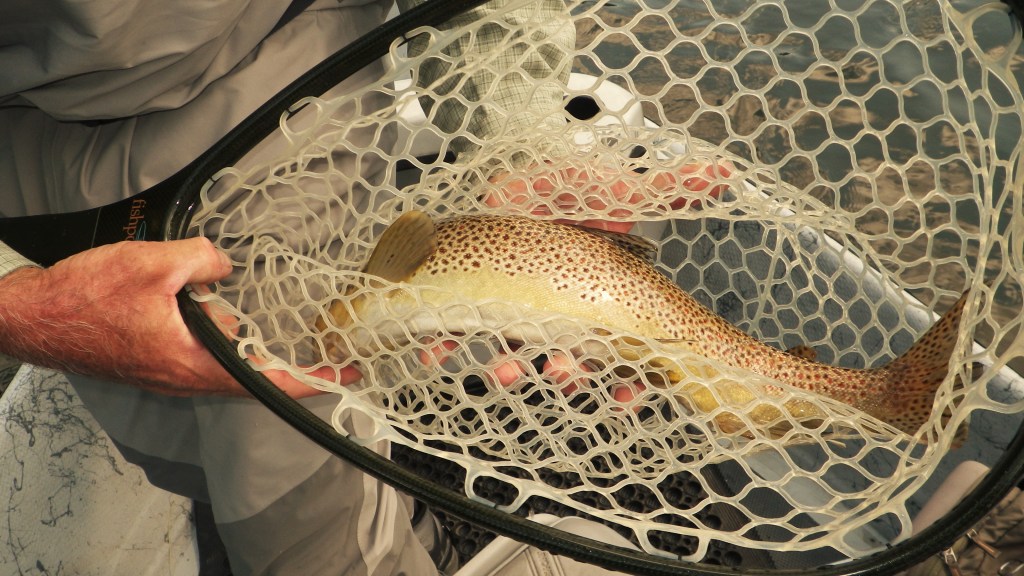
I thought I had the shot, I swear I did, but that brown just refused to stay still long enough for me to frame and press the shutter. 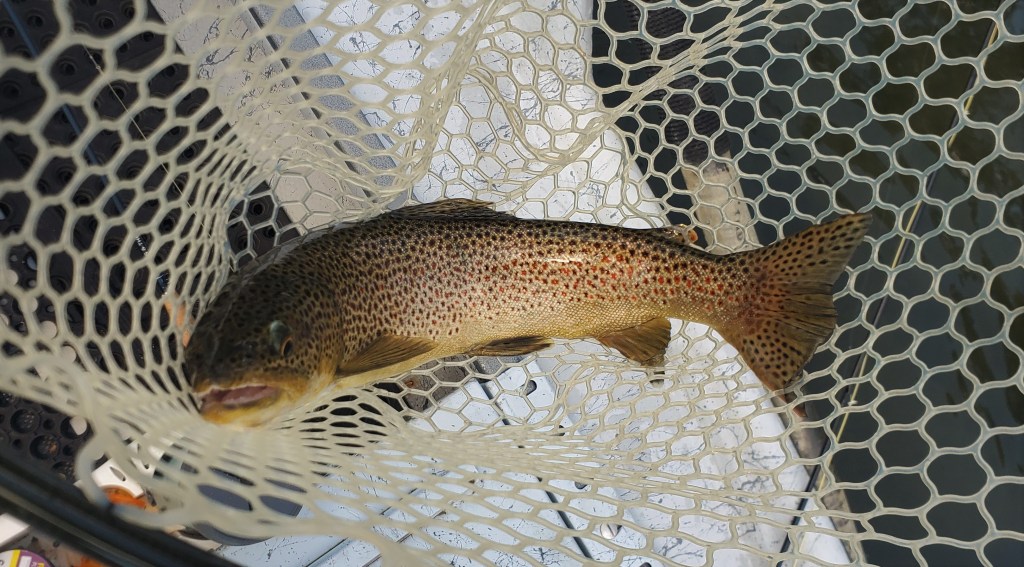
Here’s the pose I was going for. Leave it to the craftsman JA to catch the largest trout of the day and get the better shot of it. (Photo Courtesy JA) Evening overtook us before we were ready for it. No evening rise would appear, but the beauty of the sun dappled riverscape brought smiles from both of us as we passed those last few miles. It was indeed a perfect summer day: two friends sharing their passion for angling and the outdoors, catching a few nice trout and laughing at the ones that escaped our flies.
John will be the first to say he doesn’t really care if he catches a trout, for he loves the time on the river and the fishing for itself. For my own part I care, though I would much rather be out fishing bright water without catching trout, than I would not being out there fishing.
-
Back on my own two feet
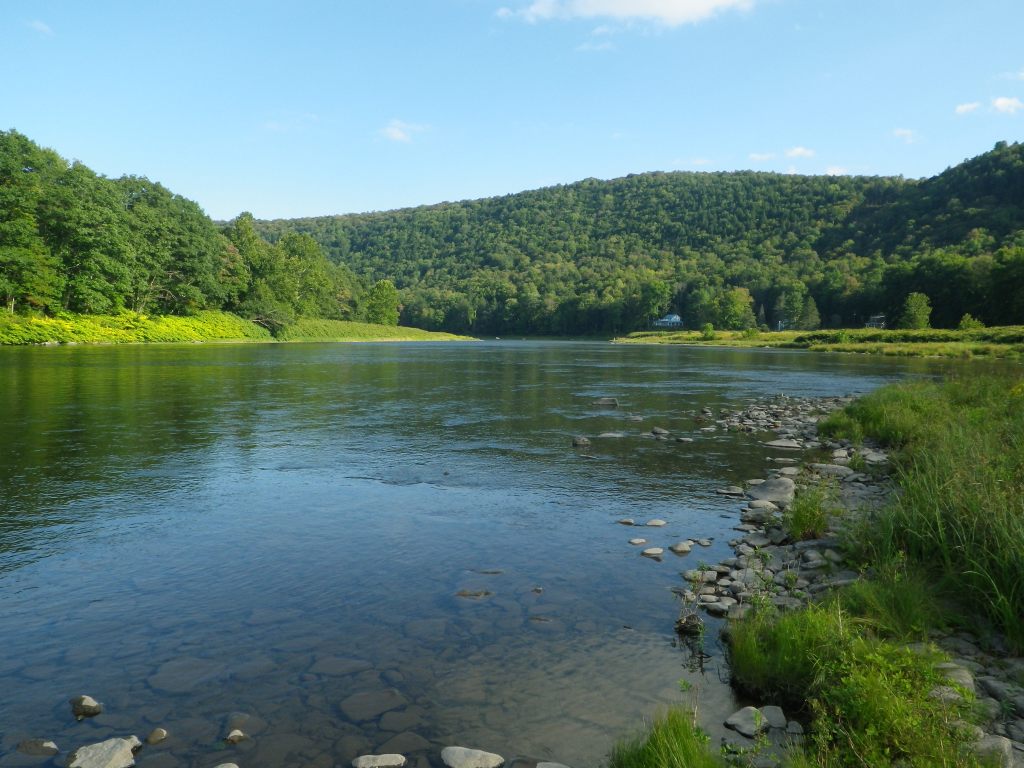
Wadable flows! I am a wading angler at heart, and glad to be back on my own two feet! In my heart and soul, I am a wading angler. I crave that connection to the water and the trout I seek, the feel of current on my legs, the eye level view of the surface. I can analyze the drift much better when I am in it, identify the flies struggling in the film, track the drift of my imitation. True, a boat allows me to fish a great deal of water in a day, but wading allows me to fish it well, to know it and feel it in my soul.
I let my excitement rule me as I began my day, overreacting to a quick, hard popping take! I never felt the trout that took my tiny caddis imitation, the 6X tippet parting on my over exuberant hookset. After that first foray into the full spring flow of the river, I put away my wading staff and let myself get comfortable on my legs alone. The Red Gods granted me that much after missing thirteen of fourteen days of summer fishing outright, then either wading one severely limited reach of crowded water or floating for another week. They give, and then they take away.
With little in the way of insects in the drift, I knotted an experimental beetle imitation to my tippet. A murmer in flat current spoke trout to me and I laid a cast deep into the shade of an overhanging tree. The take was late in the drift, and he came to me immediately, while I tried in vain to get a solid hookset with too much slack between us. I saw him just as the hook pulled free. Yes, the Red Gods give, and they take away.
As morning melted into afternoon, I missed two more opportunities. The educated wild trout of summer love to follow a tiny dry fly, nipping and refusing only late in the drift, as inevitable drag begins. I switched back and forth as the sparse naturals came in brief, mixed bag flurries; sulfur to olive to caddis, then back. When the forecast calm winds turned blustery, that experimental beetle pattern found it’s way back onto my leader. There was one good trout that had risen a few times, and had ignored my tiny mayflies. The beetle proved to be mouthful enough to overcome his suspicions, and the battle was joined!
With spring like flows invigorating us both, he fought with remarkable vigor as the lithe wisp of golden cane arched and bucked in response to his energy! He ran hard, pulling backing through the guides and I worked my way carefully to shallower water while I gave line, reeled, and gave again as the great trout battled against the pull of the working rod. Thinking victory was at hand when the line returned to my reel spool, I relaxed a bit, only to hear the staccato music of the Trutta Perfetta come to a new crescendo as my foe took back what I had gained!
Finally I maneuvered for the netting, and the heavy body and deep, glimmering hues of a very wild twenty inch brown thrashed in the clear mesh.
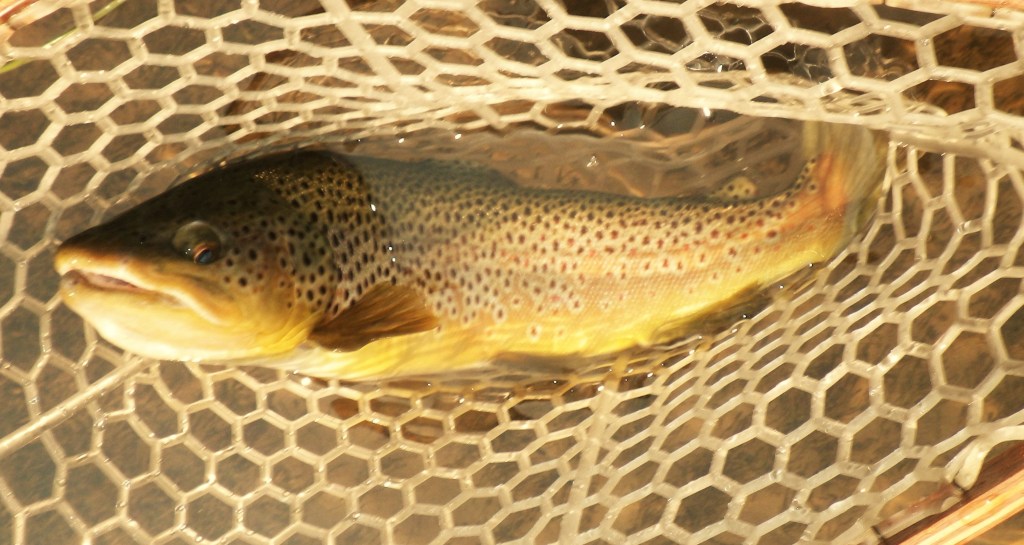
Victory! Releasing my prize into the clear, shallow water brought another rush of gratitude and appreciation for the rivers of my heart. Thankful to return to the beauty of the Catskill summers I so cherish, I lingered in the moment, snapping another photo as the brown recovered at my feet.
The wind redoubled its efforts after that, with one mighty gust that gave me pause at its ferocity, and I scanned the skies to be sure some violent storm wasn’t headed up the river valley. A rouge wind, thankfully nothing more. I continued to cast the beetle along the tree-lined shore, but no more lurking browns revealed themselves. Walking out, I expressed my quiet gratitude for the moments of grace the river had granted.
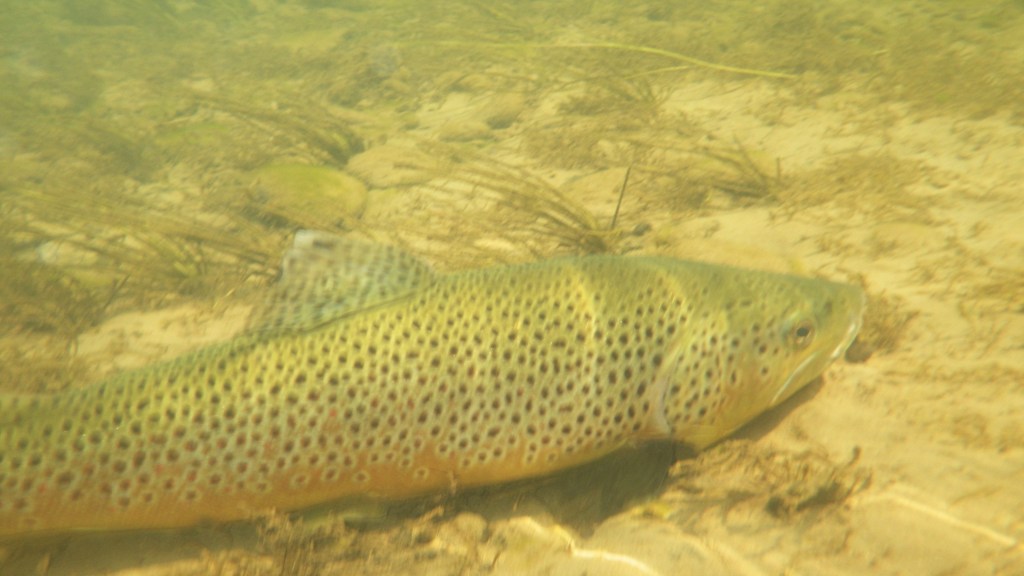
A rest and recovery after a valiant battle, where angler and golden cane proved the victor this time. I have no doubt this warrior has broken many a line and fueled many angler’s dreams. Perhaps we will meet again!
-
Soft Evenings

A taste of perfect Catskill Summer weather: misty mornings in the fifties, afternoons in the seventies, and soft evenings to put the last kiss on the day… At last, a break from the constant onslaught of storms! The past two days have offered the kind of Catskill summer I most enjoy. It was a pleasure to wade some freestone rivers and feel their full, cold flows against my legs once again!
I would like to think this weather will last, as we are indeed amidst high summer, with August on the doorstep. I want to get back to stalking trout in cool summer flows and reveling in the beauty of each day, each evening. The high flows have cooled the rivers, and that is a gift to be thankful for, but we would all prefer cool nights, moderate days and more regular, gentle evening rainfall to keep them cool, inviting and productive.
I waded the past two days, forgoing the boat as the West Branch was hammered again by Tuesday night’s storm. The flow had more than doubled by morning, and remained higher as the reservoir began to spill. I reasoned that these events would not improve the fishing, with respect to the quiet solo float I enjoyed on Tuesday.
It was refreshing to work my legs against the Beaverkill’s strong current. Running clear and cold at springtime water levels, I almost expected to see a Quill Gordon take wing. The scene took me back to April, getting my winter legs in shape with the toil of wading frigid water.
I did find some mayfly activity, but the trout seemed far more interested in chasing the emerging nymphs beneath the surface, a few splashing heavily as they caught them just below with a rush. I coaxed one up to my Cahill emerger Thursday evening, as I lingered to enjoy the river and the weather.
I returned yesterday afternoon, finding the reach deserted and a bit more tame current wise. I prospected a bit, waiting. Once again the splashes signaled the coming of the cream colored mays, and once again the trout were to focused on their subsurface chase to pay heed to a dry fly. There was one though…
He rose just two or three times, inches from the far bank, across all that rushing water. I worked my way carefully down river, until the bottom fanned into smaller cobble, and a more negotiable flow. Staff in hand, I picked my way across, knowing that one slip of a boot could take me away. Reaching a suitable casting position, I called upon the crisp three weight to take my fly the final sixty feet or so.
Light line rods are made for touch, adding reach makes them a perfect tool for summer rivers; even at springtime flows. The first cast laid the fly gently a foot and a half from the bank, from whence it drifted perfectly, though un-assailed. Cast number two floated along a foot out, gliding peacefully and likewise unmolested. Another foot of line pulled from the reel, half to close the distance just a bit more, and half to add additional slack to account for the infinitesimal slowing of the current so close to the shore. Perfect; and yes, ignored.
I felt confident that the Cahill emerger was the right fly, so I fluffed the CDC wing with a brush of Frog’s Fanny and blew the excess into the breeze. I’ll give him a moment, I told myself. He had not risen during my final approach, though I figured he remained in whatever little dip or slot he favored in the rocky bottom. I had not seen a natural drift through either.
Finally I made another pitch, right in there, half a foot from the waterline, gliding, gliding, and taken! The light rod throbbed when I raised it,. and the trout bulled into a deeper slot nearby, searching for a snag. He found one no doubt, for with my line pulling hard down toward the bottom, he rocketed out half a dozen feet upstream from the spot where my taught fly line disappeared. The jump managed to pull the line free, and I made the most of the direct connection to pressure him away from the bank and those hidden snags. He wasn’t content to come easily, fighting with everything he had to get back to the snags.
Tense moments, and nearly a standstill, each pulling hard as I wondered about my compromised tippet. If the snag had frayed it…
He showed me his flank and I increased the pressure, working him away from the bank inches at a time. He must have a tree limb down there, as rock would have cut the leader, and he wasn’t giving it up easily. Eventually, I began to win the tug of war, working him far enough from his sanctuary where I could see the bottom. Pulling with everything he had, my first glimpse of his length got me thinking he might be larger than the net would reveal. Strong trout will do that. As it was I admired a full bodied wild brown eighteen inches long, as I twisted the fly free and sent him back to his hideaway. A lovely soft evening indeed.
-
Solo
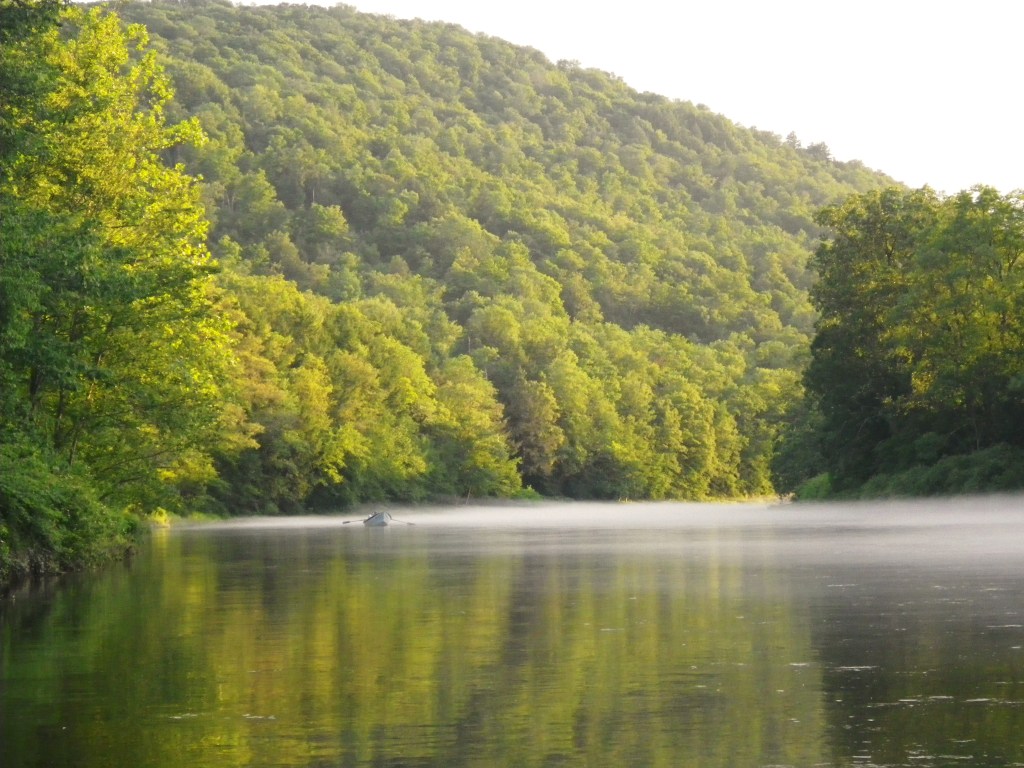
A lone drift boat appears out of the mist, rising at evening. The Red Gods saw fit to grant a single night’s reprieve from the onslaught of storm systems, and the West Branch cleared enough for fishing yesterday morning. At 2,200 cfs of flow, the cold release water accounting for two thirds of that total, I had high hopes for some mayflies and rising trout. Easing the boat across the pool through the veil of morning mist, I found solitude and reflection.
Sticking with my plan, I had rigged my rod with a big, ugly cricket-like creation I hoped would draw the attention of a bankside brown. I rowed gently to the deeper bank and anchored a cast away from it and then fired that creature beneath an overhanging branch. I immediately questioned my choice of 5X tippet, as this wad of deer hair and hackle proved much more air resistant than my typical Baby Cricket, but I continued, fishing all the stretch of bank within range before pulling the anchor and sliding down.
At the second station I elicited a rise without a take, deciding to follow up with a beetle. That trout had said his good mornings, and proved he wasn’t interested in a more engaging chat.
I switched flies again, choosing the 2020 Cricket as a compromise between big and ugly enough and too much so as to be intimidating. Sure enough, a couple of stops down that bank I garnered another rise sans take, a clear “we ain’t buying any” that sent me back to the more subtle beetle for the next hour. No one was buying that either. Crickets, either my Baby or the Master’s venerable Letort Cricket original were a powerful morning weapon on the Cumberland Valley limestoners, but the West Branch bank feeders seemed too accustomed to a diet of tiny summer mayflies to sample this succulent fare today.
After eleven I noticed the first tiny sulfurs riding the surface, and anchored below the riffle feeding a productive flat. It was half an hour before I spotted a rise. I lifted the anchor with all due care and slid over and down just enough to make a perfect cast, but the sporadic flies proved insufficient to sustain any feeding. My trout ate a handful over a ten minute period, sliding up and down in the flat, and then went back to his repose. I waited until past Noon, expecting a good hatch that never came.
The next stop offered the potential for a hatch, so I lingered watching and thanking the sentinel eagle in his lone skeleton tree for tolerating my presence. His patience proved it’s longevity, as he remained when I finally lifted my anchor and drifted on.
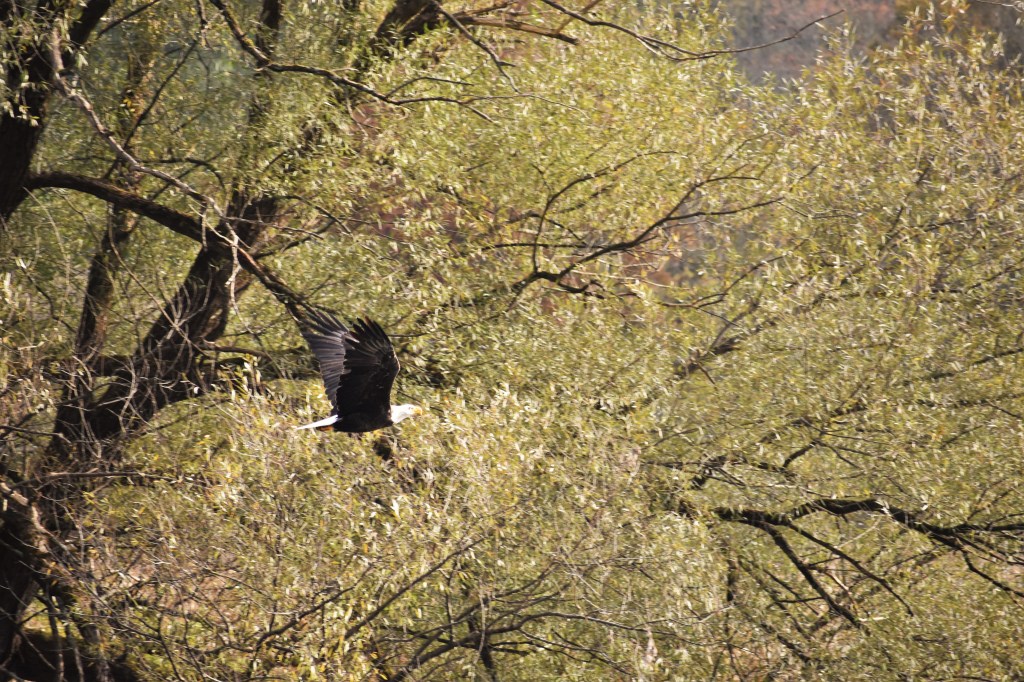
Though our eagles are used to boaters and anglers, our intrusion usually results in flight; why I appreciated this morning’s regal bird tolerating my presence and sharing my vigil. I left him to his watch. I covered several miles of river during the next couple of hours, passing a single boat, and many spots where I expected flies, though the river remained quiet and serene as the sun warmed the air. A little bump in water temperature often triggers a hatch, so I covered the next mile with careful attention. Rounding a bend I saw them at last, two or three trout rising freely along the bank. I scanned the surface to find a few tiny sulfurs, before tying a new longer tippet and a size 20 parachute to my leader.
I slipped into position without alarming those trout, and went to work with the four weight.
The riffled water upstream seemingly funneled enough sulfurs down along that one reach of bank to keep at least three trout happy for a while, and they fed along in their usual picky style. One cut the surface with his dorsal after sipping a fly in the quieter current tight to a dip in the bank, bringing a knowing smile to my weathered face. My next cast put the fly close, clearing the tree branch between us and allowing enough slack to give the fly a few seconds of float time before the faster current ripped it out of that pocket. It was just enough time for six inches of drift.
The trout took quickly, and the rod bucked as I tightened and the big brown shot out into the current and away. That bank is steep, and the river deepens considerably where the full force of the flow comes through a constriction. That brownie knew just how to fight the rod on his terms. It was a long test for that tiny fly hook, for even after his long runs had subsided, he darted and twisted down into the rock strewn channel each time I tried to bring him to the boat. He had given me several good looks during my efforts, easily over twenty inches, and I wanted him. The hook held, the reason I tie the majority of my small flies on a special model, and I finally managed the scoop with the long handled boat net; a beauty, and happy to return to the ice cold river after our struggle.
The battle had pushed his partner further down the bank, so I repositioned before fishing to him. He had seen my little sulfur several times before his companion showed himself and garnered all of my attention, and he simply refused to give it a look now. I had seen one or two larger flies taken with relish, so I opted for one of the Light Cahill parachutes I had tied for the summer boat box. He couldn’t resist the bigger meal.
With two good trout in the boat my anticipation peaked. It was mid-afternoon and I expected to round a corner to find a hatch and pods of trout working at every bend. Flies remained scarce though as I floated through the rest of that pool, a gorgeous riffle, and on through a favorite run seeing nothing but scenery. Lingering again at the top of a pool, I smiled when I spotted a single rise along the bank downstream. My move was calculated and as stealthy as possible, and I was rewarded with another hard fighting brown.
The haze had thickened during the day, and here within the shadow of the mountain it was cooler. The afternoon continued to soften, and I knew evening would not be far behind. I reveled in the solitude and the simply beauty of the river while I waited.
I spotted the last rise from a distance, tight to the bank and soft, with wide spreading rings. A good fish. I left some distance between us, as this place is familiar and it’s trout particularly wary. The Cahill was still on my tippet, and I had seen a few taking wing from the faster water, where the run becomes the great pool. My casts were perfect, the drifts flawless, but this trout was not impressed. He continued to feed at intervals, sometimes sipping gently, and occasionally tipping his nose above the flat surface and giving me that white wink with his open mouth.
There were a few small flies about, but my size 20 olive was likewise ignored. The sulfur, not interested, not even for a dainty spinner imitation recommended by the softness of his initial rise. I could see a lighter colored fly once or twice, perhaps a natural Cahill, but these mayflies were clearly not on his menu either. I had offered all of the likely imitations without a glance, while he still moved about in his pocket among the rocks and fed happily.
My eyes fell upon the big Halo Isonychia stuck in the boat’s foam fly patch as I cut off the spinner. I knotted it securely and prepared to cast, still certain he was taking smaller flies. I cannot recall what distracted me, perhaps the loose fly line on the floor catching on my shoe or the anchor rope, but I looked down and then back at my fly, late to the take. I managed a rushed hookset, though not one that inspired confidence, and that trout bored away from the bank hard and fast. Deeper water was closest to me, so he closed upon me, while I stripped line as fast as possible. That was when the tangle occurred.
I found it when he charged downstream, taking line until that tangle was an inch from my stripping guide. Disaster an inch away, and a big trout fighting like leviathan! We went back and forth like that, the fish running back toward me so I stripped feverishly, then running hard away while I feathered the line, picking at the tangle whenever he stopped and thrashed the water.
Somehow I managed to stop that fish each time, the tangle a whisper from jamming the guide, and finally picked it free. With the fish on the reel my heart rate eased just a bit. All the while that trout felt like a true behemoth, and I expected I’d need at least a two foot ruler if I eventually brought him to the net. Sometimes their heart makes up for their size. In the boat at last, I wrestled the fly from deep in the mouth of my hard won brown. I didn’t measure him, estimating he might make nineteen inches, and not a thirty-second more.
I felt the tension in my shoulders relax after the release, though the fire in my neck wasn’t going anywhere. From that point on I floated freely, savoring the glow of a hazy summer evening as the mist rose all around. I stopped just once, finding nothing of consequence, and drifted on, calling home to tell Cathy she needn’t wait until eight to come collect me.
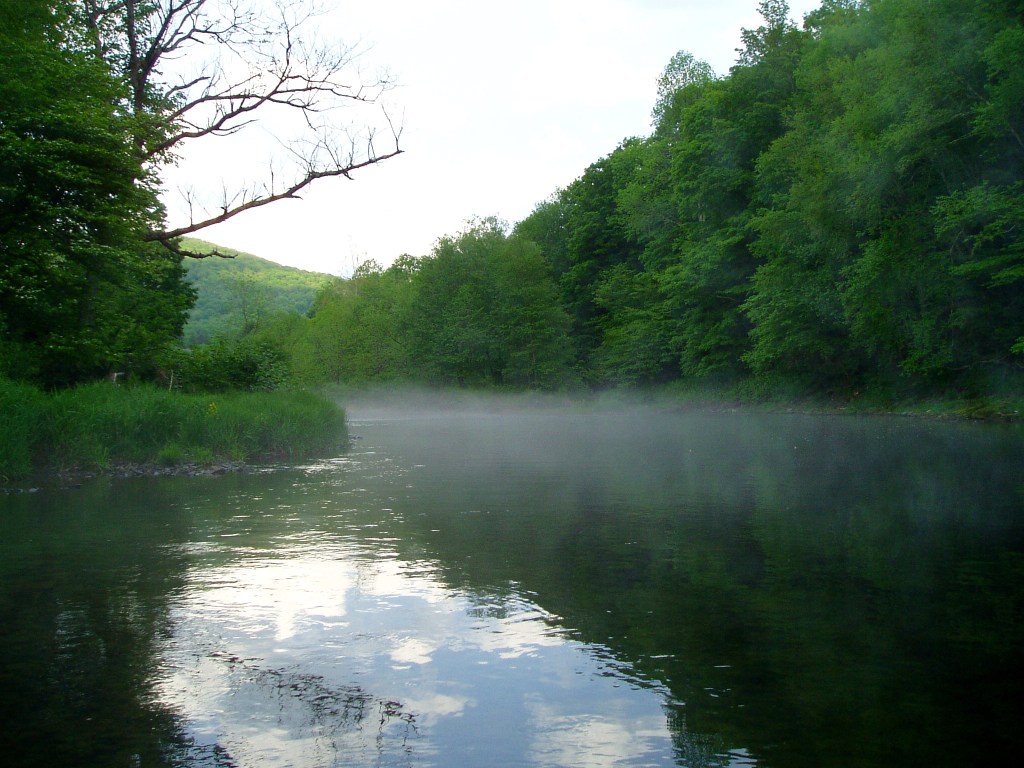
The mist rises beneath the glow of a hazy summer sun.
-
Quiet Hours
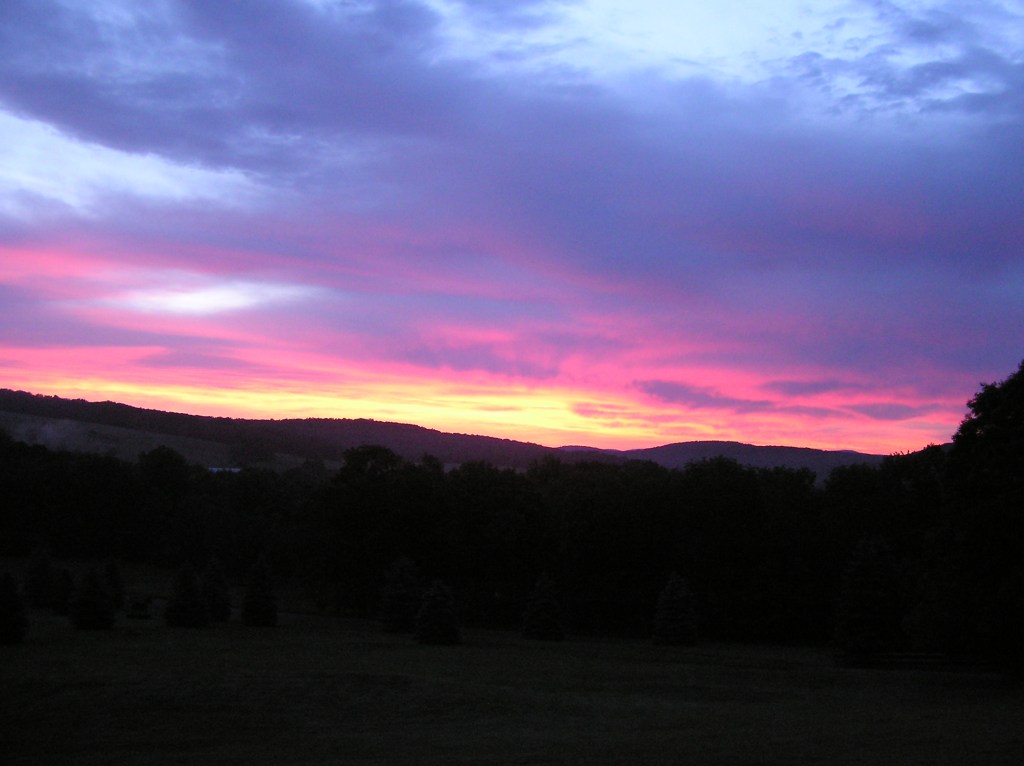
The quiet hours of the morning are often as productive as they are beautiful. There is an advantage to old, discarded habits sometimes. During all of my working years I awoke at five each morning to prepare for the day. It seems that programming is now intrinsic to my body clock’s operations, though I arguably could sleep as late as I want. I don’t mind, in fact I actually enjoy it. The quiet hours of the morning are productive hours for me.
Just this morning I finished my preparations for a day’s fishing, even finding time to write this blog entry. Mornings are my favorite time to write. I tied a few new flies, some big, black, mean looking terrestrials I think might tempt a big brownie to the surface. River flows are still high as the storm runoff recedes, and runoff events tend to put a lot of different food into the current for trout. It can be surprising to understand just how long some of that food can stay around and be available rather than being instantly swept away.
Have you ever picked up an old, decayed mayfly dun or spinner from the surface? Bugs get caught in eddies and swirling currents all the time, and can spend a lot of time in one place until something disturbs the equilibrium of the eddy. That’s why I feel confident that some big, juicy looking runoff terrestrials could account for the fish of the day, making them an ideal fly for prospecting until a hatch begins. High water dry fly fishing is all about pockets of calmer water.
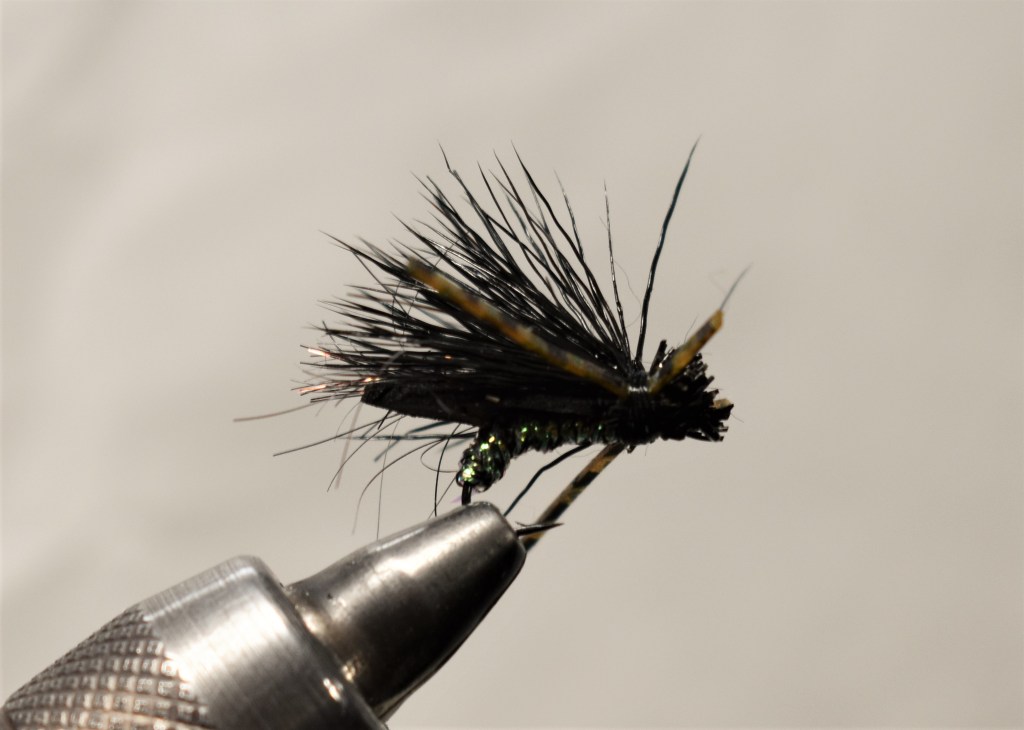
Last year’s update of my cricket pattern is a good fly for runoff prospecting. It is a bit larger than the small Baby Crickets I have tied and fished successfully for decades, sits lower in the water, and offers a little flash and some movement. A bank hugging brown that has had his leisurely slow water summer feeding interrupted by stormwater ought to love it! The City has been trying to prevent spill from Cannonsville by running close to maximum release, putting twice as much cold, oxygenated water into the river. So far, so good. Now that most of the muddy, debris laden storm runoff has passed downstream, we anglers are hoping for some excellent daytime hatches. The window may be brief, as tonight’s and tomorrow’s forecasts include increased likelihood for more heavy thunderstorms. I hope Ma Nature gives us a break, letting us enjoy a week of great fishing instead.
-
2018

Cannonsville Reservoir, August 2018: Water up in the trees and spilling. I am beginning to believe in time travel, for I think that I have returned to 2018. It was the year I retired, and a year in which I did far less fishing than just about any previous year going back three decades. I was running back and forth between Chambersburg, PA and Hancock, NY looking for a house where we could live out our retirement years close to bright water and the undeniable beauty and magic of the Catskills, and it was a long, hard search. It was late in July when I finally settled on a little house here and took up temporary residence.
There were projects to do: rebuilding the porch, painting and replacing the flooring in the kitchen, and setting up my fly tying room that would become the center of my world. I took a couple of afternoons to fish the summer sulfur hatch on the West Branch, and then it began to rain, daily. That was a water year to end all water years. The heat and humidity stayed high, and the rains kept coming, filling the reservoirs of the Delaware River watershed, then spilling out and flooding the rivers downstream. My fly fishing came to a very abrupt end, leaving me plenty of time to work on those projects.
When autumn arrived, I took to the Catskill Mountains to enjoy some grouse hunting, finding still more water. It ran down every slope in the mountains, not just in the brooks and ravines, everywhere! The abandoned apple trees bore no fruit, so I found no grouse where I hoped to, though it was a rather miraculous experience simply hiking and watching all of the water fall. It was as if every mountainside was one great spring seep.
The past week and a half has convinced me that the clock has turned back.
I fished daily during the first week of July, enjoying a fairly typical summer, if there is such a thing. Then the storms arrived, one after another, day after day, and the rivers grew high and muddy and stayed that way. Finally, on July 15th, I was able to get out for an afternoon on the upper West Branch. The single tributary had finished it’s runoff phase and the river was clear and wadable above the village of Deposit. As of July 16th, the watershed for the New York City reservoirs had received 6.79 inches of rainfall for the first half of the month; the historical average rainfall for the entire month of July is two inches. Last evening and on into the night the storms kept coming, bringing another inch and a quarter to Hancock. The rivers, already high from increased reservoir releases as well as daily runoff, are higher still this morning, and no doubt muddy again. Hello 2018!
I am fortunate that I have a drift boat at my disposal this summer, something I did not have for the first 2018. Of course the rivers still have to have a chance to clear again before there will be a chance to float them and search for a little dry fly fishing. Time will tell…
Back in June we all prayed for rain, for the rivers were low and their temperatures too warm for wild trout in many cases. The East Branch and Beaverkill waters soared into the eighties and remained there for too long a period. The Beaverkill, trickling along at a measly 120 cfs to begin July, crested near 7,000 cfs after yesterday’s storms.
The cold water is good for the trout of the Delaware system, particularly those in the mainstem of the river. Hopefully, the City will sustain the elevated releases from both Delaware branches once the runoff passes downstream, and hopefully, the storms will give us a break. The rivers should fish well with a good head of clear cold water. No one here would mind seeing a sustained period of perfect Catskill summer weather either, with daily highs in the mid-seventies and some gentle evening showers once or twice a week.
As for today, well, the forecast is for rain showers, a big improvement over violent storms with heavy downpours. It looks like a good day to tie some more flies, watch the ballgame, and just relax!
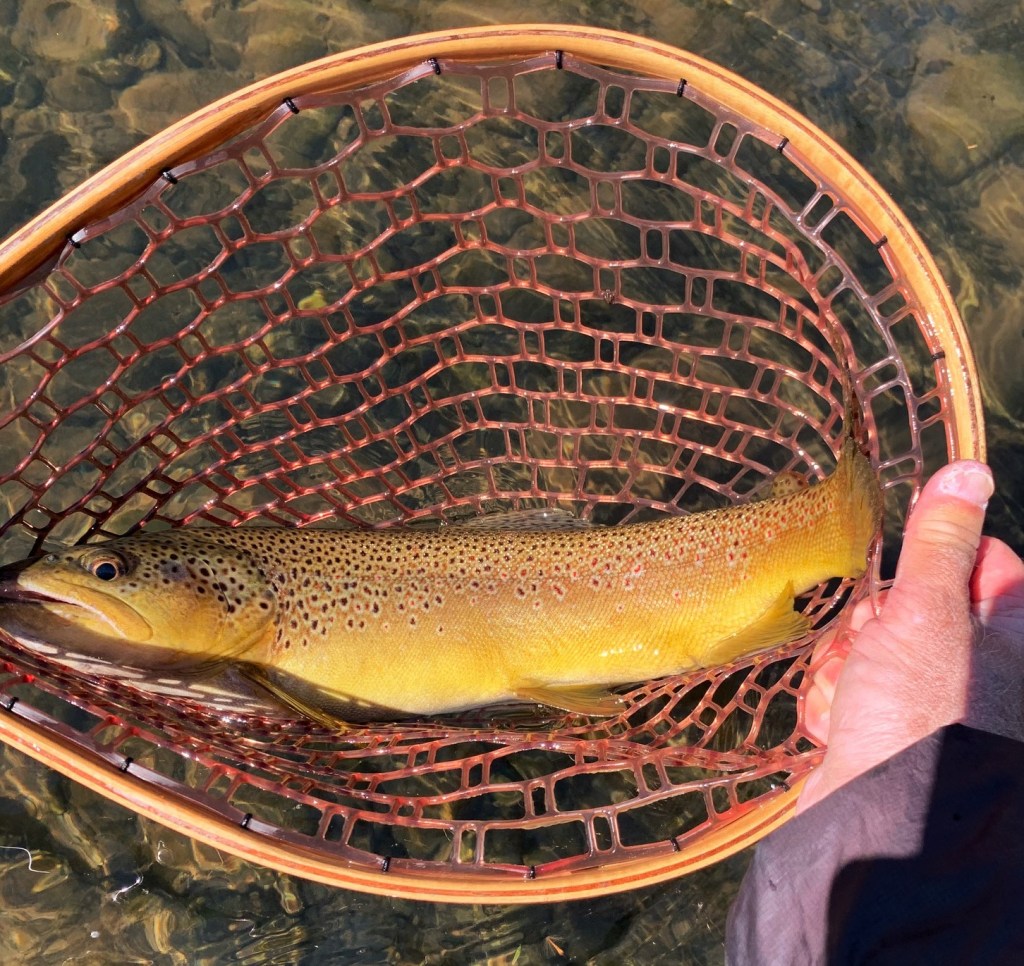
Photo courtesy Michael Saylor
-
Falling Waters
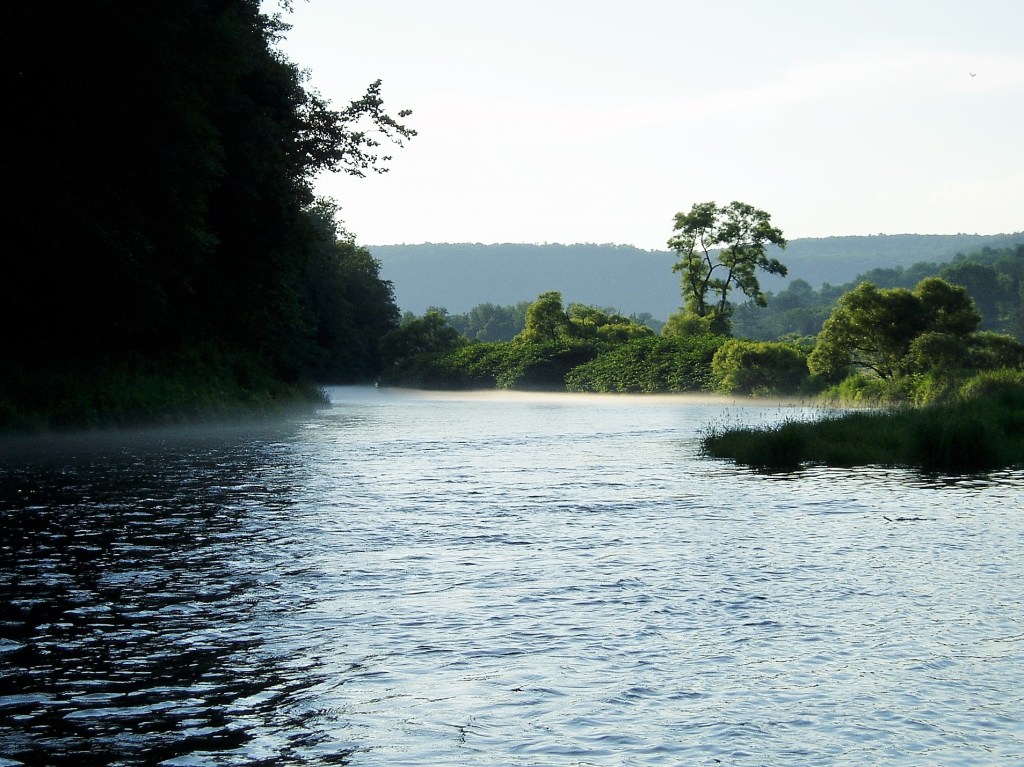
Cold water meets warm air as evening nears, a common theme on the West Branch tailwater. It was a grand relief to wade into the West Branch Delaware late this morning. I feared the crowds would grow, since the upper river was effectively the only fishable water in the system, but the afternoon turned pleasant, with the few anglers keeping their distance. A week without fishing, particularly a week in high summer, is a foreign thing to me. Retirement has its benefits, chief among them is the license to linger along bright water as often as I please.
I had driven up to check the river late yesterday, finding it clear above and high and muddy below, quickly dispensing with my thought of a float trip. I hoped the summer sulfur hatch would bring trout to the surface. The cold water in Deposit makes the little yellow mays reliable, at least in a normal year, but this one has been anything but normal.
With the usual boat traffic, standing in the river and waiting for the rise cannot be counted on to secure one’s fishing area. The old line guides always gave wading anglers a wide berth, but the culture of youth doesn’t seem to honor that tradition. I decided to tie on one of those chunky size 14 Letort Crickets, tied days ago, to see if I could interest a lurker while working my way downstream to the place I hoped the trout would intercept the sulfurs. Even actively fishing and wading downstream wasn’t enough to keep one drift boat from cutting close around me and peppering my destination water with casts. I let him know what I thought of his tactic, loudly though politely.
The first rise soothed my ruffled feathers, and I shot a long cast out to the bank and fed some slack into the drift. The water bulged ever so slightly and I reacted, missing the take. No number of casts would bring him back again. The waiting game began when I resigned myself to that inevitability.
It took an hour before the first sulfurs appeared. They were sparse, and coaxed no rises from a known productive run of water. Though I hoped for a better hatch with the overnight addition of cold release water, it was not to be.
Resigned there were too few sulfurs to bring on a rise of trout, I resumed working down river with the cricket, until drift boat number two cut me off and slid into the bank I was headed for. Perturbed once again, my mood did not improve with a second bump, sans take, as the cricket worked the bank. I paused again and knotted the Grizz to the tippet trailing from my Thomas & Thomas, determined to get myself a trout from a quiet, yet fishy looking stretch of bank.
The smooth flex of the bamboo sent the beetle to the edge despite the wind that had risen, but the chop from that wind disguised the take. Sometimes there is an extra sense, the one that tells you to tighten even though seeing nothing, and I always obey the instinct. The soft glow of caramel colored cane as it catches the sun, throbbing in a full arch, will always improve my perspective. If not for the vibration in the rod, I might have thought I was hooked to a log, though he soon moved quickly upstream, still tight to the edge. The 6X tippet amid the rocks and water weeds concerned me, but I played him deftly, and ultimately to the net. A fine brown, an inch short of the trophy benchmark, wriggled valiantly as I reached for the fly.
Out of water, thanks to the offending guide boat, I fished my way back upstream on my way to the path. Three spirited young brown trout kept a smile on my face, as they moved about the riffled and wind ruffled water picking off every stray sulfur they could find. When the activity quelled around three, I called it a day.
I remember days on this water when the hatch was as prolific as any you could find on a Catskill river, when the run held hundreds of trout, until the anglers tried their best to outnumber them. The first sign of the decline came half a dozen years ago, when no matter how heavy the hatch, the rising trout could be counted on one’s fingers. Perhaps it has taken that long to sink in, for the hordes of anglers to look elsewhere. I looked upon this run once last year and imagined a circus, for the clowns were out in force.
Perhaps, if they are not too quick to return the fishing will have a chance to rebound. I may live to see the run alive with sulfurs and rising trout once again. That would be a wonderful turn of events, though word would spread and the crowds would return and begin the cycle of decline once again. There was a time when many of us believed the growth in fly fishing would bring more voices to preserve and protect the rivers. In some cases that has occurred, though in others that growth has led only to crowding and a loss of courtesy and sportsmanship. May tomorrow’s anglers learn to do better.
-
No Fishing
Now there’s a sign I never want to see! They always seem to appear next to a truly inviting stretch of water. There are fish rising beyond some of them, obvious spots with great cover and some depth, the ones where the prevailing current carries everything right down and concentrates it where that cover meets that deeper water, screaming big fish here! Those signs have been up for most of the last week, not man’s, but Mother Nature’s.
We needed rain and some relief from the heat, and we got it. Trouble is we keep getting it; not the gentle showers that soak in and really do the rivers some good, top to bottom in the watershed, but the heavy downpours that muddy the rivers and add to the silt load our riverbeds can do without.
Last night was a doozy, a serious storm packing a tornado warning, coming right down the pipe with Hancock in it’s sights. The cell phones went off with ten minutes to spare, and the TV was immediately switched from the Home Run Derby to the Weather Channel: Severe thunderstorm south of Deposit and moving East at 20 mph likely to spawn tornadoes. Rotation observed on radar, seek shelter immediately! The weather map showed the updated storm track, reaching from Balls Eddy to Stockport, and there were some very tense moments ahead, particularly when the Fire Department’s siren went off as the storm hit us full force. Thankfully, that rotation observed on radar never materialized into a funnel cloud on the ground. A lot more to worry about than some lost fishing time there.
This morning has been about giving thanks and wondering if I’ll find some fishing sometime this week. This whacky season has already pushed me into some crazy days at the bench.
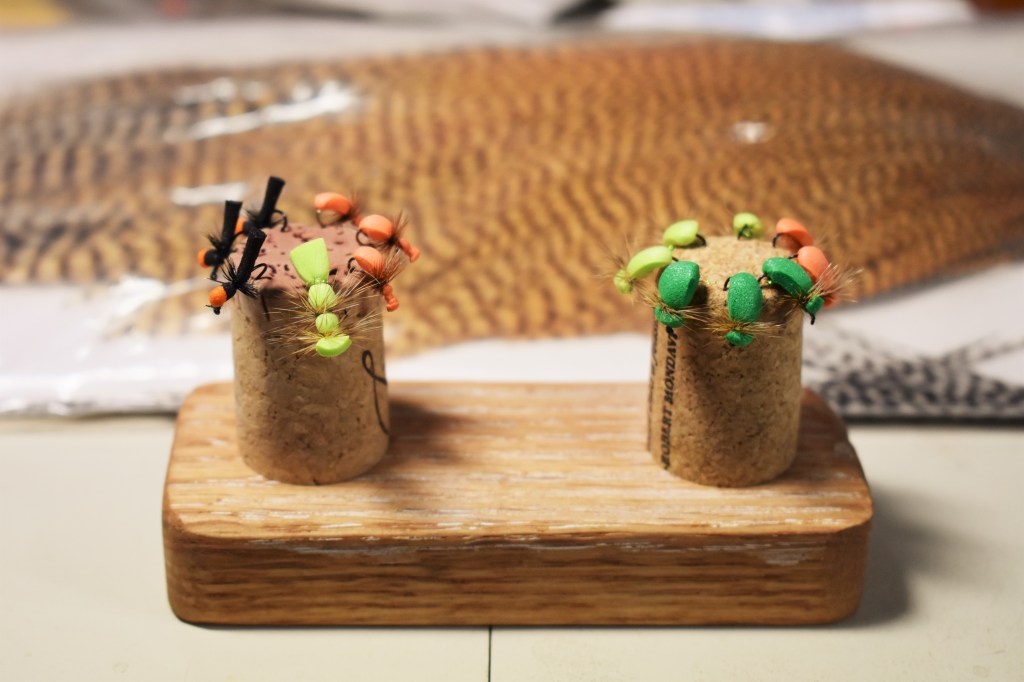
Beetlemania: I pulled out a bunch of wild colors and tied something different, beetles in green, orange and insect green, along with a thing loosely inspired by a caterpillar. With mayflies and caddis seemingly absent, gotta find something to wake ’em up! Wild colors do appear in Nature. Back in the Cumberland Valley, where terrestrials powered the bulk of our dry fly fishing in the limestone meadows, I used to tie a very bright orange ant pattern. I blended up a special dubbing and tied the fly in a size 18 with a white CDC wing. It was reserved for particularly difficult fish, and it often proved the charm for catching them. Catskill trout are not keyed in upon terrestrials the way our spring creek trout were in those meadows – I still haven’t found any hopper fishing – but with a paucity of traditional aquatic fare, I hope they come around. Maybe an orange foam beetle will look tasty to a big Catskill brown, or perhaps that caterpillar thing will spark some interest.
Actually, a post storm day should be a good time to tie on a Letort Cricket and pound the river banks, as the rush of runoff water can put a lot of food in the drift. Once the rivers clear a bit, I am going to try to get the boat in the water, and there will be crickets in my fly box! I think I’ll get tying…
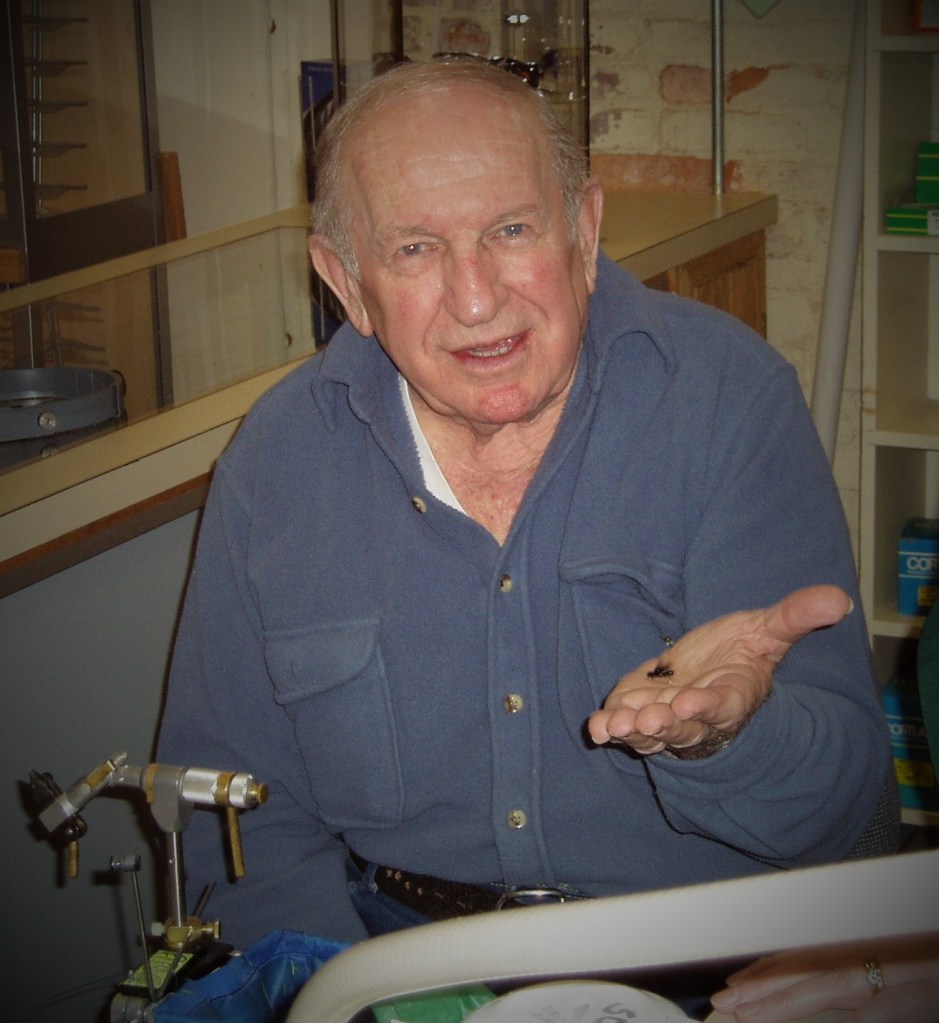
The late Ed Shenk with a fresh from the vise sample of one of his signature flies, the Letort Cricket.
-
The Simple Joy of Trout Fishing
Why is that man standing in the river smiling? I was out trout hunting again yesterday afternoon and, despite having the eagle greet me upon my arrival, the hunting did not seem destined to produce any big Catskill trout. I was seriously fishing terrestrials, though they brought no response, not even when cast to a bankside rise. As I approached some faster water, I noticed a couple of small rises, so I tied on a little sulfur cripple and made a few casts. When I decided to move upstream, I let my line drag behind me. By ignoring my fly I caught a trout.
The little brown brought a smile to my face and changed my focus, helping me to rediscover the simple joy of trout fishing!
That tiny cripple wasn’t floating too well in the riffled water, so I tried a pair of sulfur comparaduns, first an 18 and then a 20. I remembered this riffle from last autumn, and felt there ought to be some good fish around. I decided to tie on the lone size 12 Halo Isonychia in my box and fish that riffle in earnest. It was the right decision at the right time.
There were a lot of trout in that riffle, and a number of them were willing to come up and take a swipe at my Iso. Another brownie was the first taker. All of ten inches, he fought the soft tip of the old Granger bamboo with all the heart of a trout twice his size. I let him have his head a bit before bringing him to hand. The smile was growing.
It was a warm, beautiful afternoon on a gorgeous reach of Catskill river, and I was alone. The Granger kept flicking the water from that dry fly, and then placing it in another lie, anywhere I could see a deeper slot or a larger rock on the bottom. The trout responded.
As I worked my way upstream into faster sections of the riff, wild Delaware rainbows replaced the browns. Their characteristic quick little spurt rises were hard to react to, as I was stripping as fast as I could just to retrieve the line while my fly bobbed rapidly down the current. I missed a number of them: whack, there and gone in an instant, until I adjusted to the pace of the river.
Between misses, I caught a few chunky bows, every one fighting like the legendary senior members of their tribe. None of these wild trout quite reached a foot in length, but they had the wide profile of healthy, well fed fish. They sure could pull as they cavorted against the arching tip of my old cane rod!
I smiled and laughed at those caught as I twisted the hook free, and laughed even harder at those quick strikes that left me no time at all to react. I finished my afternoon right there in that riffle, grinning. I could hunt leviathan another day.
Sometimes we get very, very serious about trout fishing. If we hook small fish when we feel we should be catching trout of a certain size, we can feel like we are missing something. I hate to hear the scorn in some angler’s voices when they frown and say “nuthin’ but dinks” to a query of “catchin’ any?” The youngsters are as wild and beautiful as the elder members of the clan, and their heart is undeniable. We should all appreciate them more then we do. Trout don’t pop out of the gravel at eighteen inches long, they all start out little, and we owe our trophy trout fishery to the stamina and tenacity all of those small fry swimming in the rivers and streams.
-
Smalls
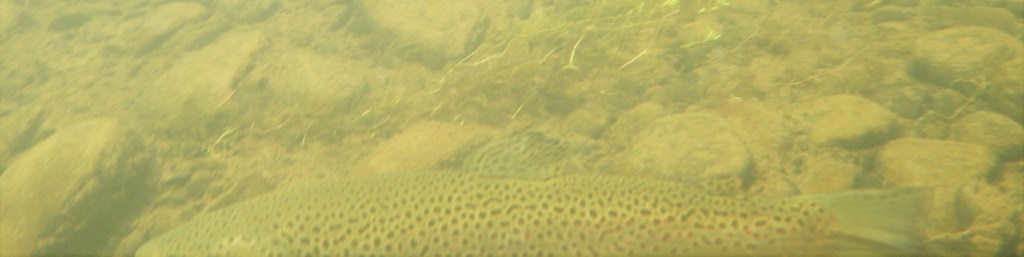
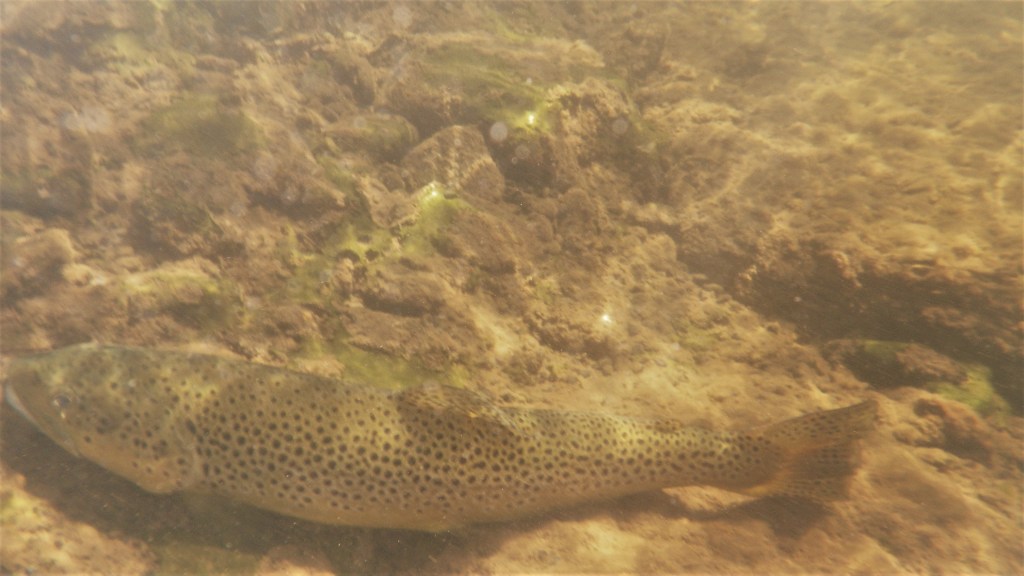
The challenge of blind underwater photography: submerge camera and find yourself unable to see the view screen; point & guess, withdraw camera from icy cold water into warm, humid summer air and view screen fogs, thus the photo capture cannot be observed. Resign self to hoping image is captured correctly. Find in editing that what was captured was less than that which was desired. Punt and call it artistic! A 19″ Delaware brown trout ponders the wisdom of selecting that tiny rusty spinner from those available for a morning snack. It has been a strange year. To be honest, that comment comes to the tongue every year, testament to the incredible variety of Nature and the wonder and puzzlement of angling Catskill rivers.
Though the first hatches of spring were wonderful, with incredible variety and at times prodigious volume, insect production has seemed rather spare since then. Even back in May, I noted an unusual number of uncharacteristicly small flies on the water. I was caught short on my first solo float of the season when confronted with thousands of Shad Fly caddis in a diminutive size 20. Only field surgery saved the day!
Summer is traditionally small fly season on our rivers, featuring the littlest mayflies: sulfurs from size 18 down to 22, various olives in sizes 20 to 26, Summer Blue Quills in sizes 18 and 20 and eventually the tiny size 24 tricorythodes. I am thinking that downsizing terrestrials may be my best move as well.
My concentration this morning was to add some smaller Grizzly Beetles to my terrestrial box. While I fished tiny little beetles when necessary in the Cumberland Valley spring creeks, I have used larger, meatier versions quite often. Ed Shenk called the miniscule black beetles Willow Beetles as they habitually were found in the willow trees lining the streams. A size 20 tended to be a bit large for imitations on most days. I was amazed at the little spun deer hair flies the Master tied for these, clipped just so to provide the rounded profile of the natural. Closed cell foam became hugely popular for tying similar flies, but I never seemed to have the same results the Master did with his deer hair creations. Then again, I was the student and he the Master.
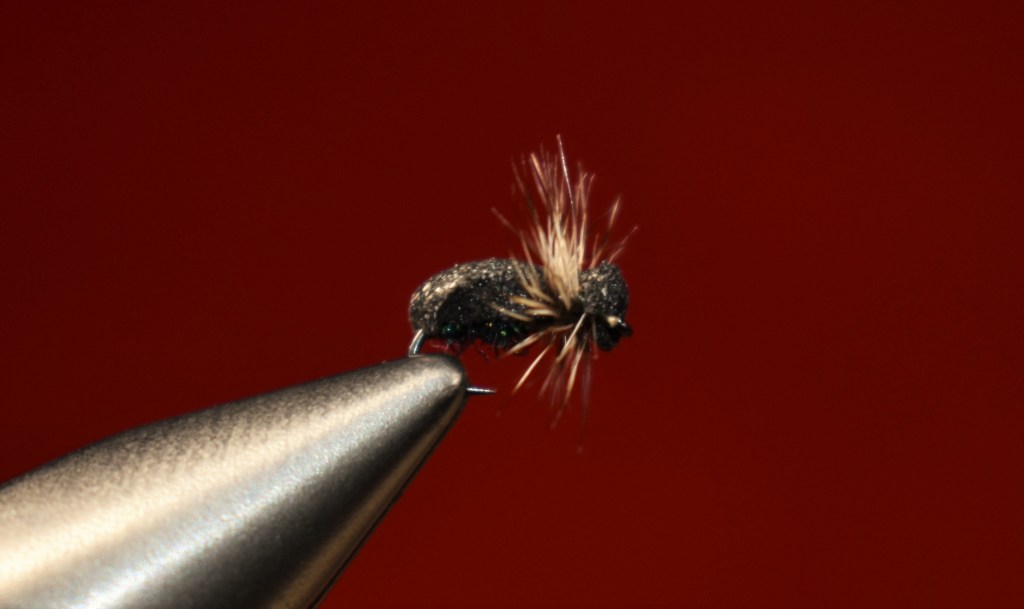
Smalls: Grizz 19: a size 19 Grizzly Beetle that I hope might tempt a few more reticent summer trout than the standby size 17 and 15 flies. The Tiemco TMC102Y is a special dry fly hook, offered in the odd numbered sizes in the English tradition. It is my favorite hook for many terrestrial patterns. The combination of the Sproat bend and wide gape in a fine wire, black finished hook offers improved hooking capabilities for these types of dry flies. They are strong hooks, despite the fine wire, and hold well on larger than average trout! In truth, I have not spun any deer hair in decades, not since I dawdled at bass fishing with the fly rod. I may need to revisit the technique in deference to the looked for Shenk Tribute Rod, expected this summer. It would be only proper to set out with a small fly box of The Master’s patterns when I first introduce that rod to the rivers of my heart.
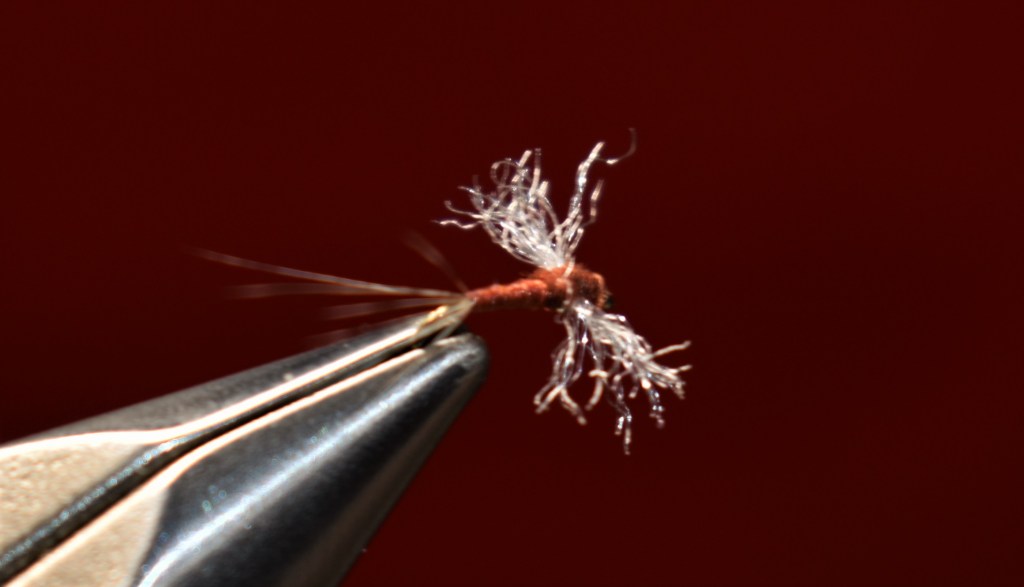
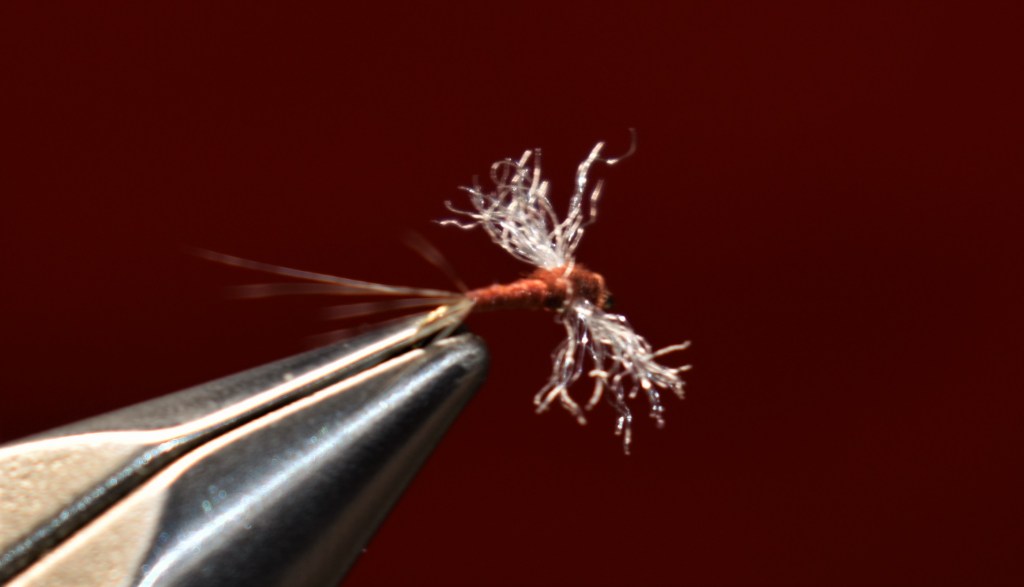
Tiny size 20 Rusty Spinners seem to have been the preferred early morning fare in these early weeks of summer. No more than a tying thread body, or a few wrapped strands of rust colored Trigger Point Fibers are required. I don’t go in for split tails on smaller spinners, preferring splayed hackle fibers for a little more support in the film. Clear Antron yarn, or a few Spinner Wing Trigger Point Fibers work nicely for the wings. Fishing flies should be realistic, effective, and quick and easy to tie! The fine brownie in the opening Fly Over photo selected one of these from Nature’s offerings. I fished along throughout June more or less expecting a late hatch of some of the spring flies I missed during May. When we finally got a real cold snap, plunging the rivers from the seventies back into the fifties over night, there was a day or two when some of those larger flies emerged. I saw Gray Fox, large sulfurs, as well a good numbers of “normal” sulfurs in sizes 16 and 18, the flies May forgot. I wish the cold snap had lasted – I never packed the sweatshirts and fleece away into storage. Oh it would have been heaven to enjoy a solid week of that fishing!
Now that July has come, summer seems destined to stay, so the Smalls will take care of the dry fly fishing for the duration. A light cane rod, a three or four weight line on a small classic reel, long leaders and 6X and 7X tippets will be the standard outfit for the next few months!

-
The Rainy Day Chill
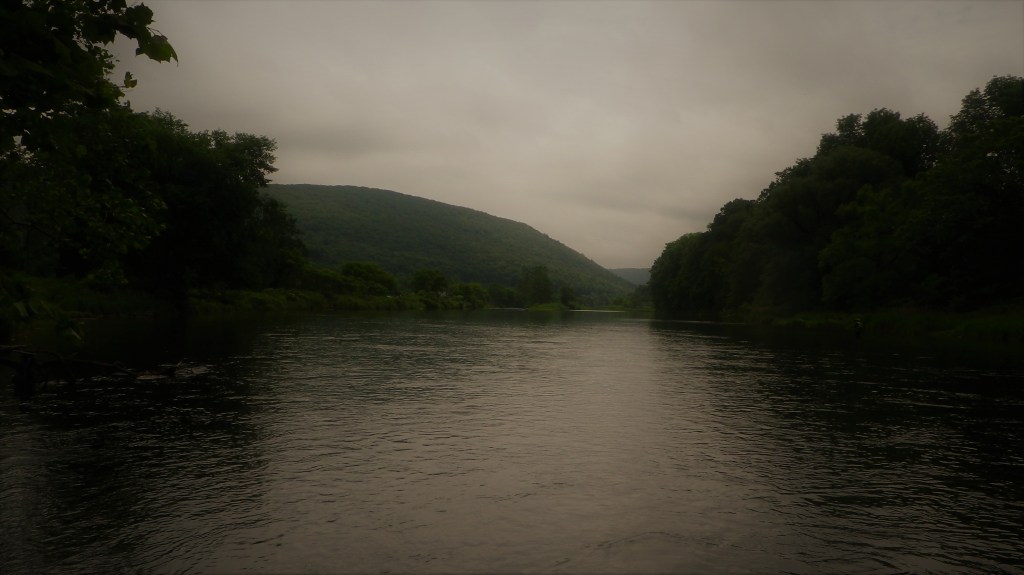
A few hours of forty-seven degree water immersion easily makes 70 something degrees feel COLD on a rainy, breezy front day. I let the heat drive me to the coldest water I could find the other day, and I found a little fishing. The stifling weather seemed to keep most of the fishermen at home, work, or some other air conditioned place, and I was happy for it.
I used to fish the West Branch every summer, making a long trip around the Fourth of July. The trout were always difficult, and that difficulty has increased with the massive increases in fishing pressure the river has seen. It has become pretty normal to find our Catskill trout keying upon moving naturals on all of our rivers. Once upon a time a simple thread bodied CDC dun was medicine on these picky feeders, but the trout have fine tuned their targeting abilities during the past decade.
I managed three trout, a hard fighting brownie between nineteen and twenty inches, and a couple sixteen inch fish that were equally determined to give their all on the bottom of the river. I had to estimate the larger fish, as the fly popped out with his just his back half in the net. That guy ate a delicate size 18 silk bodied CDC dun, a fly with a sparse wing that requires constant attention to keep it floating. I like to tie the wings heavy and tall to maximize visibility and movement, but some trout have begun to shy away from them, requiring a more subtle fly.
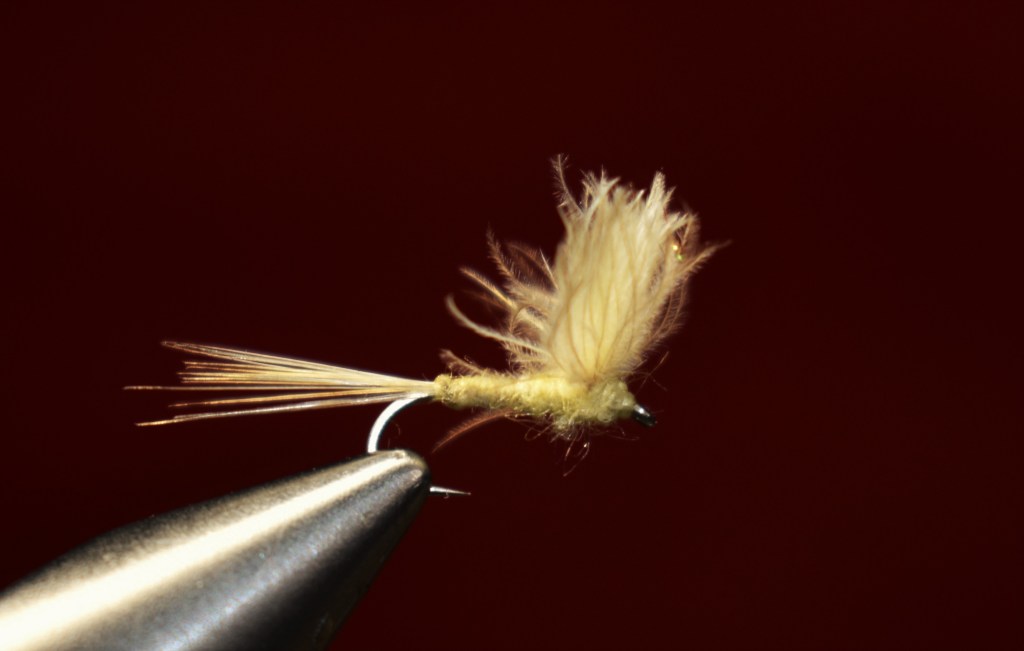
A silk bodied CDC dun with a fairly high, medium density wing, a fly that is good for a lot of selective, movement oriented trout. A few seem suspicious though, preferring a version tied just a touch slimmer in the body, with the wing a bit sparser and roughly three quarters height. Canting that wing back a skooch doesn’t hurt either. Tactics often dictate fishing long, and downstream and across to picky trout, and the constant retrieving of sparsely winged CDC flies wets them thoroughly. These fish often require multiple casts if they are feeding upon a good hatch of naturals, and that means a lot of time spent drying and fluffing the fly. Still, if a good trout demands subtle, you either give it to them or pass them by.
I learned thirty years ago that a fly will be more attractive to a trout if it appears alive and moving. The late great Gary LaFontaine impressed upon me that the light reflecting qualities of my flies imitated movement, so I try to incorporate those abilities in most of my patterns. I am not talking about Flashabou ribs here, more like a touch of Antron blended into the dubbing, or used as a sparse trailing shuck. Perhaps I am losing it, but trailing shucks have become so commonplace that some trout seem to have gone off of them.
If a shuck isn’t the answer, then maybe a little sparkle in the wing is. I was talking with JA a couple of years ago about flies and materials when the topic came around to Enrico Puglisi’s Trigger Point Fibers. I was using them for bodies, spinner wings and posted wings and having good results, and JA mentioned that a friend tied comparaduns with the stuff. “Gotta try that”, I said and I did. The material lends itself to comparadun wings and is much easier and faster to tie with than deer hair. The wings are a lot more durable too. Trigger Point fibers have a subtle sparkle that I believe imitates moving wings effectively, but it not as flashy as Antron. Selective trout seem to like them.
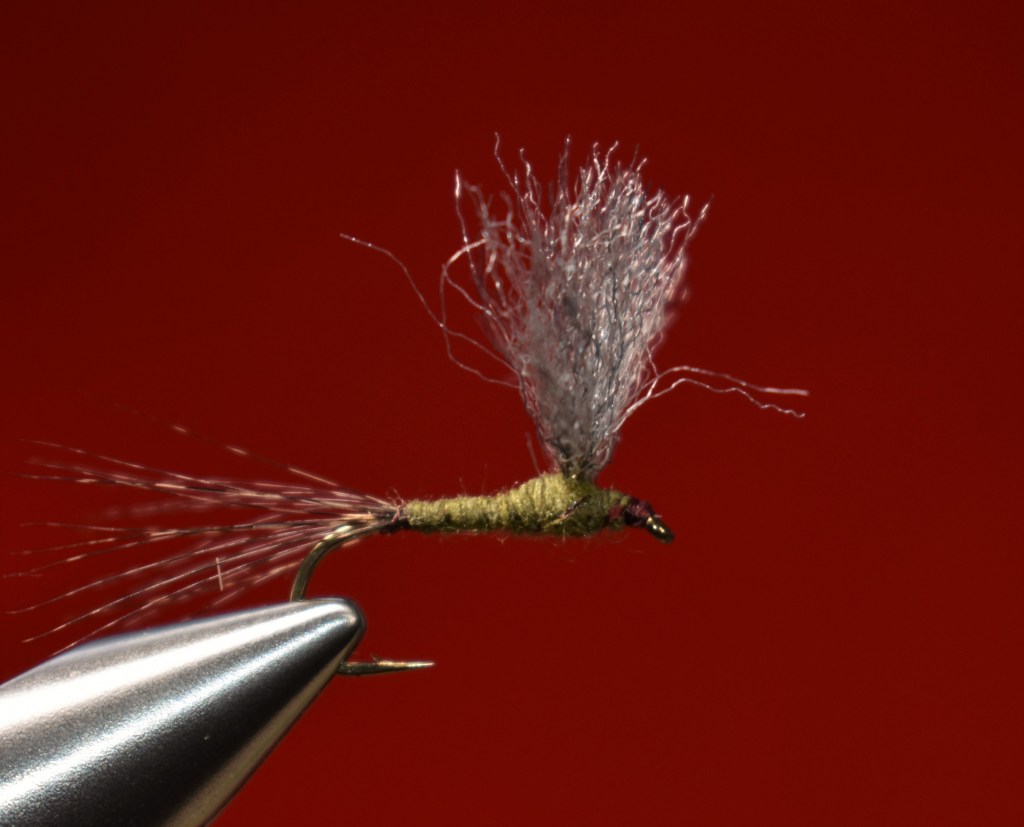
My Trigger Point winged Halo Isonychia has proven deadly! So, in a nutshell, I guess I am saying that picky trout get pickier as we get trickier. That is the reason I am continuously experimenting with fly patterns, materials and tying techniques. None of us have any hope of staying ahead of all of the trout in the river, but I hope I can always experiment a bit and stay ahead of some of them!
Search
Archives
- September 2026 (3)
- August 2026 (14)
- July 2026 (15)
- June 2026 (13)
- May 2026 (6)
- April 2026 (12)
- March 2026 (10)
- February 2026 (9)
- January 2026 (14)
- December 2025 (14)
- November 2025 (10)
- October 2025 (10)
- September 2025 (9)
- August 2025 (10)
- July 2025 (10)
- June 2025 (8)
- May 2025 (12)
- April 2025 (12)
- March 2025 (9)
- February 2025 (10)
- January 2025 (15)
- December 2024 (12)
- November 2024 (13)
- October 2024 (12)
- September 2024 (10)
- August 2024 (12)
- July 2024 (10)
- June 2024 (12)
- May 2024 (11)
- April 2024 (14)
- March 2024 (11)
- February 2024 (13)
- January 2024 (14)
- December 2023 (16)
- November 2023 (11)
- October 2023 (11)
- September 2023 (8)
- August 2023 (10)
- July 2023 (9)
- June 2023 (12)
- May 2023 (13)
- April 2023 (13)
- March 2023 (14)
- February 2023 (15)
- January 2023 (15)
- December 2022 (13)
- November 2022 (5)
- October 2022 (10)
- September 2022 (10)
- August 2022 (8)
- July 2022 (9)
- June 2022 (10)
- May 2022 (10)
- April 2022 (13)
- March 2022 (14)
- February 2022 (13)
- January 2022 (13)
- December 2021 (10)
- November 2021 (9)
- October 2021 (7)
- September 2021 (9)
- August 2021 (12)
- July 2021 (11)
- June 2021 (12)
- May 2021 (15)
- April 2021 (16)
- March 2021 (14)
- February 2021 (14)
- January 2021 (12)
- December 2020 (11)
- November 2020 (13)
- October 2020 (14)
- September 2020 (13)
- August 2020 (14)
- July 2020 (13)
- June 2020 (16)
- May 2020 (16)
- April 2020 (18)
- March 2020 (13)
- February 2020 (11)
- January 2020 (8)
- December 2019 (6)
 Bright Waters Catskill