I fished the limestone springs of Pennsylvania's Cumberland Valley for a couple of decades, founded Falling Spring Outfitters, guided, tied and oh yes, fell in love with the Catskill Rivers I can now call home.
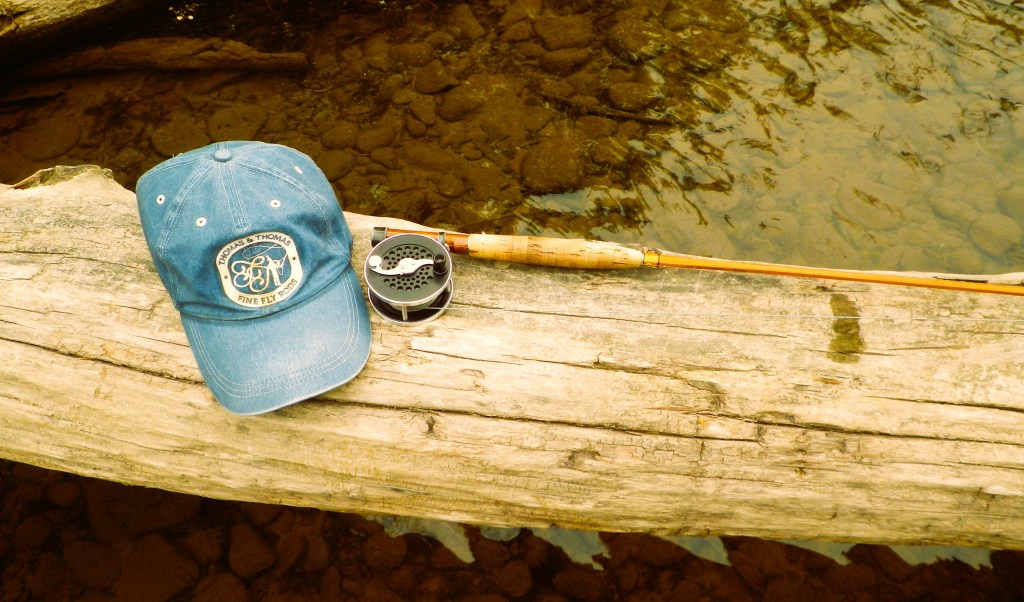
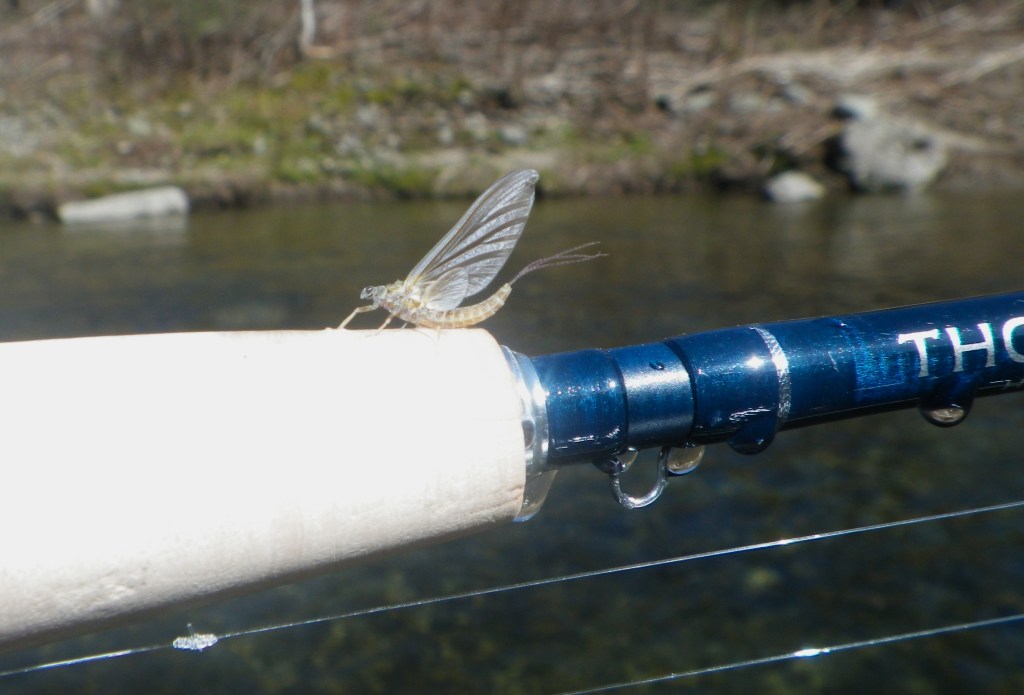
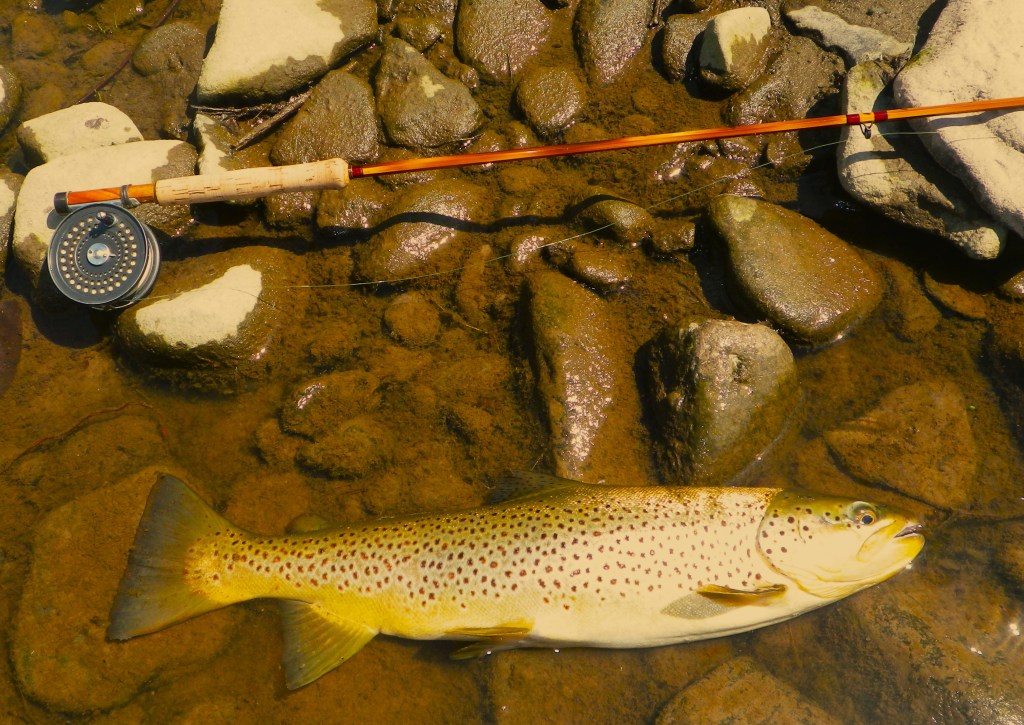
Tools of the angler’s trade: my faithful Thomas & Thomas Hendrickson. Rainy days and impregnated bamboo rods are a perfect combination!
This first weekend allowed for a little recovery from five days of fishing to begin my dry fly season and, now that it has passed, it’s time to get back to work.
Yes, I love retirement! For six to seven months each year my weekday job is fishing bright waters. As I get older, I feel the rigors of the job in my bones most days, but I’ll get back in shape before too long.
My tools are ready in the corner, that lovely old, impregnated Thomas & Thomas Hendrickson is always up to the challenge. Funny that some anglers don’t like impregnated bamboo. They complain they feel heavy to them and similar grumbles. Yes, some Orvis rods feel a little heavier and have a slower action, and my 8 1/2-foot Wright & McGill Water Seal needs a line weight heavier than my 8642 Goodwin Granger, but they are quite pleasant and capable fly rods. The T&T’s are really special though!
In their vintage catalogs, the company described this finish as a light impregnation, and that suits both in color and demeanor. My Hendrickson weighs just 3-3/8th ounces, quite the lithe eight-footer, taking a five weight line. I like the freedom from worry when fishing on a rainy day, for there is no concern about some unknown scratch in the varnish allowing moisture to seep into the cane. Back there in the seventies, Thomas & Thomas offered a choice of finish on all of their rod models, either their faultless varnishing or this light impregnation.
My vest is still fully loaded with Hendricksons, though there are signs that the hatch may be waning already in some quarters. Such has been reported on the Beaver Kill. I’ll be sure to have a well-stocked caddis box along too, but I still wait for a truly heavy and memorable hatch of my favorite mayfly.
The warm spell ignited yesterday demands I take the light rain jacket, for some portion of this coming week is fated to bring showers and even thunderstorms. Funny how quickly we have gone from chilled-to-the-bone cold to muggy.
I’d love a sunny morning to stimulate some spinners or a nice caddis hatch, but it isn’t looking like that kind of day.
Well, it’s half past six, time to get everything together, make a good breakfast to last me through a long day on the river, and concentrate on the job ahead. Here’s to a job hopefully well done!
The angler’s spring, finally commenced and at least partially intact, and I have found myself rushing about trying to make up for what was lost to ridiculously high water and a very late turn of cold, cold weather. It is nearly May and I do have a week’s fishing under my belt, though it hasn’t been enough to wipe away the rust from my skills.
The week began well enough, drifting down the river and noting how wintry the mountains looked, barer than expected more than a month ago when the warm sunshine had me duped to expect that marvelous gift, the early spring. It was hard to shake the feeling that I had missed out on a full, glorious week since I had. I was convinced that no self-respecting trout was going to surface feed in high water flowing much closer to forty degrees than fifty, a position borne of too many cold, windswept, early days upon lifeless rivers. Mother Nature never pays any attention to an angler’s experience, and perhaps that is the only mantra we should retain and recite.
I didn’t encounter a heavy hatch, but there was enough of one to produce some pleasant fishing and some quality, hard fighting trout. I went wading the next day and found that the lower, warmer freestone water quizzically revealed fewer bugs and barely any rises, though I did manage a pair of healthy fish. I took that as a good sign and kept my boots on the ground for the duration, though I couldn’t shake the thought that those trout were actually just the consolation prize.
There had been another opportunity, one that frustrated me for I had failed in something as simple as tying a tippet knot and controlling my admittedly rusty reflexes. I had tied that fresh tippet to my carefully inspected leader in the comfort of my angler’s den and held every confidence when I made that long cast to the very edge of victory. The rise was heavy, one of those whitewater explosions we all dream about, and I struck to feel just a millisecond of that wondrous surge before the line came free. That trout kept both my fly and four feet of tippet.
The rest of the week simply continued to impress me with just how much my timing, condition and attention to detail had suffered during six full months of winter. I found some hatching flies and all that, caught a few average sized wild brown trout, but as soon as I found myself squaring off with the truly difficult trout that I love, I found myself woefully lacking in the nuances of the art. I am not shortchanging those smaller fish. A wild trout taken fairly on a dry fly is one of the great gifts an angler receives from the rivers that define him, but I do feel the effects of age and rust have gotten the better of me this week, and I don’t like it.
Angling teaches humility, and we all get a lesson from time to time. I know that I should have fought off the mental malaise that the longer reach of winter inflicted upon me, should have gotten out more and exercised away more of the stiffness and pain of the sedentary season. I let the winter into my head and allowed it to rob me of my focus.
Friday afternoon I worked through my difficulties, I thought. After subjecting myself to enhanced frustration for the best part of the hatch, I got hold of myself and relaxed. My casting distances increased markedly with the old smooth grace I expected, and I was gifted another opportunity, in fact a handful of them.
The wind subsided and a group of impressive riseforms appeared down river. I stalked them patiently and carefully and my casts fell accurately. These fish were taking the odd drifting dun in flat water, but they showed no interest in mine. Each allowed a single drift before they demurred.
As I stalked the last in the group, I had perfect concentration and clear focus on the task before me, and I executed the cast perfectly. The drift seemed to cover a quarter mile rather than a few feet, but I was calm, intent. That fish took my fly perfectly, and after taking half a breath I raised the rod, sharply though controlled, felt the spark of his energy and watched the tippet-less leader come sailing back to me through the sunlit air.
Let me meditate on that and what should have been…
Ah, at last a chance to remember what spring actually feels like. Wading in shirtsleeves, enjoying the sparkle of clear, moving water under the sun, and watching mayflies depart the river, winging skyward!
It was a welcome old feeling, sitting there on the riverbank, baking in the sunshine, and there were Hendricksons about with all the promise that entails to a dry fly angler with time on his hands, full fly boxes and a favorite rod. I am home at last!
How the angler’s mind wanders… will the trout rise under such bright skies? Of course they will, but why aren’t they rising now? There are enough bugs to bring an eager fish or two to the surface. Oh, how we seek to capture perfection when it lies within our grasp!
In truth the trout chose not to rise, but it was early, and I waited patiently. Heard a car door shut behind me. The idyl vanished for a moment, until I saw a figure upstream on the bank, keeping his distance, seeking his own water and leaving me to mine just as it should be. He waits for a while, still early for the hatch after all, then runs out of patience and I hear the car door again.
I waited. Twice I rose and waded out into the caress of the current. The wind drove me back, howling suddenly, swirling, the Red Gods reminding me they were in attendance. The second time I rose as more flies appeared, stood my ground in mid river and searched every well-known lie of this place. I noticed two odd little blips in the current, nothing certain, but enough to draw me further from repose on the sundrenched riverbank. Yes, yes, no mistaking that, an exuberant rise; a trout as happy to be a trout as I was ecstatically an angler!
He was well, tight to the bank, there where the current rushes and bulges and the steep, rocky terrain rebuffs the wind and makes it’s own eddies in the air. I waded hip deep, taking my time, uncoiling line from the Hardy, holding onto the fly as the current took the line downstream, released it and started to cast. Puffs of wind delight in blowing the fly away from the bank as the leader seeks to lay it nearly touching the gravel. Another foot of line, and patience, until the gusts subside.
He had risen enthusiastically four or five times, when my sleek winged 100-Year Dun touched down so perfectly, bounced two, three times with the current, and then it was his fly. He ran immediately, the rod heavily bowed and the Hardy coming to full chorus, sharing that magical energy he derived from cold, clear water and abundant oxygen!
I fought him at first from my hip deep stance in the force of the current, but he refused to let me bring him near, running again and again as the Hardy soloed over the swell of Nature’s orchestra. I started toward the shallower edge and my sunlit bank, reeling a few yards of line and then surrendering it once more. In the quieter flow we played the final dance. He was heavy, and wild and strong as I twisted the fly from it’s hold and sent him back with gratitude.
I was full of the magic then, drying the fly, fluffing it’s hackles, eyes searching eagerly for the next foe. There were plenty of flies on the water now, but no rises, no more valiant warriors to sample the bounty. There are times when Nature bestows a single gift, and ours is simply to bow our heads in thanks.
I waded out, took a last, reverent look and traveled to another haunt. I found a line of soldiers knee deep in a usually forgotten run, all watching, unrequited.
Hendricksons danced upon the surface, but the trout demurred, less than eager to run the gauntlet of man. I walked upriver, pausing and studying the runs and boils, until one splash of white water brought a smile to my face. The picket line below retreated to land, found reinforcements, and departed for other missions while I hunted those white splashes amid the tumbling rush of water.
The Red Gods weren’t inclined to allow another moment of triumph, raising the winds again and swirling them between the ridges of the mountains. Those splashes demanded all the reach I could muster, giving the Red winds time to toy with aerialized line, leader and fly. I cast and cast despite the blow, and three times my dragging fly detonated a whitewater explosion as the Red Gods howled with laughter.
I was alone on the river now, and in the solitude, I hunted the last scattered rises. I waded carefully, deeper into the quickness and power of the flow. Shorten the casting distance and even the odds.
Between gusts I fired a cast to my target, kicked the rod tip back and dropped it with the fly close to the surface, and managed a suitable drift. He came to it with a splash and exploded into the air as the rod arched, and then it was all white water and the screaming of the reel above the roar of the wind.
The runs and leaps continued as I backed slowly toward shallow water, Mr. Delaware rainbow was not giving any quarter.
I brought him at last to the net, buried the mesh in the writhing current as I pulled the fly from it’s hold. Swim free aerialist! My thanks for your energy and your spirit!
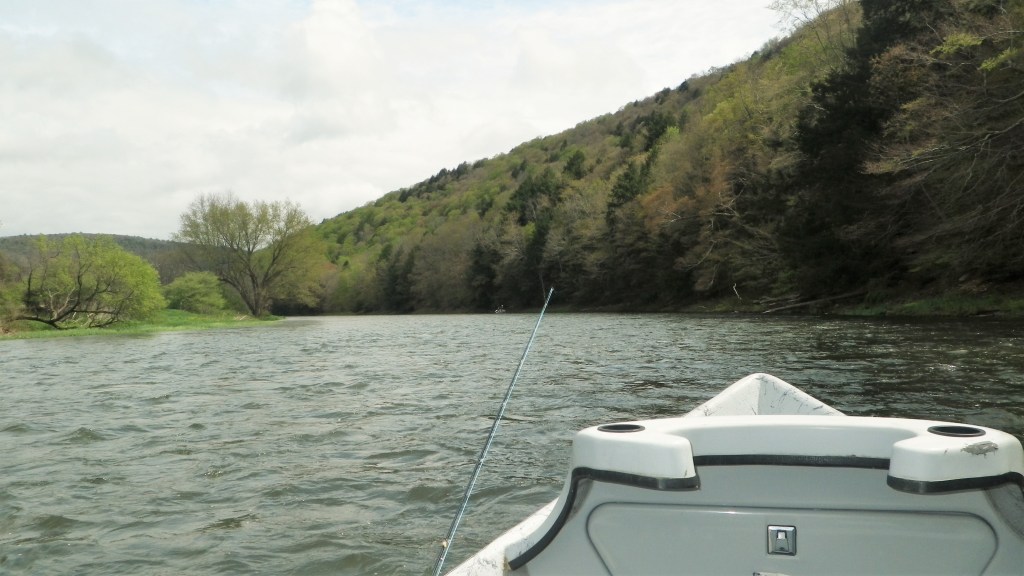
I had heard some testimony over the weekend, people I trusted had fished to hatching Hendricksons on the West Branch last week, despite the cold wind and water. Though I resigned myself to making the first solo float of the season to start the week, the heavy frost and Crooked Eddy’s twenty-six-degree air temperature did not fill me with hope.
I put in a bit later than normal, due to the morning chill, and was surprised to find tiny olives on the water as I began my drift just past eleven. I passed two rising fish during my first mile and a half, the sneaky kind that don’t betray their presence until the boat is next to them, leaving no time to set up and anchor. Those olives would persist more or less throughout the day.
The sun was bright and worked it’s magic on the frost, though I kept my insulated jacket on until mid-afternoon. Here and there I passed another rise, none with sufficient advance warning to set up and fish. What the day failed to offer in fishing, it made up for with the beauty of cobalt blue skies and that sunshine.
There are a couple of places where I expect to find some Hendricksons when I float this river in April, though I tend to find a bevy of drift boats in those same environs. With the downstream winds picking up, some of those areas were too exposed, making it impossible to see any mayflies that might be on the water. I stopped and waited dutifully at each, finding signs of neither mayflies nor old Salmo trutta. I came upon my last, best place with nary a boat in sight. I could scarcely believe it.
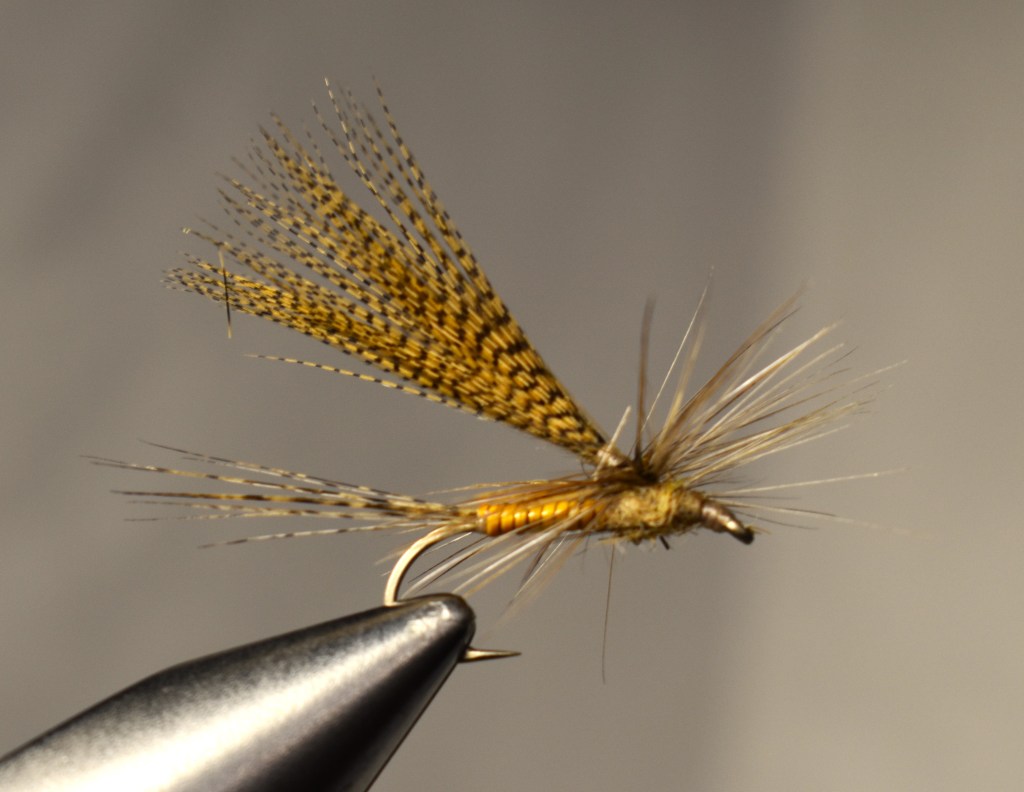
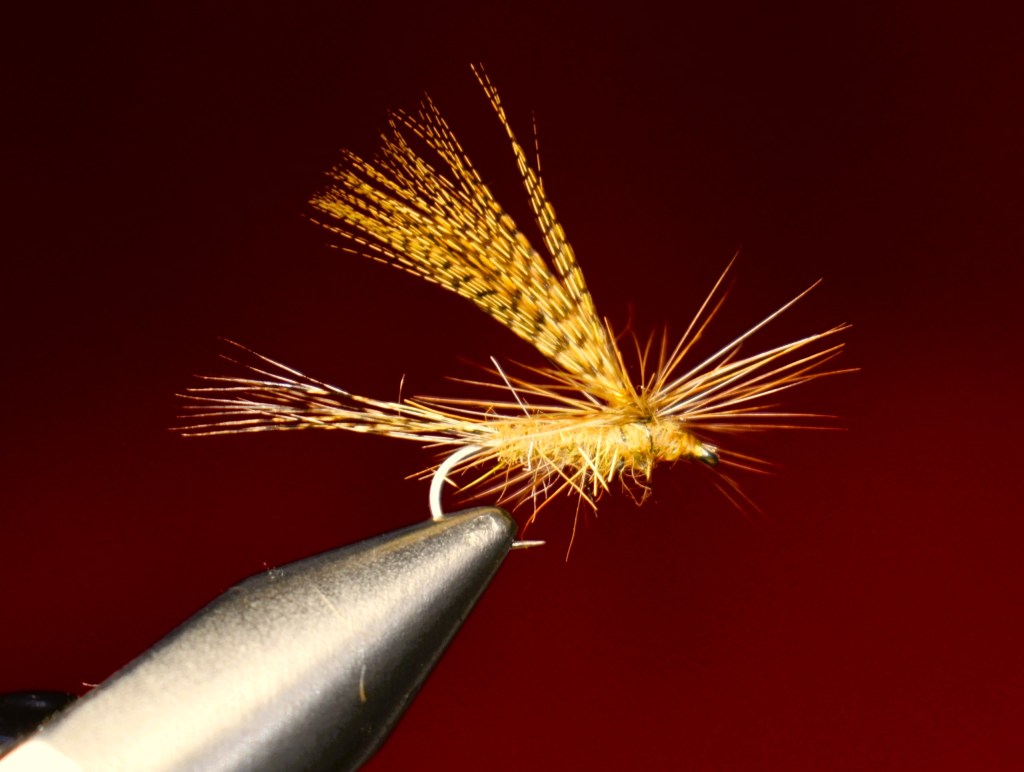
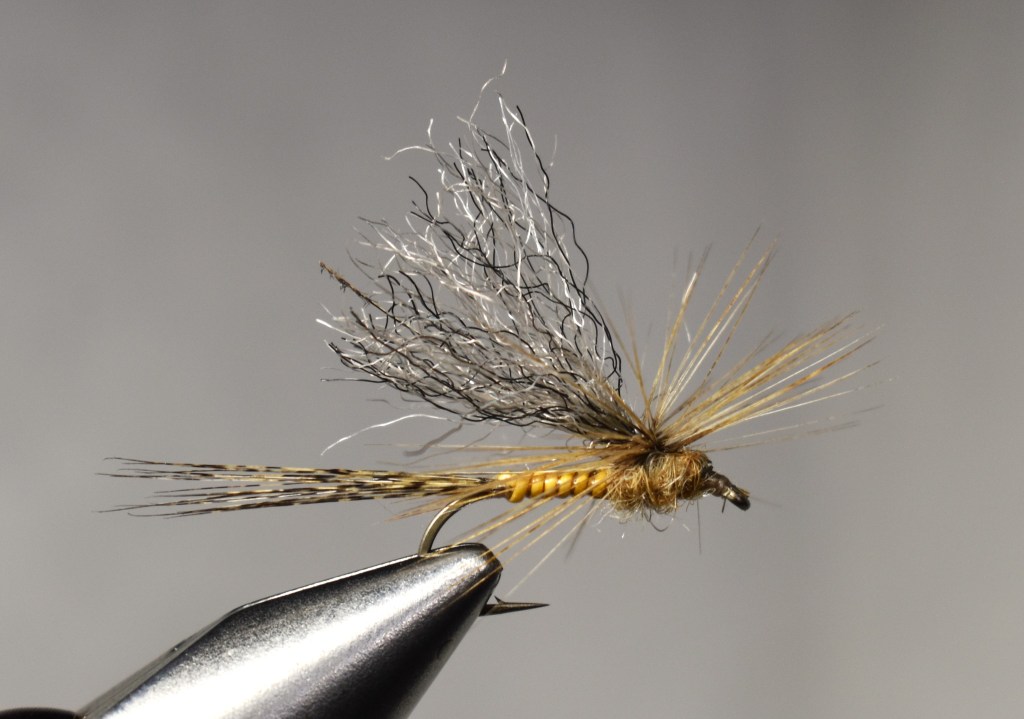
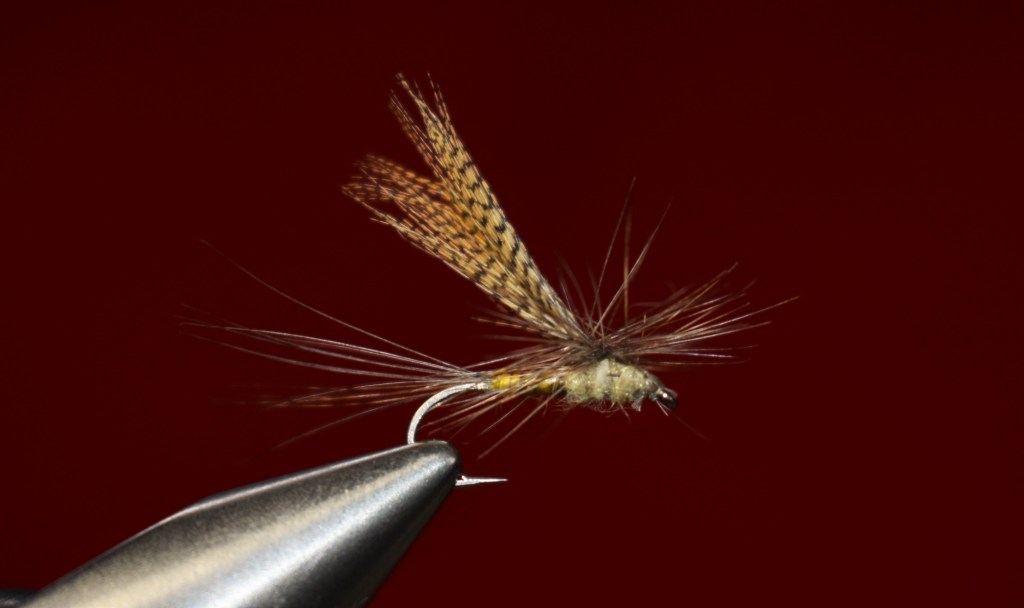
I anchored up at the tail of the riffle and waited, tying one of my size 16 CDC emergers to the 5X tippet. I had tied a handful of these, as well as some CDC sparkle duns with my A.I. Hendrickson dubbing blend, figuring the scraggly body would help the CDC wing mimic a live and struggling dun fighting to emerge amid the cold water and wind. The little fly would prove to be a very good choice!
I had spotted a fish that rose a couple of times tight to the bank, and I eased the anchor off the bottom to let the Hyde slide down current into casting range. When settled into position, I noticed the first larger duns beginning to mix with those ubiquitous olives in the drift lane. The A.I. Emerger looked alive to that brownie, and he bored out into the windblown current as I gave him the steel.
I had forgotten just how hard it can be to coax a good trout to the net from a drift boat, particularly one anchored in strong current. Playing and netting from the boat is ideally a two-man affair. I got him in there eventually, a heavy bodied eighteen incher, my first trout of 2024.
I had to slide down current once more when I spied a couple of suspicious swirls just out of casting range. With a little patience, they evolved into two distinct riseforms. Both of these fish were moving, not far, just sliding around a bankside pocket with a little wooden cover among the rocks. I fluffed the emerger’s wing and started working to the outside fish. It took a few casts to synch my presentation with his movement, before he sucked my floundering fly into his mouth.
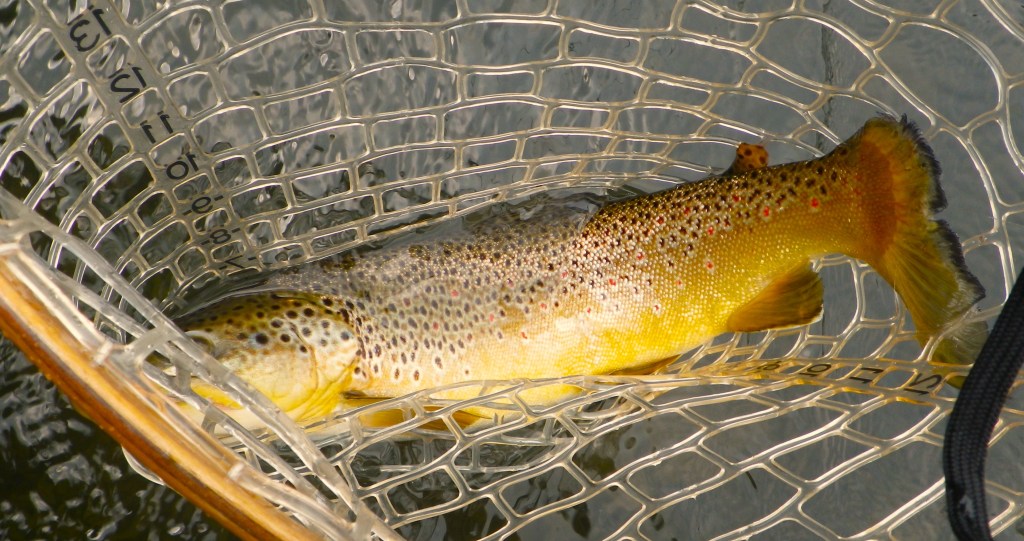
Trout number two was even more determined to avoid getting into my boat, though my old Thomas & Thomas won out in the end. At nineteen inches, he would be the best of the day. I stayed put after boating this one, as another had risen not far below that sunken limb.
The emerger had lost some CDC fibers, but I fluffed it up enough to try for number three. The Red Gods seemed to have decided I was having too much fun, so they cranked the wind another notch, adding some gusts timed with some of my back casts. Accuracy and presentation suffer under such conditions, but I kept after that last riser until he too made war to avoid the net. He lost that fight just like his brethren, and I hefted aboard another solid brownie of about the same size.
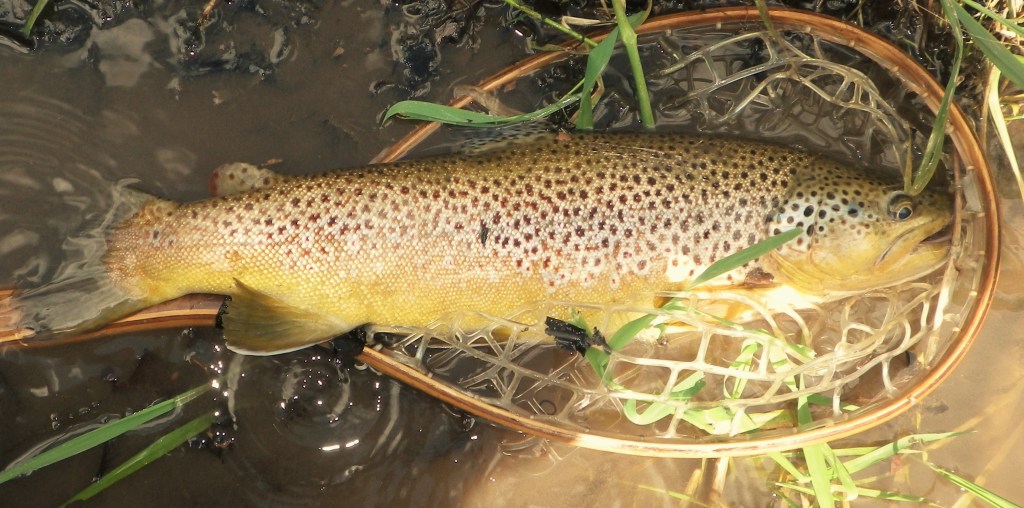
The hatch wasn’t heavy, and it didn’t last as those epic West Branch Hendrickson emergences that haunt my memory did. The next few miles failed to show me any feeders, until I rolled into my traditional last stop. A solid trout rose hard to take a straggling dun, and then the Red Gods put the fans on high. I waited until things calmed down briefly, spotted a sip and offered the Century Dun I had tied on while the wind blew. The fish took the fly quietly, then headed for deeper water in a rush. I netted him a bit easier due to the slower, shallower water I had anchored in. All of these browns looked to be within about an inch of one another, a lovely quartet of hard fighting wild trout to finally get me on the board in 2024!
My tying kit is ready for tomorrow’s Fly Tyer’s Rendezvous, and the boat net and dry bag are packed into the car for the week ahead. The weather doesn’t look very springlike but, if the wind doesn’t get too far out of hand, I am finally going to do some floating next week. There have been reports of “great fishing” though looking at the water temperatures, winds and rainfall doesn’t quite seem to jibe with that line. Advertising. Hey, it’s always great to go fishing, right?
The third week of April comes to an end, and I have spent zero hours on rivers for it’s duration. Looking ahead at the forecast, a winter coat seems in order for next week’s angling, but I have freshened the leader on my number one boat rod and reel in anticipation anyway.
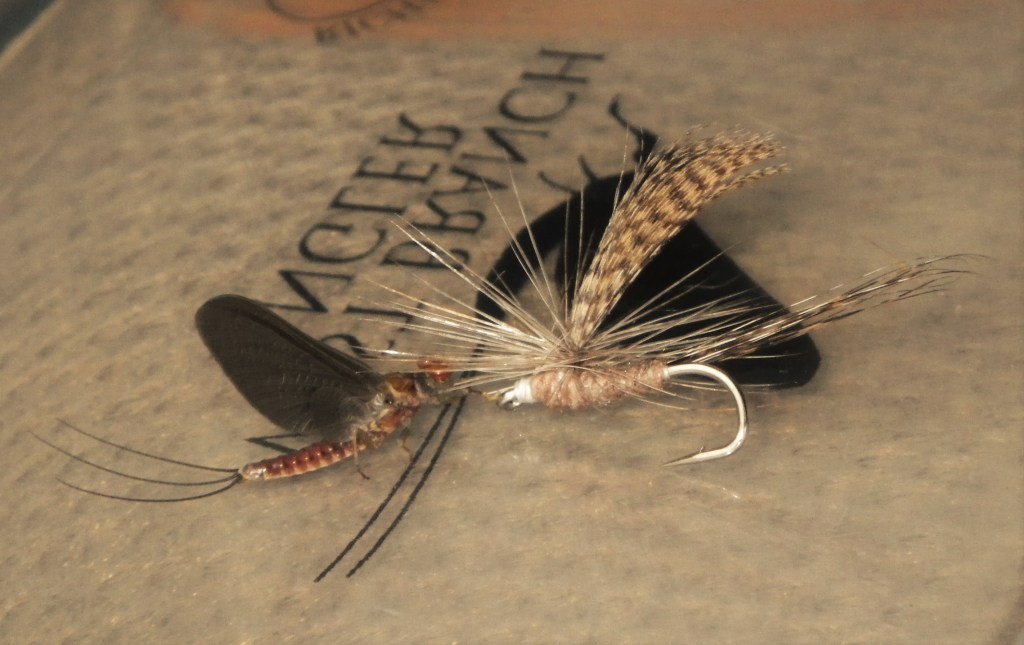
I tied a few boat flies the other day, some with heavier CDC wings and some of the Trigger Point wing variety I call Century Duns. Both of these styles are more suitable for the long, downstream casting ritual common to float fishing. The tying gave me something positive to occupy my mind for a couple of hours. Keeping my sanity is kind of tough when winters hang on into the weeks we consider to be part of spring.
Traditionally, Hendricksons starting to hatch during the third week of April is what I consider a normal spring. There really isn’t any normal here in the Catskills, but it’s good to have some sort of benchmark for talking’s sake. Second week early, third week normal and fourth week late – those are the guides I use to judge the timing of the best mayfly hatch of the season, which is the real arrival of spring to a dedicated angler.
Of course those reports I mentioned have included the H-word, but I won’t believe it until I see them, along with a number of healthy rings in the surface telling me the trout are really feeding on them. To be fair, some of those reports casually mentioned that the Hendricksons and Blue Quills they were advertising were seen down river on the Mainstem. They usually start first on the lower reaches of the big river, but there is a lot of flow out there, and it hasn’t cracked that magic 50-degree water temperature for a week, so I wonder.
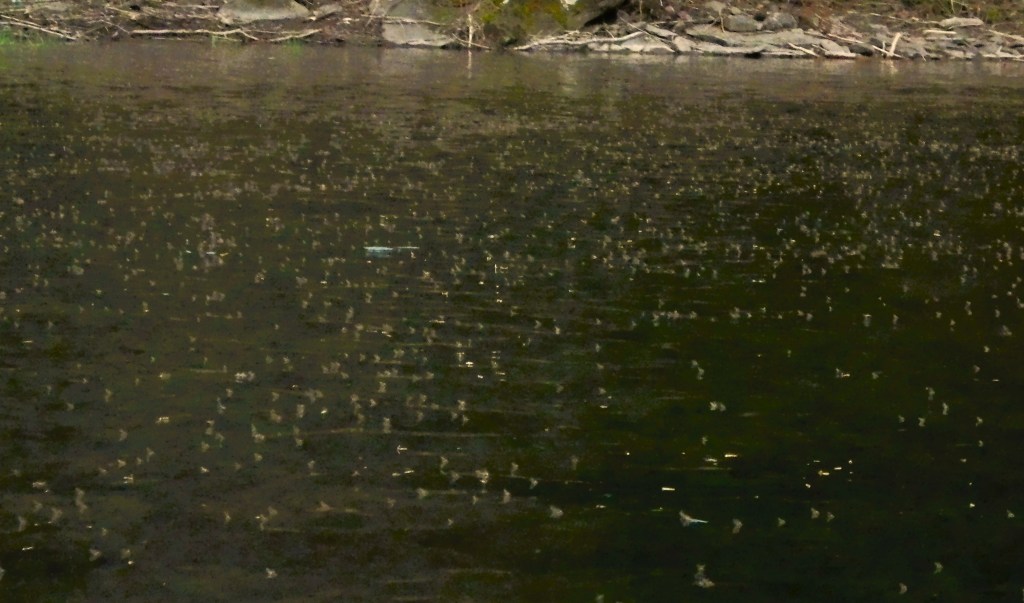
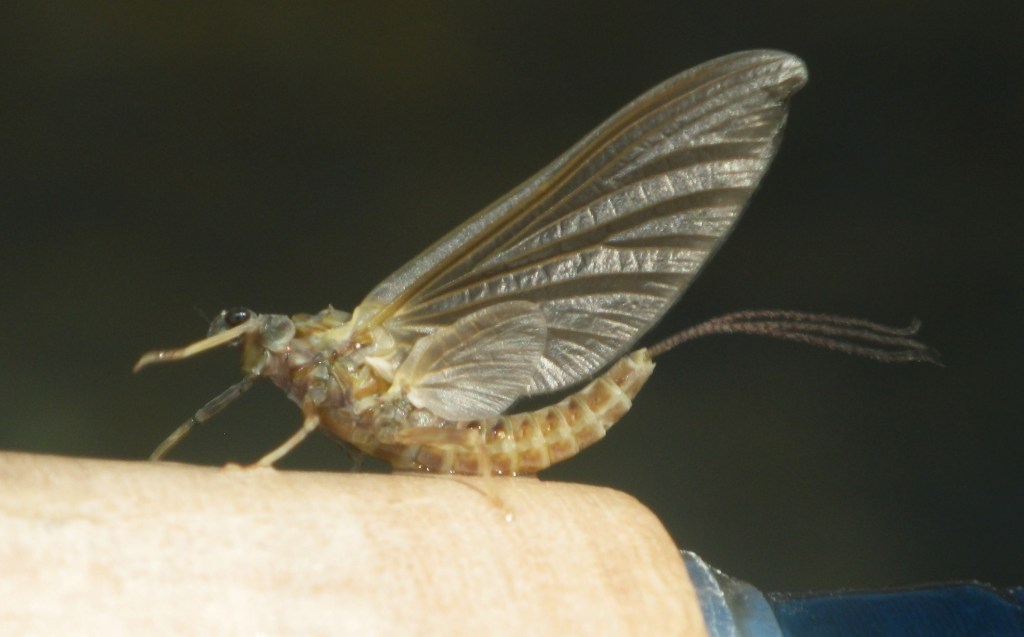
This is what a nice Hendrickson hatch looks like. You cannot help but notice there are a lot more than a handful of bugs on the water. See any rises? NO, you don’t, cause the cold front shut down the couple of trout that had been rising before I took this photo.
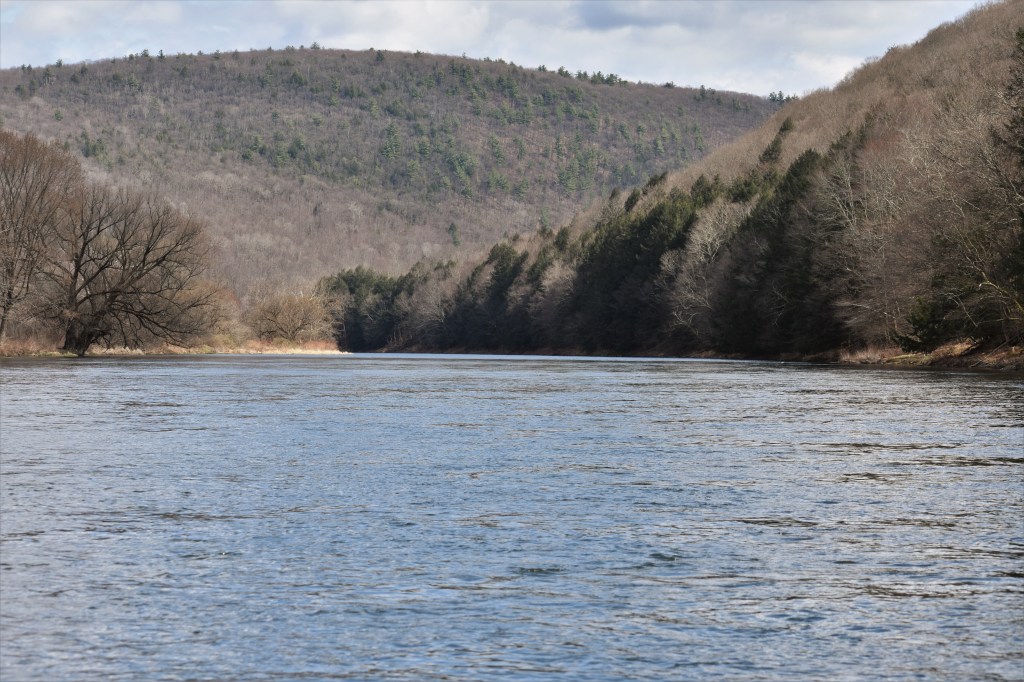
I will be looking for a scene like this one, hopefully including rises, when I drift down the river next week. I wish I could say that I had a lot of confidence in finding a nice hatch, but that water is still cold, and cold water doesn’t flow through my version of Valhalla. The deal is, I could find a few flies here and there, and a good brownie or two sipping in some little out of the way pocket along a random stretch of riverbank, and I am very cool with that. Kind of thing that can make your day!
Yesterday was a lovely day to be outside, with a fine dose of warm sunshine and gentle breezes. Piloting the mower rather than the drift boat my heart craved, I contented myself with the simple accomplishment of necessary chores. While there are some who will run the West Branch during flows in excess of 4,000 cfs, I am not one of them.
All of our rivers are wild and rough again today, so this day, expected to dawn as lovely as yesterday, will doubtless be another chore day for me.
I recognize the safety concerns of high river flows, and I respect even the milder rivers like the West Branch, refusing to overestimate my own prowess as an oarsman. Once flows rise much above 3,000 cfs, I have found little chance of dry fly fishing. Trout seek protected pockets along the riverbanks if they are drawn to the idea of surface feeding, and the more flow the fewer pockets that remain the calm collectors of insects such fish crave.
Our forecast calls for another three quarters of an inch of rainfall over the next three days, with most of it coming down tomorrow. The Delaware reservoirs are higher and spilling from April’s rain that has already been more than twice the historic average. I cannot even estimate when I might see floatable flows on the West, much less wadable ones.
My prayer is simple; that the rivers welcome me at the same time they welcome the Hendricksons!
Dodging much of the rain forecast this week, I managed four afternoons on the water. Yesterday seemed as if it would be the one to open Nature’s coffers and provide sustenance to the soul of this long-suffering dry fly angler. It was not meant to be.
My freshly re-treated rain jacket stayed dry yesterday, but the faithful bamboo fly rod was used for nothing more than a few practice casts. No flies hatched, no trout rose, and during the night all of that rain found the watershed of the Beaver Kill. She has risen nearly two feet since four o’clock yesterday, and the graphs of discharge and gage height are vertical lines. I expect all those dozens of Quill Gordons tied over the winter will be put to rest until next year. There’s even a bit of snow in tomorrow’s forecast. Such is life on the river.
Waiting for Hendricksons
And still, I have fared much better than one of my friends. Mike Canonico called me yesterday to relate his fishing on a mountain stream. It was not a tale of solitude and bliss, of bright trout rising to his dry flies. Instead, his was a tale about the dark side of solitude.
Mike related a sudden and serious injury, alone on a reach of water. His cell phone was useless, he was in pain and unable to walk out. Crawling back to the nearest road is not what this angler had in mind when he set out for a day of fishing, but grim determination saved him. He’s okay now, though facing surgery and a long rehab which will cost him the majority of his fishing season, and his tale will make us all stop and think before venturing off in the mountains alone. Heal up my friend, and I’ll save you a seat in the boat when you’re up to it.
Spring is out there somewhere. I’ll keep searching…
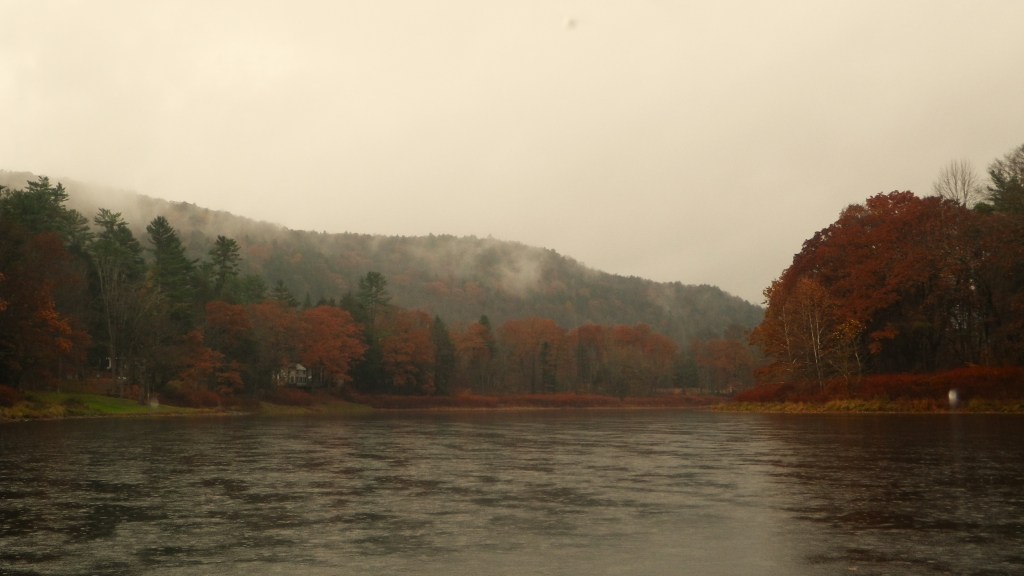
Wednesday, April 10th: A chilly rain is falling, and the mist wraiths surround me on this quiet little pool. The past two warm, lovely, sunlit days left me waiting and wanting for some actual fishing, and it was hard to come out today and muster hope for something more. I find I have less of my old willingness to suffer the weather in pursuit of trout.
We have all read those epic tales, blizzard hatches in snowstorms, trout feeding madly in pouring rain and sleet, but have we lived them? There are too many uncomfortable days spent upon rivers to count in my memory, yet I find it a truly difficult task to recall the few that offered even mediocre fishing. Perhaps all of those scribes had suffered alone and wished for companionship in the afterlife; or they simply felt that all of their readers should suffer the defeats of cold, wind and rain to better appreciate the sunny days.
Cold, gray light and mist wraiths!
I was warm enough when I settled into my seat on the riverbank, my old rain jacket zipped up to my neck. My arrival was punctuated by a burst of heavier rainfall, a gift of the Red Gods deigned to shake what little resolve I had. There was no appreciable wind, and for that I was thankful.
I had dented the soft soil and brown grass for more than an hour when I saw the rise, rising myself to work down to what I prayed would be a casting position. I had knotted the new A.I. Quill Gordon, thinking the buggy, disheveled dubbed body appropriate for a mayfly struggling to emerge in unfriendly spring conditions.
Once in reasonable range I settled my feet and resumed a patient vigil. The rain moderated, then intensified and moderated again, and at last the rise was repeated. It seems the season’s first fish was moving, for I saw some motion in the current as my fly floated beyond the target, a look as drag ensued. Watching, he slid about the fast current of the flat, rising twice more in different locations, then the rain increased once more. Chess, in a chilly spring rain!
When the droplets paused again, I was ready. He rose, I cast and he took the fly, leaving me wondering in which pocket I had stashed my sense of timing. Dulled by five and a half months of winter, I had missed him cleanly.
It would be half an hour before I caught a disturbance in the surface again. Sure enough, my missed fish had discovered another mayfly. This time I was sure I had him, but just as the electricity started up the line and into the rod it was gone. Timing too late perhaps? I know only that the hook pulled free.
The flies were sparse, as they had been on those preceding gorgeous days, coming for less than an hour. It was nearly done, though each time I thought to depart a straggler would appear, and I waited there as the cold worked it’s way into me. I saw one dance down toward an obstruction and vanish in the gentlest sipping rise, sent my fly to follow it’s path to no avail.
My traveler was finished then, and no more would he crease the flow and entice me. When the rain picked up once more, I turned. Though thoroughly chilled now, I felt that faint tingle of excitement, a hint of the old magic winking at me through the rain. Well, the season has begun…
I enjoyed a little warmth, the sight of a sparse handful of mayflies of different varieties, and I even made a few casts, just to get those muscles reintroduced to the feeling of presentation. I was hopeful, more so until I checked the water temperature just after Noon, and relished the moment. Of course, once my thermometer registered only 42 degrees, I let my expectations recede a bit.
It is ten degrees warmer this morning than yesterday, and the high is forecast to reach 74 degrees. I hope this day will amount to more than another tease, for nearly two inches of rain are expected over the next five days of falling temperatures. This is spring in the Catskills, and it seems each year unveils a different scenario.
May brings the springtime anglers dream and reminisce about. April is simply ephemeral. (Photo courtesy Chuck Coronato)
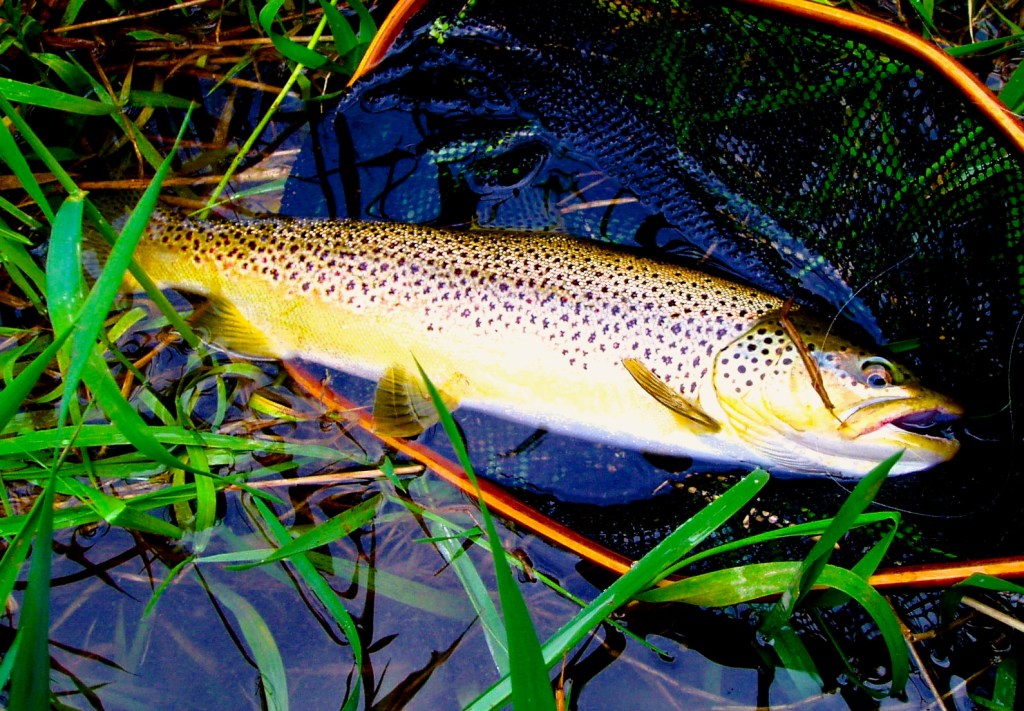
A case in point concerns last April. The tenth was my zero hour and it blossomed into a sunny day in the sixties. Though flies and rising trout were sparse, the three brownies I found feeding at the surface were duped by my offerings and put an arch in the Leonard. Good fish they were too, seventeen to nineteen inches, and I can picture each of their lies and the cast that seduced them still! Of course, it would not be April without Mother Nature’s mysteries. The week warmed daily until Friday afternoon flirted with ninety degrees. The sun shone, the winds blew, and there were neither hatches nor risers throughout.
Logic would lead one to expect continued good fishing with air and water warming daily, but it wasn’t in Nature’s deck of cards. Hatches and the fishing awakened once the afternoons cooled down to more springlike temperatures, though there were still fits and starts. Ah yes, April!
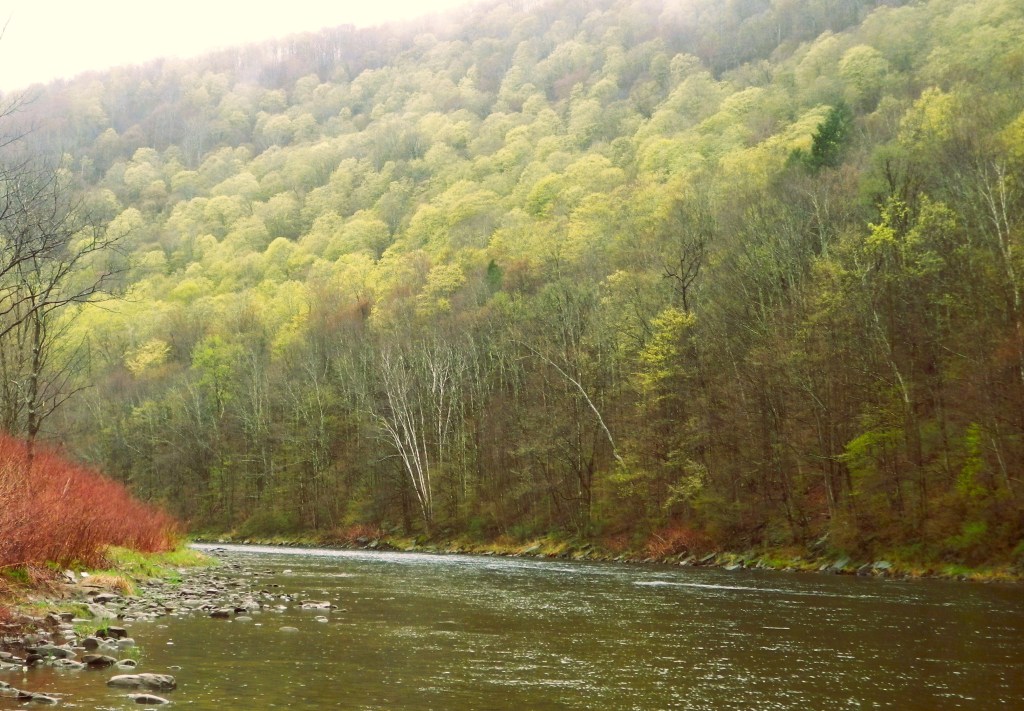
Decades ago, and the Beaver Kill flows into Hendrickson’s Pool with the incendiary glow of spring’s first blush.
My countdown is complete, and I am more than ready for the first rise, that first arch of the rod and whirr of the reel that tells me in a tactile sense that it is spring.
Yes, I am ready, though it appears that the river is not. The Beaver Kill rose once more overnight, telling me there is still enough of that late snow among the high ridges of it’s watershed which melts in the afternoon sun and journeys downstream to the reaches stalked by eager anglers such as I. The water temperature is cold by trout fishing standards, though it did not drop as low as the air temperature. Six AM, and it is twenty-seven degrees here in Crooked Eddy.
The Wheatley fly boxes are filled to overflowing, nestled in vest pockets dutifully protected for deep wading, and all of my gear is waiting in the car. The celebratory box carries something new, a handful of A.I. soft hackled wets to match the Quill Gordons. I have waited all of these months for the dry fly, but high cold water makes the chance of a rise less likely. Rather than standing motionless in the chill of the river for hours, a bit of movement and a swing of the wet fly might increase my patience. Epeorous mayflies emerge at the bottom of the river after all, the winged duns rising through the currents to their chance to fly at the surface. Typically, the chance of enough mayflies to bring a trout to the surface is rare on first days, no matter who’s calendar one follows.
It seems the country is aflutter as concerns the eclipse, and when and where afternoon clouds might obscure it. I am an angler and would prefer the sun remain strong to warm the river closer toward that magic fifty-degree mark. My chief concern regarding the eclipse is a casual wondering if the unexpected low light might stimulate a wary brown to rise. Should leviathan take my dry fly, leap, and obscure the sun, that would be a celestial event!
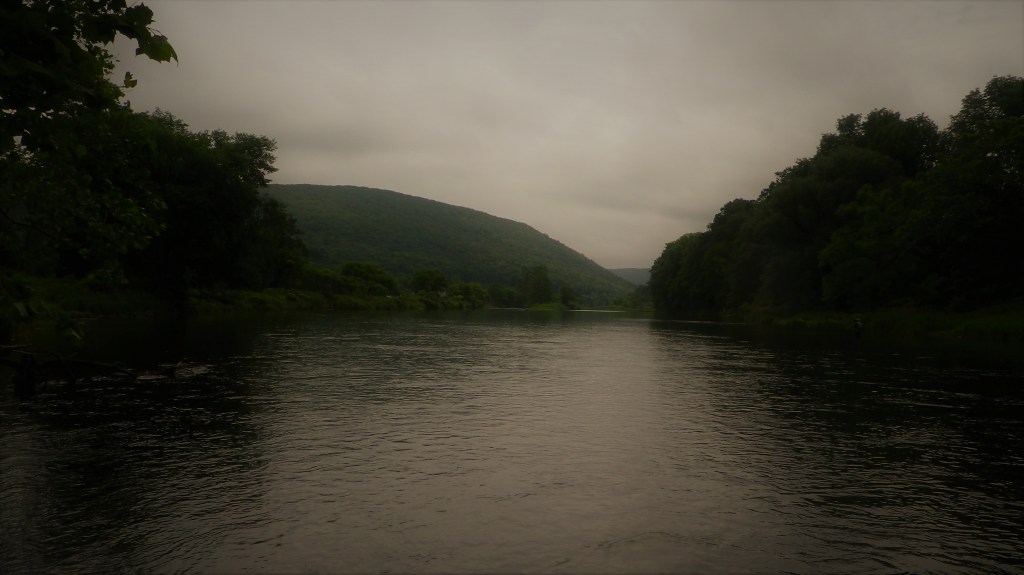
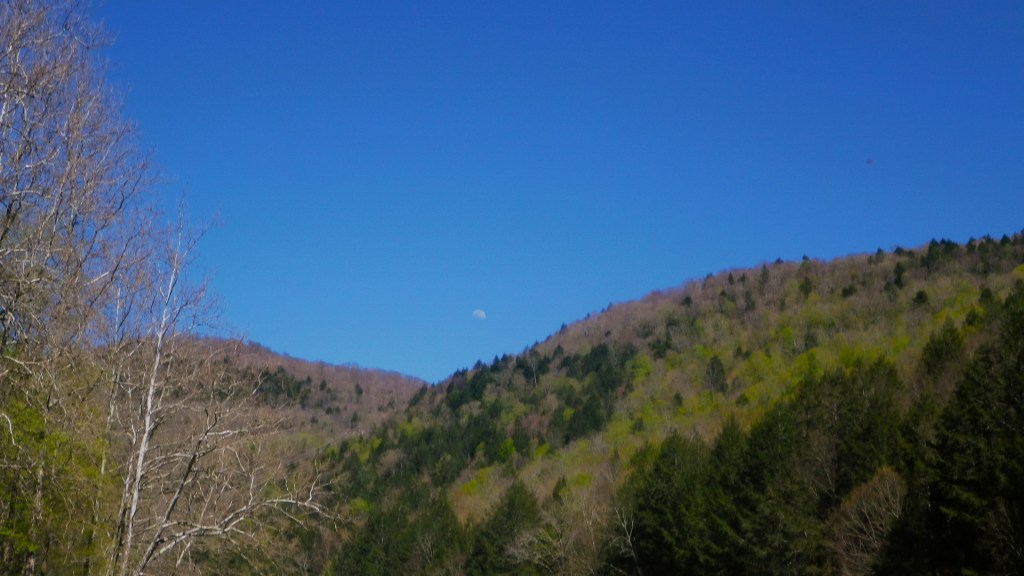
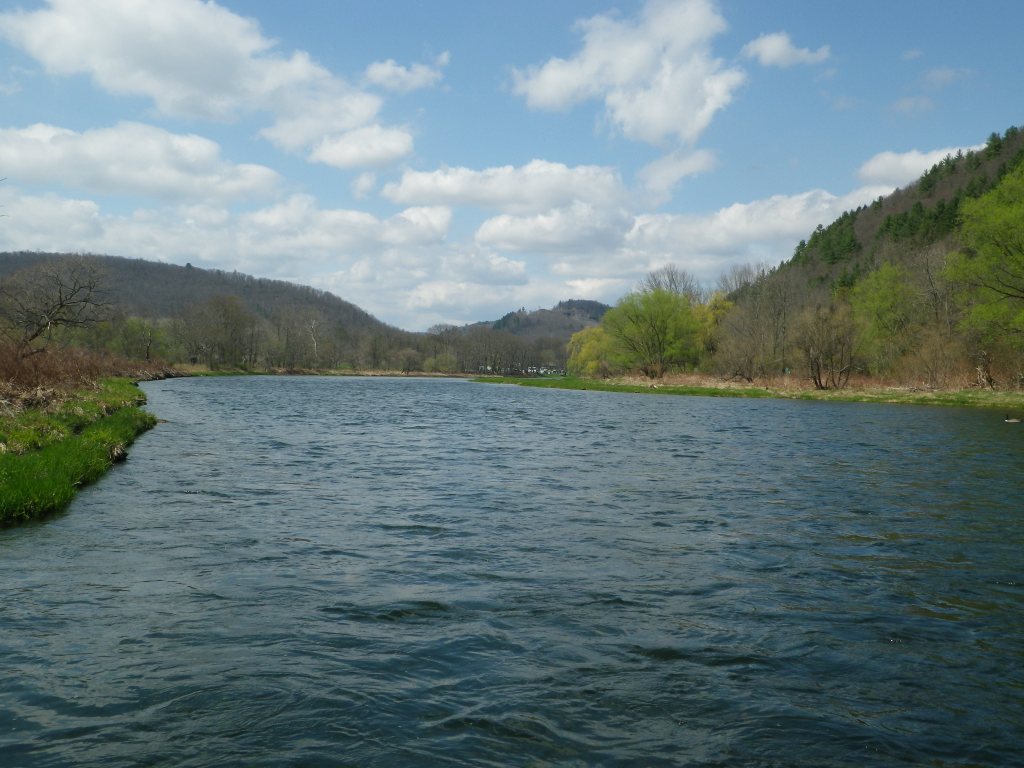
There is color in the eastern sky now, as the sun ascends above the ridgeline of the sheltering mountains. Hancock sits in a little pocket, with ridges to the West, North and East and the great Delaware to the South. I can hear birdsong as the morning advances.
My porch is situated to watch the sun’s descent, to enjoy the orange and red of sunsets. Were I a rich man, I suppose I would have a second porch with an eastern view to watch the day begin. I’d enclose that one and set my fly-tying bench there. I often tie flies as the morning light rises, flies for the day’s fishing. They are good luck!
Perhaps I will tie one fly when I close this post, a single Gordon’s Quill to knot to that first tippet and cast with that first inspiration of hope for the new season. It all lies there before us!








 Bright Waters Catskill