A Celebration

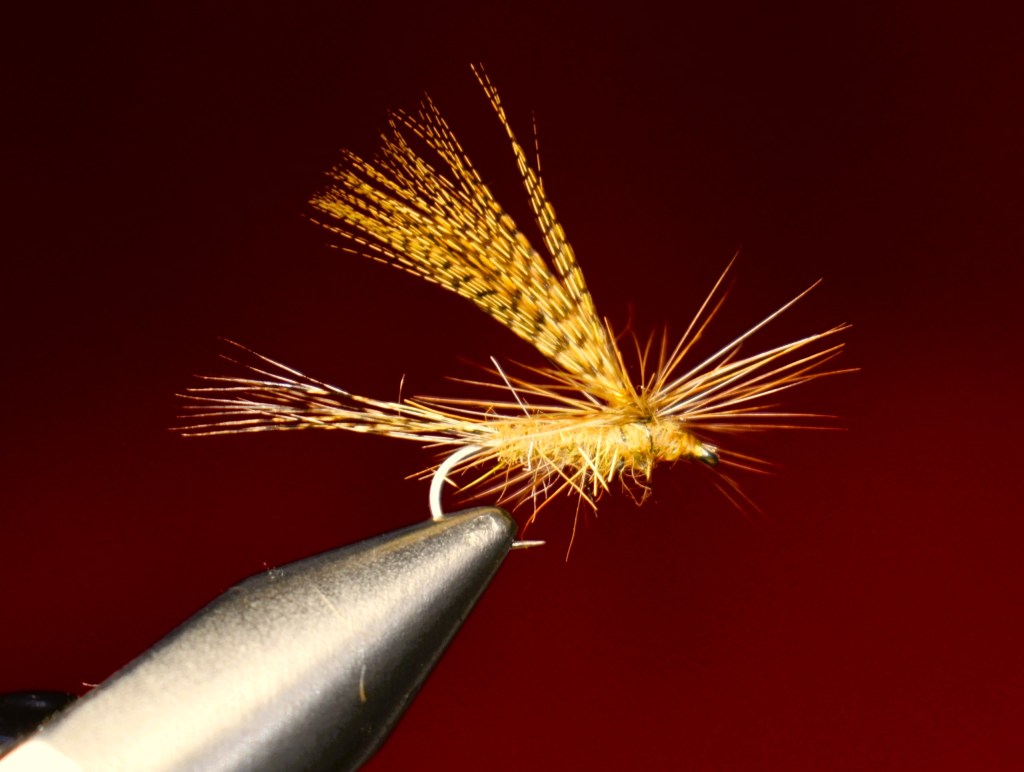
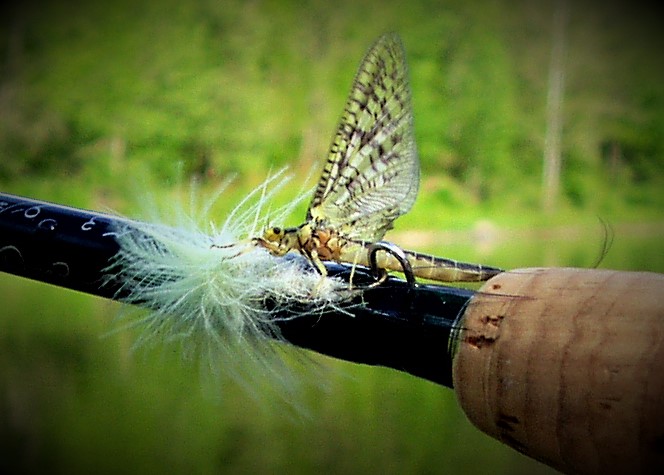
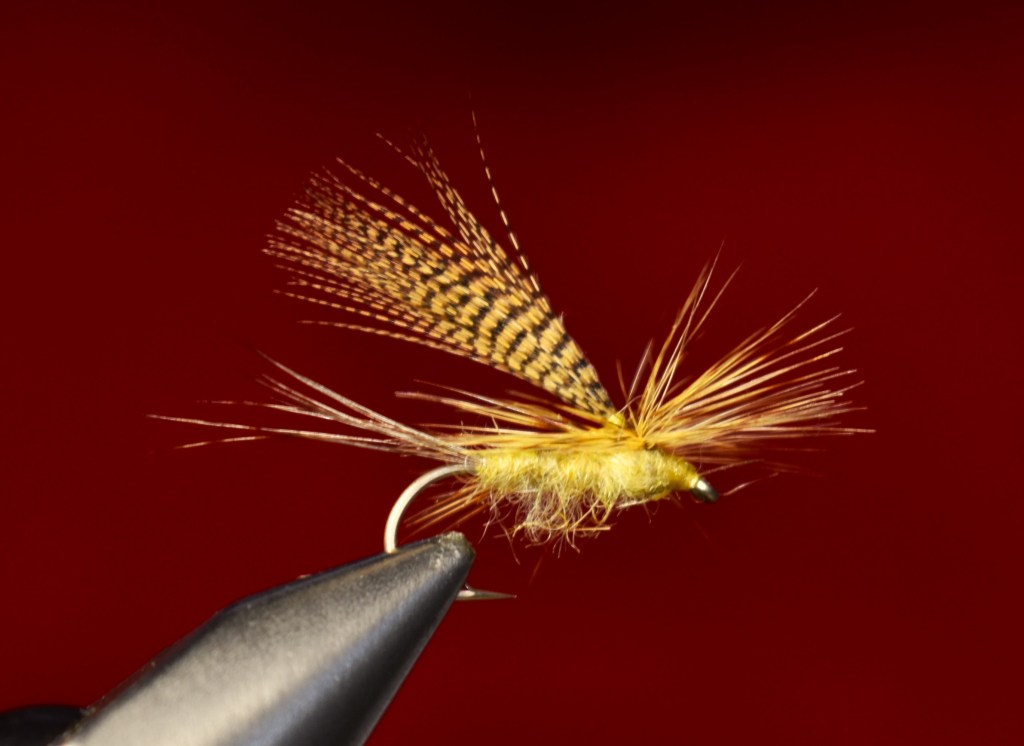
A variation of my Green Drake Crippled Emerger

Indeed, yesterday was Memorial Day and a national celebration and remembrance of those who have served America and paid the ultimate price for our freedom. It became a personal day of celebration too, as it evolved.

I regularly tease my friend JA that he needs to do a better job of understanding retirement. True he does enjoy life, I mean he had an unbelievable week of fly fishing in Argentina this spring, but he seems often to have too many things to do. I give him some good natured grief for things like working at his cabin rather than going fishing! Yesterday, the finale of our spring dry fly season, he finally took the evening off to join me for some fishing. Green Drakes have been spotted here and there, and I truly wanted him to get a taste of our greatest thrill with a bamboo fly rod in hand.

The beginning of the Green Drake hatch is reason for celebration all by itself. They do not appear in their former multitudes, and they are truly ephemeral in their dance upon bright waters, yet they are still truly special to witness. Big Catskill trout like them too.

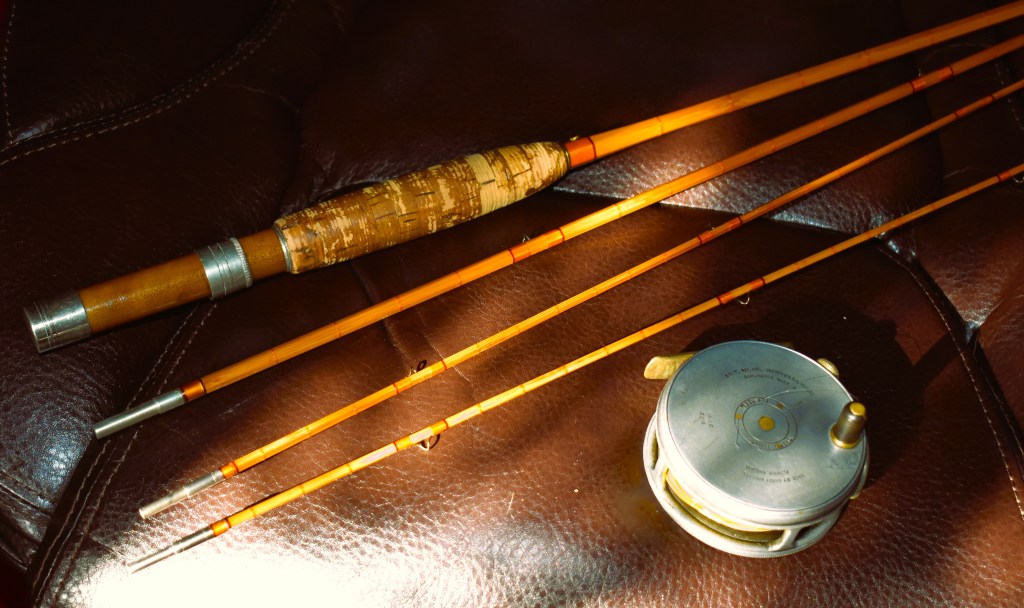
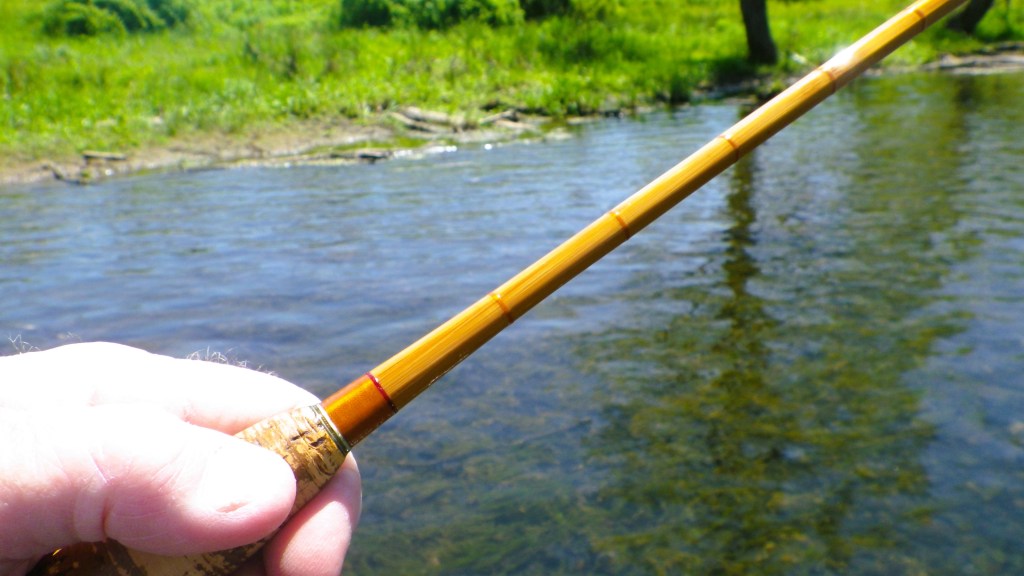
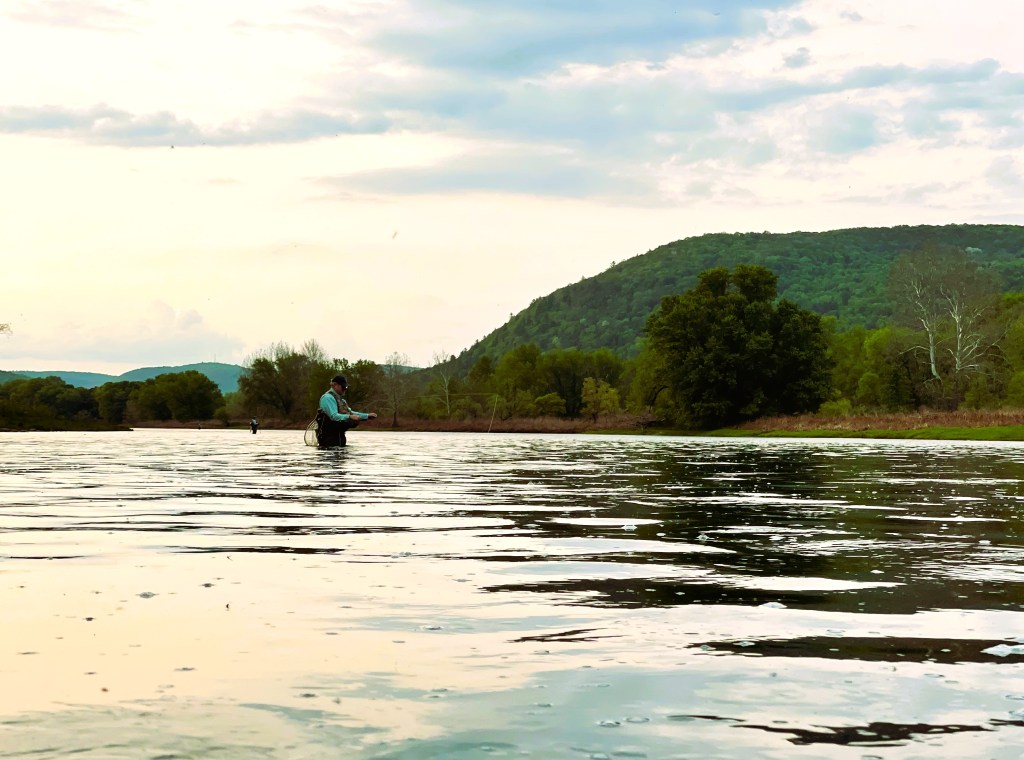
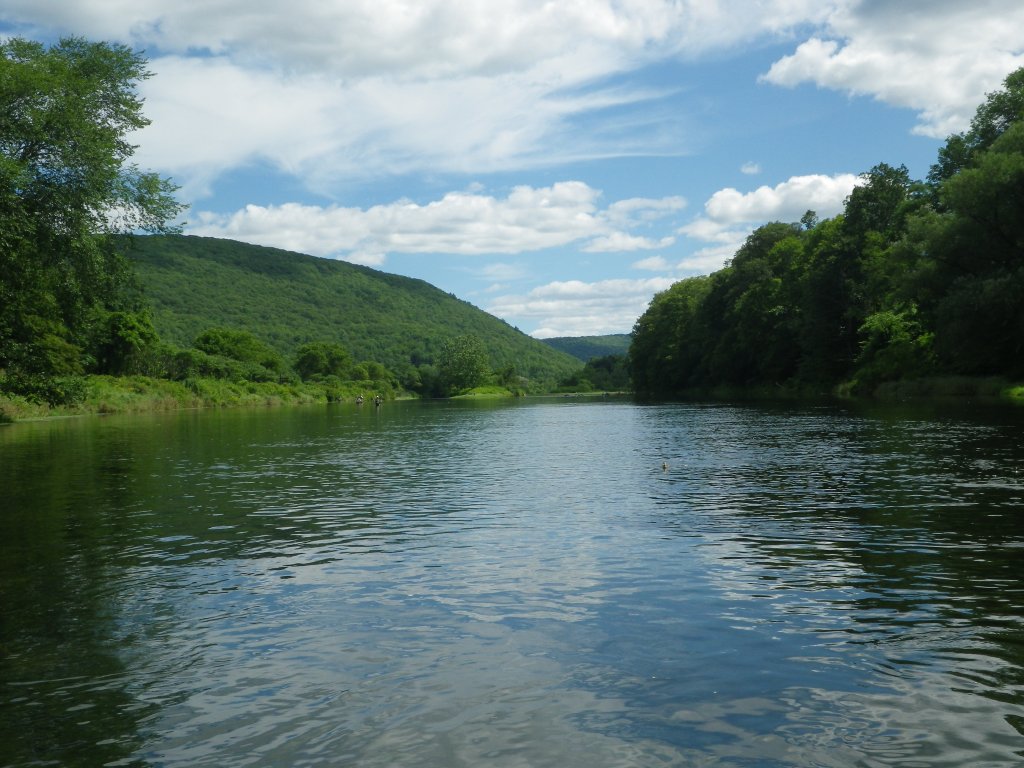
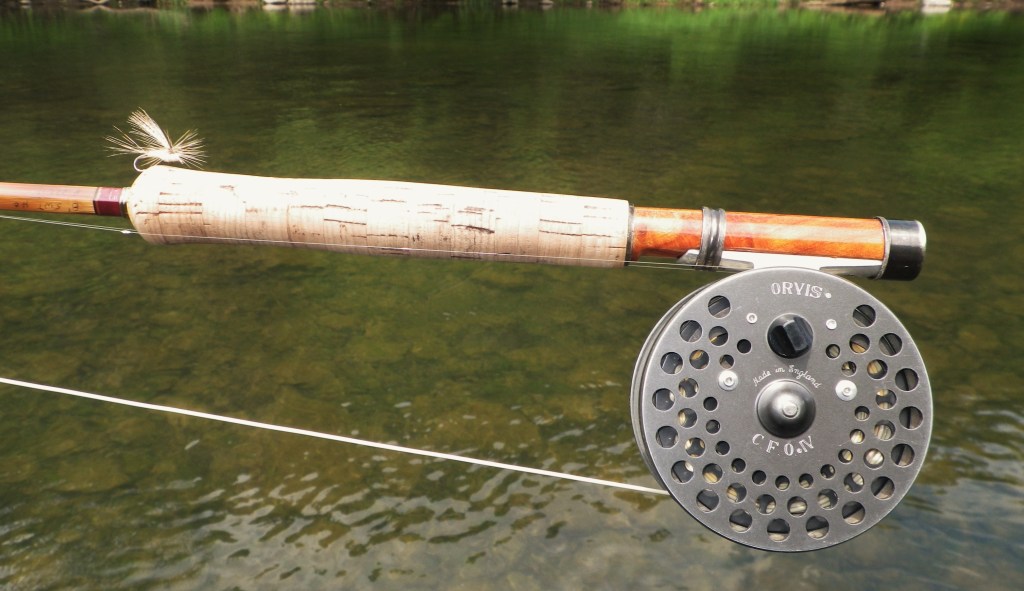
We met down by the river, each bearing a fine bamboo rod created to honor the memory of Jim Payne. JA’s was a creation of his own hands (see, I said he was too busy!) and mine a collaboration between Pittsburgh rod maker Tim Zietak and the late George Guba, and a veteran of the Drake Wars. It was a lovely, and very warm early evening, the water stroked by an occasional breeze. A few tiny flies flew from the surface, sulfurs we concluded, as we waded slowly to our chosen fishing grounds.

For the first couple of hours, a few scattered trout enjoyed teasing us with the occasional rise. Whenever one of these cruisers ventured within range, we flicked our flies out for their inspection. Though we never heard them laughing, we had clear evidence of their disdain. Gradually, a few large mayflies began to appear at a distance. When the first of those flies vanished in a swirl, we concluded our relaxing interlude for the evening and became deadly serious.

As the flies increased, they would never be numerous, I targeted casts to cover each scattered rise before me. With a sporadic hatch, our wild trout tend to reduce their cruising behavior to more of a local patrol scenario. They would not hold a station and rise with regularity. Long experience with these habits have led me to try earnestly to put my fly on each rise form in a matter of seconds, showing that trout another tasty mouthful before he moves on in his patrol.

I could see several Drakes pop to the surface in one particular area, wriggle a bit, and then drift quietly. My dun pattern drew no interest, so I switched it out for a crippled emerger pattern. I designed these with a very full, tri-color CDC wing, for movement and as a more realistic imitation of the insect’s heavily marked wings. The most recent incarnation is truly a special fly, with props owed to JA for his preeminent abilities in processing and dyeing natural fly-tying materials.

I cannot recall what momentarily distracted my eye, what stimulus caused me to glance away from my drifting fly. I glanced back, quickly enough it seems, to see my fly had vanished. When the dreaded look away happens, it is typical to stare for a second or two at the empty water, just enough time for that stealthy trout to spit out the fly and go on about his business. This time, my tired old casting arm reacted before my brain finished processing the scene. That was a blessing!

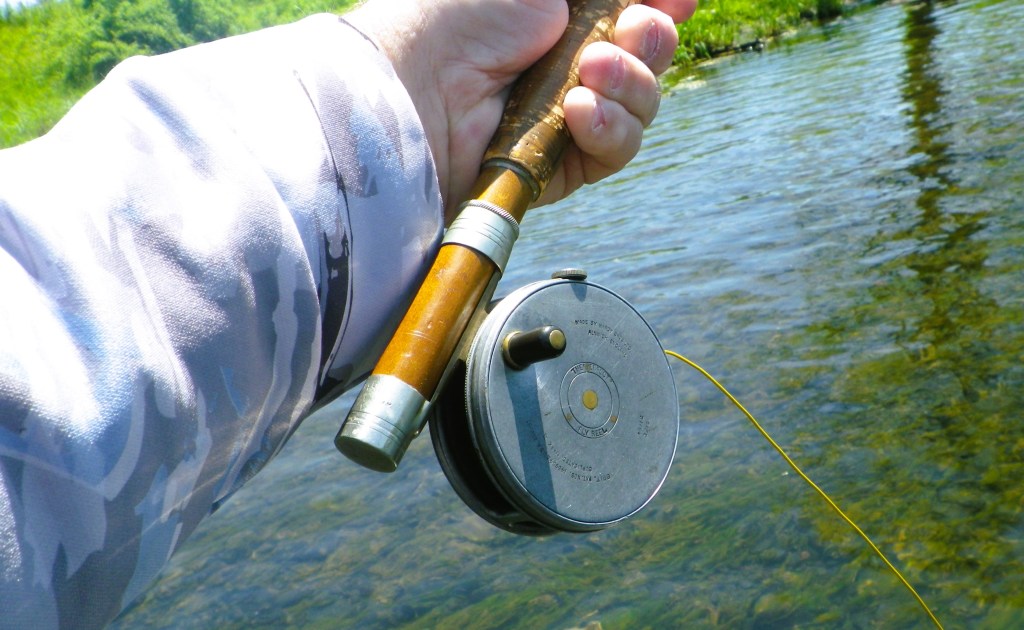
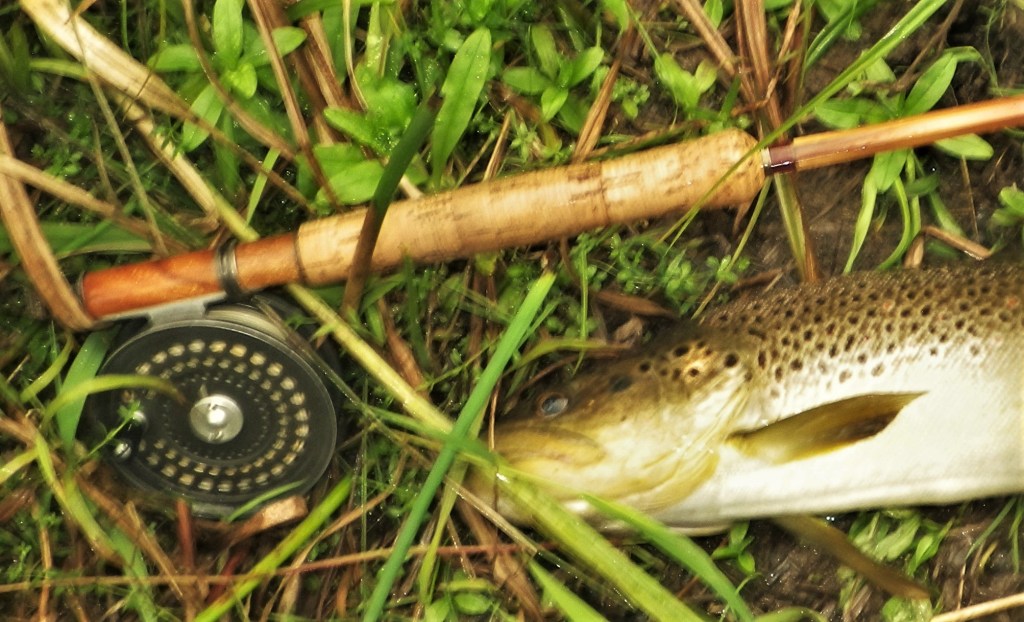
The rod arched heavily, menacingly, and the line cut rapidly upstream as I stripped to maintain tension, when that initial run stopped, I began to reel the slack line onto my old, classic Hardy Perfect, before he launched into another seething run, and collected the slack for me. The night air was rent by the screams of that 1950’s bit of British hand-made perfection. Have I ever mentioned that I love that sound?

This foe gave no quarter, and I forced myself to match him run for run and blow for blow. He would streak for some bankside boulder or hidden snag, and I would lay the rod down parallel to the water to apply pressure with the rod butt. When he turned, I would reel as fast as I could while he boiled and surged. I never got a look at him until I had my net in hand and the leader’s butt reeled almost onto the old Hardy’s drum. We were both tired then, and I led him close enough to bring the net up underneath him. He thrashed, boiled, and tumbled partially into the bag while I fought to raise it from the water. At last, it was done.

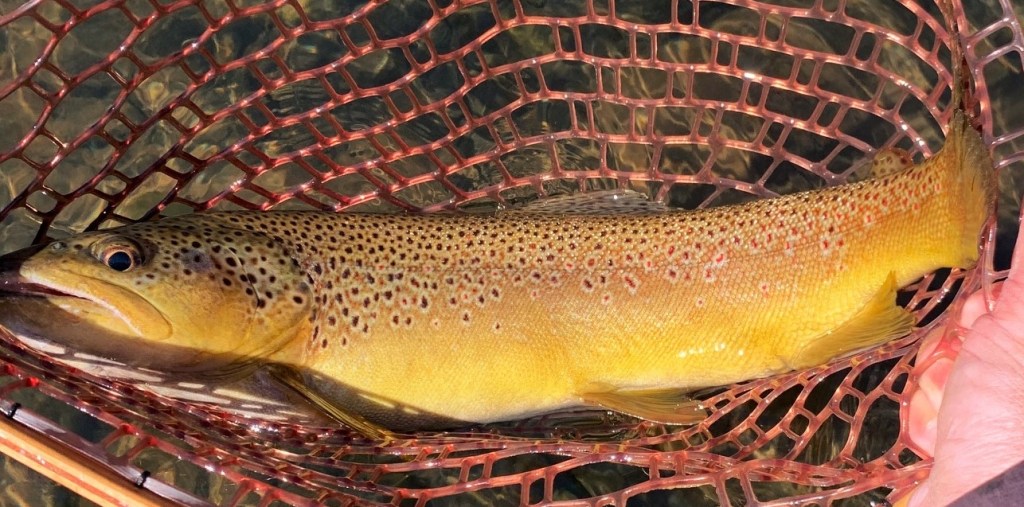
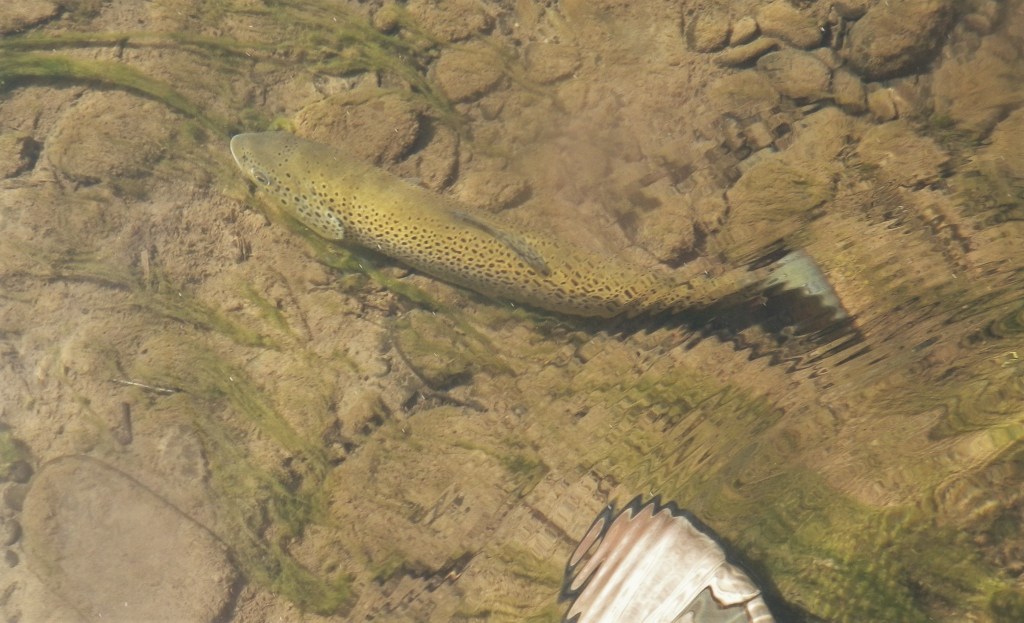
The fly was securely imbedded in the front of his lip, and I twisted it free far more easily than I expected. He was terribly heavy, and I braced the net against my legs and scrambled for my camera. I lifted him once, calling to JA upstream, and then laid him back down to kiss the river. He swirled unsteadily, and I netted him again, then held his face into the current until he swam out of my grasp and turned back toward the cover he had hunted. The largest wild brown trout I have ever been privileged to capture on the dry fly had me shaking as I returned the net to it’s holder and collected my leader and it’s slimed and soggy fly. A bull of a brown trout, twenty-six inches long, I estimated his weight at six and a half to seven pounds.
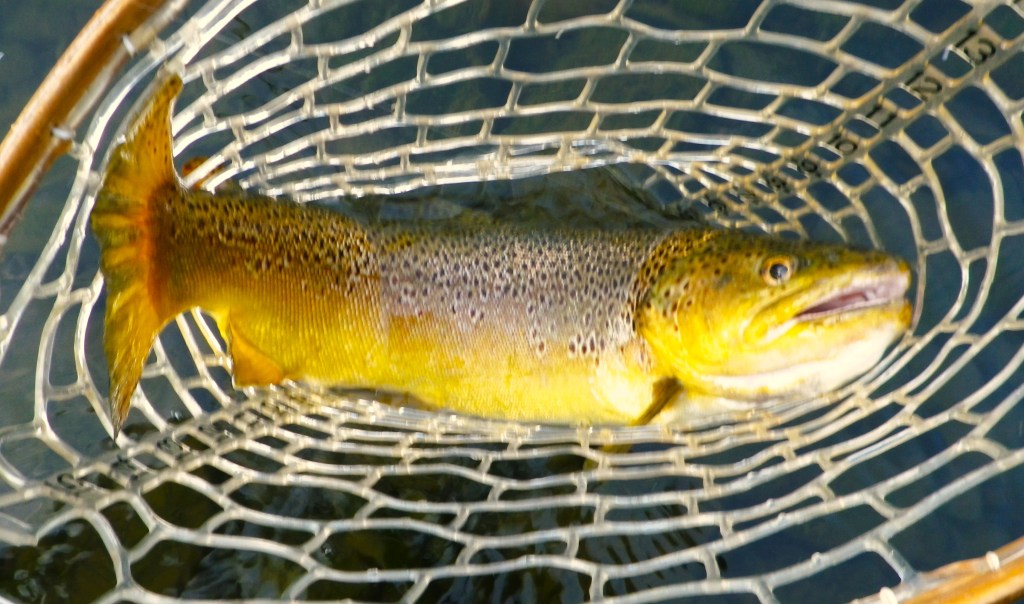
I would battle another leviathan before darkness overtook us, that battle ending when the fly pulled out. Our celebration was completed when JA hooked up on a bruiser of his own, a four pound fish pushing twenty inches, and so fat he could not get his hand around him, his best on that reach of bright water.

There was never a big, frenetic hatch. Just enough of the great Drakes to urge some of the largest brownies to play in the clear, shallow waters. Truly the most exciting technical dry fly fishing an angler may enjoy! I hope that our evening was indeed the beginning, that the hatch will appear for a few days that I might follow it and partake of the magic once more. There are flies to be tied after breakfast…

Traditions

I probably have a couple hundred Green Drake dry flies on hand, tied during the past fifteen years. It is always worthwhile to tie a few more though, to make some detailed changes, experiment with new ideas, even to design a few brand new patterns.

On Saturday night, a couple of gentlemen that I think of as friends were honored as Catskill Legends. They are both exquisite fly tyers and true scholars of our Catskill fly fishing and tying history, Dave Catizone and Tom Mason. I was pleased to congratulate the pair, as I too have a special fondness for our fly fishing history, something both of them spend a great deal of time and a terrific amount of effort to foster and support.

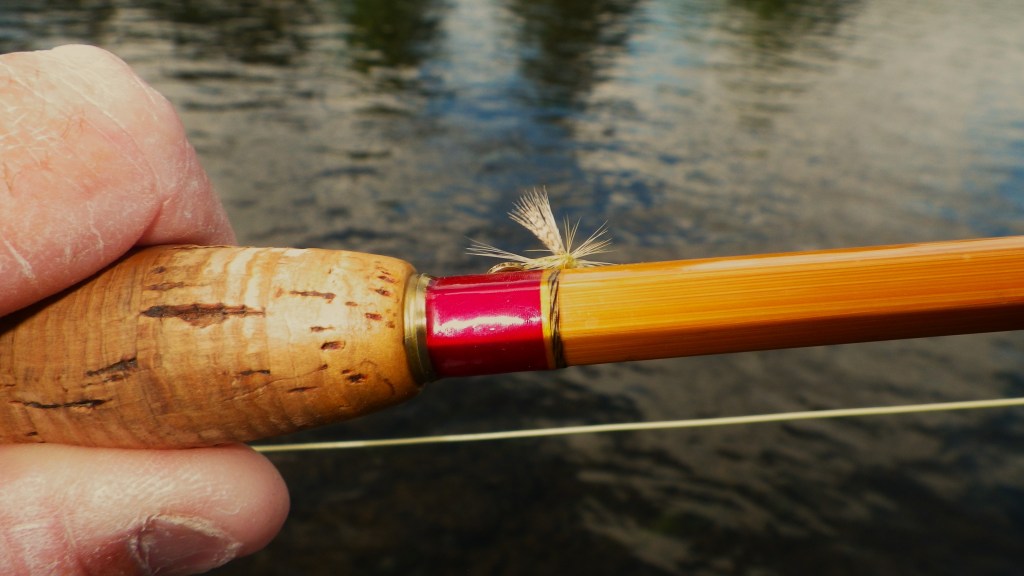
I had that in mind this morning when I sat down to tie just a few more Green Drakes, dry flies for the hatch that long ago captured my heart. I considered a technique that Tom had demonstrated, touch dubbing a well waxed strand of silk and spinning the bobbin, creating a fly body with movement: the essence of life! I tied my Drake bodies full as compared to some of Tom’s ephemeral North Country classics that he ties with this method. The goal was to craft a subtle imitation of a very big mayfly with a softer outline and that gentle movement. I used a bit smaller hook too, a size 10 1X Sprite dry fly hook, letting the indistinct dubbed body give an impression of the larger bug. Fishing in low water, I believe these 100-Year Duns might prove to be an advantage.

I know which rod will accompany me to the river as the shadows begin to gather come evening, a well-used copy of a classic Payne 102H. It is a modern rod built in the image of a classic. With the strength of modern glues, I feel secure stalking amid the darkness for the chance at a trout that might prove too much for a true vintage rod that’s seen more years than I.

I have already taken out a vintage Hardy Perfect to compliment the rod. It too bears a modern edge, as it carries an Airflo Tactical Taper fly line. It’s long, thin front taper will allow me to set these large dry flies down as gently as possible with the long casts required in low water.

I guess I find it fitting, this blend of old and new, for the goal of such tackle is to honor the quarry and the traditions that shaped our sporting consciousness. There is something very special about fishing vintage classics, touching the history they hold with the magic of a spirited wild trout spawned in our time. We are fortunate in that regard, for our forebears fished in the age of heavy stocking of these Catskill rivers.

Consider the gifts we have been given and honor the traditions of sportsmanship passed down to us.

Hunting In Low Water

Memorial Day, the peak of our spring dry fly season, and perhaps the hunt will be for a few damp stones along the river banks, rather than the trout of our dreams.

This is not the first time we have been hit with the season’s first heat wave beneath cloudless skies on this most popular weekend for the Catskill angler, yet it may be the first time that much of the damage has been so easily avoidable.

New York City is about to begin their drawdown of the reservoirs tributary to the damaged Delaware Aqueduct. Though the details still seem to be shrouded, commencement seems eminent on June 1st, three short days hence. With afternoon water temperatures reaching from 69 to more than 70 degrees yesterday on the tailwater rivers below those three dams, common sense, decency, and at least some appreciation for the wild trout and the anglers who flock here to Mecca, one would like to think that the New York City Department of Environmental Protection would move their valves from this morning’s minimal release flows and give the rivers and their permanent and temporary inhabitants a break.

Friday would have been a good time to raise the flows enough to counteract the heat wave and welcome the thousands of hopeful anglers. I am not demanding high flows for boating, for most of these anglers prefer to wade the rivers and experience the special magic of bright water and wild trout close to their hearts. Another 150 to 200 cfs of flow from Cannonsville, Pepacton and Neversink would have created near perfect fishing conditions, thanks to the cool nights we may thankfully continue to enjoy – just a mild preview of the higher flows planned to accomplish their drawdown.

Our ten-day forecast promises not a drop of rainfall, with highs reaching 90 degrees by Friday. Fly fishers know this time of the season affectionately as “Bug Week”, and it is sad that the greatest sport of the season will be diminished by, what, avarice? Come on New York, protect the environment, and give is a drink!

Vintage Catskills

Bright water in May!

This fourth week of May is closing out in fine style. In fact, one could say it has been vintage Catskills. I have enjoyed a couple of days fishing with two good friends, the trout and the elements cooperating to show us a good time.

Mike Saylor and I were expecting calmer winds yesterday afternoon, as well as more crowded fishing conditions. We found the tables turned though, having the selected reach of the West Branch nearly to ourselves and the winds strong and steady straight downstream. Mother Nature insists we pay our dues sometimes.

The caddis hatch that provided my friends and I with some nice technical dry fly fishing was quite sparse yesterday. Coupled with the wind rippled surface conditions, that meant that the few trout that did show themselves weren’t rising regularly. In fact, most seemed to be taking just subsurface.

Expecting calm winds of course, I had chosen to make this a vintage bamboo day. Armed with a classic old Catskill rod and one of my oldest Hardy Perfects.

Some will maintain that you can’t fish such tackle in windy conditions, that you need stiff, frighteningly unforgiving graphite rods and overweighted fly lines. Hogwash! Did anglers stop fishing in the 1930’s and 1940’s when the wind blew? Of course, they didn’t. One of the wonderful subtleties of bamboo is it’s sense of touch and control!

Fishing the flats we had chosen required some longer casts and using the tackle to take best advantage of that control. I find it best to fish with the wind under these circumstances, that on this day meant approaching the trout from upstream and across. Contrary to the modern, more power theory, I slow down my rhythm and allow an extra tenth of a second or so for my back cast. The wind helped to drive the downstream cast, and all that was required to put the slack that wind removed from my leader back into play was a very subtle reverse twitch of the rod tip inches before the fly touched down.

Regardless of how nicely that classic tackle performed under tough conditions, the trout were particularly difficult with just a handful of windblown and waterlogged caddis to interest them. The fact is, I didn’t take a fish on my go to caddis pattern that had been golden on the previous days.

The saving grace was the fairly short duration hatch of Hendricksons. Since the trout weren’t rising regularly, I changed my tactics and covered more river, stalking slowly. Before I noticed any mayflies on the water, I spotted a single heavy rise across the river. As the afternoon warmed, the winds grew stronger, gusting at intervals; the Red Gods hard at work to stifle our efforts.

When I reached a casting position above that heavy riseform I had stalked, I tried my caddis, since I still had not seen a mayfly. If that trout was still holding in that lie, he wasn’t having any caddisflies. I figured he might have blasted an early mayfly, so I knotted a worn, well used A.I Hendrickson to my 5X tippet. I smoothed some floatant into the shaggy fur blend body and worked the bunched-up hackle fibers around the base of the canted wing so the fly would sit correctly on the water. Satisfied that the fly had one more fish in it, I waited for the gusts to calm a bit.

My Atherton Inspired (A.I.) Hendrickson has been my most productive Hendrickson pattern this spring.

I made one cast, between the gusts, and placed the fly in the perfect line of drift, parallel to a bubble line of current trailing from a submerged rock. The trout took it, I raised that lovely old rod, and all hell broke loose!

That fish made a hard surge and took off downstream trying to spool my ninety-year-old Perfect! God I love that sound, but I began to wonder if he was going to stop. My mind flashed: Rainbow? If he is he’s headed all the way down to Hancock! Damn, fish! He took a breath and I lowered the rod, pointed it at him to use the butt to apply pressure. I got three or four turns of the reel handle and he was off again.

I kept fighting him like that, the rod down low to the water and pointed his way until he checked his run, and then I’d reel when he grudgingly came my way. Sometimes he would just pull and turn his flank into the current, so I would roll the reel up to even the strain on the eighty-year-old bamboo. It was a long battle, the cold, oxygenated water had that trout at his best, and he gave it all. When I finally got a look at him, I was surprised he wasn’t three feet long with all the power he had displayed.

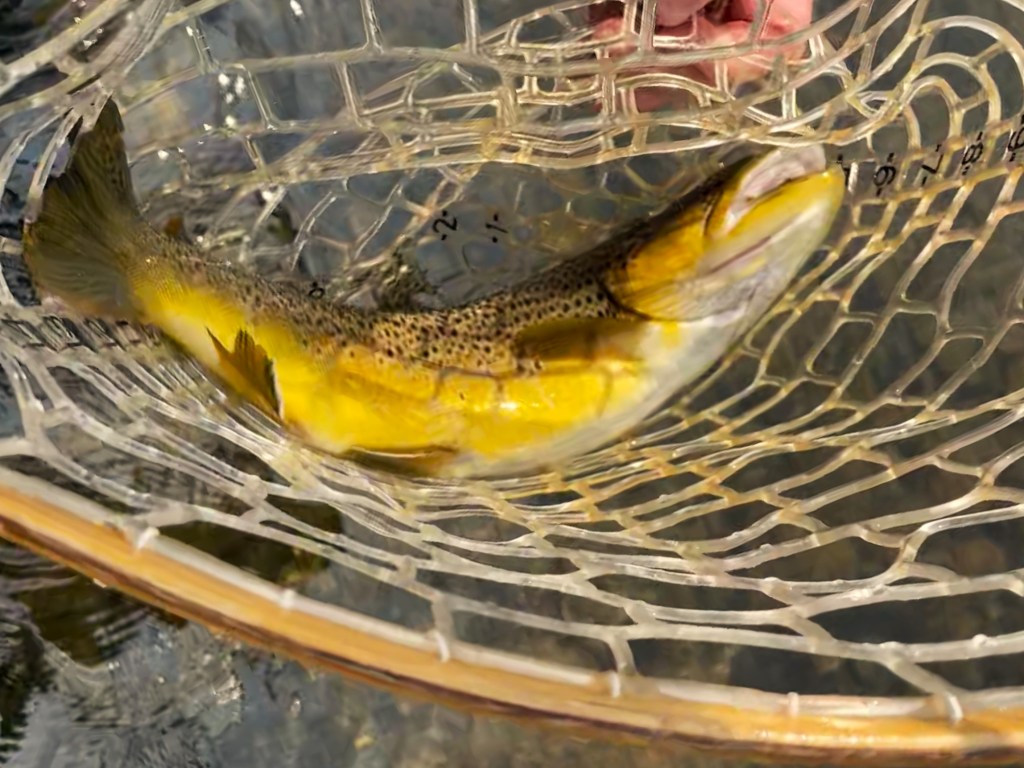
In the meshes at last, he lined up to the 12 and 8 marks on the net bag, twenty inches on the nose. He was a brownie, fat and thick bodied from gills to tail, and I slipped him right back into that cold flow once I twisted the Hendrickson from his lip. Yea, vintage Catskills!

The Pinnacle

It is Friday, the 26th day of May, two thousand and twenty-three, gateway to Memorial Day weekend and the pinnacle of our Catskill dry fly season. It is 35 degrees here in Crooked Eddy.

Once again the spring season has reached it’s climax, too quickly it seems after proceeding in fits and starts from that quizzically warm second week in April. It could be my own tainted recollections, but it seems this has been one of the windiest runs of spring weather among my decades stalking Catskill rivers.

My longtime friend Mike Saylor rolled into the Eddy yesterday for an all too infrequent visit. He battled Boston traffic during the early morning hours, heading south from a visit with his new granddaughter. Mike and Cheryl have been travelling the world since his retirement, both with and without a fly rod in hand. It is good to see him back to enjoy some of our old Catskill haunts.

That spring wind was brutal here in Crooked Eddy as we shared greetings and donned our waders for an afternoon of fishing. Fearing the worst, we found conditions much better once we reached the river and waded in.

The trout were waiting for us. Numerous soft rings interrupted the ripples from the breeze across the shallow flats, good fish delicately taking the scattered shad caddis. My CDX brought music to the scene quickly, as the little Hardy was urged into song by an angry brownie. He was gorgeously colored, plump and firm in the net as I twisted the little fly free and sent him back to ponder his dietary choices.

It was pleasant fishing for a pair of old friends, easy wading, and smooth, gentle casts each time the breeze abated. The wild browns were strong and willing, though as always demanding of perfect pattern and presentation.

When Hendrickson duns joined the caddis on the water, the trout quickly shunned the CDX, and an Atherton Inspired 100-Year Dun replaced it on my long 5X tippet. The fly was immediately accepted, and that familiar chorus rose amid the rustling notes of the wind.

We tallied half a dozen fine fish between us, and Mike made sure to call me over to help him out by netting his twenty incher. A fine reunion for two friends who fished often during thirty years of friendship. We have waded the rivers and streams of the Catskills, Montana and Pennsylvania, chased steelhead in Ohio and Michigan, always eager for one more cast.

Another day lies before us, so I will tie a few more flies to tempt those brownies…

Two Days In May

Evening approaches on the wide water of the Delaware (Photo courtesy Andy Boryan)

For the prime time of May, fishing has been a bit slow of late, so when my friend Andy found a couple of days to spare, I couldn’t offer too much encouragement for him to toss his gear in the truck and make the half day drive to Hancock. I told him about the past week, and that things can change at any moment, finally adding my own personal rule: whenever you can go fishing, you should!

Andy rolled into West Branch Angler right behind me on Monday afternoon, and it didn’t take long for us to uncase the bamboo fly rods. Yes, I have to take much of the responsibility for infecting him with that disease, along with the friend who gave him his first cane rod as a wedding gift. I’m not apologizing for my role for, as I noted two years ago watching him fish his vintage Granger on another Catskill river, bamboo suits him.

I watched his casting with the lovely Sweetgrass pent as we encountered a few rising brown trout at an old haunt of mine. He fell for the 8-foot taper that Jerry Kustich had designed for me back in 2020, a crisp four weight that offers anything you might want when fishing Catskill rivers in summer. Andy loves the rod, and it shows in his fishing. The fine presentation that duped a very nice West Branch brownie early in our little tour of rivers, complimented by the wide smile as the fish took line against the arch of gleaming bamboo, made that crystal clear.

That initial success helped us enjoy our time together even more, as our sparse little parade of mixed mayflies and thus the rising trout vanished rather quickly into the afternoon haze. We headed out for the wide expanse of the Delaware, hoping to find a good evening rise, but though there were some scattered sulfurs and a pair of March Browns drifting past, the trout we encountered played an oft repeated Mainstem role. I expected rainbows, keyed in by their constant movement and the splashy little spurt rises, and told Andy we might have a lot of fun, or a good dose of frustration with these trout. The effort to cash in, to finally put our flies in the spot at least one of those traveling bows was heading toward kept our energy up, though it proved to be unrewarded. Andy did cross paths with one of them near dark, though his celebration looked a lot like a man standing in a river admiring his broken leader. I wasn’t quite so lucky.

The “Old Man” went vintage for the tour, casting the five weight Thomas & Thomas Paradigm (Photo courtesy Andy Boryan)

We dodged dust and guide boats, meeting in the fly shop parking lot the next morning, bringing back many memories of decades of mornings at West Branch Angler. I had hoped we would find the river uncrowded with our morning start, and though solitude wasn’t in the offing, we found enough room to search for a rise. We each found only one, neither the consistent kind we craved, but gave them some time and plenty of casts, just in case. By Noon, I decided it was time to execute my afternoon plan, the one that came up rather golden as it turned out.

Rather than dealing with more waiting and a paucity of bugs, we fished through three different hatches in the course of a few hours. There were sulfurs on the water when we arrived, and a few soft rises showed nearby. I was still giving my friend the lay of the land when his rod arched with the pull of a big, angry brown trout. “Hey what are you doing, I’m talking here”, I laughed, “you should be paying rapt attention, not catching fish!” I was answered by a grinning “I’m showin’ you up old man” punctuated by the ratcheting scream of his reel. Luckily the “old man” wasn’t the one who forgot his net, and kindly landed the youngster’s brightly colored nineteen-inch wild brownie!

Old golden belly put the test to Andy’s Sweetgrass pent, expressing his outrage that his lunch had a hook in it!
(Photo courtesy Andy Boryan)

We spread out and got to work, fishing through the sulfur hatch and right into a very nice hatch of Shadlfy caddis. As soon as I exchanged my sulfur for a CDX, I felt the big bend of the Paradigm’s classic progressive action as the result of choosing just the right riseform to cast to. Now my old Hardy rent the air with screams of torment. Ha! Vengeance for the old man! That brown measured a cool 21 inches.

We each landed three hard fighting trout, and missed as many more. When the caddis finally petered out, we looked at one another and Andy said “what do you think”. Before I could answer I spied a flotilla of taller gray wings drifting by – Hendricksons! I had three fish in a row, sipping delicately in shallow water. Neither of the first two tolerated a cast, despite my most gentle presentation. Big fish are not comfortable in inches of water! I dropped my fly further above the last trout in the row, and I guess he must have slipped down beneath it to give it a real close look. The surface parted, his white mouth opened, and I was a split second too quick to raise my rod. Goodbye opportunity for a last taste of Hendricksons!

We waded further, searching for additional risers. Despite of good number of big, juicy Hendricksons drifting down the current, we failed to find a taker to set up on. I was headed toward a devilish lie, one where I hooked and lost the same big trout twice in the same day last season, first when the hook simply pulled free, the second two hours later when a hard pull straightened it. I found no one at home.

Andy spotted a single rise, never repeated, and thus we called our day complete. We were smiling and talking as we waded back to our exit trail, happy and fulfilled for the excitement of the chase which highlighted our afternoon. Until next time, my friend!

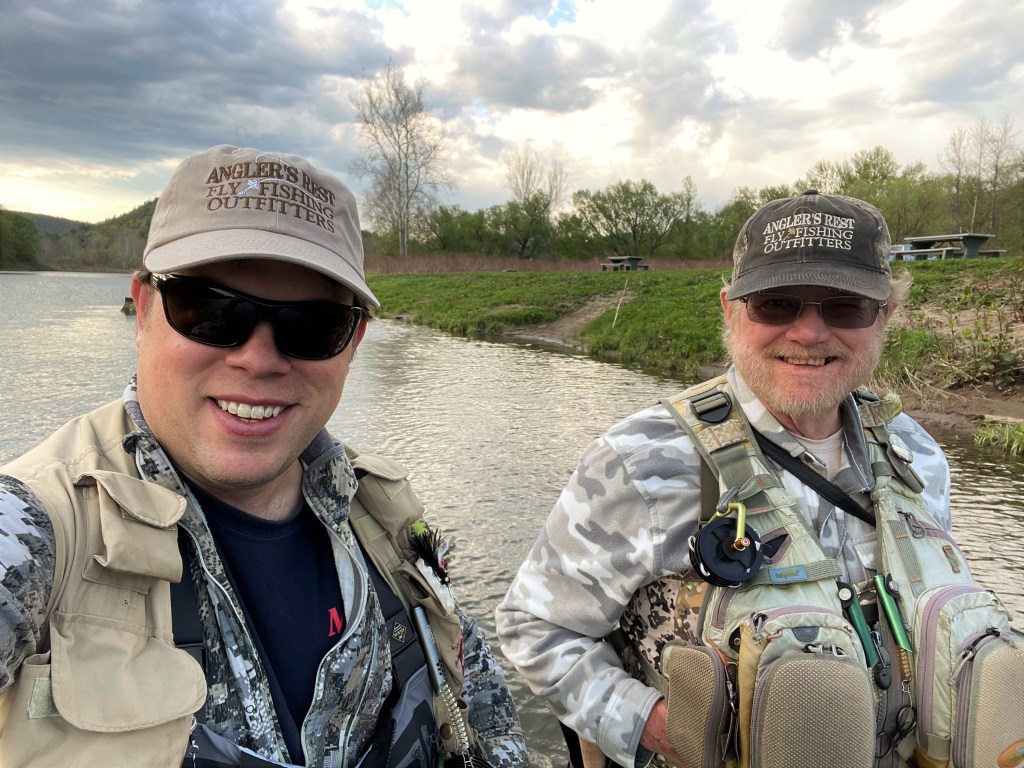
Friends – May 17, 2021 both in camo mode (Photo courtesy Andy Boryan)

Gregory A. Hoover 1953-2023

Chambersburg Pennsylvania’s Falling Spring Branch

I learned this morning of last week’s passing of Greg Hoover, a celebrated entomologist, gentleman fly angler, writer and fly tyer. Known widely for his expertise in the study of aquatic insects, Greg was a lifelong sportsman who freely shared his time and knowledge with his fellow anglers.

I would see Greg annually at the Fly Fishers Club of Harrisburg banquet and other angling functions around the Commonwealth, always enjoying our conversations. My fondest memory, from nearly thirty years ago, involves a talk about hatches on my little Falling Spring Branch. I mentioned the small hatch of Yellow Drakes (Ephemera varia) that occurred in the lower reach of that limestone spring. Greg acknowledged that these large mayflies were somewhat rare in Southcentral Pennsylvania’s small streams. He became excited when I stated that they hatched quite reliably about the 20th of May each spring. Greg counseled that varia is typically a late June emergence in the slow, finely silted areas of eastern rivers and questioned my timing. I assured him that I kept written records as I gained knowledge about my home water.

Greg thought there was a chance that these mayflies were a different species, one thought to be extinct, rather than Ephemera varia. We made a date to meet at my fly shop and visit the Falling Spring to witness the emergence. Greg arrived fully equipped with a large collecting net, magnifiers and specimen bottles. We relaxed and talked about the treasure of the limestone springs until the first mayflies appeared near dusk. He successfully collected several male imagos as required for DNA testing, a process that he waited several years for the opportunity to perform.

Whenever I would see Greg thereafter, I would ask about those tests, and we would relive our little twilight adventure. When at last the results were in, he let me know that the flies were indeed varia, attributing their early emergence date to the stability of water temperatures throughout the year. This had been my guess during our original discussion, but only that, and I appreciated his sharing his broad knowledge. That discovery has remained with me all these years, for it has given me some confidence in the degree day theory of hatch timing.

I had thought of Greg a couple of seasons back when my friend Mike Saylor had asked about periodic cicadas on Catskill Rivers. I found his Penn State email address still listed on the University website but failed to reach him. It was a number of years past his retirement. Hoover likely had more knowledge regarding this mythic seventeen-year cycle mega hatch than anyone.

I remember Greg as always being generous with his knowledge, ever with that light in his eyes when discussing stream insects, flies and fishing!

Rest in peace my friend and may all the mayflies perform for your delight as you fish on around the bend!

Wandering In The Wind

One of the qualifiers to the marvelous spring fly fishing here in the Catskill Mountains region is the prevalence of strong winds on open waters. We have been having quite a run with them lately.

My favorite online weather forecast provides just a two-day window for it’s wind predictions. You get today, tonight and tomorrow and beyond that, well, you just have to wait and see. Our winds seem to outperform the forecast more than they don’t. Monday didn’t look too bad for example, with winds from 10 to 15 miles per hour expected. Growing up in the flat topography of Southern Maryland, I would see that and expect a nice day with a light breeze, and maybe an occasional little gust that flirted with fifteen miles an hour. Life in the mountains is different, and life on the rivers leads to a very different interpretation of that forecast. What I would expect, and incidentally what I got, was a fairly steady blow in the neighborhood of fifteen mph with higher gusts. There were a lot of gusts.

That is more than enough wind to defeat the dry fly angler, for what makes our fishing here so special is that we have sublimely educated wild trout. Our rivers produce a great deal of natural food and host a great many fly fishers, so our trout grow to impressive sizes and display a very high level of selectivity. Your dry fly has to be a good imitation of the insect the fish are feeding upon and it has to be presented perfectly. That means casting accuracy and delicacy is paramount, often at greater distances than most Eastern fishermen are accustomed to.

The absolute key to dry fly success is delivering your fly consistently with a natural, drag free float. Gentle, accurate and drag free are the requirements, and to all of these, wind is the enemy.

I spend a great deal of time and energy trying to plan my fishing to counteract the worst the winds have to offer. I know from long experience that, if I am in the wrong place for the winds, it really doesn’t matter much whether there is a good hatch or not. Those wind forecasts are vital to my planning, though it is a shame they aren’t more reliable.

Yesterday seemed to be an easy decision. I had business to take care of near the West Branch Delaware River, true, the winds were forecast at ten to twenty miles per hour but were supposed to be from the West. I planned to fish a reach of river with a high western bank, a reach where I expected some bugs and rising trout. The river flows north to south there and that high western bank will block a westerly wind very effectively. I should be golden!

The Red Gods were otherwise occupied when I first arrived, and I entered the river under quite calm conditions, even though the winds had risen a couple of hours earlier. Despite the fact that this was a Tuesday afternoon, the river was crowded with wading anglers and a steady procession of drift boats, but there was a clear path ahead.

I took my time crossing the river, rather suddenly at low flow, and scanning a wide swath of shallow water in front of me. I could see the bottom clearly, so I moved slowly and gently and, there it was, a very subtle little rise about sixty feet ahead. I had knotted an A.I. 100-Year Dun in expectation of a few Hendricksons, and I pulled enough line from the reel to make the cast. There was no sign of that riser, but I know that trout often move about in shallow water to intercept their choice morsels from the sparse numbers of bugs available. I extended my casts gradually and voila!

The take was subtle and the reaction bold, with a very nice brown jumping and streaking away from the pressure of the rod, my Hardy singing merrily! We had a wild time out there in the middle of the river, the brown rushing in and out and trying to thrash the tippet with his tail while I alternated reeling and giving line and doing my best to keep him off balance and away from the larger chunks of rock. He still had plenty of vigor when I scooped him in the net.

I was about to continue my mid-river search when the Red Gods noticed my presence, no doubt tipped off by the music of the little Hardy and the jumping trout, and turned on the fans to chase any other bug sipping brownies off those flats. Undaunted, I eased my way over to that protective western bank and waited.

Do west winds usually blow from due north, due south and east? It seems they do here. The expected calm would have made fishing that bank easy pickings, at least as easy as it ever gets for our PhD West Branch browns; the strong and ever changing winds did not.

I feel certain that the gusts topped twenty miles per hour several times, leaving me to do my best to adjust. After all, it isn’t like this kind of scenario doesn’t occur most days of the season. The trout I had to fish for seemed to be spread out in the slightly deeper band of water close to the bank, taking advantage of the rocks and logs that populate the bottom. I got no more interest from the Hendrickson, not even after a few naturals appeared around three o’clock. The occasional rises indicated moving trout and the only thing on the menu were tiny Shadfly caddis. I gave up on the mayfly and tied on a long 5X tippet and a size 20 CDX.

One of the other “advantages” of spring winds is the multitude of color they bring to the water, seed pods, bits of leaves and stalks from all of the freshly vegetated trees and bushes, all bearing very similar hues to the light tan wings of those caddisflies. Tracking a windblown size 20 dry fly takes on a whole new challenge amid hundreds of other things that look similar from fifty feet away.

I managed to intercept another moving target, a twin to the first brownie, while constantly checking my back cast to keep it free from the passing boats, and casting between the then downstream gusts. Those winds must have liked blowing straight down from the North, for they ceased their earlier changing of direction and put their best efforts into maintaining a steady blow, eventually ending the rises along my little reach of riverbank.

No complaints here, just a wry smile in appreciation of a typical afternoon on the river. I had a nice little mix of fishing and boat dodging and took a pair of very nice wild browns despite the Red Gods and their games. Let’s see, which direction is the wind supposed to blow from today?

Latent Hendricksons

It is the sixteenth day of May here in Crooked Eddy and my porch thermometer reads 34 degrees. Though I am still running the furnace overnight, and paying the ever-growing gas bill it brings, such mornings are a blessing for our freestone rivers. The forecast high for Hancock, New York today is 76. The sunshine that affects that forty-two degree rise works on the flowing waters too, so the cold nights are buffer and balm. I have been told a significant run of dry weather is expected, and the evening chill will remain most welcome.

I fished yesterday at a place I have not visited for a while, one that tends to awaken for the season in the middle of May. Most of that fishing involved three hours of sitting on a riverbank and scanning the windswept reaches of the river for some sign of the mayflies I anticipate at this season. Though our hatches seem to be just about level with an early to normal spring progression, I saw nothing but a handful of the inexplicably tiny shadfly caddis, and nary a rise.

I walked out around half past two, stretched my legs and ate a snack with a fresh, cold bottle of water, then decided to take another look at the river. Walking back down, I stopped at an overlook and saw something completely unexpected, a trout’s rise. I backed away, cut down river through the bushes, and emerged below a fallen tree. The rise had been upstream of the obstruction, so my plan was to stalk up close to it to allow an upstream cast, one that would be short enough I would have some chance if this turned out to be a big bruiser of a trout determined to dive into the fallen tree.

When I reached that position, I cast a shad caddis to no avail, even after the rise was repeated. It was at that point that I witnessed another unexpected development. Just after the second rise, a bug tumbled through the roily surface film: it was a Hendrickson.

I clipped my caddis and selected a well-used A.I Hendrickson 100-Year Dun from my vest, one of the flies that had treated me so well during this year’s hatch, more than two weeks ago. You can guess the rest: a couple of casts, a rise to the fly, and a hooked trout. Brought to hand, I displayed my trophy across the width of my palm, four inches of quivering, wild brownie! I couldn’t help but chuckle to myself. After all, I had spotted the rise, stalked into position, identified the hatch, and made the perfect presentation to ensure success, exactly as planned. This would not be a fishless day, at least not technically.

I walked back upstream, taking a last look at the river as the winds swirled, still laughing to myself about my “luck” at finding a rising fish to save a fishless day. I was enjoying my final moments on the river when I saw a rise at the tail of a broad pool. A trout seemed to be gliding about the tailout, picking off stray Hendricksons before they tumbled over the lip of the pool; or were there two? It can be hard to tell when trout are moving about like that, but there seemed to be a difference in the rise forms, one much bolder than the other.

That particular location is not back cast friendly, so I had no choice but to ease into the water and try to get closer to the rises while wading away from them. Luckily the river level was low enough that I was able to ease into a reasonable casting position without swimming. I was carrying a rod with a double tapered five line, a re-creation of a Payne 102H that is as close as I will ever get to owning a rod by the man considered the greatest bamboo rodmaker of all time. I did get to cast the real thing last year, though not side by side with my copy, and I finally can say that it’s feel and casting ability seem favorably close to the real thing. I Have always liked that rod, and I knew it well enough to be confident it would shoot the DT line so that I could cast the long line required with the shorter back cast available.

I made several attempts to put my fly in the path of that moving target and, at the end of one lovely long drift down the glide, he bulged the flat surface and took it cleanly. The fish shot away toward the far bank and vaulted into the air, leaving me to feather all of the slack line retrieved during the drift in a hurry. When he turned though, still short of my being able to get him on the reel, he came at me rapidly. More wild stripping and hand control succeeded, and I finally got him on the reel where he could strike up that classic, vintage Hardy chorus.

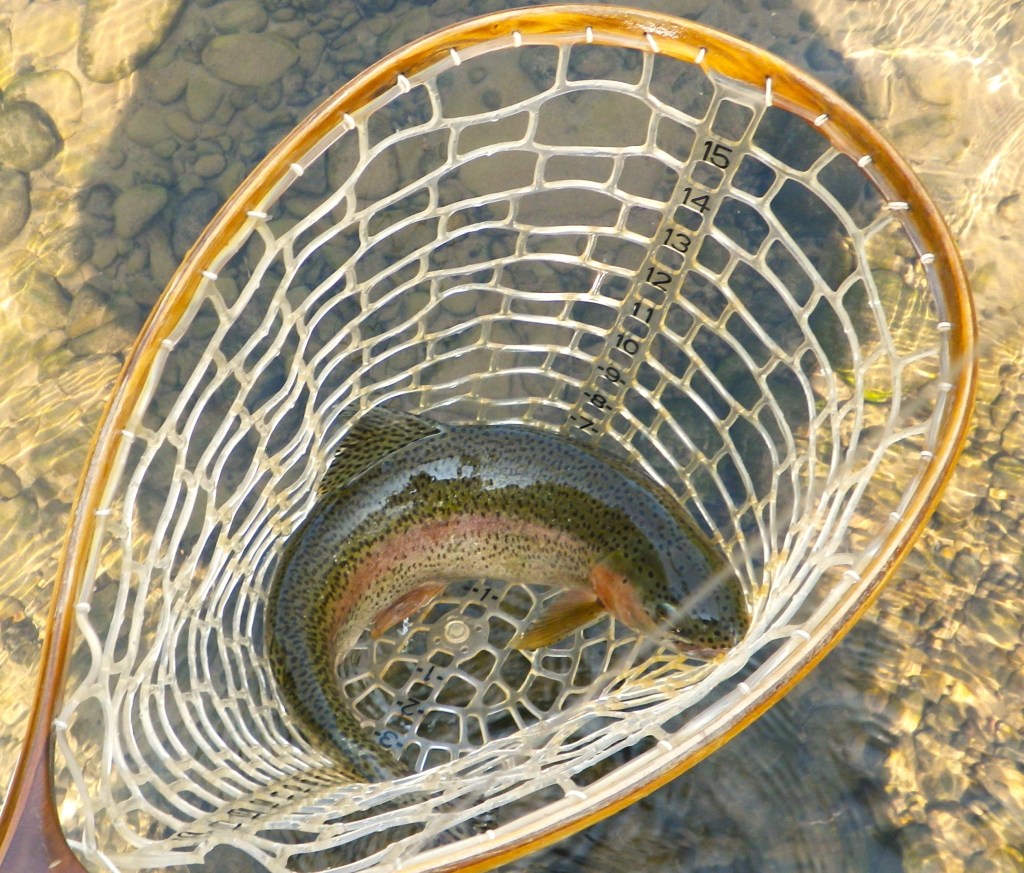
Your average Delaware rainbow is a hard fighting fish, and this fellow was well above average, but I brought him to net thanks to the grace of split bamboo. Twenty-one inches measured, with a wide flank that gave him plenty of purchase against the current in a fight, I dared lift him from the water for only a quick snapshot in the net, then sent him on his way.

As I enjoyed the grin on my windburned face and stood watching that glide across the tailout, the other rise appeared again; so there are two of them feeding.

There weren’t a lot of flies out there, but every once in a while that second roving trout would find one, just as he eventually found my A.I. Hendrickson. Though smaller than that spectacular bow, this one still gave his all against the pull of my arc of cane. Though I had suspected another rainbow, this was a brown trout, not big, but a quality fish of about seventeen inches. I slipped the A.I. from his mandible gently and offered my thanks as he shot away.

Sometimes, patience is rewarded.

Boo Time

My Dennis Menscer five weight sports a March Brown 100-Year Dun.

It is thirty-seven degrees here in Crooked Eddy, with the expectation of sunshine and highs above seventy. Rivers have fallen, and prime conditions for wade fishing are with us.

I just finished cleaning the ferrules on my hollowbuilt Menscer rod, a necessary task with bamboo. Ferrule fitting is perhaps the most mysterious of the black arts learned by master bamboo rodmakers like Dennis. Another rod crafter I knew described it as fitting smoke, and I thought that the perfect analogy. Mating surfaces should be cleaned for each day of use, wiping gently with denatured alcohol on a soft, clean cloth or a Q-tip for the female, no abrasives whatsoever, and the alcohol must never touch the varnish!

The nine year old Airflo fly line on that dedicated CFO IV was freshly cleaned and lubricated as well. I am particular about the care of my fly lines, one reason that I can still fish that line after nine hard seasons. I desire the best performance out of the tackle each time I take it on the water, one of the little details that make a great difference in taking difficult trout. We have all experienced those moments when our best cast fell inches short of the feeding lane of the trout of our dreams, again and again. Gaining those magic inches can come down to small details.

My friend the ghost will join me today. He has earned the name by vanishing outside the dry fly season, only to return when mayflies take wing in springtime. It will be good to talk with the ghost, to catch up on where he has been and what’s afoot since he vanished last summer.

Of course, we will both keep our eyes glued to the surface of the water, searching for the sight of wings, or the soft rings made by large trout feeding secretly. Would that we do witness those events, the beginnings of the magic on bright water!