I fished the limestone springs of Pennsylvania's Cumberland Valley for a couple of decades, founded Falling Spring Outfitters, guided, tied and oh yes, fell in love with the Catskill Rivers I can now call home.
Saturday we were shivering all day with our ancient heating system trying to make semi-comfortable conditions out of minus ten degrees temperatures. Sunday afternoon I was kicking back on the porch with the thermometer reading 52 as the sun tried its best to burn through the clouds over Point Mountain. What?
I know I keep saying it, but every season is different.
All hail the winter sun and a Cold Snap! Thanks to the Red Gods for a few moments of sunlight to thaw the chill from my bones!
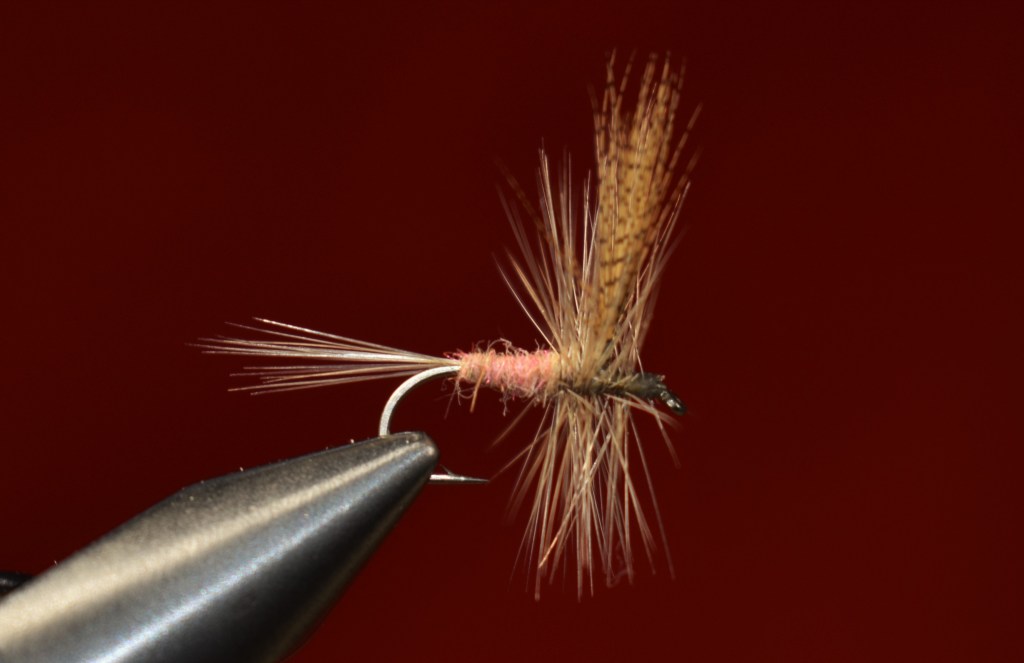
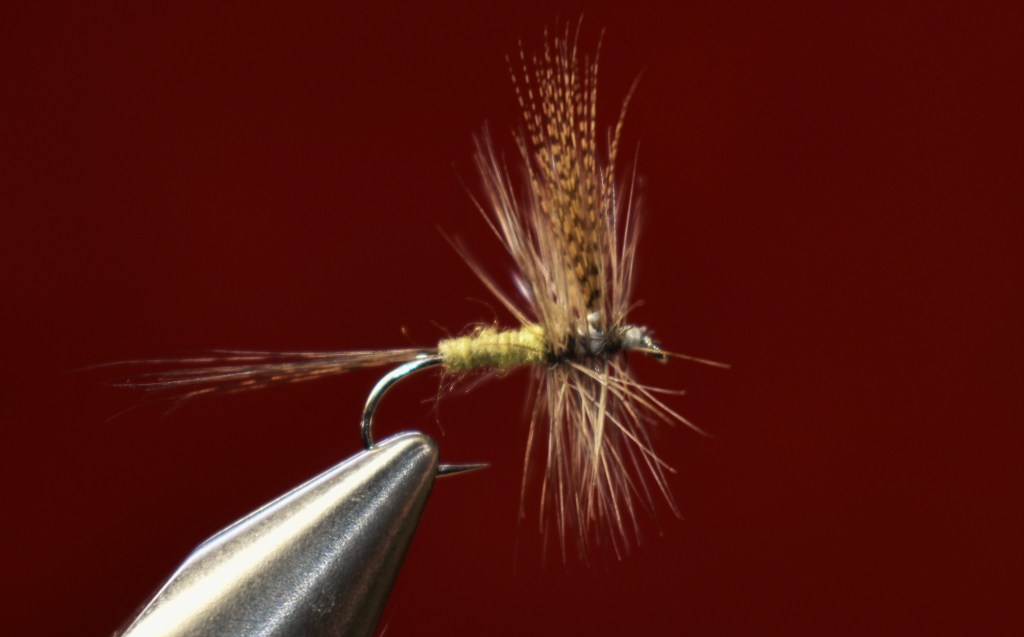
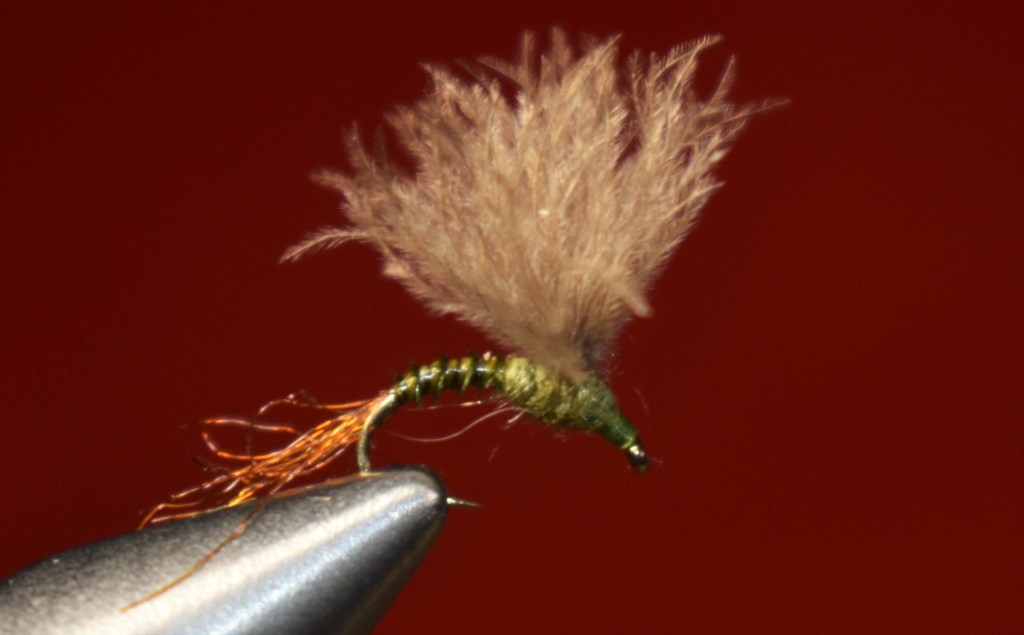
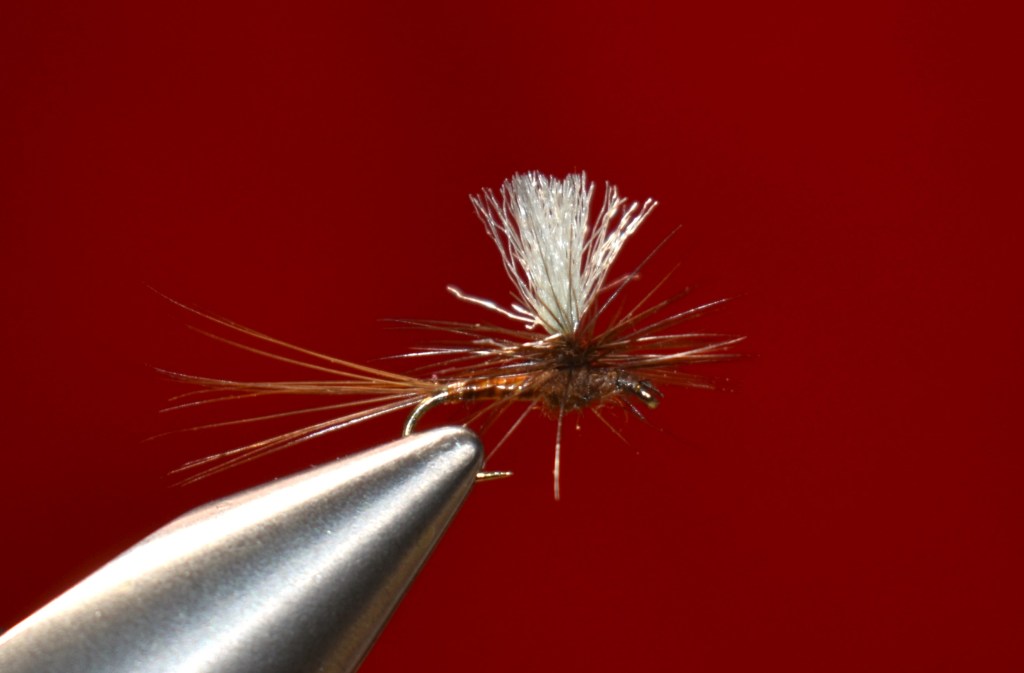
Drawing from the inspiration for the Partridge & Sulfur Orange, I tied a few more North Country style Translucence patterns, delicate little flies to match the ubiquitous small olives of the tailwaters and summer’s pale counterparts. Continuing the theme, I ordered some more of Alec Jackson’s hooks, larger sizes so I might prepare a few more imitations for spring and early summer. I will miss his dry fly hooks, as Daiichi seems to have discontinued making the model 1222.
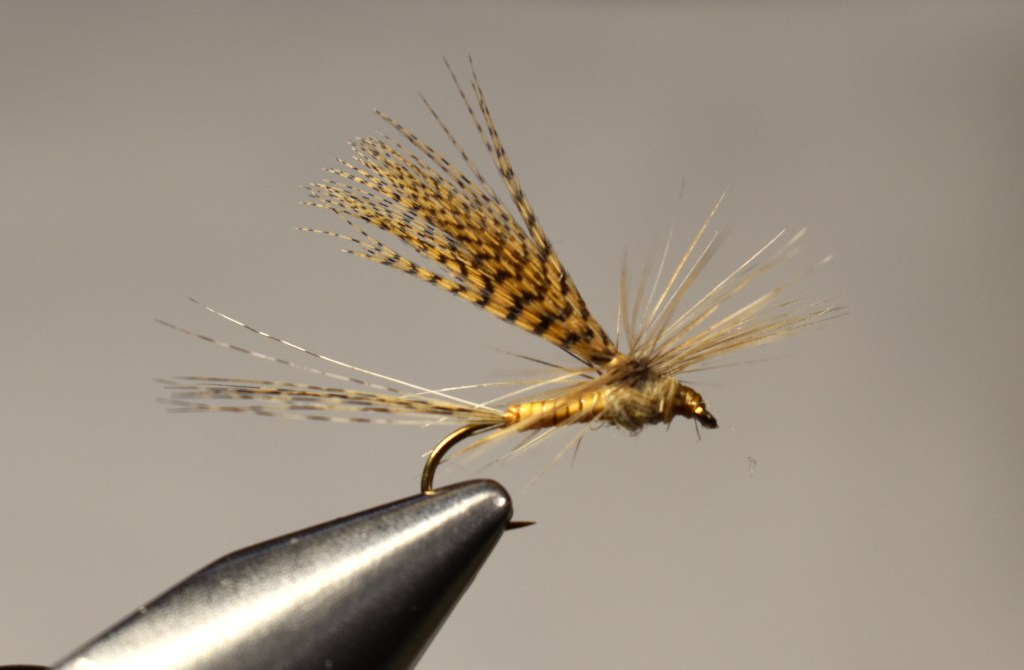
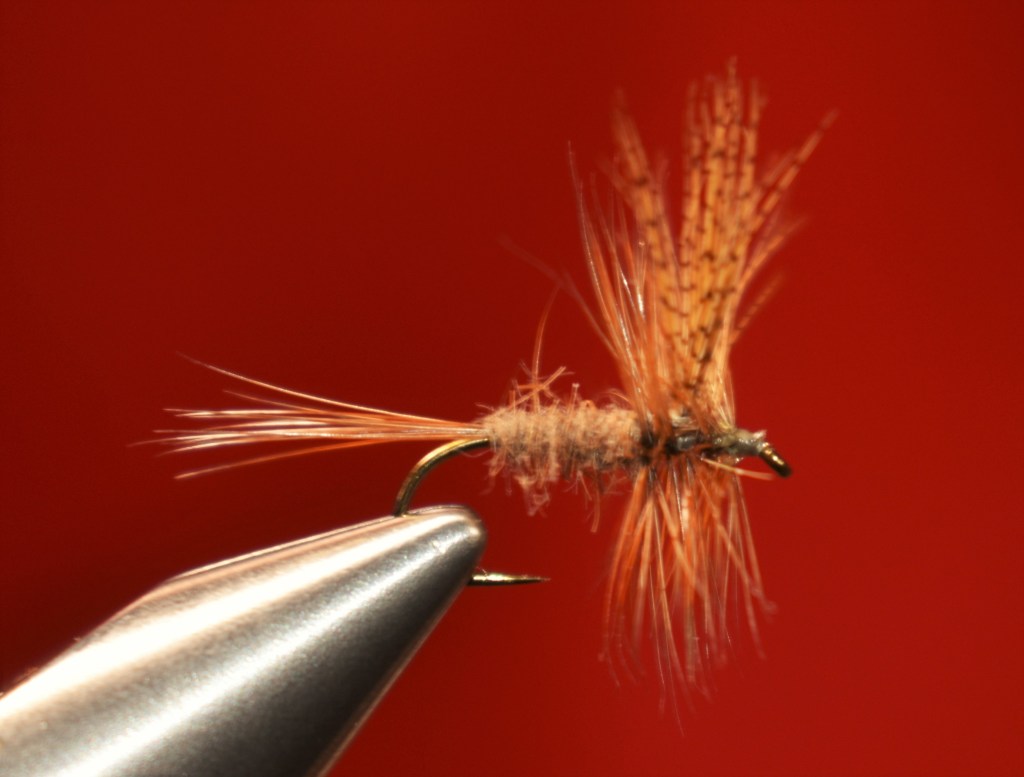
Jackson’s design is perfect for 100-Year Duns, as well as any mayfly imitation with a canted wing. I believe that companies that cater to fly fishers and fly tyers should make it a practice to loudly announce their intentions to do away with products at least six months prior to suspending manufacture and liquidating their stock. There are always tyers and anglers who rely upon items not popular with the masses, and we would appreciate the chance to lay in a lasting supply before the cork is pulled.
I have been pursuing an interest in soft hackles and the English North Country spiders for the past year, though my curiosity was ignited quite some years ago. During one of my rare visits to the Fly Fishing Show I enjoyed a presentation by Mr. John Shaner on the form and history behind these English spiders. That look into the past put the style on my radar, and conversations with proponents the likes of Shaner and the Guild’s Tom Mason continue to fuel my interest. It is beyond difficult to get a dry fly out of my hand and off my leader on the rivers, but I am trying gentlemen.
I cultivated quite early my interests in angling history and traditions, and those interests hold sway upon me now more than ever, as I work on into my fourth decade with the fly rod. The more I explore this grand game, the more I shun the current great push of technology. I have come to the point where this most overused word in our language hits my ears like a profanity. Enough! There is a dignity and contentment inherent in fly fishing that too many are missing, as they are constantly assaulted by the competition of greed. Take an old cane rod out on a quiet stream, a simple reel and a basic floating line, and look and experience and feel what there is around you!
Pondering The Rise, Mid-August (Photo courtesy Chuck Coronato)
There are moments when ideas arrive, twitch the synapses, and require immediate attention. I was enjoying a quiet winter morning: reading Walden’s “Upstream and Down” from 1938, a truly lyrical tour of one angler’s insight and passion, afterwards cooking and savoring a breakfast that brought memories of countless mornings on the road to the Catskills, the anticipation of fishing quickening my heartbeat. Suddenly a thought of tradition popped up and entwined itself with my ongoing pursuit of translucence. I was transported to the West Branch, to one of dozens of summer afternoons amid the fluttering emergence of tiny sulfurs, and the trials presented by some of our most educated and well-fed wild trout.
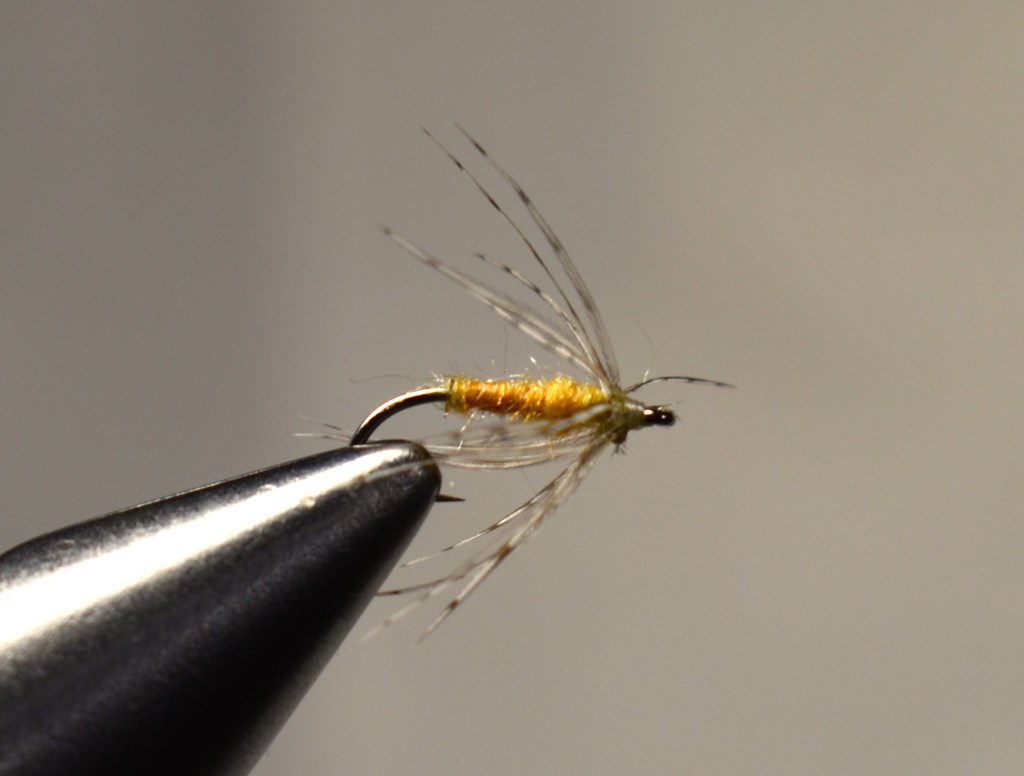
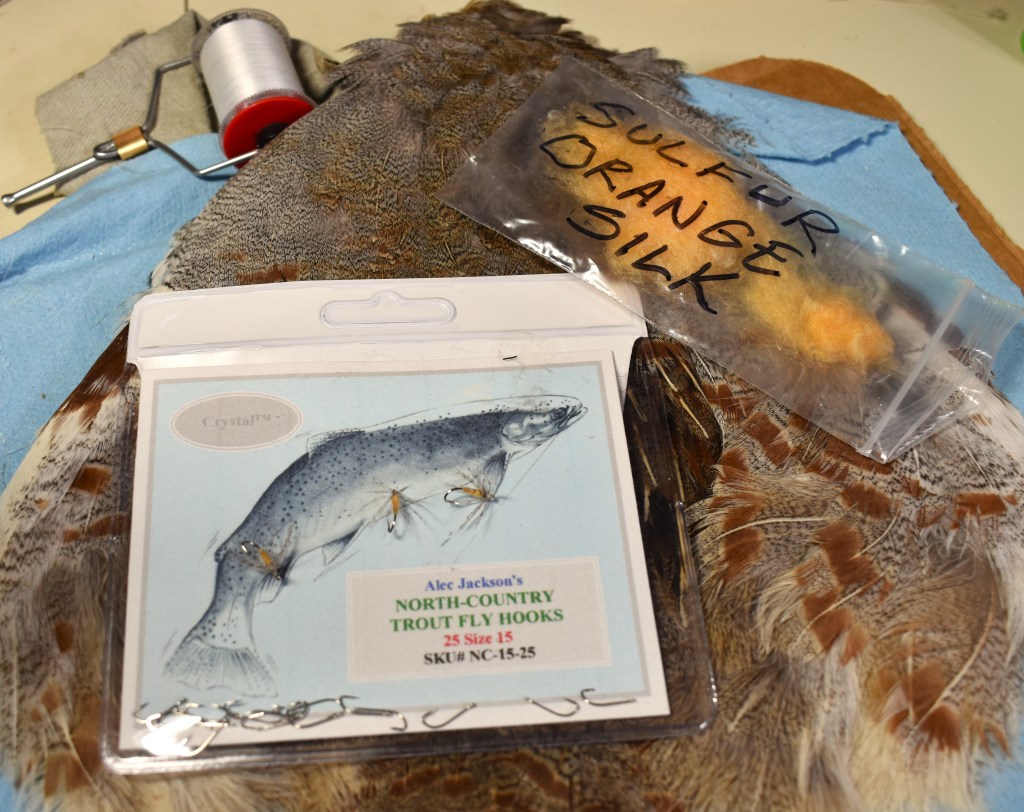
Away here to the bench, I secured two materials and a hook then brought the idea to life: the Partridge & Sulfur Orange, the first Translucence Series non-dry fly!
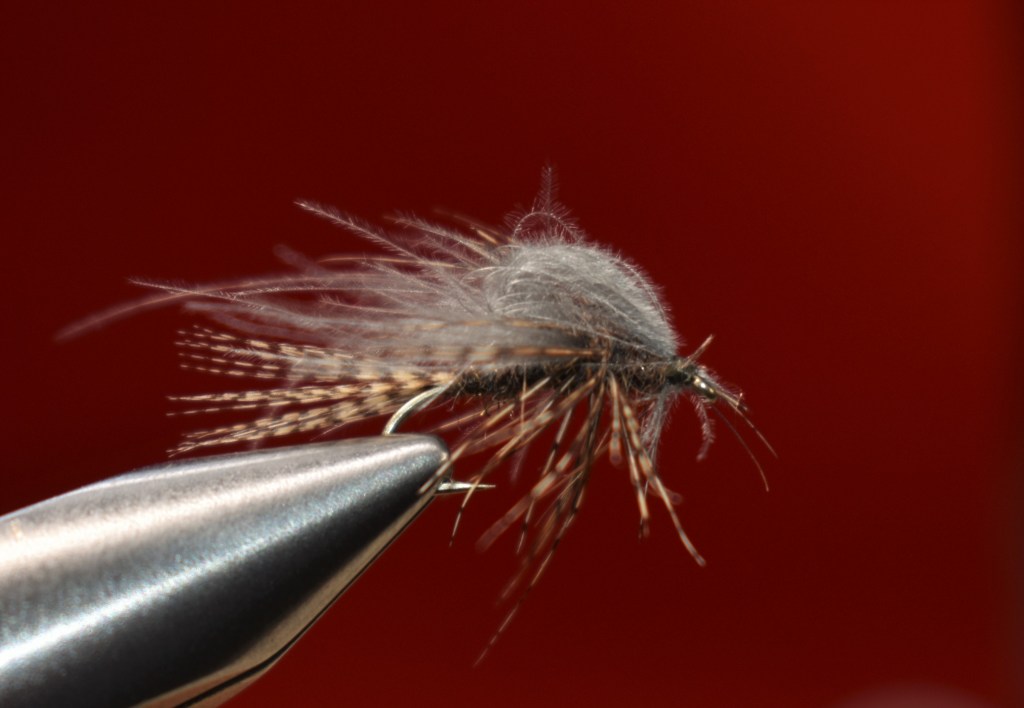
The Alec Jackson North-Country Trout Fly Hooks are made with Daiichi’s Crystal Finish so, following my Translucence formula, white Benecchi’s 14/0 thread dubbed gently with my sulfur orange silk blend and wound with a small gray Hungarian Partridge hackle just may prove the undoing of some of those exasperating brownies that demure in the presence of all sulfur duns, both live and fraudulently crafted.
It seems that a further bow to tradition might eschew dubbing, and then blending individual strands of tying silk, orange and primrose, could produce a similar color effect. I cannot say I have ever offered a standard, traditional Partridge & Orange to one of these maddening summer trout, though it was an effective foil against the pods of winter midge sipping wild rainbows on Gunpowder Falls during my fly fishing infancy. Again, the color aspect concerns me. Many sulfurs appear in a true light yellow, and I have taken fish on Patridge & Yellow and derivative patterns when sulfurs were upon the water. Those with the orange cast are very softly colored, a hue achieved by a blend of perhaps one part of light orange and at least two parts light yellow.
I recall a beautiful Falling Spring brown that glided up and about to nick a few morning sulfurs from a quick little run on that limestone gem during it’s better days. He had no interest in any dry fly I offered but came at last to a small soft hackle sulfur, tied with blue dun dyed hen for both hackle and tail with a dubbed body of yellow silk. I can see that fish in my mind’s eye after so many years, brilliantly colored and heavily spotted, as my shaking hands pulled the tape past twenty inches there in the shallow water.
Pardon the frost on my typing this morning. Our friends at the Weather Channel gave minus ten degrees as Hancock’s temperature at six this morning. I did not venture out to the porch to check my actual reading here at Crooked Eddy. Shivering in my 54 degree kitchen, I fetched coffee and sat down to confer with Arnold Gingrich, wrapped securely in a blanket. As a great man once said “I am getting too old for this shit”.
Luckily the living room was decidedly warmer: 57. “The Joys of Trout” got me through my coffee, fighting the urge to immerse myself in the deliciously warm liquid, and here I sit waiting for the sun to do what it may to make The Rest more livable. Eventually I muddled through the kitchen snow drifts and scrambled some ham and eggs, returning to my blanket to enjoy my repast.
The Jave Quill Light Hendrickson 100-Year Dun, as if I needed another Hendrickson pattern. There are times though that the trout really take a shine to the quill bodies, so why not! Of course, once I found those quills, a few CDC Duns joined the ranks in my well stuffed Wheatley.
I found a friend’s message this morning asking about that 100-Year Dun. I answered with a quick history of my design, noting that nearly all of the mayflies I fish these days are either 100-Year Duns or their CDC partners. When I originally conceived this fly it was a Green Drake, many variations of one in fact. After a decade and a half, I’ve tied and fished them down to size 20 for the olives, summer sulfurs and the like. With this winter’s new Translucence versions, I have both silver Wheatley’s stuffed with them, with only the early season hatches represented.
Ah, the joy of a fly tyer!
I still have to excavate some of my other spring fly boxes, to sort and manage them to be sure I have the alternative patterns at hand, once that countdown reaches single digits. The beginnings of our dry fly fishing most often come in high water, a time when the classic Catskill style fly comes very much to the fore. Yes, I fish the 100-Year and CDC duns in the high flows, but there are times when a well tied Catskill dry bouncing down the current is just what a Beaver Kill brown is looking for.
A taste of my Catskill arsenal,top to bottom: Atherton No. 5, Catskill Adams, Hendrickson (Flick), Dark Hendrickson (Darbee), Red Quill and Translucence ‘Quill’ Gordon
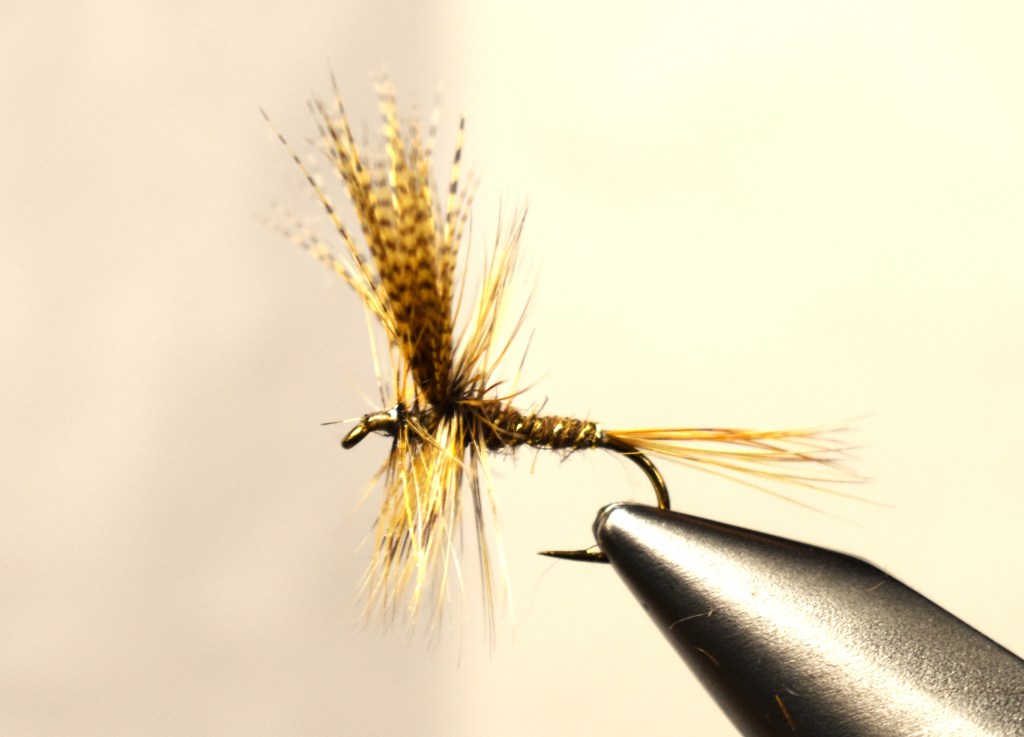
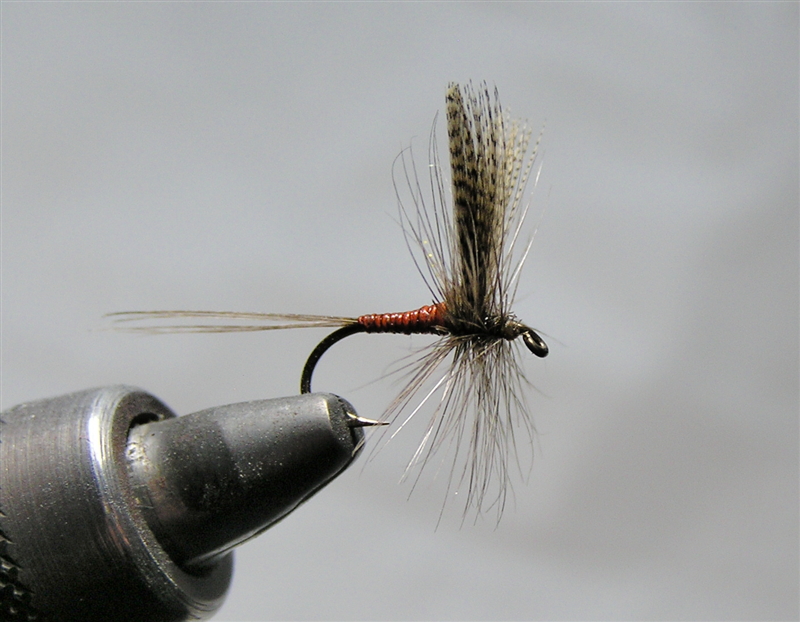
I worked on my box of Translucence Series flies again yesterday, filling one of the final slots in my early spring lineup by considering a match for the venerable Red Quill. My Translucence version clearly is not a quill body so I am calling it Translucence Subvaria Male.
The Catskill Fly Tyers Guild enjoyed another Thursday night fly tying session via Zoom last night, and we found our way around to a bit of the Great Debate. Many of us are soundly packed into our respective corners when it comes to fly color and even materials ideas and theories, so we had a lively discussion. I just wrote a blog about color matching, so I will leave that topic alone; well maybe. What I wanted to put out there today is sort of my case for the CDC fly, at least the styles of CDC flies that I prefer to tie and fish.
I saw my first little carded baggie of CDC feathers better than thirty years ago in the late Wally Vait’s “On The Fly” fly shop near Maryland’s Big Gunpowder Falls. European tyers had been using this material for a while I gathered, but I think that Umpqua Feather Merchants had just begun offering it here in the U.S. I know that I was attracted to that little baggie of wispy gray feathers immediately and bought them. Going back to my roots, Ed Shenk was my major influence in fly tying and design, and it was he who impressed upon me the importance of movement in the fly itself. Ed taught me about various soft materials that produced such movement, as well as special tying techniques that let other materials move. When I saw that first bag of CDC feathers I envisioned “tiny marabou that floats” in my little inexperienced fly tyer’s pea brain, and I have never looked back.
As we tied a variety of Hendrickson comparaduns last night, someone asked the question “how many CDC feathers are you using”. I answered simply in my turn: “two puffs”. That statement ignited another chapter of the Great Debate! For some reason, most of the tyers I have talked to about CDC flies have the same idea, namely “I don’t like CDC puffs”. Some say they sink, some feel they are unruly on the fly. I happen to think that CDC puffs, particularly the large ones taken from geese are the greatest material ever harvested from a waterfowl. I say that despite my overt fondness for the glory of the Catskill fly, the lemon woodduck flank feather.
This is about my passion for CDC flies in general, though I understand completely any tyer that hates CDC puffs. If you have wasted your money buying them, particularly the large dark and light natural dun variety, please contact me and I will buy or trade you for your unwanted puffs.
Cul-de-canard has a number of attributes as a fly tying material. It has remarkable floatation and fish attracting capabilities. The feather structure holds multitudes of tiny air bubbles which not only provides that flotation but reflects light, simulating movement and life. Most importantly, in my opinion, is the fact that those soft, air encrusted fibers move in the current when they are in touch with it. Movement of the parts of the fly itself is a primary indicator of life!
Primarily, I tie three styles of CDC flies, and I prefer puffs for all of them. Why? Lacking stems, puff feathers are softer and provide more movement. They are ideally shaped and sized for an instant wing, thus making your tying faster and simpler. They also have a hidden property which has at times tempted some very special trout that otherwise proved content to ignore flies in general. My number one CDC fly is a puff comparadun or sparkle dun. Whether you choose tailing or a shuck, these are quick to tie, realistic, and known to be devastating to picky trout.
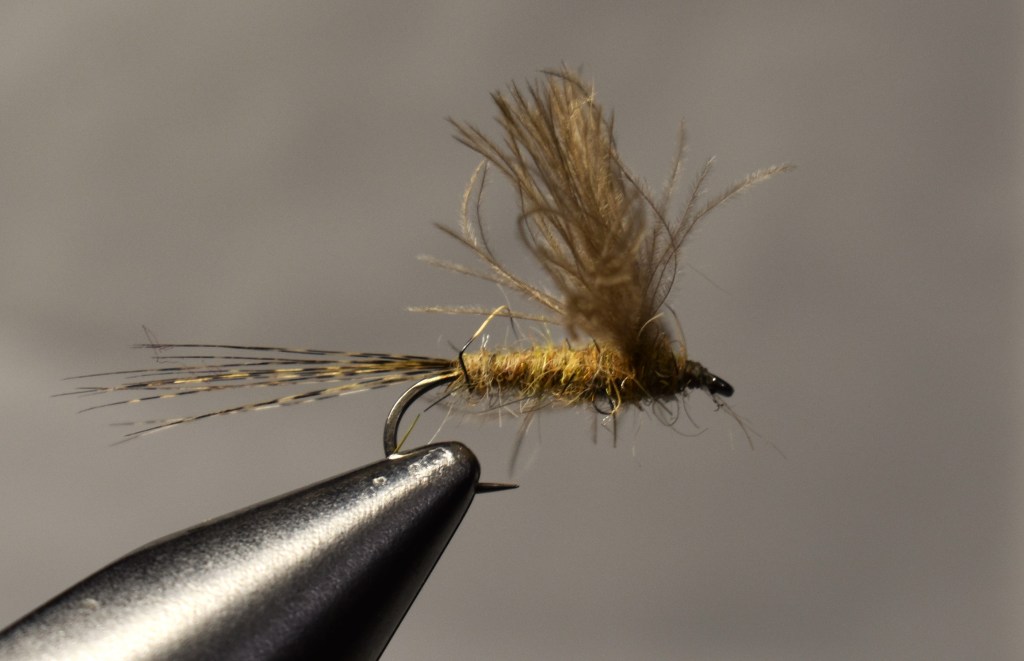
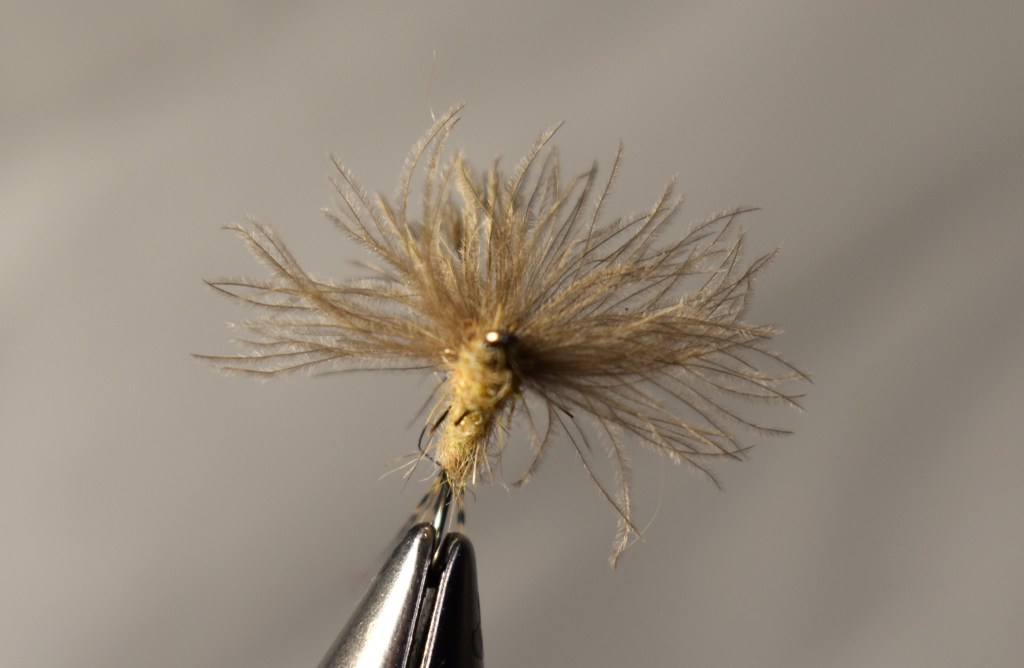
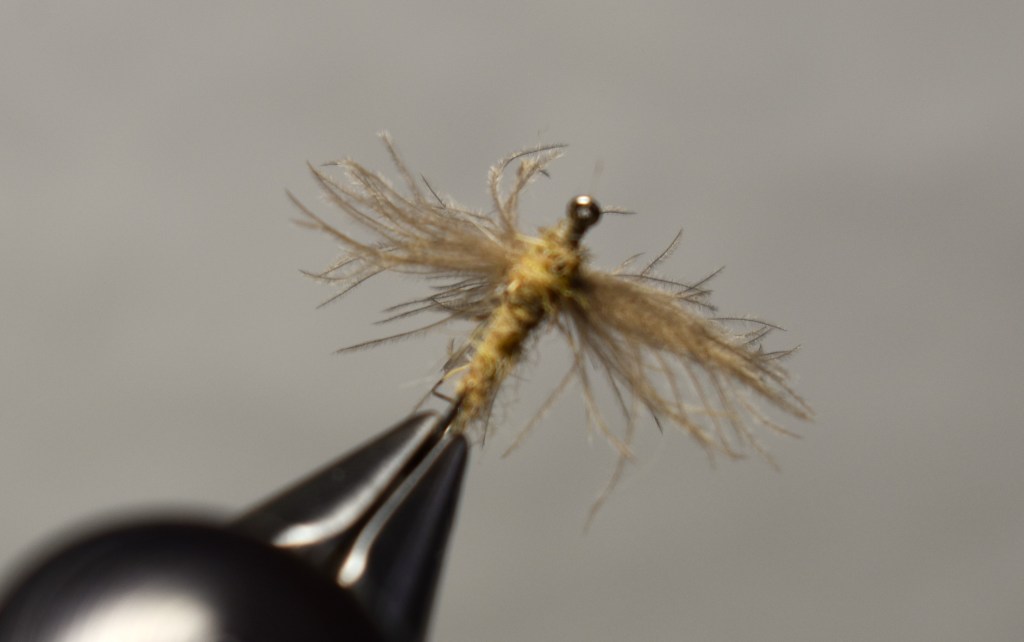
The anatomy of a CDC comparadun: (Left) hackle fiber tailing, a dubbed body and a CDC puff wing give you a very simple fly. I like to give the wing a little cant mimicking the naturals, though I tie some fully upright too. (Center)With the free CDC fibers fanned out like the deer hair wing of a standard comparadun, fibers are in touch with the water and will move enticingly with each little movement of the current. (Right) On the underside we have the silhouette of the mayfly and the wing has some depth thanks to those “unruly” fibers, enhancing the appearance of motion. The motion becomes real on a breezy day!
The second most used design of CDC fly in my boxes is the emerger/cripple style fly, and I tie them in a wide range of sizes and complexities, to match different stages of mayflies and produce different effects.
Emergers and cripples: (Left) my original CDC emerger from thirty years ago, this one for the Hendricksonand tied with standard CDC feathers as a looped emerging wing. (Center) The turkey biot bodied March Brown, an emerger/cripple style fly with the enhancement of a touch of Trigger Point fibers in the front of the two-color puff wing. (Right) The basic turkey biot bodied puff cripple BWO.
The old faithful loop wing emergers were one of my first uses of CDC feathers. I published my series of these in the old Mid-Atlantic Fly Fishing Guide back in the early nineties. A couple of months later, Fly Fisherman magazine ran a feature by a guy named Rene Harrop who was tying a very similar style of fly. I had never heard of the guy or seen his flies, but we all know his name today! Damn, I coulda been famous!
The crippled emerger style with the high puff wing has proven to be very versatile for imitating emerging mayflies during the early stages of a hatch as well as crippled duns that can show up on the water at most any time during a specific species annual emergence cycle. This is the fly with the bonus that has tipped the scales a few times, particularly with the large mayflies. There are generally three of the largest puffs in the wing of these size 8 and 10 flies and that has a lot of floatation and a lot of movement. Some fish though like to chase emerging nymphs and just don’t want to take anything even partly on the surface. At the end of my drift, I will lift the rod tip high and twitch one of these flies and sink it. Sometimes I let it swing slowly for a time, then raise the rod and twitch it lightly once more before mending and feeding slack immediately. The fly hovers and then rises, all the way to the surface again, though it doesn’t always make it that far!
Do puff dry flies sink more than other CDC flies? I don’t know that that is the case, at least not if they are tied with enough of the material. The size 14 Hendrickson in the first photo gallery is tied with two medium size puffs. These are the medium sized puffs in a bag of the large ones previously marketed by that Harrop fellow under the Trout Hunter name. The total length of these is about the same as the length of a size 14 dry fly hook. A bag of feathers will have various sizes of puffs, some long enough for size 10 and 12 hooks, even size 8 hooks at their largest, and some better suited to sizes 14 or 16, even 18. A particularly full medium length puff might be enough to tie a size 14 dry fly all by itself, but most of the time two of them will make a better floating, more effective fly.
A full CDC puff wing doesn’t overburden a fly, though I have seen commercial patterns that looked like a big white fuzz ball. Think about fluttering wings when you tie your flies and size those wings, and you should end up with the right amount of material.
Durability can be a concern for some tyers. I prefer very strong fine tying thread for my CDC flies, with 14/0 being a favorite. Giorgio Bennecci and Veevus both offer very good threads. I wax my thread when tying, rubbing a bit on my index finger and running that up and down my thread. Fine thread allows me to tie my puff wings down with more tight wraps without building up unwanted bulk. You can cut feather fibers if you overdo it, so don’t go crazy with thread tension. I typically catch a lot of fish on one of my CDC flies before it gets thrown away. If you don’t grab the wing with forceps, or try to yank a fly out of a trout’s mouth by the wing, your CDC flies won’t come apart.
Some may look at my CDC comparadun and scoff that it looks messy. Thank you; so does a fluttering mayfly! Difficult wild trout are my passion, and they are thus the only judges I give a damn about when it comes to evaluating my fly designs and tying. If I am in the mood to tie a show fly, that’s fine, and it is something I enjoy. I don’t tie those for fishing.
I more or less promised to stay away from the color debate, but…
CDC flies are designed and tied to sit partially in and partially on the surface, some even partially under the surface. In light of that, I believe that matching the color of the natural flies as well as we are able is important to success. Light, sky and water conditions all play a role in that equation, as does the depth and current. Tie the best fly you can tie to imitate a living mayfly, or caddisfly or stonefly. It certainly cannot hurt your chances if it happens to be the right color.
I sat and watched old Punxsutawney Phil make his prediction at dawn this morning, flanked by hordes of shivering onlookers: six more weeks of winter. I wasn’t surprised, since my countdown stretches out over a significantly longer span. Sixty-seven days is a bit more than nine and a half weeks and, though I love springtime, the dry fly season just doesn’t begin until the new season has settled in.
I found an email from a friend over on the Esopus, one with an imbedded video clip of a famous fly guy tying Ed Shenk’s “Letort Hopper”. This video guy was about as far away from tying the actual legendary pattern as he could get, but what I saw, brought back a flood of memories.
It has been more than thirty years since I first sat alongside the man they called The Master of the Letort and learned how to tie his legendary fly patterns. I recall my feelings of excitement and a bit of intimidation; the same feelings I felt a day earlier as we stalked the meadows of Pennsylvania’s most challenging and historic limestone stream. Ed taught me how to hunt trophy trout, how vital it is to consider each move before ever drawing near to the water. I think of him frequently as I stalk the bright waters of our Catskill rivers.
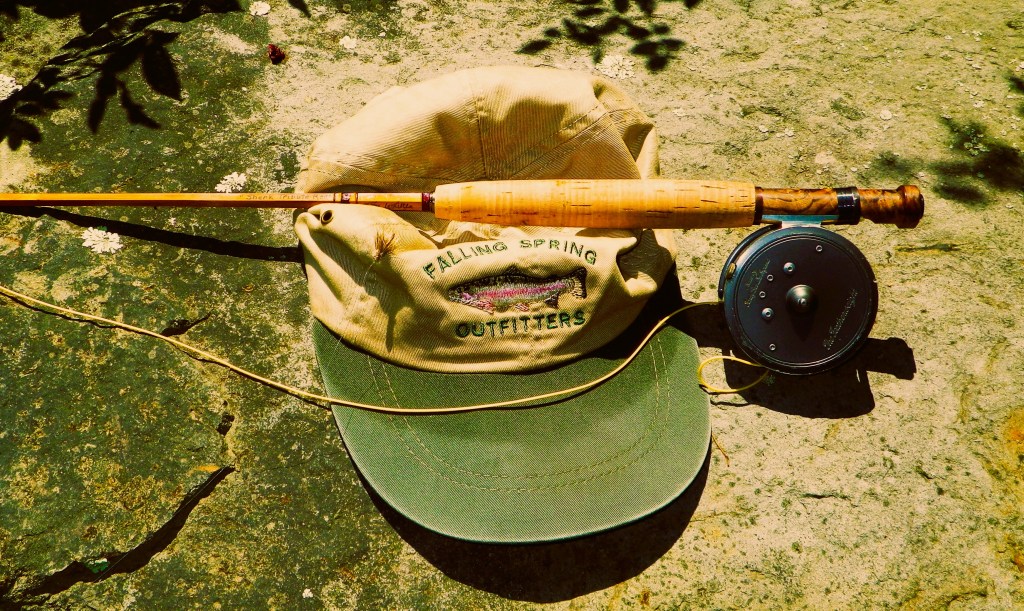
The Shenk Tribute Rod, bearing Ed’s Hardy Featherweight, with a Letort Hopper knotted and ready for a stalk.
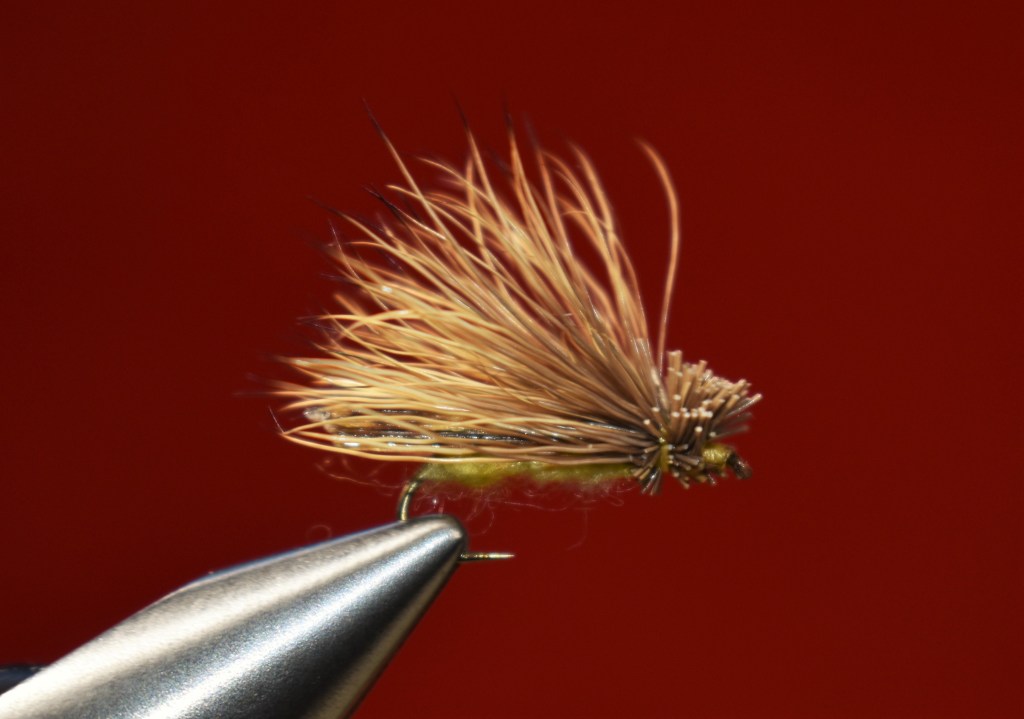
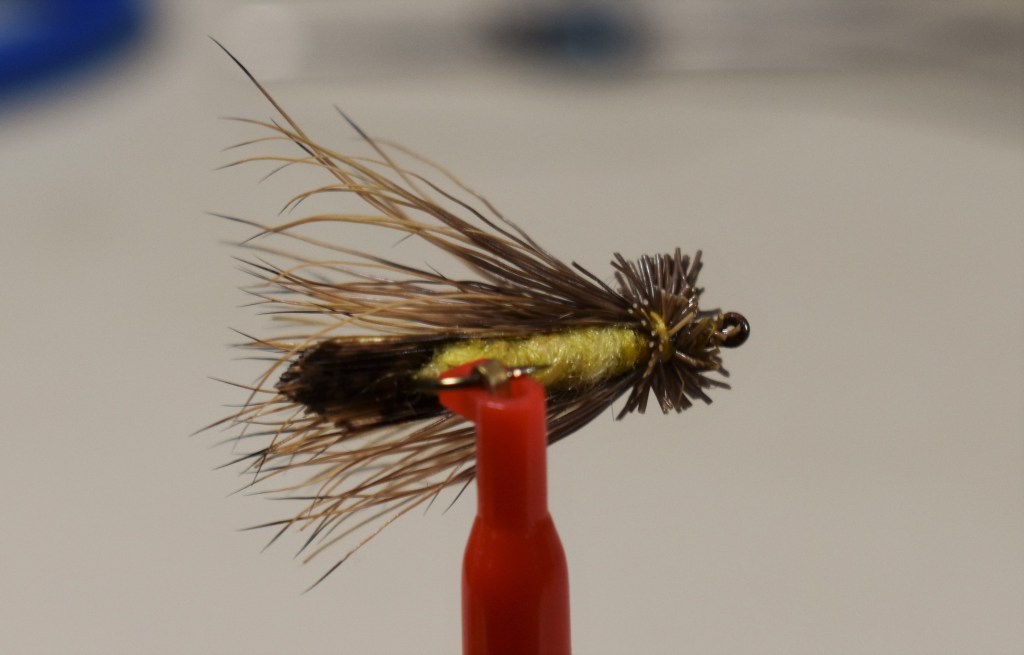
Remembering that morning in Shenk’s den, I recalled the specifics of the Letort Hopper as I messaged my friend about the liberties that fishlebrity took in tying the fly. When Ed tied Hoppers, or any other fly for that matter, he tied them with the efficiency of an expert professional fly tyer. The hooks chosen would be 2XL dry fly hooks and his favorites were always the size 14 and 16 flies. At the time he passed his knowledge to me, he had settled on Fly-Rite poly dubbing, #14 Golden Amber for the bodies, and preferred the mottled tan and brown wing quills from a wild turkey. The deer hair he chose was whitetail, tannish colored early season body hair with well-marked tips, and coarse enough near those tips that it would flare properly. Observing the natural world since he was a tot taught him the importance of Nature’s mixtures of coloration, and he selected his tying materials accordingly.
Hopper bodies were dubbed a bit thicker than mayfly bodies, the turkey feathers cut into strips twice the width required and folded in half lengthwise, then their tips were cut in a broad vee shape before sealing them with tying cement. Fly bodies and underwings were crafted, the feather cemented, thread half hitched and cut off, and then the bodies were set aside to dry thoroughly. Once several dozen of these had become thoroughly dry and hardened, Ed would begin the deer hair wings, measuring them even with the tip of the underwing, stacking the hair with the aid of a .45 ACP cartridge casing, and cutting the excess butt ends. These were tied in on top of the thread wraps securing the underwing, the hair flared prominently, and the thread brought forward to the hook eye and whip finished. Trimming the head of the fly was the final step, done after hair wings had been fixed to all of the finished bodies: flat at the front and rounded along the top and sides to achieve a “can” shape.
The extreme closeups certainly show the flaws in the fly, my imperfect trimming looks better at actual size, but they clearly feature the silhouette that is key to Shenk’s design and the correct proportions of hook, body, underwing, head and wing that make this fly a classic that has caught trout worldwide.
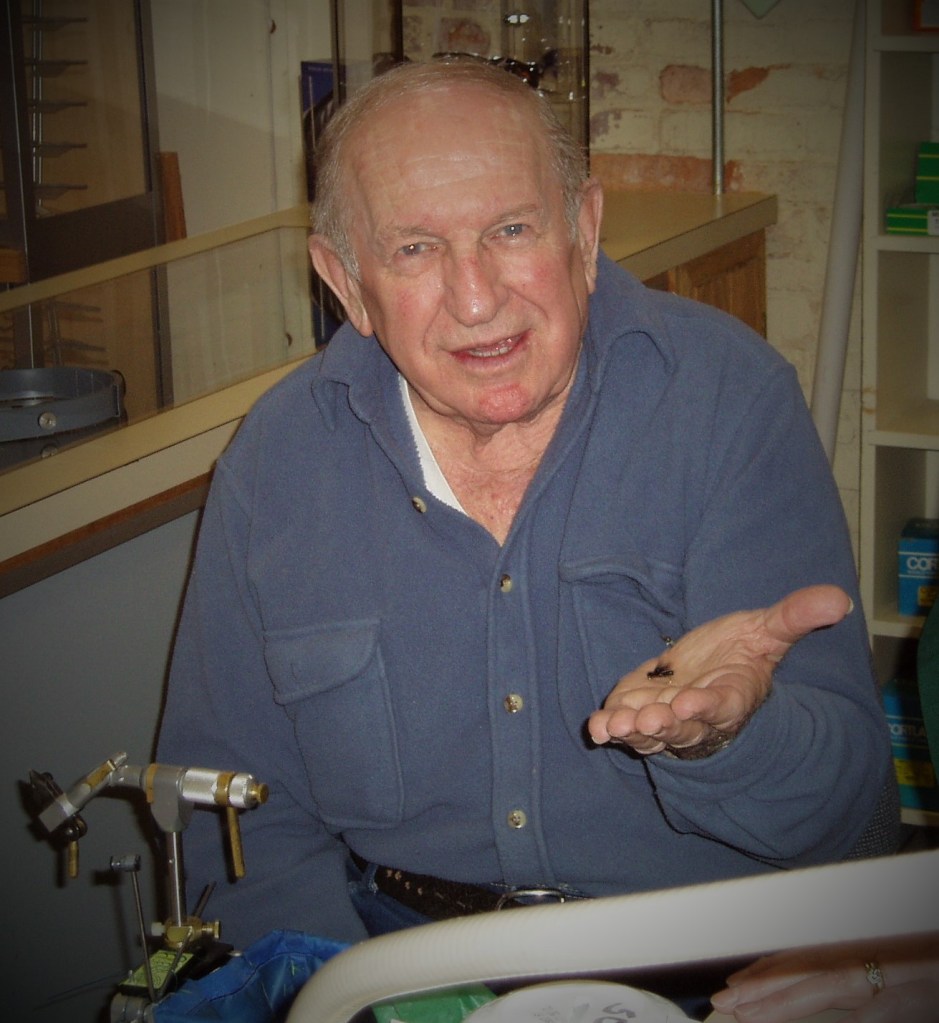
The late Ed Shenk presents a Letort Cricket fresh from the vise during a demonstration at Cold Spring Anglers, Carlisle, PA in 2007.
The Letort was a challenging classroom in those days, and I returned over many years to practice the lessons The Master had taught me. Observation, approach, casting and fly selection were paramount, as was my growing familiarity with the stream. I always marveled at how a few huge browns would hunt late, lingering precious moments after dawn. I would creep into the Barnyard Meadow at first light and begin watching the stream from a distance. There would be no motion save the current itself, and I would advance slowly toward the bank, ever watchful for signs of life. More than once I crouched in the tall grass on summer mornings when a broad wake would develop forty yards upstream and streak down and past my position. With the sun over the trees at the edge of the meadow, I would see the wide bronze flanks of a tremendous Letort brown as it sped past overtop of the weed beds. I began to believe that the gentle sunrise itself spooked those trout.
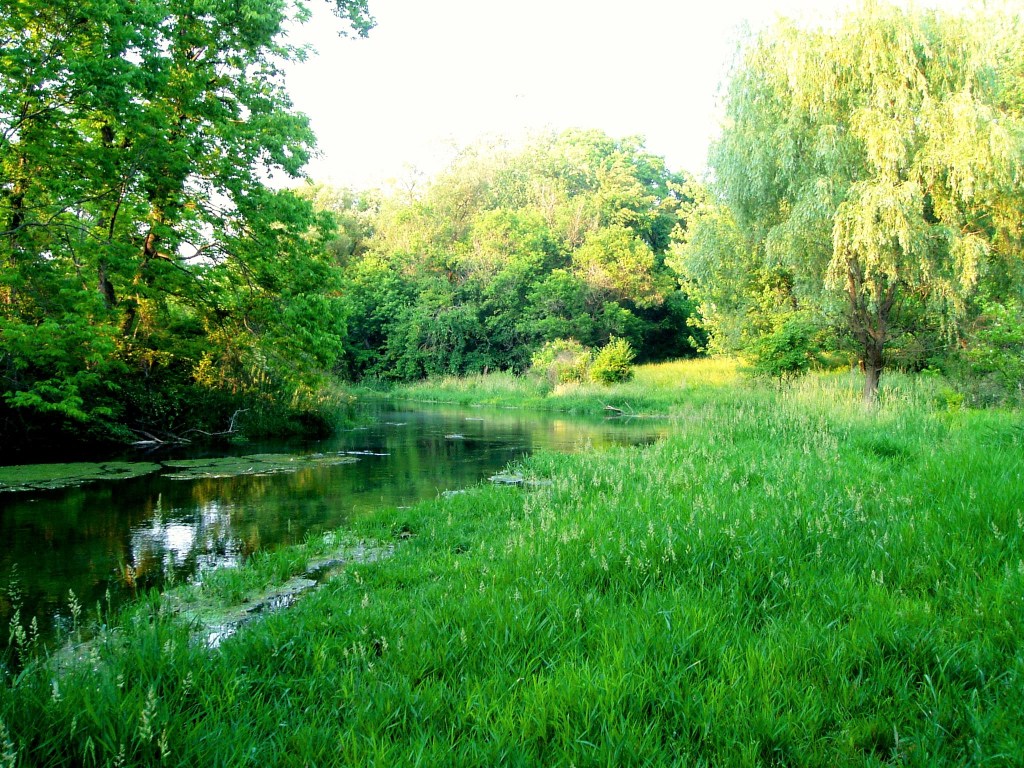
The Barnyard Meadow, in June.
I took my first large Letort brown trout in that same Barnyard Meadow, casting a size 16 Letort Cricket above a log jam two thirds as wide as the channel at dawn. The eighteen incher sipped the fly as it twirled in the tiny eddy if front of the upstream logs and gave me a real problem trying to play him out from beneath the fallen forest on light tackle. He was dark and beautiful when I finally lifted him in my net, completing my spiritual bond with the bright waters of the limestone springs whose legends still haunt me.
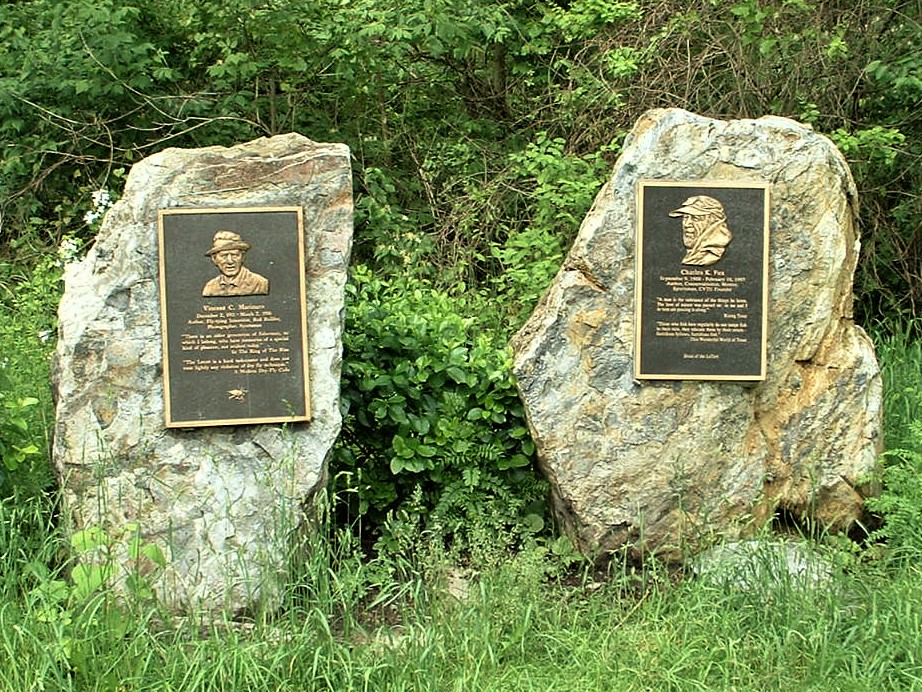
These monuments mark the fisherman’s trail into the upper reach of the old Barnyard Meadow, since renamed Marinaro’s Meadow by the Cumberland Valley Chapter of Trout Unlimitedwho owns and maintains the access.
We lost Ed Shenk nearly three years ago. His passing was unexpected, for though many years had passed since our first meeting, he never seemed to me to age. Though our friendship was comfortable and cordial, I could not help but hold the man in reverence, for he was a towering figure in the lore and legend of American fly fishing.
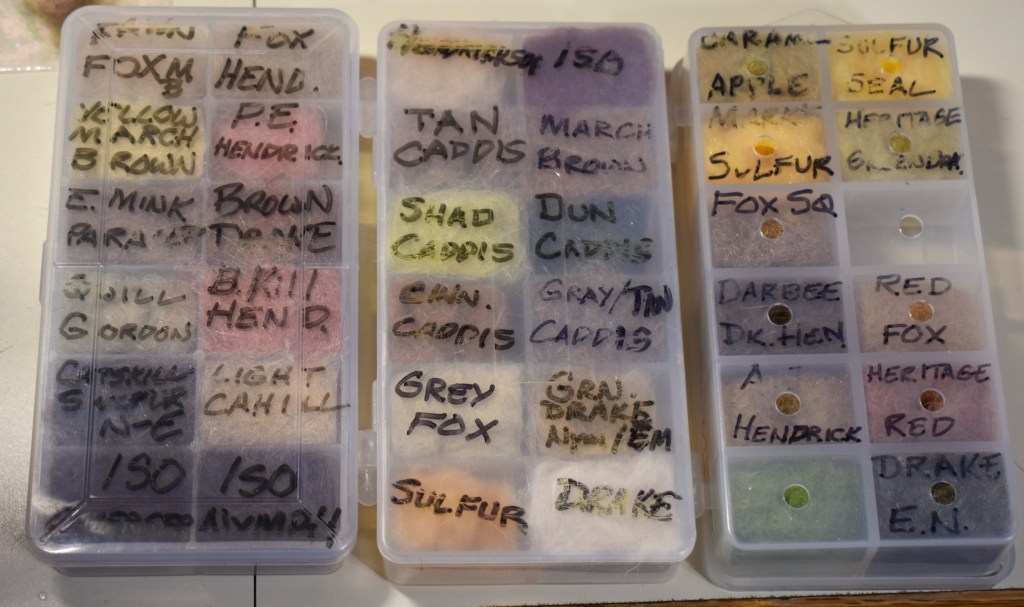
My dubbing boxes: three and counting, filled with the main blends I use to imitate the fly hatches of our Catskill rivers. There are dozens of little labeled baggies holding wisps of blends concocted for rare hatches and once angled streams, but these boxes house the mainstays.
I am a color guy and, if you have read a few posts on this blog, you know that matching fly color is important to me as a fly tyer. I learned the lesson the day I fished through my very first hatch: color matters! It is one of those oft debated topics among anglers, fishermen tending to be convinced by their experiences and influences for or against the importance of fly color and pattern versus presentation. My experiences have led me to the conclusion that all the facets of the fly, the line and leader and presentation make a difference in fishing success, thus I try to put my best foot forward in regard to all of these factors. They are all important, and their ranking as related to angling success varies constantly at the whims of Nature!
I know that matching color and translucency are important, and I know that the level of importance varies under a myriad of conditions of light, current, water clarity and temperature. I have flies in my boxes that are not perfect color matches of some of our primary hatches, and they are proven reliable patterns.
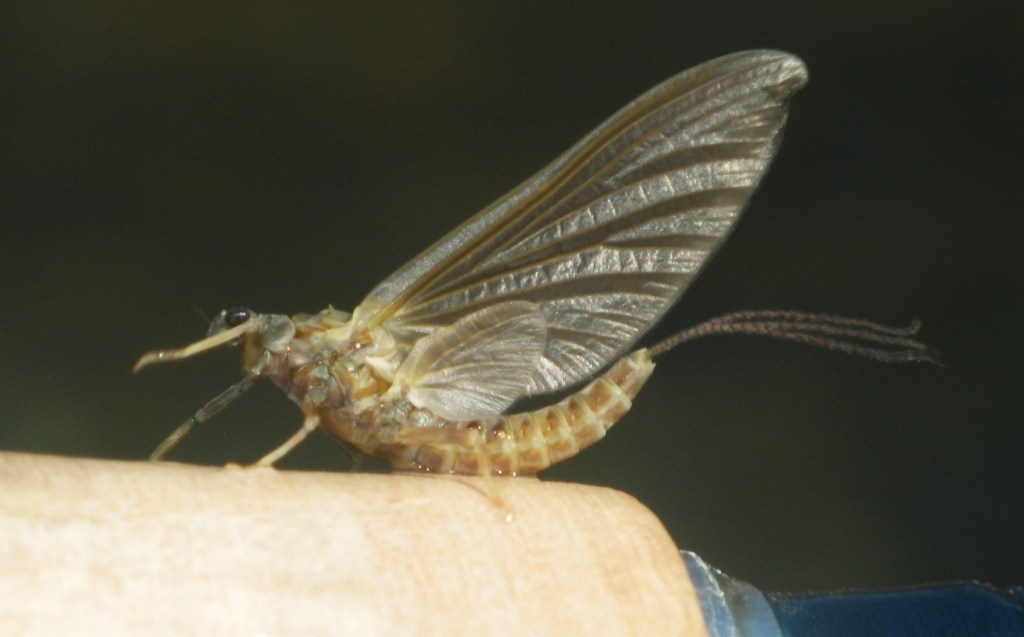
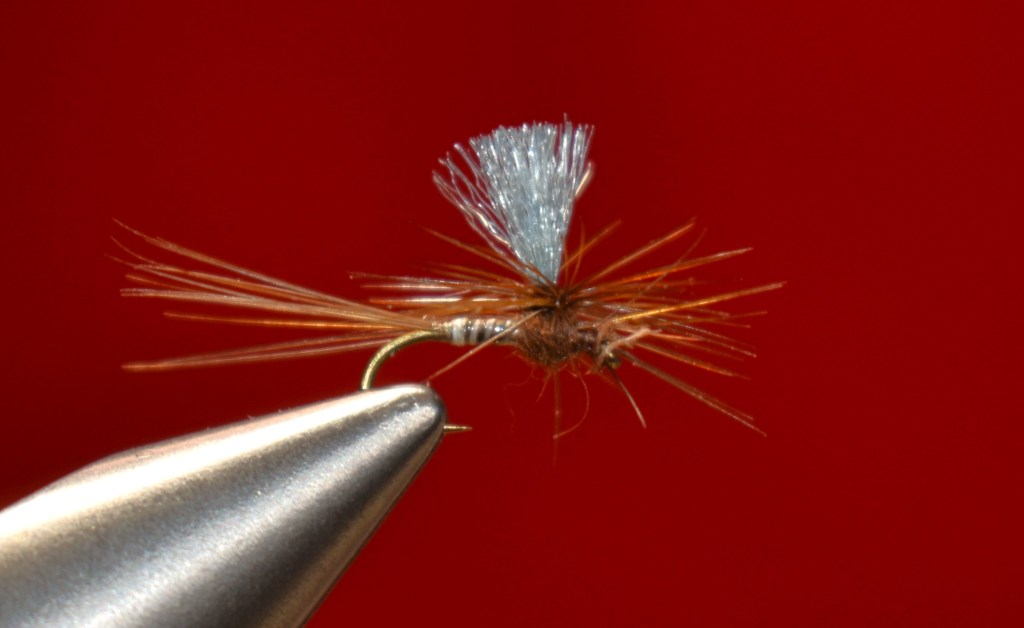
Yesterday I took to tying a few Blue Quills, the common and traditional name for flies to match the Paraleptophlebia adoptiva mayfly. The traditional Blue Quill is tied with a stripped peacock herl quill body that may vary in color based upon the herl used, often producing a grayish to brownish body with a darker stripe. The mayfly itself is brown, generally darker than the brown toned quills, but I have long tied my favorite little Blue Quill Parachute with biots from a wild turkey primary feather. That fly works! It has taken many trophy trout for me when Paraleps are on the water, and it isn’t brown.
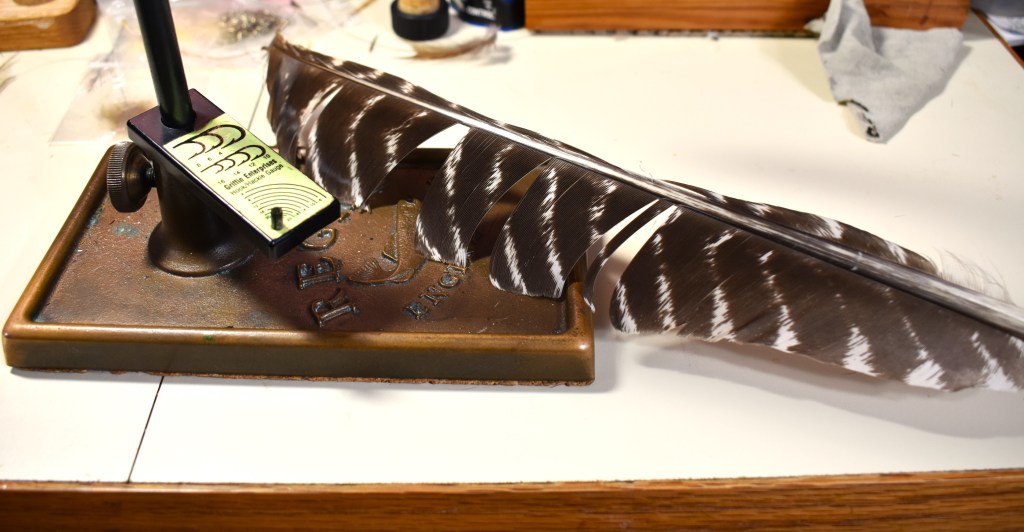
Note the black and gray striped body of my old reliable Blue Quill Parachute, and the wild turkey primary wing feather that provides the body.
After I tied half a dozen old faithfuls, I chose a dyed wild turkey primary to tie a few size 16 quills in a deep hatch matching brown color, covering all my bases. One of the two places I ever bought flies in the Catskills was the Roscoe shop owned by the late Dennis Skarka. Dennis tied his Blue Quill Parachutes with bleached peacock quills. His flies had a nice lighter gray body with the dark striped segmentation, and they were deadly. That’s the effect I have in mind when using the wild turkey biots and trailing edge fibers.
My spring fly boxes for the beginning of our dry fly season will have both colors of my biot parachutes, CDC winged duns featuring both biot and dubbed bodies, and a few hackled duns with peacock quill bodies, often in a poster style with an Antron post wing. This spring, there are some Translucence 100-Year Duns that will be joining them. I will have the fly side of the game well covered. Presentation comes with every cast and includes every step toward a casting position and every adjustment to leader and tippet made before a fly is tied on.
There are days when matching the color of the natural flies is paramount to success, and there are days when it isn’t. When you get right down to it, the importance of color might vary from one rising trout to another. Whether that is influenced by the light and water clarity or the fish’s mood no one can say. My goal is to be prepared to match colors to the greatest extent possible, as I think its pretty hard to go wrong with the right color fly.
A new morning, another glimpse of memories of springtime!
To have the simple beauty of clear blue skies and brilliant sunshine greet me two days in a row must have been too much for me to savor. I thrilled to it, walked the riverside again reveling in the sunshine, yet still believed that the chill of winter would rule the day. Paradise lost!
Refreshed from the cold, bright riverwalk, I languished through the day, watching the wind ripple the flag and reading of old rods and old times. When at last I expected the mail, I stepped onto the porch and was struck by the warmth radiating from the southwestern sky. A glance at the thermometer beguiled me: 48 degrees! With February knocking, 48-degree sunshine feels quite like summer, and I was driven to sit awhile, to sip my favorite Cold Snap ale and enjoy the moment. By the time I had checked the contents of my parcel from Dette Flies and finished my draught, the awakened thermometer betrayed fifty-one!
That pleasant moment left me with regret, for I realized this day had offered more than a sunny riverwalk. The gift offered was a fishing day, one I failed to unwrap and enjoy.
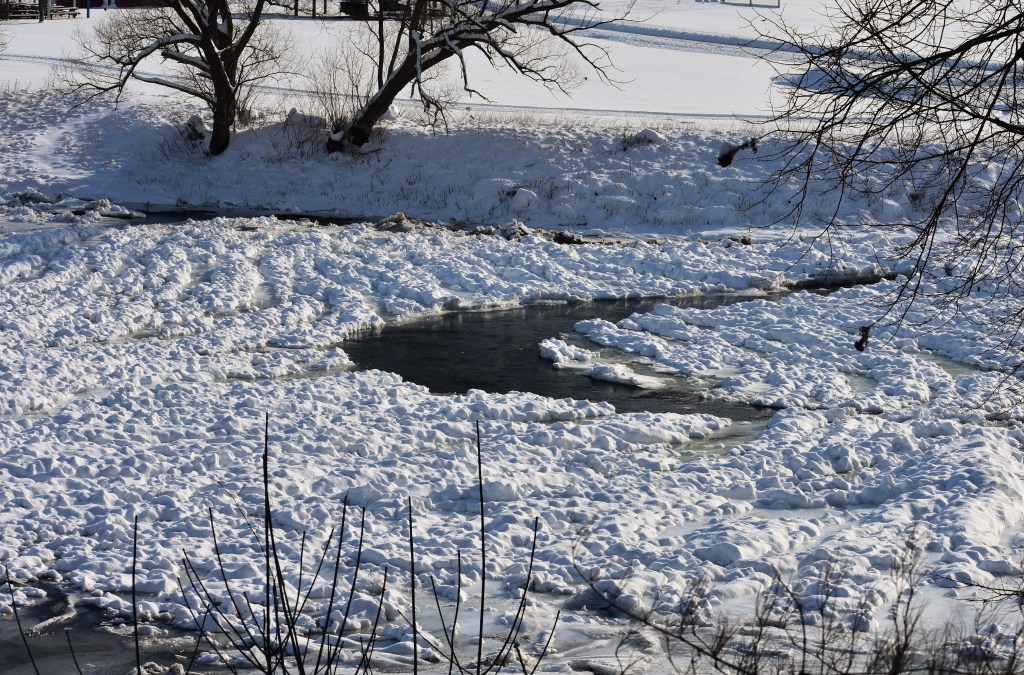
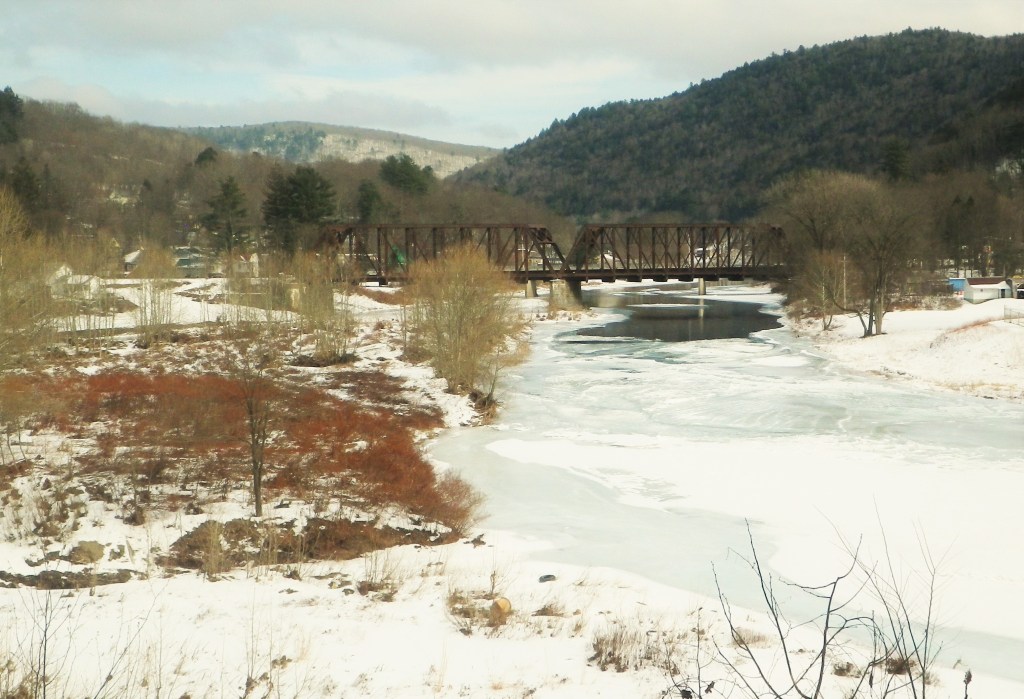
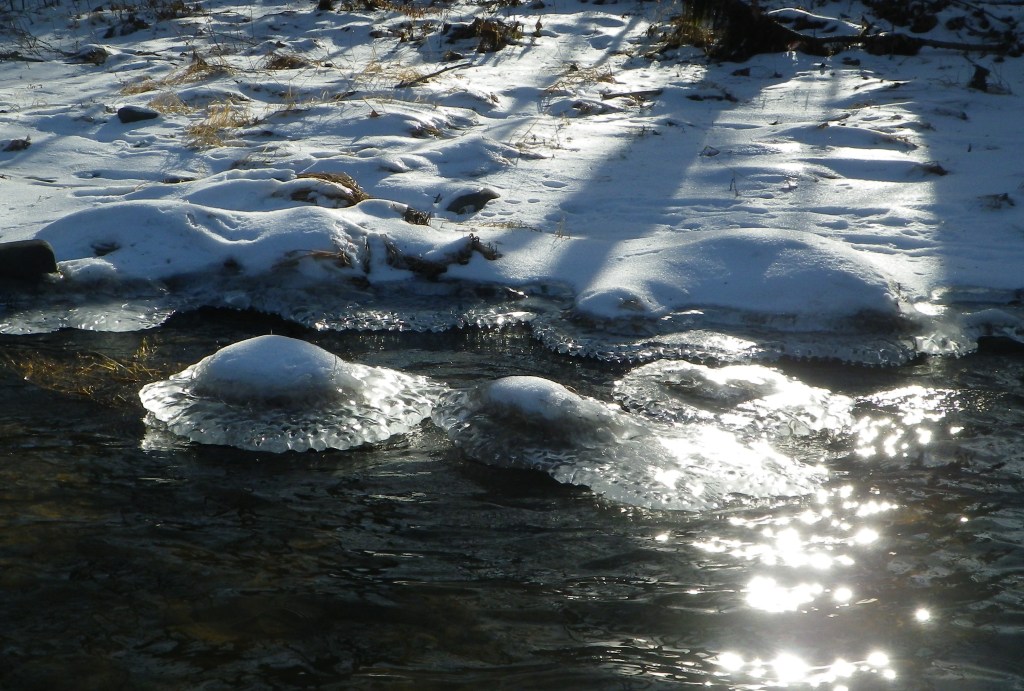
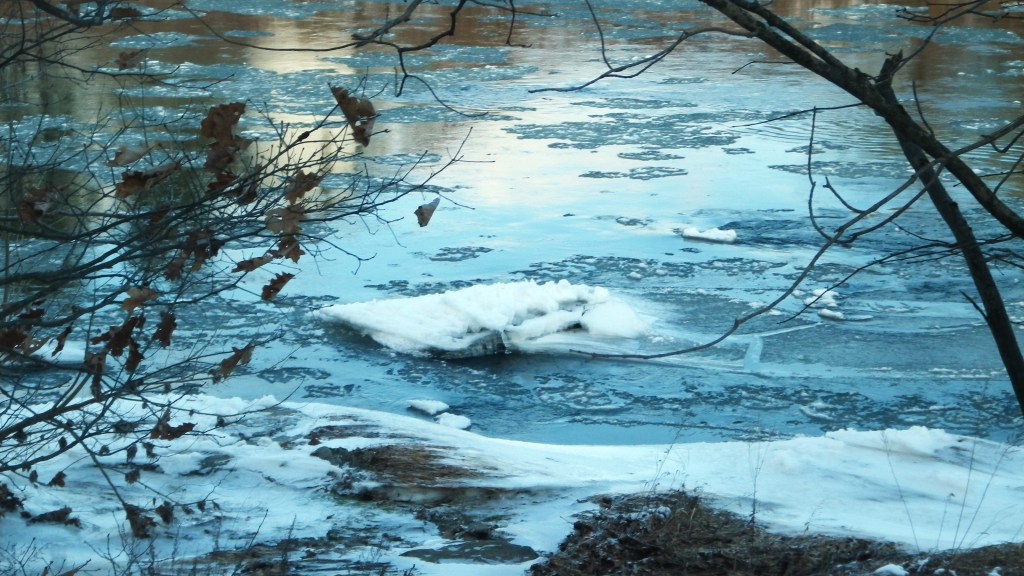
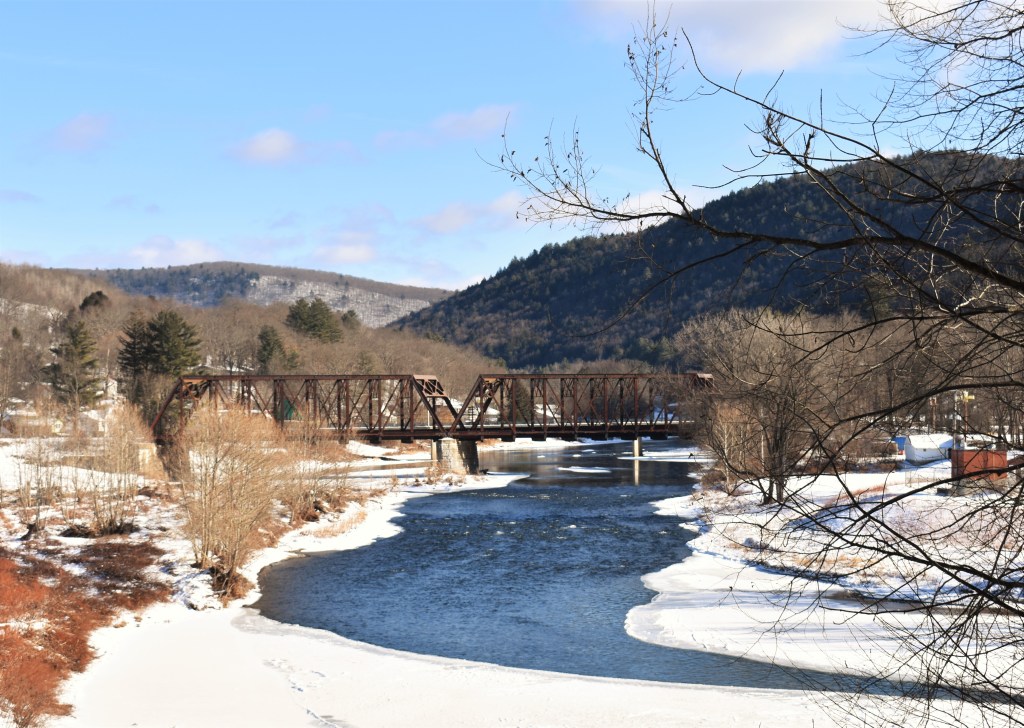
Ice and snow catches in the slack water… and grows there until sunlight returns.
I was looking at pictures of the river and, glancing up, saw snowflakes drifting down from the gray of the heavens. I finished my breakfast and, walking back found the living room flooded with sunlight! An unexpected blessing this, for it was just yesterday I perused the ten day forecast, reading the word cloudy ten times.
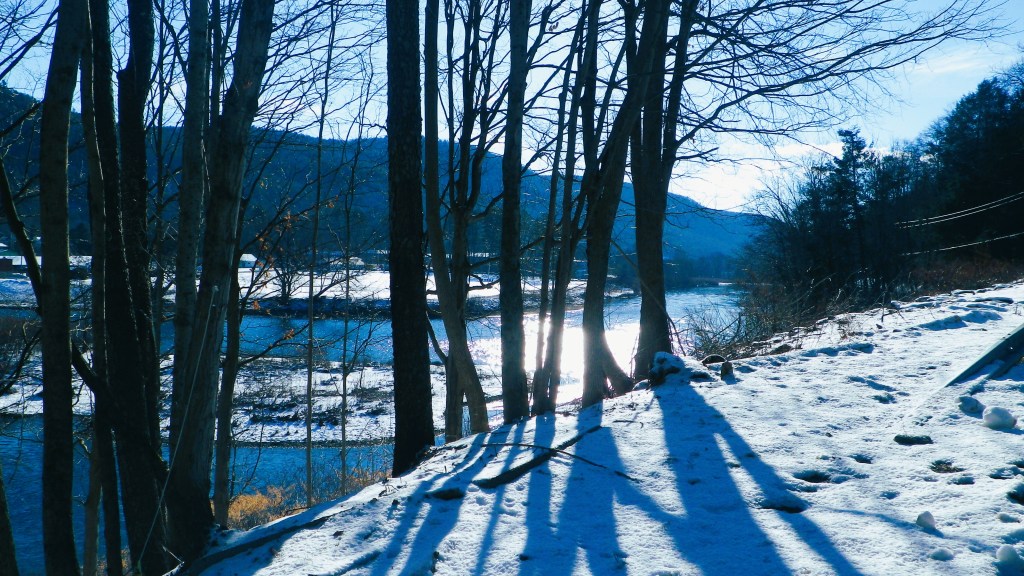
I found myself instantly inspired, brewed my second cup in my Rambler and stronger than the first, grabbed coat and hat and was away. A morning riverwalk is best this time of year, at least when there is a gift of sunlight, for it turns south early such that my road is shadowed by the mountain.
As I reached the bank above Crooked Eddy, ice crystals danced in the glow, animating my view of the river – simply beautiful! The moment took me back to other views of these tiny snowflakes, lit by the morning sun, with their ability to stir the soul. I had watched them here one morning of my first winter in the Catskills, high on a Pennsylvania ridge where I searched for whitetails, and west toward the Laurel Highlands where I took a bright cock pheasant on my very first hunt behind a pointing dog so many years ago.
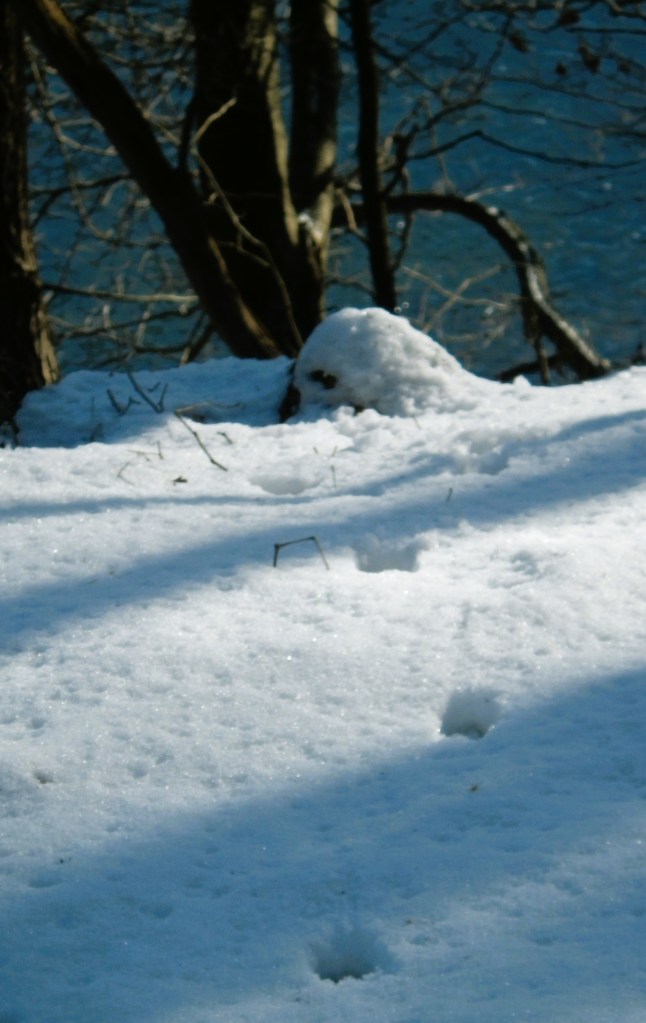
I found the tracks of a deer tracing the roads edge amid my own boot prints from yesterday, and then further down, another larger set. They seem to walk that edge as much as I!
Alas the glory of the sunlight soon battled with dark cloud masses advancing from the southwest, and the chill of the late January morning returned as the clouds won victory. I sipped the hot coffee and smiled to myself as I walked; my spirit refreshed by the lovely bright interlude!
A couple of new approaches to my favorite mayfly design: The Fox Squirrel and Royal Coachman.
I do read a lot of older books as I work my way through the Catskill mountain winter, so perhaps those favorite authors are to blame. Dana Lamb seemed to write of casting a Fanwing Royal more than any other dry fly, and Connett and Gingrich flew that same flag, right here on Catskill waters. My online friend, Ed Ostapczuk, has penned a pair of wonderful books concerning his sixty-year love affair with the Catskill rivers, two of a small selection of recent volumes that I would recommend. As ranking Sage of the Esopus, Ed likes a Hairwing Royal Coachman when the isonychia mayflies are hatching there, much as Gingrich did.
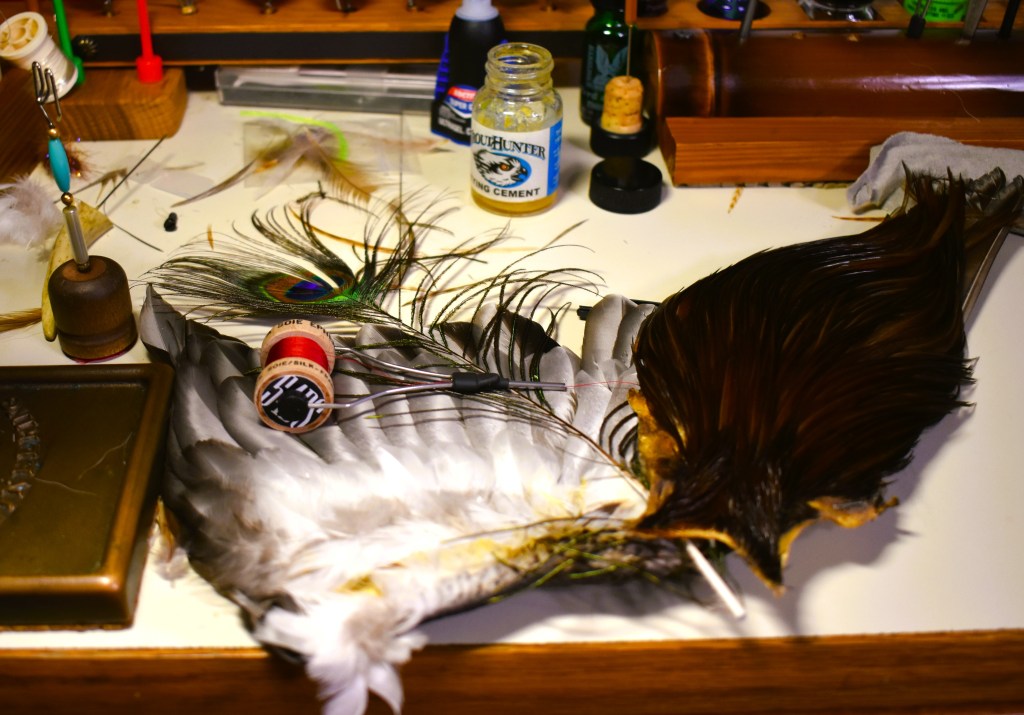
I messaged back and forth with Ed yesterday, mentioning that I might even tie some 100-Year Coachmen for fishing, after sending him the photo of the Christmas Fly I posted here a month ago. I was pondering the proposed activities of my snowy morning when I decided that I may as well get out some red silk, peacock, and a Rusty Smoky Dun Collins cape I’m fond of and tie a few to line a compartment in June’s isonychia box. Always be prepared to show them something different!
I had to look a bit to find a suitable feather for the rolled feather wing of my 100-Year Dun style. Woodduck breast, of fanwing fame, is too short and delicate, but flipping a pair of mallard wings showed me what I needed. The fibers are shorter than those of a waterfowl flank feather, so the wing refused to fold to produce the clumped, Gordon style wing. My manipulations though, did give me a suitable wing profile. I’ll have no problem showing one of these to an isonychia connoisseur on either Beaver Kill or Delaware.
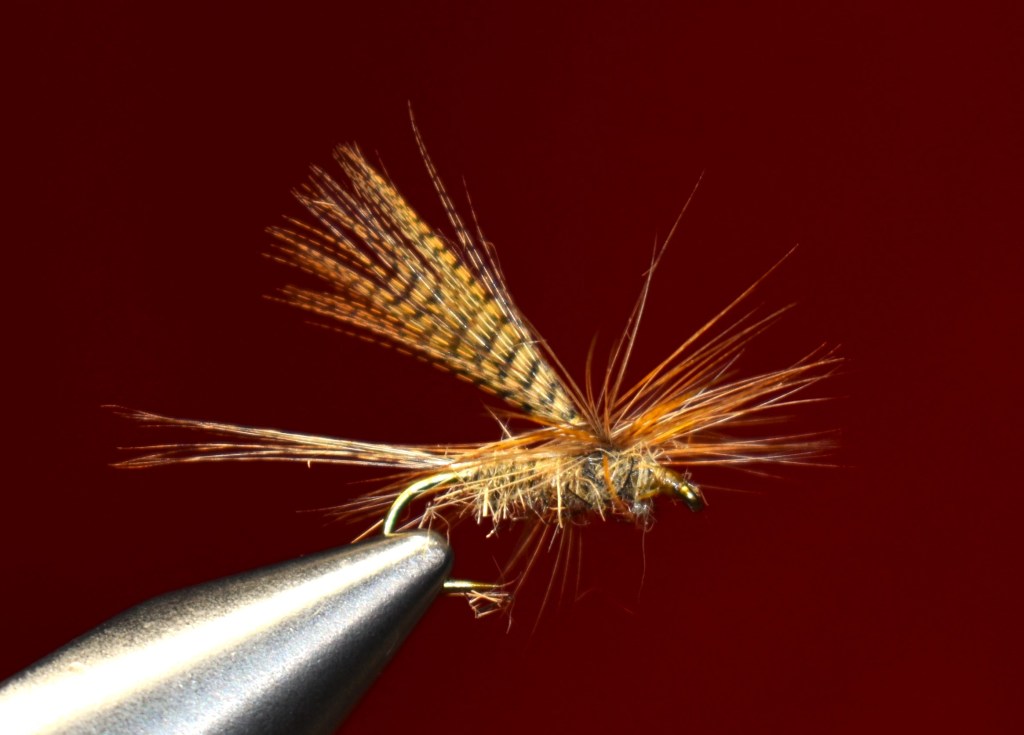
While musing about the contradiction inherent in an attractor canted wing mayfly imitation, I recalled the effectiveness of several classic general purpose flies and determined that a Fox Squirrel version of my fly would be a good addition to my fly box. There are times when hatches are sparse that a buggy, general purpose dry fly will turn the trick, just ask any of the hundreds of thousands of anglers who sing the praises of the Gold Ribbed Hare’s Ear. I have always liked the looks of squirrel fur due to the variations in color and the short, spiky, barred guard hairs. For an all-around buggy early season fly, natural fox squirrel is my favorite, so I blended some with one part Squirrel Belly Antron and the barest hint of fawn colored red fox fur. A Darbee line Rusty Dun cape provided the perfect hackle to encircle the woodduck wing!
I could tie a few Fox Squirrels with the cree hackle I use for my Catskill version of the fly, though I do like the look of that rusty dun. Something to think about for tomorrow…
The snow petered out quite early but has returned with a vengeance. Perhaps we will get enough to work on that aquifer recharge I’ve been wishing for. Time for a hot mug of Starbucks Italian Roast while I consider whether a snowy riverwalk will be in my afternoon plans.
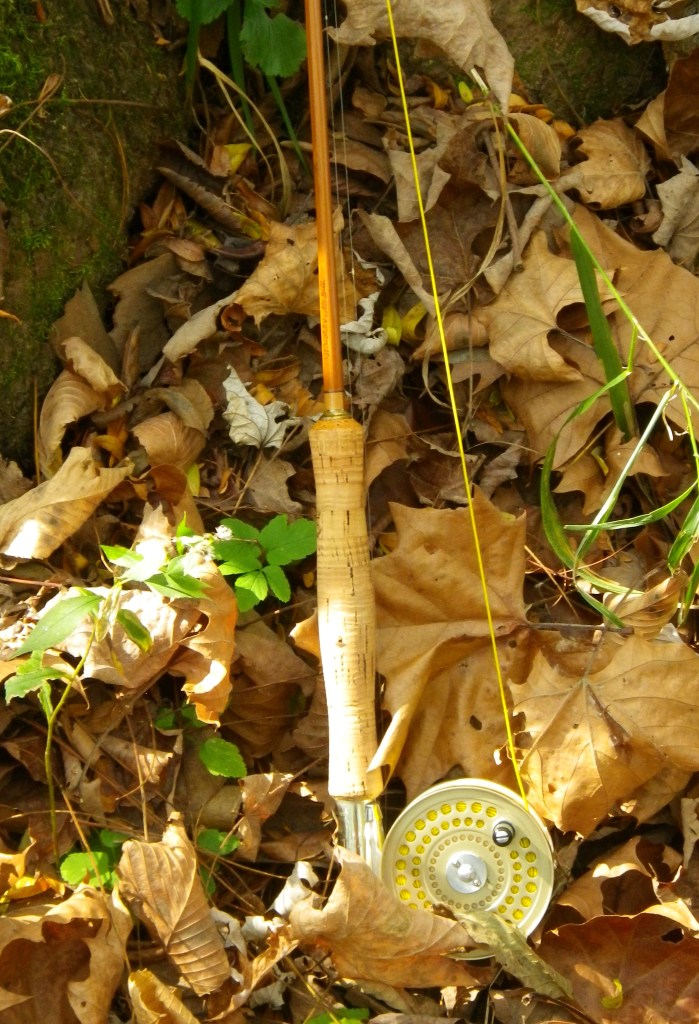
The tackle for the day rests upon autumn leaves as the angler reclines streamside, waiting and watching for what the current’s thread may reveal.
I have spent many hours sitting upon riverbanks, learning much which I might otherwise have missed.
In my early days of flyfishing I seemed always to be wading and casting, at times wearing myself thin passing the least productive hours of the day searching all the water with my fly. It was my growing appreciation, no, my passion for the dry fly that saved me from expiring riverside due to overzealous fishing without catching.
Counting the years now behind me, I realize that much of that time has been spent watching, and it has been during these times that countless lessons have been learned. In truth, fly fishing should not come down to some relentless pursuit of everything that swims. One caught up in such a constant, fevered search hasn’t time to listen to the river, to learn what Nature has to teach.
In decades of sitting and watching rivers, I have witnessed countless subtle clues to the magic and the mystery of trout and fly. Volumes of angling lore have primed the neophyte to expect to be engulfed in a cloud of mayflies when visiting any stream his guidebook states holds certain hatches. Finding no such cloud of fluttering insects, he splashes and tramps through water that might have made hjis day sublime. It takes time to learn that writers oft get caught up in the bliss of their most breathtaking moments astream, portraying rare occurrences as commonplace. An afternoon spent sitting quietly on the bank reveals the truth behind fantasy.
Cultivating patience and stream craft is the antithesis of the instant gratification society leads many to seek, and the patience learned along riverbanks has led me to see and appreciate the wonder of rivers.
These old eyes see so much more when given the time to study currents and eddies, pockets of shade and the tiny motion of a single mayfly plastered in the film. I cannot count the times that studying the subtleties of the river’s flow has revealed the lie of some trophy trout. Waiting puts me at ease, and once the clues have been discovered, the transition from rest to a careful stalk comes naturally.
Learning the habits of rivers, and those quiet hours of study help form an understanding of the game that cannot be taken from a book or an article. The knowledge gained from years of careful angling fuels instincts that guide my fishing. Certainly, there are times when covering water is the best gameplan, but not with a hurried, haphazard attack. Wading teaches a connection with the river, care and stealth should be the result. When I “cover water” I am hunting; I concentrate on certain parts of that water, constantly assessing the best approach, the prime casting position for each reach of current I have targeted.
I have reaped great pleasure from time along the water. There are times when I have been relatively certain I would not take a trout, when my pleasure came instead from watching an eagle glide between treetops, or the soft shadows of clouds above the mountains. I have a special fondness for the myriad effects of light upon the water and the landscape, and take moments to appreciate the simple beauty before me.










 Bright Waters Catskill