I fished the limestone springs of Pennsylvania's Cumberland Valley for a couple of decades, founded Falling Spring Outfitters, guided, tied and oh yes, fell in love with the Catskill Rivers I can now call home.
Summer on the West Branch – our best bet for rising trout due to plentiful cold water.
The forecasters, and my own sincere desire for the vital rainfall they promised, boondoggled me once again. I decided against fishing yesterday to avoid the severe thunderstorms they told me were threatening but never occurred. Not that I craved severe weather, I would trade any number of thunderstorms for a nice gentle all-night rain.
Hancock had a little shower in the morning and then a very brief wetting in early evening. Cannot bring myself to call that one a shower. I spent my day reading, writing, and casting a favorite rod with a three weight line, just to refamiliarize myself with it’s charms. Preparations: tying a handful of flies, checking reels, lines and leaders, and generally making ready for tomorrow.
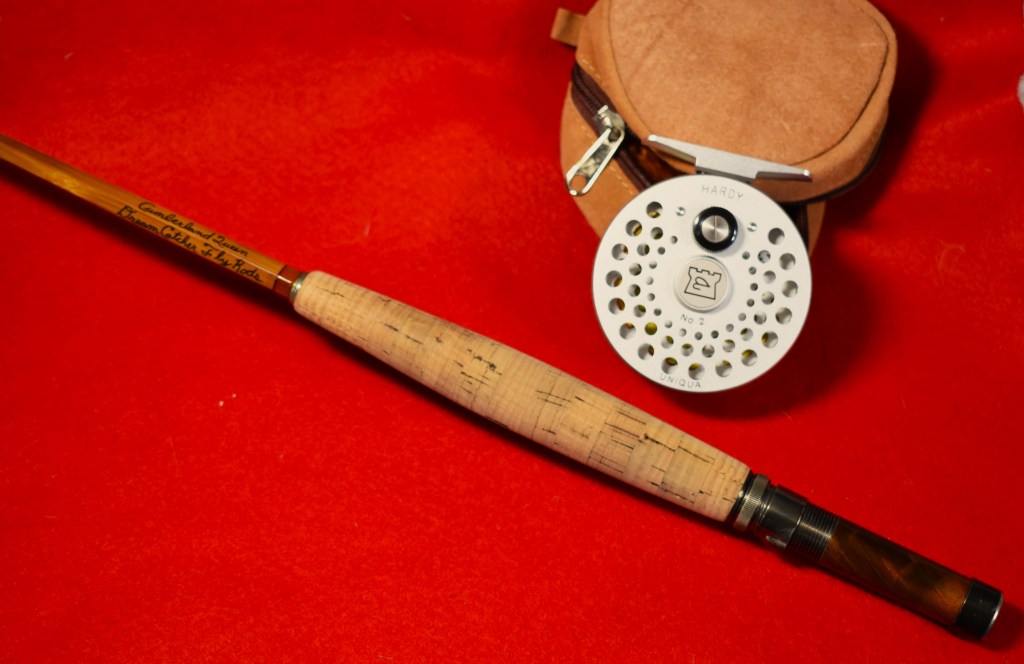
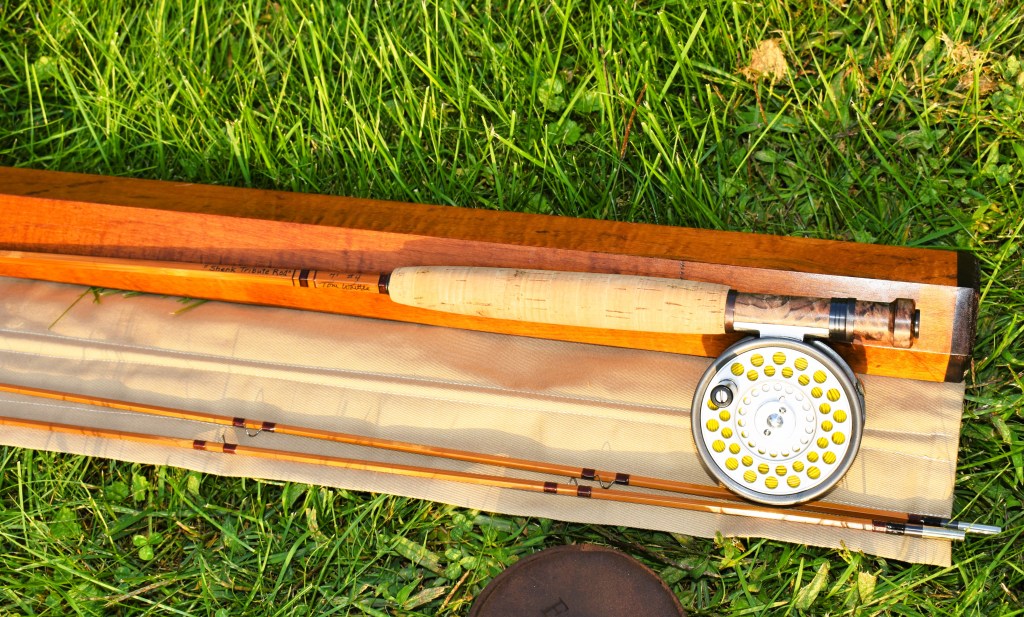
My Cumberland Queen gets the nod today, freshly polished after removing traces of the familiar West Branchslime.
I am set to try one of Cortland’s Sylk double taper lines on an old favorite rod today, my Dream Catcher Cumberland Queen, a lovely flamed eight foot four weight that is a deft summer weapon against the speed and energy of our outsized Catskill trout. The rod’s first debut was on the same West Branch Delaware, on a blustery September evening nearly a decade ago, casting a big size 10 Isonychia emerger. Now conventional angling wisdom would tell you that a four weight bamboo rod was not the tackle to toss such large dry flies in gusty, 20 mph winds, but the Queen excelled in meeting that challenge!
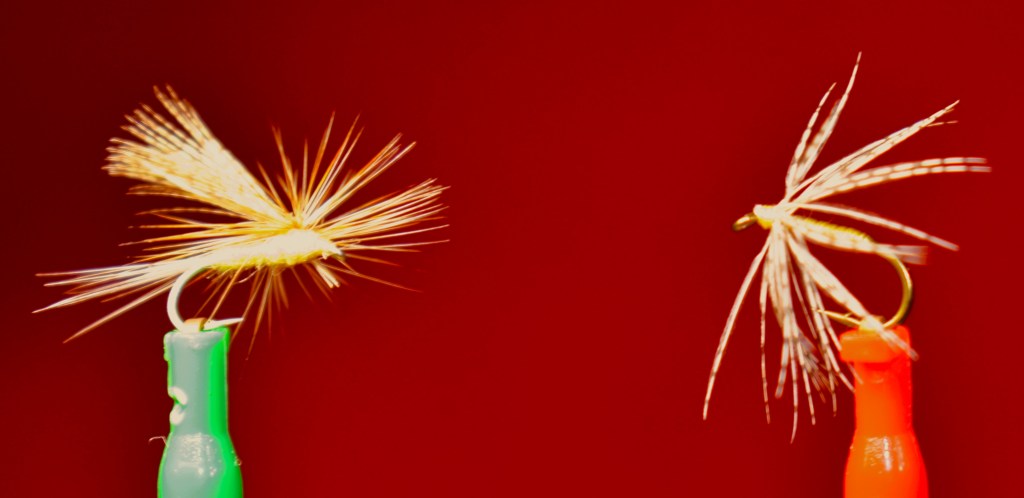
Dual tactics for those impossible brownies hunting the odd sulfur on a hot, bright afternoon: a 100-Year Dun and a North Country style spider.
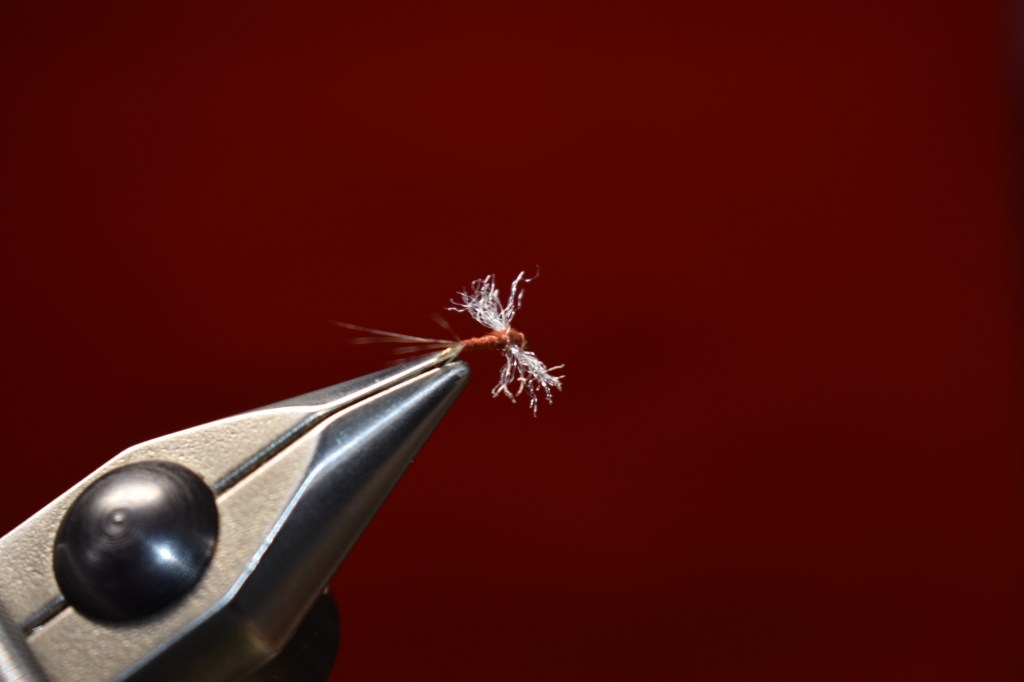
The old girl will have an easier time of it today. Not that there won’t be wind, but she won’t have to toss big size 10 dries against it. The Queen will be called upon for another of her considerable attributes – delicacy of presentation. I tied half a dozen primrose spiders this morning to be prepared should the trout shun the surface and look to the wiggling emergers just beneath the film. I have seen their moods change, one willing to sip the dun from the surface, another demurring and gently inhaling something unseen with the barest disturbance to the film.
The morning’s flies are nestled in a shirt pocket box along with yesterday’s and a few changeups, and I just tied a bit more than four feet of new 5X fluorocarbon tippet to the little Hardy’s leader. Time to shower and take care of some errands before driving out to the river to begin the hunt.
Summer fishing is more relaxed than the rush of springtime, trying to contain six months of pent-up energy and anticipation for the season’s first hatch. You feel like you know what you will find in summer, though the river gods can hatch surprises at any time. I’d love to find just enough of a breeze to ripple the surface and help the trout feel better about taking duns on a bright afternoon, and I would happily welcome more sulfurs and fewer midweek anglers. I’ll never turn down a chance for a little solitude on a summer river!
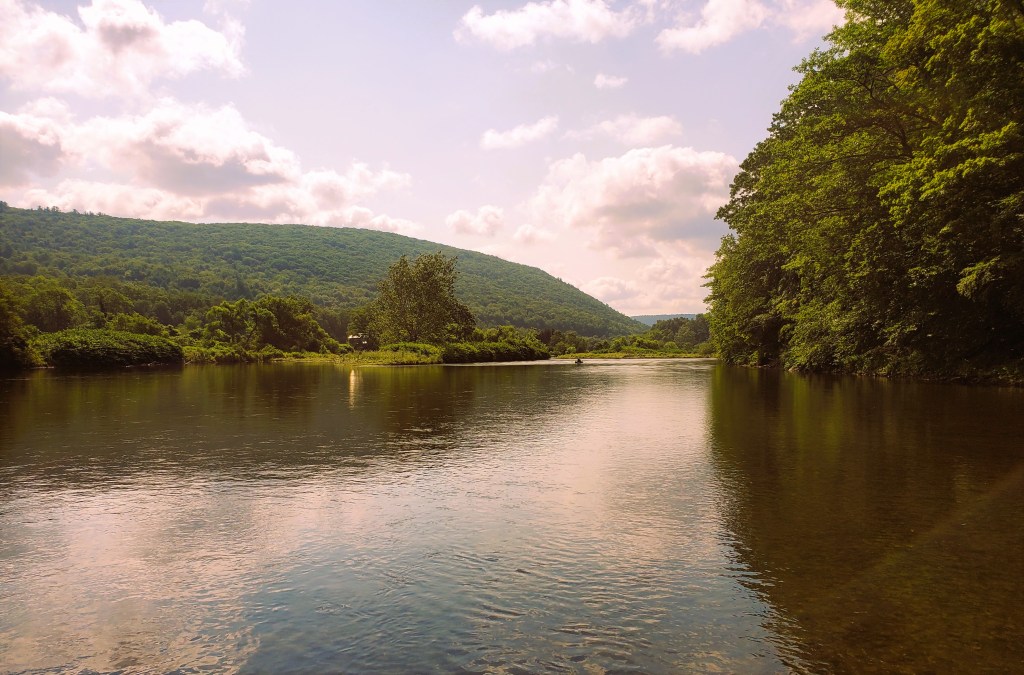
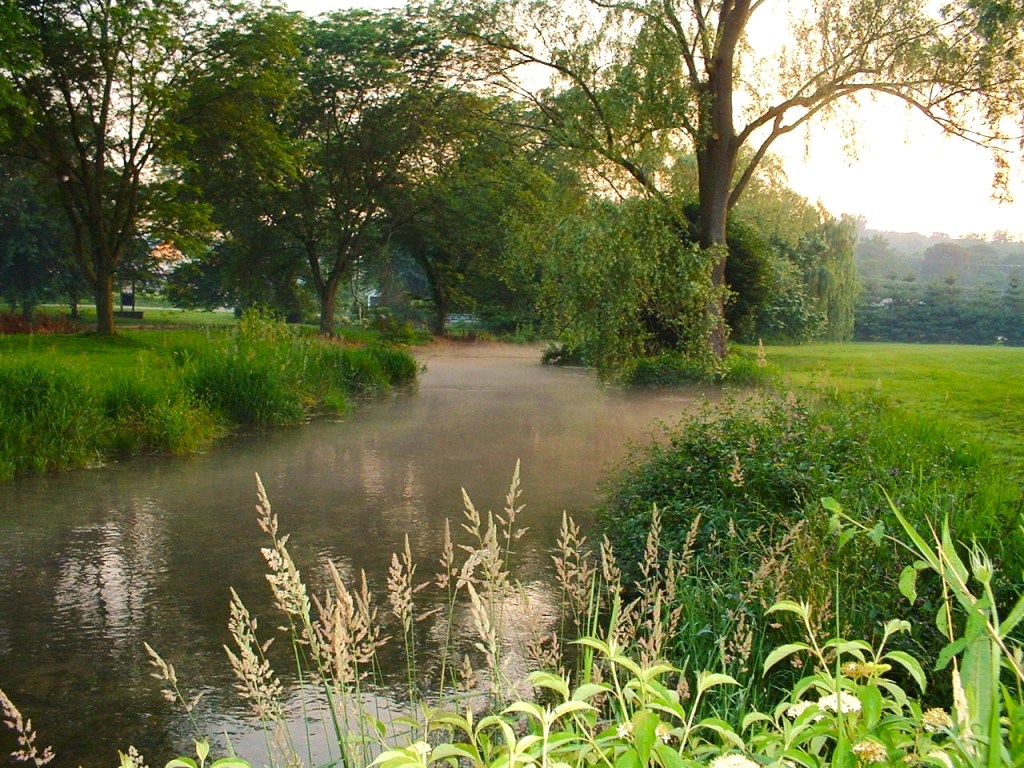
A touch of Nature’s simple beauty, often taken for granted.
I caught up with one of my best friends last evening and spent much of the message telling him why I didn’t think it was worth his effort to drive up today for a little fishing. I do like for my friends to have good fishing when they visit, and I know that this one would be hoping for more than perhaps one shot at one very difficult trout, but in thinking about the conversation this morning I realize the irony. You see, I am unobligingly happy to be alive, retired, and fishing in the Catskills! What more could anyone ask to share?
I learned long ago that seasons and days on the water vary constantly. I learned to take what the river gave me and appreciate that, for every day spent astream is worthwhile, even sacred. Fly fishing is so much more than a fish on the line, or a few in the creel of our minds. Indeed, this season has not panned out the way I had hoped, nor the way countless other anglers had dreamed about. Our boundless fly hatches have clearly found their bounds and, for the second year in a row, rising trout have been at a premium. That makes those few we encounter all that much more precious!
As a confirmed dry fly man, I choose not to try sunken flies and other methods simply to see if I could catch a few more trout. I love the challenge as much as the method, and a year like 2022 presents a great deal of daily challenges on our Catskill rivers. I do not offer apology for my passions, I simply state the truth.
I read a beautiful sentiment this morning. It got me to thinking about those passions, some stimulated by it’s author. I met Jerry Girard a number of years ago through the Pennsylvania Fly Fishing Museum Association. He is a long time angling historian, collector and author, and one of many who formed the seed of my encompassing interest in classic fly fishing tackle. Jerry recently published a book entitled Casting About (The Whitefish Press, 2022) that contains the fifty columns he wrote for the Catskill Fly Fishing Center and Museum’s Castabout newsletter between 2010 and 2016. The words that inspired me are found in column number 27, Winter Rambling Thoughts, Perhaps Even Rants:
“Fly fishing is not just a physical journey, but a spiritual one as well. It is a blend of art, literature, science, history, philosophy and camaraderie. These are the things that lift our spirits and add to our joys when we cast a fly and maybe catch a fish.” Beautifully said Jerry! The book is available at the CFFCM gift shop and should be required reading for anyone who fly fishes. As the author laments, too few of the many fly fishers encountered today have any knowledge of those who came before and all that fly fishing entails, and that diminishes their enjoyment whether they know it or not.
During my working life, I was drawn to live in Pennsylvania’s Cumberland Valley, one of the two greatest nexuses of American fly fishing. The history there drew me as well as the lure of difficult trout, the desire for beauty and art and challenge! In retirement I sought life amid the other great nexus, the seed of American fly fishing and birthplace of our own traditions of dry fly fishing, the Catskills. The challenges are sweet!
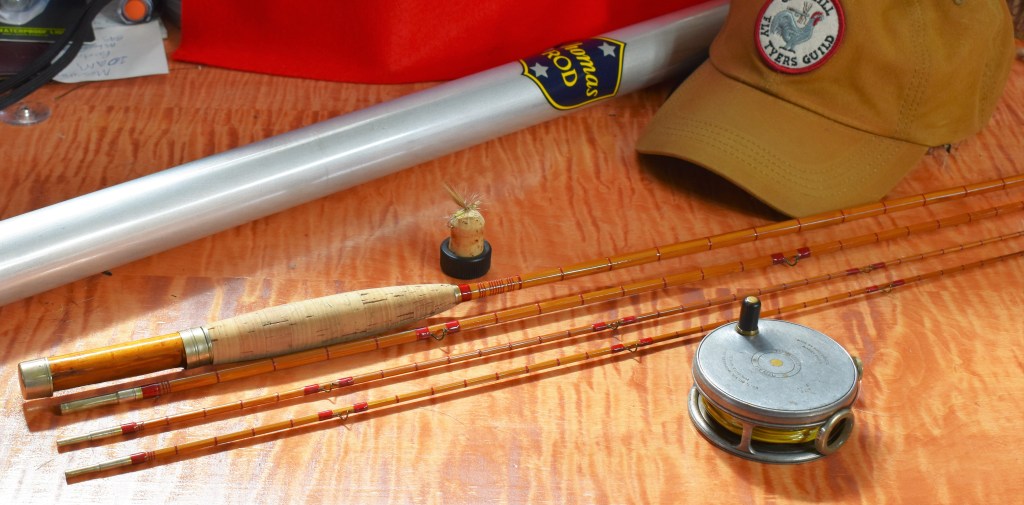
The joys of our angling history: my F.E. Thomas fly rod from 1918 and Hardy Perfect fly reel from 1929, still fished and enjoyed today.
It is a rainy and potentially stormy day here in the Catskills. I was looking forward to fishing, having polished up a favorite bamboo rod yesterday morning after casting it with a variety of fly lines and reels. The weather has decided this will not be a fishing day, and I am thankful, more than willing to offer up a cherished day for the gift of rainfall our mountains, fields and especially our rivers so desperately need. There are always a few fly lines that could be cleaned, and I could certainly tie a fly or two…
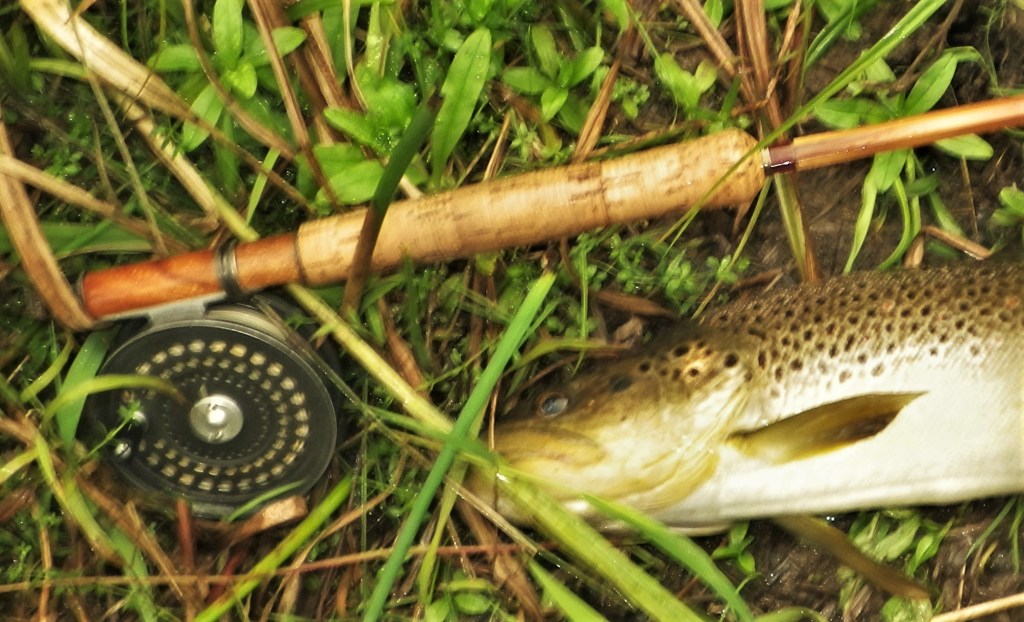
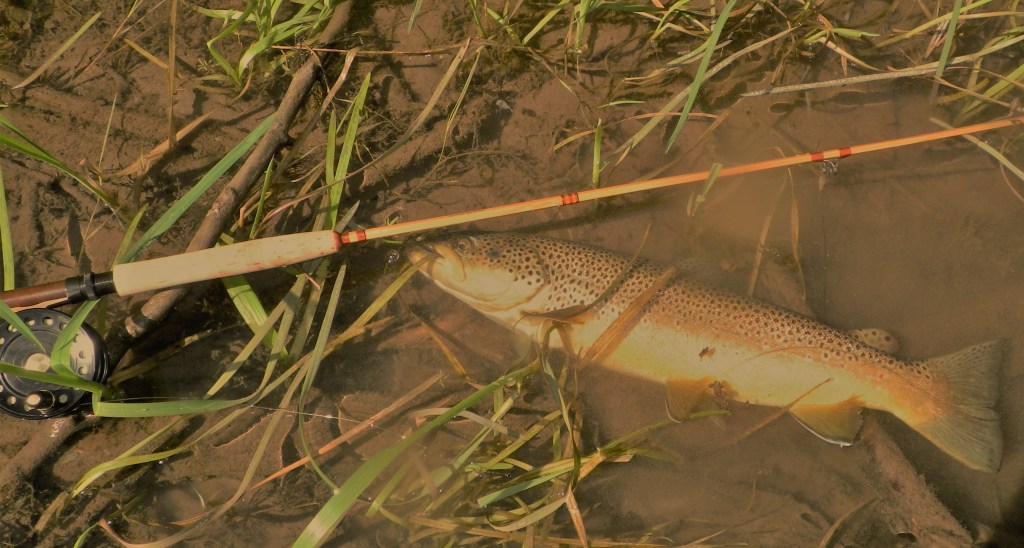
My Dennis Menscer Hollowbuilt pauses with a rainy day brownie.
I have no problem fishing in the rain, though I take a practical approach. Experience has revealed that light, intermittent rainfall can bring an excellent afternoon of fishing. These conditions seem to encourage daytime hatches even in summer, bringing olives and sulfurs to the surface with trout close behind.
Heavy rain is not a recipe for good fishing in my experience. I have seen it shut down trout rising to a hatch time and time again. There are exceptions to every rule, but I have not found many such instances in more than three decades on the water. It has always seemed to me that trout cease surface feeding whenever there is a lot of surface disturbance, whether heavy rainfall or high wind and wave action, and I expect that occurs when conditions begin to hamper their vision of their prey. Wild trout grow and survive by feeding efficiently. If they cannot target surface insects amid a maelstrom, they simply either stop feeding or seek an underwater alternative.
Yesterday afternoon was a case in point. With a cold front passing through leading a line of thunderstorms, the winds quickly became untenable. Swirling and gusting just after my arrival, the trout I found running sneak attacks on a few bobbing sulfur duns quickly abandoned the wind tossed surface. I kept watching the leeward areas close to shore, but no rises were displayed there. There were a few more sulfurs than my last visit, but they were being blown around on the surface when the gusts and wave action increased. I saw virtually none drifting through those protected bankside environs.
The short, but vital break from all of this came with the advance of the first evil looking thunderheads, deep blue black, towering masses which warned me it was just about time to get off the river. With the winds calmed momentarily, and those sulfurs still drifting through, I began to see a rise or two. Glancing over my shoulder, I was keeping tabs on those advancing thunderheads, ready to flee at the first little flash or crack of thunder.
The wind was still strong enough to challenge casting, but it was possible to present a dry fly at close range, which I did repeatedly when a good trout showed. The duns on the water were quite yellow this time, and my phantom trout ignored my orange bodied dun that had been the choice the past couple of weeks. Checking the thunderhead’s progress, I switched out that fly for a yellow silk Translucense 100-Year Dun. The storm clouds were overtaking the far bank as I flicked my wrist and put the fly in the path of my moving target.
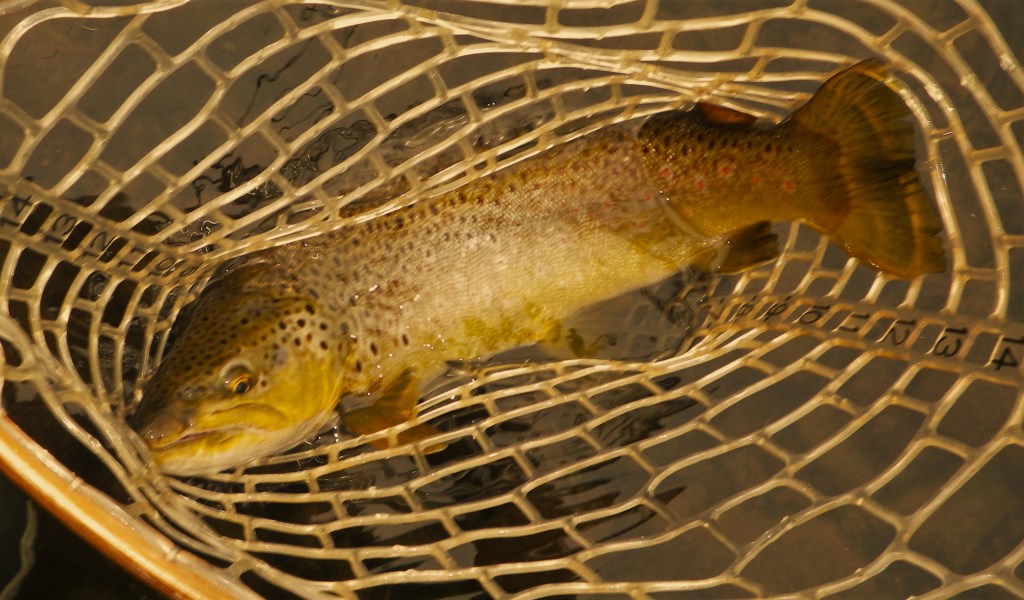
He took and the fun began, heightened by the perceived danger of the storm front which was now right on top of me. I fought that trout as quickly as his size and vigor allowed, telling myself there had been no lightning and no thunder and I wasn’t going to get electrocuted as penance for catching this trout. He swung past my net on the first jab, but I brought him around again and made the second swipe a success. I twisted the fly free, lined him up on the graduated centerline of the net, then said goodbye as I slipped him back in the river.
Those towering thunderheads were flying overhead, still silent thankfully, as I reeled in the rest of my line, unfolded my wading staff, and headed for the bank.
Sitting in the car, I let the first few raindrops splash in through the open windows. I had landed a real nice brownie, a big fish by most angler’s standards, and avoided a wetting by the skin of my teeth. That first wave of storm clouds never brought any thunder or lightning, but I began to hear the first few rolls off to the west after sitting there for several minutes. Driving home, I could see the storm passing north of Hancock, though another would come around after supper.
I wish I could say that that front had given us some substantial rains, though sadly it didn’t. The Catskills are in a run of hot weather and little or no rainfall that seems to have some staying power. Most of the passing thunder showers have left us dry for the past three weeks. Rivers and anglers would welcome a day long gentle, soaking rain. I’d just get out my rain jacket and go fishing!
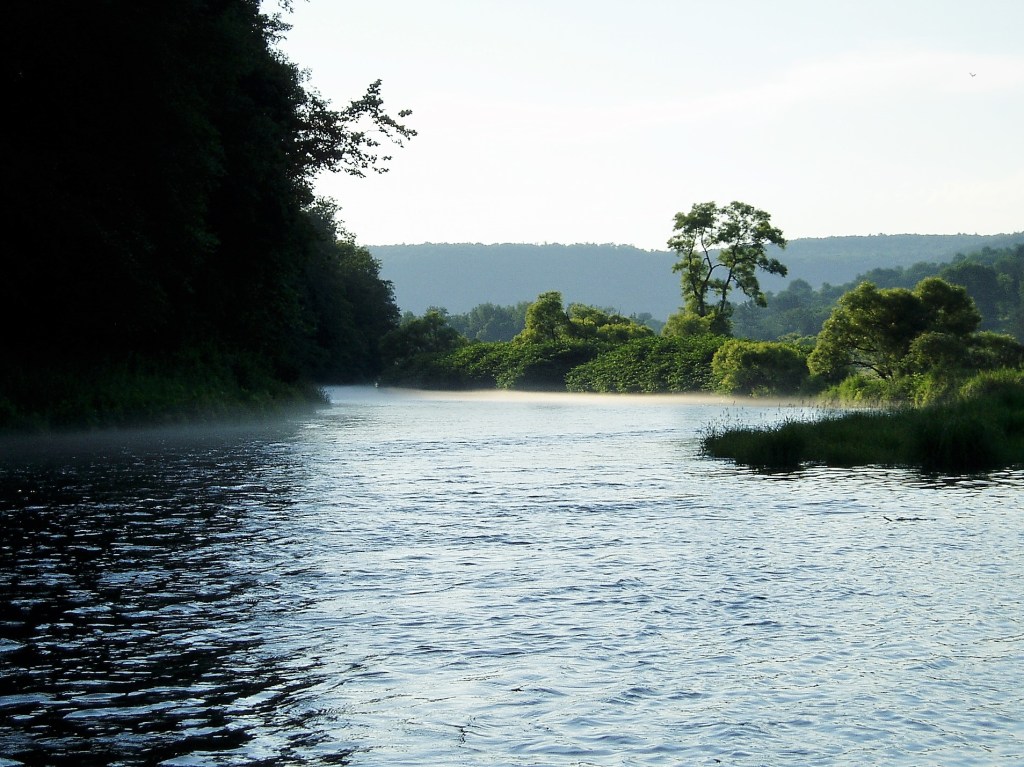
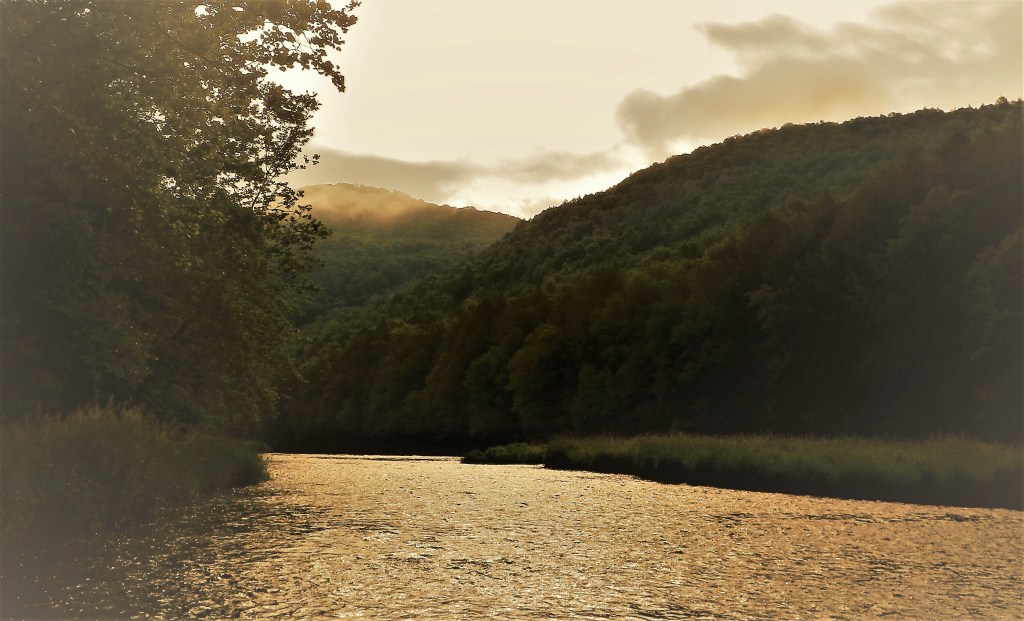
The evening mist creeps down the river during one of the loveliest portions of an angler’s day.
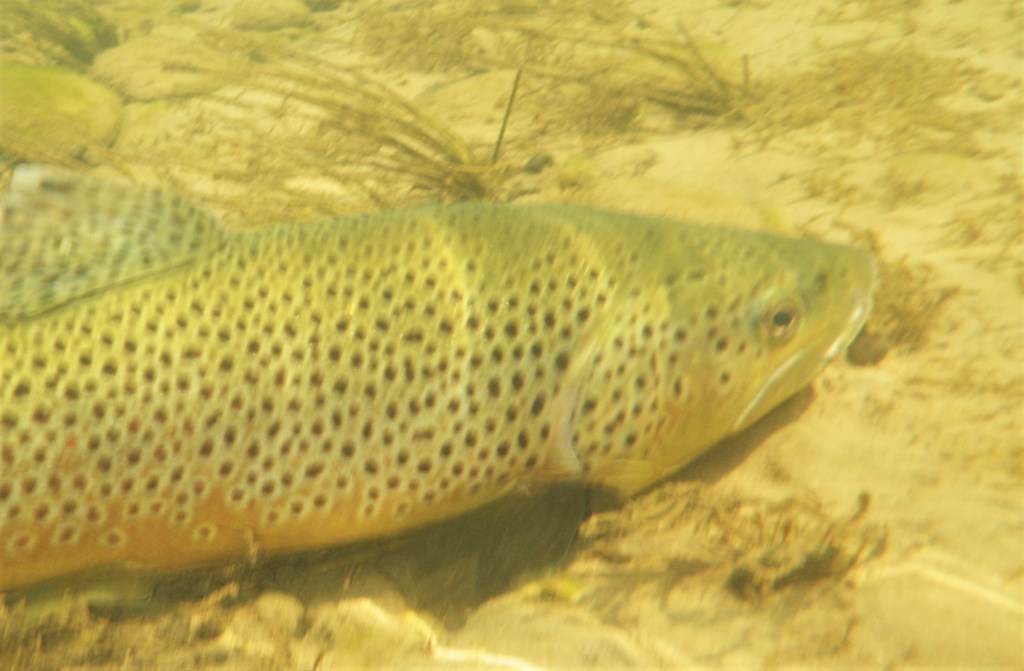
Every once in a while you run into a trout that exudes a sense of comfort and security… I take that as a personal challenge!
Have you ever come across a trout that was so secure in his lair that he basically ignored you and your puny attempts at angling for him? Generally, these guys are taking advantage of nearly impenetrable cover, some depth, obstructions, and the perfect flow of current to bring them their daily fare. I am talking about the ideal lie and feeding station here, and they come and go in the lives of rivers. Flood waters giveth, and flood waters taketh away, so you may run into one of these scenarios only once, or on a repeating basis for several seasons.
I started early yesterday morning, hoping to recapture some of the great summer fishing I have enjoyed over the years. I enjoyed the cool morning air and the solitude of the river, and by the time I reached my fishing location, I enjoyed the thrill of watching a big fish sip something tiny from the film. This is 2022 though, and there still are not very many bugs on the water, day in and day out. By the time I reached that early riser, he was gone.
There were a couple of cruisers that attracted my attention, though the odds seemed to be stacked against me this day. I recall mornings when I had great fun with those cruisers. The daybreak fare was somewhat consistent and, there were enough of those little flies around that I could spot one and choose a matching fly. This was not one of those mornings.
It took me a couple of hours to amass a bank of information regarding just what kind of trout food was in the drift. It wasn’t consistent, in fact changing throughout the day, and it seems that it changed frequently. I found two sizes of tiny rusty spinners, two sizes of small sulfur spinners, the occasional sulfur dun, two sizes of dead sulfur duns, yellow jackets, another unidentified tiny spinner, a few mayfly duns so minute that I could not imitate them even with the pack of size 32 hooks that has lived, unopened in my store of fly tying materials for a couple of decades. Just to be accurate, there were also a couple of things I simply could not identify, that may have been mangled insects of some kind.
So, after chasing the very occasional cruisers and changing, changing and changing flies for those couple of hours, I came upon the only consistently feeding trout I would encounter. He was ensconced in an impressive array of cover, with his own little conveyor belt carrying all of those sporadically appearing and disappearing menu items. This guy was secure in that lie let me tell you, just how secure I would learn during the course of our association.
I expect the progression is familiar to most of you that angle for selective trout. I began with a small beetle which was summarily ignored. I tried one of those little size 20 sulfurs; also ignored. I stared at the surface to see what else was drifting by at that moment, then dug out an imitation and tried it. Sulfur spinners in 18 and 20, an ant, a different beetle, a perfect little size 22 parachute olive, a size 20 olive comparadun. After another hour or two I spotted one of the rusty spinners in the film. Aha!
The size 18 rusty that was lurking in my fly box was larger than I wanted. I had not looked closely when I grabbed that box, satisfied that it was my summer box with various little spinners, olives, even tricos. I knew there were size 20 rusty spinners in there, but there weren’t. The 18 though did tell me something about that trout. It told me just how smug and secure he was in his super lie, and that he had nothing to fear from any angler. I believed he had sipped in my rusty you see, and I lifted the bamboo rod to set the hook. The trout flipped his nose in the air and splashed when the fly departed right on top of him! I expected that our interview was concluded, but it wasn’t sixty seconds later that he sipped something again.
As the afternoon warmed, the breeze rose a bit, and I tried a run of terrestrials again. Then I went back through the sulfurs and spinners to no avail. Ring, dimple, ring…hello I’m feeding here! You can’t touch me! I changed to 6x tippet early in this game, then back to 5X (longer), and finally to 6X fluorocarbon. I never fish 6X in heavy cover, but hey, this was the only trout in town and the game had become personal.
I am not one of those guys who gets philosophical to take the edge off defeat. I don’t sigh “fooling them is the primary goal, the real victory” when a tough customer breaks my leader or opens up my hook and escapes. You either catch a trout or you don’t. I knew that using 6X in this lie, with this trout, was courting failure, but I also knew that he wasn’t going to be seduced by anything but a perfect drift of the right fly at the right moment, whatever that was.
After another dig through the bowels of my chest pack, I found a single, disheveled size 20 rusty spinner in a gob of flies and managed to dislodge it without spearing my fingers on any of those intertwined hooks. Allright damn you, here you go!
Fishing classic bamboo fly rods is a game of pluses and minuses, just like everything else. Bamboo is the best rod to give you a flawless presentation, but it is not the tool you want to horse a big fish out of cover. Fly fishing isn’t about horsing fish anyway, it is about finesse and beauty and art. I think that, sometimes, the softer, more natural flex of cane lets you control a fish where the harsh reflex of graphite just pisses them off more than the hook already has.
I made another series of casts, vying with the breeze for the perfect drift. The trout would shift around in his little enclave, taking in four quadrants: sometimes up, sometimes back, sometimes tight to a log on the bank, and sometimes out a bit, closer to me. Everything finally came together when he shifted out and I sent that tiny spinner on its way for the last time.
I think he was shocked that he had been fooled and hooked, at least for a second, and I used every bit of that second to let the pull of the late George Maurer’s beautifully flamed bamboo begin to bring him my way, and out from that maze of cover. He thrashed and shook his head, and I kept stripping line and coaxing him out, six inches at a time. I didn’t use the reel; I simply kept stripping and kept the line tight and in control with my hands. The click of a reel often seems to irritate a fighting trout, to energize him even more. That’s a beautiful thing when a fish is making a long musical run into your backing, but it is not the tactic that is beneficial to getting a sizeable trout out of heavy cover. I did let him spin my old Hardy a bit once he was clear of disaster!
That brownie measured nineteen inches, not the biggest trout I have landed this season, but he does get the prize for being in the most difficult lie. I invested the major part of my fishing day in angling for that fellow, with very short odds, and I felt a little glow of appreciation and satisfaction when I released him back to the cool river. I noticed that the sun had grown hot, and the wind had increased to an honest gusty summer blow. Hmmm, maybe now I can tempt one with terrestrials…
There’s not much to a size 20 Rusty Spinner, but sometimes it’s enough!
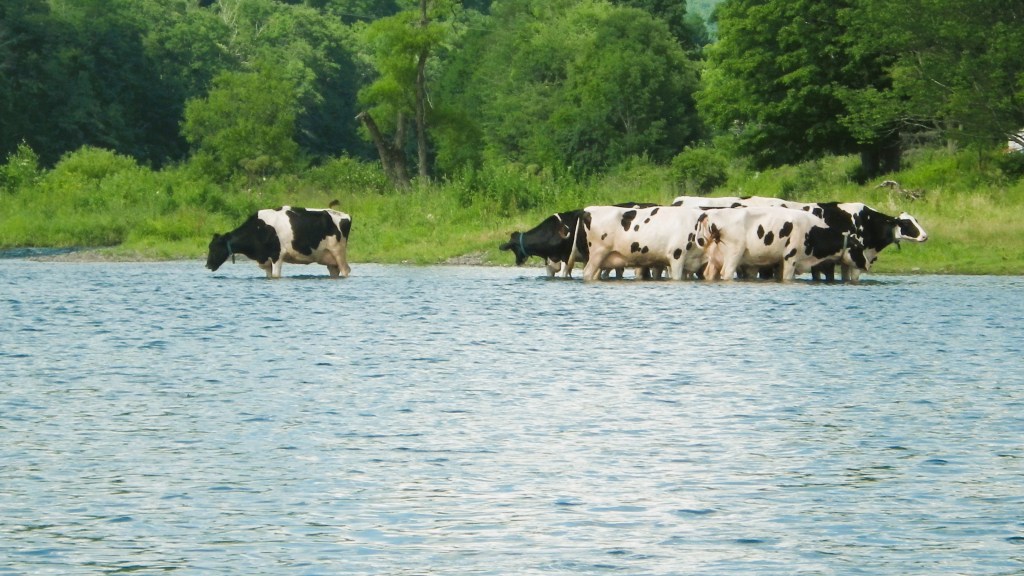
The Crowd at the Farm Pool discusses patterns versus presentation. The one on the left is the presentationist no doubt, the others are the fly tyers.
I was going to take a ride to the Eastern Catskills today, but then one thing led to another, and I admitted to myself that I really didn’t have a high level of confidence of finding good fishing. I decided to head nearby to the West Branch and try to get a little distance between myself and the crowd.
There were two guys planted in the Farm Pool… OK I’ve said it, it’s a run not a pool, but I’m not the guy who named it! Anyway, two guys there, and one was of course in “the spot”. Must have been the first one there, for the second guy was well upstream in the riffle. Another pair parked next to me while I was getting ready to fish. The driver recognized me from my many years at West Branch Angler, Tom he said, and told me he had always seen people fishing there but never had waded out himself. He asked me if fishing was good there and I answered him honestly “not really”.
I explained that a lot of people seem to fish there out of habit, that there was once a lot of trout in that water and tons of bugs hatching, but that the City’s dewatering and two winters of anchor ice had really done a number on those mayflies, and insane fishing pressure had done a number on the trout. I left Tom with the thought that, though there would not be a substantial hatch, they should see a few rising fish.
I waded away from the growing gathering of anglers until I was alone in the middle of the river, and I spent an hour or more walking no more than 100 feet further while studying the river on both sides. Eventually, I spotted a quick little ring in the shallow flat.
I had tied on one of my new size 18 Dorothea 100-Year Duns and set out to stalk within a long cast of that ring. I spent more than an hour making just a few casts every time one of those ghost trout sipped a sulfur. Not one displayed any interest, so I walked, and I waited.
The hatch was even thinner than it had been a few days ago, and you can’t expect trout to get too interested in almost nothing to eat. At intervals, there would be a brief little flurry, and maybe a dozen flies would drift past within the sixty-foot casting range I considered comfortable for my three-weight. I can throw more line with it, but power casting kind of defeats the entire purpose of fishing a three-weight outfit.
I called the fish ghost trout for a reason. Mature wild fish aren’t comfortable in very shallow water, particularly in bright sunshine. When there was a little flurry of mayflies, a trout or two would sip and move a couple of times, then vanish. They were edgy, but they wanted the handful of flies that they could get, so they hung around in that shallow water, but drew the line at holding to a feeding station. I had played this game a couple of times during the past week or two, thus the three-weight Thomas & Thomas with my nice dull gray Airflo Delta Taper fly line. My casts were going to be as unobtrusive as possible, since the odds were already stacked against me.
As the afternoon got on with itself, a little flurry of the larger size 16 sulfurs drifted by. These were the flies that had interested the ghost trout in the past, so I knotted a sixteen 100-Year Dun to a brand new tippet. The first one I stalked was the best one, but he didn’t hang around long enough for me to get that one perfect cast over him. I would have to wait for another.
Lined up and ready, my signature fly would get the acid test on perhaps the most heavily pressured and evolved wild troutin the Catskills. In spring it’s not uncommon for one hundred boats a day to drift the length of the West Branch Delaware. I can’t begin to count the numbers of wading anglers.
The second sipper treated me better, coming up well in range, at least as soon as I removed the balls of green slime my leader had collected while I waited for him. A good float and that natural profile did him in, and we got to play jump and run in the shallows. That eighteen-inch brownie may have been the most brilliantly butter yellow and golden hued trout I have ever brought to hand. I should have snapped a photo, but I had already spotted another ghost nearby.
“Too good to be true”, I told myself, as that one vanished before I could extend my line enough to make the cast. I had to cool my heels until another little wave of sulfurs came through to see a trout no more than fifteen feet upstream. He took the fly confidently, but my timing was too quick for his proximity, and I pulled the fly away before he could turn back upstream with it.
Another flurry of mayflies, another little ghost ring, and this time my cast and my hookset played just right. He came out of the water three or four times right where I had hooked him, then decided to try to make a run for it. We had a good time standing there in the middle of the river, a little musical accompaniment from my Hardy Duchess, some more leaps and bounds, and a meeting of the minds snug in my net. This aerialist was an inch longer and a bit heavier than his golden companion, and I thanked him for his energy.
All in all, an interesting afternoon on the river. I would strike too quickly and miss a fourth ghost, this one barely ten feet from my rod tip. Must be the camo waders convince the trout I am just another rock draped in green slime! The truth is I had been completely still for several minutes both times that a trout rose very close by. Stillness is stealth after all.
I think that the three-weight outfit was the right choice, though I do still have my old Orvis 8’4″ two weight. That rod has seen service on the West Branch before when fishing small flies to skittish trout in shallow summer flows.
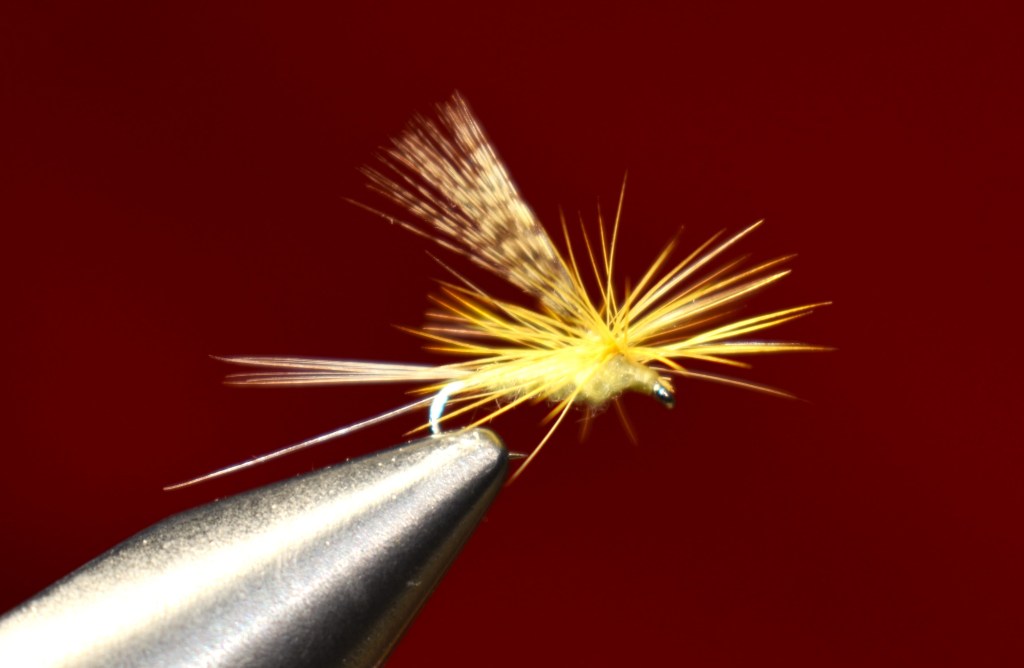
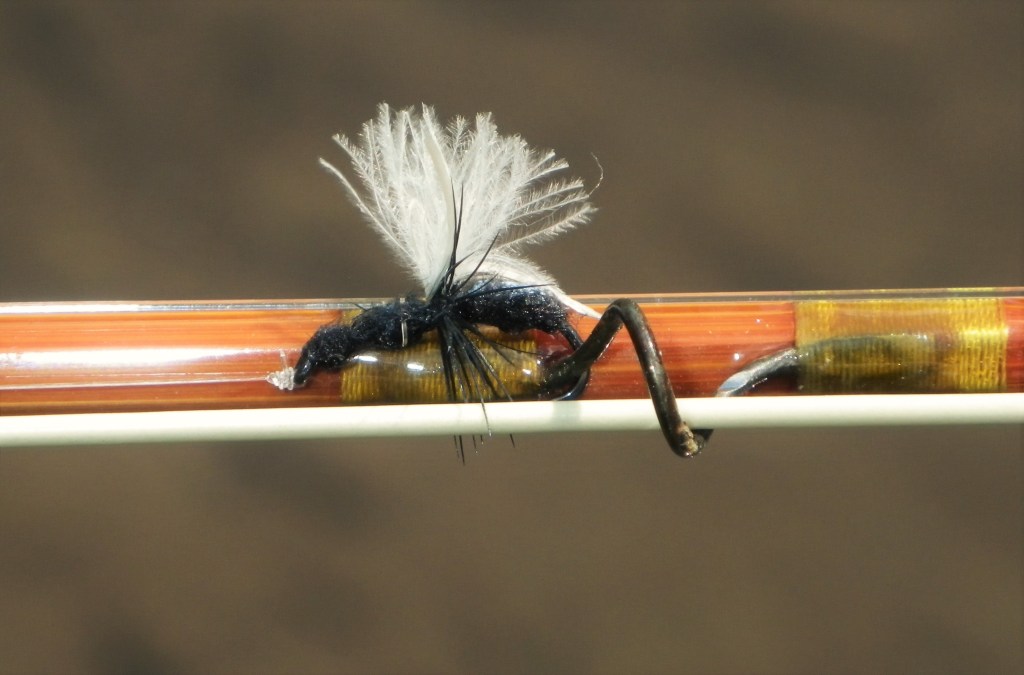
Though conceived as a more natural imitationfor large mayflies, particularly the Green Drake, my 100-Year Dun design has worked its way down to this: a size 18 Dorothea!
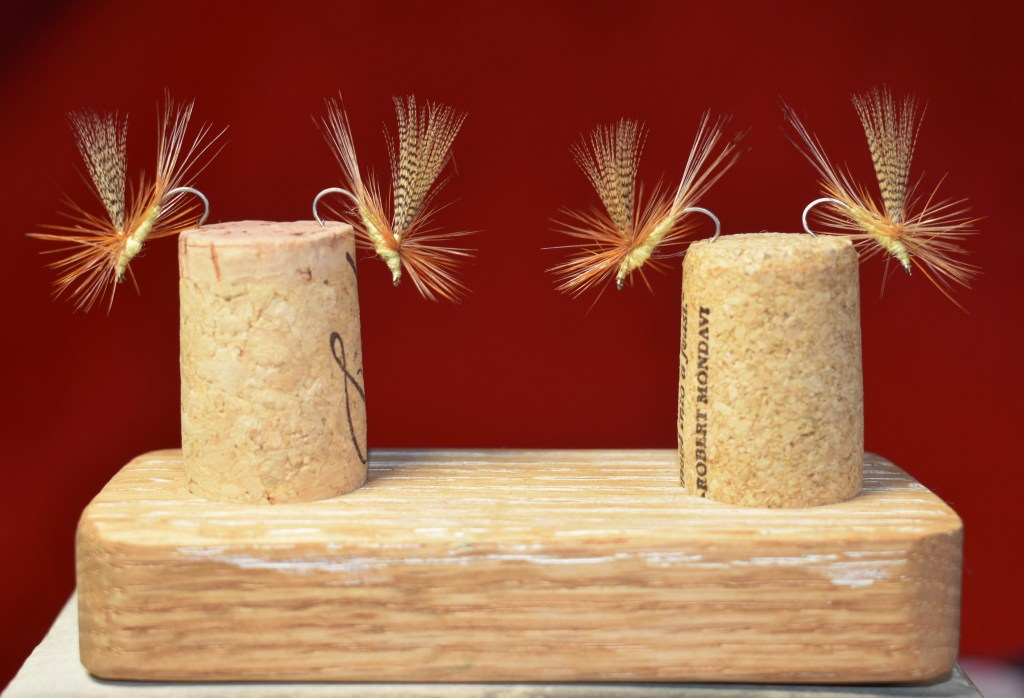
I have tied and fished 100-Year Duns now for something like fifteen seasons. With retirement comes the time to experiment, both on the river and at the vise, and I have paid a lot of attention to the virtues of this design. To date I have found success with Quill Gordon’s, Hendricksons, March Browns, larger Sulfurs, Cahills and Coffin Flies in addition to the original Green Drakes. There are a few Isonychia in my boxes still waiting for me to run into some naturals.
The sulfurs were tied down to size 16 last year and proved their worth immediately, so it was only natural that I follow the diminishing size of these lovely little mayflies down the rabbit hole. I thought that eighteens might be stretching things but managed to scrounge a few tiny woodduck feathers from my supply and give them a try. I expect I will have to craft a few olives next, standing at this new threshold of diminution.
Half a dozen size 18 duns have been bouncing around in my fly box for a couple of days, waiting for me to encounter a fishable sulfur hatch. The few nice trout I have found surfacing have been picking off the odd size 16 sulfurs, so the sixteen 100-year Duns have been employed in those instances. Those sixteens should have brought a pair of larger brownies to hand but for my recent bout with bad luck.
I had stalked across a shallow, windswept river last week when I spied a couple of suspicious dimples in a very shallow flat. A big trout was sliding around in water he wouldn’t ordinarily inhabit, gently sipping a few of the sparse, larger sulfurs toward the end of a mediocre hatch. Playing the game with a moving target is always difficult. Wind adds another negative in the angler’s column. I had a lock it seemed, until a gust blew my leader at delivery and set my fly down some five feet closer to the fish than I had planned. He was on it the instant it touched the water, catching me with my line hand out of position with no good way to set the hook. I flailed hurriedly with both rod and line hands and managed to leave the fly in the fish!
On the Fourth I spotted another good one in that same vicinity, falling victim to a suddenly weak tippet knot. That trout kept my fly and four feet of tippet, and I barely felt him. I felt only partially redeemed when I presented another size 16 fly to a late comer, a fat seventeen incher who did his best to collect as much green slime on my leader as possible.
Perhaps today will finally provide the opportunity to trot out one of those brand spanking new eighteens!
I am planning to take a day to investigate a new reach of water this week, one where I have a little hope for debuting another fly. Back in the Cumberland Valley, I didn’t wait until August to fish grasshoppers. I tied and fished a baby hopper pattern that was simple but effective when the immature hoppers showed up in the limestone meadows in late June. The Catskill rivers of my heart don’t exhibit a lot of hopper habitat. Where there are substantial grassy banks, they are most often on the shallow side of the river. It may not be impossible to find a sizeable trout lurking with his dorsal getting a sunburn, but it’s damned close.
Just thinking about summertime hopper fishing gets me longing for the good old days on the limestoners, back before those fisheries declined. I have only made two trips West in my life, and neither coincided with any hopper activity. Perhaps one of these days…
A typically beautiful July evening at The Angler from back in the good old days.
I called it my Summer Jam, and it was most often my final big road trip for the fly fishing season. The tradition began some twenty years ago. Memory gets a bit foggy, but my July Fourth wanderings to West Branch Angler were tied to the more stable summer releases of cold water from Cannonsville Reservoir. Back then, the summer sulfur hatch on the West Branch Delaware was truly legendary.
The trout were difficult even then, but the little yellow-orange mayflies came wriggling to the surface and got them excited. There were thousands of mayflies, day after day, and usually plenty of rising trout. The trick was to pick out the larger fish among the throng and concentrate efforts on them. On the best days, a windblown cast might land two feet off course, with the fly being taken by a different trout than the one I was casting to. Sometimes the eager neighbor was a good fish, a wild brown in that 17″ to 19″ range, a trout that would test your tackle. Landing these guys on 6X and 7X tippets and size 20 dry flies depended a lot upon the weeds on the river bottom. If the trout got you down deep in those weeds, you were done for.
I landed some beauties over those trips, and I had my heart broken too. My first two-foot-long brownie was taken on the first afternoon of Summer Jam 2005, on a borrowed rod; Matt Batschelet’s 8’6″ Winston. That was quite a sales booster, and I purchased my own 8’6″ Winston five weight from Matt and Sam at West Branch Angler the next morning.
July 7, 2005, and the first trout of my Summer Jam.He taped out at a full 24 inches long and took a size 20 cream colored X-Caddis before the sulfur hatch began: a very special fish to me!
Those were wonderful years, and I grew a lot as an angler. I haunted different pools on the West Branch and encountered just a handful of anglers. Sure, there were popular places where you could find half a dozen or more guys lined up through the pool, but there were spots where finding anyone else was honestly a surprise on a weekday. Ah, how I wish I could return to those days!
A couple of terribly cold winters with below normal flows, to say nothing of the October 2020 dewatering of the river for maintenance work, seem to have effectively humbled the once prolific insect population of this great river. I have wandered over to the West Branch thrice in recent weeks and seen very few sulfurs, or anything else, on the water. There are plenty of anglers, plenty of boats, but not many bugs or rising trout these days.
The Stilesville Riffs on October 5th, 2020. These riffles once produced thousands of sulfur mayflies, day after day from June through early August.
According to my recollection, the Stilesville gage recorded a low flow of approximately 36 cfs during that time. The plan was to shut down release flow completely, zero for three full days, before the community of anglers, guides, resort owners and conservation groups cried foul loud enough to make New York City curtail their murder of the West Branch Delaware. Something was saved by our community’s reaction, but we are living the legacy of lesser hatches. Summer Jam no more.
The promise of summer: a big wild Catskill brown trout decorates the shallows beside my Sweetgrass rod.
Summer has offered many gifts, from visions of mist wraiths retreating from the sunrise to big, bold wild trout racing away to the accompaniment of the celebrated Hardy click pawl chorus. This summer is brand new, and I hope it will share it’s bounty too in time. It seems clear that this will be another summer offering little in the way of mayflies. Anglers must remain ready to grasp whatever fleeting moments of dry fly bliss that come to pass.
I stood in the river yesterday afternoon, bamboo rod at my side, my waders open and rolled down to my waist in deference to the heat. For about an hour, a very few of those little yellow-orange mayflies appeared. Two trout found time to rise, perhaps a dozen times. The first shook the hook in a wink, the second gave a fine account of himself before resting a moment in my net: he was eleven inches long. The tenacity of that small wild trout was heartening, giving me hope for a return to the plenty of an earlier time.
June continues to be a month of changing moods. All but perhaps its first week typically brings summer weather patterns to the Catskills, however this year has been quite different. Though we have had a handful of warm weekends since Memorial Day, there have been more chilly days and some very cold nights. A blessing to the rivers as far as water temperatures, these cold spells have kept the angler guessing.
I began fishing summer patterns and tactics mid-month and have concentrated on them since. The first couple of days produced admirably. Enter the last cold front, complete with a pair of 42 degree mornings and some much needed rain. Expecting some mayfly activity on the cool, cloudy days, I found very little. The clouds cleared and the sun shone on Thursday evening, and Friday dawned bright and a bit warmer.
My friend Henry was in town again, and we took a chance that the runoff strengthened flows might invigorate the trout and hopefully, the insect life. The sun warmed quickly, and we found ourselves with another summer day, with neither bugs nor trout on hand. I suggested to Henry that we try summertime tactics and flies, at least until the river told us otherwise.
Summer is classic terrestrial time, but cold, damp weather isn’t conducive to making these various insects active like a hot, breezy day. That’s the kind of weather an old spring creek angler like myself likes to see come summertime.
As morning drifted into afternoon, we compared notes. Neither of us had anything to show for our efforts. Henry had been fishing a sulfur emerger, since we had begun to see the odd dun flying around about Noon, but the only rises spotted had been a few one-timers scattered around the pool. I had fished a variety of proven summer patterns, flies that tend to provoke a response from hunting trout, but I had drawn a blank.
We separated and continued to fish, wading back together after another fruitless hour or so. While we were talking, we both saw a decent rise along the far bank. I told my friend to “go get him”. Henry worked the lie expertly, first with the sulfur and then a beetle imitation. The trout rose again, just downstream of a bank side bush, and I knew that Henry should do some good with that beetle.
I had begun to look for some evidence of my own when Henry exclaimed ” I’ve got him!” The fish fought well, and Henry’s old favorite Winston four weight matched every move. Netting a solid eighteen-inch wild brown lifted both my friend’s spirits and my own. If one was eating along the riverbank, there ought to be another. It took some time to find him, but find him I did.
There was no rise, simply a brief disturbance of the water that put me onto that fish. I waded in deeper to be sure I could put the fly within that magic inch. The soft curls in my tippet were nearly spent, the fly having drifted some four feet along the bank. The take was almost a surprise, coming so late in the drift, but I set the steel in him solidly and enjoyed the fight!
Henry was kind enough to take a sequence of photos as the game neared its conclusion, thus:
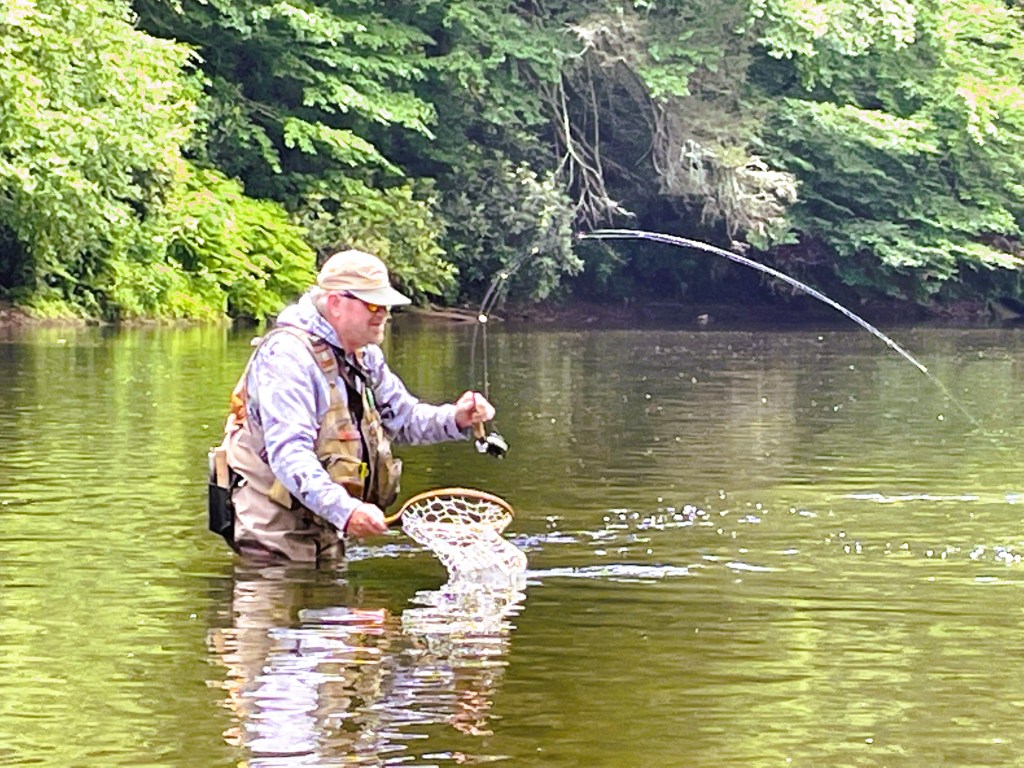
Whoa! My decades old four weightParadigm has a big bendas I work a hefty brownie close. Indeed, fly rods are supposed to bend!T&T Paradigm rods have always featured what some term a parabolic action, perfect for presentation and playing fish.Come on in! The trout is at the surface, and I feel confident he will earn a place in my log.In the net at last and I’m checking the measurements…A beautiful heavyweight Catskill brown trout, twenty-two inches long. (All photos courtesy Henry Jaung).
This was a unique experience for me, having a companion shoot a sequence of the fight and capture of a trophy trout, and I though it should be shared here.
We enjoyed our fellowship and a gorgeous day on a Catskill river, and each managed a fine trout to remember on a day when we really had to work for an opportunity. Henry and I spent a day back in May sitting on a riverbank and talking while we waited all afternoon for the hatch that never appeared. We enjoyed that day immensely. I have always said: “You have to take what the river gives you”. There are days the river offers one fish, days it offers many, and plenty of days that it offers only the experience of natural beauty and contemplation. I come back to the river day after day and find that I am always blessed.
Summertime and the livin’ is easy… fish are jumpin’… well maybe sippin’ once in awhile.
Our general cold front has had some legs, and our days and nights are still chilly. That has helped the rivers to be sure, as will the rain that has lasted all night long and shows no sign of stopping today. The weather radar shows a long, long band running remarkably south to north so our chances of fishing today seems to have washed away.
I have guessed wrong on the weather the past couple of days, wearing my rain jacket all day Tuesday and letting some early morning sunshine send me on the river in my shirtsleeves on Wednesday. I counted maybe two dozen raindrops Tuesday and spent an uncomfortably muggy fishless day on two rivers. Yesterday I froze until I finally waded back to the car and donned a fleece jacket. I did manage some productive fishing despite my case of the shivers.
The chilly, cloudy conditions finally put a few sulfurs on the surface, not a lot, even giving a variety of sizes, but just enough to entice a few of our more difficult trout to cruise around and pick off the ones that looked vulnerable to them. Technical dry fly fishing is my passion, and this day certainly fed my passion.
The cruising phenomena has become more frequent during the past season or two, and it presents a unique challenge, particularly in gin clear, slow pool environments. Our Catskill wild trout have evolved, no doubt finding new ways to succeed amid increasing fishing pressure and more limited hatches.
The bottom line is, the angler cannot chase them in flat water. Every movement sends pressure waves which puts the trout on higher alert, so the game requires good long range casting ability. The guy that makes a dozen or more false casts before delivering his fly isn’t going to win this game. By the time his fly arrives where he spotted a rise, that trout has moved on.
Repetitive casting to the site of a single rise isn’t a winning technique either. It takes judgement and a bit of luck to determine when a fish is taking a break from perpetual motion and hanging out in one place. Two rises in the same location get my attention, and I will make one good cast to the fish immediately after each rise. If he rises again in that spot, I will cast again and continue casting until catching him or instinctually believing that he isn’t going to accept my fly.
This can be a frustrating way to fly fish but casting over and over when trout are cruising means you are likely lining your target fish or others that are moving through unseen. Often you will simply turn them off their already limited feed and the water will grow very quiet. Patience and experience are necessary, along with the casting skills to take advantage of the opportunites offered.
I fished and shivered for a couple of hours without moving very much at all. It took me a long time to stalk into a position where I could cover the section of the pool where I noted a few sporadic rises. I started with a size twenty sulfur dun with a wispy trailing shuck and stayed with that fly until I had offered it to two or three different cruisers. There were twenties on the water, but there were also some larger size eighteen naturals and a few sixteens. The eighteens seemed to have become the most numerous, so I knotted one of my standard CDC duns in that size.
That fly was offered to a couple of different fish before I noted one that was hanging out in the same location. I worked him carefully, satisfied that my Thomas & Thomas Paradigm bamboo rod was giving me good distance capability with a much more delicate presentation, and finally got the take I had waited for. That was a quality trout, and he fought very hard for his size; seventeen inches in the net.
I stayed with that same fly as morning evaporated into early afternoon, but I wasn’t finding any more risers that weren’t constantly on the move. There’s no telling how many seconds a cruising trout will remain in the same location after rising and taking a mayfly, some swim up, take the bug and never stop moving. Even an immediate, accurate cast isn’t going to catch that fish.
Eventually I figured that most, if not all of the trout cruising through the water within my casting range had seen enough of my CDC dun and chose to alter the game. I chose a size sixteen 100-Year Dun, tied with one of my orangey dubbing blends, figuring the strong profile would be hard for one of these cruising trout to resist. Cruisers seem to be attracted to moving insects, but I reasoned that the sparse little sulfur hatch had been going for an hour and a half or more, and the trout were now actively looking for them, wiggling or not.
I had a close look from one cruiser, then saw a strong rise just out of range along a sheltered bank. I took four smooth, cunning steps as I stripped out several more feet of fly line, then delivered my signature fly a couple of feet up current from the riseform and a foot from the riverbank. It drifted about four feet and was engulfed in another heavy rise.
The old Paradigm arched boldly, leaving no doubt I was into a heavy fish. He headed my way quickly, forcing me to strip line as fast as I could, all the while trying to drop each coil away from my body on my downstream side. Slack fly line loves to tangle, and the consequences from those tangles can be lost trout or worse: a broken tip to a cherished rod.
I kept that brownie under control thankfully and managed to get that slack line back on my little 3″ Hardy St. George. Yea, large arbor reels are what the marketing machine wants everyone to have, but none of them match a vintage bamboo rod, nor sing with a running trout like a classic Hardy!
Trout number two measured out to twenty inches, before I slipped him back into that cold, clear pool. The cruising and rising seemed to slow considerably after another quarter hour, and that’s when I waded out to grab that jacket. I was to get one more shot before calling it a day.
An old favorite lie beckoned, and I stalked close enough to watch for any sign of activity. Within ten minutes, I saw two un-mistakeable little silvery winks of light deep on the edge of the shadowy bank. Three careful steps put me in range for a long, graceful cast, and I watched that little 100-Year Dun drift, drift, drift; right into another silver wink.
When that big old brownie took, it would have been easy for him to turn and break my line in the submerged tree trunk a foot behind him, but he chose to shake his heavy head vigorously and swim out of the cover toward me. Maybe he was in the mood for a little exercise. Stripping line again to keep up, I managed to drop all of that slack fly line to the side and downstream. I started reeling in that slack when the trout seemed to be holding and head shaking in one place. I would quickly learn that was the wrong call. Better to risk problems with trailing line than to rest the fish mid-fight.
I felt a dodge and a weave and suddenly the load on my rod was much lighter. I retrieved my line to find three golf ball sized globs of mossy goo on my leader, one for each knot. I was light half of my 5.5X tippet and fly and of course, a fish. He had laced my leader through some emergent weeds shrouded in goo and used his lacework to break the tippet without my even feeling a surge.
Just fishing, the good comes with the not so good, though it is always great to tangle with a wily old wild leviathan! Who knows, maybe he will get a taste for 100-Year Sulfur Duns after chewing on it for a while.
June 19, 2022, and it is forty-two degrees here in Crooked Eddy. I fired up the furnace last night, at least for the upstairs. Wishing I had hit the downstairs thermostat too. It has been colder here at my tying desk, yes certainly much colder, but perhaps it is my recent acclimation to sunshine that makes it feel downright icy. It was eighty degrees on Friday afternoon.
I trust that Beaver Kill anglers are benefitting. There seemed to be plenty about yesterday morning as I drove to The Manor. It was good to see some friends at the Museum. I have missed fishing with JA since April’s abundance of mucho grande Argentine trout recked his casting arm. Mine has continued to hold up thankfully, despite the advance of arthritis, carpal tunnel, and the various intricacies of age. I credit the magical properties of bamboo with cushioning the stress of casting five to six days per week.
Long and recurring bouts with high, cold water and overzealous winds have found graphite in my hand too often this season, though I continue to shun the stiff, fast action rods the fly fishing industry seems to insist we torture ourselves with. In truth I have minimized the damage thanks to a pair of Thomas & Thomas Paradigm graphites that have passed their twentieth birthdays. Funny how they will present flies so perfectly at distance when they aren’t anywhere near being fast action rods.
Nothing beats bamboo though. My only regret is that I learned on graphite and, like many, believed too much of the hype as rods became stiffer and less tractable. Fly fishing for wild trout is not about power.
Daydreaming fantasies find their way into my consciousness every once in a while, particularly dealing with the chance to walk back in time. Imagine it is say, 1960 and you have five hundred dollars in your pocket; you stroll into Jim Payne’s rodshop, visit Fred Thomas and perhaps Leonard, walking out with money in your pocket and a few of the greatest bamboo trout rods ever made. Though the economies of time are vastly different, there are a multitude of choices today.
You can still buy a Payne, Thomas or Leonard, though of course you won’t be visiting with Jim, or Fred, or Hiram. There are a lot of truly gifted rodmakers out there today that you can go talk to. My friends Dennis Menscer and Tom Whittle will be pleased to make you a rod you will truly enjoy for the rest of your days. This spring I cast a three weight Per Brandin rod that stole my heart, and Dennis made a new model last year that took my breath away: an eight and half-foot, fully hollow built four weight that feels like the ultimate summer Catskill rod for fishing fine and far off as I love to do.
Fantasies are entertaining, but the art of bamboo rod making has advanced. Modern makers like the gentlemen mentioned have learned from the cherished old masters, using their own ingenuity, taste and skill to create amazing fly rods!
Well, time to get back into the warmer part of the house…



 Bright Waters Catskill