Blast From the Past

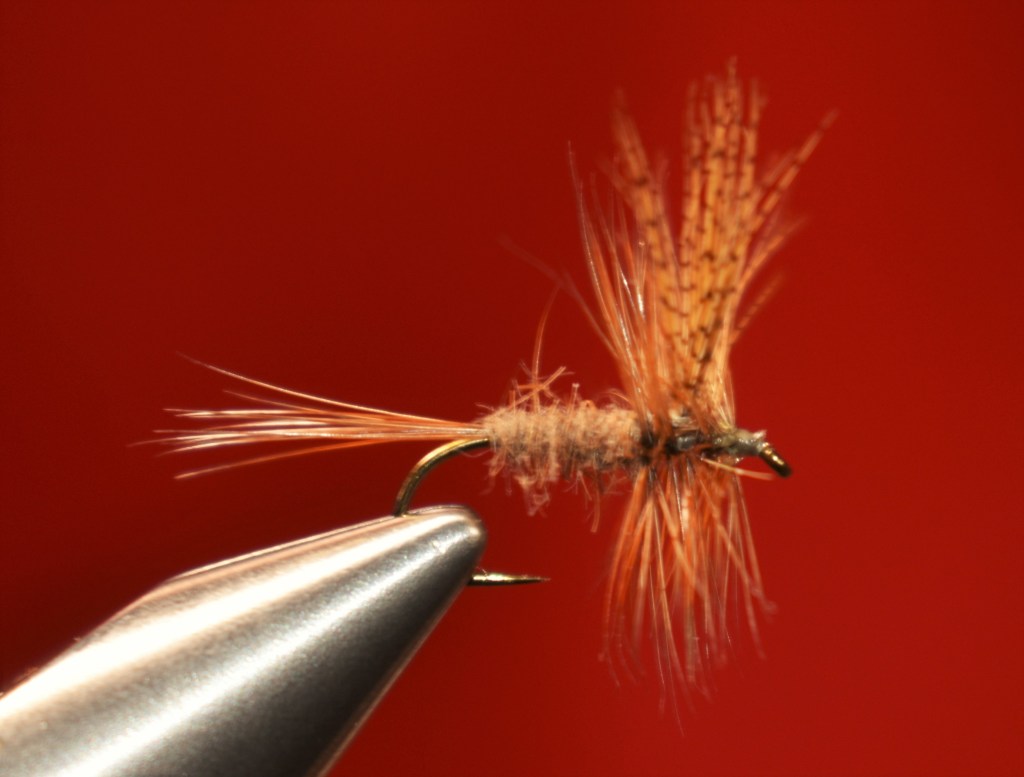
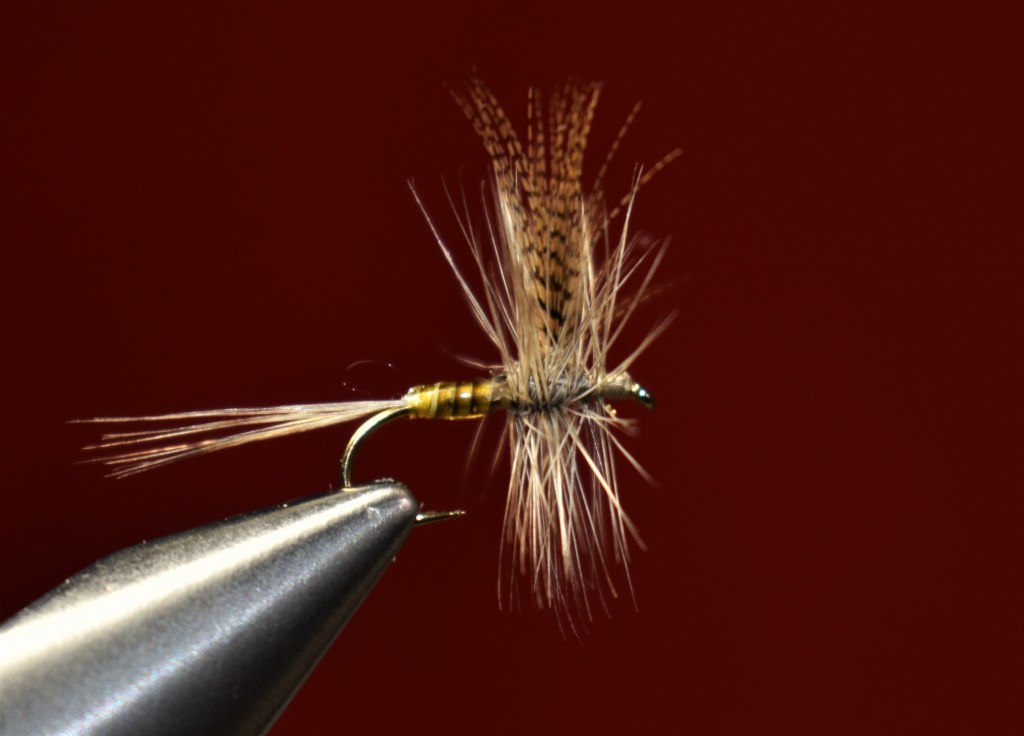
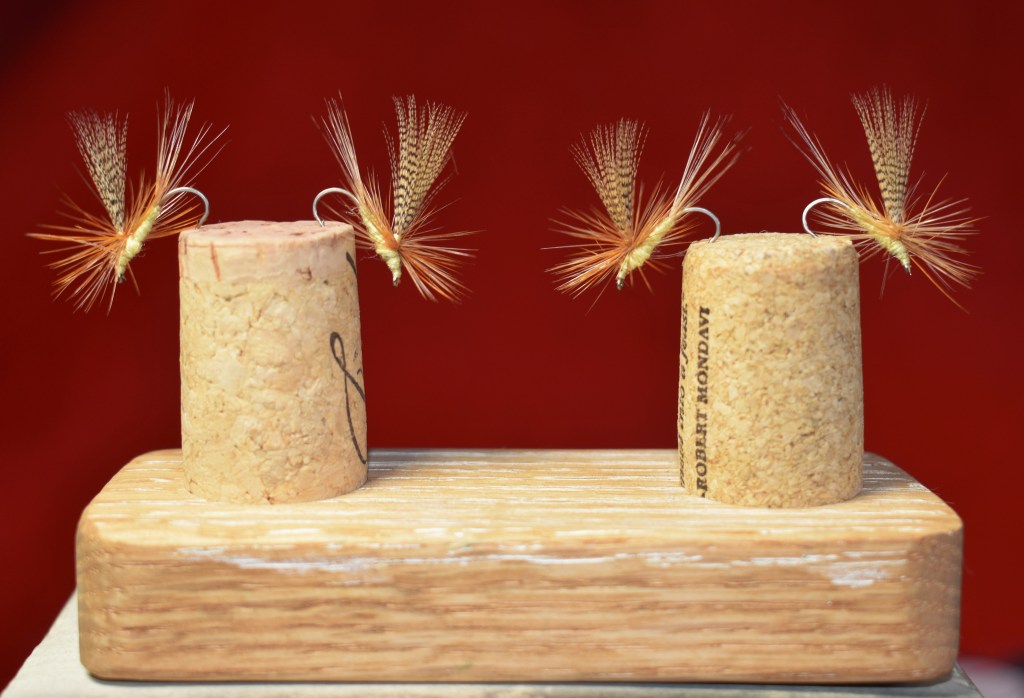
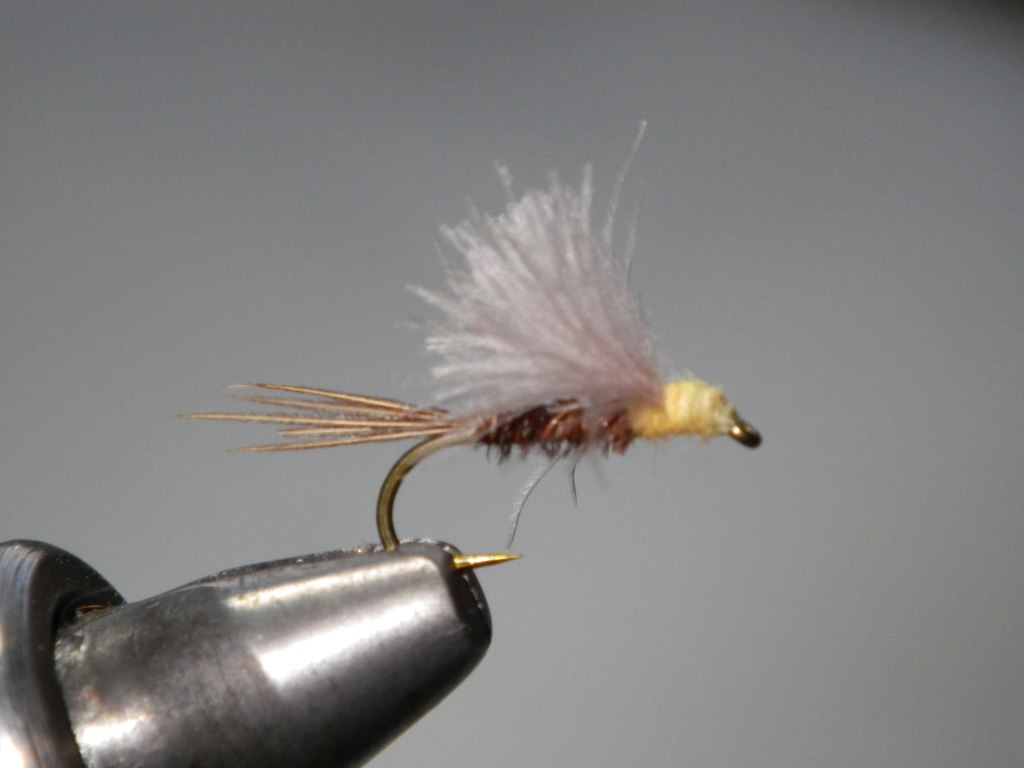
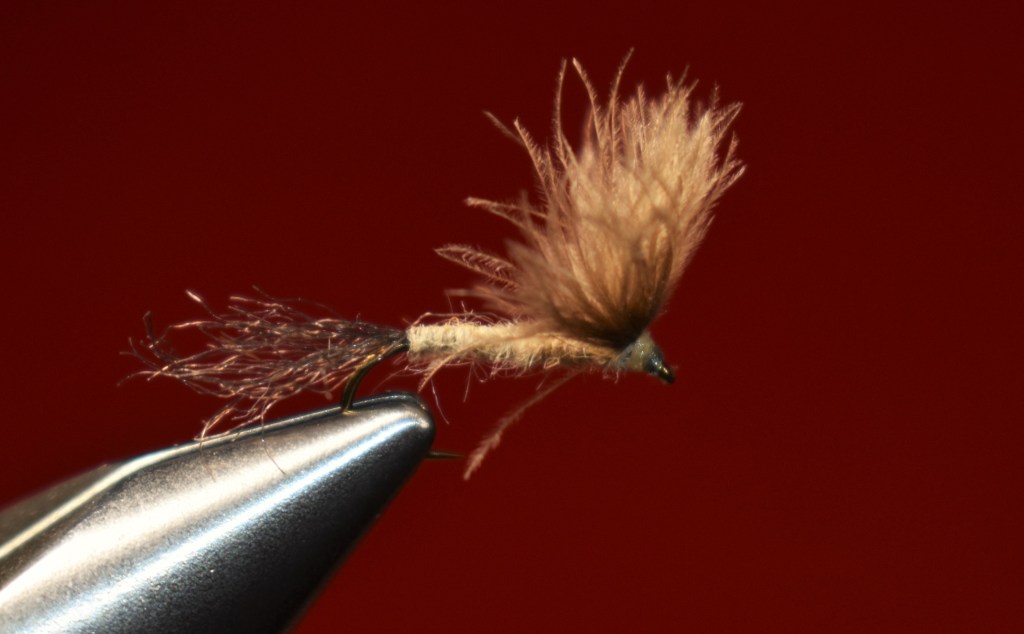
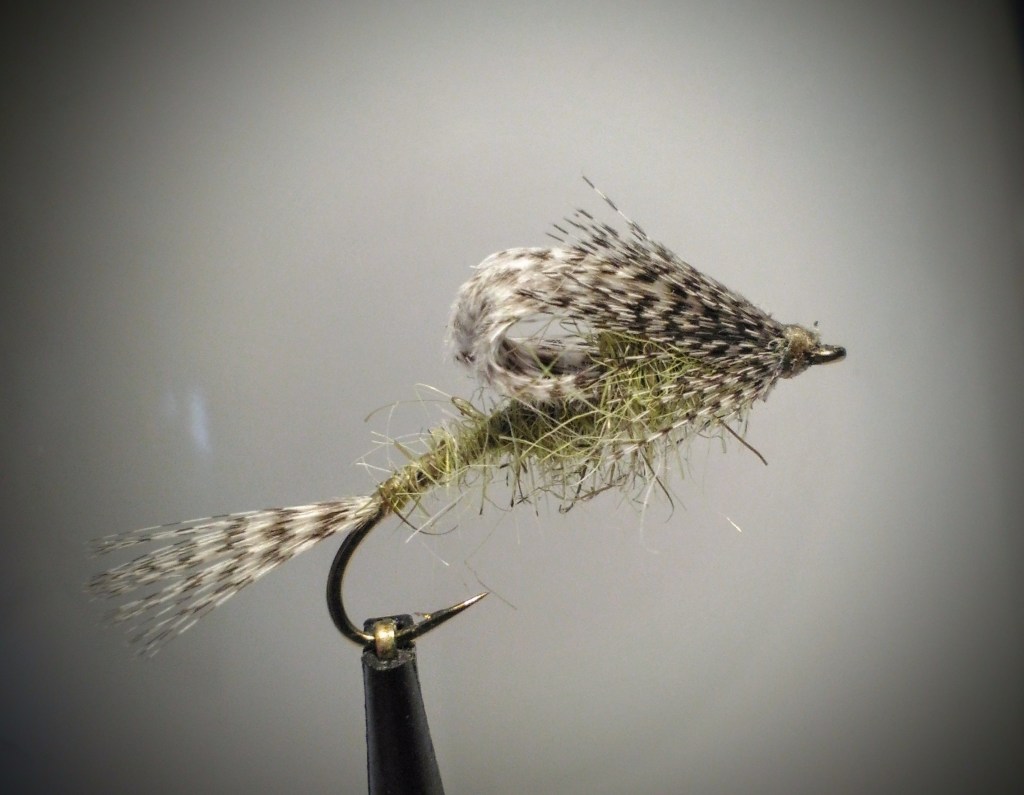
A Green Drake pattern attributed to the late Ray Bergman, equisitely tied and photographed by Tom Mason.

I was fooling around with, well, a swimming nymph variation for the Green Drake last week. I wanted to try a different approach to a fly to use on those days, you know the ones, the bane of the dry fly angler; the days when the trout rise nearly to the top to take the rising nymphs, and simply refuse anything visible on the surface. I had one of those days last season, the only day in fact I encountered any sort of hatch of the big drakes, and it wasn’t pretty.

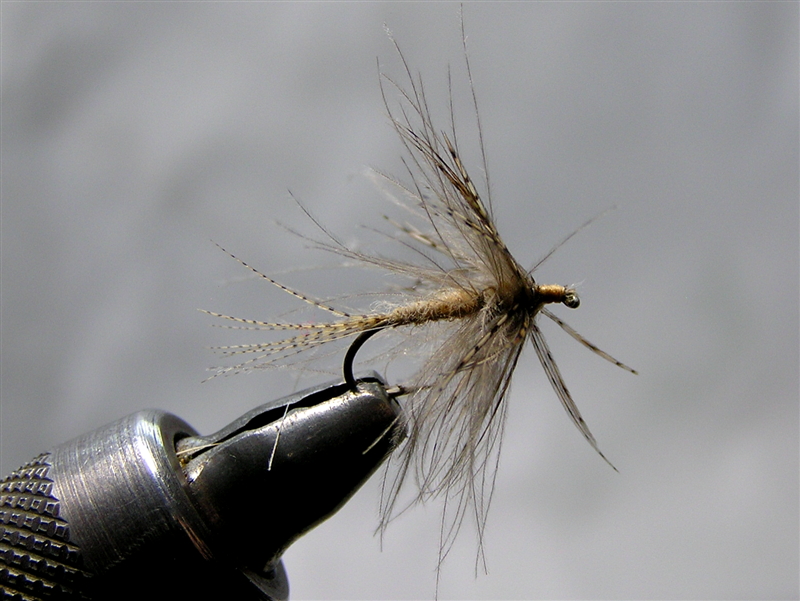
After I blended some dubbing and fashioned half a dozen big, ugly flies, I got to thinking about much older solutions. The gentlemen across the pond have a long tradition in soft hackled flies, spiders and North Country flies, and I wondered if they had such a fly for their “Mayfly”, the Ephemera danica, a relative of our Eastern Green Drake. I contacted a friend and fellow member of the Catskill Fly Tyers Guild, Tom Mason. Tom has an interest in ancient and classic flies, particularly soft hackles, and is a masterful tyer of multiple styles of trout flies, and I wondered if he may have knowledge of an English Danica pattern. While Tom didn’t have a Danica spider at his fingertips, he did surprise me with a drake imitation with an interesting history.

Tom learned of the pattern pictured above from an old angler he met on the streets of Roscoe, New York some thirty years ago. The fellow showed Tom this big fly, tied with pale green seal’s fur and teal flank feathers, offering that he had fished with iconic writer and angler Ray Bergman down on the Beaverkill near Butternut Grove back in the 1940’s. The fly was Bergman’s pattern.

Tom is what I would call a scholar when it comes to trout flies and thus researched the fly, finding no trace of it in Bergman’s prolific writings. It seems this must have been a favorite fish catcher he kept under his hat. Tom allows that the fly, a pattern we would recognize as an emerger today, has been very successful for him. He doubts Ray Bergman called it that, for emerger wasn’t a term used for trout flies back in the 1940’s. This is one of the pleasant little questions that will continue to intrigue.

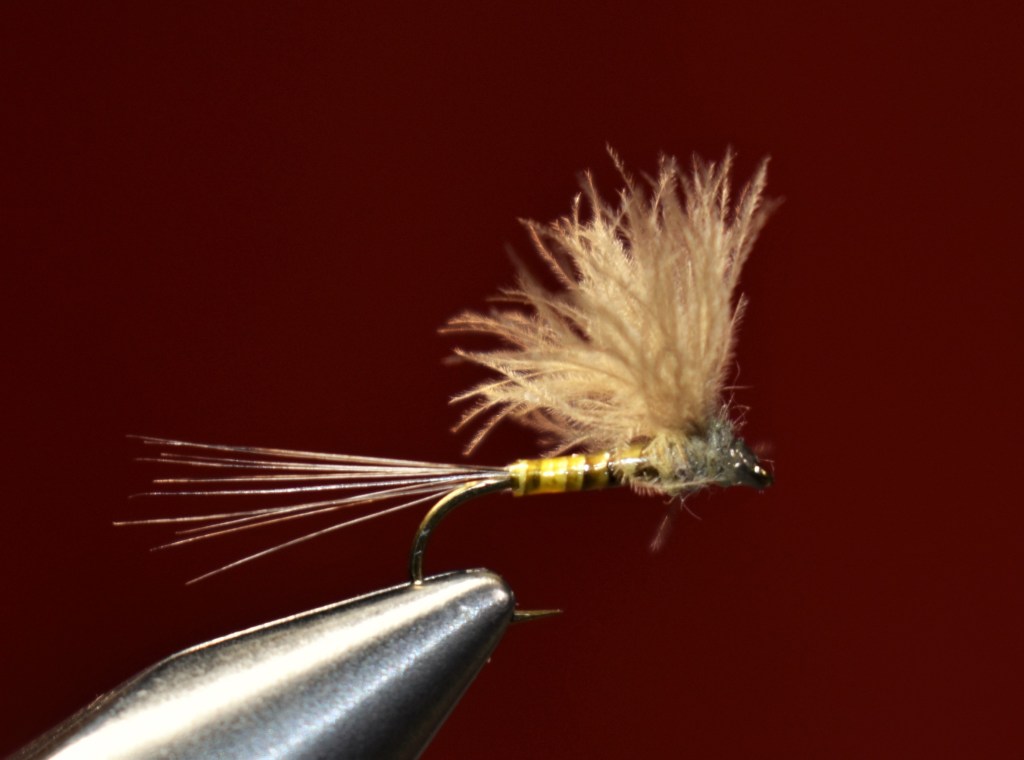
As soon as Tom handed me the fly I smiled with recognition, as the technique is much the same as the CDC emergers I designed and tied thirty years ago. Bergman had used folded teal flank to imitate the emerging wing bud with a low loop, just as I had used a pair of CDC feathers fifty years later. This loop style wing bud will trap air bubbles and hang the fly in the surface film with the body submerged, just like a struggling nymph. There are no new flies.

Though I have an extensive selection of tying materials, I haven’t a wisp of seal’s fur, so I set about making a blend to achieve a similar effect. I started with Angora Goat dubbing in medium olive, light gray and yellow, this fur being widely used as a substitute for seal. I added bits of olive hare’s ear, bleached squirrel, light olive dun Antron and Hemingway’s Beaver Plus dubbing to get as close as possible to the color and translucency of seal fur. I still have some experimenting to do, both in blending and in selecting a dubbing technique to achieve the sparse, spiky abdomen on Tom’s imitation. One look tells me that Tom’s fly will be clustered with air bubbles when fished and will look very much alive. He has a particular touch with traditional materials to get that very deadly effect, whereas I turn to Antron to get sparkly bubbles and light reflections.
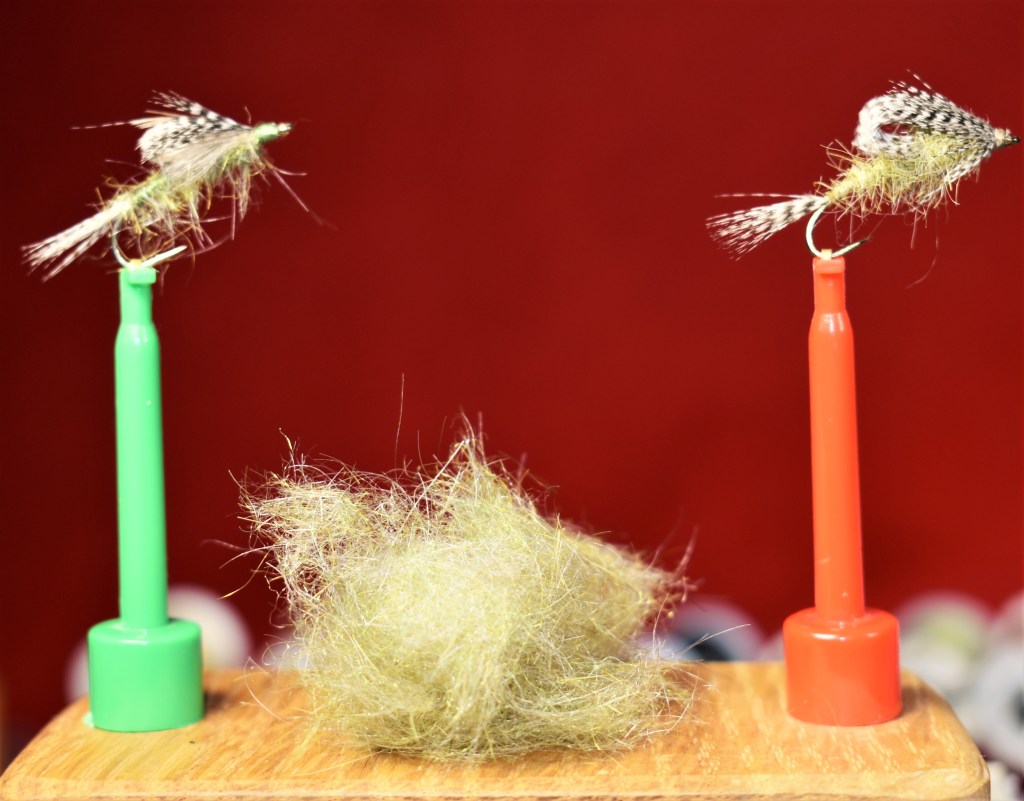
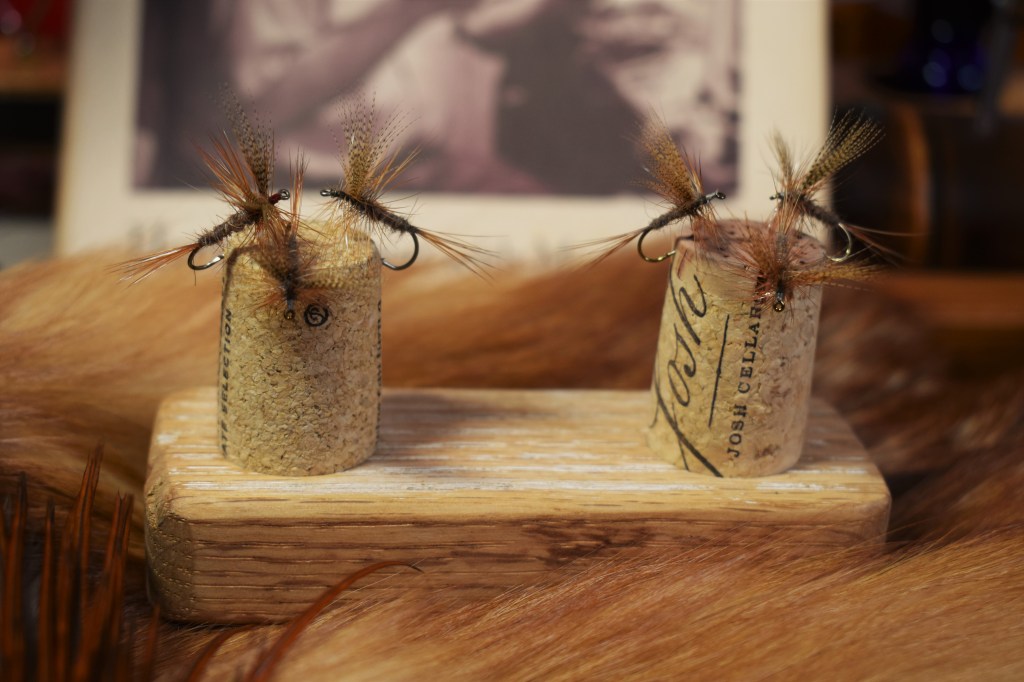
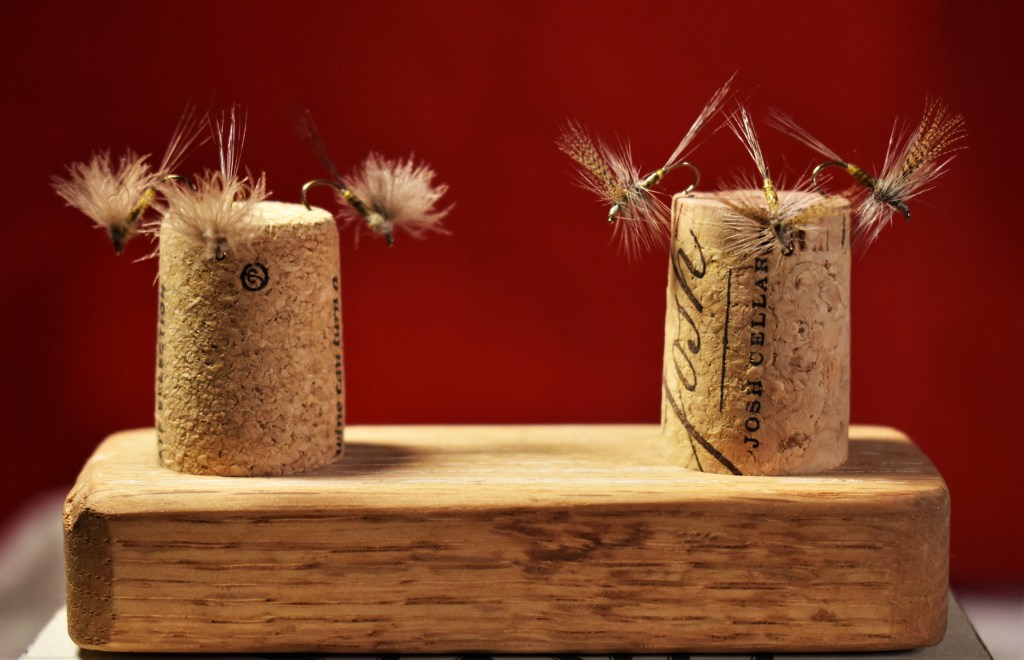
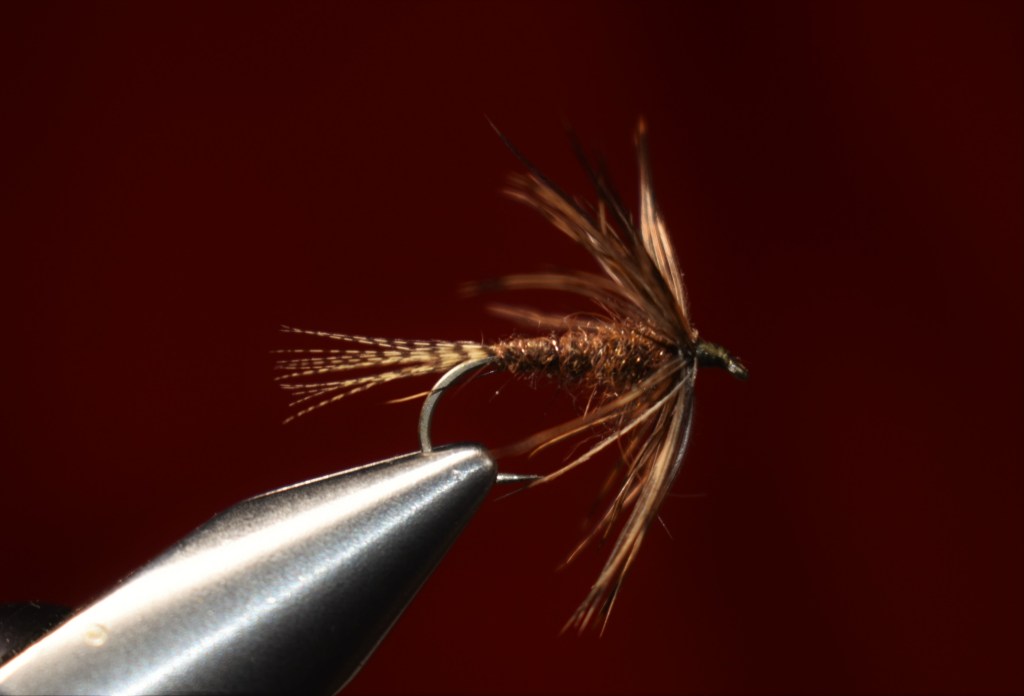
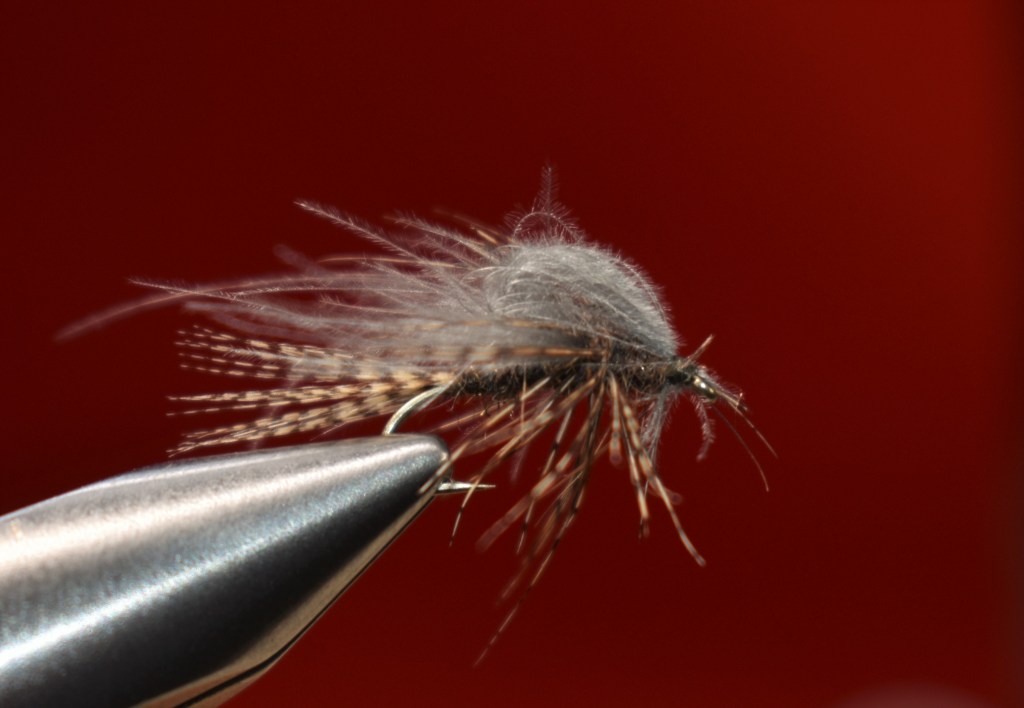
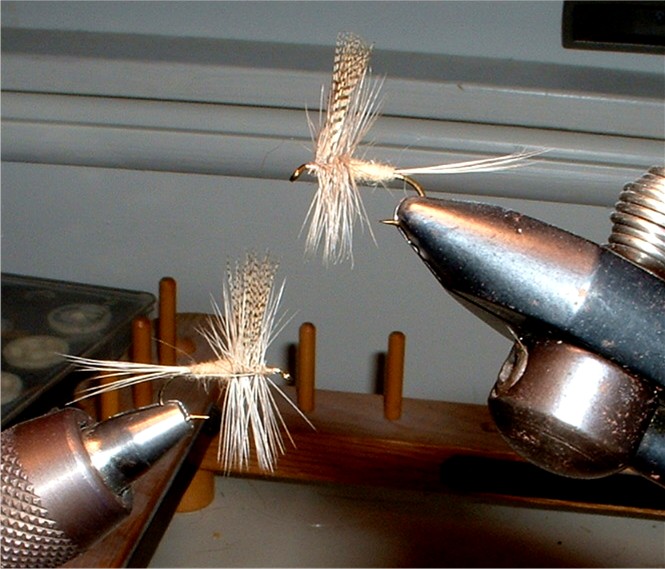
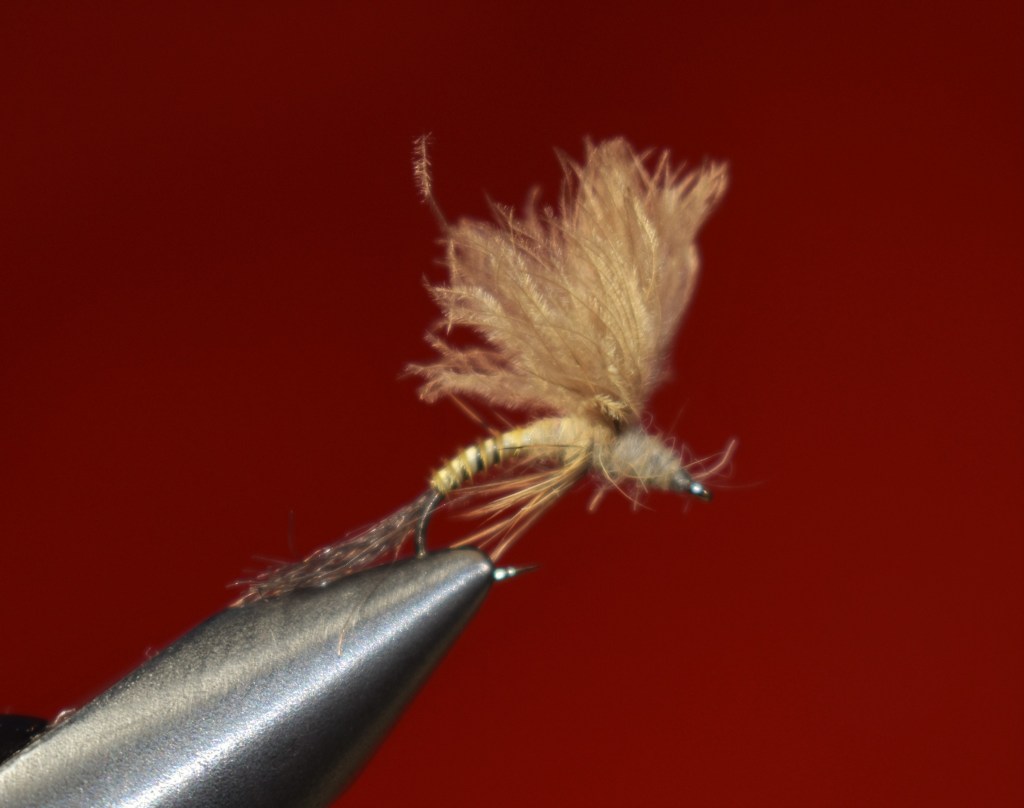
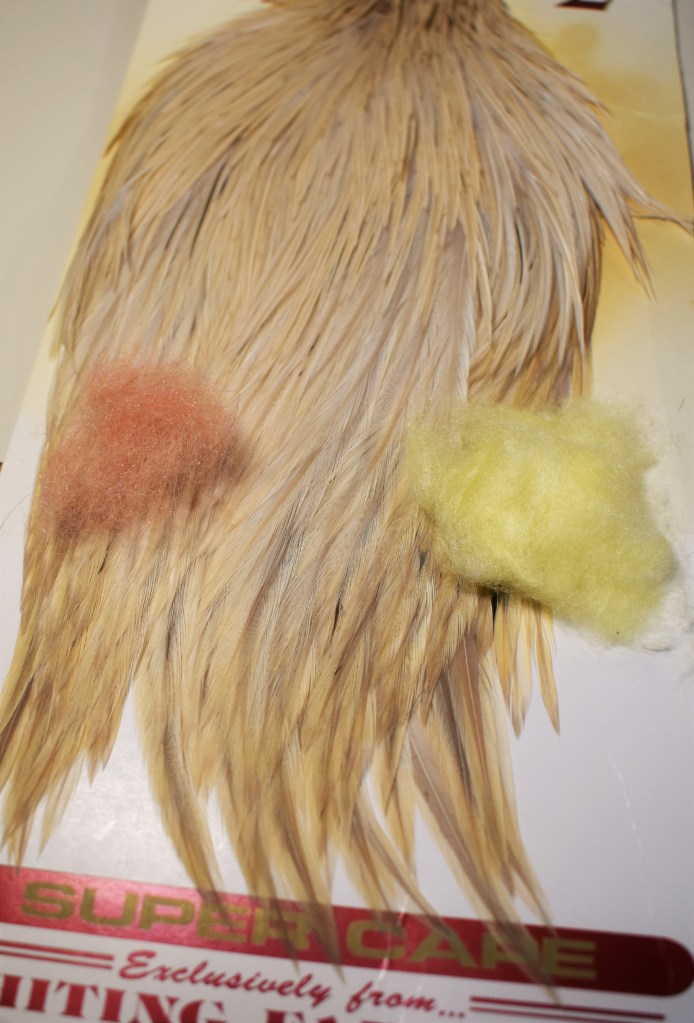
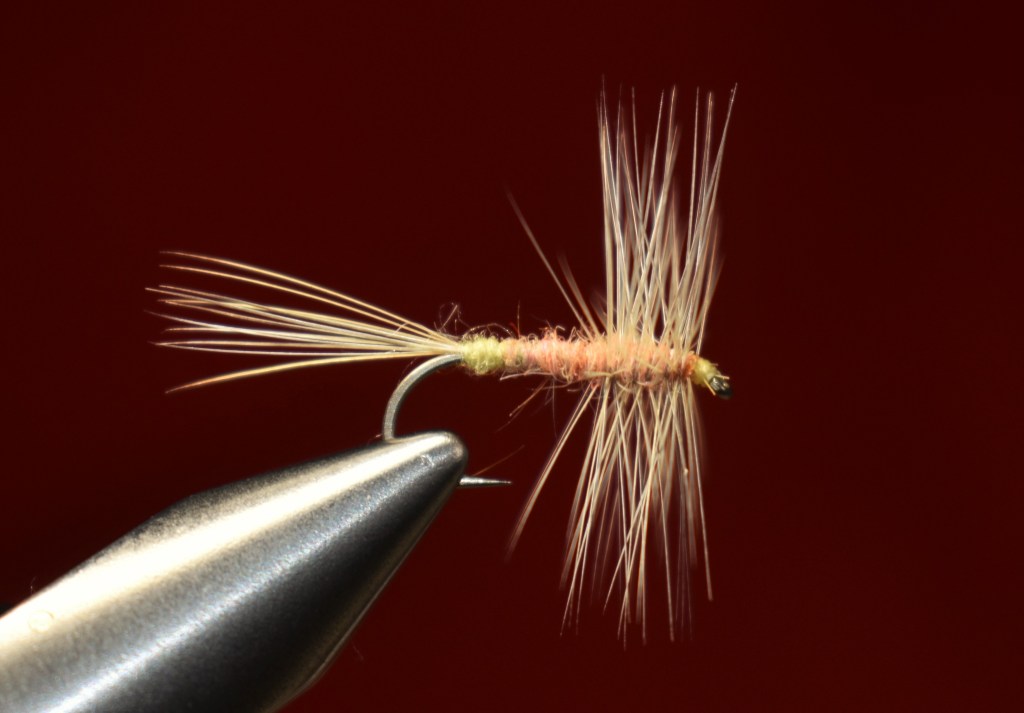
My multiblended dubbing ball flanked by Tom’s original Bergman Emerger on the right, and my trial version on the left. I added a pair of wild duck CDC feathers underneath a Gadwall flank feather as an alternative to Teal flank.

My thanks to Tom for graciously sharing this pattern and the story behind it. I look forward to tying a few more and then fishing them this season. It will be neat to fool some of our educated, oversized Catskill browns with an eighty-year-old secret fly!
Winter

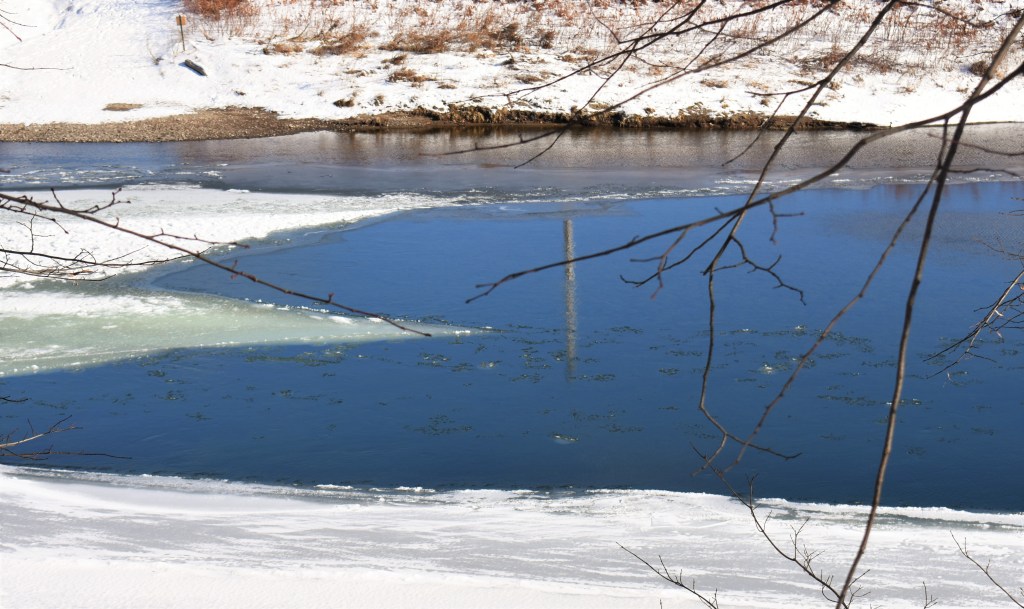
Spires in the current where the river lingers between solid and liquid.

At eight degrees below zero the boards of my old porch loudly protest each footstep. It is quiet here just after sunrise, the sky as blue and clear as the heavens themselves.

I am bundled here in my little angling retreat, for the heat in this old house cannot battle such cold. To pass the early morning hours I think of fishing, of bright skies which shelter me in warmth, and mayflies on the wing. I crave a different chill, the chill of the mist on a summer morning, the feel of goosebumps beneath my shirtsleeves as I stalk a still pool after daybreak. There is an electricity to that sensation not felt in the true, deep cold of winter.

There’s a four-weight bamboo rod in my left hand, and my grip tenses ever so slightly when I note the first gentle ring upon the mirror of the surface, before the mist obscures my view. The line is free now, laying in soft coils on the water, until my arm and wrist lift and shoot them outward and away. My eyes squint to track the tiny fly at distance, its sparse hackles offering minute specs of light, evidence of its being until the mirror bulges softly and the game begins.

I am connected then to the life of the river, the energy of that mystical, natural world by the living fibers of cane. The trout pulls hard toward the middle of the river, the reel shrill and bright as the morning, and for a while I am awash in his world.

The droplets are cold on my hands as I slip him back into his world; and then the warmth of the rising sun tingles on my flesh, and I realize I am back in my own world…

Tying Harry’s Fly

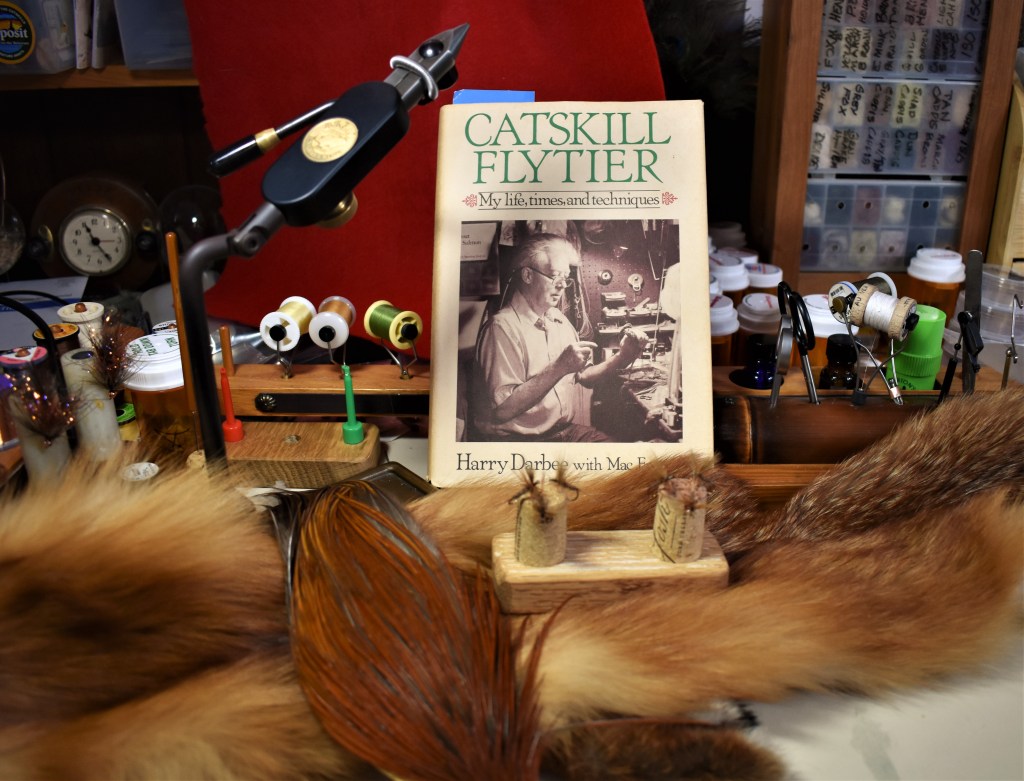
Reading through Harry Darbee’s “Catskill Flytier” I came upon his pattern for the Dark Hendrickson; and so…

One of the classic Catskill dry flies that I have rarely tied or fished is the Dark Hendrickson. Perhaps the name affected my viewpoint: all of the hundreds of Hendrickson mayflies I have plucked from the surface of Catskill rivers have been tan or reddish in their bodies. The general recipes for the Dark Hendrickson have called for muskrat fur, and I never had that much confidence in a plain gray fly. My thinking has changed today, during another trip through the past.

The late Harry Darbee published his book Catskill Flytier in 1977, forty-five years ago. In it he recounts his story growing up in this region and, with his wife Elsie, becoming one of the most lauded pairs of Catskill fly tyers in our region’s history. The Darbees formed an intrinsic part of the Golden Age of Catskill fly fishing. I have owned the book for many years, though I still recognized a bit of information that had escaped my earlier readings.

The last fly listed under “Darbees’ Deadly Dozen” is their version of the Dark Hendrickson, tied with dark rusty dun hackles and “Brownish gray dubbing from red fox fur”, something very different from the gray over gray patterns others tied with muskrat and dark dun hackle. I liked the idea of old Harry’s version immediately.

As it turns out, I was ordering some Coq-De-Leon tailing hackle last week when I noticed a page on the dealer’s website offering Darbee Duns hackle credited to a single hackle breeder that has maintained a small flock of Darbee strain birds. I took a chance and added a half cape in rusty dun to my order. I was pleased with the feathers when they arrived, and when I saw Harry’s Dark Hendrickson recipe, well, what could have been more natural?

I took down a red fox skin this morning and cut some of the short brown fur from the outer leg and some longer pinches from the back of the hide, tossing it in my blender until I had a nice “brownish gray”. Then I set out to tie half a dozen of Harry’s classic dry flies.

Harry Darbee’s Dark Hendrickson: I like the guard hairs in the red fox fur, as they encourage air bubbles that help a dry fly look alive. You can trim the long ones if you wish, but don’t remove them all from the fur!

In Catskill Flytier, Harry recommends the pattern in sizes 10 through 14. I decided to tie mine in 10’s and 12’s with any eye toward fishing them when I find the big reddish Hendricksons hatching on the Beaverkill next spring. I could find myself tying one on when the isonychia are hatching too. I think Harry’s Dark Hendrickson will be a good searching pattern when fish have been tuned into isos during the summer.

Of course, I would love to be able to get out there right now and give the fly a try. I’m quite sure that no trout is going to rise through the ice along the river today, no matter what the fly’s pedigree.

A Winter’s Afternoon

There’s a chill in Crooked Eddy despite the sun…

There’s a chill here in Crooked Eddy and growing colder despite the glorious winter sunshine. Well covered up for my river walk, I felt the bite of the wind upon my bare countenance walking back homeward. I realized we have passed the first month of winter, a milestone for those of an angling persuasion who count the days until rising trout might accompany such a stroll along bright water. There are eighty remaining by my count.

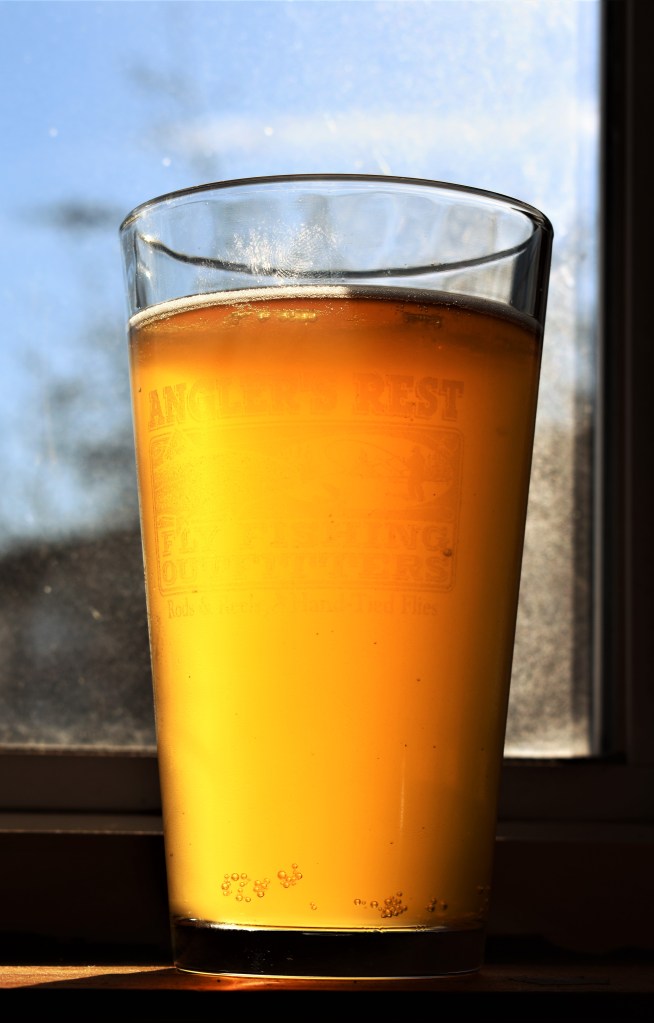
The wind heralds the onset of another cold snap, the kind that brings us subzero dawns, a thing I never welcome. That contemplation put me in the mind to celebrate the cold snap with a chilled glass of my favorite brew, called coincidentally by the same name as that all too familiar meteorological phenomena. My gratitude to Mr. Koch and company.

A Cold Snap to the cold snap: may the subzero readings be kept at bay!

Before my little snack and break I decided this was a good time to tie a few dries to salute the later turn of spring, that lovely May/June period when the larger mayflies whisper their hellos on balmy afternoons and calm, comfortable evenings.

I have had such wonderful results with my 100-Year Duns that I have continued to tie more of them, being sure to have some on hand for most every hatch. The varying shades of woodduck and brighter hackles caught my eye, and I spun some Light Cahills and a pair of March Browns.

A brace of March Browns and two brace of Cahills; ready to float down to the surface above some discriminating golden flanked warrior.

I first tied this style of dry fly for the largest of hatches, our Eastern Green Drake. The pattern evolved gradually over a number of seasons, and all have proven to be the right medicine for trout which delight in ignoring or refusing my more conventional offerings. Old Gordon was onto something! I find a timeless grace in the long, canted wing. The fly sits the water provocatively, the canted hackle turns serving to support the offset weight of the fly. I love to watch them float down a quiet thread of current!

Eighty days is still a long time, and there is no promise that spring will warm the rivers in time for my personal opener. That is why there are flies to be tied and rods that wish for a gentle polish. I am well into my winter reading, with Harry Darbee’s Catskill Fly Tyer beside my big leather chair today. I can find it difficult to commit my attentions to one off-season activity for long periods, so on certain days I will jump from the tying desk to the reading chair and back. River walks help calm my spirit.

I find a perfectly serene state of calm with a river flowing around my legs, and there is really no long-term substitute for that. Bright water is its own state of perfection. It has a mystical ability to allow us entry for a time, a chance to become as the trout and the mayflies, part of the magic of the river!

My friend snapped this photo, coming gently upstream late in the afternoon to find me battling a prodigious brown trout. I had no idea he was even near, locked as I was in our connection through that golden arc of cane. The fish would exceed five pounds! (Photo courtesy Michael Saylor)

The Bow

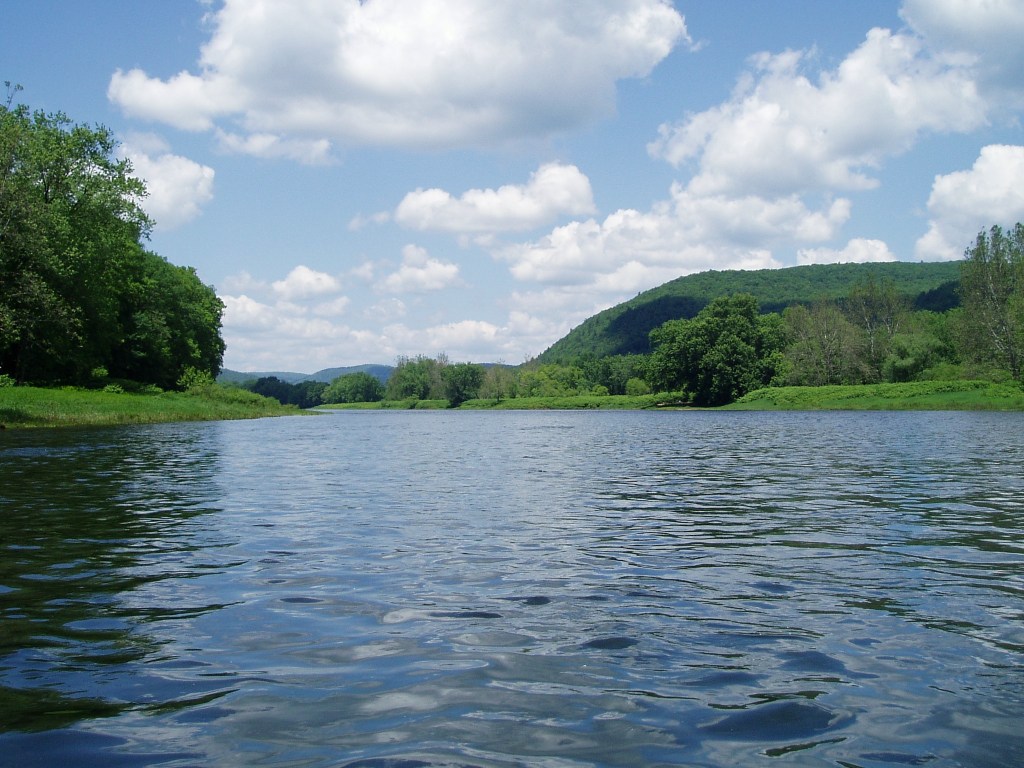
The Upper Delaware River: her wild trout are hard earned and wonderful, particularly the ones with the red racing stripes…

Many anglers travel to the Upper Delaware River each spring, some just to witness her natural beauty, most to cast a fly and find out what all the excitement is about, and a few to measure themselves against the legendary difficulty of her grandest rewards.

The wild rainbows are the stuff these legends are made of, the moving wraiths of the great river. Even big fish can be curiously subtle when feeding in plain view. Hundreds of hopeful anglers walk right by those isolated little spurts of bubbles in the midst of a wide riffle, their eyes searching for some expected head and tail rise, some grand profile on display like an artist’s rendering.

A fifteen-inch Delaware rainbow can spool you if he has the inkling, and an eighteen-inch fish can send you running toward shore with your rod high in the air and leave you with visions of leviathan haunting your dreams. Life, survival is hard in this greatest of Catskill rivers, and those trout that succeed leave an impression of electricity and muscle to tease the angler who has enjoyed a taste of their energy.

The eighteen-inch bow is a big fish in the Delaware, for the difficult life in the river and long, seasonal migrations to avoid wide temperature swings do not foster a long lifespan. A few reach the coveted twenty-inch mark, and those of us who love them never forget the days when such very special fish are brought to hand.

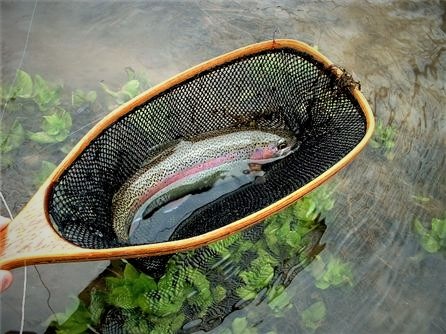
A 22-inch torpedo that reigned as my largest Delaware rainbow for more than a decade. Scanning the wide riffle in the background for subtleties drew my cast to a tiny spurt of bubbles I thought I saw.

Once I had tangled with my first mighty Delaware rainbows, I had a quest for one larger than the rest, a fish in excess of that twenty-inch size, a giant for the river. That quest lasted a decade, until the trout pictured above came to hand on a gray, early May afternoon. During those years I learned to spot those insignificant little spits amid the riffles, the kind my mind once believed were nothing but cast offs from the constantly rolling currents that bounced through the rocks of the riverbed. The great Haig-Brown wrote of the glory of the unexpected fish, and Delaware rainbows of this ilk truly deserve that moniker.

I shall never forget the monstrous, deeply hued fish that grabbed my Leadwing Coachman on a morning swing in another great Delaware riffle, then vaulted from the boiling water. I was left flyless and shaking when he rushed downstream, leaping again and again until the tippet parted on that final aerial display. Indeed, an unexpected fish as I idly swung that wet fly waiting for signs of a hatch.

One morning two seasons ago I stalked into a quiet bit of water. The gentle bubbles along one thread of current attracted my attention. I cast my caddis dry fly once, twice and then again, giving it consecutive drifts downstream. A mild spurt of bubbles greeted it on that third pass, and I raised the vintage bamboo rod in my hand to see the calm river explode! A great silver fish leaped five times in succession, rushing toward the opposite bank, and then the reel was spinning and screaming in my hand!

Fly line and backing vanished in the distance until the bow vaulted once more from deeper water, the spray caught in midair as a crescendo of light. This time though, that final, spectacular leap was not a goodbye. The ancient rod doubled fearfully, though it turned the fish out there a hundred and fifty feet away. I reeled furiously to recover my backing, then ceded it once more in a second blistering run.

Each run grew shorter after I regained my line, and at last I brought him to the net. I ached for a photo but dared not let him linger in the slack water at my feet. Holding him against the net, his length touched the old mark: twenty-two inches, but the depth of his flank and his girth exceeded the torpedo like proportions of my long-ago trophy. My hands shook as I walked him to faster current and cradled him in the flow. An unexpected fish, yes, and a memory I can brightly recall to bring a smile and a touch of excitement to a winter’s day.

Quill Gordons

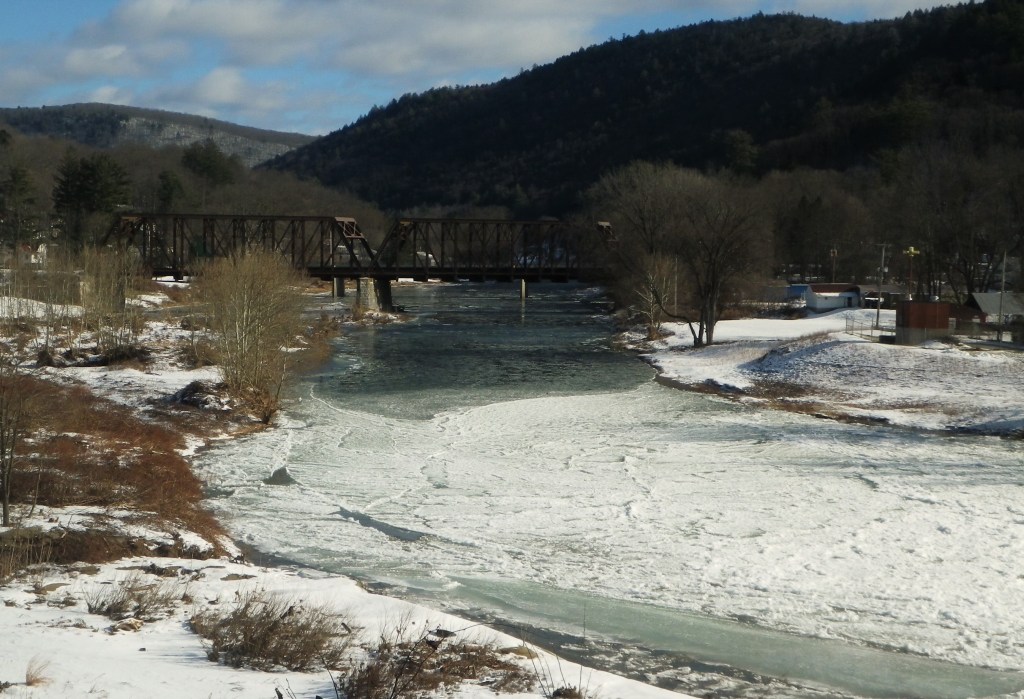
A glimpse of the East Branch at Hancock from January 24th, 2021: the riffle halted as it enters Crooked Eddy.

I will not take my riverwalk this morning to confirm that the river looks the same as it did last year. I expect it is eerily similar, for the official temperature for Hancock this morning is four degrees below zero. Here in Crooked Eddy, we tend to be a couple of degrees colder than the “official” temperature, though with the wind chill at twenty-one below, I shall not go out to check my own thermometer. Our trade off comes on sunny afternoons, when we tend to warm a bit above the official temperature. Ah how gladly would I welcome a sunny afternoon!

I got out yesterday for a visit with my friend Dennis Menscer, rodmaker extraordinaire, over on the other side of Point Mountain. He took a few moments to take a breather from the pace he has been keeping for the past year, though still working while we talked. Checking the progress of freshly varnished rod sections and crafting a set of ferrules, he keeps busy even when taking a rest.

There are rod orders to fill, a goodly number of them, and everyone hopes to have theirs by spring. Some will find a home right here in the Catskills, others out West, like the wonderful eight and one half-foot four weight, hollowbuilt masterpiece he designed for a client intent upon angling Idaho’s Silver Creek (I immediately volunteered to take one out there and test it last summer). There are a few headed to Patagonia to tackle the muy grande trucha of the legendary rivers that Schwiebert wrote so beautifully of in earlier times. There’s another duty I would happily accept! Our visits have been few this past year, as I feel guilty keeping my friend from his craft, though I always enjoy our talks of rods and reels, rivers and anglers.

I took my leave at lunchtime and headed home to a meeting at my tying desk. Quill Gordons were waiting. The mail came early, and I received a few materials, including a stripped peacock eye dyed yellow. As I feared though, these cannot be tied with without a good deal of soaking. They will wait for another day.

If you look at the photos of an ancient, original Gordon Quill, you will note the stark banding of the fly body. Some say there used to be eyes from a different species of peacock readily available, whose lighter quills created that contrast. I have a jar full, from more than twenty years ago, and when stripped and wound, they result in an uninspiring brown body with a blackish stripe. That darker, low contrast banding seems common with any of the eyes I have acquired over thirty years of fly tying, so I long ago found a substitute.

Turkey biots have long been popular for fly bodies on a variety of flies. White domestic turkey feathers are dyed and sold in many insect-matching colors, but I like the wild bird’s plumage, specifically the black and white barred primary wing feathers. I have used them for years to tie my Quill Gordons and Blue Quills.

I have seen more Quill Gordons hatching on the storied Beaverkill than on any of the rivers I fish, and those flies are a very strong shade of yellow on the bottom; still banded, but with dark gray to black and yellow. More than twenty years ago, a good friend gave me a bunch of the stripped biots from wild turkey primaries he had dyed to make fletching for the custom arrows he crafted, and those yellow ones make deadly Quill Gordons.

Half a dozen of my Dyed Wild Quill Gordons, my hatch matchers for early spring on the Beaverkill!

Of course, being a color-oriented fly tyer, I have blended a dubbing to match those yellow Beaverkill Quill Gordon mayflies. I have found success with the dubbed bodies, though I confess to a particular fondness for the Dyed Wild biot quills. Difficult trout seem to like them too!

A Catskill style Dyed Wild Quill Gordon: Grizzly variant Coq-De-Leon, a wild turkey biot selected to show lots of yellow in this case, and Charlie Collins’ beautiful, barred dun rooster hackle produces a good match as well as a very lively looking fly.

You can get varying color and effects depending upon which biot you pull from the quill to wrap your fly body. A distinct gray edge on some of these produces a very bronzy tone when wrapped over the brighter yellow, still with the prominent, dark segmentation effect from the black, thick edge of the biot feather. I like to tie some of each, always with my yellow/gray blend dubbing for the thorax on the comparaduns, as I have seen color variations in the naturals.

When a trout refuses to select the Catskill tie, I will offer a CDC Comparadun. That usually closes the deal. Sometimes the naturals are more active and certain trout need the inducement of movement to commit. The speckled and barred tails and hackle on the Catskill tie give an impression of movement, often inducement enough in the higher currents of the early season.

The undyed wild turkey biots are great for Blue Quills, and where you find the Quill Gordons lacking the heavy yellow coloration. I have always liked to design my own imitations, and I think that their uniqueness brings better responses from heavily pressured trout. If a fly is a good imitation of the natural and doesn’t look just like something that big old brownie has seen coming past his window day after day throughout the spring, I believe he is more likely to accept it. Fly fishermen, we all have our theories, right?

When I am not in a hurry to tie a few flies for the morning’s fishing, I like to put a coat of Hard as Hull head cement on the biot body. The fly is thus more durable, and the colors and segmentation really pop with that glossy topcoat. I tie tails and then the biot body and whip finish before adding the cement coating, setting aside the bodies to let the cement harden. When thoroughly dry, I reattach my thread and add the wings and hackle and finish the flies, a production tying technique Ed Shenk taught me decades ago.

The morning sun is lighting up the curtain above my tying desk, belying the frigid air outside. The little weather gremlin note at the bottom of my screen winks at me: -3F Sunny. Visual deception: kind of like what we try to accomplish with trout flies!

Warmer Times

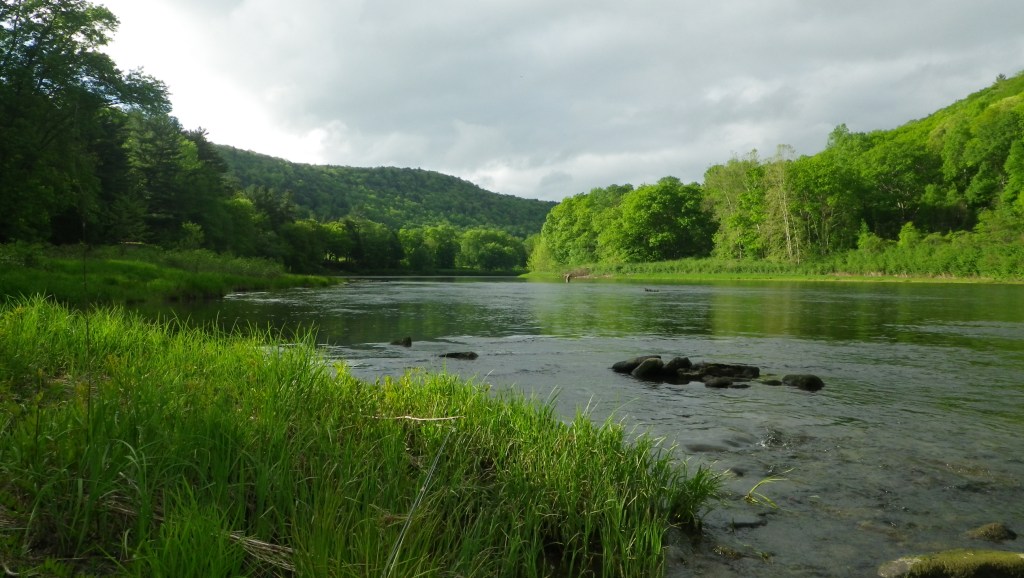
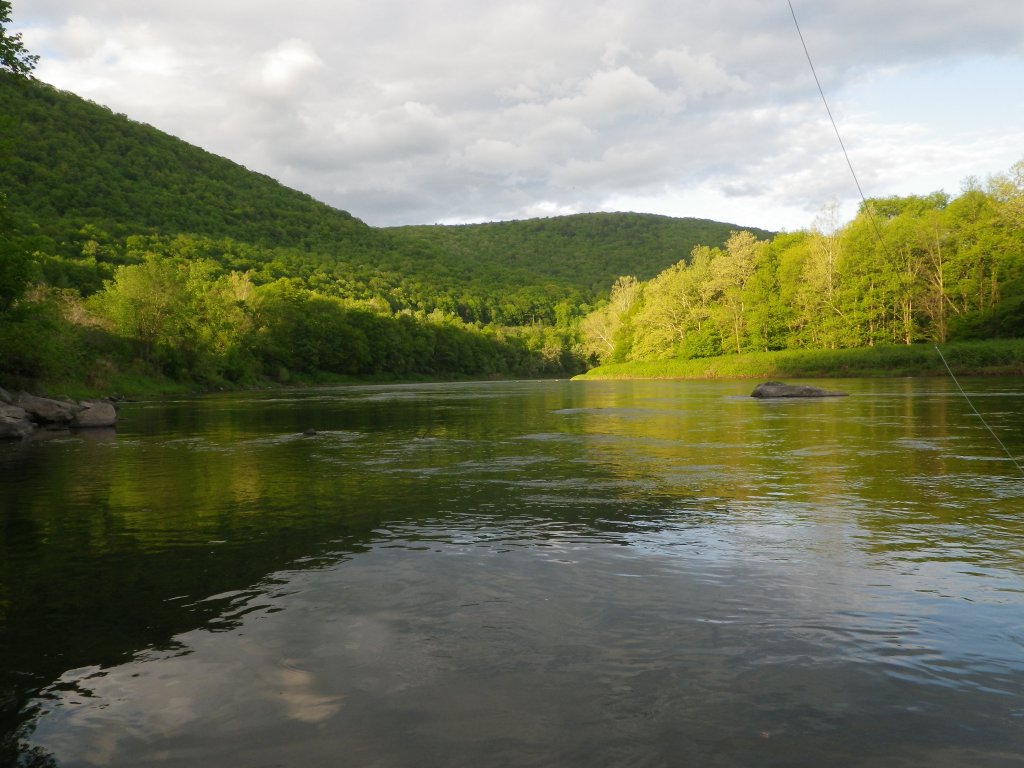
The Delaware, in afternoon light in late May

The television proclaimed that we are not too far below freezing this morning, and promised a warm day, defined as reaching perhaps 35, even 36 degrees. We will pay for Nature’s largesse come Friday night though! Another day that I will not wade bright water, another when the closest I may come is a walk along the ice laden river, followed by a drowsy dream of warmer times.

April is the target; not its beginning, but later near the middle of the month, such days hold the most hope for early mayflies, and rising trout. That week, that span of days when maybe becomes imminent, begins eighty-seven days from today.

Here in the Catskills, we never quite know what April will bring. Strong northwest winds are expected, blowing anything from moderately mild air to sleet and snow, but the sun will be closer and with us more hours each day. Warm southerly breezes can arrive at any time to make us feel giddy, as on the eighty-degree days that closed out last April; a preview of the perfection that is May.

May begins the finest time for the fly fisher, particularly those of my ilk who worship at the altar of the dry fly. It begins with the continuation of the Hendricksons, and progresses through the various spring caddisflies, March Browns, Gray Fox and at last the lovely sulfurs!

The big ones: 100-Year Duns in size 12, await the choice appearances of our largest sulfurs. Pale yellow silk, and woodduck towering over a carpet of ginger hackle!

We are graced by many beautiful yellow mays, from those slender size twelves to the tiny size twenties of summer. There is always a bit of mystery as to which ones, and when might they appear. Some of my favorite surprises have come on warm, sunny days, first with a few of the smaller Dorotheas and then more; enough to bring the trout on the rise! Sometimes the larger flies will show between the little flurries of Dorotheas, and I will pick out the trout of the day and tempt him with a large, graceful CDC or 100-Year Dun. Each of these days is as different as it is special.

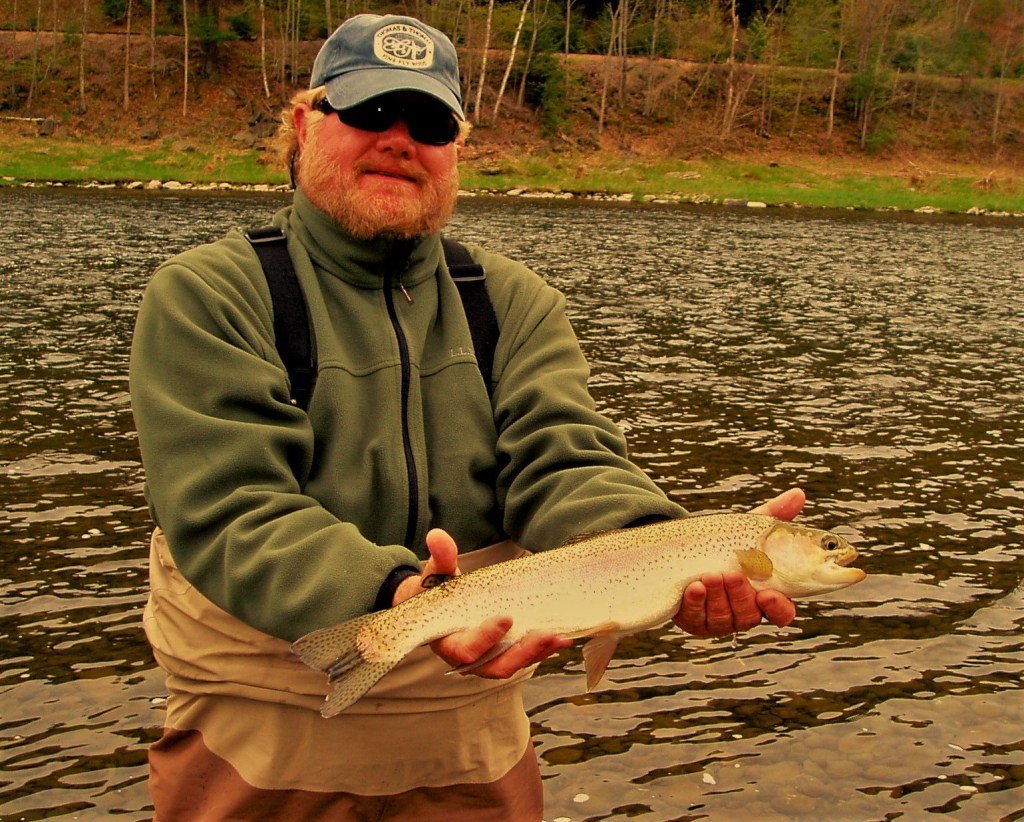
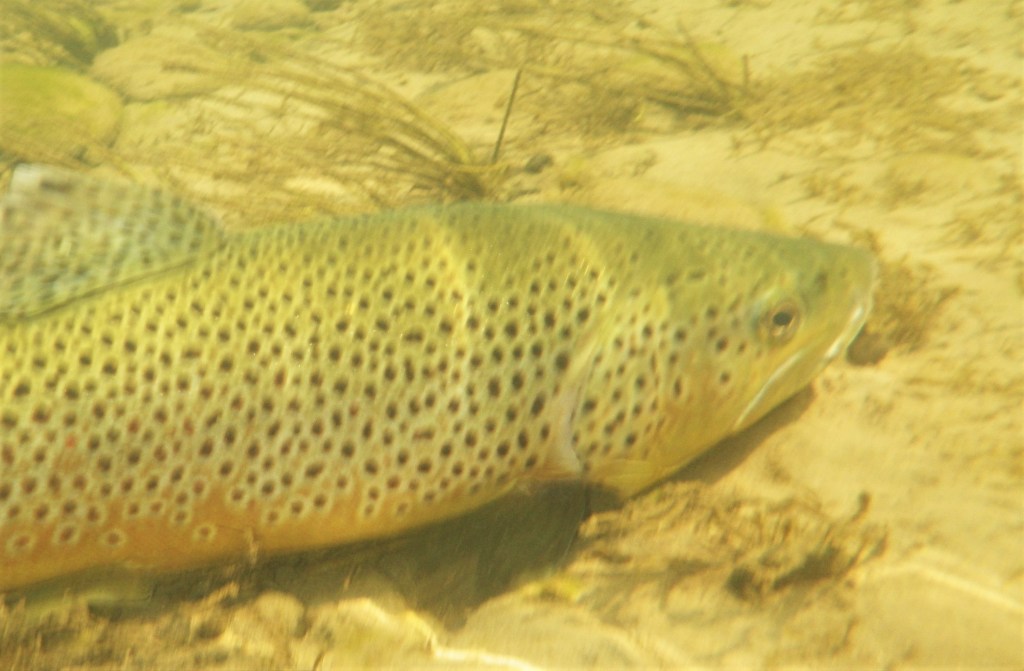
A Delaware brown: his taste for sulfurs brought an arch to my bamboo!

The sulfurs were my first hatch you see, decades ago on a bright afternoon on Gunpowder Falls. I was a novice then, proud owner of a single box for dry flies, and the pickings were slim. I knew enough to recognize the soft yellow flies as sulfurs, mayflies I had learned to expect in the dimness of evening; and I knew that, among my spare collection of flies at least, the Light Cahill was the matching fly. The trout disagreed, as they ravished the hatching duns greedily while ignoring both of my Cahills. They wanted that yellow. As a last resort, a 16 caddis, my sole yellow bodied fly brought success. Those wild Gunpowder browns taught me the lesson of color that afternoon, there where the little river’s clear water bubbled over bright gravel!

The evening emergences were my favorite times along the limestone springs of the Cumberland Valley. Often, we anglers would arrive after six and walk the banks with longing. It might be half past eight before the first fluttering duns would arise from the gentle currents. Half an hour of delight followed, made sweeter by its brevity and the sure, unwavering curtain of darkness.

On special evenings I might find an eager, early riser chasing the first few nymphs to struggle to the surface. An emerger was the crossover, the link between the trout’s world and the angler’s dry fly game. Oh, what joy to tempt one of those rare, early trout to peek into my world of air and light!

As I travelled early on to the wide waters of these Catskills, I found sulfurs on those first soft summer evenings. The wonder of that last light fishing was extended on the large rivers by taking advantage of every last wave of light in the sky, though it still had the old urgency. I shall never forget making long casts in twilight on the West Branch, tracking the bright orange dot of my my little parachute fly until the subtle wink of light that accompanied the bulge in the surface signaled a take! Darkness made the rod buck harder and the runs of those big-shouldered browns seemed like they would never end within the confines of the pool.

Time for the sulfurs to come, as the last of the light traces the fly amid the magic of the mist wraiths!

May becomes summer and the magic continues. It seems then to be forever until season’s end!

Hatches By Degrees

Hendricksons on the West Branch Delaware, May 1st, 2005

I took a short break from chipping the ice from the asphalt of my little two-car driveway to tie a few flies this afternoon. I have been gradually working into my winter tying, though I haven’t had one of those big rush days when I turned out a couple of dozen. There was a missing pattern for my planned assault on the Hendricksons next April, and I figured I might as well knock a few out while I was thinking of them.

The Hendrickson Grouse Hackle or, the fly I never hope to use.

As a dry fly angler, I always play the game to tempt a trout to rise and take my fly from the surface. Though I hate to admit it, there are some trout that will simply refuse to come up that last inch and eat anything sporting a wing, thus it makes sense to have a soft hackle nymph style of fly that can sit right down in the film or drift along in that first inch of water. I call my version the Hendrickson Grouse Hackle simply because well, that’s what it is.

Tied on a standard dry fly hook, the tails are woodduck, the dubbing my dark brown ephemerella blend, and the hackle is a soft, mottled feather from the wing of a Ruffed Grouse. I tie the thorax ball by spinning that dubbing in a thread loop, making it buggy and capable of holding a little bit of air within. It is the fly I hope I will never have to use, the one I would prefer remains in the fly box throughout the hatch.

In a perfect mayfly hatch scenario, the intrepid angler would fish the hatch by degrees. When the nymphs have risen close to the surface and are about to emerge, a fly like the Hendrickson Grouse Hackle provides an imitation of that pre-emergent nymph. The second degree is the actual emergence, when the nymph struggles through the film, splits it’s wingcase, and the dun begins crawling out of the nymphal shuck. At that point, the bug is neither wholly a nymph nor a dun, and an emerger is the fly of choice.

Mark’s Hendrickson CDC Emerger, a true transitional fly I developed more than 25 years ago. Tied as a nymph, with an emerging wing of looped CDC feathers, this imitates the point when dry fly fishing begins. With the body only wetted, the CDC loop wing is visible on the surface with the rest of the fly hanging below. The stray CDC fibers and soft hackle barbules give the fly a bit of movement.

I have heard a lot of fly fishers call a soft hackle nymph an emerger. I have no quarrel with that way of looking at things, theirs is simply a different point of view, but I think of an emerger as a transitional fly, with partially unfolded wings breaking the surface. Once the dun crawls out of that shuck, anglers usually fish a dry fly pattern. Those of us who have fished for a number of years have learned that Nature and bugs and trout don’t always follow that nice little progression, thus we tie and fish duns with trailing shucks, as well as classic dun imitations like Mr. Steenrod’s noble Hendrickson, even cripples to imitate a fly that just can’t quite get itself airborne.

That selection of flies might be considered for degrees 2.5, 2.75 and 3 I guess, if we stick with my mathematical model. You might also think of them as good swings for Nature’s curve balls.

A few years ago I decided that there was another median stage in the Hendrickson hatch, and I designed a simple fly to imitate the drowned duns I sometimes found good trout keying on. Hundreds of perfect mayflies drifting down current, and Mr. Picky wants nothing save the dead ones plastered in the film with their soggy wings akimbo.

My Drowned Hendrickson: woodduck, my standard Hendrickson dubbing blend, a few turns of a medium dun CDC feather capped with two turns of Hungarian Partridge.

Yes, I will be carrying half a dozen very different patterns for the Hendrickson hatch with this system, and that won’t include the Art Flick inspired pinkish Catskill ties or his Red Quill, nor Sparkle Duns, emergers and cripples to match those smaller ruddy males of the species. In the past couple of years I have encountered two more Hendricksons, whether separate species or variations I cannot say. Obviously, there is no room in my Hendrickson box for a DNA kit, but there is for a couple of patterns to match those new duns.

It would be interesting to learn whether these mayflies are variations upon the same species or different related ephemerella mayflies, but I don’t need to answer those questions to fish them effectively. Maybe I should tie some more of those Grouse Hackles in a size 16 too…

Icy Morning, Steaming Cup and a Tup’s

My twenty plus year old Honey Dun cape flanked by my own Tup’s blend and the blended silk dubbing I use frequently in my sulfur dries.

Well into my winter reading, I found another bit of inspiration that lured me to my tying desk this morning. Yesterday I began working through Mike Valla’s wonderful “Tying Catskill-Style Dry Flies” (HeadWater Books, 2009) and enjoying the result of his passion and research. His treatment of an iconic old English pattern, the Tup’s Indispensable, included his own blend of dubbing materials to recreate the alchemy of the old fly’s secret ingredients. Considering Valla’s rendition got me thinking about one of my blends and how that might be the perfect platform to craft my own Tup’s.

Fresh off my read of Theodore Gordon’s writings, I recalled his fashioning the fly when provided with a sample of the originator’s mixture, which had got me to remembering the pattern’s inclusion in various writings from the Cumberland Valley sages: Fox, Shenk and Marinaro. All recommended the Tup’s as an excellent fly for the sulfur hatch, the predominate mayfly in the Valley’s limestone springs.

I once puzzled as to where I might find the revealed secret material, the highly translucent wool from the testicles of the male sheep (a tup in the British countryman’s vernacular), long ago abandoning any search for the stuff. Valla’s research led him to a creamy pink color with a touch of dark orange, and armed with that color I determined just what to do.

My Flick inspired pink Hendrickson dubbing is a blend of cream and light reddish fur from the skin of a Red Fox, enhanced with a special pink Antron dubbing. The Pink Enhanced Hendricksons I tied for the past two seasons have proven to be very attractive to our Catskill trout, and I was sure a bit of that blend could be easily modified to craft my own Tup’s with the addition of a touch of dark orange Antron and some more of the cream-colored fox fur.

My tie of the Tup’s Indispensable has borrowed from Mike Valla’s research. He credited the originator, Mr. R.S. Austin, with sometimes tying the fly with a tag of yellow silk. I also followed the teaching of my Cumberland Valley mentor, the late Ed Shenk, by wrapping the hackle over a dubbed thorax. Ed tied his Shenk Sulfur Dun wingless in this manor, and it is the first sulfur pattern I learned to tie more than thirty years ago.

My variation of the classic Tup’s Indispensable: tails of long, splayed Honey Dun hackle barbs, four turns of blended yellow silk dubbing as a tag effect, then the abdomen and thorax dubbed loosely with the Tup’s blend I have described. The Honey Dun hackle is slightly oversized as wrapped over the dubbed thorax of the fly. Here, the fly is tied on a size 12 Sprite dry fly hook for photographic clarity, though for fishing I tied the pattern in sizes 14 and 16.

I can picture the soft colors of May and feel the tingle of anticipation as I knot my little size 16 Tup’s to a 5X tippet. The lovely yellow mays are drifting quietly on the surface and, at intervals, a soft broad ring forms on the glassy surface where a trout has gently taken one of them. My old cane rod flexes smoothly, and my Tup’s is the next in that same line of drift…

The Catskill Adams

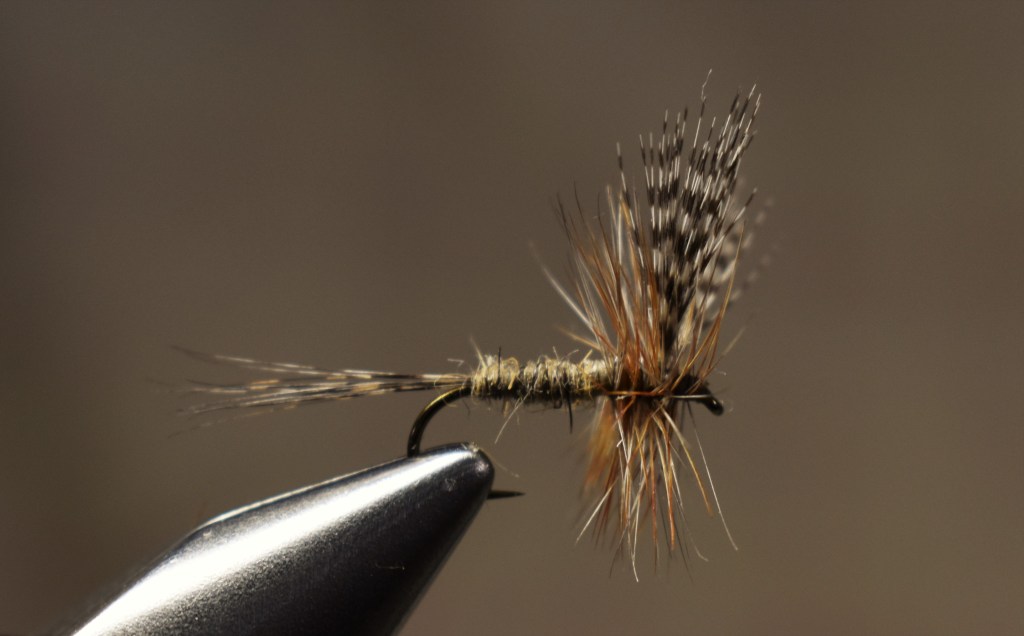
The Catskill Adams: Buggy and with a little contrast for visibility.

There are times when it makes sense to fish a general-purpose dry fly, something that looks enough like several different mayflies that could be on the water but aren’t. A long time ago that guy in Michigan developed a “caddis” that was renamed The Adams and became a legendary general-purpose fly. There is no denying that the Adams is a great fly, and some fish the pattern almost to the exclusion of others, but it has never been a favorite of mine.

I have never been a fan of hackle tip wings. They look nice sitting there in the vise, but they are not particularly durable once you start squeezing on some floatant and fishing them. Opinions vary as to what type of hackle tips to use. I have an old non-genetic hen neck that has pretty good color and the nice, rounded feather tips most Adams tyers prefer. The downside of hen is that the stems are soft and thin, so the wings tend to get pushed and bent out of position when fished. Dry fly hackle tends to have sharper contrast in the barring and may have stiffer stems, but the current genetic dry fly hackles have sharp pointed tips.

My other complaint with the Adams is the plain gray body. I like some mottling and roughness in the body of a general-purpose fly, that quality fly tyers refer to as “bugginess”, and the gray muskrat fur doesn’t deliver. I am a fan of barred hackle, though grizzly isn’t my first choice when I reach into my hackle box for a cape. So, as I said, the Adams isn’t a favorite.

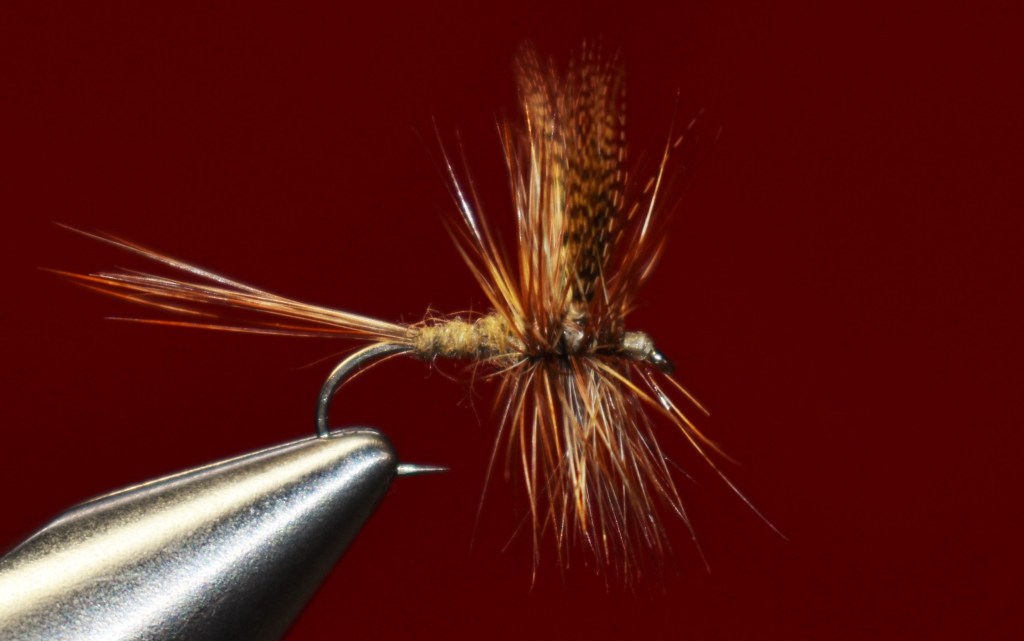
I was thinking about all of this and my own general-purpose fly, the pattern I call the Fox Squirrel. It’s buggy, close enough to most of our early season mayflies, and has the classic Catskill look to it. I tie it with natural Fox Squirrel fur dubbing and Cree hackle, winged with wood duck. As with a lot of wood duck winged flies, there are times when visibility isn’t perfect. On dark, cloudy days when fishing at a distance against a dark background, the fly can be a little hard to see. The black and white barred wings of the Adams show up better in such difficult conditions, and that gave me the idea for my Catskill Adams.

The Fox Squirrel.

Wanting to avoid those hackle tip wings and preserve a Catskill style, I decided to wing the new pattern with teal flank to get the contrast of the black and white barred wing of the Adams. The body remains natural Fox Squirrel, a beautifully buggy tannish, grayish fur that helps the fly look alive in the water. Squirrel fur has short, barred guard hairs that produce a spiky, rough dubbed body that traps air bubbles. I wanted nice, stiff traditional tailing with speckling, so I chose the Grizzly Variant Coq-De-Leon hackle barbs that have become a favorite of mine.

I wanted the hackle to pop, to reinforce the impression of life and movement and, at the same time, I wanted my fly to be a little lighter in tone. My solution was to choose two barred hackles: a barred ginger and a dark, rusty toned dun barred with pale gray. I like the way the fly turned out. The only drawback I can see with my Catskill Adams is the three and a half months of winter remaining before I can expect to be able to fish it!