I fished the limestone springs of Pennsylvania's Cumberland Valley for a couple of decades, founded Falling Spring Outfitters, guided, tied and oh yes, fell in love with the Catskill Rivers I can now call home.
Now there’s a sign I never want to see! They always seem to appear next to a truly inviting stretch of water. There are fish rising beyond some of them, obvious spots with great cover and some depth, the ones where the prevailing current carries everything right down and concentrates it where that cover meets that deeper water, screaming big fish here! Those signs have been up for most of the last week, not man’s, but Mother Nature’s.
We needed rain and some relief from the heat, and we got it. Trouble is we keep getting it; not the gentle showers that soak in and really do the rivers some good, top to bottom in the watershed, but the heavy downpours that muddy the rivers and add to the silt load our riverbeds can do without.
Last night was a doozy, a serious storm packing a tornado warning, coming right down the pipe with Hancock in it’s sights. The cell phones went off with ten minutes to spare, and the TV was immediately switched from the Home Run Derby to the Weather Channel: Severe thunderstorm south of Deposit and moving East at 20 mph likely to spawn tornadoes. Rotation observed on radar, seek shelter immediately! The weather map showed the updated storm track, reaching from Balls Eddy to Stockport, and there were some very tense moments ahead, particularly when the Fire Department’s siren went off as the storm hit us full force. Thankfully, that rotation observed on radar never materialized into a funnel cloud on the ground. A lot more to worry about than some lost fishing time there.
This morning has been about giving thanks and wondering if I’ll find some fishing sometime this week. This whacky season has already pushed me into some crazy days at the bench.
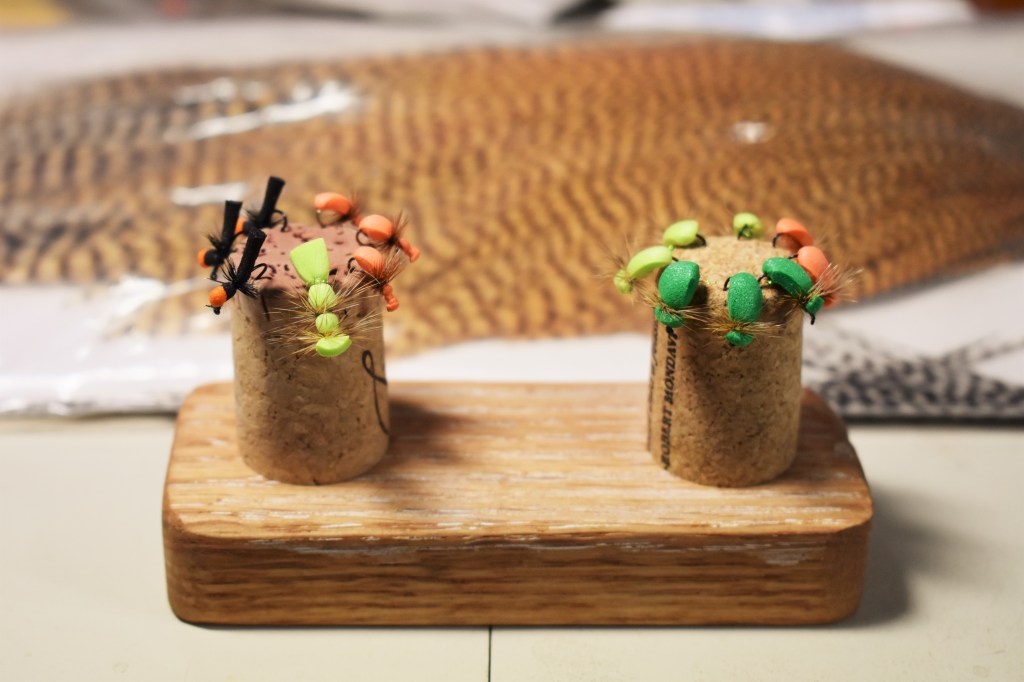
Beetlemania: I pulled out a bunch of wild colors and tied something different, beetles in green, orange and insect green, along with a thing loosely inspired by a caterpillar. With mayflies and caddis seemingly absent, gotta find something to wake ’em up!
Wild colors do appear in Nature. Back in the Cumberland Valley, where terrestrials powered the bulk of our dry fly fishing in the limestone meadows, I used to tie a very bright orange ant pattern. I blended up a special dubbing and tied the fly in a size 18 with a white CDC wing. It was reserved for particularly difficult fish, and it often proved the charm for catching them. Catskill trout are not keyed in upon terrestrials the way our spring creek trout were in those meadows – I still haven’t found any hopper fishing – but with a paucity of traditional aquatic fare, I hope they come around. Maybe an orange foam beetle will look tasty to a big Catskill brown, or perhaps that caterpillar thing will spark some interest.
Actually, a post storm day should be a good time to tie on a Letort Cricket and pound the river banks, as the rush of runoff water can put a lot of food in the drift. Once the rivers clear a bit, I am going to try to get the boat in the water, and there will be crickets in my fly box! I think I’ll get tying…
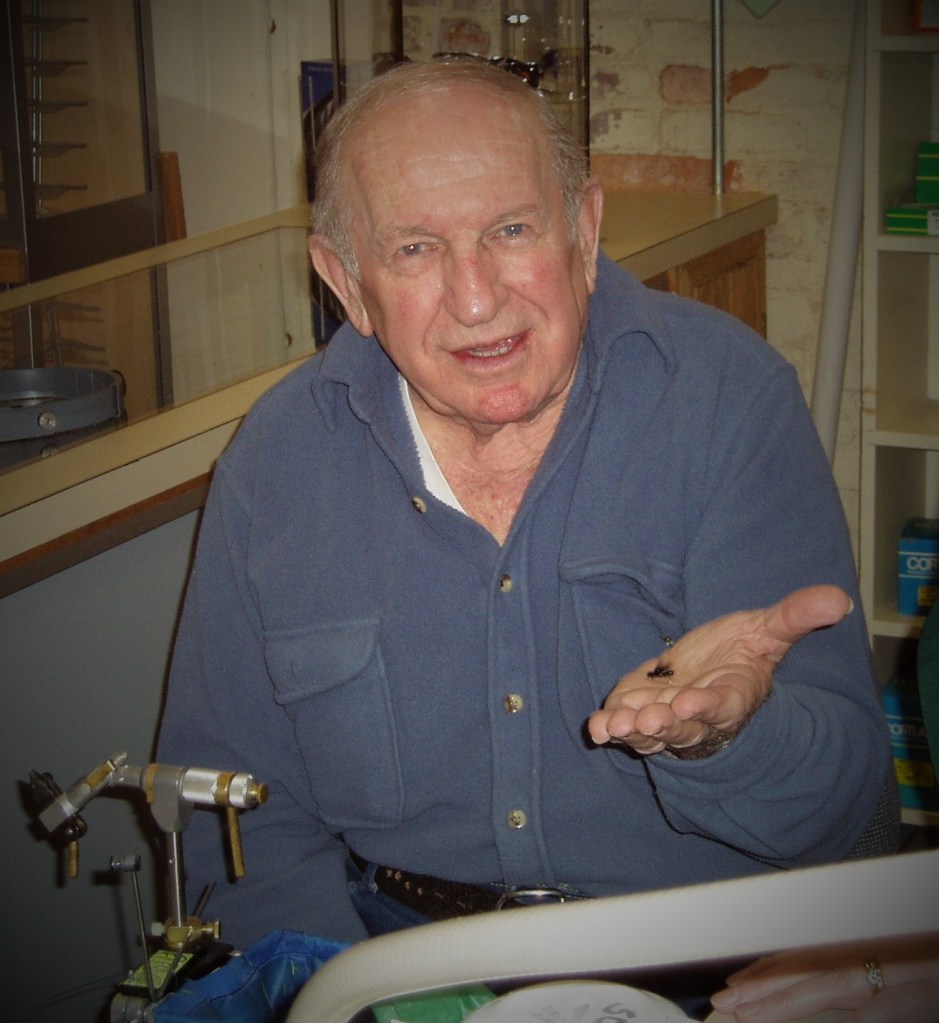
The late Ed Shenk with a fresh from the vise sample of one of his signature flies, the Letort Cricket.
I was out trout hunting again yesterday afternoon and, despite having the eagle greet me upon my arrival, the hunting did not seem destined to produce any big Catskill trout. I was seriously fishing terrestrials, though they brought no response, not even when cast to a bankside rise. As I approached some faster water, I noticed a couple of small rises, so I tied on a little sulfur cripple and made a few casts. When I decided to move upstream, I let my line drag behind me. By ignoring my fly I caught a trout.
The little brown brought a smile to my face and changed my focus, helping me to rediscover the simple joy of trout fishing!
That tiny cripple wasn’t floating too well in the riffled water, so I tried a pair of sulfur comparaduns, first an 18 and then a 20. I remembered this riffle from last autumn, and felt there ought to be some good fish around. I decided to tie on the lone size 12 Halo Isonychia in my box and fish that riffle in earnest. It was the right decision at the right time.
There were a lot of trout in that riffle, and a number of them were willing to come up and take a swipe at my Iso. Another brownie was the first taker. All of ten inches, he fought the soft tip of the old Granger bamboo with all the heart of a trout twice his size. I let him have his head a bit before bringing him to hand. The smile was growing.
It was a warm, beautiful afternoon on a gorgeous reach of Catskill river, and I was alone. The Granger kept flicking the water from that dry fly, and then placing it in another lie, anywhere I could see a deeper slot or a larger rock on the bottom. The trout responded.
As I worked my way upstream into faster sections of the riff, wild Delaware rainbows replaced the browns. Their characteristic quick little spurt rises were hard to react to, as I was stripping as fast as I could just to retrieve the line while my fly bobbed rapidly down the current. I missed a number of them: whack, there and gone in an instant, until I adjusted to the pace of the river.
Between misses, I caught a few chunky bows, every one fighting like the legendary senior members of their tribe. None of these wild trout quite reached a foot in length, but they had the wide profile of healthy, well fed fish. They sure could pull as they cavorted against the arching tip of my old cane rod!
I smiled and laughed at those caught as I twisted the hook free, and laughed even harder at those quick strikes that left me no time at all to react. I finished my afternoon right there in that riffle, grinning. I could hunt leviathan another day.
Sometimes we get very, very serious about trout fishing. If we hook small fish when we feel we should be catching trout of a certain size, we can feel like we are missing something. I hate to hear the scorn in some angler’s voices when they frown and say “nuthin’ but dinks” to a query of “catchin’ any?” The youngsters are as wild and beautiful as the elder members of the clan, and their heart is undeniable. We should all appreciate them more then we do. Trout don’t pop out of the gravel at eighteen inches long, they all start out little, and we owe our trophy trout fishery to the stamina and tenacity all of those small fry swimming in the rivers and streams.
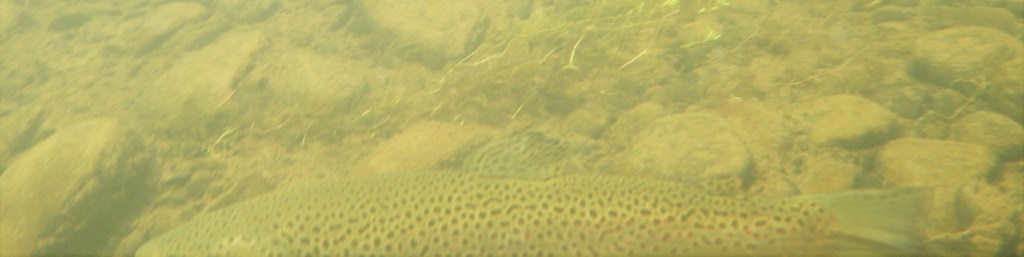
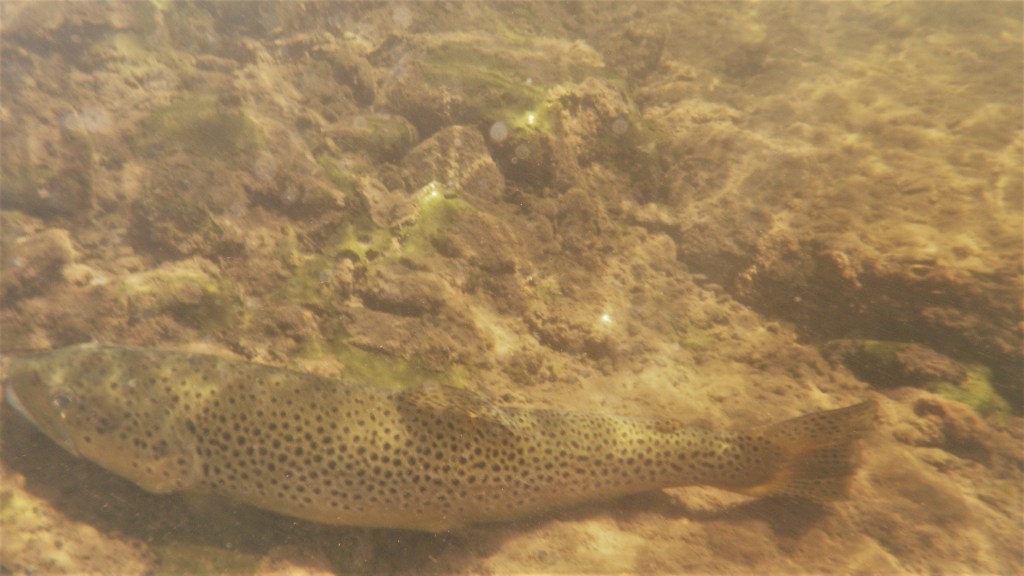
The challenge of blind underwater photography: submerge cameraand find yourself unable to see the view screen; point & guess, withdraw camera from icy cold water into warm, humid summer air and view screen fogs, thus the photo capture cannot be observed. Resign self to hoping image is captured correctly. Find in editing that what was captured was less than that which was desired. Punt and call it artistic!A 19″ Delaware browntrout ponders the wisdom of selecting that tiny rusty spinner from those available for a morning snack.
It has been a strange year. To be honest, that comment comes to the tongue every year, testament to the incredible variety of Nature and the wonder and puzzlement of angling Catskill rivers.
Though the first hatches of spring were wonderful, with incredible variety and at times prodigious volume, insect production has seemed rather spare since then. Even back in May, I noted an unusual number of uncharacteristicly small flies on the water. I was caught short on my first solo float of the season when confronted with thousands of Shad Fly caddis in a diminutive size 20. Only field surgery saved the day!
Summer is traditionally small fly season on our rivers, featuring the littlest mayflies: sulfurs from size 18 down to 22, various olives in sizes 20 to 26, Summer Blue Quills in sizes 18 and 20 and eventually the tiny size 24 tricorythodes. I am thinking that downsizing terrestrials may be my best move as well.
My concentration this morning was to add some smaller Grizzly Beetles to my terrestrial box. While I fished tiny little beetles when necessary in the Cumberland Valley spring creeks, I have used larger, meatier versions quite often. Ed Shenk called the miniscule black beetles Willow Beetles as they habitually were found in the willow trees lining the streams. A size 20 tended to be a bit large for imitations on most days. I was amazed at the little spun deer hair flies the Master tied for these, clipped just so to provide the rounded profile of the natural. Closed cell foam became hugely popular for tying similar flies, but I never seemed to have the same results the Master did with his deer hair creations. Then again, I was the student and he the Master.
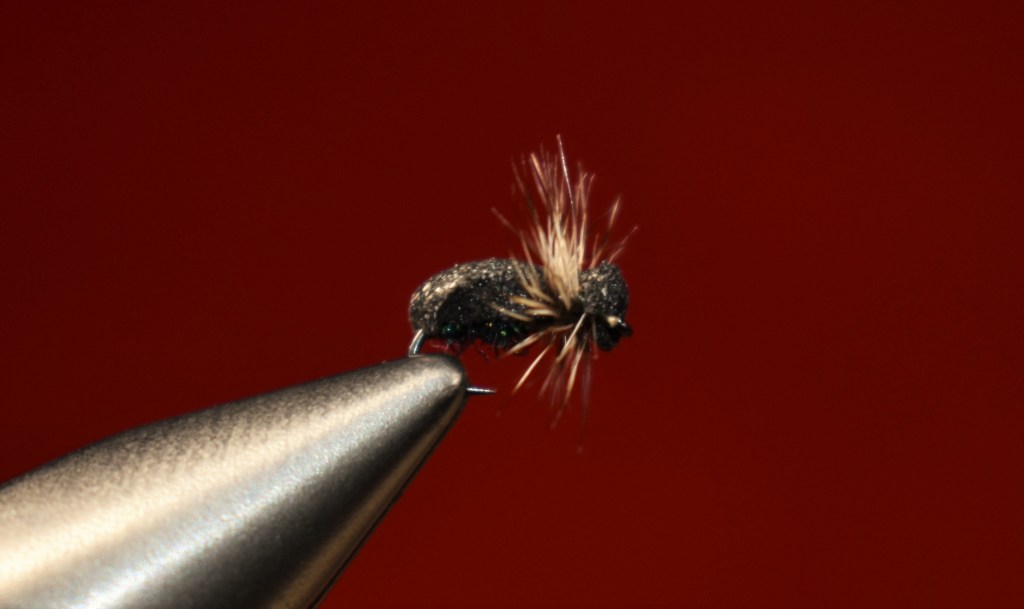
Smalls: Grizz 19: a size 19 Grizzly Beetle that I hope might tempt a few more reticent summer trout than the standby size 17 and 15 flies. The TiemcoTMC102Y is a special dry fly hook, offered in the odd numbered sizes in the English tradition. It is my favorite hook for many terrestrial patterns.The combination of the Sproat bend and wide gape in a fine wire, black finished hook offers improved hooking capabilities for these types of dry flies. They are strong hooks, despite the fine wire, and hold well on larger than average trout!
In truth, I have not spun any deer hair in decades, not since I dawdled at bass fishing with the fly rod. I may need to revisit the technique in deference to the looked for Shenk Tribute Rod, expected this summer. It would be only proper to set out with a small fly box of The Master’s patterns when I first introduce that rod to the rivers of my heart.
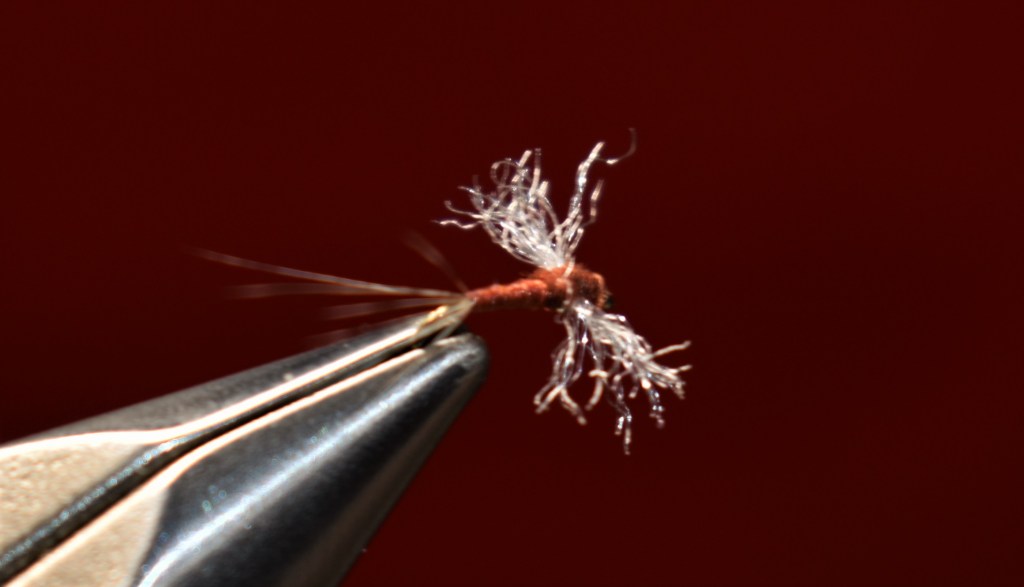
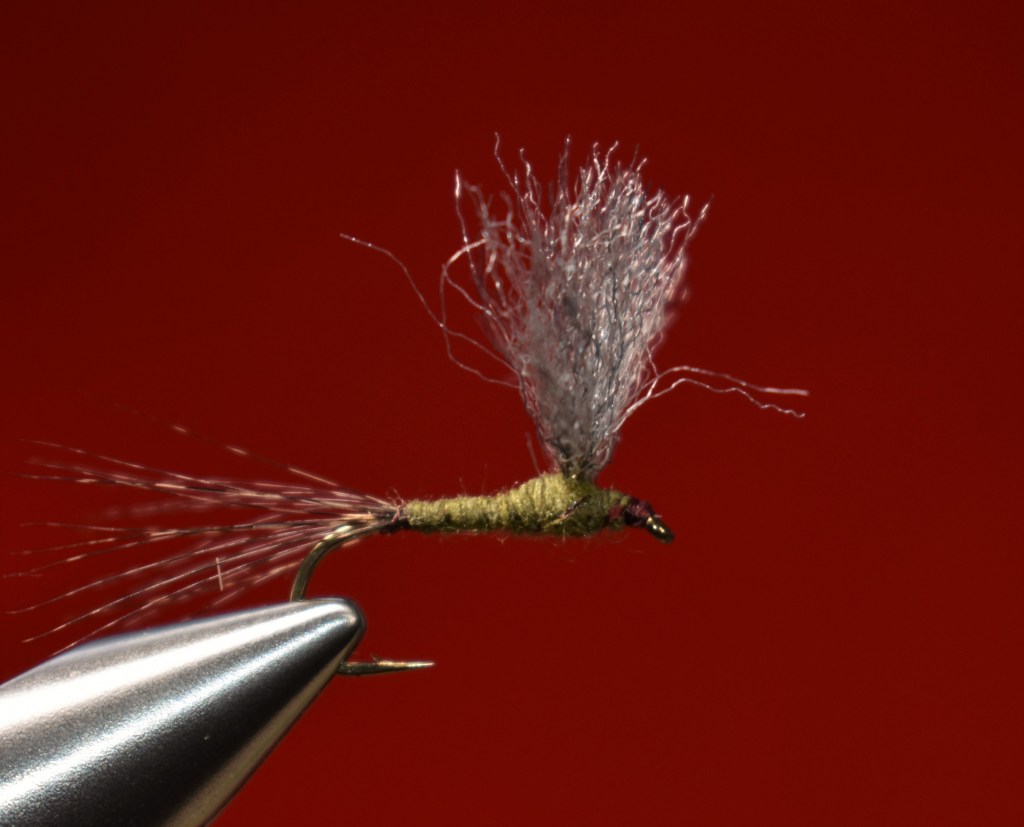
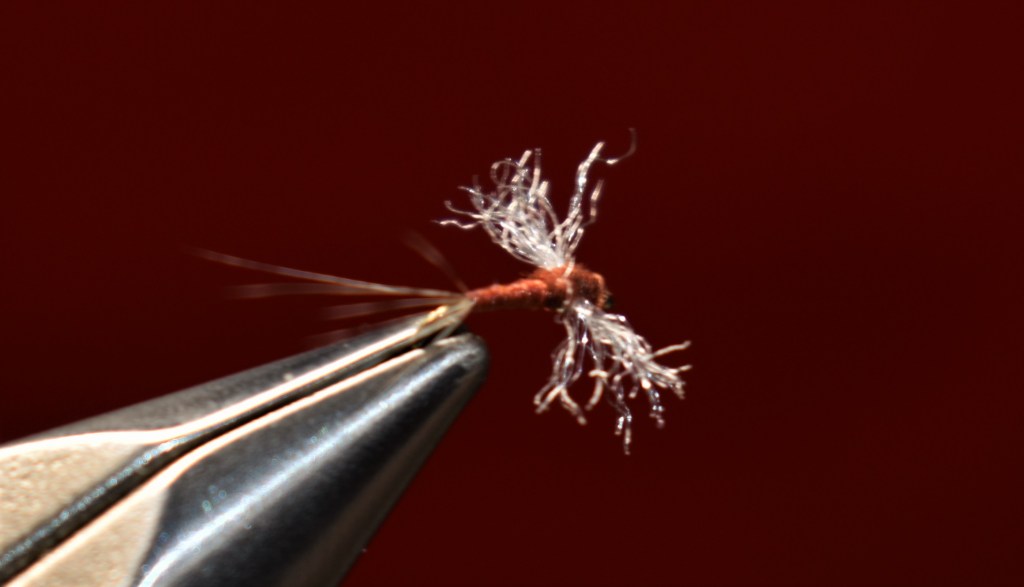
Tiny size 20 Rusty Spinners seem to have been the preferred early morning fare in these early weeks of summer. No more than a tying thread body, or a few wrapped strands of rust colored Trigger Point Fibers are required. I don’t go in for split tails on smaller spinners, preferring splayed hackle fibers for a little more support in the film. Clear Antron yarn, or a few Spinner Wing Trigger Point Fibers work nicely for the wings. Fishing flies should be realistic, effective, and quick and easy to tie! The fine brownie in the opening Fly Over photoselected one of these from Nature’s offerings.
I fished along throughout June more or less expecting a late hatch of some of the spring flies I missed during May. When we finally got a real cold snap, plunging the rivers from the seventies back into the fifties over night, there was a day or two when some of those larger flies emerged. I saw Gray Fox, large sulfurs, as well a good numbers of “normal” sulfurs in sizes 16 and 18, the flies May forgot. I wish the cold snap had lasted – I never packed the sweatshirts and fleece away into storage. Oh it would have been heaven to enjoy a solid week of that fishing!
Now that July has come, summer seems destined to stay, so the Smalls will take care of the dry fly fishing for the duration. A light cane rod, a three or four weight line on a small classic reel, long leaders and 6X and 7X tippets will be the standard outfit for the next few months!
A few hours of forty-seven degree water immersion easily makes 70 something degrees feel COLD on a rainy, breezy front day.
I let the heat drive me to the coldest water I could find the other day, and I found a little fishing. The stifling weather seemed to keep most of the fishermen at home, work, or some other air conditioned place, and I was happy for it.
I used to fish the West Branch every summer, making a long trip around the Fourth of July. The trout were always difficult, and that difficulty has increased with the massive increases in fishing pressure the river has seen. It has become pretty normal to find our Catskill trout keying upon moving naturals on all of our rivers. Once upon a time a simple thread bodied CDC dun was medicine on these picky feeders, but the trout have fine tuned their targeting abilities during the past decade.
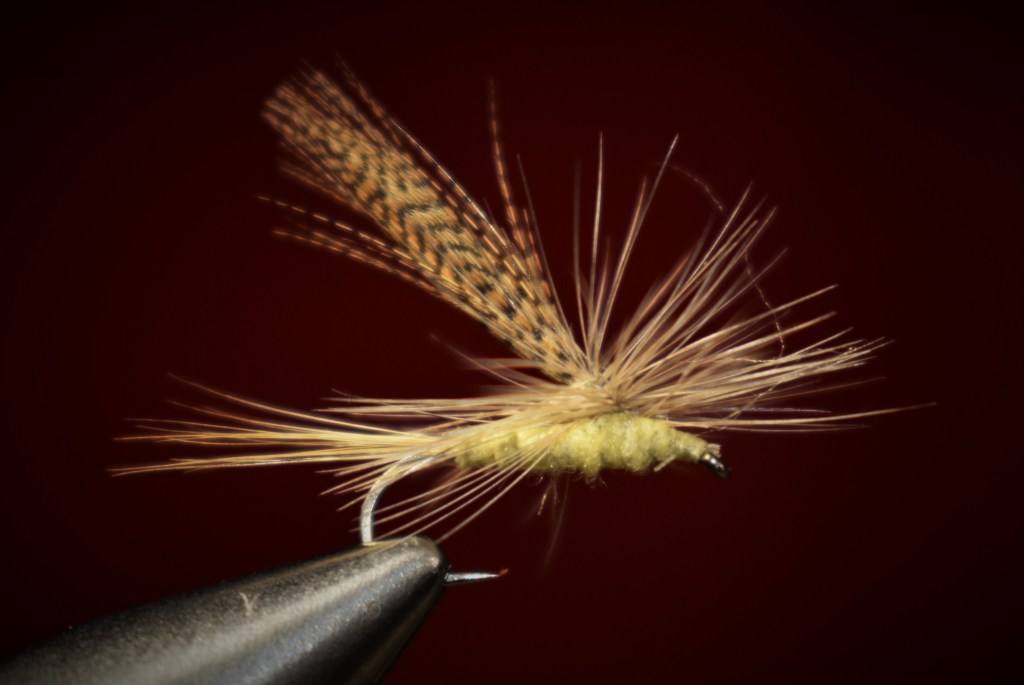
I managed three trout, a hard fighting brownie between nineteen and twenty inches, and a couple sixteen inch fish that were equally determined to give their all on the bottom of the river. I had to estimate the larger fish, as the fly popped out with his just his back half in the net. That guy ate a delicate size 18 silk bodied CDC dun, a fly with a sparse wing that requires constant attention to keep it floating. I like to tie the wings heavy and tall to maximize visibility and movement, but some trout have begun to shy away from them, requiring a more subtle fly.
A silk bodied CDC dun with a fairly high, medium density wing, a fly that is good for a lot of selective, movement oriented trout. A few seem suspicious though, preferring a version tied just a touch slimmer in the body, with the wing a bit sparser and roughly three quarters height. Canting that wing back a skooch doesn’t hurt either.
Tactics often dictate fishing long, and downstream and across to picky trout, and the constant retrieving of sparsely winged CDC flies wets them thoroughly. These fish often require multiple casts if they are feeding upon a good hatch of naturals, and that means a lot of time spent drying and fluffing the fly. Still, if a good trout demands subtle, you either give it to them or pass them by.
I learned thirty years ago that a fly will be more attractive to a trout if it appears alive and moving. The late great Gary LaFontaine impressed upon me that the light reflecting qualities of my flies imitated movement, so I try to incorporate those abilities in most of my patterns. I am not talking about Flashabou ribs here, more like a touch of Antron blended into the dubbing, or used as a sparse trailing shuck. Perhaps I am losing it, but trailing shucks have become so commonplace that some trout seem to have gone off of them.
If a shuck isn’t the answer, then maybe a little sparkle in the wing is. I was talking with JA a couple of years ago about flies and materials when the topic came around to Enrico Puglisi’s Trigger Point Fibers. I was using them for bodies, spinner wings and posted wings and having good results, and JA mentioned that a friend tied comparaduns with the stuff. “Gotta try that”, I said and I did. The material lends itself to comparadun wings and is much easier and faster to tie with than deer hair. The wings are a lot more durable too. Trigger Point fibers have a subtle sparkle that I believe imitates moving wings effectively, but it not as flashy as Antron. Selective trout seem to like them.
My Trigger Point winged Halo Isonychia has proven deadly!
So, in a nutshell, I guess I am saying that picky trout get pickier as we get trickier. That is the reason I am continuously experimenting with fly patterns, materials and tying techniques. None of us have any hope of staying ahead of all of the trout in the river, but I hope I can always experiment a bit and stay ahead of some of them!
The heat wave remains in full swing, and our afternoons and evenings are certainly less than pleasant. It was 90 degrees in our bedroom at midnight last night. The mornings are my release, cooler air and cool water draws me to the hunt.
There are promises of relief, tales of glorious rainfall and temperatures in the seventies, but the rainfall percentages seem to be dropping day by day. Oh how I would love a gentle, cool rain to last all day and all night!
Hunting has been lean as always, for the season of plenty has passed into this angler’s history. Fly life is sparse to say the least. Some days, the opportunities simply don’t materialize.
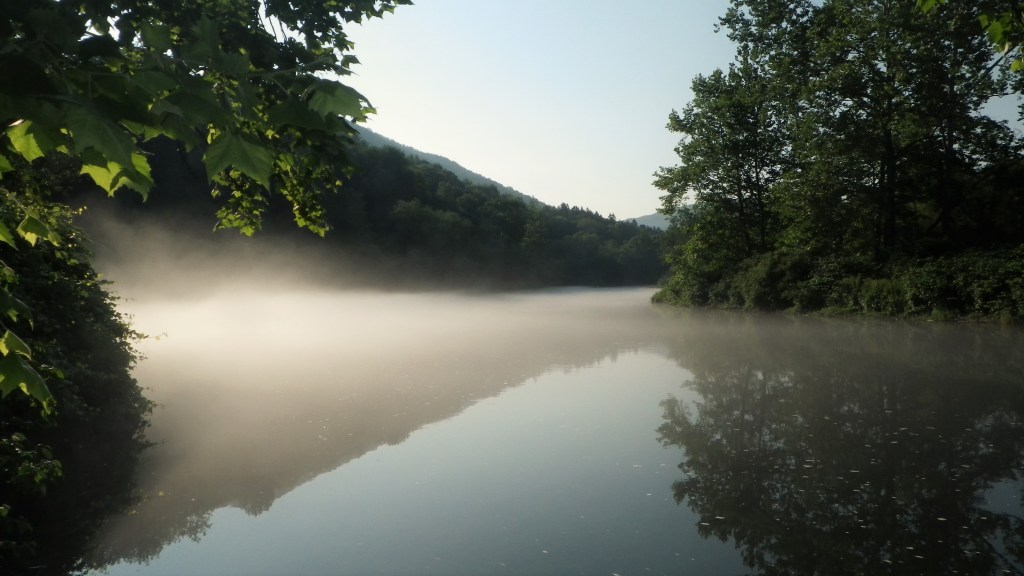
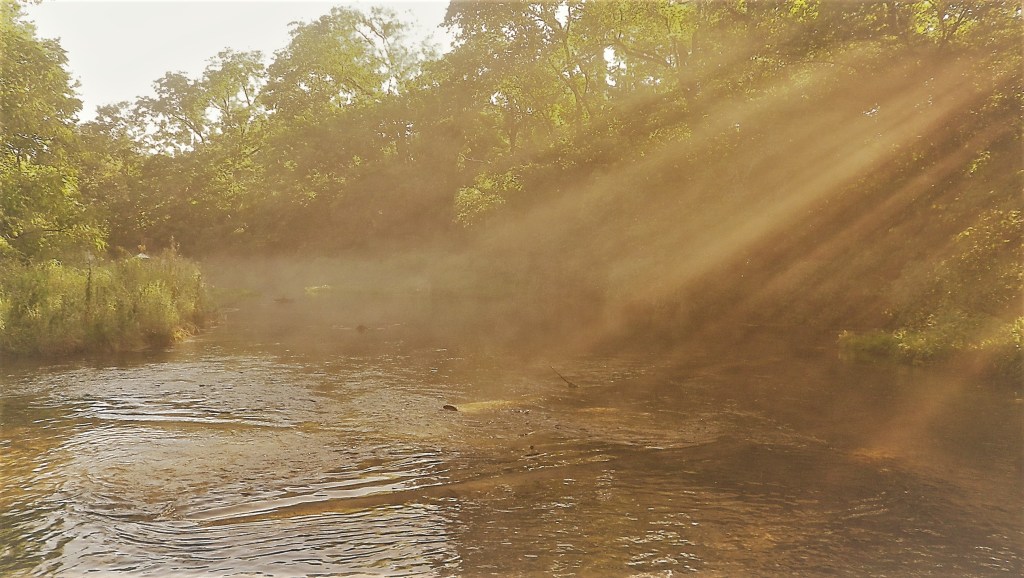
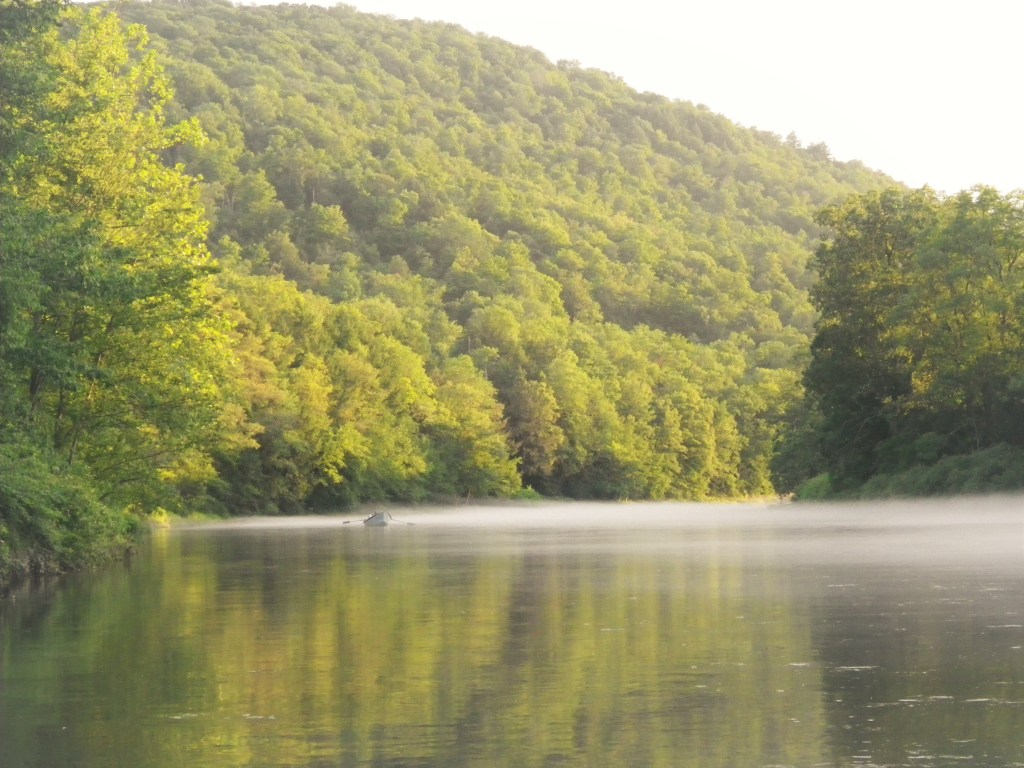
Morning light filters through the trees and ignites the mist.
On Monday I fooled the first trout I encountered, a spirited fellow who set to spinning my reel immediately. A nice brown, not a big one, but he put a smile on my face; as if the cool, quiet beauty of the morning wasn’t enough. There were no other opportunities, though I stalked a few with hopeful eyes; cruising fish sampling the few tiny tidbits the surface held. I noticed more than one rusty spinner, not enough to constitute a fall, but I made a note to tie some and stock the box in my summer chest pack. The heat has led me to release the vest from it’s daily duty.
On Tuesday I somehow felt cooler, my body perhaps adjusting to the summer swelter. I stalked with an old friend, the 8040 Granger and yes, one of those freshly tied size 20 rusty spinners. We managed to creep up on the first trout of the morning without sending him to the other side of the river, a challenge in itself. It’s a waiting game, this fishing. The waiting begins when a rise is spotted, typically a distant rise, as the long, painfully slow approach unfolds. Often the trout disappears, off to sample other quarters, while I remain stalking the location of his initial rise. Once a casting position has been reached, waiting turns on the vagaries of the drift. It all worked out for this first opportunity, as I stood with line ready and the tiny fly in my hand. The subtle rise and the smile came simultaneously.
The first cast drew no interest, and experience has forced me to accept the fact that presentations must be limited to a single cast following each rise. Some of these trout are relentlessly cruising, and even the homebodies are casting about for any morsel in their area. These are not the classic rising trout on feeding lies. At last he rose again, two feet to the left of his previous excursion, and I squeezed the cork lightly to drop that spinner as delicately as I could. The rises are unique, little swirls in the film, sometimes followed by a dorsal fin, rather than the classic expanding ring. I freeze momentarily, watching that little swirl and waiting, the last of it in this case, and then a steady lift until the trout erupts at the sting.
This fellow objected strenuously to my intrusion, hurtling skyward with energy that belied the delicacy of his feeding. The Hardy wailed briefly, and he was out again, spraying droplets everywhere like sparks in the morning light. Another brief run, a third jump, then a long searing run as the Bougle` played it’s chorus. It took some time to land this one, and I enjoyed every minute. At nineteen inches, this acrobatic brownie was on the cusp between nice and big, as if mere dimensions could accent or diminish his beauty and his wildness.
Catching one ruined my composure somewhat, and multiple casts spoiled what might have been when the second sipping cruiser was approached. Did I mention that the rules of this fishing demand one cast per rise? That cast has to be on him quickly too! The assumption being that the trout is moving, taking, then moving along. A late cast, a second or third may put him down with a leader dropped too close, or other sins.
An hour further on, one more stayed in the same locale long enough for me to approach and prepare a cast. I had seen two or three half drowned sulfurs by then, little ones, and had changed to a 20 cripple pattern. While watching, my trout began to move left, sipping a sulfur or two along his path. He stopped in midriver, hovering near a group of boulders, and rose confidently. My cast was on target, but he did not come, then rose again after I retrieved the line. Despite a perfect drift, I thought he disdained that presentation as well, and glanced upstream at another swirl. Breaking concentration like that is a cardinal sin, as his take came as soon as I looked away. Sometimes providence smiles, and my rod hand came up before I even switched my gaze. Got him!
Hooked in deeper water, this twin did not take to the air, running instead for the far side of the river, while the check of the Bougle` shattered the morning stillness once again. Another hard fight, ending in the meshes of my net. The sun was high now, yet the breeze and cool water kept me very comfortable. I fooled one more after stalking a couple of unapproachables in the sheerest water. He was straight downstream of my rod hand, close enough and shallow enough that movement was out of the question. He ignored my spinner initially, as well as a tiny sulfur and an even smaller ant. The rises said spinner, so I lengthened my 6X tippet and knotted the same little rusty to my freshened leader. This time he accepted it on a perfect drift, and I paused at the take to account for the smallness of the fly and downstream drift, but the hook caught hold for only a second before releasing him. A good fish, but one who sidestepped his opportunity to dance with the Granger.
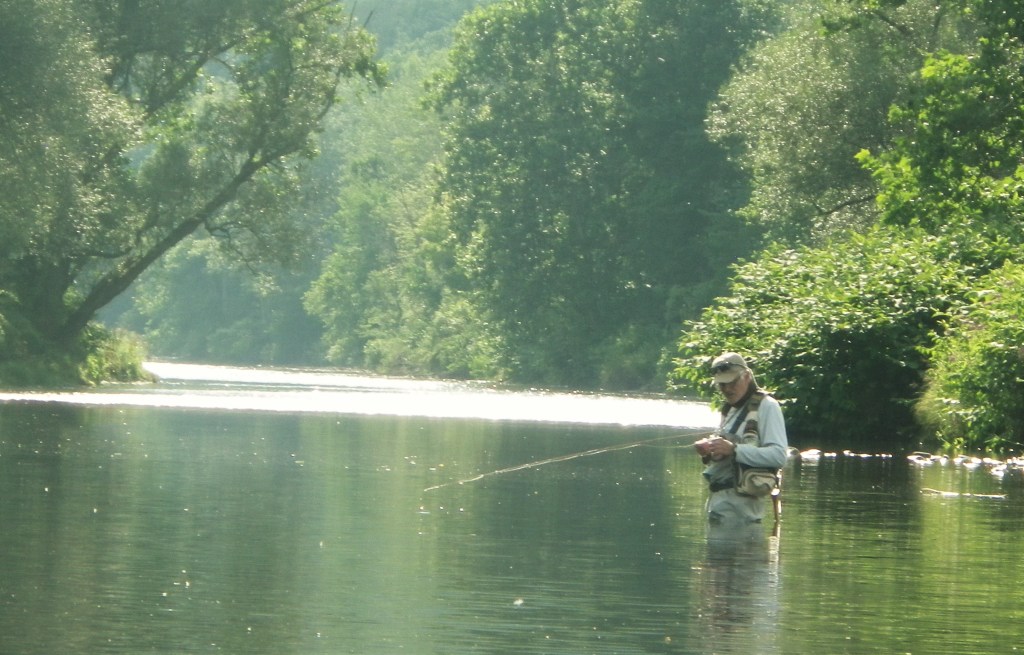
JA working the pattern puzzle on a hot summer afternoon. You can see the heat in the air!
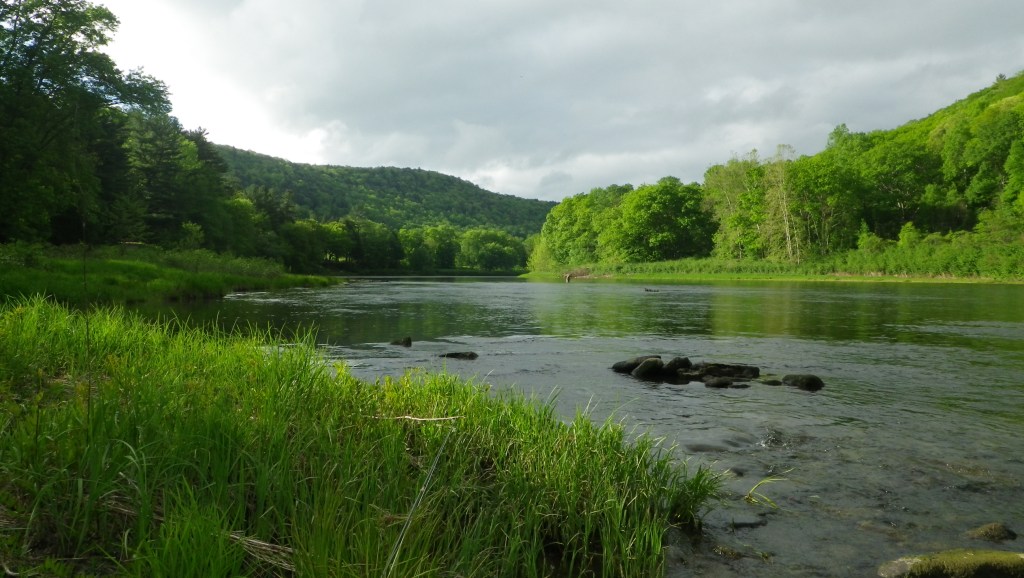
Summer, and the river grass is more than head high as I walk an old, favorite path along it’s banks. I can trace my steps back twenty years and more…
A last cool morning, though warmer than the previous two, and the insect availability has returned to summer conditions. The river is still cold this morning, though the few degrees of warming since midweek has changed things once again. Tiny flies… and technical dry fly fishing are the order of the day.
As often happens, the flies the trout are sipping are only in their line of drift, there is nothing in mine, so I squint and guess, running through the flies of the season; five minute hatches. In the time it takes to figure out just what is being taken, the bugs change again: wonderment, puzzlement, then elation as each little discovery is made. What’s that, something shining, moving…there a spinner, red, no olive, a cornuta spinner!It’s smaller though, an 18 perhaps, not the 16’s the duns have been, not the spinners I tied. Try anyway… no, no, not having any. Surgery: clip the wing tips and tails, reduce the profile and maybe… no, not having it.
By the time that little sequence concluded I spotted something lighter in the drift out there, tiny sulfurs perhaps? Tiny olives then. I try those flies again, but once again they are not the answer. Suddenly there are more fish rising, all the most delicate little sipping rises! Perhaps a cripple will do, a very small cripple… Have a taste for that? No, huh, forever no. What about you, you seem to be fairly regular my friend? Drift, drift, drift, twitch and PULL! Yea, that’s what I needed, he’s a good one! The brown takes line, and slowly I reclaim a little before he takes some more. Can’t be heavy handed with 6X and little hooks. Oh, he doesn’t want to come visit my net, not in the least. Oh my, there you are! Lets see now, settle in the mesh… twenty one, very nice, a big heavy boy. There you go, stay a moment and recover.
The game persists into mid afternoon. Solving one fish does not reveal the answer for another. The wind finally arrives, and a fly change to a different crippled emerger, half and half style. A gust catches the cast when the fly is half way to it’s target, and blows the fly too far upstream straightening out all 16 feet of leader and tippet. I knew it would drag before it drifted down to him. All I could hope for is a bit of luck, that he ignores it and I can wait for a second shot. Luck gives me a refusal to the dragging fly; that fish is done.
The rises are quiet now, little to see on the surface. Wait, here’s a little flurry just over there. Sulfurs again? The puzzle remains unsolved and then, as I am contemplating my withdrawal, I see a lone sentinel, a single larger sulfur drifting slowly. Taking my cue I tie the 100-Year Dun to the fragile 6X, not the best choice for a size 14 dry fly, hoping for one more shot.
Watching another sentinel, I look away and hear a little plop. Looking back, the big fly is gone, and a bubble trail is dissipating. I work the fish, waiting when the breeze picks up; no more dragging, and no more refusals. On the right drift, he takes it like he waited for my fly alone. He bucks and boils, not wanting to leave the cover, and I can do little but hold the line gently in my fingers with the light rod tip high. We absorb that frenzy, and the first run. Each time I raise the tip high as he heads for rock, keeping his head, and the tippet away from sharp stone. He runs, darts, turns and I reel. Give and take with Old Blue’s soft action. Summer is time for four weights.
At last, there he lies in the mesh. Twenty and a bit; half an inch? A perfect way to end a beautiful day on the rivers of my heart! The sun has been bright, and the water is warming. Time to let them rest. I’ve a dinner date tonight, and there’s music on the Square.
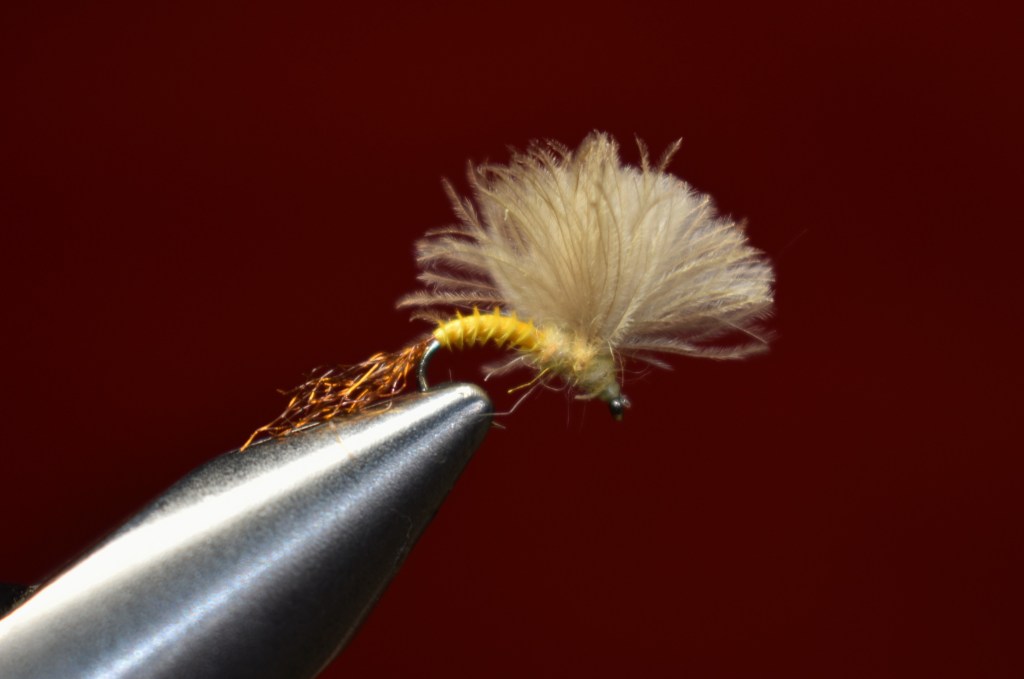
A crippled sulfur emerger: light, color and movement.
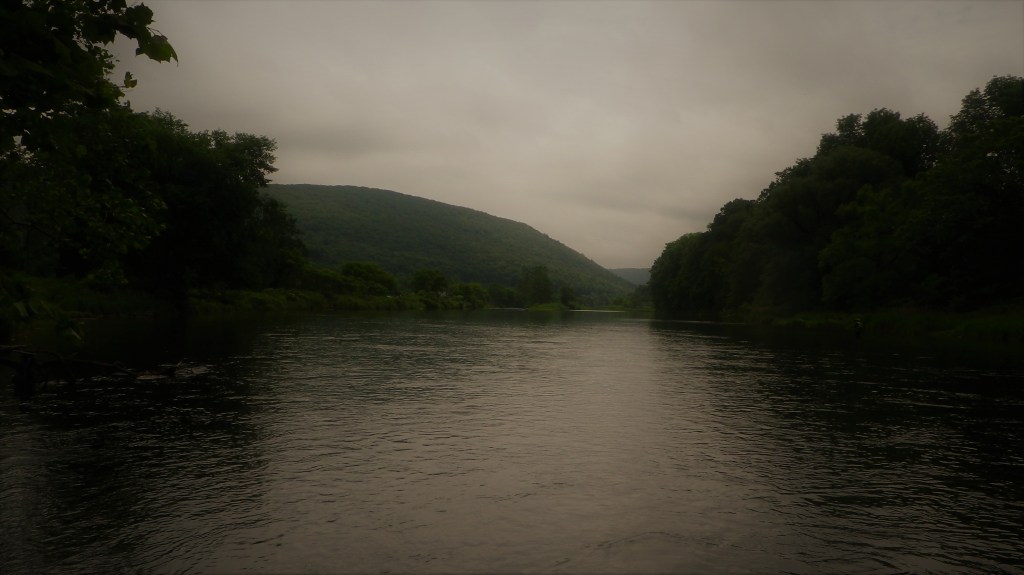
Summer Along The Delaware – A few cold nights are welcome, as are the cooler, cloudy days, when the great river can make the most of the cold water discharge from Cannonsville Reservoir.
It is the twenty-fifth of June and forty-eight degrees here in Crooked Eddy. It is actually warmer this morning than it has been the past two, when we shivered at sunrise at forty-four. The cold nights and cooler days have been welcome, bringing some new life to the rivers: two days of mayflies and a few rising trout!
Wind has accompanied the spring temperatures, and I guess that is fitting, at least for the windiest spring in my Catskill memory. Forecast 5 to 10, never mind, Mother Nature cranked it up to 25, and I believe some of those gusts must have hit 30. Challenging conditions for fly fishing. The additional tension caused by the wind and fretting over my compromised presentation cost me dearly. I broke off a special fish, and that got my nerves further on edge, so I remained too quick and too firm on the draw. As the afternoon lengthened, I redeemed myself with a fine twenty inch brown cruising and picking off sulfurs, though my encounters with another haunt me.
Yesterday I was ready for the sulfur parade, large ones and small ones, though none of the big Gray Fox that surprised me on Wednesday. There was some hope and a plan that caused me to tie those special 100-Year Duns in a size 14 with blended yellow silk and wings from the Catskill Legend Dave Brandt’s cache of wood duck flank feathers. That hope was rewarded, when I saw the first taller winged sulfurs bobbing upon the wind waves.
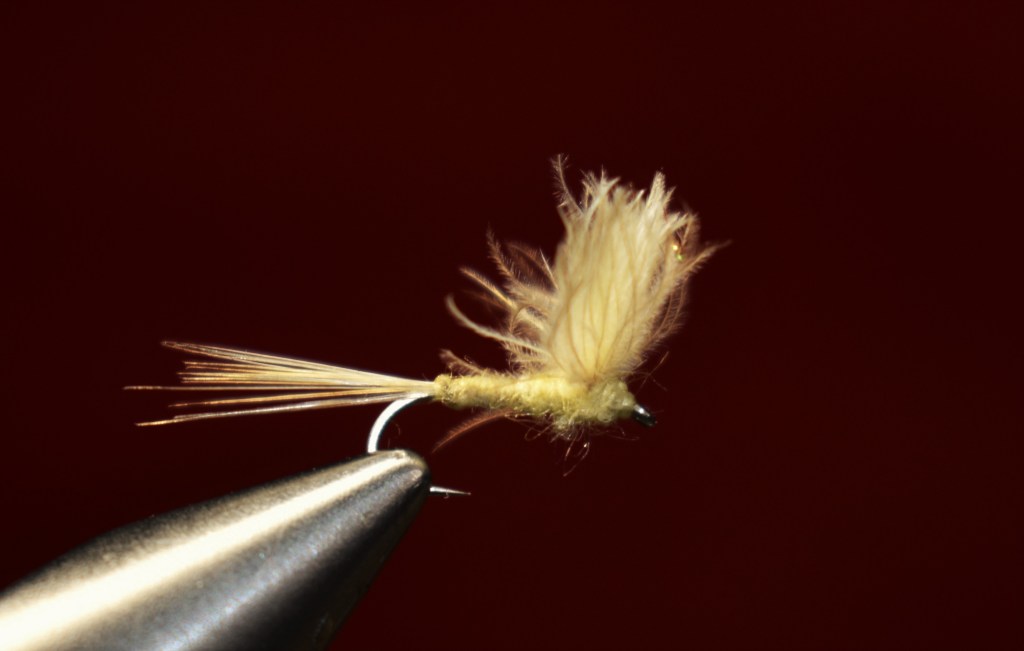
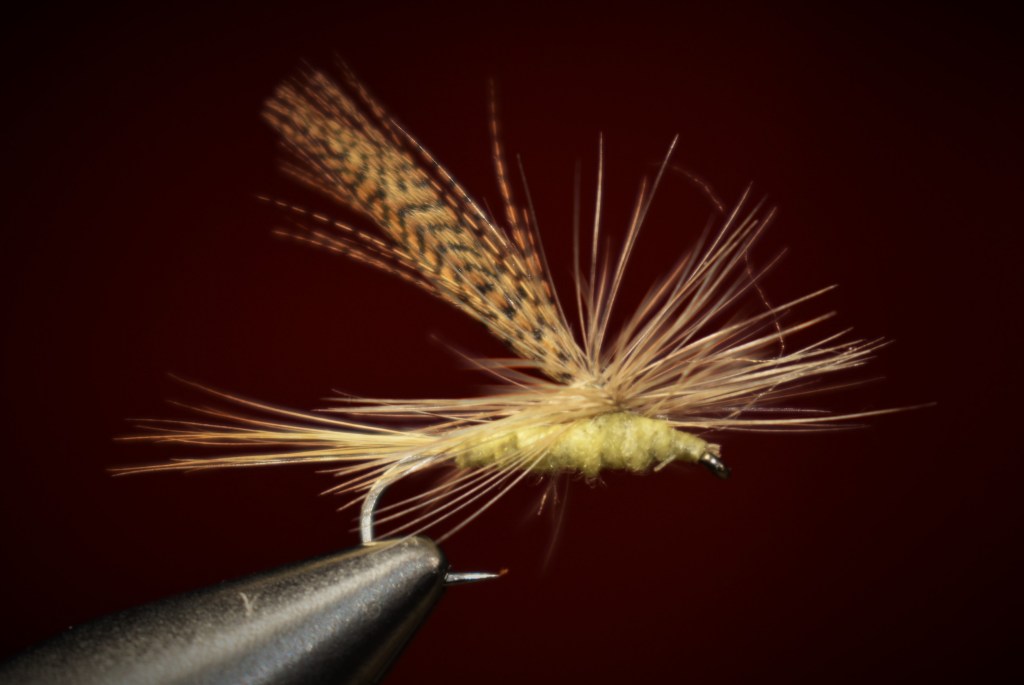
My 100-Year Dunin sulfur configuration: size 14, pale ginger tails, blended yellow silk, winged with those special wood duck flanksand hackled with a perfect light dun Collins cape.
I covered a rise while the wind blew steadily upstream, and the lovely old fly brought a take. That brownie was a just short of a foot, but he fought with everything he had. The gusts redoubled their efforts for a while, and there were no more rises, yet the sparse hatch of flies continued.
Wonder of wonders, a calm spell materialized without warning, and within two minutes time a rise appeared. The glint under the surface betrayed the old boy, no matter how dainty the disturbance. I cast the Dun above him, allowing just the right amount of slack to float it perfectly; how easy without a howling wind. He took solidly, seduced by the bobbing, canted wing and that provocative slouch, and I gave him the steel!
He tested my 5X tippet, and the flex of “old blue”, cavorting all over the river in search of a sharp edged boulder with which to undo our frail connection. In the end, he was mine, dedicated to that passed master, a friend that might have been, all twenty-one inches of him writhing in the net as I retrieved my fly. Back in the cold, clear embrace of bright water he posed.
“Seduced by that bobbing, canted wing and provocative slouch” indeed! All I wanted was a bit of lunch!
Each time the winds rushed back, the fishing ceased, but the welcome calmer spells fed my need. A foot long brownie found the Dun to his liking, wishing he was big as he battled to hand. Like all the lovely, miraculous things in Nature, the un-seasonal hatch came to a close. This day there were more quiet moments, but the little sulfurs did not appear in numbers for the finale.
Toward mid-afternoon the howl increased, and I marveled at the caprices of the mountains. Two days with winds diametrically opposed, yet the gale blew upstream each day with a vengeance! This was the stormfront, sans dark clouds or rain, and it brought down leaves and branches and all manner of things scattered from the forest! The rises had been quieted for an hour or more, then there was one little plop.
The Grizzly Beetle was flipped to that spot, having replaced the Dun when the hatch demurred and the gale appeared, and the response was immediate. The big brown dug for the safety of the jagged bottom, and I held him at standoff for tense moments. At last he decided flight was a more lucrative choice. But I am no junior player either my finny friend! I turned him at each obstruction, gave him free rein as he ran from one toward another, leading him ever to the mesh. Four trout, two better than the twenty inch benchmark, under comically impossible conditions. Ah the magic of the Catskills!
A beautiful moment, though there are no mayflies nor rising trout on the pool. Slow days and foibles are certainly part of fishing.
Fishing has been tough for more than a month now, hatches have been thin or non-existent, the weather has been up and down between too hot and unseasonably cold. Such are the twists and turns of the seasons along the rivers.
I have fared pretty well if it comes to taking stock of things, had some truly memorable moments, but it has been dues paying time of late.
With a stormy afternoon forecast yesterday, I headed out for my fishing in the morning. The skies looked menacing, and the wind kicked up enough to make casting a challenge. There was little activity as I waded along, searching for a rise, a bug, anything to seize upon to plan my strategy. Eventually I found a couple of sippers in flat water, touchy sippers. One gentle cast and they were gone.
I covered some more ground, or riverbed to be accurate, and finally found a good trout sipping in a familiar lie. Since there hadn’t been any bugs in evidence, I tied on a small caddis some of the picky eaters have liked, to see if that would tempt him. I guess it was my second or third cast that appealed to him, for he tipped up and sucked it down. The Sweetgrass arched and he exploded, taking off for points south in a big hurry! Two or three more runs into the fight, the hook simply pulled out, and the first big brownie was lost for the day.
It must have been a couple of hours later when a few sulfurs trickled off the riffle upriver and another good fish set up shop. He was keeping a low profile, sipping without exposing himself in the shallow water, but I could tell he was a nice, nice brown. He was sliding a little to his right and then a little to his left behind a submerged rock, so we played that little game of which side are you going to eat on. As it turned out, he was right square behind the rock when he sipped my size 18 sulfur, and I lifted a touch too quickly and pulled the fly right back out of his mouth.
After a rest, he was at it again, so I changed patterns and went back to the left, right, left casting game. I persisted for half an hour, resting him every few minutes, then taking up the cadence again. He rose to the fly, I hesitated as I should, and when I lifted the rod he swatted the 6X tippet with his tail and broke it off of the leader. Damnedest thing I have seen this season; and the second big brownie was lost for the day.
I fished to a couple of risers without getting a look from either of them, until the sulfurs petered out and we were back to bugless. The wind picked up again, blowing much harder then it had been, so I decided to work my way back downstream with a Grizzly Beetle. There was this large shady spot beneath an overhanging tree and I peppered it with long, delicate casts, letting the beetle drift twenty feet or so then gently drawing it out toward the middle of the river for a pickup. My main line of drift was collecting all of the leaves and detritus the wind was sending toward that bank, and I never saw the rise when a trout finally took my fly. I gently pulled to the side at the end of my drift and the rod doubled over!
Oh boy, big, big brown trout, but he wants to take me deeper into the tree where the snags are! In my position I couldn’t do anything but try to hold him, the rod bucking like crazy as I feathered the line between my fingers, and… off. I retrieved my beetle, perfectly intact, with no fish attached. Big fish number three lost for the day: my trifecta of woe. Yes indeed, this is the other side of fishing. A “damn” escaped my lips, and then a chuckle, “not my day, just not my day today”.
I am thankful for every day I am blessed to spend along bright water. Even days like this one.
We did get a little rain last evening, and this morning was cool and drizzly when I left the house, hoping for some mayflies hatching and an honest good rise of trout. Rainy days are tailor made for olives, and I have fished some nice sulfur hatches on damp days too. I strung up the Paradigm this time, happy that the rod’s impregnated finish protects the lovely caramel colored bamboo from the elements. I was ready for a great day!
The river was quiet when I walked in, so I decided to fish the fast water with a Sulfur Poster, expecting the real thing to begin hatching any moment. They didn’t show and, after a few minutes I had a feeling that I needed something more substantial to wake up a good one. In my Isonychia box I found a deer hair cripple tied with a claret turkey biot, just the thing to entice a resting trout to rise. I worked some floatant into the hair and the dubbed thorax, and began working my way up the bubble lines. There was a little blip of a rise and I raised the Paradigm sharply; everything else happened in a wink.
The CFO screamed, a big bright sided trout leaped out of the water, and then lit up the afterburners and headed upstream! You have to love the sound of those old hand made Hardy spring an pawl drags. I do, dearly, but I didn’t get to listen very long. At the end of that long run he found some leverage and my line fell slack: gone as quickly as he came.
I kept fishing of course, working some flat water where a good fish or two sipped the occasional little olive, or something, during the long, bone chilling afternoon. I worked one extremely handsome fellow with every type of tiny olive I had: hanging emergers, low floating emergers, cripples, parachutes, and then on to terrestrials and even a Grizzly Midge. Every once in awhile he would show me his full length, just to impress me, and believe me I was impressed! I couldn’t be certain if it was the tiny olives he was taking, as the bugs he ate were the ones that were jumping around and twitching on the surface, to exclusion. My fly won’t do that, no matter what size 22 pattern I tie.
My 100-Year Dun in the Yellow May pattern; the first fly I tied with the late Dave Brandt’s wood duck feathers.
After sixteen months, the Catskill Fly Tyers Guild held a live, in person meeting yesterday at the Wulff Gallery of the Catskill Fly Fishing Center and Museum. This was a small celebration, an open tying session meant to allow all who were able to attend to shake hands and tell tales, sharing some favorite sulfur patterns we all hope will catch some trout over the summer. There was a solemn note to the afternoon as well.
The Guild, and in a larger sense, all of Catskill fly fishing lost one of it’s giants last year: a well loved gentleman angler and fly tyer by the name of Dave Brandt. As per his wishes, members of the Guild had the honor of distributing Dave’s substantial collection of fly tying materials. The last pieces of that collection were made available to Guild members on Saturday.
I was fortunate to attend one of the last Guild meetings before the pandemic threw our world into chaos. On December 19, 2019 Dave Brandt offered an interesting and historic presentation on the history and tying methods for the late Walt Dette’s Riffle Dun. Brandt was known far and wide as one of the masters of the classic Catskill style dry fly, and everyone gathered enjoyed watching and listening to the master at work. I wanted to have a chance to meet the man after the presentation, but he was immediately surrounded by old friends and admirers, long time Guild members, and others, as might be expected of a Catskill Legend. I realized the rest of his afternoon would be quite full and headed home, confident I would have a chance to say hello the next time our group met. Sadly, that next time would never come for Dave Brandt.
With the opportunity to connect in some small way, I acquired a bag of Dave Brandt’s wood duck flank feathers on Saturday afternoon. These are the quintessential ingredient in the classic Catskill dry fly that Brandt loved. I was tying some little stuff this morning, tiny Flick olives that I’ll be fishing soon enough as summer blossoms. When I took that bag of Brandt’s wood duck out of my travel bag, a single loose feather wafted through the air. I caught it, and knew that I needed to tie a Catskill fly with it at that moment.
I decided to tie my own special Catskill dry fly, the 100-Year Dun. Inspired by the original Catskill dry flies, Theodore Gordon’s own ties, I hoped the legendary gentleman angler I never got to meet would approve. From what I have read and heard of the man, I trust that he would have. I will keep this fly in my own little collection. It won’t be fished. I tied two others that I’ll introduce to my own favorite runs and pools when I spot a sulfur dun fluttering on the surface.
One of the hardest things to come to terms with as life continues past a certain age is the loss of friends, family, and the people who have meant something in our lives, even the friends we never quite had the chance to know.
Footnote: The video of Dave Brandt’s tying demonstration of Dette’s Riffle Dun can be viewed by a visit to the Catskill Fly Fishing Center and Museum’s website at cffcm.com. Among the new and refurbished exhibits at the Museum in 2021 is an exhibit of Brandt’s legacy.
Welcome to the inescapable beauty of Catskill Summers
The Summer Solstice arrives on Sunday with an entire new season of outdoor splendor. Yes, we have had some summer weather already: a taste in April, a snippet in May, and June has provided a fair number of days that fit the profile; but it becomes official in two days time. The rivers are transitioning; they always are. Hatches have become smaller and less prolific as water temperatures have run the gamut from far too warm for comfort, to pretty chilly some mornings. Here at Crooked Eddy the Weather Channel gave our air temperature as 46 degrees just after sunrise.
Though I love to sleep with the windows open, relishing the mountain air, such unseasonably cold nights are a blessing to the rivers, particularly when rainfall has been scarce. It mixes things up a bit too, changes the activity periods of some of the wild things, and generally makes life here more interesting. I love Catskill summers, as they can seem to go on forever.
The little early glimpses of summer have changed the habits of at least some of the trout. I have stood in the river on several days lately, looking for mayflies that did not appear. Haven’t seen a lot of caddis activity either. A few trout have started to pay attention to terrestrials though, and that is good news to me. Just the other day I figured that the strong winds that helped to erase my hope for morning hatches might be useful in the right context.
I changed locations, fished for a short while in the afternoon where vegetation hugged the riverbanks, and found what I was looking for. Those winds kicked up some actual waves on open water, blowing upstream no less, and I figure that cost me a few opportunities. I fished through a few choice hideouts during the worst of the blow, and heard the distinct plop of a rise or two during the next little calm spell, after I had passed them by.
There was a spot where I knew a good brown had been hanging his hat, as I’d spooked him out of very shallow water by laying down my cast too close. As I approached that area, I changed position slightly to accommodate my new improved game plan. I was more than pleased with my casting that afternoon, a happy accident of pairing a different line and reel with a favorite rod. It’s funny how much difference a particular fly line can make to a caster with a bamboo rod. The rod in question, a vintage Thomas & Thomas Paradigm, casts beautifully with several lines, but the weight forward Airflo line I casually brought with me really opened my eyes.
Strong, gusting winds are not friendly to fly casting. The uninitiated would likely scoff at a guy carrying a bamboo fly rod on such a day, believing the hype that one simply must have a high line speed, fast action graphite stick. But a well crafted cane rod with the right reel and line is a very beautiful and effective tool. It gives the caster a lot of control, and control is the name of the game. Presentation counts.
So I worked just the right angle to make a long cast to this trout’s lie, waited for a calm moment between gusts, and sent a cast down and across stream some 65 feet or so, letting the fly alight very gently ten feet above the place where I had spooked that fish the day before. I immediately pulled another ten feet of line from my reel and shook the slack out of the rod tip to extend the drift. Experience tells me, if that shallow lie won’t allow a close presentation, I had to make one that touched down further away and let the drift take it into his dinner table. Then the waiting came into play, and the last chance to mess things up by overreacting when the take finally came.
It seemed like quite a long time that I was watching that tiny speck of light on the surface, drifting down ever so slowly. An old friend, one who preached the virtues of good old slow action bamboo rods decades ago, had a favorite saying about casting them: “I like to make my back cast and then smoke a cigarette while I’m waiting for that rod to load, before I make my forward cast“. The drift of my fly in that slow pool brought that to mind and made me smile.
That trout was right where I hoped he would be, and I watched a gentle little murmur in the surface when my speck arrived. I raised the rod evenly and tightened, felt an initial tug, and then began stripping all of that fly line in as fast as I could. That cagey old soak just kept swimming upstream right toward me, but I barely managed to keep some contact. I couldn’t feel his weight until he got about twenty feet away and then turned hard for a snag on the bank! Maneuver parried my friend, with a big sweeping arc of bamboo. He found just enough resistance to make him turn away from certain freedom and make a run back downstream.
Once he put some distance between us, I began the chore of getting all of my extra fly line back on the reel. I don’t like playing good fish by stripping line, too many things to tangle and cost me a nice trout in the net! Once he was on the reel, I got to enjoy the music of a classic Hardy crafted spring and pawl check with every run. My grin was pretty wide when I dipped that big fellow in the net: twenty-one inches long, and a scowl on his mug from getting duped by that long, slow, stealthy drift!
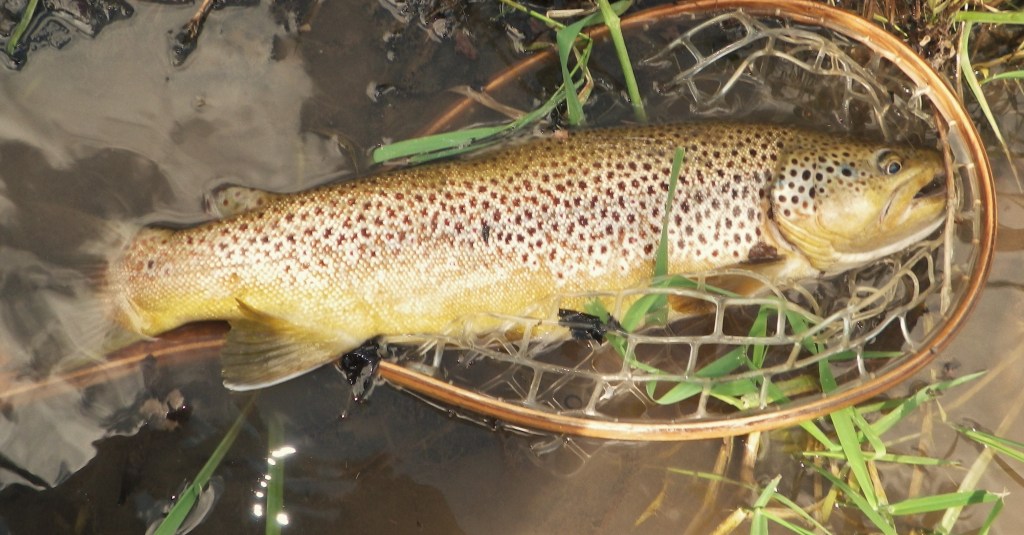
Didn’t photograph the trout in question, that scowl would have ruined a nice shot! This fellow was a bit longer, and just as vibrantly colored, so I’ll let him be the stand in model.
Taking advantage of the natural transitions as spring turns to summer, making the best of some tough weather conditions, and a little advance planning allowed me to more or less correct my previous mistake. I hoped that this big brownie would be working the same stretch of bank as he was when I spooked him. He was rising on that first encounter, so I knew he was finding some food to his liking.
I even found the perfect fly line to match with my Paradigm when distance casting is called for. I do a lot of experimenting with lines and rods. It gives me something to do in down time and is the only way I know to find the line that will make a fine cane rod really sing! A fine afternoon all around.
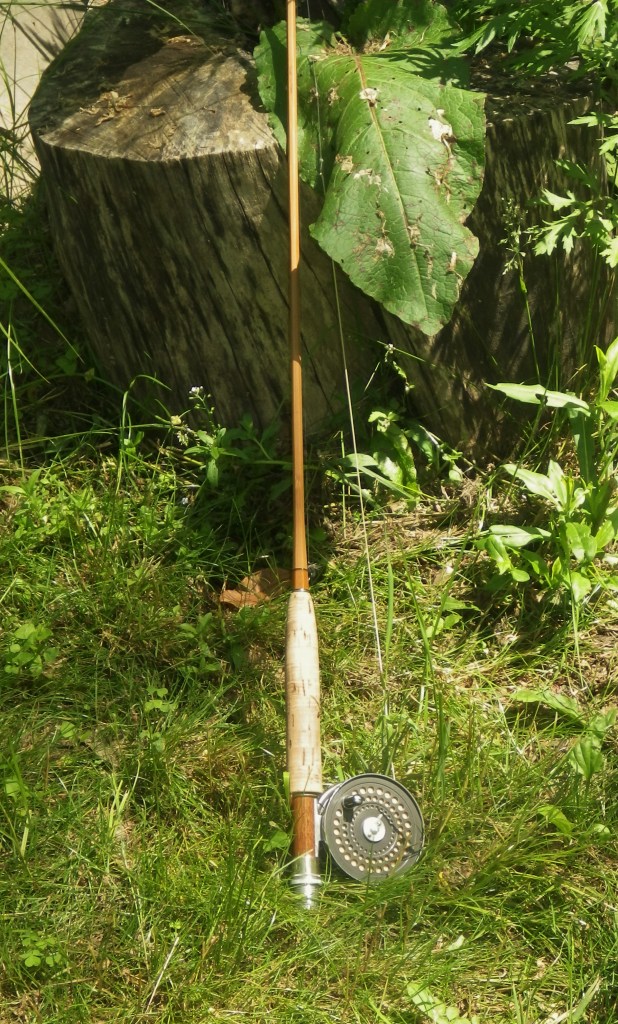
My T&T Paradigm, 1970’s vintage, wears an original Hardy made Orvis CFO IV from the same era very well. Spooledwith a slick, suppleAirflo Elite TroutWF5F fly line, it is a remarkable casting machine. There is a lot to be said for pairing the right equipment for the job at hand. What no disc drag? No. Nothing sounds like that venerable Hardy spring and pawl drag. It protects the lightest tippets, and the palming rim puts optimum control right there in my hands.


 Bright Waters Catskill