A Late Indian Summer

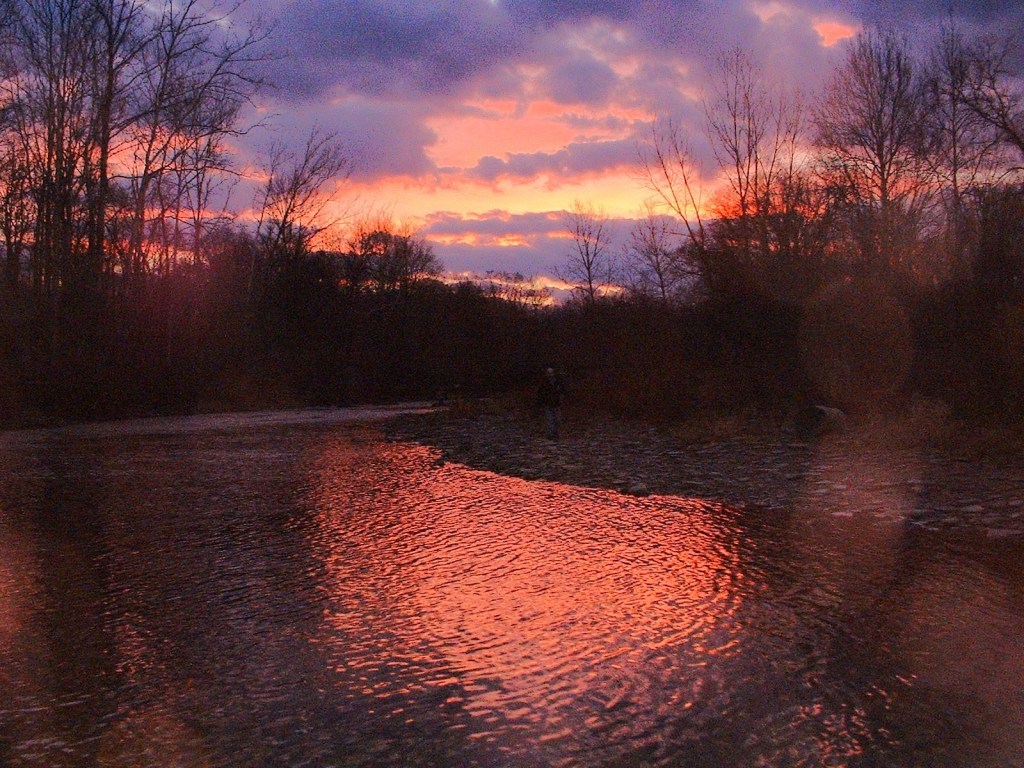
November’s Bright Water

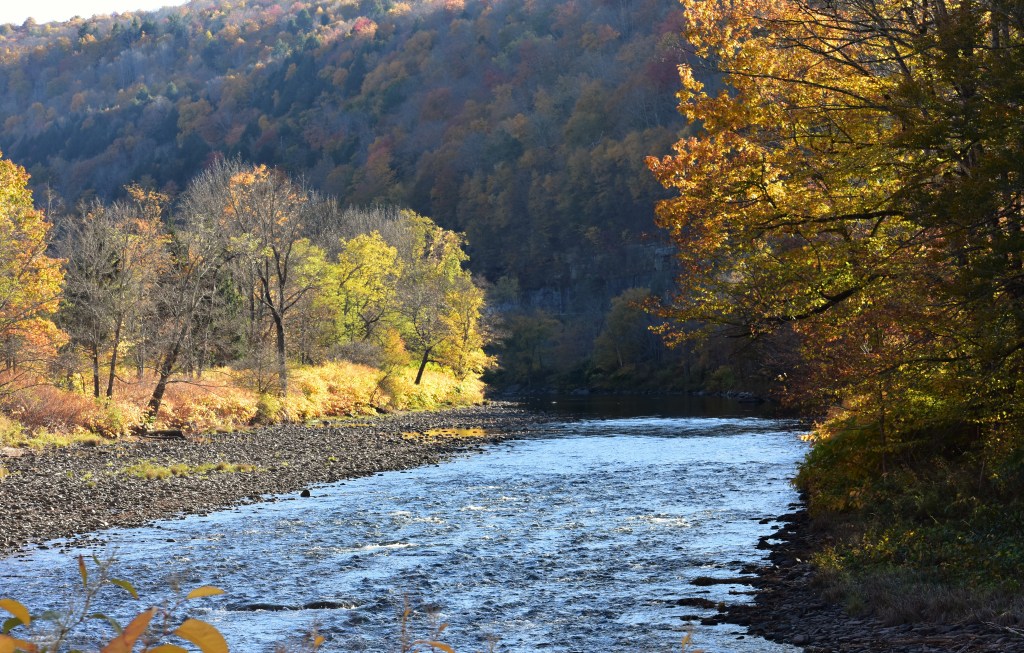
I am used to enjoying a span of Indian Summer weather sometime during October, after the first cold winds and frosty nights have convinced that summer has fully passed and autumn rules the land. What began as a short string of November afternoons in the low sixties has become a full on week of sunshine and near record temperatures. It is lovely, but it is late; and I fear too late.

I have fished each day of this interlude, seen mayflies upon the water, but there have been no rises, no real hope of the last kiss of dry fly fishing that I equate with Indian Summer. The rains of late October called our brown trout to the spawning grounds, and it seems very few have returned to my chosen reaches of river. River temperatures were near forty degrees when this unseasonable burst of warmth began, but they have risen grudgingly. Three more days of seventy degree sunshine are in our future, the last chance for shirtsleeve fishing; the last chance for a Catskill brown to come to a surface fly.

I walked the river banks yesterday, waiting and watching, certain that the warming water would bring some action. I enjoyed the time to reflect, to appreciate all that the rivers have given me this year. As the afternoon was drawing toward its close I resigned myself to swinging a little soft hackle wet through the bright water, prospecting to see if there were any trout willing to feed at all.

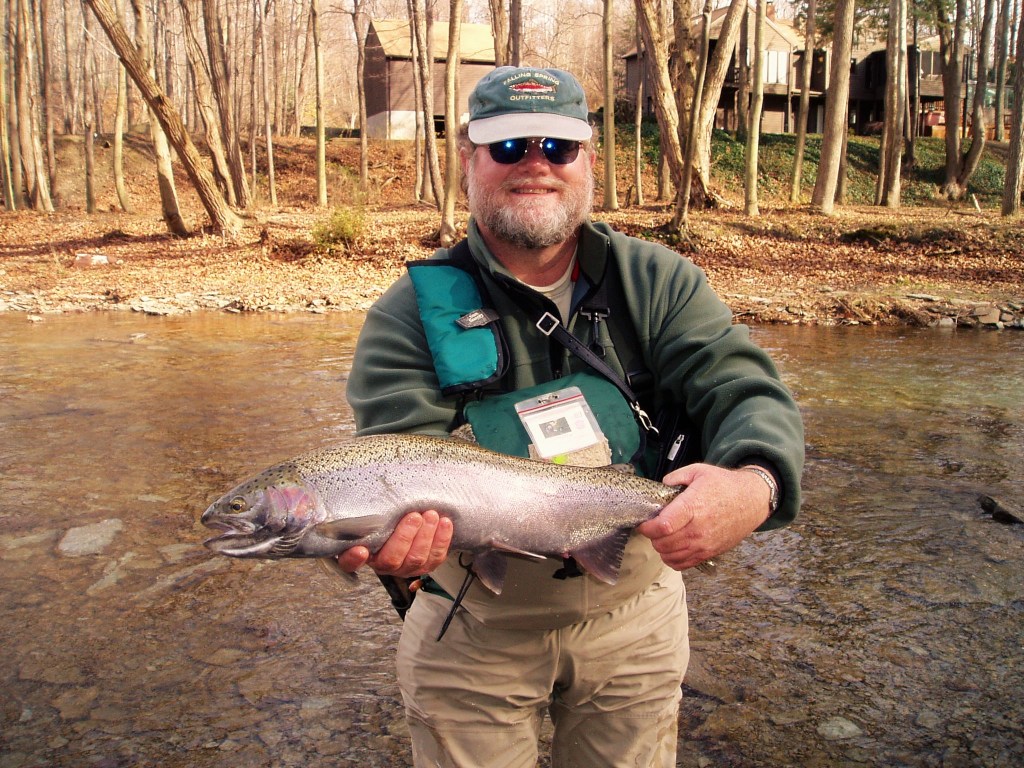
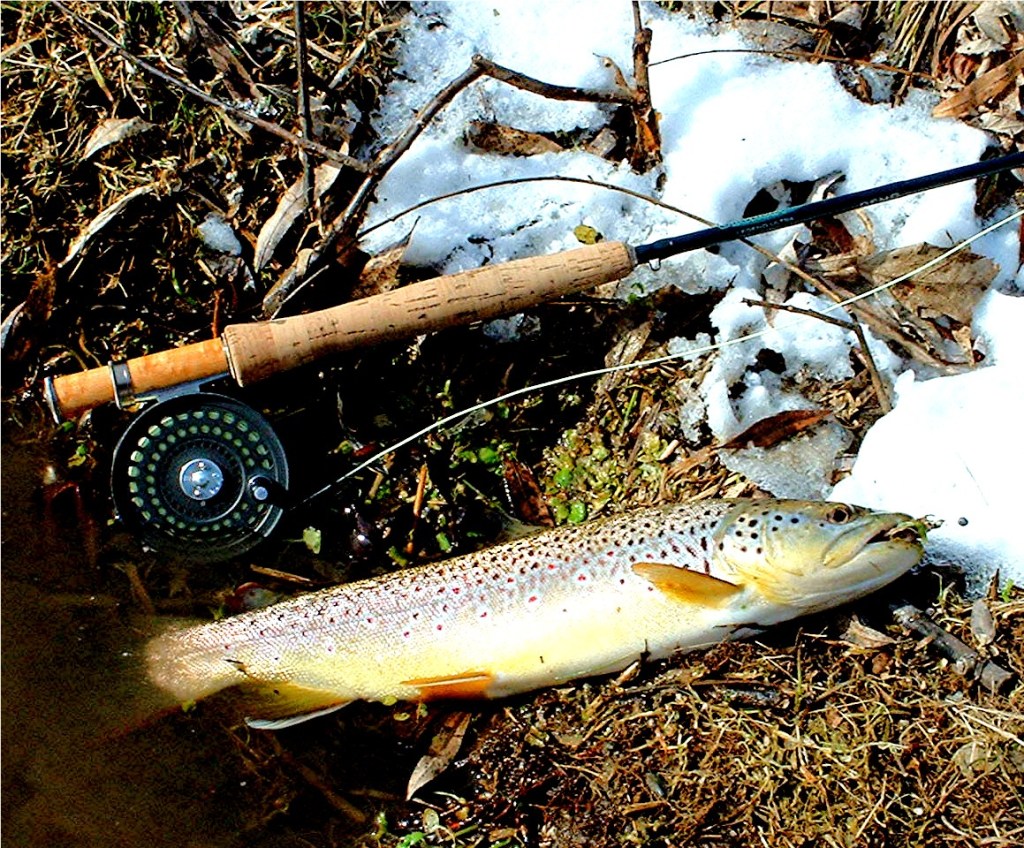
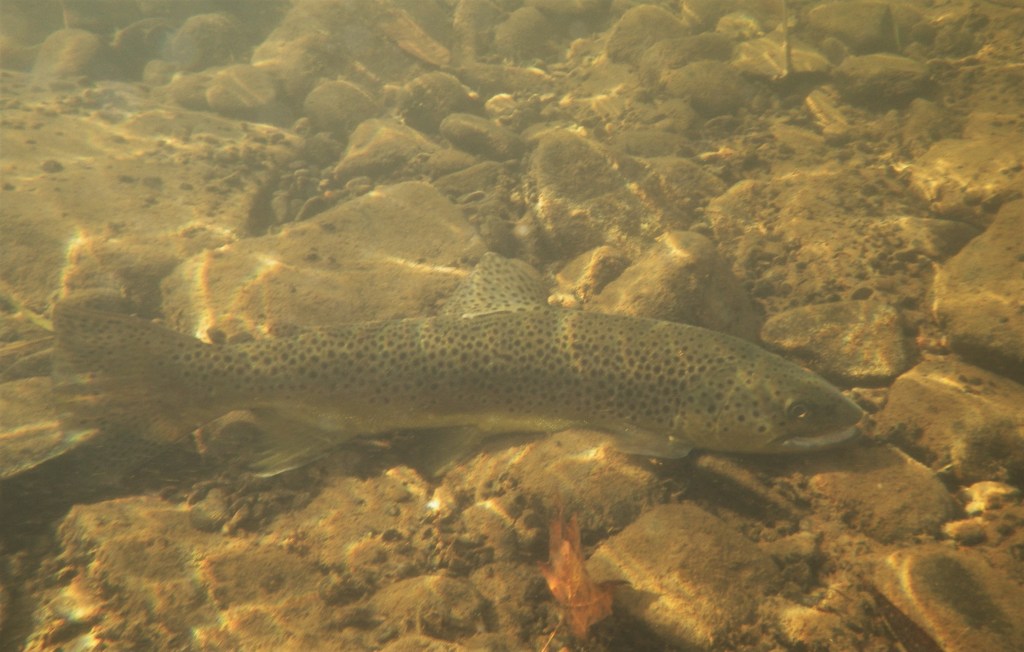
Half way down the rod tip bounced and the lithe bamboo transmitted the throb of life to my hands: a good fish, dancing with the old brown Orvis, and bringing sweet notes from the St. George. Corralling him in the shallows I slipped the fly free, snapped a quick photo with rod and reel; a remembrance, an honorarium for all that the river has shared.
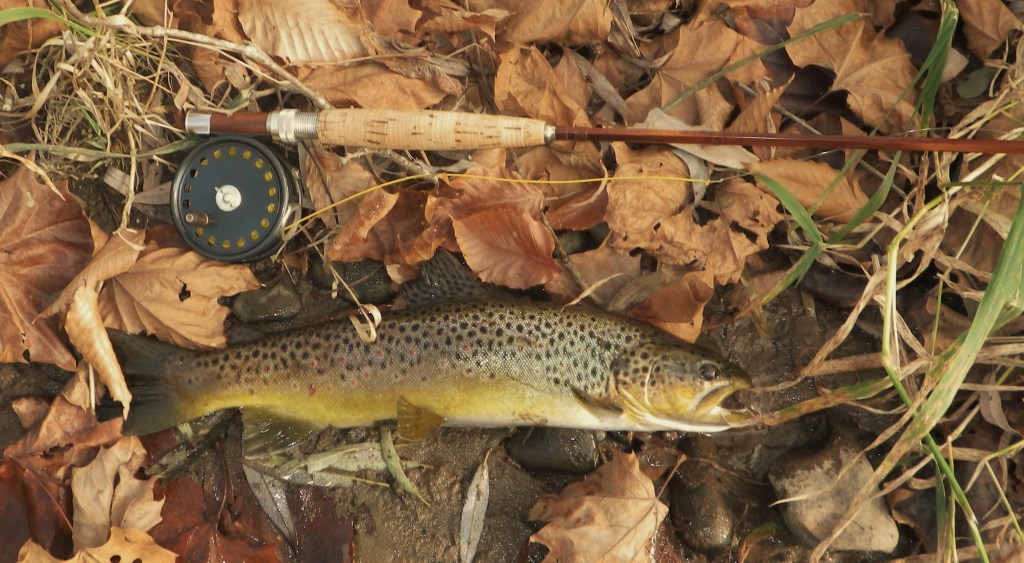
Remembrance

Today I will take advantage of the warm sunshine to park the drift boat in the yard, to cover it and make it ready for snow and ice and the long months of winter. There it will rest until spring and high water. Catskill weather can change rapidly, and today’s record high could well be the prelude to next weekend’s snowfall. It makes sense to continue my year end ritual.

If the brown trout are busy with procreation and recovery, I will let them be, and stalk the haunts of the Delaware rainbows. It is time to bid farewell to the great river. Somewhere, at some bend in the river, at just the right time of day a handful of trout will rise to the last mayflies of the season. It will be a brief encounter I am sure, but one I hope to witness. One last gift to share before winter, before my feet take me to higher ground, and the walnut of a gunstock replaces the walnut of a reel seat and flamed bamboo in my hands.

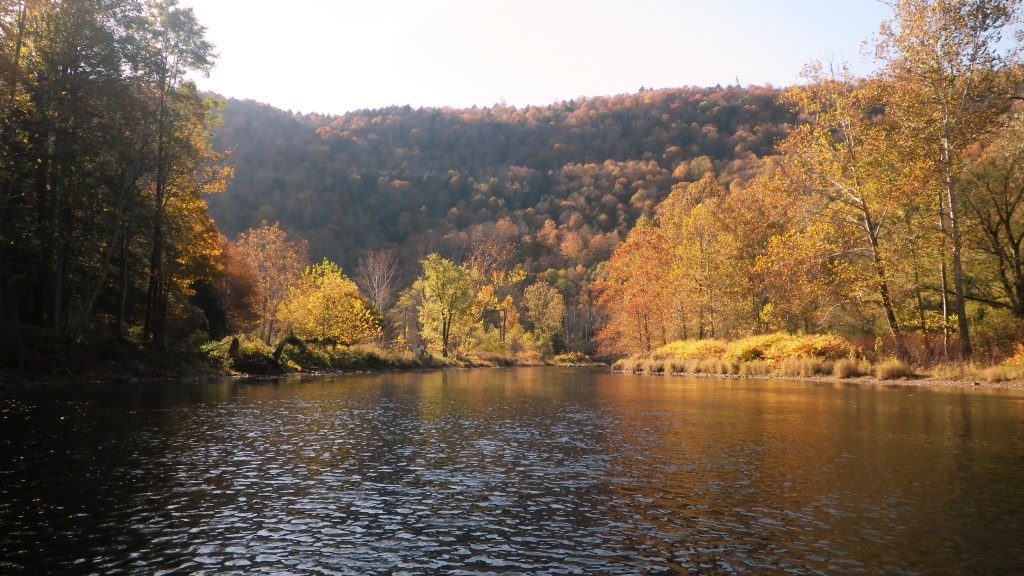
I have lingered along the rivers too late into autumn, left the grouse to their own for a month. I have traded the joy of walking the ridgelines at the peak of autumn fire for watching the afternoon sun light the trees over the lovely mirror of bright water. Time to accept the change of seasons, a difficult task in seventy degree sunshine.
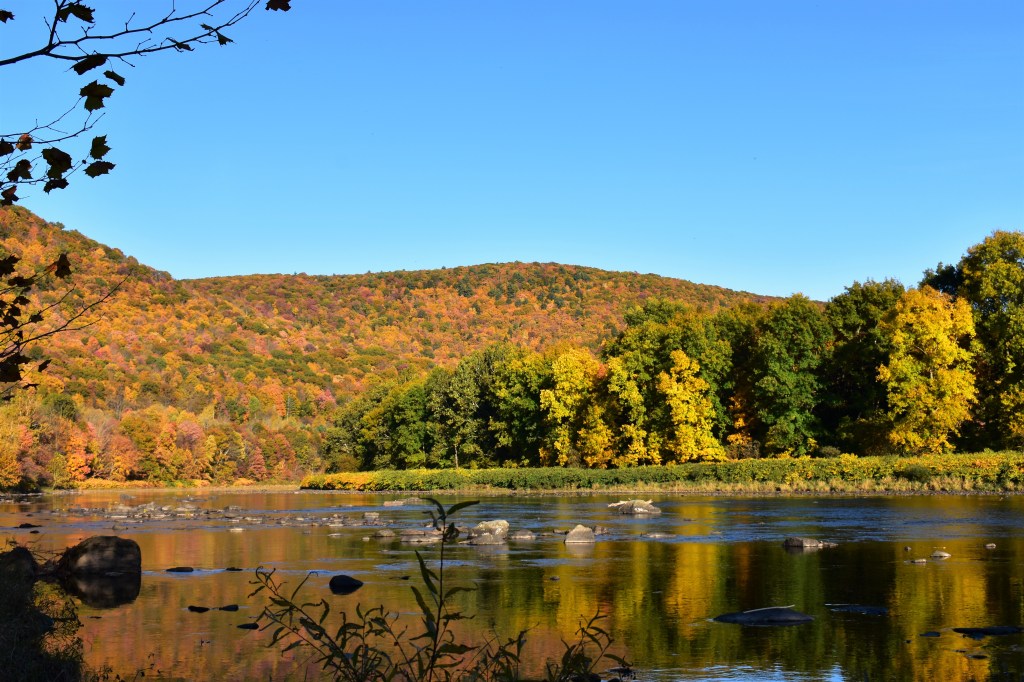
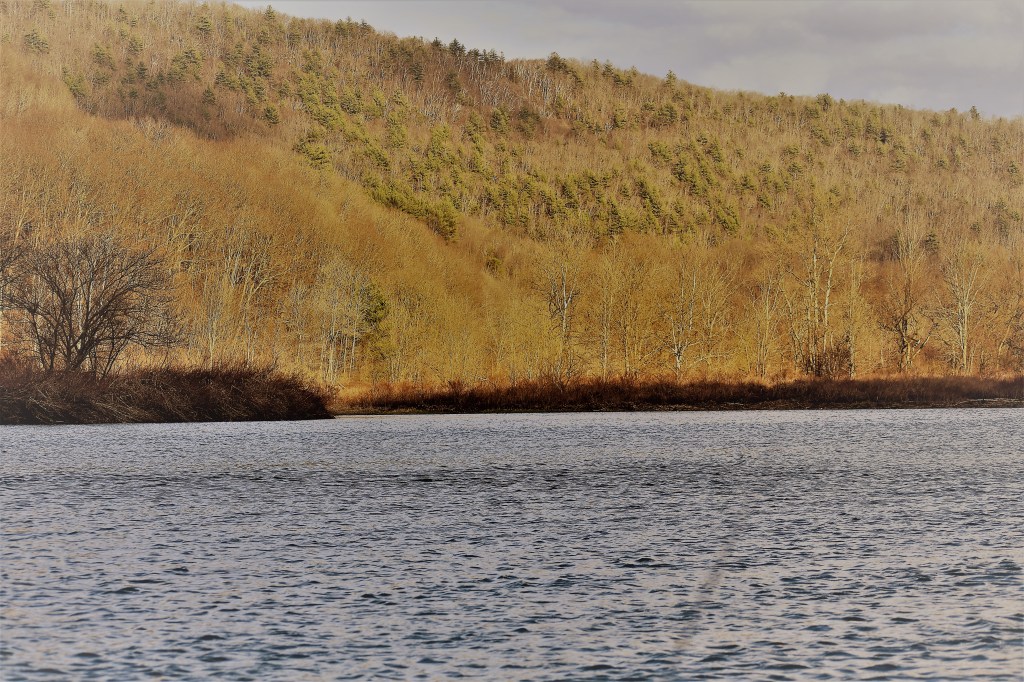
Sunshine

It doesn’t look like spring, though it certainly feels like it…

After the first real blast of winter weather, complete with snow and howling winds, a miraculous thing has appeared in the first week of November: sunshine! With the sun has come the warmth, and a run of days with highs in the mid-sixties. When all hope seemed lost I grabbed my gear and hurried to the river! The flows are reminiscent of spring time as are the brief, warm afternoons.

I set about swinging flies, certain that the forty degree water would surrender nothing on the surface, yet my faith in that conviction was tested. I was casting and swinging, mending and swinging, all the while dreaming that a nose might break the surface when I saw them; wings in the slick current, and more than a single pair.

There seemed to be a number of mayflies floating down, the rays of the sun lighting their wings – an advertisement, a tease, and I fell for it. I reeled in the fly line, cut the wet fly away and measured four feet of 5X tippet, extending my leader with hands trembling with excitement. A few flies took wing, guaranteeing those were really mayflies I was seeing and not bits of leaves lighted by the sun and animated by the breeze and my imagination. They looked light, and I fumbled for one of the September peach flies still amid the tumble of my summer chest pack.

Every once in a while the quick current would bulge and flip droplets into the air as it slid over a submerged boulder. I wanted it to be a trout, wanted it so badly, coveted the thought of one more dry fly experience. I cast, mended in the air, and watched my fly bob through that little blurp of water with every sense on edge. Nothing; I saw no nose, no flash in the sunlight, so I changed the fly and cast again…

The boulder never rose. Though that little blip of current was irregular, it was current alone that deceived me, twisted the wanting in my heart to make my eyes see something that wasn’t there.

The flies continued; tiny ones, larger ones, flies taking flight from the bright, slick current, though none were interrupted in their journey. Warm sunshine and cold water are not the prime conditions for rising trout in November, no matter how badly I want them to be.

It was early when the sun dipped behind the ridge, bathing the water in shadow, and the breeze betrayed a hint of chill once again. I watched, waited, still clinging to the hope that one fin might break the glassy surface, turning away at last as the shadows crossed the water to envelop me. November…

A Southwestern Flavor

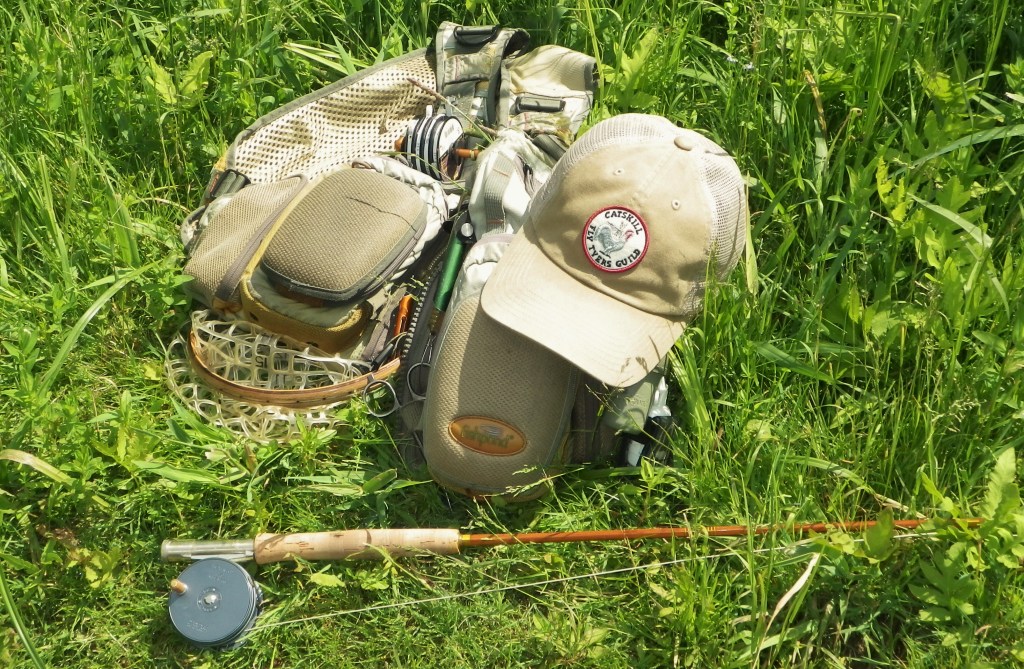
My 100-Year Dun Jave Red Quill, waiting for spring…

My friend John is an extremely talented and innovative fly tier, one who has an explorer’s streak when it comes to materials. He is also one of the finest men I have ever known. John has been sharing unique fly tying materials with me since our meeting two decades ago, most recently one with a distinct southwestern flavor. If you pay any attention to hunting, chances are you have run across the Javelina. They have been a popular bowhunting quarry as long as I can remember, and thus the subject of articles in sporting magazines and today, television and video.

When I was a youngster, javelina’s seemed to be thought of as a species of wild pig, which they are not. Their appearance explains that to some extent, particularly the ruff of brown and whitish hair around their shoulders. I don’t know if western fly tiers have ever appropriated this javelina hair, but some of John’s friends from the southwest certainly figured that he could find a use for it. Being a creative tier, John set about dying the hair, which is barred brown and creamy white, in a variety of colors.

John had used the hair for quill bodies, and was impressed with its ease of use, appearance and durability. Being the kind of friend he is, John provided me with a bunch of dyed javelina hair and suggested I go wild.

Among that first batch was a pale greenish color that simply screamed Green Drake to me, and it found its way onto a variety of my drake patterns. Sadly I did not hit a significant hatch this season, though there were a couple of days when a handful of duns appeared. The quill body was a natural for my 100-Year Dun pattern and it was the fly that fooled a pair of very large trout, the only two I witnessed taking one of those sparse Green Drakes. If you fish the hatch, you know that big, wild Catskill trout can be extremely picky when it comes to the flies we use to convince them a real Green Drake is floating overhead.

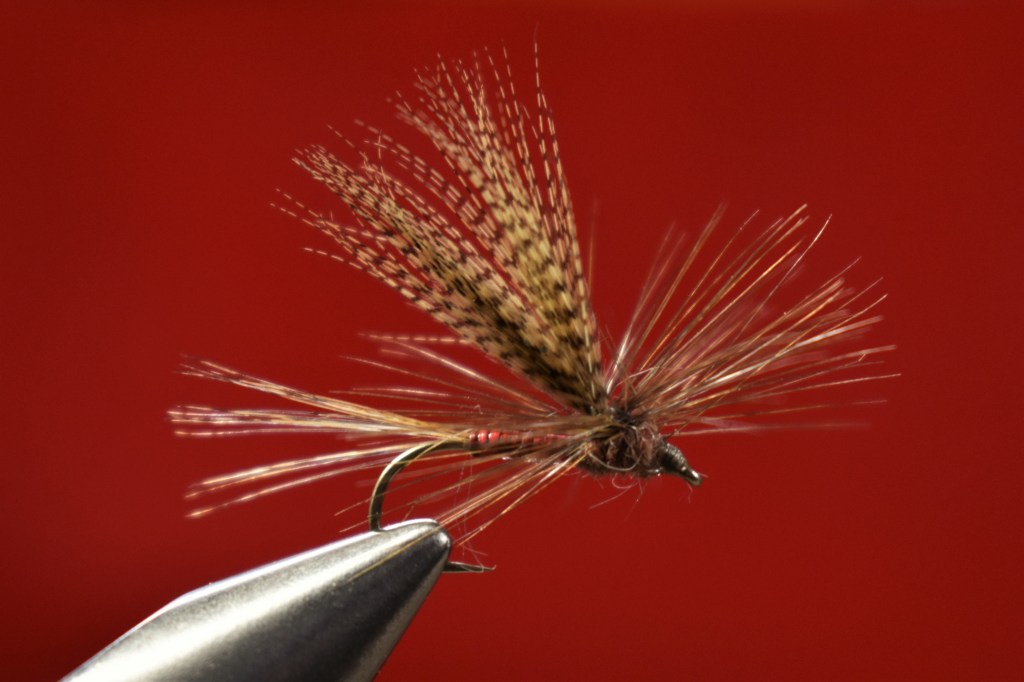
100-Year Drake Jave Quill

The fact that this fly was accepted by two monster trout, each on the first cast, impressed me, and I plan to tie a lot of jave quill patterns for 2021.

I wrote a passage about Hendricksons the other day, and thinking about the hatch got me working out a few Hendrickson and Red Quill variations featuring John’s dyed javelina “quill” bodies. My anticipation for next spring grew substantially as I tied.

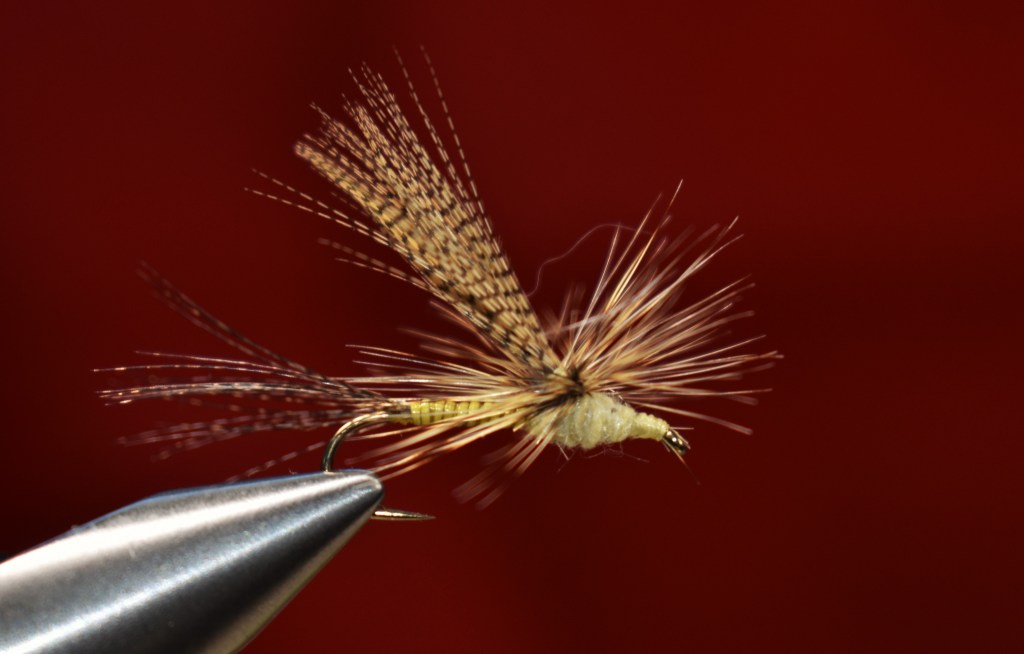
Pink Hendrickson Jave Quill Poster
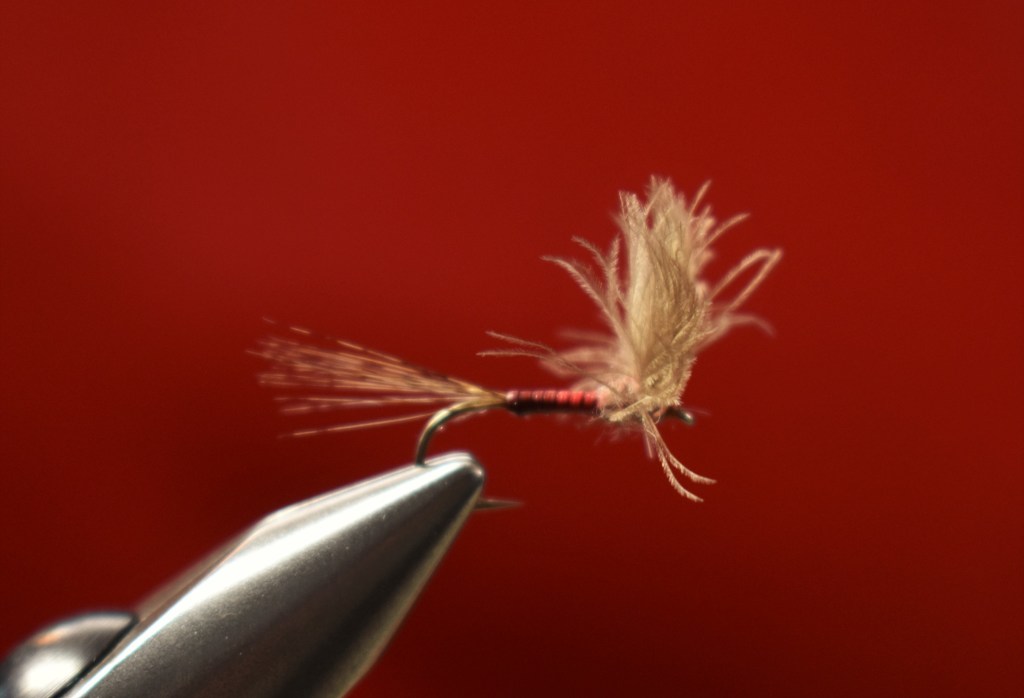
Jave Red Quill CDC Comparadun

I have more colors suited to Hendricksons, March Browns, Sulfurs and more, and have already tied some Isonychia which I unfortunately didn’t get a chance to try; another great bug that didn’t show me a lot of activity this season. There will be a lot of experimentation over the long Catskill winter. John told me he has had interesting results coloring the dyed javelina hair with a Sharpie, achieving an overwash effect. That can open even more doors at the tying desk. I have an idea for ribbing a hair quill body with very fine thread dubbed with sparse silk, to take advantage of the halo effect devised for my effective Halo Isonychia. The quest for imitation marches on!

November

A November morning on Ohio’s Conneaut Creek.

November and, as an angler, I am on the wrong part of the map. November is steelhead time, time to watch the fronts moving through the Great Lakes in an attempt to catch one’s favorite tributary the morning after its apex. It becomes a science unto its own, this search for chrome, as each tributary has a unique drainage area and its own timetable.

A significant rainfall event will raise the flow markedly and bring steelhead waiting near the river mouths upstream. High, muddy water isn’t fishable, though it brings urgent fish upstream in a rush. It is that period just after the apex, when the flows drop and the streams just begin to clear, that fresh fish turn aggressive: angler’s nirvana. In the flat shale bottomed streams like Pennsylvania’s Elk Creek, that window is two days long. The larger, more varied watershed of the Conneaut lengthens the span: more time is required to go from too high to just right, and the span of great fishing conditions is likewise extended. If this sounds somewhat predictable, keep in mind that each rainfall event is different in volume and duration, and each small watershed has a wealth of variables. Too, the best predictions go out the window when a second or third shot of rainfall follows the first by hours or days.

It can be a grand game just determining when and where to fish. Local steelheaders have an inside track of course, but only if they can find time off from work to get on the water when its perfect. For the traveling angler, it is a roll of the dice; but oh the rewards when you don’t roll craps!

Mike Saylor and I hit things just right once in about ten years of trying. We made the five and a half hour drive to Elk Creek after work, arriving close to midnight. After a few fitful hours of sleep we were on the water at the moment. We each hooked a couple of dozen fresh run chromers, landing about half of those we battled. Man it was an electric day! The next morning much lower and clearer water greeted us at daylight, and our hookups and landings were still thrilling, though reduced by nearly fifty percent. On day three the low clear water we had fished for nine of those ten years was the rule. I think we managed a fish apiece, perhaps two, but my memory is still marked by those first two days and everything else is fuzzy.

Low water can still produce fish, but it is a very different game. Think trying to catch a five to ten pound silver bullet hunkered down under the branches of a sunken tree with 5X tippet. On a good day you might land a couple, but the odds are very strongly against you.

A low water eight pounder from Walnut Creek in 2003

Ah yes, November is tributary time, but not for me, not this year. Mike nearly made it, until the unwanted effects of an ill timed flu shot derailed his plans.

Being retired, we both hoped we would be able to take better advantage of the autumn run, but then there is the pandemic to be concerned with. Erie tributaries are small streams and they draw a huge throng of anglers, some of whom think nothing of fishing right on top of you. I recall a guy with a spinning rod walking up and standing on the opposite bank, exactly above the spot where my short casts were entering the water. My polite suggestion that he move on just drew a stupid grin and some mumbling about “public water” as he drifted his bait through the same run. It wasn’t until I hooked my third steelhead on a fly during his “visit” that this fellow finally shuffled off grumbling. My Covid fearing psyche isn’t up to that this fall. There is simply no way to avoid crowds of people during the steelhead run.

Sunrise on Elk Creek…maybe next year!

I still want to get back to Michigan for some autumn steelheading. My friend Matt Supinski has a river full of wild steelhead at the doorstep of his Gray Drake Lodge, and I want to get back up there to fish with him before old age catches up with me. The photo of my twenty-one pounder, my personal best taken with Matt in 2012, hangs on the wall above my tying desk, and I think about going back every time I look at it. Our plan had been to fish the summer Skamania steelhead in August of 2011, but Mother Nature sent a deluge to the region just days before the trip, washing away any chance for fishing. I still want to do that too!

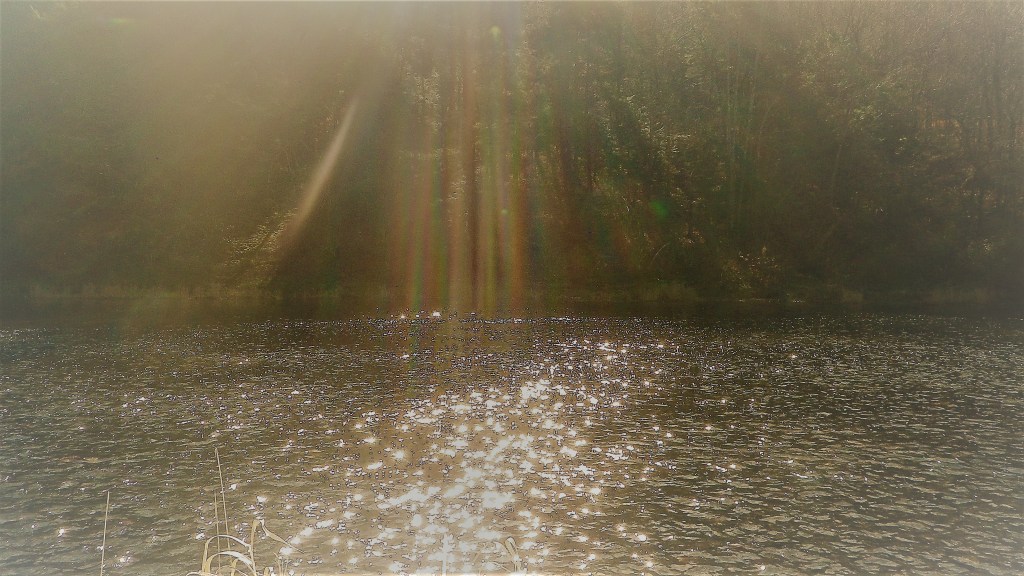
For now I have to navigate a couple more days of wind and rain and snow flurries before a promised run of sixty degree days finds me back on one of my Catskill rivers. I don’t expect to be casting dry flies to rising trout, but I’ll still enjoy that sunshine as it twinkles upon the surface of bright water!

The Dry Fly Season

A Falling Spring wild brown trout from a winter long past

The first dry fly trout of the year was a foot long brown that took a size 20 blue winged olive on March 27th near Junction Pool on the Delaware River; the last may be the fifteen inch brown that took my size 22 Olive T.P. Dun on October 26th. It is raining now, and snow remains in the forecast for tonight and tomorrow. Beyond that, the nighttime lows will head down into the thirties, then the twenties, those lows and the cold rain and snowfall causing river temperatures to drop drastically.

A seven month span of dry fly fishing is a wonderful thing, a remarkable gift given freely by nature, and cherished by seasoned anglers devoted to the dry fly. I am grateful for another year of pursuing the lovely wild trout of these Catskill Mountains by the means I most enjoy; casting dry flies born on my vise, with bamboo rods both old and new.

Fishing is not over for the year, as some of us simply cannot stay away from bright water for five to six months of the year. Though the wet fly will see the lion’s share of drifts, there will always be a few small dry flies among our gear. Hope springs eternal they say, and for the dry fly fisher that is a well kept truth.

As winter brings it’s freezing winds, it’s snow and ice, I will recall balmy days on the rivers of my heart. Flies will be tied with an eye toward spring, and the first glimpse of the early mayflies: Quill Gordon, Blue Quill and Hendrickson. My dreams will be of bright gravel nurturing the next generation of trout and the hatches that sustain them, and pools filled with fluttering wings and dimples in the film!

I am hoping for an epic hatch of Hendricksons next year, as it has been some time since I witnessed one. Fifteen years ago it seemed an annual occurrence, and I travelled here each spring to take part. Millions of tan bodied flies filled the surface, and the trout feasted. They were never easy to catch with so heavy a larder, but the challenge spawned new fly patterns and long hours upon favorite pools waiting for a chance to play the game on nature’s grandest stage.

A Hendrickson hatch from spring 2005: the duns were this numerous as far as one could see both upstream and down; some upright like little sailboats and classic Catskill dries, others prone in the film or struggling to free themselves from their nymphal shucks. Three hours of this to thrill and humble even the best dry fly man and fly tier !

I am likewise longing for a good Green Drake hatch, the epitome of the hatch matcher’s season. The huge duns are hard to imitate, and the ultimate challenge to both fly tier and angler. I found no honest hatch this season, witnessing merely a handful of duns on the water for a day or two, then nothing. My favorite hatch, and I have missed it two out of the last three years.

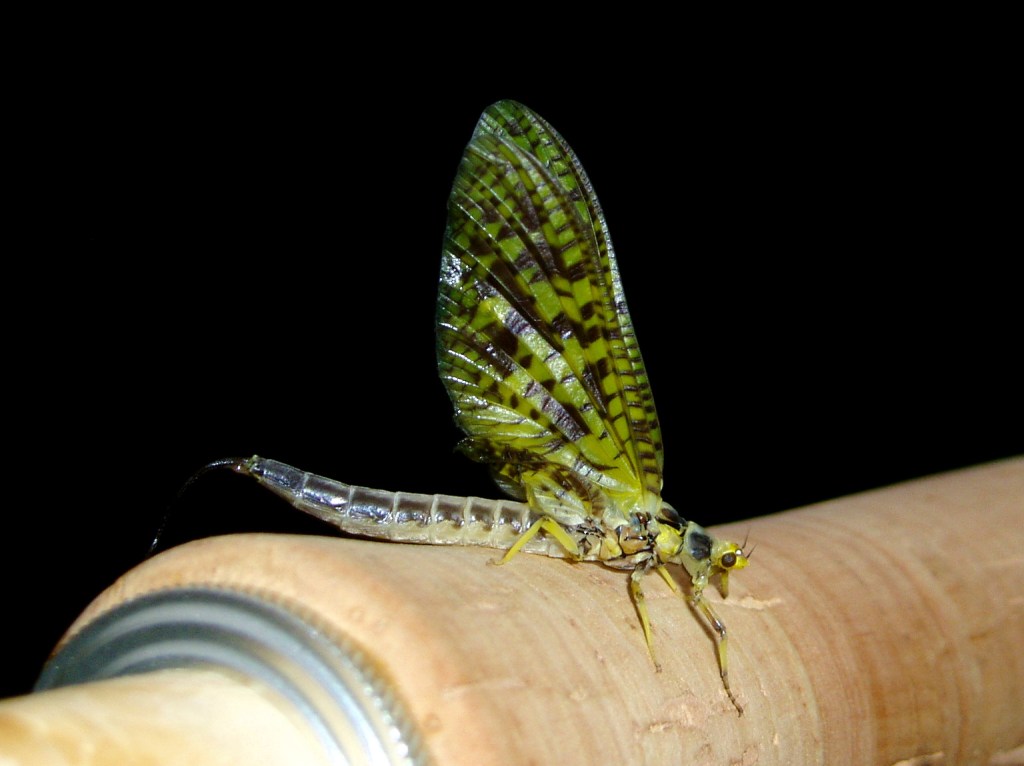
A fully emerged Green Drake dun, Ephemera guttulata poses on the cork of a Winston fly rod.
My answer to the magic of the drakes!

It has been a trying year for mankind, and I am particularly thankful to be standing, contemplating my love of angling, and looking forward to another season upon bright water. My family and friends are well, all are safe, at least as safe as any of us can be amid this challenging time.

The rain refreshes the rivers, and there may still be a window should a warm front fly through to replace the cold. Who knows? If it is meant to be, it shall be. If not, then I will wait until spring to feel my heart jump at the year’s first vision of the ring of the rise.

Fishing The Chill

Nocturne

It was forty-five degrees when I reached the river, wisps of cloud hanging on the ridgeline, the autumn colors so full and bright just days ago, now gone. Last week I fished in shirtsleeves, and today in a poly fleece hoodie, Thermoball jacket and rain gear; enough insulation to stay comfortable while I waited and hoped for a trout to rise.

I called the wardrobe right, as I was still comfy after standing and scanning the surface for an hour. I was about to consider the merits of a sunken fly when that little ring appeared near the opposite bank. Try as I might, I could see nothing but a bubble line on top, yet that trout had risen to something. The rainy day, and being nearly November convinced me it had to be olives, something between a size 20 and a 24. And so the game begins…

It was another half an hour I guess before that rise was repeated, and the fish settled in to feed lazily on something I still couldn’t see. I went through all three sizes, T.P. Duns with and without a trailing shuck, a tiny Flick BWO, and a couple of CDC sparkle duns. Mr. Trout was unimpressed. I changed it up for a few casts with a beetle: nope. Finally I was able to see a speck of gray here and there, and once or twice what looked like upright wings. Hmm… the twenties looked too big, but the 24 didn’t draw any interest either.

On the third dig through my three fly boxes I found a single size 22 T.P. Dun, and decided that just had to do the trick. Twenty or more presentations later, it finally did. The fifteen inch brown cavorted in the shallow water and pulled some line from my CFO, a nice fish. I twisted the fly free when I had him in the net, and he settled to the bottom right in front of my feet. He seemed to like my company.

Perhaps half an hour later another trout rose once or twice, and came for that 22 right there in the bubble line. I was maybe a split second late in my reaction, the tiny dry lost in the bubble line, but I hooked him, at least for a moment.

I whiled away the afternoon presenting different olives to the occasional riser, but the two that had felt the steel in my frauds must have spread the word; there were no more takers. A couple of times the rises stopped altogether and, just when I had decided the game was done for the day, a new fish would show himself with a bright little wink in the surface. The possibility kept me interested, the insulation kept me warm, and the activity actually picked up as it got later, the opposite of my expectations for a forty-five degree rainy day and forty eight degree water.

It was getting on after four o’clock, time to be heading out, when a good fish sucked in the half drowned size 20 T.P. that had the honor of being my last fly of the day. He wasn’t happy finding the sting in his supper, and I was equally surprised when a good size brown leapt out of the water to show me his indignation. I guessed him at better than eighteen inches, with a dark back that blended with the stones on the bottom. He made a second jump, convinced me that he meant business, and I began to slowly work him toward me. Everything was working out perfectly, the best fish of the day on the last cast and all that, when the hook let go.

I checked the traitorous fly, but found the bend secure and no reason for the hook to have let him go early like that. Must have had him in the bone of his lip where the hook didn’t penetrate enough to hold I thought, so I tipped my hat to him and headed for the trail.

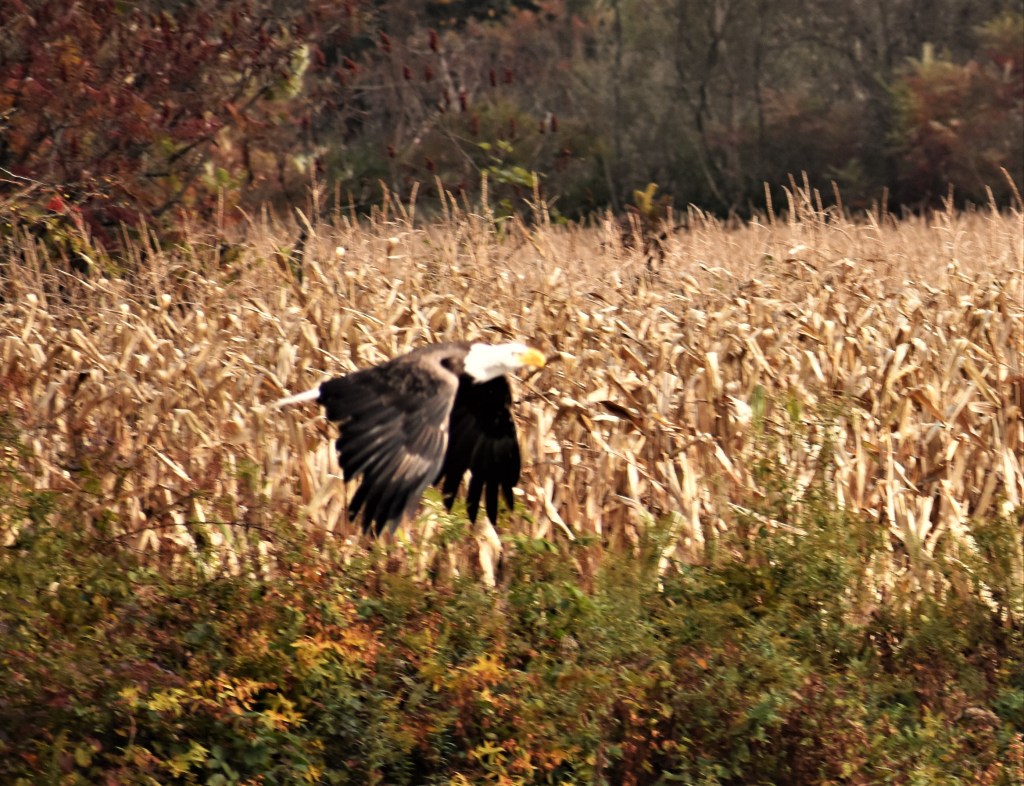
On the way out I was pleased to see my friend the eagle heading home upstream. “Hope to see you again”, I told him, “and if not then goodbye until next year.” I do hope to get back, maybe find a few nice browns sipping those cantankerously tiny duns again. It makes for a fine way to spend a wet, chilly autumn afternoon.

The Curtain Falls

Time passes swiftly and Nature’s glowing light recedes: summer is well past and November is on the doorstep

I sat on the porch Saturday afternoon luxuriating in the last of the day’s seventy degree sunshine; apparently the last of the year’s seventy degree sunshine. Twenty-four hours later I sat there once more, huddled in a hoody and a Primaloft jacket, tending the grill with a pair of Porterhouse steaks nestled in the flames. Twenty degrees colder in twenty-four hours, with the addition of a chilling wind just to drive the point home: summer, and the last sweet kiss of autumn is behind us.
I always mourn the loss of dry fly season, and a full Catskill season is a cherished thing, so I feel the loss here most of all. Yes, I will still hold out a bit of stubborn hope, I will continue to spend time upon the rivers of my heart, looking and hoping for a glimpse of wings upon the surface, a subtle movement at odds with the current; a little something that says life!

My friend called me the other evening to tell me that rain had come to the Erie tributaries, and that he was gathering his steelhead gear for an assault. He asked me to join him. My heart leapt at the thought of fresh run chrome and a chance to swing some flies with the old Orvis bamboo rod I have kept for that purpose. It has been a number of years since I last had the opportunity to chase steelhead.

Sadly I declined his generous offer, knowing there would be a rush of anglers to this first good run of the season, and crowds are not good places for me to be with Covid still hovering in the air. Mike assumed that I would take that safer road, but he wanted to give me the first chance anyway. I hope he hits the run just right and battles some of those big, beautiful bright fish into the net; and most of all I hope he stays safe and well.

It is hard to turn down a chance at steelhead fishing, for they are the most electric trout of all!

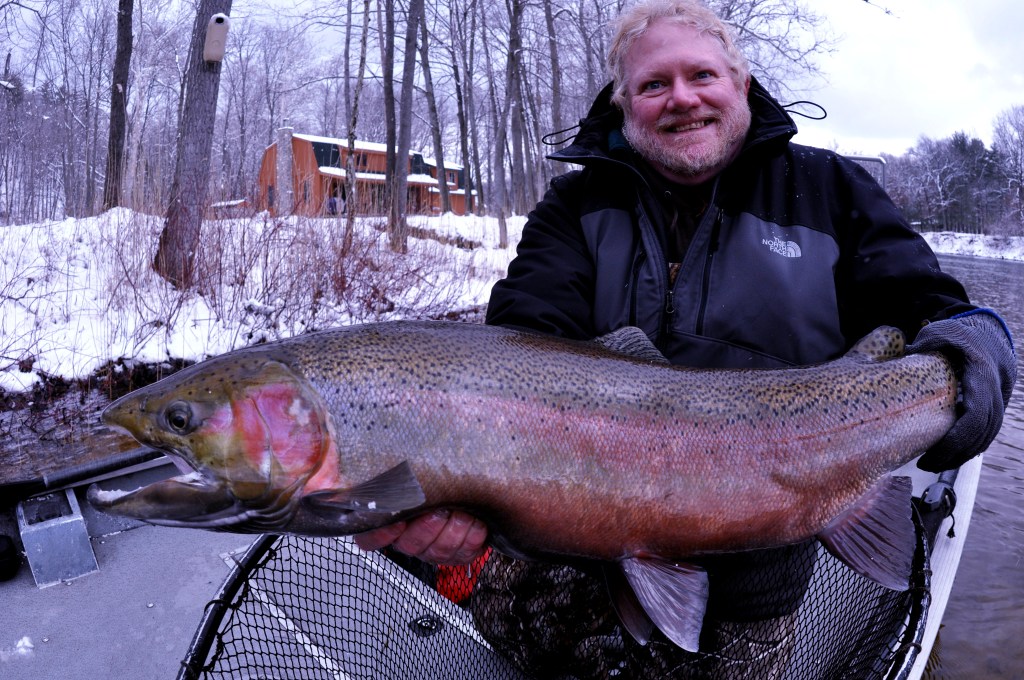
My best, a wild 21 pound double red-banded buck steelhead from Michigan’s Muskegon River
(Photo courtesy Matthew Supinski)

Though I have no expectations of landing a fish larger than my Michigan buck, I do have a strong desire to fish with and catch steelhead on classic tackle. I have a vintage Orvis bamboo rod once owned by Dr. Livingston Parsons, author of Salmon Camp: The Boland Brook Story. At eight and one half feet, the rod casts an eight weight line with authority. My steelhead tackle bag contains a suitable companion, a vintage Hardy Zenith reel with a spring and pawl drag up to the task of fighting salmon and steelhead. The next step in my quest for chrome involves swinging an appropriate spey fly to entice a significant steelhead, so that I might battle him one on one as fly fishers battled them during the Golden Age. That goal still lies before me, un-assailed, but not forgotten. Perhaps next year…

It is well past time for the mountains to draw more of my attention. I have wandered only twice in search of grouse, instead feeding my burning desire to find the rising fish that seemingly deserted me on October first. I simply refused to accept the end of my dry fly season at the turn of the calendar. Thankfully my perseverance was rewarded, though it took two weeks of trying to find that first lovely ring upon the surface. Now however, I feel I must begin to accept the inevitable.

The warmest weather to come in the next ten days advertises a high of fifty-two degrees, and the first flirtation with snow may occur on Friday morning. I began my dry fly season on the heels of snowfall, and it may well be that I am forced to end it the same way.

I have missed walking in the woods during the glorious peak of autumn colors, though I have taken plenty of time to stare from river’s edge. It is time to return to the forest, to see the last moments with the mountainsides ablaze in the sunlight, smell the smells of autumn, and walk the ridges and the hollows where all bright waters are born.

October Along The Delaware

Riseforms

The soft, classic riseform of a typical bank feeder taking small mayflies, visible but not at all showy.

We dry fly anglers simply live for the riseform; it is our greeting, our magic wink, the single natural phenomenon that calls us to cast a fly just upstream. Ah the telltale ring upon the surface: a trout is feeding here, taking on top my good man, go ahead and see what you can do!

There are times of course when we search in vain for them, finding none, and leave the river dejected, particularly so if there was any sort of hatch on. The presence of insects and the absence of riseforms leaves us spare, with only questions and no answers. Sometimes they are there but we don’t see them, failing to recognize the clues, to read the signs the river gives us. This was nearly such a day. The river flowed, just barely; the water being lower than I have ever seen it. The breeze was strong and gusty, and the surface littered with leaves: everything to see but what I’m looking for.

There are places on familiar waters where we expect a rise, places where we know that trout will feed if there is anything, anything at all to draw their attention. I watched such a place for half an hour, seeing nothing. I moved on, knotted a Grizzly Beetle and went prospecting, though to no avail.

My thoughts wandered to yesterday’s good fortune, when a handful of tiny olives brought one fine trout to the surface. A different day, a different river, though perhaps early afternoon would still bring a few flies to the surface.

I returned to one of those places, a reach where trout hold, where they feed and where they shelter, but still there was nothing to be seen save thousands of drifting leaves. Patience is oft rewarded, and the retreating clouds allowed the sun to light the water. Leaves, more leaves, colors and shapes, and the barest glint of something in the spaces between them. Wings!

I tied the duplicate of yesterday’s size 20 olive to my tippet and watched the steady parade of leaves that had collected in one primary line of drift. Every few minutes there was something along that line of drift; not a proper riseform, no ring, no dimple or bubble to give him away, just the barest, most discrete little movement on the glassy surface. Might a gust of wind have turned over one of those leaves? Could some tiny bit of bark or vegetation have blown down from the trees, or was it truly evidence of life? I never cease to be amazed by how invisibly a twenty inch wild Catskill brown trout can feed in a drift line.

I added my little olive T.P. Dun to the assortment of flotsam in the drift line, tracked it carefully as it floated oh so slowly downstream, cast after cast, drift after drift, until at last that imperceptible motion of the surface coincided with it, and I tightened and felt the full arch of the Granger’s tip and midsection. Nothing had become a trout!

The Hardy sang above the wind, the cane throbbed, and my smile widened. Bringing him close at last I spotted him beneath the shimmering orange and yellow of the drifting leaves, reeled half the leader through the guides, and slipped him head first into the net. I checked his length, levered the small, sharp hook from his lip, and slipped him back into the bright, cold water.

My “trout that wasn’t there” lies close after his release!

One More Time

Autumn Riverscape

Indian Summer, well no, just a short two day remembrance of one. Two days with highs in the low seventies, then the temperatures begin to crash.

Once more I will string the four weight Granger and search the quiet waters for a rise. Though the October sunshine would be welcome on my shoulders and a delight to my eyes, the cloud cover I expect is much better for the fishing. The river is down to its bones, as clear as air with little current in the pools. The shy wild trout will scrutinize everything!

Perhaps I will repeat yesterday’s good fortune, perhaps I will simply take in the beauty and serenity of the river amid the last blush of fair October.

The Sweet Taste of Dry Fly Magic

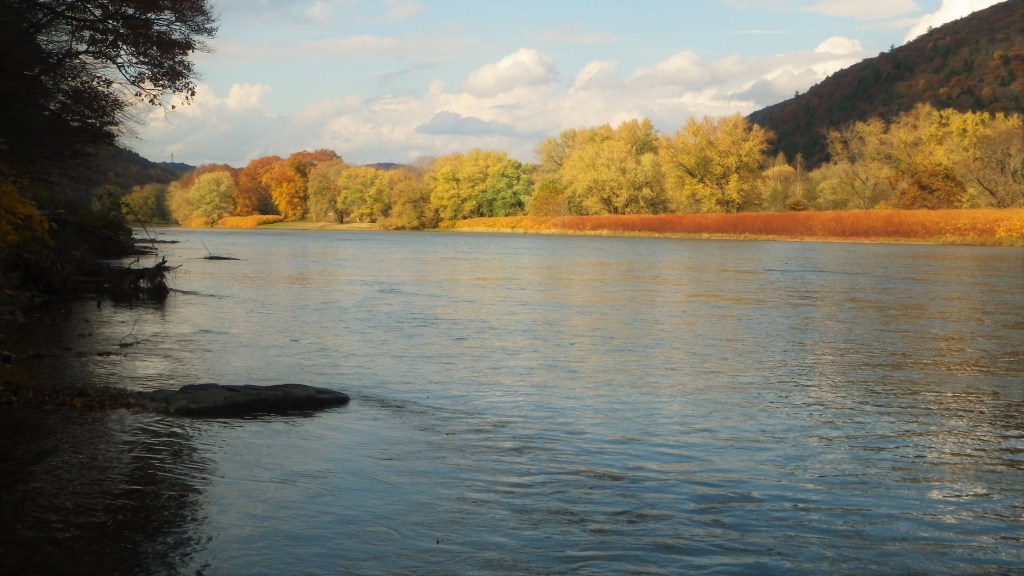
Golden Autumn sunlight highlights the lowest flow of the season on the Beaverkill

Another “rainy day”, yet the rivers are still dropping, as something keeps highjacking the rainfall we are promised. My hope for freshened flows to start the week have been dashed once again, and I resigned myself to the fact that last Thursday’s fishing was likely the end of my dry fly fishing for the year.

I had rigged the Kiley eight footer with a seven weight line, a heavier leader and one of my little pheasant and flash soft hackle creations, and I set about swinging that seductive little fly around the deeper boulders at the tailout of the pool. A twitch produced the feeling of weight, and I stripped quickly to set the hook into a substantial fish. A short, quick run spun the reel and convinced me that I had a good trout, though the dark bottom gave no visual clue despite the startling clarity of the season’s lowest flow.

After a couple more of those short runs I glimpsed a dark fish, thinking brown trout until I got a look at the wide mouth that said smallmouth bass. It was a strong, chunky fish, nearly a foot long, and I recalled the June evening in this place where an unseen foe grabbed my caddis in the darkness, pulled amazingly hard and broke my tippet. Could that have been a smallie measured in pounds rather than inches?

I had seen a tiny dimple or two around the rocks closer to shore, and expected small bass or chubs might be frolicking in the low water. I was pleasantly surprised when a nice ring appeared, and I retrieved my line and cut the wet fly from the leader. I checked the 4X tippet for nicks and, finding none, I plucked a Grizzly Beetle from my pack, knotted it fast and watched for another rise.

Whatever the fish was that was sipping among the rocks, it showed no interest for my beetle, so I cut it off and pulled four feet of 5X fluorocarbon from its spool to affix a proper dry fly tippet. When all was ready I waited for a new rise, as the mystery fish seemed to be moving around. When it came I lofted the line and dropped the beetle upstream, learning within a few more casts that it wasn’t the tippet that kept that fish from taking my fly.

I hadn’t seen anything in the air or on the water, but now I crouched and searched the mirror intently. Something drifted past just out of reach, buggy looking but unidentifiable. Scanning upstream I finally saw a tiny pair of mayfly wings drifting along.

The beetle was exchanged for a size 20 olive, one of my T.P. Duns with a sparse trailing shuck. I fluffed the wing but chose not to add floatant, hoping the fly would settle a bit into the glassy film and give the appearance of a trapped dun: an easy meal. While choosing the fly and tying it on, my mystery fish rose with a heavy bulge and a soft dimple, making it quite clear that my quarry was a substantial fish, and likely the trout I was hoping for. Decades ago I had fished the white mayfly hatch on the Susquehanna River during extreme low water, and saw smallmouth bass sipping the flies very daintily in the shallow flats, so a bit of doubt remained as I made my first cast.

It is my habit to make that first cast short, allowing a chance to check the drift with the fly far enough from the fish that any unexpected drag won’t spook the riser. The float looked perfect, so I picked the fly up once it had drifted well downstream, fed a few feet of line into the back cast, and made a down and across stream reach cast right on the mark. The fly drifted down a foot and a new bulge and dimple engulfed it!

The fish pulled hard and ran downstream, pulling the slack line through my fingers as I worked to control that first rush and get him on the reel. The boulder field worried me, so I kept the tip of the rod elevated, letting the big fish fight the arc of the supple cane. The Kiley has a lot of flex for a seven weight fly rod, and I used it to full advantage. My first look came as I drew him close, a brown trout easily topping twenty inches!

That fine brownie wasn’t happy dueling in such shallow water, and ran again against the drag. He reached the deeper boulders but the sweep of bamboo turned him short of any hangups, and we continued our dance back and forth, and all the way to my waiting net. He was heavy and beautiful, twenty-two inches of autumn brown trout that chose to rise at just the right moment.

Once he darted away to the safety of his boulder field, I scanned upstream and down for a sign of additional mayflies and another rise. There were none to be found. Dry fly magic: that brown had appeared in front of me for the briefest moment, one chance to make the afternoon particularly memorable; truly a gift from the river.

Can you imagine fishing a size 20 dry fly on glassy water with a seven weight graphite rod? Not a high probability of success in that scenario, but bamboo adapts. I extended my leader to roughly thirteen feet, and the sweet action of the bamboo allowed the gentlest of presentations where there was no margin for error. Is it any wonder I love fishing bamboo?