Blog Feed

An Anniversary Season

“Stockport PM”

The opening of this trout season will mark an anniversary for me. It will be five years since I was struck down and barely evaded a float down my last river. I had no idea that my heart was in trouble. The brief, bubbly burning sensation below my Adam’s Apple had been dismissed by the medical types, so I went fishing.

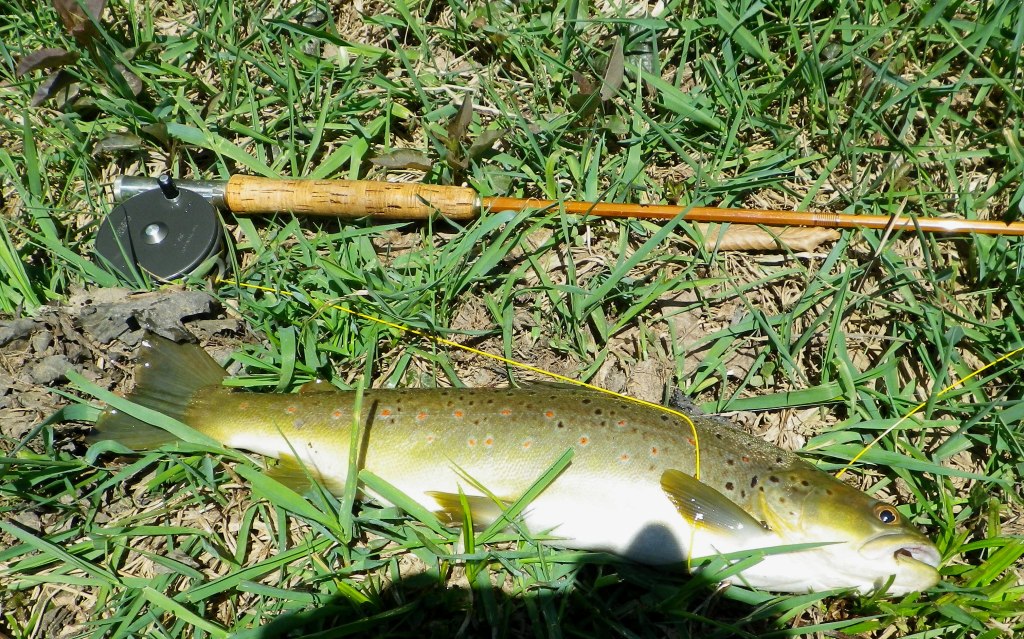
Friend Andy Boryan and I were savoring what would be the last of the great fishing on Big Spring, and I had found a big, wild rainbow rising to a sparse emergence of tiny olives. My size twenty fly laid gently upon the surface turned the trick and I played and landed that beautiful fish with my old Granger bamboo rod. A heavy, twenty inch bow will get you excited, but oh the burning felt like so much more than joy and elation. Not too many days thence I was laying in a hospital bed taking regular doses of nitroglycerine.

There was fear, and disbelief, and a lot of hope that the surgeon could save me. She did. I worked hard in recovery, resigned to the fact that I was going to miss that precious spring upon the rivers that sustained me. A month after the surgery I was able to cast a fly rod, so I went fishing.

My early May newspaper column from Chambersburg’s Public Opinion told the tale of the beginning of my season here in the Catskills. The season I nearly didn’t have:

“I have seen Hendricksons, but not the heavy hatches common to these rivers. Conditions seem perfect, but the bugs have their own agenda. Rather than the typical 3:00 PM emergence, there seem to be a few flies on the water from mid-morning until dark. Finding a good trout rising to these sparse pickings has been extremely challenging, even with the best of help.

Knowing that my body is not yet ready for the rigors of wading the great rivers, I have enjoyed fishing from the luxury of McKenzie drift boats, ably piloted by guides Ben Rinker and Kevin Corser. Both have toiled at the oars, dragged boats across riffles to shallow to float the craft, and managed to put me in front of the fish that were willing to eat a bug now and then. My hat’s off to both, fine guides and the best of company on the river.

Of course the Red Gods have to have their fun as well, typically at the expense of the wayward angler. A picture will tell the tale best: After scanning the river, the sharp eyes of the guide have located a trout casually sipping duns. The approach is perfect and the cast true, as are the next twenty casts until the wind blows the fly of course a bit and the angler cannot see it on the water, fixing his gaze on an actual Hendrickson he believes to be his fly. Of course that is the one and only cast that produces a take.

There are variations on the theme, but these are the kinds of things the Red Gods like to toss out to fly fishers. It must give them a multitude of enjoyment judging by the frequency they play such games.

Undaunted we push on until evening, interrupted by a fine Delaware rainbow that actually eats my fly while I’m looking at it and fights with great spirit and the reel spinning runs his kind are known for.” Fishing isn’t always perfect, but even the challenging days are a gift when we have the sense to realize it.

“It is evening, and the sun is off the water, yet still lights the treetops along the east bank of the river. It is absolutely gorgeous as all my days here have been. There is a riff ahead, pouring hard against the steep bank of an outside bend, and I cannot wait to fish it, but as we approach there are two drift boats anchored in the prime spots.

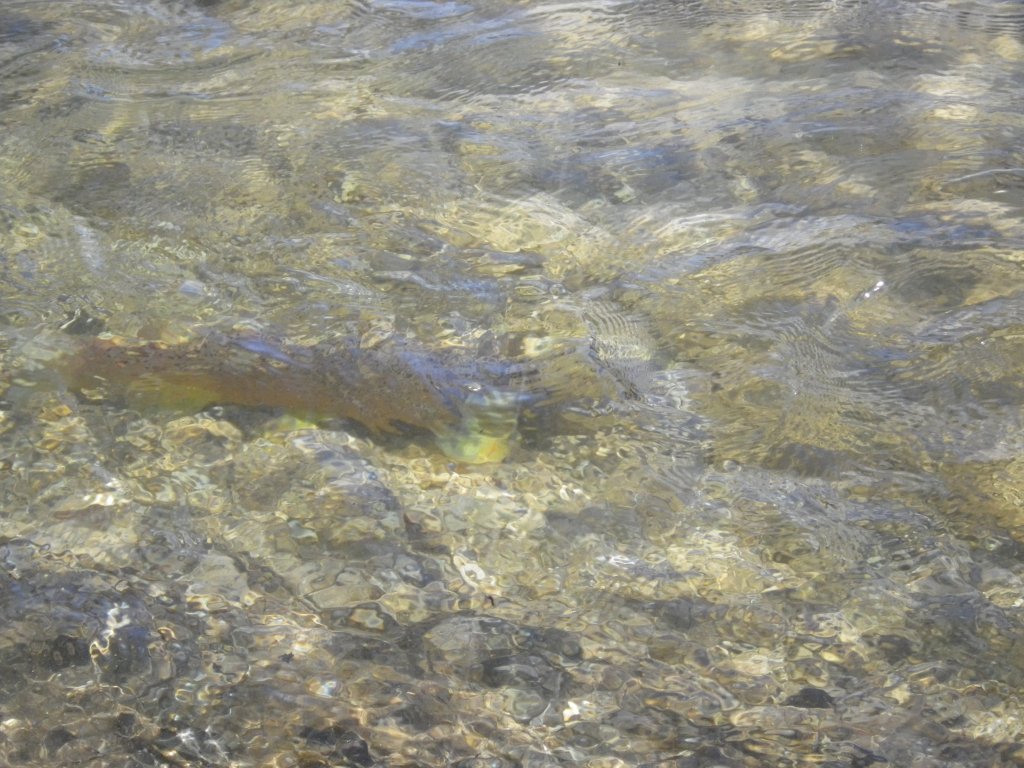
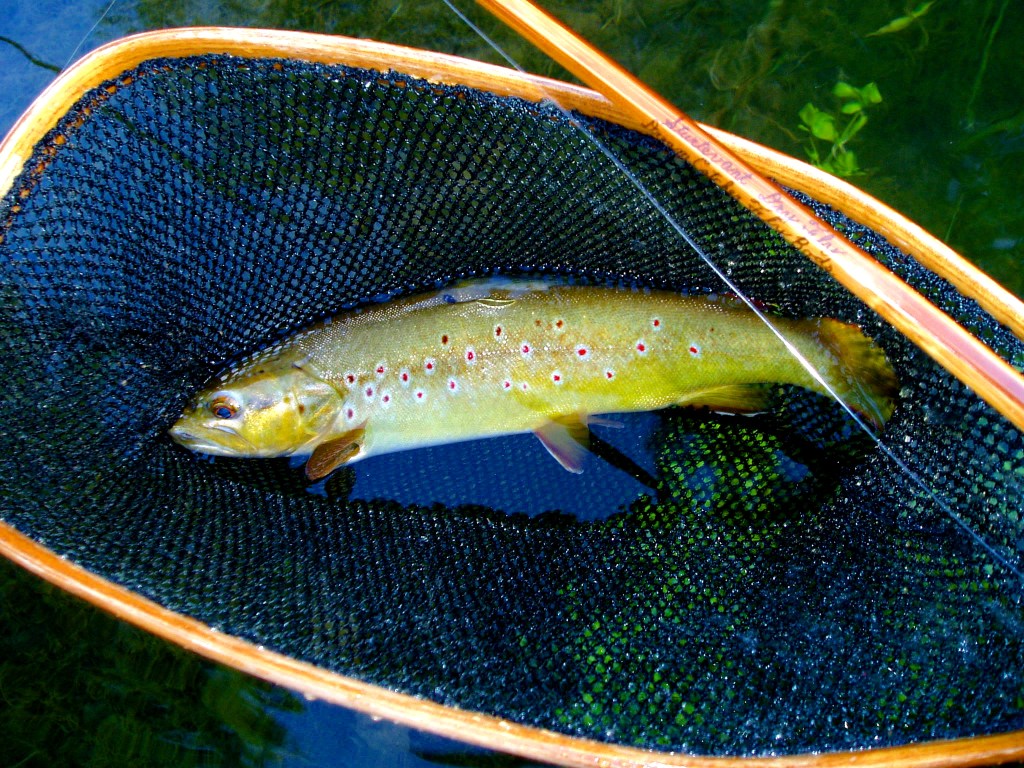
Kevin is looking east however, studying a soft edge where the fast water meets slow. With a subtle pull on the oars he glides the boat into position and tells me to watch that edge. There are trout rising in a line, most in the faster water, a few more subtly just inside in the softer water. One of Mary Dette’s Hendricksons elicits a rise and the battle is joined, the fish charging downstream and using his weight in the current! In the net he measures nineteen inches, a wonderful Delaware brown, and the highlight of the day!” I cannot explain how grateful I felt to be alive and fishing that day, but if you happen to be an angler with a near-death experience in your resume, you understand.

This season will open five years from the day I had to place my life in the hands of a lady I had just met. Thank you Dr. McCarty.

I have done a lot of fishing since that fateful day in late March, and loved every minute of those five seasons. Walking the river banks, sitting alone in the sunshine waiting for the hatch, or stalking into range and casting to a gorgeous wild trout, I have lived to feel the energy of the rivers flowing through me. My time on the rivers healed the part of me the art of the surgeon’s scalpel could not; my soul.

I take more time now to appreciate each facet of life: my time outdoors, conversations with friends, little walks with my girl, little daily tasks most of us regard as a bother. They are all worthwhile, all special. I find myself looking at the sky and the light as it rises and falls behind the mountains. I still laugh out loud when a trout finds a new and exciting way to avoid my fly, jus as I laugh when I slip a good one back into the clear river at my feet.
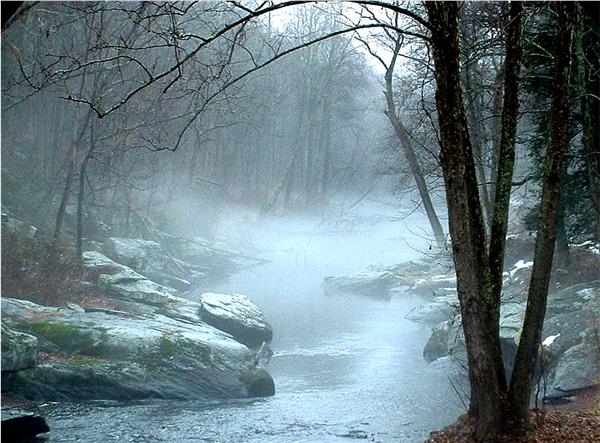
Pushing Spring – Thoughts from February 2011

Winter has had a lock on Central Pennsylvania since November. The snowstorms that hammered the Northeast coast were kind enough to sweep around us but we’ve had more ice than any reasonable fly fisher needs to see.

The extreme cold has kept me from any winter steelheading. With Lake Erie being five to six hours away, there has to be a serious warm spell to get me on the road. Sure any of the little thaws might bring fishable conditions, but they don’t last long enough for those of us a day’s drive away.

Living in the Cumberland Valley there are a handful of waters close at hand that play savior to the snowbound angler. Our limestone springs: Falling Spring, Big Spring and the Letort meander through the countryside at about 52 degrees even in the bowels of winter. The wild trout feed and grow, and they can be caught with the right presentation of the right fly.

As much as I love the spring creeks, they are small waters and can become a bit too familiar when they offer the only available fly fishing for several months.

So here we are a couple of days past Valentine’s Day and the sun shows up. Fifty degrees, sixty, even sixty-five makes you want to believe its springtime even when you know its not. Rods, reels and waders are in the truck so there’s no holding back.

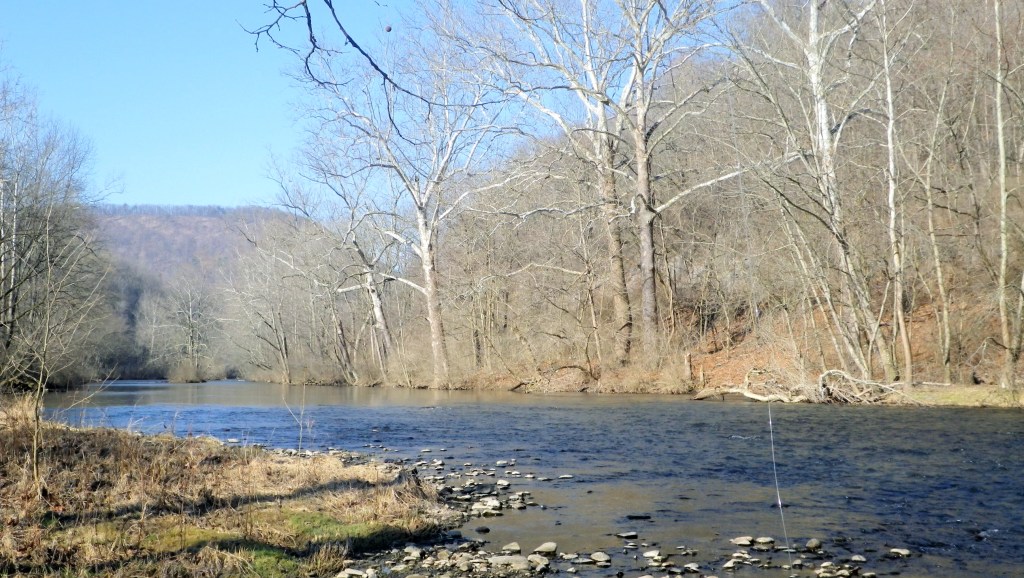
The Little Juniata River has a reputation as one of Pennsylvania’s best trout streams. She’s come a long way to earn that reputation. Coming back from decades of pollution, the stream boasted good hatches of mayflies and caddis until a still undetermined spill killed off the insect life in 1996. The river rebounded again, and the last few years have offered heavy hatches of Grannom caddis and fishable emergences of olives, sulfurs, Cahills, Isonychia and tricos.

Driving through the mountains toward the village of Spruce Creek I note the variations on my Envoy’s exterior thermometer: 45 on top of the ridges, 36 in the valleys. I remind myself it’s only eight o’clock and the forecast is calling for the upper fifties.

By 9:30 I’m wading the river and my feet are feeling the cold. I nymph slowly and painstakingly through the big riffle above Spruce Creek but nothing touches the fly. The need to warm up my feet convinces me to head to my favorite pool, and I welcome the break.

There are memories in this pool, many memories of the Grannoms that are still two months away from making the appearance that will kick start the dry fly season. The water and the gravel look dark, and the morning sun reveals only the snow flecked bare gray and brown landscape of winter.

The river banks hold patches of ice and snow in the low places, and I long for a hint of green and the dimple of a rising trout. It is understood this trip is about going fishing and not about catching trout. Dangling my thermometer as I rig a heavier tippet, I tie on a fox tail streamer before I pluck it from the icy flow. The 38 degree reading confirms my plans for the day: fishing, not catching.

Halfway down the pool I am used to the rhythm; cast to the bank, mend and swing, then twitch it gently back. To say I am surprised when the fly stops is understatement, but the pull increases as I tighten and the rod slowly throbs with life. The foot long brown is scrappier than expected in water so cold and I chuckle to myself with the thought that he’s two kinds of fish… a trout and a fluke.

Where the pool deepens to the point that the water laps at my vest pockets I stop and turn, heading back to the head where the fast current rushes past the island. Knowing better I make a few more casts into the bank, twitching the fly as the current pulls it back downstream. No more “fluke” here.

I wade slowly back around the island, sure footing it on the slippery stones to avoid a 38 degree bath. At the top of the island I throw that streamer into the pockets I nymphed earlier, with the same result. Cold feet get me thinking about a walk back to the truck and the ham sandwich I packed for lunch.

My path to the bank brings me to the tail of a deep, flat pool where I see the unbelievable dimple of a soft rise. Staring for a moment I note that I am not dreaming, there are 3 or 4 trout sipping midges in the glassy tailout.

Now the spirit of the afflicted dry fly angler is awakened, and I cut back and rebuild a suitable leader to present a tiny midge. A compound tippet works well with the poly leader butt I’ve been using for nymphs and streamers. Finishing with a long soft section of 6X, I dig a size 22 biot midge out of my spring creek box and knot it fast.

The trout are holding in inches of water, so a single bad cast will erase this magical opportunity before my eyes. I slide into position still standing in the riffle, and just below the lip of the tailout. I prepare for the cast, and the devilish wind springs up out of nowhere, and my heart falls. I have lived this exact moment a thousand times. I think of God with his hand on the fan switch, laughing.

For a few moments I stand there in the river and the darkness of unending winter begins to take hold of my spirit, then the wind calms and I compose myself, waiting tensely, even praying for another rise.

The first cast alights perfectly, the tiny fly drifts with the line of current as designed then disappears in a soft rise. The foot long brownie races toward me then away, and I am sure he will send his brethren scurrying from their exposed positions. Once again I am surprised at the trout’s vigor in this frigid river. Sliding my hand beneath him, it takes but a touch of my finger to dislodge the fly.

The frantic movements of the hooked trout have put the others on the alert but did not scatter them as I feared. The next one to rise takes a couple of casts before he is satisfied with the fraud. He thrashes wildly and the tiny hook comes free.

Another gust ripples the surface and the action dies for awhile. Eventually trout number three sips again and my cast offers the midge. This one is more difficult. The long winter has not dulled his instincts. I loose count of the casts and drifts he ignores. At last the fly and the slack of the tippet fall perfectly in his line of drift, defeating the micro currents, and bringing him to the table.

Releasing the brown I smile at the deep gold and bronze flanks, the blood red spots, and the remarkable spirit that has helped his clan thrive despite the river’s turmoil. He slides from my hand with a kick of his tail.

It takes a few minutes before the last of the four risers reveals himself. He has chosen the position where drag is all but assured, where a little rise in the stony bottom, breaks the seemingly smooth flow into thousands of swirling, dancing eddies. The best lies for the best fish I muse as I make a few cautions steps, choosing an angle to present the fly.

The game continues: a sip, a cast, repeat. I want to fool this trout, though part of me wants the game to continue indefinitely. I know this comfortable afternoon is but a tease and winter is not ready to release us.

When the perfect drift intercepts the perfect line, the trout takes the fly. Immediately it is clear that he is the largest of this little troop of surface feeders, and I enjoy every minute of his energy. At fourteen inches he is not a trophy on this river, though he means a great deal to me, coming as he does on a tiny dry fly amid the icy surrounds of a river struggling with the season.

The tailout is again calm and lifeless. Though the temperature has reached the mid-sixties the sun has hidden during the afternoon, and it does not feel warm amid the breezes crossing the cold water.

After such an interlude, I cannot bring myself to rig another weighted fly and search the bottom. I have already had the best the river will offer for the day.

Walking out I still long for April, for green leaves and grass, and caddis on the wing, but the want is less tangible. The river has smiled briefly, blown me a kiss, and I am still savoring the sweetness.

Little Juniata River

Stolen Hours

Baltimore County’s Big Gunpowder Falls

I stole a couple of hours from Old Man Winter yesterday. After days of cold and wet, stormy skies the sun brightened the mountainsides, and I headed out for the Beaverkill.

I have always been a winter fly fisher, unable to stay away from rivers for any length of time. I began this habit on the Gunpowder, the stream I have always called my first love. Much younger then, I was able to climb along the steep, slippery footpaths along the upper river all winter long and fish that lovely little tailwater for wild browns and rainbows.

I was fortunate to discover the Gunpowder at the perfect time, after the right kind of politics and a lot of hard work had developed a fine wild brown trout population. The rainbows were a surprise. I believe that some of the rainbows stocked miles downstream in the put and take reach of the stream followed their spawning urge upstream, reproduced, and that they and their offspring found the Wild Trout Management Area to their liking.

Many of those bows gathered in pods to feed on the midges and microcaddis during the autumn and winter in the couple of miles of river directly below the dam, the reach I affectionally dubbed “The Canyon”. Those pod feeders were 14″ to 17″ long and very tough to catch. My new fly tying skills were tested imitating the tiny bugs, and my presentation was upgraded by necessity.

The rainbow fishery was somewhat short lived. One day after their decline I encountered a couple of the Maryland DNR biologists in the “canyon” trying to figure out what had happened. I never learned if they solved the puzzle to their satisfaction. It was fun while it lasted, and I feel privileged to have enjoyed the best of it. The little river still maintains a healthy brown trout fishery.

I have yet to discover any winter midge activity on the Catskill rivers I now call my home waters. Water temperatures on the days I have fished have ranged from 36 to 38 degrees during the daytime. Nightime flows are another matter.

During those halcyon days on the Gunpowder I fished rising brown trout in 36 degree water during a particularly rough winter in the early nineties. That occurred within the first half mile below the Prettyboy dam where the trout tended to acclimate to the cold water discharge. The bottom release water gushed forth at a relatively steady 42 degrees regardless of season. Those experiences led me to first expect, and still hope for similar activity in our Catskill tailwaters.

It appears the colder climate here will not grant the blessing of a rising trout in winter. Still the milder days find me walking the river banks with a rod in hand. As I said, I simply cannot stay away from rivers for any length of time. I still need the energy infused as the currents wash over my legs, just as I need the freshness of the mountain air.

I carry soft hackle wets and small streamers, each tied to entice with subtle movement, the spark of life: cast, mend and swing. Still, somewhere deep in my bag or my vest there is something, a pill bottle or a little box which holds a few midges, tiny blue winged olives and an early stonefly or two. There is always hope in the soul of a confirmed dry fly man.

Night Sounds

It had been a good day. The flies had come sporadically as they do this time of year, a few bringing good browns to the surface with thrusts of spray. I had stalked each one, then waited for that second rise, poised to present my fly should it come.

As always when the fish aren’t actively feeding, there were some that didn’t come again; but there were some that did. I had brought a few to hand as the afternoon expired, and now I was sitting in the tall grass of the river bank, waiting as the last of the warm sunlight retreated over the ridge. I rested there for a couple of hours, feeling the sudden cooling of the air as the sun completed its passage, and struggling into a pullover as evening descended upon the pool.

I was restless once the sun left the water, and more than ready to see flies drifting again. Another hour drifted by before I noticed the first wings on the current, and I watched them pass on and out of site.

I had learned patience on that river bank, through fifteen years of familiarity; years when the flies did not appear, and years when the flies arrived on cue but rising trout never showed. Great years and lean years, always knowing that this was the apogee of the season, making each minute more precious whether casting or waiting.

The first eruption came down above the tailout, just one to break the stillness while the sky turned a deeper blue. I rose and walked the bank until I was fifty yards from the spot, and then slipped into the pool as gently as my stiff legs allowed.

The rise had come along the bank opposite a deep dropoff that limited my approach, leaving a 70-foot cast for the Granger where the river lapped at the bottom of my vest. I waited, begged for that second rise but it would not come. A drake drifted down the bank unmolested and I felt the cold depth of the water tighten my tired leg muscles even more.

I stood for another hour, the chill of the river working into my bones before the quiet eddy along the bank was turned to sudden foam a hundred feet upstream. My feet seemed reluctant to move, ignoring the impulses from my brain, and I felt my heart pounding.

Slowly my motor response returned and I worked into casting position just as the second burst of spray gave me a target. I dropped the fly a few feet short on purpose to check the float and the angle, then lifted it gently once clear and shot it above the mark, the rise coming like a boxer’s punch from below. Nine feet of bamboo raised into a beautiful arc and the hook pulled home.

The brown gave a fine account of himself, pulling for the deep hole I had waited in downstream, and I wished I had chosen the musical old Hardy instead of the Orvis reel with its silent drag. Twenty inches and a shade I decided, as I measured him against the long net handle before I slipped him back to the pool.

The drakes were coming more frequently by then, and I marked five rises along the next one hundred yards of river bank. It was already past eight, and I knew my time was short, though the calm surface of the pool demanded an agonizingly patient approach, stealing precious minutes with each stalk.

The second fish came short to my fly, pricked but a moment, just long enough to feel the strain of his courage before the hook popped free.

Stalking the next rise I clipped my fly and knotted a fresh one, a comparadun with tall CDC wings more visible in the dwindling light. When I reached my range the fly proved equal to the task, though that brown insisted upon a dozen casts before he was satisfied. His nineteen inches were hard won at the cost of precious time and daylight.

The pool is a favorite of mine, but the deeper bank where the good trout hold rises continuously to the top of the mountain, and when daylight fades it becomes a wall of blackness. There is no afterglow with its generous extension of fishing time.

I managed to fish to four of those five risers, landing a twenty-one inch beauty after three heavy runs against the drag. The fourth disdained my flies and ignored the numerous naturals once I had made my approach.

Little precious light remained as I eased closer to the last ring, deep in a pocket between two boulders. The spray of white water revealed his position clearly each time a drake met its maker, but the after rise vanished into the ebony mirror leaving me uncertain with each cast.

I had changed again to a fresh puffy-winged dun, liberally powdered with floatant, but I had to strain to find it each time a cast landed. I expected the explosion, and was nearly fooled when the fly I thought I was watching quietly disappeared. I reacted too hard knowing I was late, and was saved by the soft tip of the sixty-year old rod.

The rod throbbed as the boil and splash revealed the trout’s lie, and I fought him there in the darkness, backing slowly toward shallow water. It nearly ended at the net for I could not see the great fish even at my feet. When he darted away again I resumed my backing, and the next time I brought him near I could see his splashing disrupt the dark mirror. I stabbed once with the net and missed, then reached where the water boiled and had him.

I slipped the hook free as he lay in an inch of water, then measured him along the net. I felt the scalloped cuts the netmaker had carved in the handle, and the brown’s nose just past the twenty-two inch mark.

I righted the trout and walked him out until the water covered his gills again, standing there some minutes working him gently in my hands until his tail pulsed and he vanished into the mirror.

I stepped onto the bank and walked slowly up river, listening. The pool was black now, and though I could easily hear the heavy rises along the mountainside, I could no longer see the white water that sprayed with each vicious take. I stood there and listened for a while, wondering just how many trout and how many flies now worked that single reach of river.

I listened as I walked out in the dark, tracing the flashlight beam through the tall grass. After two hundred yards I still heard bombs dropping into the river, many an easy cast away in the blackness, certain that every trout in the river was feasting upon the finale of springtime.

The Groundhog Speaks

Delaware River February 3rd, 50 degrees and sunny

So old Phil says it will be an early spring and then the next day looks and feels like he’s speaking the truth. Sure the morning was cold with heavy clouds as I tramped through the slush around town, but that sun burned those clouds away and started melting the slush and snow and I just had to get out on the river!

This was my first day on the mainstem this winter. The water temperature was steady at 36 overnight down at Lordville and a degree or two warmer at Hale Eddy on the West Branch, so I figured that that gorgeous sunshine might just warm up the Junction Pool enough to wake up a fish or two. I guessed right but geared wrong.

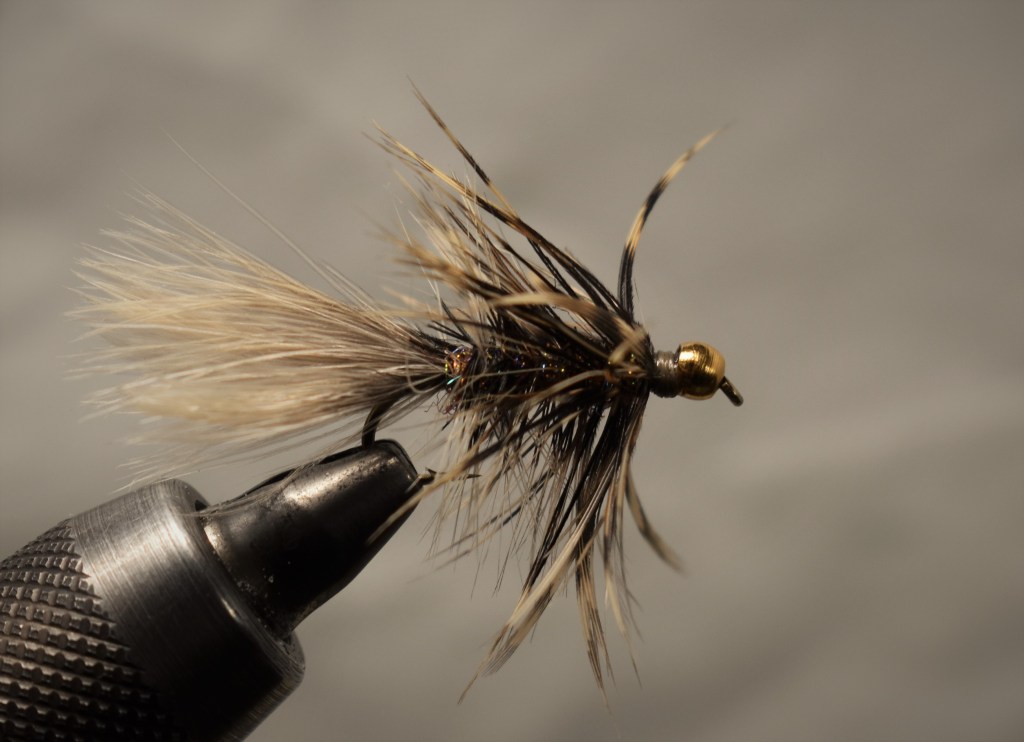
I carried the trout spey rod, rigged with a 7′ fast sinking leader butt and a weighted fly, a brand new offspring of the old reliable wooly bugger and the beautiful hen pheasant skin my friend John gave me over the weekend. I figured swinging something that would really pulse and wiggle in the soft currents, slowly presented, just might entice an old brownie to mouth it.

The fly looked wonderful in the water, but I had to enjoy another winter afternoon without the benefit of a fish.

Swinging the fly slowly downstream I saw a little blip of water along the far bank, the shallow, sunny bank where that sun had been doing its work for a couple of hours. There it was again, something stirring in the flat water! Had to be a fish!

It was gone before I could even think about re-rigging, so of course I swung my fly through the area repeatedly, to no applause. That did get my blood pumping faster for a moment.

Later, as the afternoon temperature reached its apex, I switched to an intermediate leader butt and an unweighted soft hackle Pheasant Tail. I swung that fly carefully through the tailout of the Junction Pool. Absorbing the sunshine and the energy of the flowing river I heard a call somewhere overhead and realized I was not alone. I hadn’t seen the bald eagle as he was circling directly overhead. He knows that tailout is a good fishing spot too.

Casting is a required course

For many years I worked to develop my casting skills on smaller waters. Accuracy and delicacy were paramount, and distance was not normally required. As I fished more and more on the larger Catskill Rivers, I gradually worked to increase my distance casting. The trick was to maintain the accuracy and delicacy, particularly when the winds would blow.

I was somewhat satisfied that I could make good presentations at 85 feet when I needed to though, this being fishing, there would still arise situations where I needed an extra foot or two. This scenario seemed more common when some larger fish presented themselves, often in the wind, leading to some frustration. I continued to work on my casting.

I learned a valuable lesson last year during my first full season on these rivers.

Wading through the interminable winter I decided to sell my best 6 weight boron rod. It was a pleasurable rod to fish though it never proved to be the answer to my quest for greater distance. I was offered a good price so I sent it along its way.

I never pay any attention to fly rod advertising, and, fishing bamboo as much as I do, a new graphite rod really wasn’t part of my thinking. Spring arrived at last but with a continuation of 2018’s high water. I had every day available to fish, though I couldn’t get out on the water. Reports of hatches started filtering in and still nothing was wadeable. Finally I set out to fish regardless, wading rivers at much higher flows than ever before. I caught a couple of nice brown trout but then that distance issue entered the equation.

During all of this spring mania, I began to miss my big 9 foot 6 weight and started wondering if rod makers really had made any progress in the decade since I had acquired my old rod. In talking with my friends at West Branch Angler I had heard some very favorable opinions on Thomas & Thomas’s new Avantt rods. I have always like T&T rods so I finally tried the new 6 weight and was impressed enough to buy one. Distance improved, and was easier to achieve, but that high water still kept me short of some of the places I needed to present my fly.

If you fish bamboo long enough, you will learn that fly rods can respond very differently to different fly lines. Cane rods tend to cast several lines well, and are often versatile enough to work nicely with a couple of different line weights. My experiences with bamboo led me to experiment with the new graphite. The T&T was a very powerful rod, but the half size heavy lines manufacturers push for fast action rods didn’t prove to be the perfect match.

Several years back I picked up a J. Ryall reel with a pair of extra spools, one with a nearly new fly line on it. Thankfully the previous owner had placed the little label on the back of the spool allowing me to identify the line: a Scientific Anglers Mastery Expert Distance WF6-F. A bit of research revealed that was a 105-foot fly line of standard weight for a number 6 class, so I spooled it on the reel I was using with the Avantt and headed out to wade deeper than I should once again.

I had continued to work on my distance casting technique all the while and, with the right tools, I started to present the fly repeatedly to the fish I had not been able to reach. I laid one hundred feet of fly line and a fifteen foot leader out there, kicked the slack into the tippet as I would on a thirty-foot cast, and watched my fly drift perfectly along the far bank of the river until it was taken by one of those 20″ and better browns that had been frustrating me.

The importance of working hard and experimenting with lines and rods truly came into focus during my favorite hatch of the season. The river was much higher than normal when the hatch got going, and there were a lot of anglers out despite the conditions. There were good browns eating Green Drakes, and the best of them were close to the far bank. The other fishermen seemed timid to wade very deep and, with no more than average casting abilities, they simply could not fish to the risers along that far bank. I saw only one angler out of ten manage to hook a fish, though he lost it in short order.

In a pool full of fly fishers, I was the only guy that could fish to those rising trout. I landed four of them, all more than twenty inches long. Many of those guys saw me catching fish, and none of them even tried to cast their fly past mid-river. I guess they simply admitted defeat, feeling that same frustration that I used to when I came up short.

When I guided and owned a fly shop I talked with a lot of fly fishermen. When I saw them on the stream, most proved to be very marginal fly casters. The surprising thing was, they wouldn’t do anything about it. I offered free casting lessons to a lot of folks back then, and it amazed me how few would take me up on my offer.

Fly casting is a lifelong learning experience for those who are passionate about their fishing. I am certain that all of us want to experience more of those remarkable days, the days when we solve all of the puzzles and make all of the difficult casts. I for one will never stop learning and working toward improving my skills; the rivers won’t let me.

The Art of Bamboo

Tools of the trade

My earliest exposure to flyfishing came at the age of 5, watching my grandfather cast his big bamboo rod in the yard in Maryland. He showed me how, but it was too much for my little hands and arms at that age, though a seed was planted.

Decades later my Uncle Al passed Pap’s rod down to me. It had languished in a closet for ages, so I found a gunmaker who had a talent for restoring old rods, and eventually fished it on the Deerfield River where Pap had angled. The Royal Coachman was his favorite dry fly, so I tied a few in size 18, using them to take trout on the rod from the riffles of his Deerfield.

After moving to Chambersburg in Pennsylvania’s Cumberland Valley I met Wyatt Dietrich and was immediately enamored with his hand crafted Dreamcatcher rods. I recall meeting along the Falling Spring and casting several of his rods to choose the taper for my very own custom Dreamcatcher. That rod was my first bamboo rod to be fished in the Catskills. Upon taking the cap from its tube the fragrance of varnish brings a flood of memories.

My interest in fishing bamboo continued to grow when I met Tom Smithwick at my fly shop. We bartered and I became the caretaker of a magical 5 1/2′ one piece rod that saw action on the Falling Spring and local brook trout streams. Tom earned a nickname with me as “The Taper Wizard” thanks to his alchemy with cane. Over the years I have cast many Smithwick rods and been amazed by all of them.

Eventually I developed a casual interest in classic rods, delayed when my first impulsive attempt at purchasing one went somewhat awry. I made some contacts after that experience and began to learn about Goodwin Granger and his classic Colorado flyrods. Conversing with author Michael Sinclair, and studying his wonderful book tracing the history of Goodwin Granger and his company, left me wanting even more to fish a Granger rod.

During the frigid winter of 2014, I made good on a second attempt to acquire a fishable Granger. That rod opened me to the added dimension of history, and the delicious excitement of angling with tackle older than myself, wondering with each cast which rivers my rod and reel may have visited. That Granger Victory accompanied me to the Catskills and was duly baptized on the storied Neversink. We have taken many fine browns since that day.

During the summer of 2018 I had the opportunity to refresh a friendship from the past. John and I had lost touch for more than 20 years after meeting and fishing together at my little fly shop in the Cumberland Valley. From that first renewing handshake beside the East Branch, our friendship has continued as if those intervening decades had been moments, and last spring I passed that Granger rod on to him. May it create new stories in his capable hands!

I bought a second Granger from a friend at West Branch Angler. A rod bag was needed, and Ben put me in touch with Dennis Menscer here in Hancock. Dennis is a miraculous rod maker, one of the very few who crafts the entire rod. Not only is he a wizard with cane, his metalworking ability shines in his hand wrought reel seats and ferrules. I have missed many hours on the river during my Catskill fishing trips since our meeting, sitting in his rod shop or his kitchen talking of bamboo as interwoven through the history of Catskill fly fishing.

My Dennis Menscer 8 foot Hollowbuilt, and a memorable Delaware morning

Being fortunate to meet and come to know such talented rod makers as Wyatt, Tom and Dennis has enhanced my love of fishing cane, and thus my love of fishing and life itself. It is difficult to describe the magical connection between angler and trout as transmitted through an arch of polished bamboo!

The sheer pleasure of casting a bamboo fly rod must be experienced to be fully appreciated. There is a liveliness and a smoothness not present in the stiff synthetic rods so common today. At the strike, the wild energy of the trout passes along that arc of cane and through the heart of the angler creating one living being!

Each time I walk along the river the rod maker walks with me, so too the spirits of any who have angled with that particular rod in the past. Classic cane fished upon classic rivers connects us through time.

A River Walk

I like to take my winter walks down along the East Branch of the Delaware, down at Crooked Eddy. The sunshine the other morning got me out and about early. There is something about that sunshine, even on a fifteen degree morning!

The river was bordered by ice along either bank, with slush flowing down the main run of current, courtesy of the current cold spell: it was seven degrees at six o’clock that morning. I walked briskly and warmed right up in my down jacket, enjoying the simple beauty of a calm, bright winter morning.

Most of my daytime hours have been spent here at the tying bench, or kicked back with my winter reading. The books have fueled my interest with classic Catskill flies and tiers anew, so I have been tying a few of those. Yesterday it was the Cross Special that caught my fancy.

I was fortunate to have secured copies of the late, great Rueben Cross’ classic little tomes “Tying American Trout Lures” and “Fur, Feathers and Steel”, purchased from the collection of the late Terry Finger. Mike Valla talked about Mr. Finger in “Tying Catskill-Style Dry Flies” (Headwater Books 2009). As Valla learned to tie flies from the legendary Dettes, so too the young Terry Finger learned to tie flies from legendary Catskill fly tier Ray Smith. In both men, these early influences shaped their lives and passions for fly fishing in the Catskill tradition.

I appreciate how much those experiences mattered to both young men.

I started my own fly tying with a class taught be Joe Bruce, a well known Chesapeake Bay area fly tier. Once I started, my quest for knowledge kicked into overdrive, and I availed myself of every opportunity to learn from a master tier. Larry Duckwall, a student of Elsie Darbee, taught me to tie the Classic Catskill style, Ed Shenk walked me through his historic spring creek patterns, Gary LaFontaine revealed the techniques for his Emergent Sparkle Pupa as well as the theory behind his innovative fly designs, and A.K. Best instructed me in crafting delicate quill bodies and parachute dries.

Many of these encounters occurred through local fly shops and the first Fly Tier’s Symposium held in western Pennsylvania nearly three decades ago. That was an exciting time! That symposium exposed me to countless ideas and techniques. Rather than the overtly commercial atmosphere common to many trade shows, the energy of that weekend was centered upon sharing our passions for fishing.

Shenk and LaFontaine became the greatest influences on my own developing ideas for fly design. I recognized that movement within the fly itself was the key to imitating life. Ed taught me to tie with soft materials using techniques that allow them to move with each subtle stirring of current, while Gary championed unique materials that would subtly reflect light to mimic actual movements.

Turkey Biot Quill Gordon

I took my newfound knowledge and enthusiasm to the stream as I fished, collecting a sample of each hatching insect I could catch, choosing materials and blending dubbing to match the color and translucence of the naturals that excited the trout. Through it all the passion grew.

Years on the water have reinforced the idea that simple flies can work wonders! Too many times the solution to maddeningly difficult trout feeding upon tiny flies has been nothing more than a few wraps of thread and a wisp of cul-de-canard.

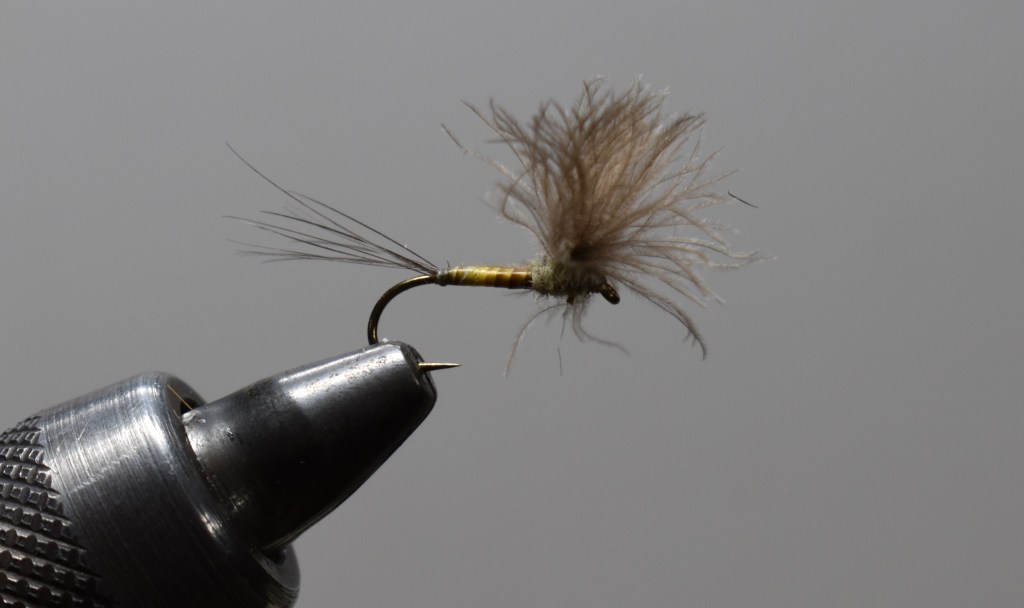
Last summer I re-discovered the beautiful silk dubbing made by the Kreinik Company. Tying a simple sulfur with a tail of hackle wisps, a silk body and a CDC puff created a wonderfully translucent, lifelike fly! The hard fished wild browns were convinced, choosing them when they shunned other more involved patterns.

It seems that many of the current hot fly tiers are building very involved patterns. I certainly respect their ideas and execution, but the trend runs contrary to my own way of thinking. I once watched a very famous English tier build a “model insect” at a demonstration. The fly was a work of art worthy of display in any fine collection of sporting art. If I recall, he told me it takes him about an hour to tie one of those flies, and he intends them for fishing. The gentleman no doubt has a tiny fly box. The detail in that stonefly was extrordinary, but it was hard and unyielding, making me wonder if it would actually catch many trout.

I never tried model insect building, and now, with carpal tunnel assaulting my hands I most certainly am not going to start. A few summers ago I landed a deep bodied wild brown trout that stretched the tape past 25 inches, my Catskill best. I worked on that fish for some time. Selectivity and an impossible lie made for quyite a challenge. What did he finally take? A size 20 CDC ant tied with two bumps of black muscrat dubbing, two turns of hackle and a tiny puff of cdc. Simple.

Dreaming…

The sun hasn’t risen yet here in the Catskills and I already have nearly half a day under my belt. Wide awake at three o’clock, and nowhere to go. One weather outlet claims it is 7 degrees outside, but I haven’t ventured out onto the porch to check my own thermometer. I think you will understand why I defer.

Restlessness is a frequent companion at this time of year, and sometimes it intrudes upon sleep. I need to get out, despite the cold and the snow squalls, just out!

I should wander over and visit my friend Dennis Menscer. I have had some wonderful talks with Dennis, as he is a wealth knowledge regarding life in these mountains, the rivers and the people who helped make up the lore of Catskill flyfishing. I especially enjoy his stories about the classic bamboo fly rods and their makers.

I feel a little guilty about stopping by just to visit, for Dennis makes some of the finest bamboo flyrods in the world. Invariably he will be working when I stop by; either building new rods or working his magic in restoring one of those classics so they might again do battle with Catskill trout. Please understand these are not five minute conversations I am talking about, they easily span four or five hours, yet I always leave wanting for more: friends and shared passions!

I can’t help but feel that I am depriving someone of time on the water with a new Menscer flyrod when I take Dennis away from his work simply to enjoy his company. I hold a certain reverence for the rod makers I know.

Yesterday I started tying boat flies for that longed for spectre of spring. If the past three seasons are any indication, there will be plenty of high water to deal with, but this time I will be ready. Boat flies are a little different from the usual contents of my vest. I tie and fish a lot of CDC patterns for selective trout on flat water, but they can be frustrating to fish from the boat. Drift boat fishing involves almost constant long casts downstream and extended floats which require stripping the fly upstream over and over, drowning even the best CDC feathers.

I tie a pattern I call the “poster” that is ideally suited for drift boat fishing. Posters have a single upright wing post tied with Antron yarn, and they are hackled like a typical Catskill dry fly. They float well on choppy water, they are easier to see on the water at distance, and they catch fish. Find a picky riser in a quiet pocket that demands a low floating imitation? One snip of the scissors and the poster rises to the challenge.

I tie other patterns a little differently when I tie them for the boat box. My drift boat parachutes have 4 or 5 turns of hackle rather then the customary two, and the CDC flies will have extra full and fluffy feathers that can stand up a little better to the repeated dunking. The sparseness I prefer takes a back seat to durability.

Filling that fly box helps me get a little closer to springtime.

It is easy to sit back and daydream, to walk the rivers of my memory…

It was a gorgeous May afternoon, perfection after a day of cold, howling winds that made it unfit for even the most ravenous fly fisher. That first day of my spring trip to the Catskills had been more punishing than the entire winter, but the second day was blissful!

I wandered the banks of the Neversink completely alone, and I reclined on the grass to revel in the luxury of sunshine and solitude. The I watched the pool for a while, fingering the old Granger on my lap, and waited for a rise.

There was a large flat topped boulder near the middle of the river that drew my attention, and it was there that I saw the first Blue Quills bouncing on the roll of bright current where the far edge of the boulder met the flow. As the minutes passed, the flies became more numerous and at last a gentle ring appeared along that rippling edge. I knotted a Blue Quill to my tippet and eased into the river, working slowly within casting range for the 60 year old rod in my hand.

The Granger offered the little dry fly gently, but the trout wasn’t yet feeding in earnest. He sampled only a pair of the naturals during the twenty minutes I waited in the cold water, showing no interest in my fly.

Larger flies began to show, Hendricksons that promised more enticement for the object of my desire, and the promise was fulfilled. The rises came again, still soft, but with a telltale bulge in the surface that quickened my heartbeat. My first offering was a classic Catskill tie, fitting for the tackle and the river, but ignored by my quarry.

There are probably more different patterns of fly in my Hendrickson box than any reasonable man would carry, but I love this hatch and anticipate it like no other. I selected a half and half style CDC emerger that rides with its’ wing awash in the film, tested the knot an extra time or two, and lifted the line into the air behind me.

The first cast alighted, drifted and was ignored; the second was taken with that soft bulge and dimple, and spring arrived with a splash and a surge for deep water. The Granger arched deeply as the Perfect sung its welcoming verse, and I stepped down and across stream to angle the fish away from the protection of the boulder. He ran freely then, heading for the rocky bank across the river, but the pull of the rod turned him, bringing him to midstream well below the rock he had chosen for his table.

The clear water revealed a gorgeous brown as I drew him closer, but he was no where near ready to succumb. I tensed each time he pulled that deep arc in the old cane rod, fearing some unknown fault might allow the heavy fish to escape, but the old classic proved more than equal to the task.

In the net I marveled at his color, then gently laid him along the long net handle on the grass. He reached the twenty inch mark and a bit more, so I hurried to snap a photo of my old Granger’s first Catskill brown.

A memorable moment, a day so cherished and beautiful it was a fit reward for enduring the long, brutal winter, and the perfect way to open a new season on the rivers of my heart.

Granger called this model “Victory”. Indeed!

Yes, it is so easy to sit back and daydream…

Tying Season

Winter has returned to the Catskills with a dusting of snow and a hearty blast of frigid temperatures. It was just midweek when I enjoyed a good long walk through the grouse woods with forty something degree sunshine and a glorious blue sky. Now the forecast maintains we won’t get above freezing for a while. It is back to the tying desk for me!

I have been working with a few new ideas off and on over the past year, always trying to capture a bit of life in the flies I offer to our wary wild trout. Often this amounts to a little pattern tinkering with the hope of improving a reliable design.

One such fly is a Green Drake dry fly I call the 100-Year Drake. The general idea was not my own, it was born of a chapter in an enjoyable book entitled “The Legendary Neversink”, edited by Justin Askins (Skyhorse Publishing 2007). There is a chapter in the book called “The 100-Year Fly”, authored by Phil Chase. It seems that Mr. Chase had been inspired by the early Theodore Gordon flies tied with a single clump of wood duck flank feather barbs, and had adapted that style to a parachute dry fly.

I had likewise studied Gordon’s style and, sometime after reading of Chase’s experiments, I began my own. I felt that the reclined wing style was particularly suited to the Green Drake duns that provide the most intense and thrilling angling of the year. There have been a number of variations on the theme in the seasons since I tied the first such flies, and it has been proven time and again on the Catskill rivers.

The 100-Year Drake is particularly suited to deceiving those big, educated brown trout that refuse or ignore all of the other drake imitations I might offer.

The 100-Year Drake
\

The new version retains many of the materials from my best previous ties: heavily barred wood duck, Charlie Collins’ Golden Grizzly hackle, dark pardo coq-de-leon split tails, and turkey biots in Green Drake or Cream colors. The enhancements involve a few tweaks I am trying to increase translucence, both with dubbed bodies and the biots. One of these fooled a heavy 22″ brown on a bright day late in the drake hatch, a fish who had ignored a lot of naturals that wiggled right through his window, to say nothing of a good dozen well presented imitations. Translucence is my watchword for fly design this season!

I have threatened to design another 100-Year Dun over the past few seasons, the March Brown being a prime candidate. This mayfly carries its wings slanted back as does the drake, so it seems to be begging to be tied in this style. Our March Brown hatches are quite variable from year to year, so it might take a few seasons to give the fly a proper trial by fire.

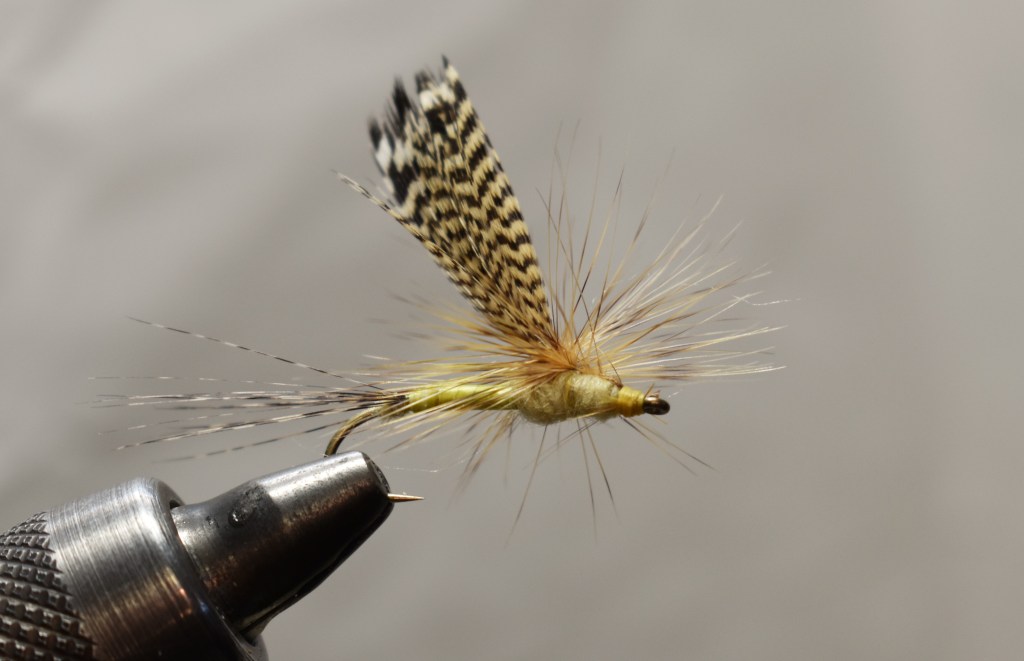
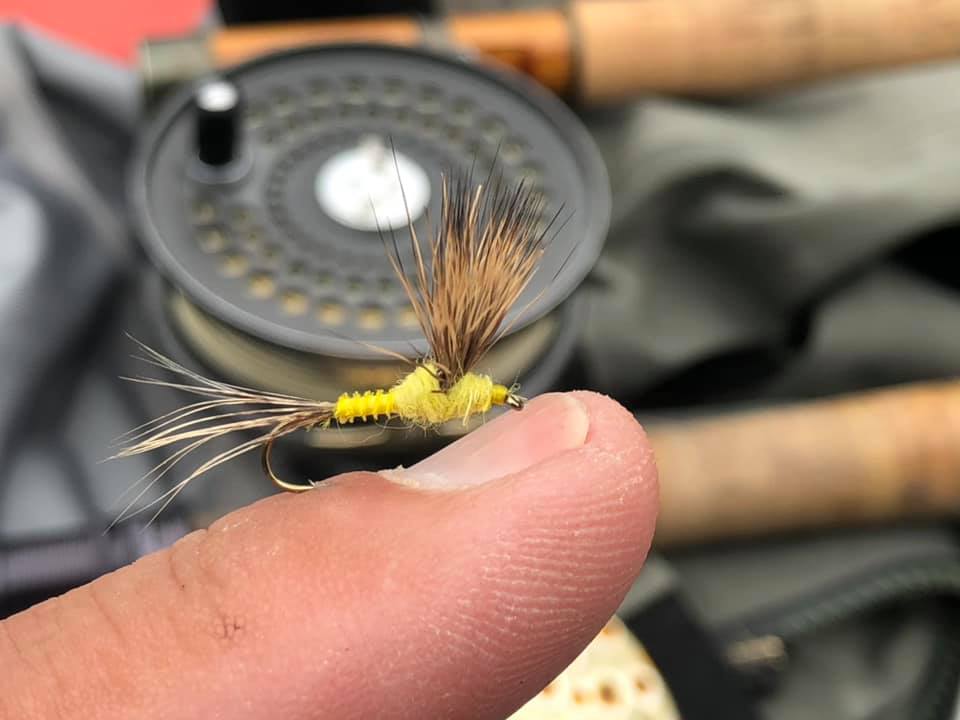
The strangest March Brown I have ever seen appeared on the Beaverkill this spring. The trout were ignoring the traditional amber and pale yellow colored flies, while taking the live duns heartily. As we were leaving, Mike Saylor picked one up, the only fly we captured that day. My best description would be “road sign yellow”. It had the heavily blotched wing one expects, and it carried them at a rearward slant, but they were the brightest mayflies I have ever encountered.

Photo courtesy Matt Supinsky

It wasn’t just a fluke that day, because I tied the monstrosity above and caught those fish for the duration of the hatch with that godawful bright yellow bodied comparadun and a similar parachute. I have seen this mayfly in amber (what I think of as caramel tan) and a pale tannish yellow, but never in day glo yellow. The flies looked very strange to us but the fish obviously weren’t put off by them, even showing selectivity to the bright color.

Mark’s Cricket 2020

The new cricket has taken shape, after waiting impatiently for some 1mm razor foam to arrive via mail order. There are two color variations at this stage, and either one or both may win a place in the terrestrial box this summer. The decision is up to those “disappearing” trophy trout.

Though the winter fishing I have been doing has amounted to swinging soft hackles and little streamers, I have been rounding into dry fly mode at the bench. I keep hoping that the first taste of fishing a few of those dry flies isn’t going to be three and a half months away.

Last winter I ran into a few early black stoneflies hatching on the West Branch. I searched so hard for a rise I think I may even have hallucinated one; just one. I spent too many winters fishing limestone spring fed waters where there were fish rising all winter to midges, little blue-winged olives, and some of those same black stoneflies. The water in our Catskill rivers is a bit colder, and I have yet to encounter a midge hatch. Still there is hope with a more stable flow regime so far this winter.

Last weekend we had a couple of days that warmed up to the low sixties. This was warm air, as it was windy with heavy cloud cover most of the time. The tailwaters jumped from 35 degrees to 43 degrees, so I can’t help but imagine what might happen if another little zephyr of unseasonable warm air wafts through accompanied by some sunshine.

Maybe I should get to tying a few midges and stoneflies…