Last day of a week that felt like autumn has already arrived and, I think I’ll go fishing.
I carried the Maxwell Leonard 50 DF yesterday, amazing myself with how beautifully it casts. I had to keep backing off on my power stroke, and watching the line simply sail out there. With a faster action than many bamboo rods, it is easy to punch this Leonard a little too hard, and that is counterproductive. My wrist fished graphite for too many years, and muscle memory lasts, confound it!
I tried a couple of rivers, taking five trout on an Isonychia pattern 100-Year Dun. Still, there was no sign of even one of the larger trout I seek, but I truly enjoyed the day. The latter portion of the afternoon was particularly blissful. The sun, revealing itself from the passing cloud banks and warming my back, caused me to turn and take in the sight of the river below: sanctuary for the soul.
Power, and grace!
Summer returns this weekend, the milder Catskill Summer I cherish, with highs from the mid-seventies to the low eighties, cool nights, and a bit of rainfall here and there, giving the freestone rivers a chance to hold onto the fishable temperatures this autumn interlude has provided. May it be so!
I may try a two-river approach again today, continuing my search for the missing leviathans, and taking advantage of this taste of gorgeous weather.
Funny how weather works. The Southwest is assaulted by record heat, while here in the Catskills today will struggle to peak near 65 degrees, as if they took our warmth to add to their heat wave. The change is pleasant here. I grabbed a fleece jacket this morning before sitting down at my desk, the windows remaining open overnight. Summer still, and the low tomorrow morning could reach the forties.
It brings me back more than forty years, to family vacations in Massachusetts’ Berkshires. We felt the crispness of August there with sunrise temperatures in the thirties. My aunt and uncle had found a little cabin on a mountainside, and a climb down the steep bank brought me face to face with a beautiful stream. Nature had provided a bountiful supply of wild brook trout in those crystalline waters, and I enjoyed two for breakfast as a special treat that next morning. Two fish was my vacation limit, and the following summers proved the worth of my stewardship. Taking a pair of seven-to-nine-inch brookies, once a year, guaranteed there would be more of like size next year.
I bought my first fly rod on that trip, though it was suited to Maryland’s warmwater ponds, not to that lovely trout brook. It started me haltingly on a path I had sought since boyhood. Ah, the memories a chill summer morning can stir! I have hope it will stir our Catskill trout as it rouses my instincts, spur them back to feeding with the flood flows now vanished from these mountains.
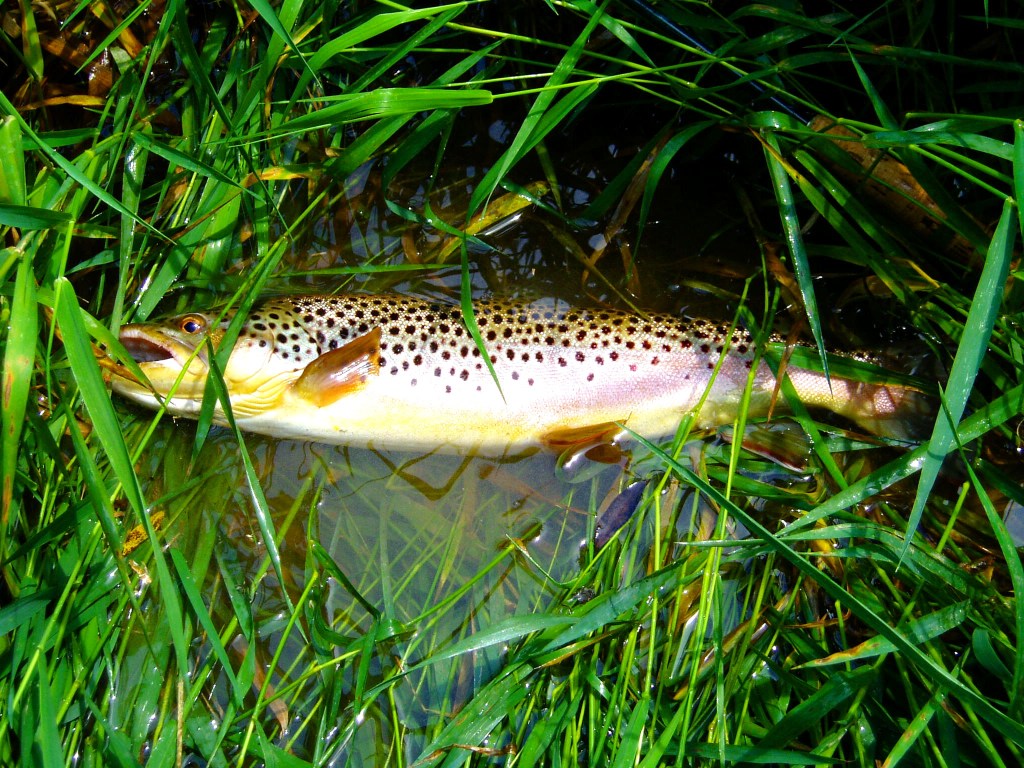
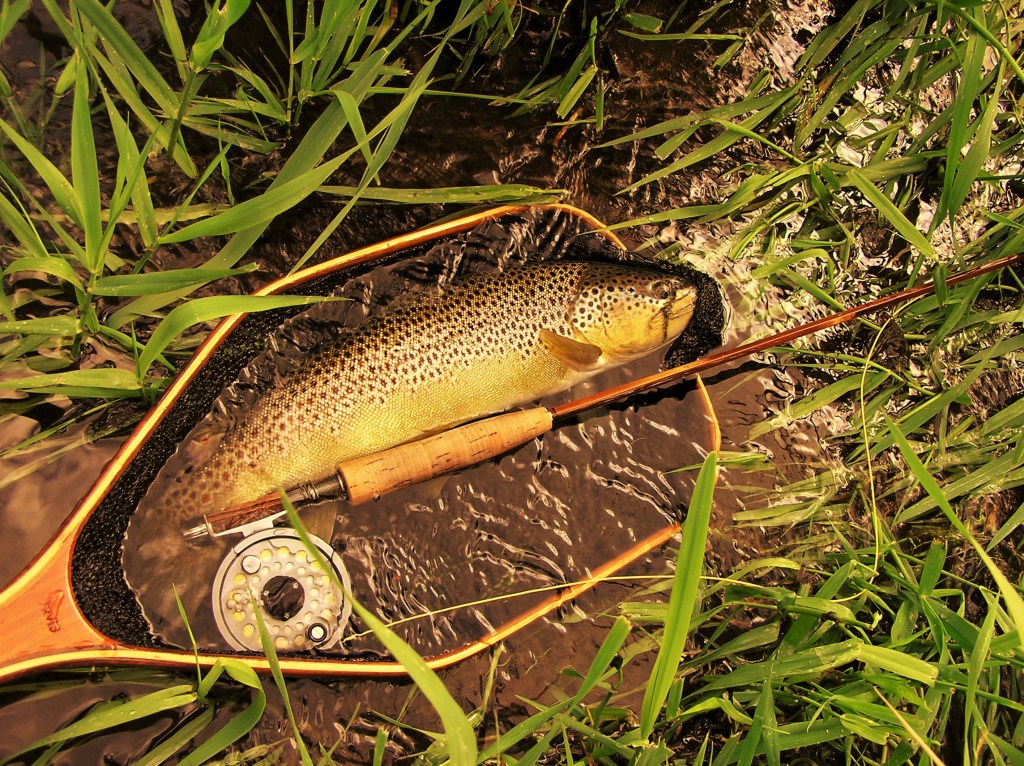
An autumn brown.
I am checking the wind forecast and pondering my tackle choices. My friend Dennis Menscer’s 8-foot hollowbuilt rod seems destined to accompany me today. I need my bamboo fix after wandering fruitlessly yesterday with a soulless graphite rod. The Menscer is known to bring good luck!
One of my Menscer Moments: A Beaver Kill brown exceeding 24 inches, taken on a blustery spring day!
I was reading a while ago, sifting through a fellow angler’s thoughts of autumn. As we pass high summer, such thoughts are never far away…
There’s the cooler air ushered in by that hurricane system and, though interrupted, seems to be lingering here in our Catskills. There is even that first tinge of yellow among the trees, quite early, brought on by the long, hot drought of summer’s first half followed by a decided surplus of rainfall. I am caught still wondering about the fate of my summer fishing and feeling the initial pangs of the inevitable season’s end.
Three seasons here can be quite ephemeral, offering up everything from classic spring sunshine to May snow squalls to begin the angler’s year, while autumn and winter can easily throw most anything at us on a daily basis. Summer is a given, or at least I like to think of it in that way, though one that can be stolen away for a time at Nature’s whim.
This weekend is one of those somber ones, rainy weather with little actual rain, but still the dark foreboding feeling of lost time, missed opportunities. I got back to fly tying yesterday, after a brief hiatus, replenishing my terrestrial box and working to finish a gift box for an esteemed visitor. I will likely tie some more today.
Still, I am trapped by my thoughts of a season waning. More than a month of summer remains, yet the uncertainty of weather and river flows seem to overpower my optimism for the season. There was a glimpse of sunlight in my window just now, Nature’s rallying cry, and I shall do my best to seize it, to tie those hoppers and ants and plot a new adventure!
The post-flood fishing has been a journey of discovery kind of situation, although I cannot say I have discovered anything more than the fact that the quality wild trout I prefer to hunt seem to have vanished from their likely haunts. Obviously, a blank day of fishing doesn’t mean the trout are not where you are looking for them, however a run of days with compromised water conditions and a complete lack of clues, as well as trout leads to a firm conclusion.
Larger trout have a lot more mass and surface area then the average foot-long fish and flood flows lead them to seek the cleanest water they can find and larger current breaks. The kind of cover that holds such fish under normal flows may not be sufficient during floods, even if we think it is. Little fish can tuck themselves behind smaller obstructions than big fish.
This is all just another facet of the puzzle the angler faces each day on the river. Water temperature, fishing pressure, predation, cover, depth and the availability of food can all change with water flows, and floods are one of Nature’s tools to create change.
I was talking with another angler a few days ago, and he was expounding on all the rises he was seeing. I dismissed these as little fish, eating little bugs. He asked me if I had caught any of them, stating that big trout can make very small rises. I didn’t feel like getting into a long discussion on reading rise forms, so I simply told him I did not bother with them.
It is true that large trout can feed with negligible riseforms. I have caught a number of them over the years that betrayed no riseform at all. Have you ever had your floating dry fly simply vanish? No ring, no bubble, no little spurt or splash or bulge, just there one second and gone the next while you are staring directly at it – this is what I am talking about. I once watched a gorgeous twenty-two-inch brown trout roll halfway onto his side and drift up toward the surface and suck down a caddisfly into the side of his mouth without a trace. He was six feet away from me in crystal clear moving water. I know his size because I cast to him and caught him once he slid back upstream a dozen feet to find another caddis.
Big trout or small? Yes, it was indeed another good one, twenty-inches give or take, sipping those tiny olive duns which appear as out-of-focus specks of gray.
Reading riseforms is a vital skill to cultivate if you wish to spend your precious stream time fishing for larger trout. After more than three decades, I have become pretty good at it, but I misjudge a trout every once in awhile. Just to check my judgement, I did a little experiment at the close of my fishing yesterday.
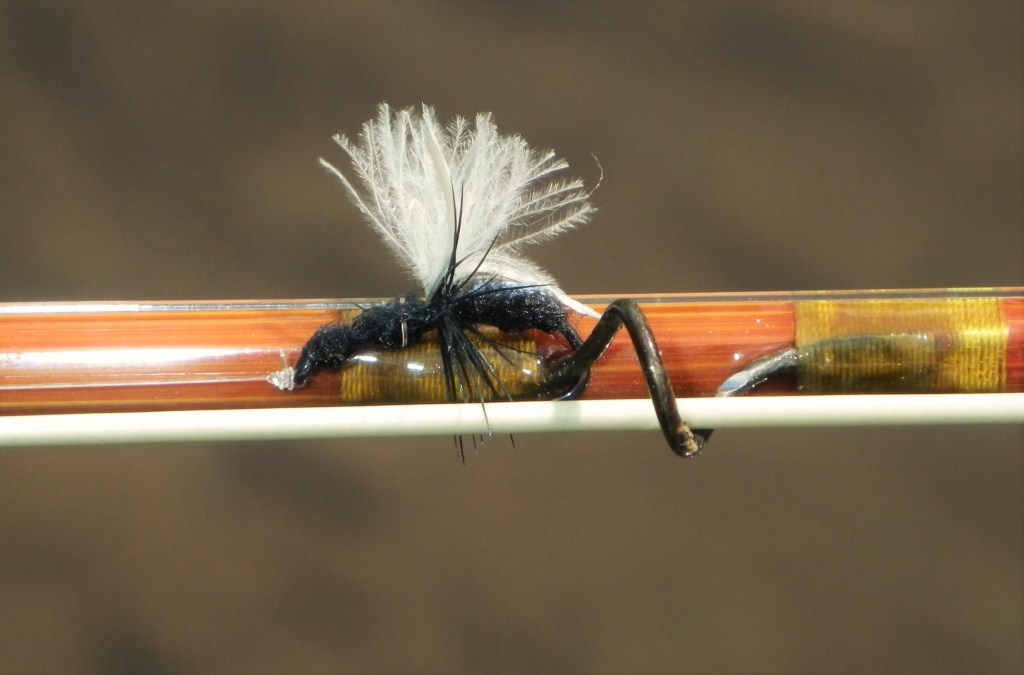
The river had been lit up with soft, little riseforms for perhaps an hour. I had watched them and determined that there were no quality fish feeding, but the little guys were having a field day. I had removed my sunglasses and checked the surface, smiling when I found tiny black flying ants adrift in the film. They looked to be about a size 22, and some where smaller still. I had none with me, the trouble with my depth perception making it not worthwhile to bother with flies I couldn’t see to tie on. I am out more days through the season than most, and I only encounter a nice ant fall once or twice every couple of seasons. I did have a size 19 foam ant with a grizzly hackle between it’s gaster and thorax, and I figured it might be just close enough.
I stood in the middle of the river and cast to riseforms, choosing the ones that looked a little better than most, and I caught and released seven wild brown trout on that ant. All of them were right around seven inches long. Yep, little fish eating little bugs, just as I thought. I hope I am still around in four of five years when those youngsters grow up. Maybe they will still eat that little grizzly hackled ant that isn’t quite small enough to match the naturals, but is just big enough for me to see to tie it on.
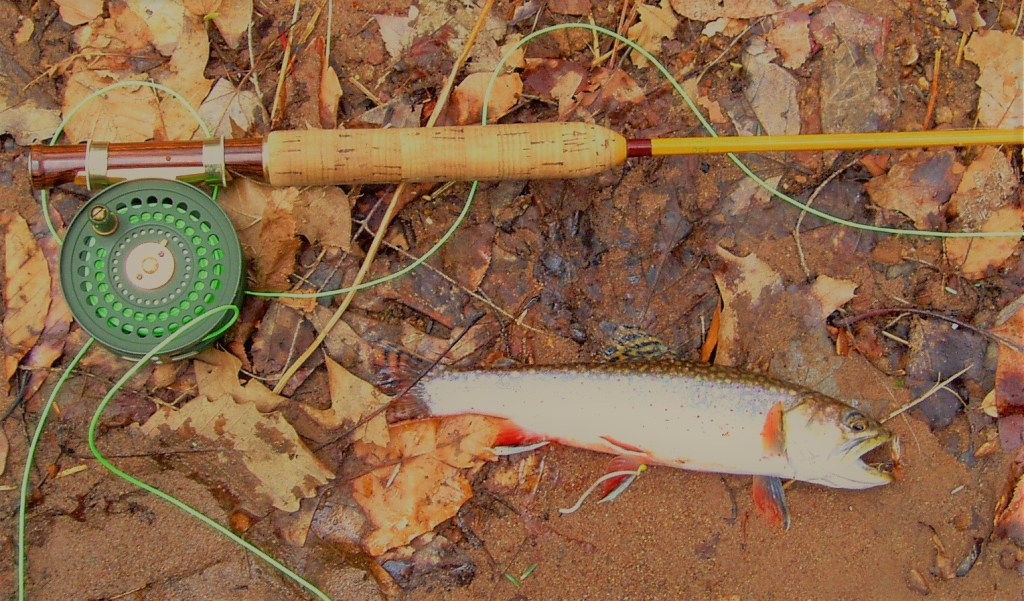
Rod by the Taper Wizard, Tom Smithwick; Royal Wulff tied by yours truly; Brook Trout by Ma Nature.
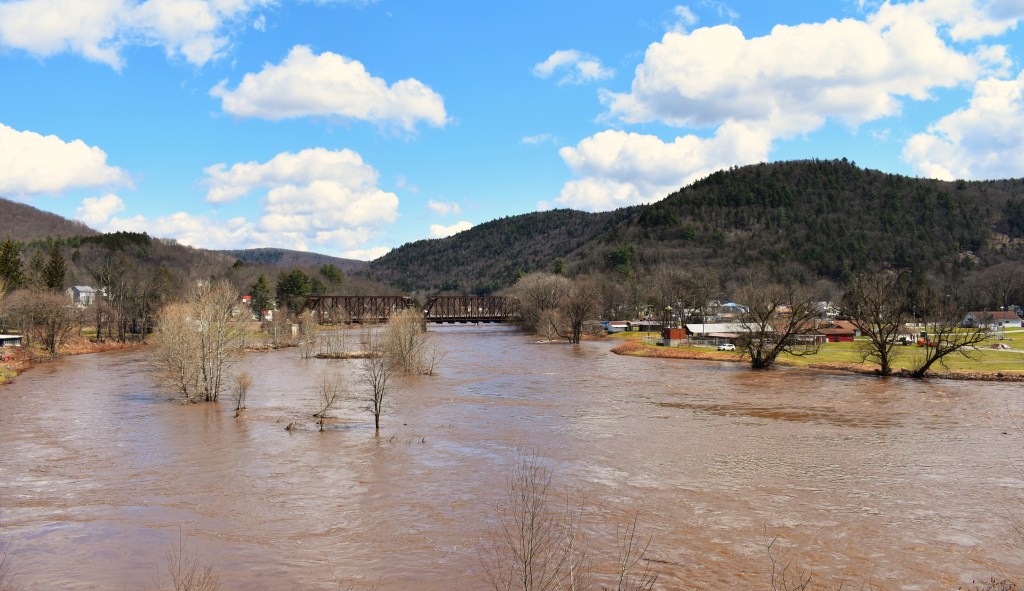
Debby’s rains came through Hancock in waves yesterday, accompanied by swirling winds and warmer tropical air. Our western Catskill rivers in the Delaware drainage flooded accordingly, and all are now receding. On April 8, 2022, when the photo above was taken, the gage height at Fishs Eddy, NY reached a crest of 14.8 feet. Last night after 10 PM, that gage recorded a crest of 14.5 feet with a peak flow of 29,600 cubic feet per second. A spring flood and a summer, tropical hurricane system flood, both bringing eerily similar results to Crooked Eddy.
This storm system brought flooding to the rivers and tributaries above the NYC reservoirs as well as to the tailwater reaches below. There will be some refilling, but it will take some time before we anglers see if that results in increased releases and better fishing through late summer, as it will take a lot of worrying and number crunching before NYC determines how that affects their schedule for the Delaware Aqueduct repair. In short, as always, Mother Nature rules.
The flow here in Crooked Eddy itself is unknown, there being no river gage in Hancock. Fish’s Eddy lies several river miles upstream, mountainous, winding river miles that receive a great deal of additional runoff. The Lordville, NY gage, the next in line, lies miles downstream on the Mainstem. Lordville’s gage recorded a crest of 17.73 feet, just short of the 18-foot Action Stage, the river flowing some 43,900 cubic feet per second.
All of these numbers mean there will be no fishing for something like a week. After that 2022 flood, I was able to return to a still high Beaver Kill on April 13th when a few representative mayflies were seen. No trout rose and no actual fishing occurred until April 15th when a ten-minute hatch caused one brown trout to rise. That fish became my first dry fly trout of the season.
For this hardened old angler, a week off is easier to weather in midsummer than it is at the end of a long winter. There is a trip to the cardiologist scheduled, my porch deck is due to be painted, and the lawn will need to be mowed once it dries out. Fun stuff!
As that week crawls along, I will begin to fiddle with tackle, tie a few flies and think about fishing once the work is done. Hope will be growing as the rivers clear and recede…
Debby is coming, or perhaps she isn’t. Weather forecasters are falling all over themselves to predict the path of the unpredictable. On it’s face, this storm looks to be a reservoir filler, but then again some of those weather maps show the bulk of Debby’s rainfall to the west of Binghamton, while others foretell a curving path toward the coast. I would like to see some water entering the reservoirs, perhaps forcing NYC to make up their minds regarding their twice postponed Delaware Aqueduct project.
This marks the third season that Catskill anglers have had this hovering over our heads, adding more uncertainty than even Mother Nature delivers when it comes to our precious trout rivers and fishable flows. Low flow has predominated since early May and the fishing has been difficult under the extended heat the Catskills have experienced. Should the reservoirs refill, and the city decide to proceed with the project, reservoir releases should improve along with fishing during the second half of summer.
Currently, Cannonsville retains 64.9 percent of it’s capacity, well below NYC’s stated 70 percent threshold required for the October first shutdown of the aqueduct. Percentage of capacity for Pepacton, Neversink, and Rondout are 81.0, 74.8 and 92.9 respectively. There has been no official statement published since 2023. Flows from Pepacton and Neversink remain low, and both of these tailwaters would benefit from a significant increase. Rondout is the catch basin, feeding water from the other, larger reservoirs directly into the Delaware Aqueduct. Recent rains have fallen below the reservoirs’ drainage areas, temporarily raising the tailwaters with warmer runoff, and failing to improve the fishing.
Gifts of a rainy day float.(Photo courtesy Capt. Patrick Schuler)
What will Debby bring? We may only wait and see. At least this week’s rain and cooler temperatures have spawned enough runoff to wash the heat from the rocky bed of the Beaver Kill. No, that doesn’t mean that historic river is fishable, but the runoff is cooler for the moment, giving the surviving trout a little break from hunkering in hidden spring seeps. Sadly, I actually saw one poor fool fishing there last Saturday morning on my way to Summerfest. The river conditions? One hundred ninety-nine cfs and 72 degrees, on it’s way to 76 by mid-afternoon.
I am still waiting to try some brook trout streams with the beautiful little bamboo rod my friend Tom Smithwick gifted me. I would love to see a nice flow in the high country!
I can hear the rain, nearly stopped now, dripping on the metal roof. Despite the forecasts, the Catskills continue to be deprived of their most precious ingredient. Brief, gentle showers fall upon us, teasers for the day-long rains our rivers desperately need.
The fishing has changed once more, trout and angler alike holding our breath perhaps to discover what high summer holds, as well as that all too rapid descent into autumn.
In one of those rare years when we have an abundance of rainfall and cold water, August fishing can be amazing for those who study the rivers and all of their moods. I do not pretend to know the science behind frigid dam releases and bounteous extended hatches of mayflies, but there is clearly a threshold uncrossed in hot, dry summers like this one. The little showers and haphazardly passing storm cells fail to open those doors.
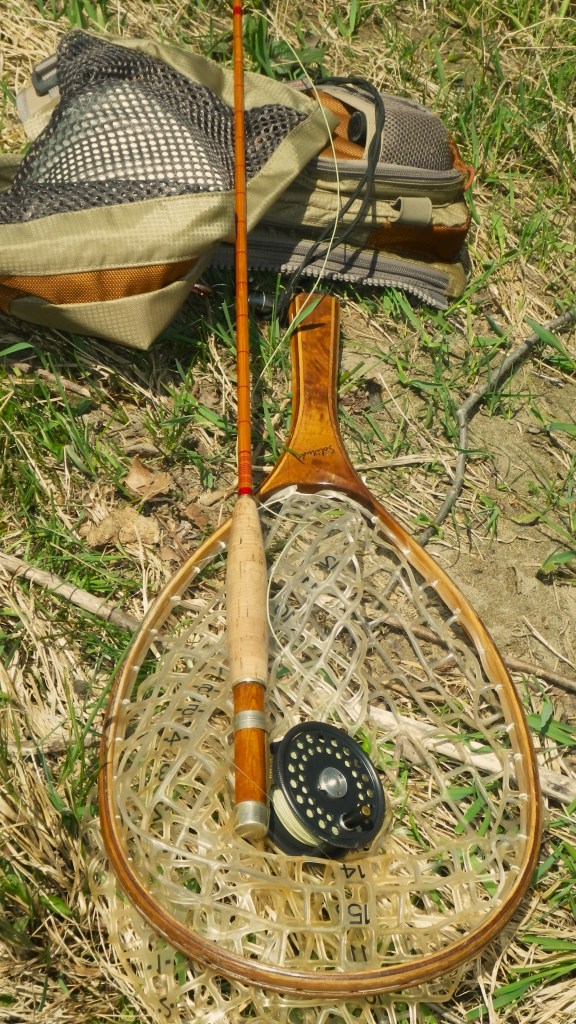
The senior member of my rod rack, my 1918 F. E. Thomas Dirigo takes a turn on the river.
Inevitably, I recognize this turning point, that time when the new season passes it’s midpoint and thoughts of it’s end creep into the quiet moments of my thoughts.
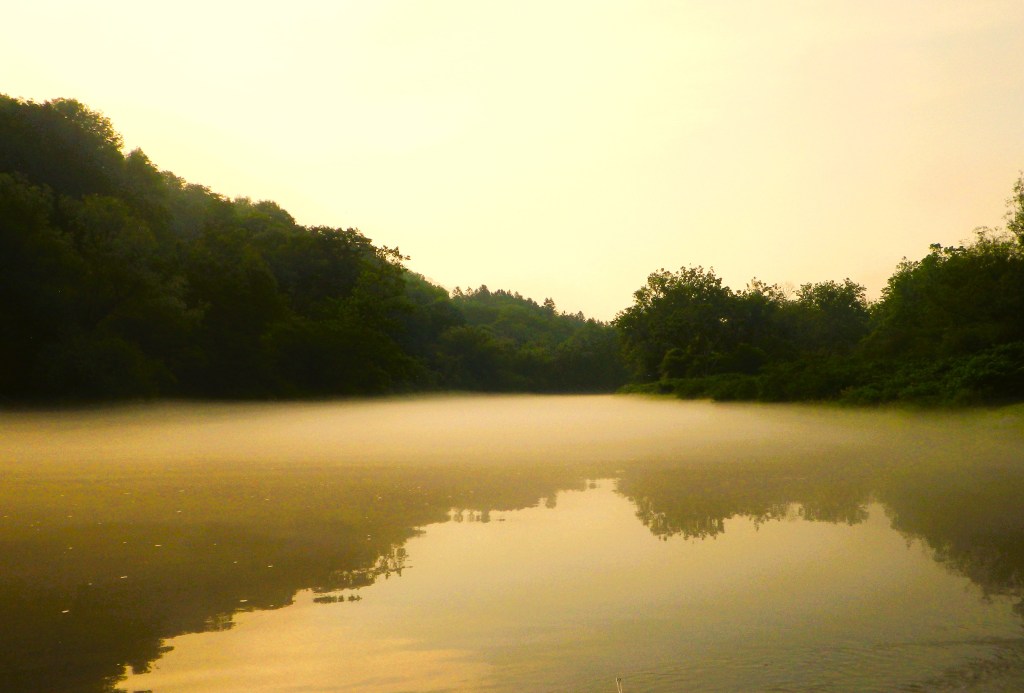
Six o’clock, and dawn is gray. My reflective mood lingers…
I heard footsteps in the water just the other day, and watched smiling as a doe escorted her twin fawns into the river for a morning drink. A moment later a soft ring dimpled along a distant riverbank, and I lofted a long line to lay my fly a foot upstream. My relaxed mindset betrayed me at the gentle take. Awakened to the urgency of the moment I reacted too quickly and missed my sole opportunity for the day. Such can be the fate of a trout hunter.
High summer lies ahead, and my thoughts consider what surprises it may bring. The ten-day forecast calls for rain each day, something this season’s experiences will not allow me to believe, and yet threatening skies are not far away. In the absence of intense downpours, such a run of weather would do our streams and rivers a great deal of good.
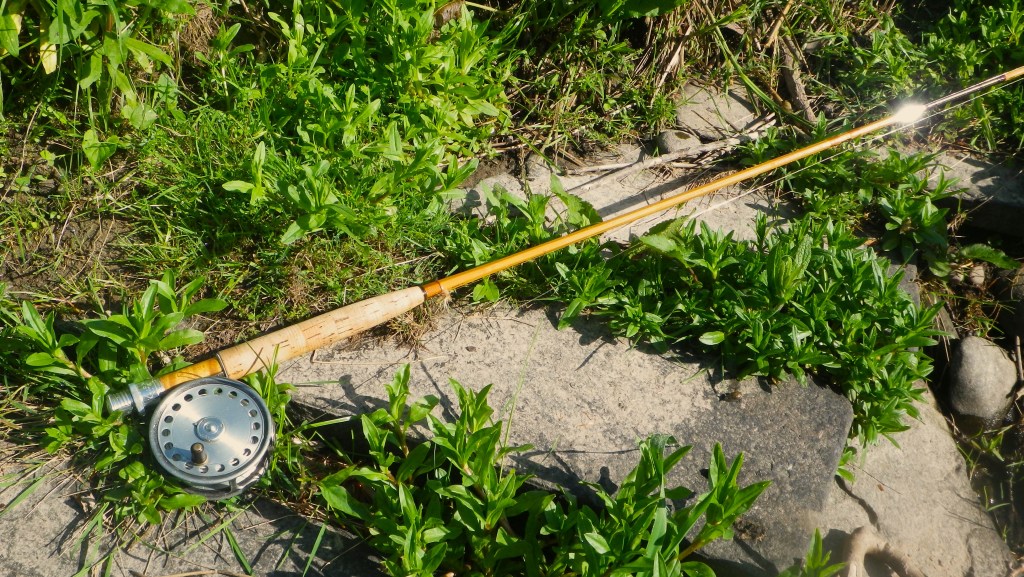
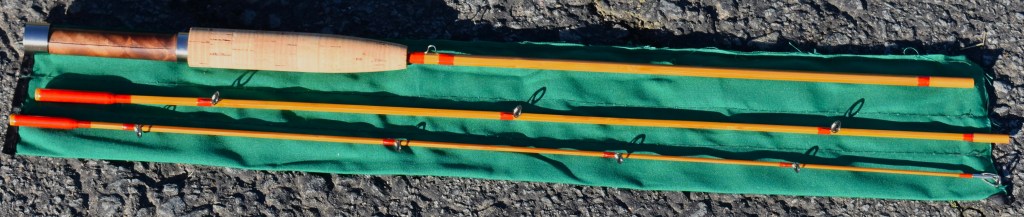
A little Orvis rod has been added to the fold, eight feet and perfectly suited to a number five line in these hands. It’s provenance tells me it was made in 1958, thus we share most of the same years of experience, and it is only fitting that we share a river or two. I wiped it down with a light coating of bowling alley wax, polished it with a soft cotton cloth, and watched the luster of flamed bamboo and it’s impregnated finish shine through. Shall we dance?
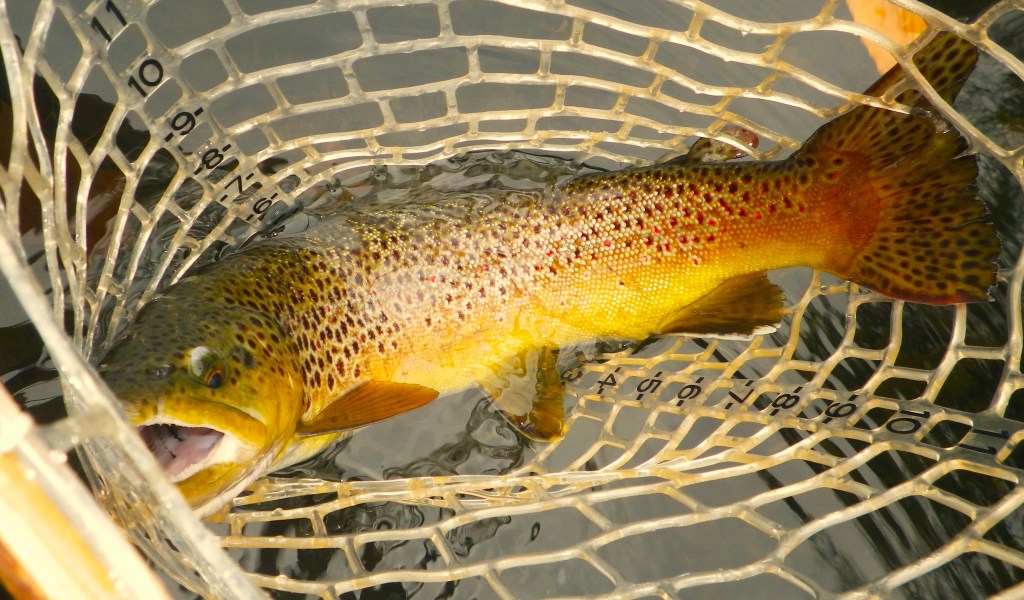
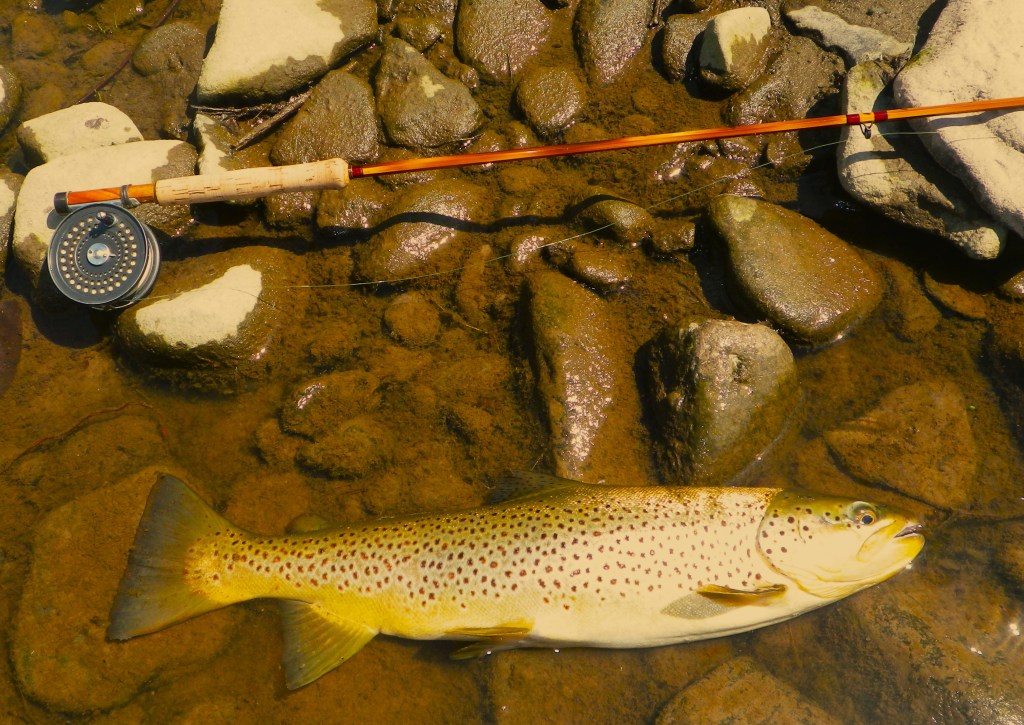
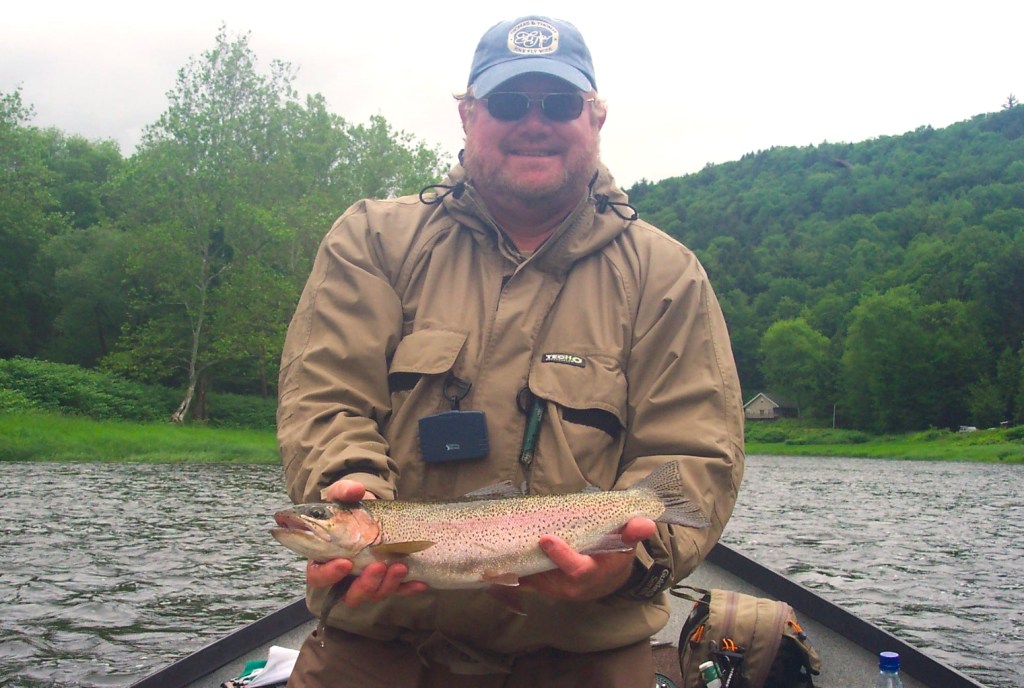
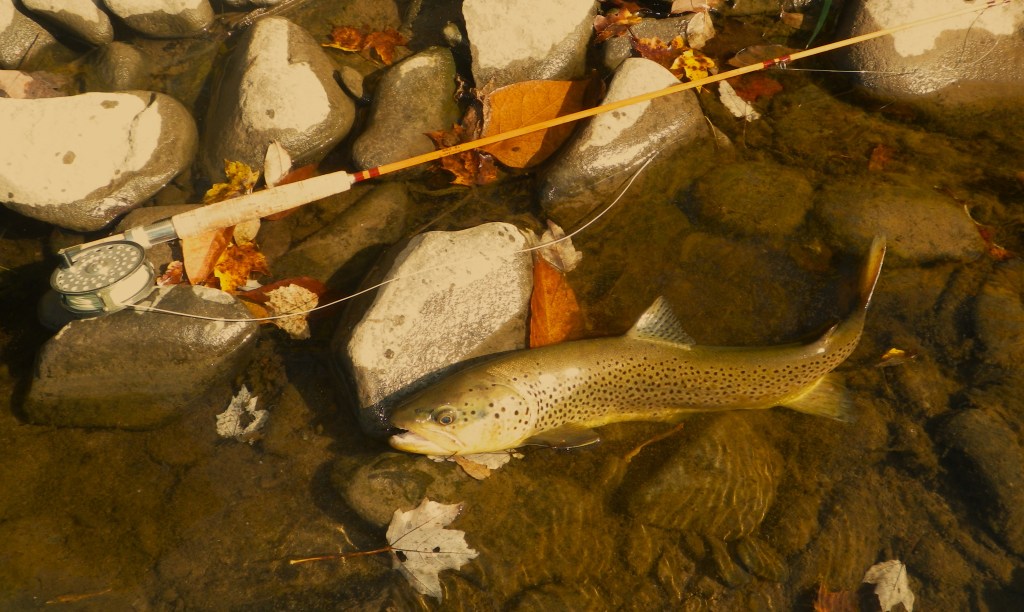
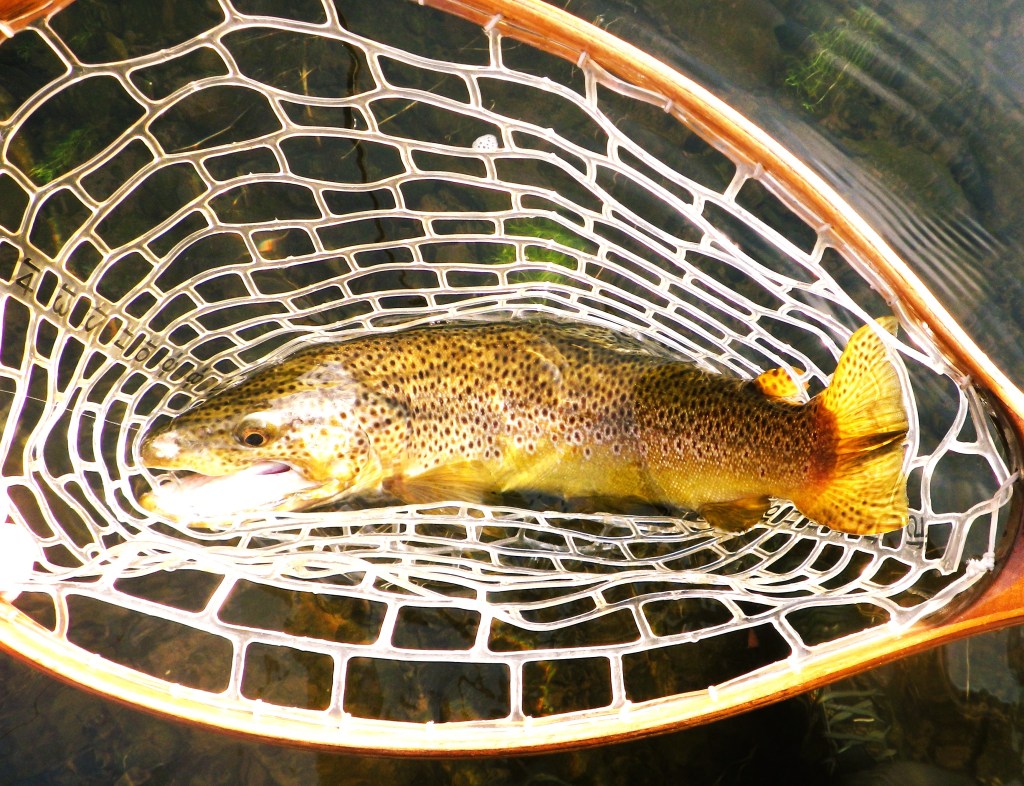
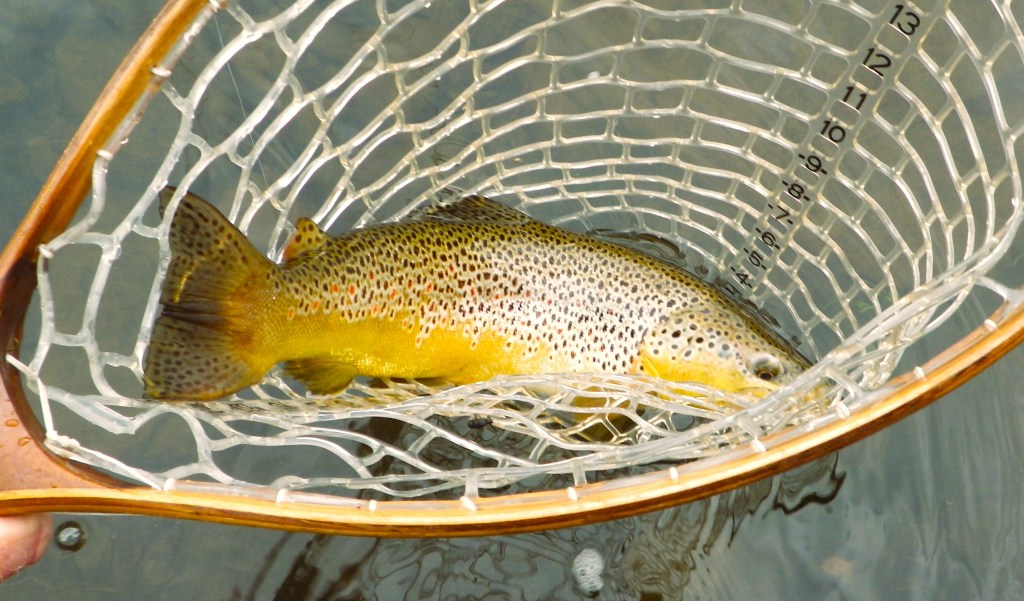
Another little Orvis rod, and a not so little Beaver Kill autumn brown.
The classic Orvis cane rods are unique, designed with full flexing actions and rated to handle what most trout anglers consider rather heavy lines, they lend themselves to sweet dry fly work when lined a size or two lighter than their ratings. They still flex smoothly and cast a long line and tend to be a bargain in today’s collector influenced market. Most of these rods were designed by the late, great Wes Jordan, truly the man who turned the Orvis arsenal of fly rods into classics.
If the rains come, I have some hope for the sight of a mayfly this week. There are still sulfurs hatching on the West Branch, and days of rain might mitigate the incessant crowds. Of course, a good shower tends to wash an assortment of terrestrial insects into the flow, good news for trout and observant anglers.
My old SST jacket has a lot of years and river miles on it, as do I. It never fails to keep me dry and fishing. I have always liked the fact that they eventually figured out how to make a jacket light enough to be comfortable in warm weather, yet truly durable and waterproof. I’m glad mine has lasted, I mean, have you seen the price of a new fishing rain jacket these days?
My suspicion is I can get away with a simple nylon fishing shirt for at least several days this week, but then again there is a tropical storm system down south. The remnants of those things are unpredictable, though we probably won’t see them until the weekend.
The two summer fly boxes in my old chest pack have sulfurs and olives and terrestrials to get me through, the smallest ones stacked on wire threaders to help me overcome the trouble with my depth perception. I have dealt with that hampering my casting so far, simply taking care to start short of my target to avoid plunking a fly on a trout’s nose.
There are those special fish though, the ones who move and hunt something good to eat. They always present the ultimate challenge, as one can never be absolutely sure where they are and where they are heading when about to drop a fly on the water. To take them, your cast has to be right on, the first time.
I had a duel with one of those last week, seeing single rises in three different places. Three different fish, or one working slowly upriver? My casts failed to elicit any response, but then I saw a brief little wake as that old warrior turned and sidled back downstream to start over. Sure enough, within five minutes there was a sipping rise just where I had seen the first one. Perhaps next time I’ll be able to figure the route and timing of his little milk run just right!
Perhaps unlike any number of anglers, I have fond memories of August, visions of countless golden hours of Catskill summers along the rivers of my heart.
Most speak of the “dog days” and conjure visions of dry pebble beds where mountain streams once bubbled downhill, and it is true that is one part of the mosaic, but there is more. August often brings a welcome change to the heat waves we see in June and July. There is a fresh breath in the air, and cool evenings return to these mountains providing a freshening with high summer.
My memories include sulfurs on the West Branch, with her wild brown trout feeding at the height of selectivity, drizzly days with tiny olive mayflies peppering the surface, where the tiniest rings from falling raindrops share a place with the soft but widening rings of good trout rising.
Summerfest arrives this very weekend, a time for anglers to gather, celebrate the history of our Catskill rivers and their lore, browse tackle treasures from the past, and share tales with old friends.
I remember finding a sweet five strip rod one Summerfest, making a trade and sweeping it off to the West Branch that afternoon. A pair of lovely big brownies christened that rod, testing it’s casting and resilience. Though that rod was traded for another seasons later, it is cast in my memory from the triumph of that very first day!
August!
July has passed with joy and anguish. I fished but five days during her last three weeks, but oh what days they were! Now I look forward to the blessing of high summer: stalking trout at the peak of their wariness, weekend music festivals, fairs and gatherings, the pleasure of cool evenings and a chill at daybreak.
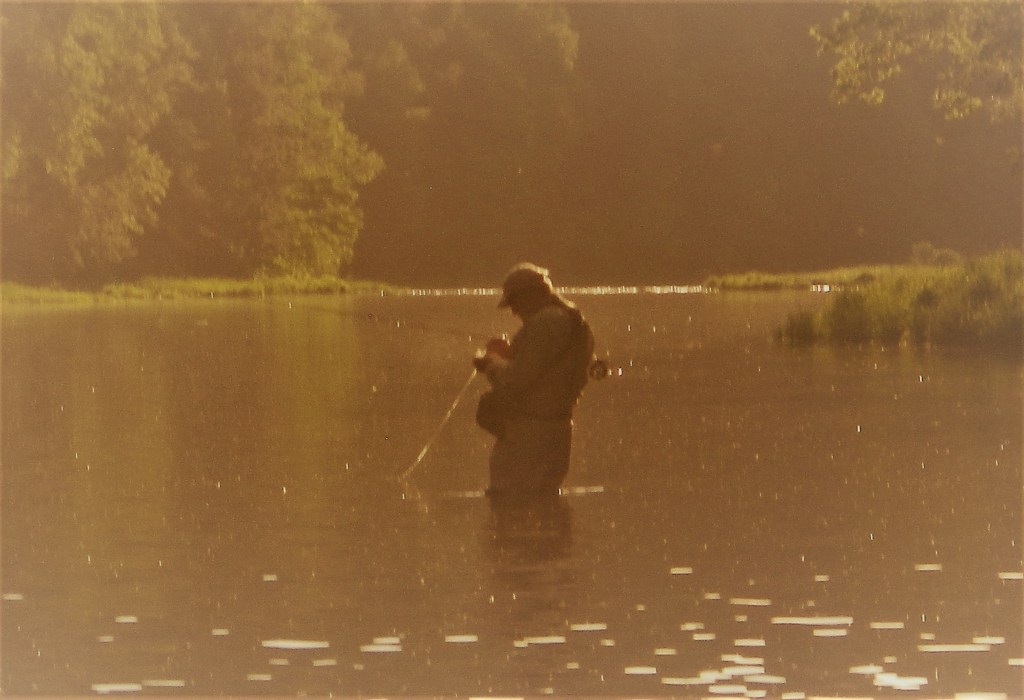
JA selects a fly as the glory of a spring evening surrounds him.
Part of the dream of a rewarding retirement is interwoven with the friends we make along the road of life. Special moments along bright water, shared with our closest friends, make memories. Chances are there are a handful of truly close friends an angler prefers to share the water with. It seems so easy in concept. Hey we’re retired right, what’s to stop us from fishing every day? Life of course has many facets that can get in the way of best laid plans.
During the first couple of years of my retirement, my friend JA and I fished and hunted together quite a bit, before our retired lives found a way to get complicated. The past three years though, our opportunities have been sorely limited, and we have fished just once a season. So far this year, we have made it to the river twice, and I am thankful for that.
Setting up our tackle at the roadside, we caught each other up on our most recent trials and tribulations. When we were geared to go, I handed JA a small puck containing the two recently conceived dry fly patterns that had produced some remarkable results in their infancy. I am no slouch as a fly tyer, but JA is better. He’s been at it for more than fifty years, still ties commercially for several fly shops, and can craft gorgeous examples of everything from midges to classic Atlantic Salmon flies. I’m the experimenter, always thinking, tying and designing in my own quest to better mimic that image of life that brings a wise old brownie to the surface.
We waded in and turned in opposing directions, each gliding into the trout’s world as gently as possible. I re-learned an old lesson very early, as the first trout of the day took my fly on a long cast to a bubble line. I heard the plop, saw the white mouth open out there in the gloom of early morning, and raised the rod to a complete lack of resistance. Missed him, was my thought, and I continued to pepper the area with casts, despite knowing that trout would not come again. Imagine my expression, twenty minutes later, when I retrieved my fly for another dose of floatant, finding the remaining four inches of tippet and nothing more. No doubt I had nicked the tippet when tying it on in the early gloom so that it parted cleanly with the first attempt at striking.
I found no other signs of life, finally turning upstream to work my way to JA, hoping he had found the trout to be more receptive. When I had approached within talking range, I related my mishap and learned he had taken one brownie and elicited a bow wave approach from an unseen hunter.
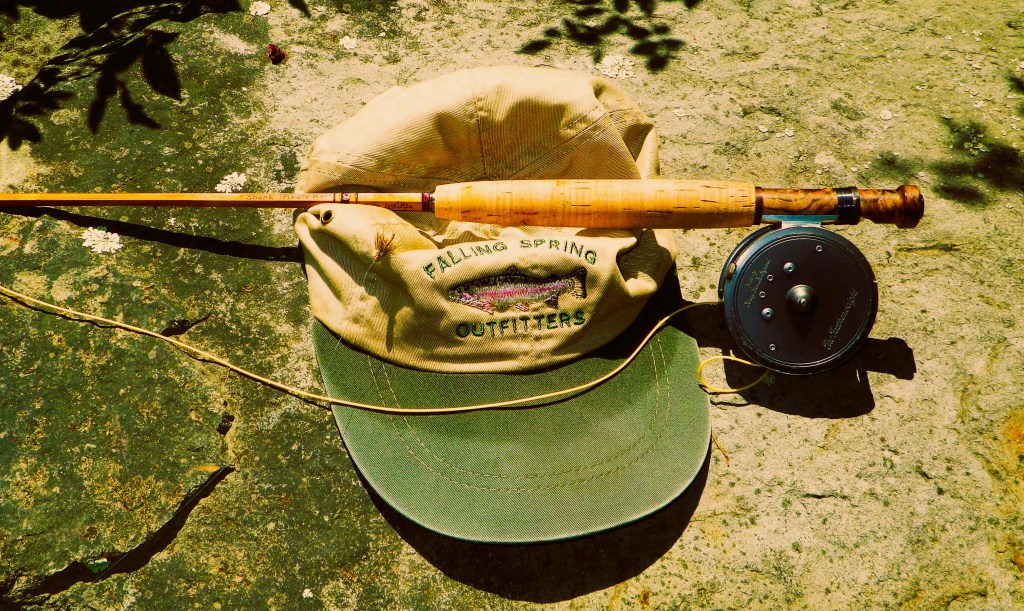
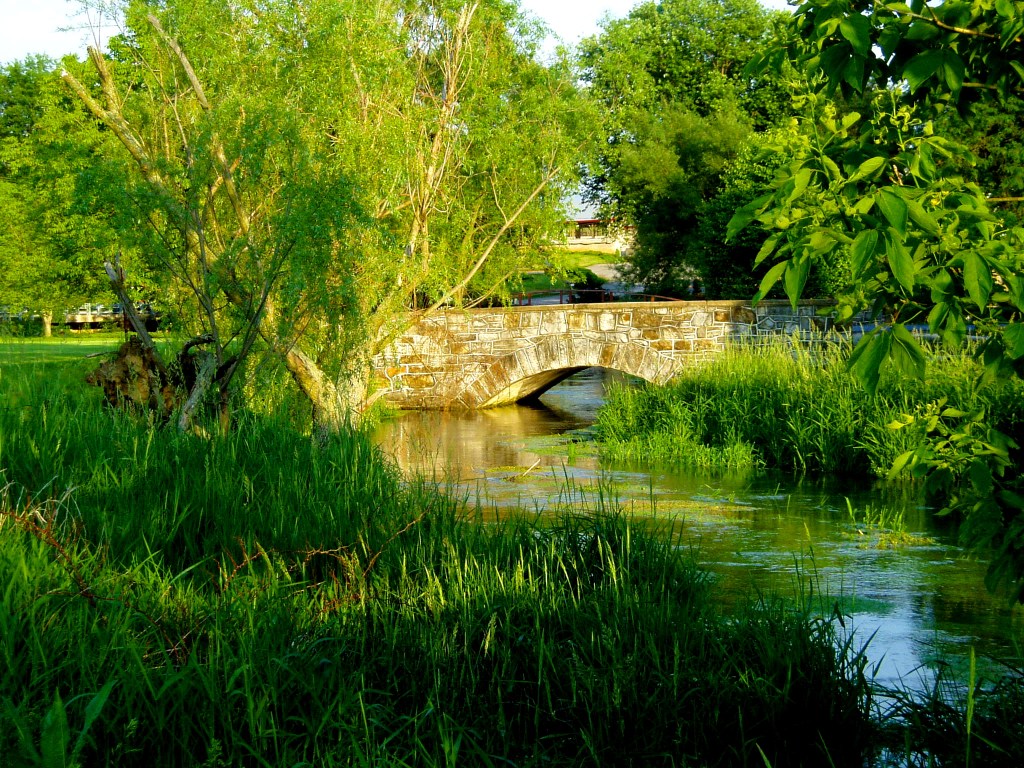
The gentle Falling Spring: JA and I became friends there some three decades ago.
We enjoy fishing within talking distance at times like these, comparing notes and thoughts amid the quiet of bright water. Our history began that way, walking the banks of another old friend, the Falling Spring Branch in Pennsylvania’s Cumberland Valley.
Eventually, my patience was rewarded with the unexpected rise of a very good trout. One of the new flies was selected, knotted to a new tippet, and thoroughly checked in daylight this time. That fellow rose again, this time in the closer edge of the current line before me, where I placed my first cast to no avail. A few turns of the reel freed enough line for my second cast to settle onto the furthest edge of that current.
I saw him come for it, his flank flashing as the long body knifed softly to the surface. He took the offering softly and I paused the required half a breath before striking.
I was wielding Dennis Menscer’s eight-foot five weight and needed the power of it’s crisp, faster action as I lowered the tip and let that big old brownie thrash his displeasure, keeping him from burying himself in tippet shearing cover nearby. The CFO ‘s voice crackled amid the quiet of the new morning, letting my friend know what was afoot.
Netted at last, I lifted that bronze flanked brute briefly and whistled softly to attract JA’s attention before I slipped him back to the embrace of cold water. There was nothing spoken just then. Two-foot trout deserve a moment of silence.
I stretched my back a bit, feeling redeemed from the pain of that opening miscue, told JA that the fish had taken “that brown fly I gave you this morning”. Turns out he had drawn the interest of a big hunter with that pattern himself.
Another friend tells me I should market some of the patterns I have designed for trophy Catskill trout, despite my lack of interest in commercializing my fishing. Perhaps JA and I could team up, designing and testing, and letting him produce dozens of perfectly tied specimens for the trade with his commercial speed and precision. Hell, we would never find time to go fishing if we did that!
The morning closed with a slow walk down river. We talked quietly. Once more life is taking a toll, and JA revealed that the week he and his wife had planned to stay at their Catskill cabin and fish had fallen victim to family responsibilities. I know they would have welcomed the break, and a real chance to relax.



 Bright Waters Catskill