After kicking around the house since the first week of deer season, battling my old foe chronic bronchitis and feeling generally bad, I emerged yesterday to attend the open fly tying session at the Catskill Fly Fishing Center & Museum. It was good to smell the fresh, cold air as I wandered about the grounds, and great to see old friends and new from the Catskill Fly Tyers Guild!
I wore one of those irritating masks left over from the assault of the Coronavirus, just to provide some protection less I cough near anyone. Bronchitis in itself is not contagious, though whatever cold or infection that fires it up can be. My cold came through the last week of November, and headed out four days later, the past two months and counting being courtesy of the scourge of the bronchitis itself.
I tied a handful of favorite patterns and talked a little with some friends, the best therapy yet, short of the brilliant sunshine the afternoon provided.
A Catskill winter is usually conducive to life as a hermit, so little gatherings like this one, or our Thursday evening Guild Zoom meetings become rather precious. I do enjoy talking fishing when I am not involved in doing it.
We are beginning another run of warmer weather with the blessing of sunshine. Cathy and I enjoyed a river walk this morning with the sun doing it’s best to set aside the cold, cold winter air. Rivers have cleared and dropped, though the Delaware reservoirs did begin spilling again this past week. Sunshine and warmer air has always been the cure for my bouts with bronchitis, and I am hopeful to find enough of that this week to free me fully from winter’s harness.
Planning is underway for Fly Fest 2024 here in the heart of the Catskills, and I am anxious to enjoy another of these wonderful winter gatherings. The Catskill Fly Fishing Center and Museum has now officially added the date to their events calendar: Saturday February 24th from 9:00 AM until 3:00PM at the Rockland House, 159 Rockland Road, Roscoe, NY. A winter festival of Catskill fly tying and a wonderful lunch at the Rockland House, what could be better?
Groundhog Day 2024, and old Punxsutawney Phil has made his prognostication: an early spring for those in need of warmth, sunshine and the healing touch of bright water. The old boy seemed excited amid the cheers of a record crowd, for whom he bolstered hope for a quick end to winter.
I would most assuredly welcome the sun once again, to feel the warm breeze on my cheek, and look for mayflies where the riffles blend into the deeper waters of a run. Often during my thirty Catskill seasons I have encountered sleet, snow and frozen wading boots in April, crunched frost from the riverbank even mornings in May. By this angler’s hopeful calendar, there are 66 days ahead before I walk those banks with a dry fly snugged in the hook keeper. I would love a chance to take that walk in shirtsleeves!
Good morning Mr. Hendrickson
Twenty twenty-three complied with my overwhelming need for sunshine, reaching sixty degrees on the first day of spring. The river managed a peak temperature of only forty-two though. I actually saw three rises the next day, something very briefly interested in the little black caddis or stoneflies?
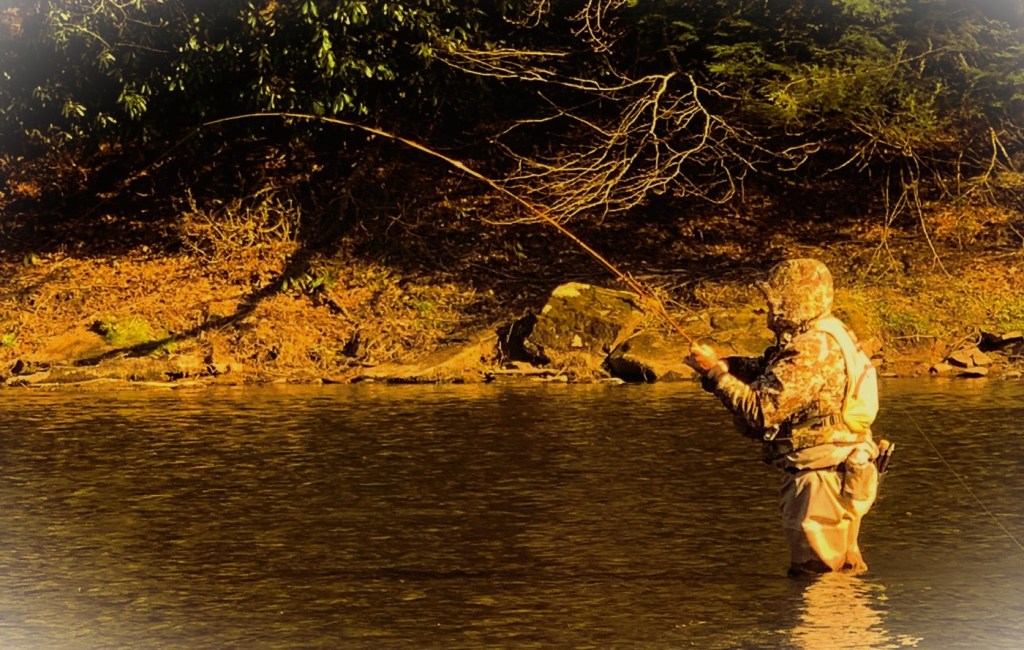
By the end of my countdown, April 10th, the river had warmed to forty-nine on another sixty-degree day. The three rising trout I found that afternoon were pleased to sample my Quill Gordon, spin the reel and put a long-awaited arch in my old Leonard bamboo.
Imagine the faithful gathered on April first, for it will always be Opening Day here in the Catskills, with mayflies floating on clear water and trout rising! We would all love to see it, and we thank old Phil for leaving us with just a little hope that this year the dream will come true.
Another milestone passed on the journey through the anglers off-season. January has brought our first snowstorms, plenty of cold rain, but also it’s share of milder days; enough to make us think that winter is letting us off easy. February though, brings it’s own set of challenges.
Though the turning of the calendar bring us closer to the promise of spring, this the shortest month, tends to bring us the largest share of winter’s wrath. But then, there are sometimes compensations.
Admittedly, my memories of so many wonderful little episodes are burgeoned by decades living south of the Mason-Dixon Line, and even my more than two decades in Southcentral Pennsylvania have added more.
In my mind, the February warmup is an actual event, generally coming when my tolerance for, my very survival through another winter hangs in the balance. Though the second month never guaranteed this respite, there are cherished memories from the times that a small handful of days rescued me from despair.
Pennsylvania’s Little Juniata River upon the full bloom of a blissfully extended February warmup.
There remains a special picture of the Little J, where one of those late February events lasted into the first days of March. I found a nice cabin to rent to take advantage of the peak before winter weather returned with a vengeance, living three days close to bright water. Blue skies, sunshine, even air temperatures reaching the sixties called me to the river I had not visited since summer. There were no more than two or three trout actually caught, but ah the treasure of fishing!
There was another February day on that river, a very brief respite from winter’s grasp. A single day lingers in memory, my legs chilled deeply from hours of wading cold water, a spare serving of sunlight in the afternoon hours, and the still air touching sixty for a moment. Walking upriver toward the path that would lead me home, I saw the impossible, dimples in the tail of the upstream pool. Instead of heading home and warming my legs with the truck’s heater, I warmed the heart inside with a lovely and challenging interlude of dry fly magic.
As I have moved ever north, I have unwillingly surrendered such cherished gifts from Februarys past. The glories of the Catskill rivers are not displayed in winter. This is my sixth winter here in Crooked Eddy, and though I have watched the ice flowing on to the Delaware day after day, there has been one magical moment, a singular gift from all of those Februarys of my past: a fifty-one degree day, sunshine to caress my check though tempered by a twenty mile-per-hour wind. I found rewards both tangible and spiritual that February day, and it’s memory carries me through!
November’s farewell to one season, and April’sgreeting for the next.
Seventy-two days behind, seventy-two ahead… I have reached dead center of the trials of winter. A long road remains.
The madness creeps in each year as the count of days mounts. Too long from the embrace of bright water, I get fidgety when I cannot get outside. The effort to beat down this bronchitis devoured my hunting season, and left me wary of chilled rivers during the milder days of December. This winter seems committed to fits and starts, numbing cold for one week, and then warmer days for a spell.
Sadly, this warmup has brought rain to melt the middling snow cover we had, all of it rushing straight to the rivers. Even if tomorrow could sprout sixty-degree sunshine, the rivers remain far too high to consider fishing. As it is, more rain and some snow are expected, with a return to highs in the thirties. As of yesterday, all three Delaware reservoirs sit at or above ninety-nine percent of capacity, with the next significant precipitation likely to add spill to their already high-water releases. Fishing is a dream far off; and retreating from view.
Sometimes a light comes from my desperation, though I will not learn whether this one amounts to brilliance or merely a feeble glow for at least the span of those seventy-two days.
The birth of the Struggle Dun
Back in my limestone epoch, I fished throughout the year. Even then, the fly hatches that had spawned the creativity of the Cumberland Valley legends had diminished greatly, and the price of that season long fishing was condemnation to the tactics of the subsurface fly. Creativity was directed there of necessity, to those dark arts.
I adapted the lessons of Nature’s impressionistic coloration and specific techniques and materials to capture the essence of life for the Gammarus shrimp and the baetis and ephemerella nymphs of the limestone springs, publishing my findings in Fly Fisherman magazine in September 1997. The dubbing blends created still occupy a dispenser box that has collected dust for most of the past twenty-five years.
Some reaction to the winter madness caused me to think about those blends, conceived to foster movement and attraction, and the Struggle Dun was born. I was thinking about those long anticipated first days upon the rivers of my heart, when flies are scarce if not fully absent, but hope convinces me there are trout in a few of those ideal runs and pools, trout with watchful eyes and their own awakening hunger.
The body of the fly is tied with a dubbing loop technique, that loop closed upon sparse whisps of my nymph blends. Squirrel fur, Antron dubbing, and a touch of Lite Brite when looped and wrapped sparsely will move, quiver in the typically higher flows of early spring, and the nondescript form, highlighted by a gentle bit of flash, will appear to struggle.
I have tied three versions, 100-Year Duns winged with wood duck and Trigger Point Fibers, and CDC duns, and I have high expectations for them. I believe the attractive element could turn the tide and convince those early watchers to rise where other dry flies do not. Can the movement and attraction overcome the lethargy of cold water and the lack of insect activity? There are seventy-two days ahead to consider, theorize, and wait…
Amid the glories of a Catskill spring and summer, life is a whirlwind of beauty and angling largesse, but it is in winter that my thoughts return to the gentle limestone valleys lying west of the Susquehanna.
I developed early an intense interest in difficult trout, angling in those formative years on northern Baltimore County’s Big Gunpowder Falls. The stream was intimate, her waters clear, and her wild browns, and for a time rainbows, darted restlessly to avoid the frequent human intrusions. I loved her dearly.
Maryland’s Big Gunpowder Fallsas spring begins to awaken.
Pennsylvania’s Cumberland Valley offered something more. There flowed the little rivers of legend, holding a store of temperamental wild trout amid icons of angling history. This pastoral valley was the epicenter of the second great age of discovery in American fly fishing. I welcomed the opportunity to study in the classroom that had spawned Shenk, Koch, Fox, Marinaro and more!
The learning curve was steep, though I was fortunate to count the greats among my professors. I learned casting and tactics beside Ed Shenk and Joe Humphreys, talked flies with Ed Koch, and for two seasons travelled to the limestone streams at every opportunity. Finally, I relocated to Chambersburg after founding Falling Spring Outfitters and began to live the angling life to its fullest.
The Letort Spring Run, Falling Spring Branch and Big Spring – the Cumberland Valley’s triumvirate of hallowed limestone spring creeks.
The opportunity to fish and daily observe the hallowed waters of the limestone springs enthralled and challenged me, for there were always new problems to surmount as our association grew in intimacy. An angler learns a great deal in those environs if he is receptive to Nature’s lessons, chief among them humility. I learned that both victories and defeats are wondrous moments in an angler’s life.
I found a special magic amid those gentle meadows, conscious of the presence of those who had gone before as I hovered behind clumps of waving grass, eyes searching for a rise. Summer brought forth every nuance of the hunt, with stream and meadow exploding in a rush of vegetation. How many rises were located first by hearing, then pinpointed by long study of the edges of land and water? Finding the trout’s hide was but half the battle, for each cast would then of necessity be planned and executed in intimate detail.
Those limestone trout offered a single chance for glory, and dozens for failure! A back cast tangled in the head high grasses spelled defeat immediately, so too a forward cast just inches off target. Hot, breezy days offered more opportunities for trout rising secretively to terrestrials, but increased the difficulties of a flawless, one-shot presentation tenfold. The memory of those days still excites me!
A two-weight rod, Baby Cricket dry fly and joy amid the watercress during Big Spring’s all too brief revival!
There were intimate joys not since encountered. A short, quick, perfect cast with a frail six to seven-foot rod, a Shenk Sculpin taken beneath a root ball by the rush of bright water and emerging with two feet of angry brown trout splashing in the morning light! Sight fishing to some leviathan obscured by moving cress and elodea until I was far too close to maintain composure.
I recall the magic of a summer evening, waist deep in cold water and greenery. Darkness was close at hand, and I was about to climb out and retire when I heard the whisper of a rise ahead. I could see only the bounty of weed beds along the right-hand bank, but I cast my Baby Cricket to that sound, and it was taken softly. The weed bed exploded in a boil and the tiny six-and-a-half-foot rod was quickly overmatched. Keeping the rod in a frightful curve, I battled the unseen foe toward the narrow, clear channel in midstream. He ran up current, buried in another, and I fought him back to open water again. It was all a flurry of constant motion and boiling water in the darkness! Somehow, the 5X tippet held, sawing through another pair of heavy weed beds and, when I brought him back to the channel that last time, I reached for the net. Five pounds of wild brown trout, his wet flanks sparkling in the last glow of twilight lay in the mesh, my hand shaking as it turned out the hook.
Such are the memories entwined in the magic of the limestone years.
Morning at Crooked Eddy, and I hear the dripping of snowmelt from the high roofline onto the low metal roof above my station. I walked out to look for the freezing rain we have been warned about and found the temperature somewhat less than a full degree above freezing. The rain is expected closer to midday, more than half an inch by tomorrow morning, and I do not doubt it will flush the light snow cover we have into the rivers.
The Delaware reservoirs have spilled on and off since the heavy rain of December, and now linger just below capacity. Releases are higher than we have seen these past few Januarys, and I am thankful for that. Better for the trout as well as the mayflies, caddisflies and their brethren, and I pray that good flows continue through February and March.
Hope remains for a little warmup between spillings, a chance to visit bright water, swing a fly and soothe my already winter weary soul.
I have volunteered to tie my simple Blue Quill Parachute for Thursday evening’s virtual gathering of the Fly Tyers Guild, and have settled on tying a size 14, that my simple webcam will allow acceptable visibility. What to do then with a fly twice the size of the natural? Not a hatch matcher, though it is a fishy looking fly, so I’ll simply toss it into a spring fly box to be trotted out on one of those spare days.
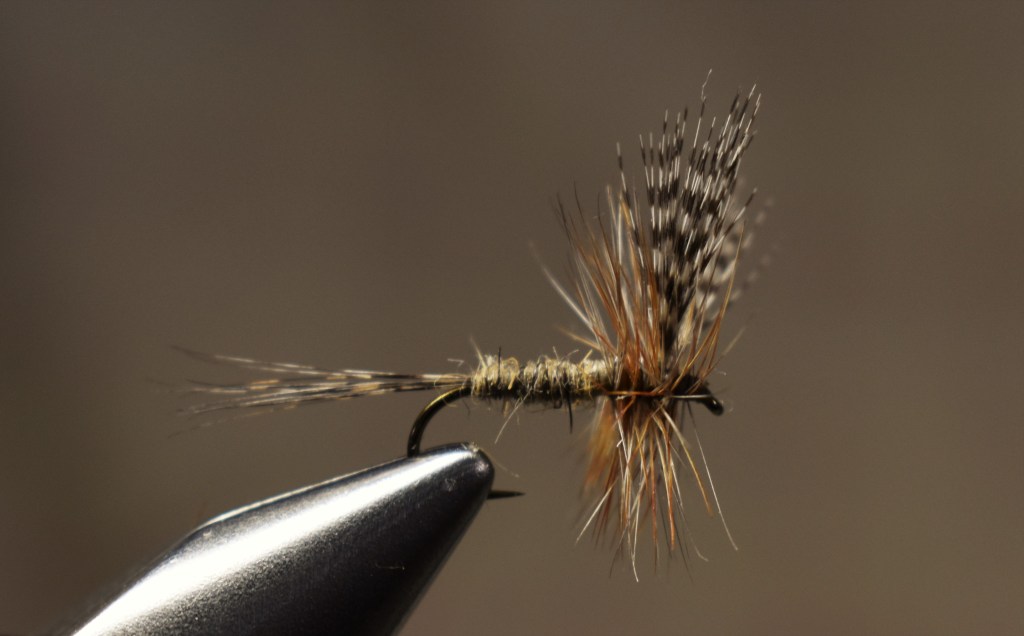
Perhaps I should set aside a small box for the dries that aren’t intended as close imitations, the Atherton’s, Fox Squirrels, Catskill Adamses and the odd variants I sometimes tie with an extra length of oversized hackle. That seems a fine idea.
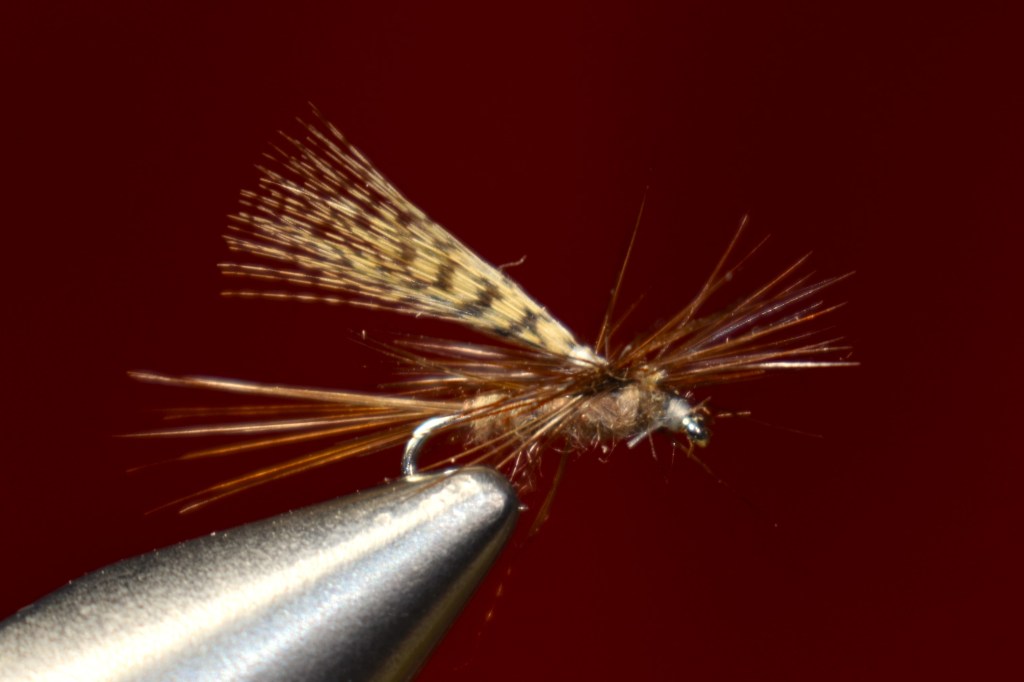
My Catskill Adams
In the past I have tucked these fishy flies in beside the proper imitations, where they have oft been overlooked just when a perfect opportunity to try them appears. To me they feature some bit of attraction, whether the dark, subtle bugginess of the Catskill Adams or the glint of golden tinsel on an Atherton No.2, and that impressionistic quality of life. Strictly speaking, species specific imitative patterns are conceived for the hatch, while these other fellows are cast with a more general appeal. Exuding an impression of life and generality, they seem to be able to appeal to a trout that happens upon them. There are many such hours along spring rivers.
Long vigils are common, particularly until the river temperatures ascend to the high side of the forties. Fifty degrees is the classic, magic number, but there are many days when weak sunlight seems more vibrant to the river starved angler, though the sunken thermometer struggles to betray 46 degrees.
Spring? Yes, though the joyous sunlight still struggles with the snow.
It is funny how I always carry a small box of the early stoneflies which brought the first dry fly fishing to the Big Gunpowder Falls and the Pennsylvania limestoners, though I have never seen a single trout rise to one on an early Catskill river. I did imagine one though, that first hopeful winter, when the calendar said spring. The little black stones were buzzing half in inch above the surface, skittering and skating along screaming eat me! I wanted that first taste of dry fly fishing so badly, I tried to convince myself a reflection flashed in the corner of my eye was a swirl!
Big Spring once held great promise as the weather warmed in March
Seventy-five days of wishing and waiting lie ahead. Each one will linger perhaps two minutes longer than the one before; a few breaths! I’ll tie no stoneflies as those days pass, though, despite my best experience, that little fly box will find its way into some vest pocket come March. Old habits… well, you know what they say.
It is the twenty-second of January, and eight degrees here in Crooked Eddy. Sixty-seven days have passed since I last waded bright water and bid farewell to another season, so in truth, I am not yet halfway through winter’s journey. My thoughts once more run to summer…
I was sitting, huddled in a blanket this morning reading Rhoderick Haig-Brown. As he recounted the various streamer flies employed for the native cutthroats, salmon and steelhead of his Campbell River, my mind wandered to Ernie Schwiebert’s Letort Beetle. It has been many years since I tied and fished that groundbreaking classic.
Ernie recounted the fly’s birth in his “Legend and the Letort” from “Remembrances of Rivers Past” (Copyright 1972 Ernest Schwiebert): “Ross Trimmer and I were sitting in the Turnaround Meadow one August afternoon. I was tying flies and noticed some pheasant skin pieces in a hackle cannister. There were a few dark greenish throat-feathers on one fragment. We tried them instead of Jungle Cock, soaking several feathers together with lacquer to get toughness and opacity.” He trimmed these to an oval shape and tied them in flat over trimmed hackles, adding “Success was remarkable and immediate.” Schwiebert recognized the perfection of Vincent Marinaro’s concept of silhouette being the trigger for the Letort’s summer sipping trout and modified the Jassid style to mimic the larger and more robust beetles so prolific in the water meadows. Anglers have been grateful for his chance inspection of that hackle cannister for decades!
The Barnyard Meadow, Letort Spring Run
While there are days upon our summer rivers that I do best with a beetle that plops when it lands upon the surface, there are times during the lowest flows when such patterns are ignored. The trout lurking in the hides of the still pools are wary, and my summer fly box needs a row of Schwiebert’s genius!
Just over the mountain, beside the gliding waters of the West Branch Delaware, Dennis Menscer applies the final coats of varnish to my ultimate foil for days such as those, a flamed eight-foot wand to make magic with a number three line! If I close my eyes I can feel it now, laying out a feather beetle like a whisper of soft summer air…
A twenty-inch beetle eater that demanded utmost delicacy!
I am caught in time, dreaming of summer delight amid the unforgiving chill of winter.
Indeed, a good half-dozen of those beetles must be tied, and I know just the feathers to employ. I have a black phase cock pheasant skin that should enhance that critical opacity.
Soon, I must begin the task of sorting fly boxes, noting any patterns and sizes that need replenishing. Reels and lines were put away cleaned and ready for use, but they will get a look, just in case. Still so many days without chance for fishing. The rivers are high and icy, reservoirs spilling into their tailwaters, and rain and a warmup headed in this week. The snow will be melted rapidly once more, and the rivers rise.
What I need is moderate flow, that joyful fifty-degree warm spell, and sunshine! Those are the days when a swung fly might tempt leviathan.
The cool steel gray of a good December brown, enticed by the slow swing of a Copper Fox.
There is a taste of sunshine this morning, though it is not expected to last. The air will not warm for hours, and then not much above freezing. The paradox of timing looms as I ponder a riverwalk, the sun lights the old road and the mountainside until mid-morning, when the air still lies cold. The sun warms the body and brings cheer, yet I fear the frigid air will torture my beleaguered lungs.
Tomorrow will bring snow and ice, and as the week warms the rain will fall, erasing the winter clarity of the big river.
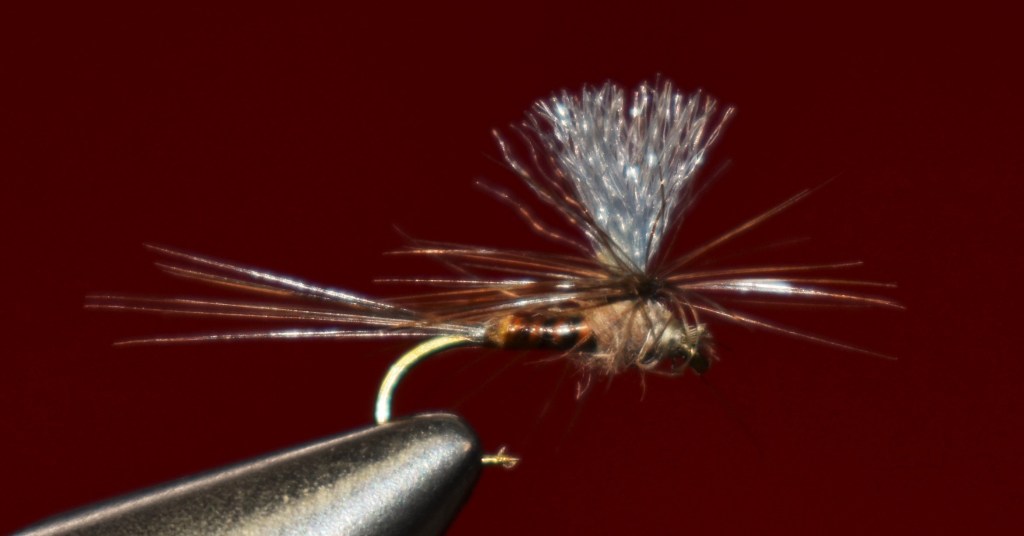
My Turkey Biot Blue Quill Parachute has a proven track record of seducing trophy Catskill browns.
Yes, I am a true believer in matching fly color to the mayflies and caddisflies I find on my favorite waters. The preponderance of my own experiences convinced me long ago that matching the color and the translucency of the insects I seek to imitate is a lofty but worthwhile goal.
I enjoy the various discussions whenever this topic comes up. Within the Catskill Fly Tyers Guild, there are many talented fly tyers, some who I accord the title of scholars in deference to their broad knowledge of the history of dry fly fishing and the art of enticing our quarry to the surface. I often find these fellows stacked against me in the color debate. As much as I respect their knowledge and opinions, I simply cannot ignore my own experiences.
In the broad realm of our immersion in angling though, there will always be instances that run counter to each of our accepted theories and beliefs. In discussing a featured fly for next week’s online gathering, the Blue Quill dry fly was suggested and embraced. I offered my own derivation pictured above for those interested in a non-traditional and easy to tie pattern that has proven itself time and again. It happens to be though, one of those proofs against the color theory.
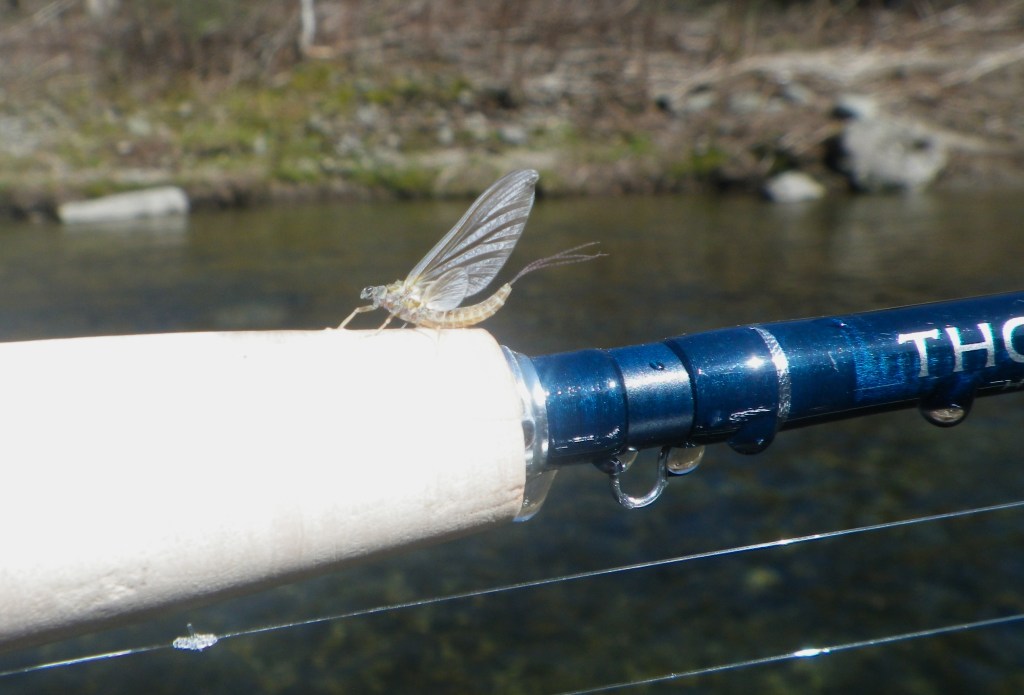
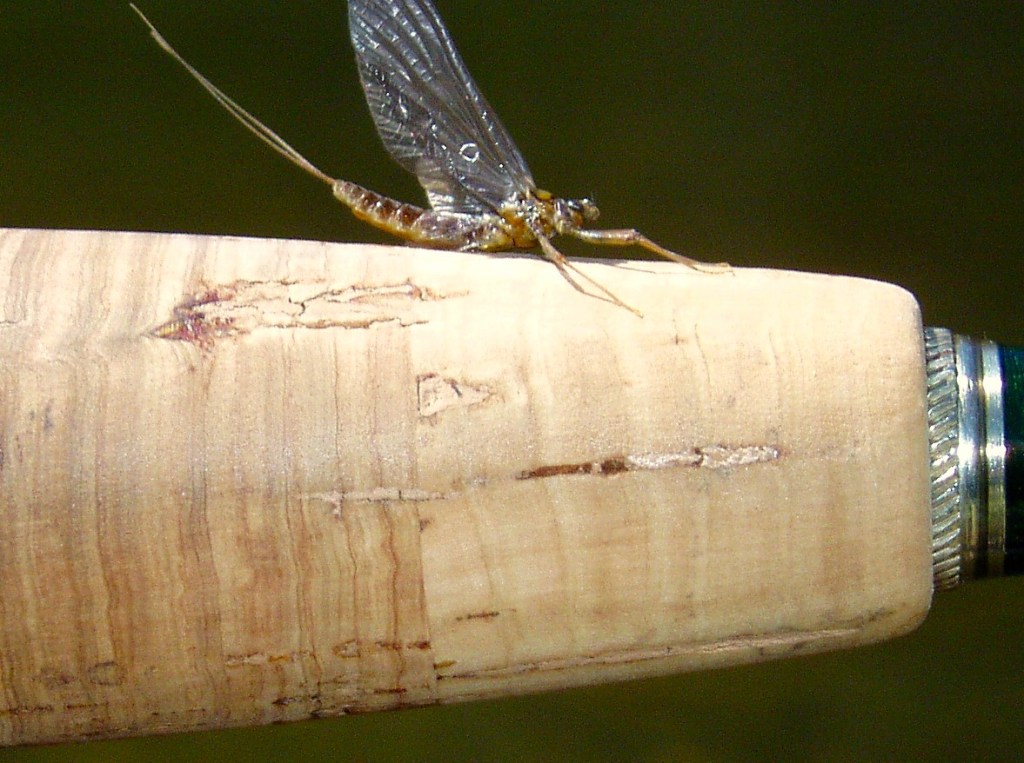
An older impromptu onstream photo of a Blue Quill adorning the cork of my Thomas & Thomas.
Throughout my decades angling the Catskills, I have been a fly tyer, fishing almost singularly with my own flies. During all of those years, I did occasionally purchase some flies to fill an immediate need. These flies came from only two sources: the Dette shop on Cottage Street and flies tied by the late Dennis Skarka of Catskill Flies. It was Dennis’ pattern for the Blue Quill that inspired my own tie.
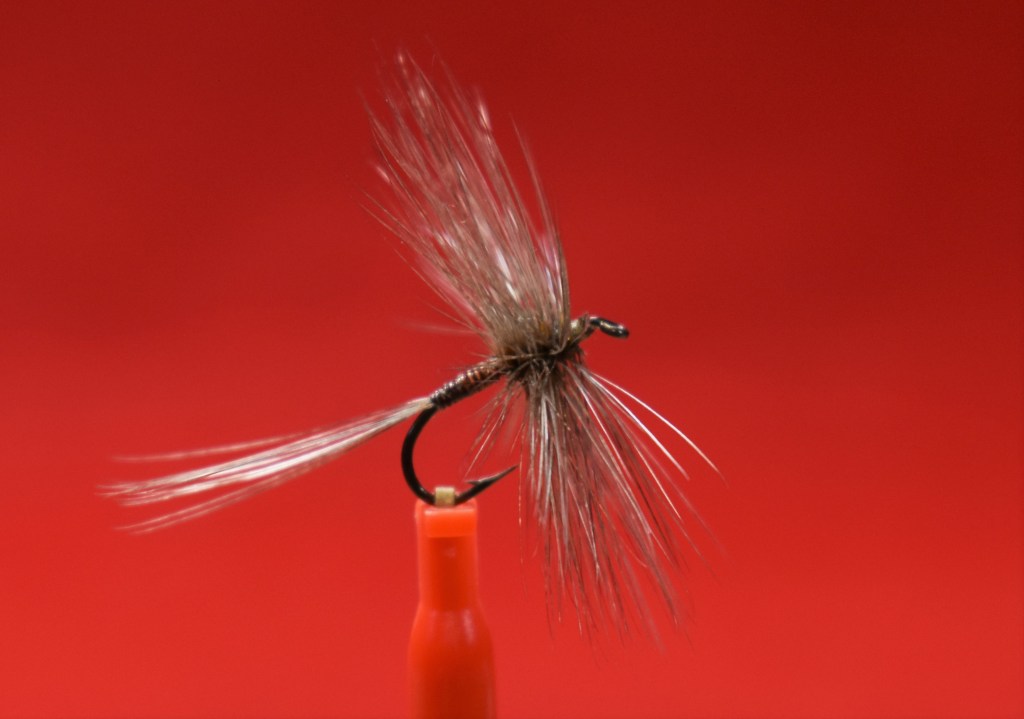
Dennis was a perfectionist at the vise, and took the time to bleach his own peacock eyes to secure lighter quills with the dark ribbing he desired for his pattern. He tied a synthetic winged parachute with dun tailing and wrapped hackle, a simple, beautiful fly that was very well received by the trout. I changed the body, being unwilling to endure the bleaching of peacock eyes and turning to the black and white barred primaries of our eastern wild turkey. The biot fibers vary, and the tyer can alter the general appearance of the dark ribbed body from a stark black and white to black with a light to medium gray, by selecting the biot fibers carefully. Blue Quill hatches can be remarkably heavy, and the reflective properties of the steel gray Antron yarn wing post make these small flies visible when light is difficult, the windblown surface is choppy, or the naturals are overwhelmingly numerous.
The underside of the natural mayfly varies also, from shades of brown to brownish gray, so to fit my own color theory the fly requires a brown abdomen, not one of black and white or banded shades of gray. The trouble is this fly, like Dennis Skarka’s original, is a deadly taker of trout feeding upon Blue Quills.
To my thinking, the brown dyed turkey biot or Translucence silk dry fly should be the best match, but there is no way I’m going to cut the original biot parachute off to try one!
Nearly all of the dry flies of my own design sit low on the water, their bodies in the film, something I tend to remind my contemporaries when discussing (arguing?) the color theory. Many maintain that color matching is vital in wet flies, but needless in dries. I find my belief in color matching is reinforced season after season, though there are exceptions. If I force myself to set aside the Skarka influenced Blue Quill and fish brown bodies, I might find reinforcement in even better performance, but that is going to take some time. The old turkey biot fly isn’t going to be replaced with a dyed biot or Translucence Series fly until it fails, one day when I am certain the refusing trout is taking Blue Quills!
The fly carries a lot of memories including the capture of the hard charging twenty-two inch West Branch brown that christened my “Trout Bum” bamboo rod, a gorgeous three-piece eight-footer crafted by my friend Wyatt Dietrich in tribute to his mentor, the late George Maurer. That moment came amid the turmoil of trying to find a home here in the Catskills in early 2018, a season that didn’t end up granting me a lot of time on the water.
That same parachute allowed me to tangle with the one of the largest brownies I have ever battled, a fish I believed would have topped 28 inches if the little size 18 hook would have held for that last fifteen feet to the net! We never forget those that remain almosts.
Thank you Dennis, may they rise frequently for your beautiful flies as you angle around the next bend. I miss our talks and fondly recall the gift of our last one!
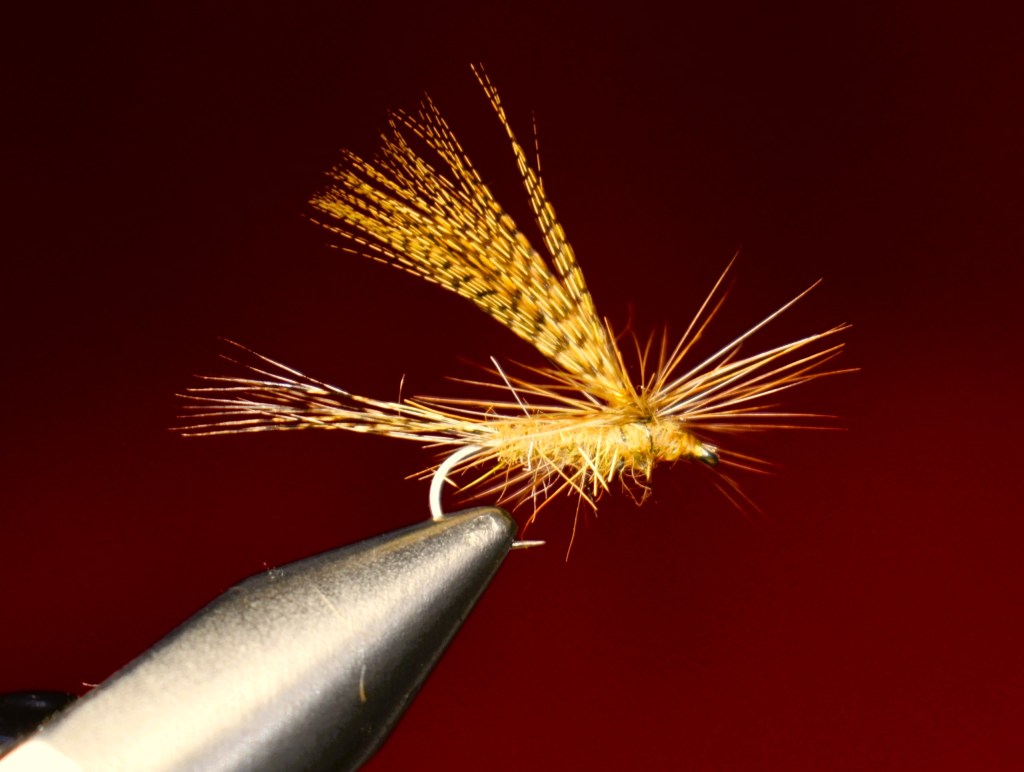
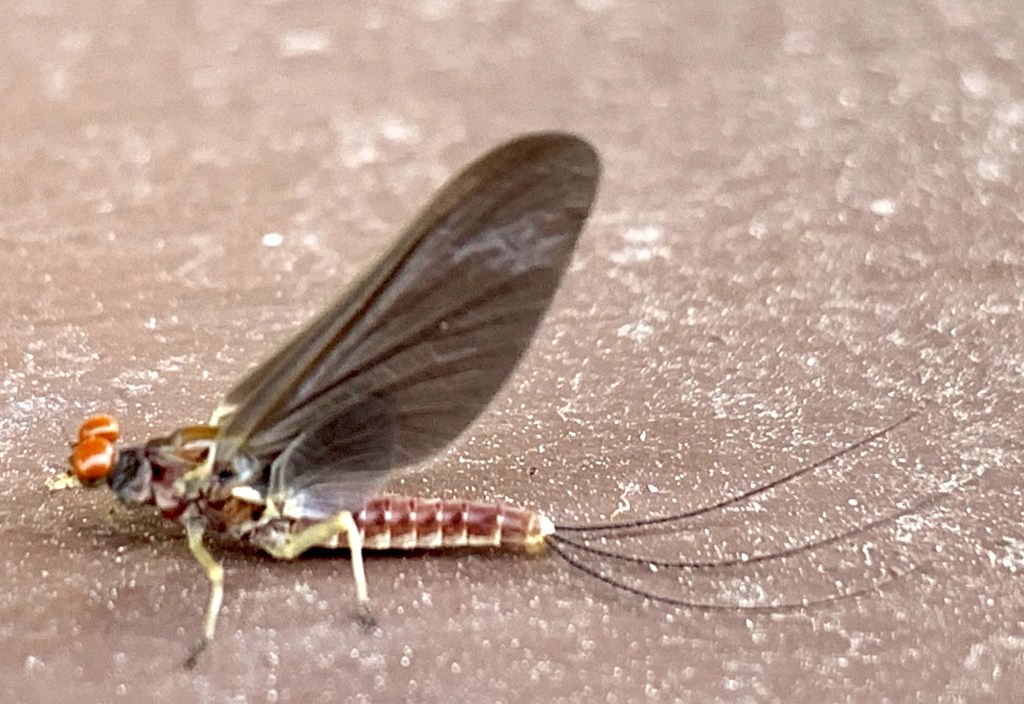
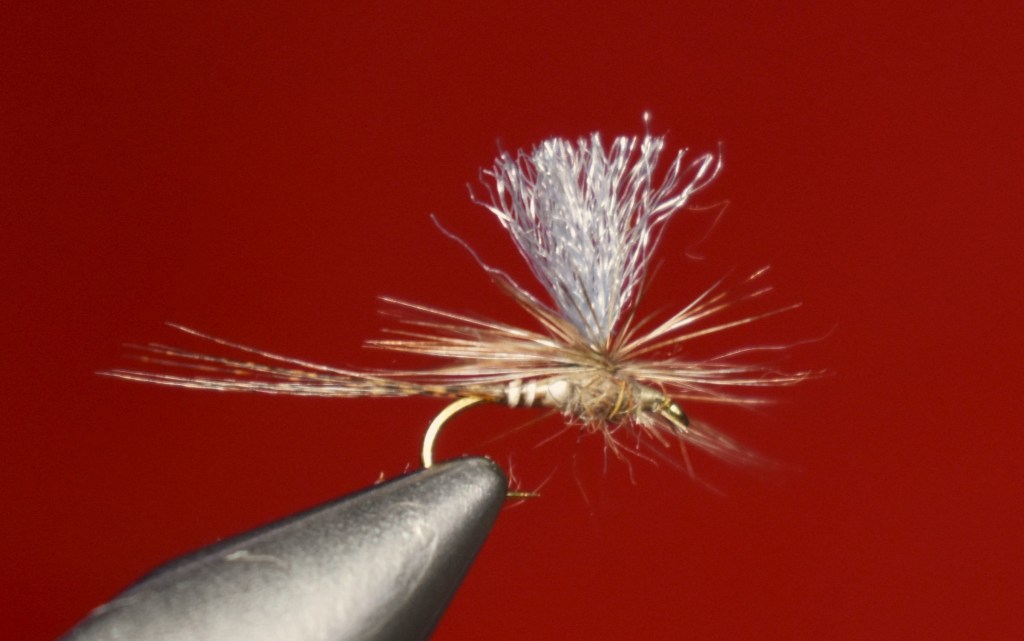
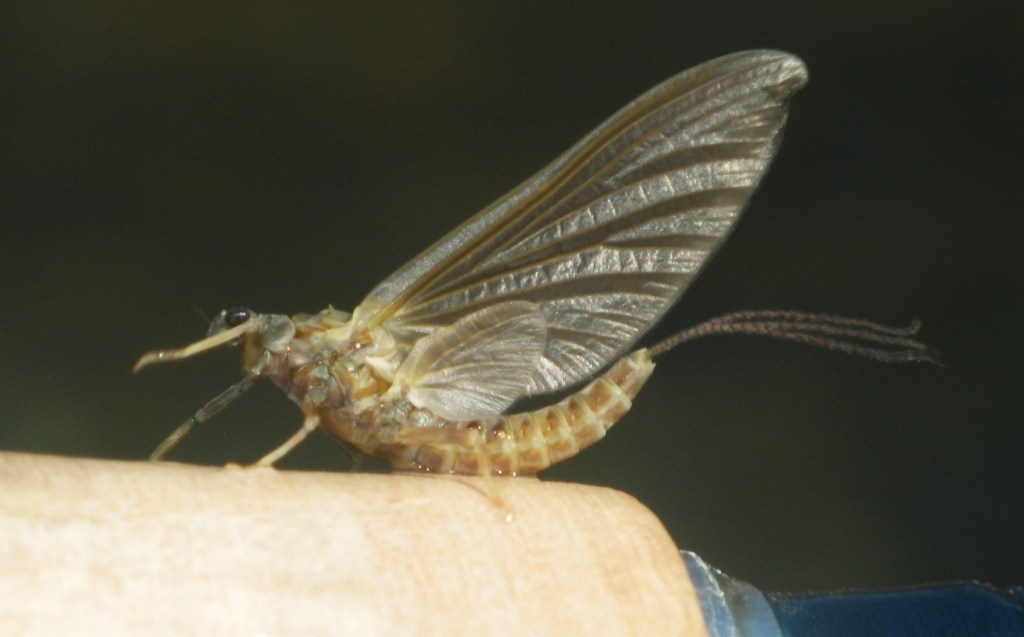
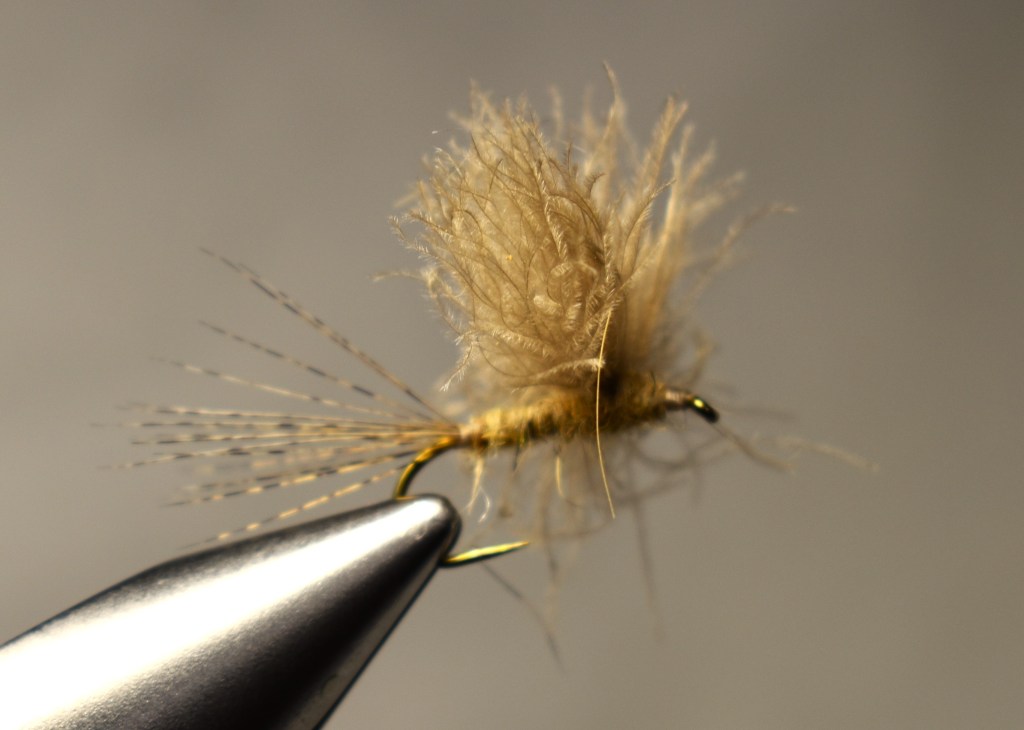
A sample of the darker tan Hendrickson duns from the wide expanse of the Beaver Kill, and my little size 16 quill bodied CDC Dun for a match. Oh, how I regret the disappearance of dark natural dun CDC puffs from the tackle dealers’ shelves!
Another cold day here in Crooked Eddy, colder than I would like, though not as cold as Mississippi yesterday morn. I have set half a dozen quill bodies aside to dry that I might complete the flies this evening when the electronic variation of the Catskill Fly Tyers Guild convenes. I am partial to the luster and protection provided by a coat or two of Hard As Hull polymer head cement and tying a clean fly demands time to allow the potion to harden. I find it fish proofs the delicate quill bodied flies, though beware that a grasp and a twist with forceps can still ruin your fly.
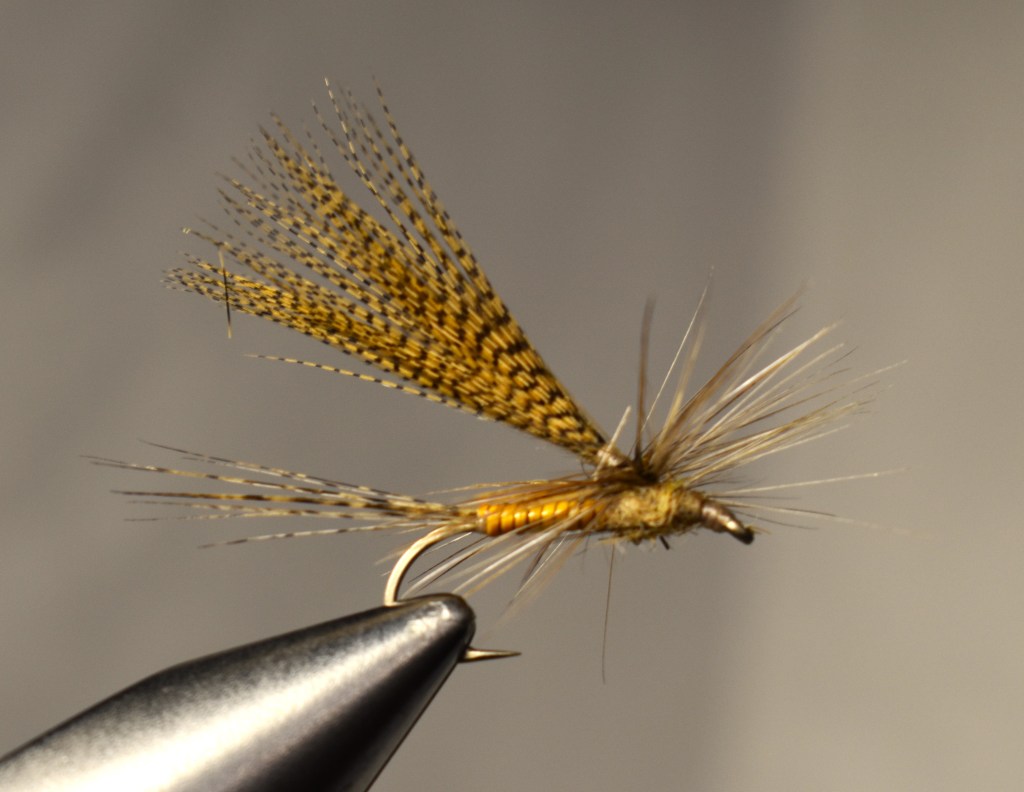
The lead photos dramatically demonstrate why I so miss the natural dun toned CDC. Compare the play of light (my daylight spectrum tying lamp) on both natural and imitation. Dyed feathers simply cannot give a tyer that! I eschew dyed hackle capes for the same reason.
This evening’s gathering will discuss many of the classic patterns designed to match the various mayflies recognized as the Hendrickson hatch, featuring the Red Quill. Art Flick’s original is a beautiful fly, and I regret that I do not encounter these “males of Ephemerella subvaria” every season. My most reliable reference for mayflies remains Al Caucci’s and Bob Nastasi’s Hatches II which, if memory serves, maintains that long held conclusion. The authors do discuss several different species of Ephemerella flies they all consider to be Hendricksons.
Currently, on Catskill rivers I find the tan bodied flies to be most common, usually a rather uniform size 14, though I once saw a large number of them in size 12 on the Neversink tailwater, and a few of these on the Beaver Kill. The Red Quills are indeed smaller, matched with a size 16. I have plucked them from the surface to find dark red bodies like Flick’s fly, bright red bodies and even what I relate to a powdery antique brick red. I have not seen this variation within a single emergence, and cannot say if all of these, or indeed any, were subvaria males. I do tie separate imitations for each!
I have noted a very large tannish brick red fly on the Beaver Kill which seems a lit larger than a size 12, and might be better matched by a size 10 standard dry fly hook, and on each occasion, there were the ubiquitous tan bodied size 14’s on the water with them. Have I noted new species of mayflies? I don’t think so, rather some of Nature’s very unique variations that I guess may be attributable to changes in water chemistry.
Though I once suggested to anyone who asked that they carry the venerable Red Quill in size 16 on these waters, seeing so many variations would lead me to recommend they might catalog that classic fly from size 18 up to size 10, just in case.
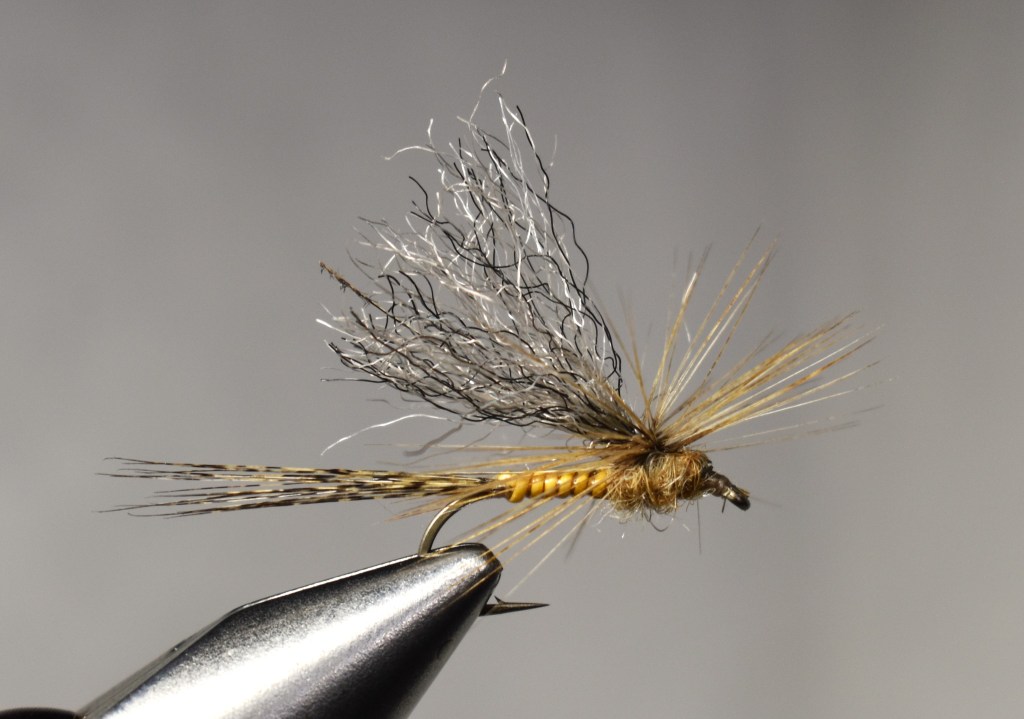
Why three tan Hendricksons?My 100-Year Dun has become my most-fished pattern as it has brought me great success. Though usually tied with a fur dubbed body, I do experiment with quill bodies too.The synthetic winged version, tied with Trigger Point Fibers, allows better visibility in poor light conditions, and the CDC Dun tips the scales when the emerging mayflies are highly active and moving as they drift the surface.
Here in the Catskills, the Hendricksons are my favorite hatches, and seem to be less variable in their intensity from year to year. In light of that, I tie, and have tied, far more than I my ever use. There are always new ideas, and of course I don’t ever wish to run out of the hot pattern during a hatch!
It is likely that I will reorganize my main fly boxes once more this winter, relegating the flies to fish over the Blue Quills and Quill Gordons to their own box, sharing some space for a few choice olives. After last April, a few size 18 ants will be tucked into the box’s foam lid! The Hendricksons have more than earned their own fly box, a special, classic Wheatley!
Prized Possession: A Catskill classic Dun Variant, tied by Mary Dette Clark (while I watched!)
It seems I have had variants on my mind of late. They have ghosted through much of my recent reading including Art Flick’s biography, and the stories of Gene Connett, Dana Lamb and others. In fact, I was moved to tie a quarter dozen quill bodied Hendrickson Variants just this morning.
I remember these beautiful big dry flies drawing my interest very early in my fly-tying career. When I first visited the Catskills more than three decades ago, I came armed with Mr. Flick’s favorite fly, the Gray Fox Variant. His Dun Variant was another pattern that was stored in one of my big compartment fly boxes, one that had seen some use back home in Pennsylvania, where the Isonychia mayflies Flick designed these big dries to imitate were found on waters such as the Little Juniata River.
I confess that my fascination with these flies waned over the years, enthralled as I was with my own patterns and experimentation. I have stashed a few variants in my big fly boxes in recent years once more, and my plan is to give them some time on the water.
One the recurring themes with classic fly patterns is that their reputations as trout catchers have been earned through decades of seasons and thousands of anglers. A majority among the new guard seems drawn to the latest conglomeration of materials, foam, synthetic flash, bug eyes and rubber legs that gets featured in magazines and videoed on YouTube. As a result, our heavily pressured wild trout do not have the familiarity with the classics that their ancestors did. That lack of familiarity often results in a lack of the avoidance behavior frequently observed on our popular rivers.
I would guess that there are a lot of brown trout out there that have never had a variant dry fly floated over them, and that makes me think I should have them on my tippet rather than sitting in a fly box!
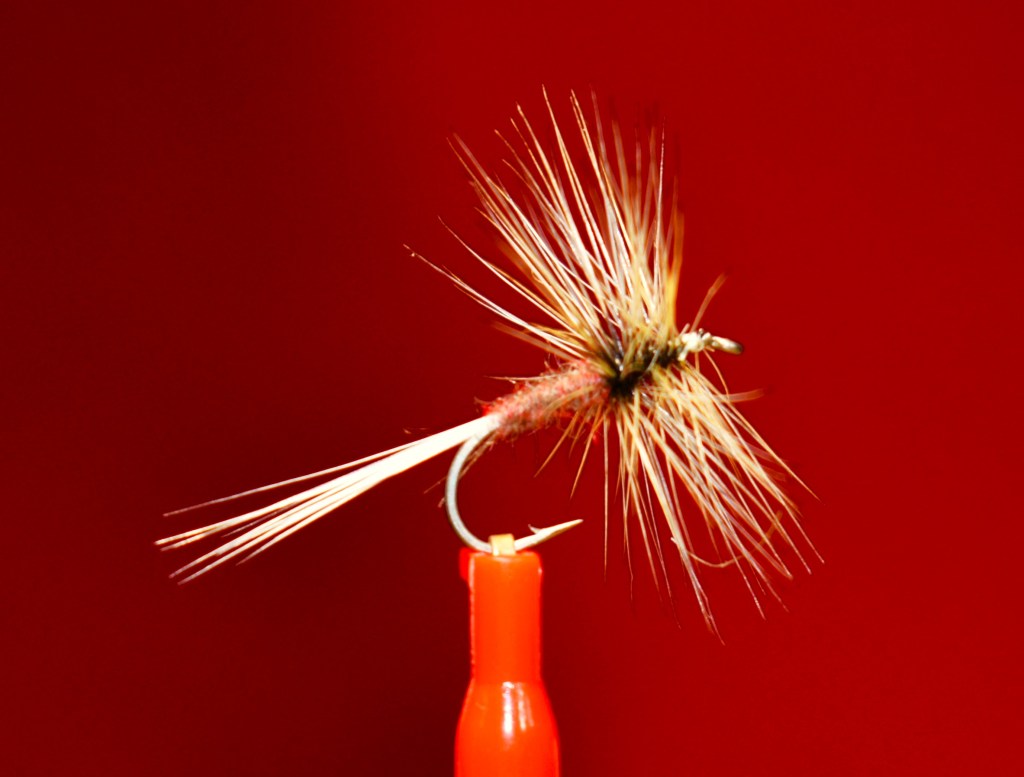
The Dette shop still ties and sells the Conover, a scaled down variant style dry fly originated in the 1930’s.This example is my own tie, and I have taken trout on it on the Delaware.
Art Flick considered his Gray Fox Variant to be a good imitation for the Green Drake, as well as pale Potamanthus mayflies, but it was his favorite pattern to fish regardless of the presence of these two giant mayflies. If you think about it, there do tend to be a few big bugs around through a long stretch of the trout season and, while a Gray Fox Variant may not be the best hatch matcher’s choice when trout are rising to sulfurs, these big flies might just be golden when cast and twitched around cover when there is no hatch going on. How many times have you seen or heard a terrific splash on one of those dead days?
I plan to fluff up the hackles on some of my stored variants and make sure they are handy once those long, sunny days of spring and summer roll around.
Come to think of it, there is one Art Flick variant that I have been fishing regularly. The Flick Blue Winged Olive is really a scaled down variant tie. I have had some great success in recent summers fishing the sparse little pale olives I find on summer mornings. I tie a thin thread body on size 20 and 22 dry fly hooks with a long, sparse hackle fiber tail and an oversized rusty dun hackle. I have taken some big browns on these and found them surprisingly visible even on long casts across flat, featureless pools.
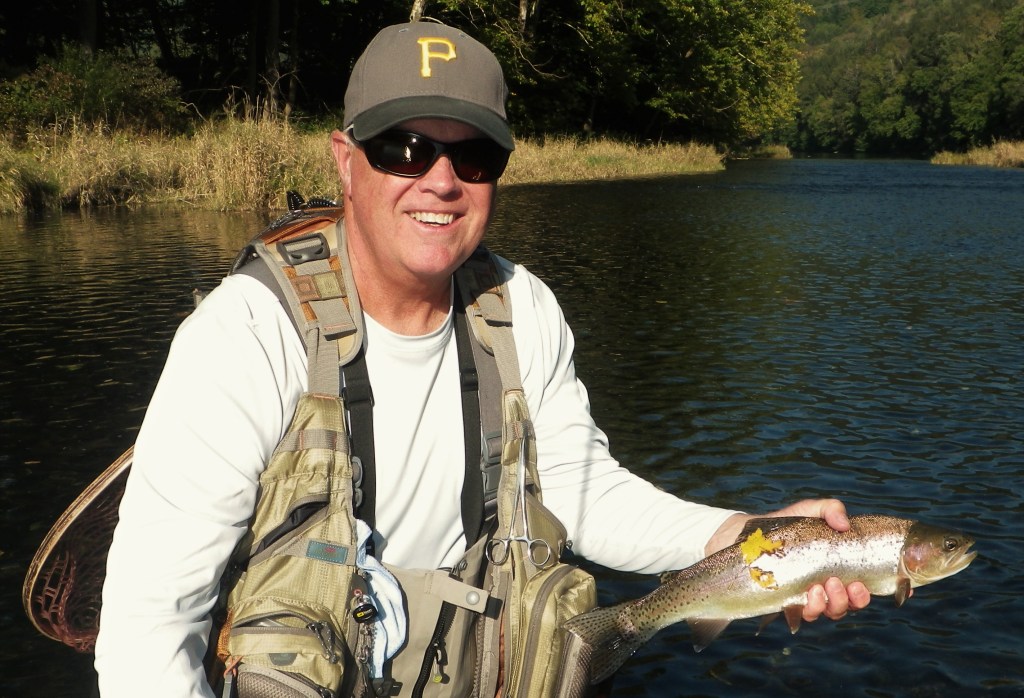
Mike Saylor with a fine Delaware rainbow taken on one of my size 22 pale Flick BWO Variants after refusing several more “sophisticated” patterns.
Besides enjoying great writing, reading old, classic angling books can give you some fresh ideas and expand your knowledge of the wonderful pursuit of dry fly fishing.








 Bright Waters Catskill