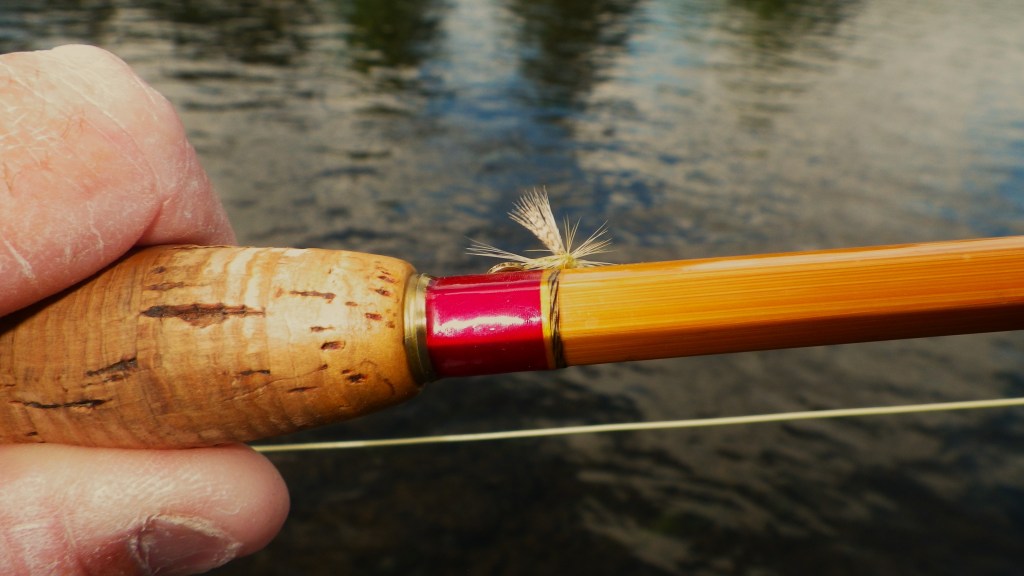
The Leonard has received its off-season polish, and the old amber cane gleams with a light that belies its nearly seventy years. My smile comes from recollections of special moments with that vintage Catskill classic.
Eight months ago, I began my annual dry fly odyssey with that rod in hand and a freshly tied Gordon’s Quill resting in the hook keeper. How perfect that the historic Catskill combination produced two fine brown trout to usher in a long and beautiful dry fly season.
Throughout the 2022 season, I had been on the losing end of a continuing battle of wits with a very special fish. Hooked and lost twice when he broke my tippet and a third time when the hook unexpectedly pulled out, the most embarrassing episode of the duel came when my autumn fly sailed free of the flawed tippet on my cast, only to alight and drift untethered to be taken by my foe.
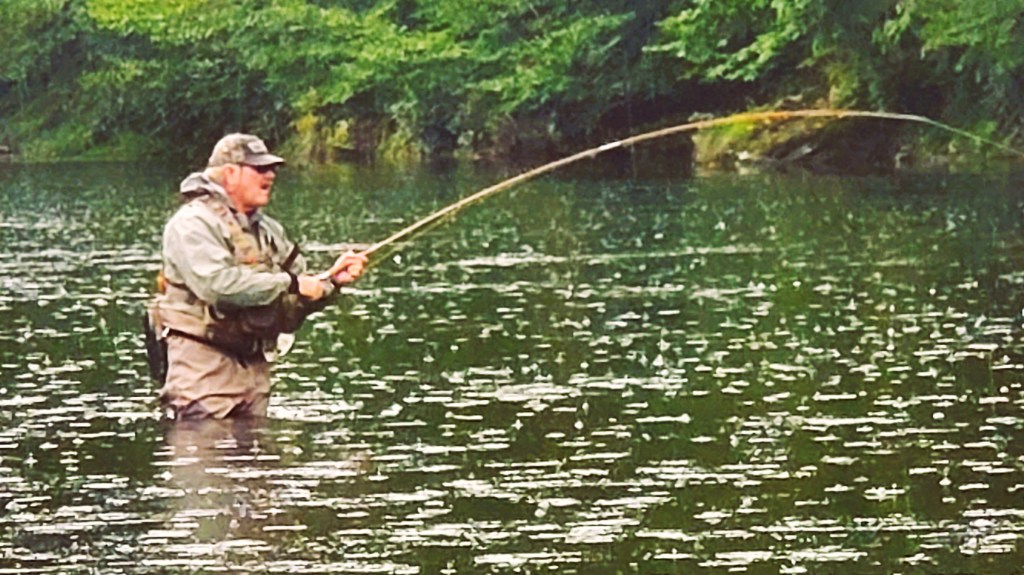
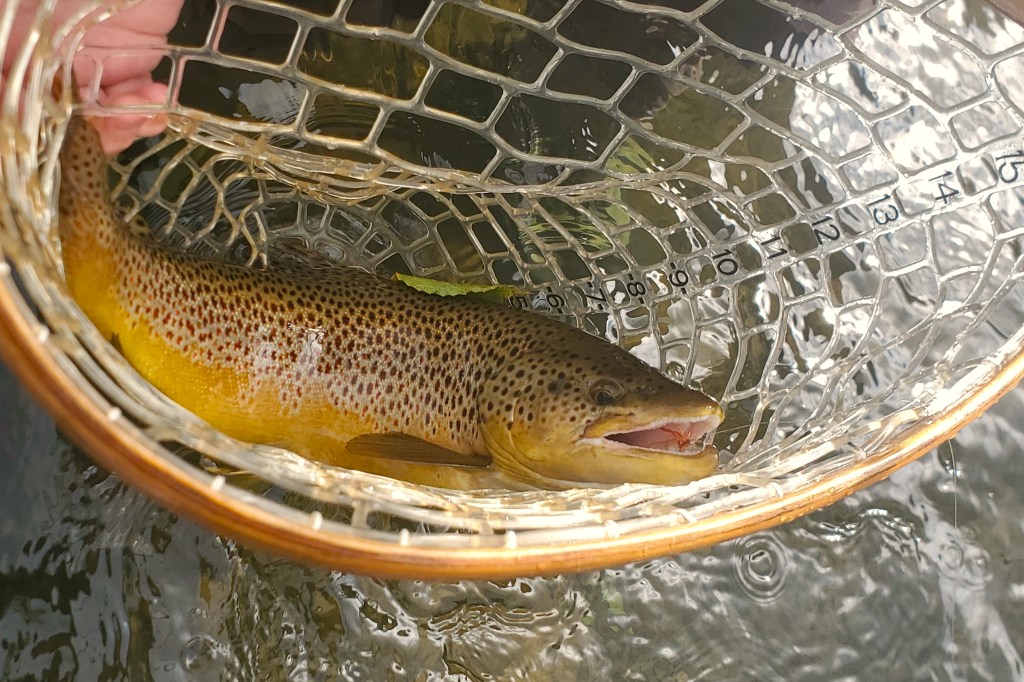
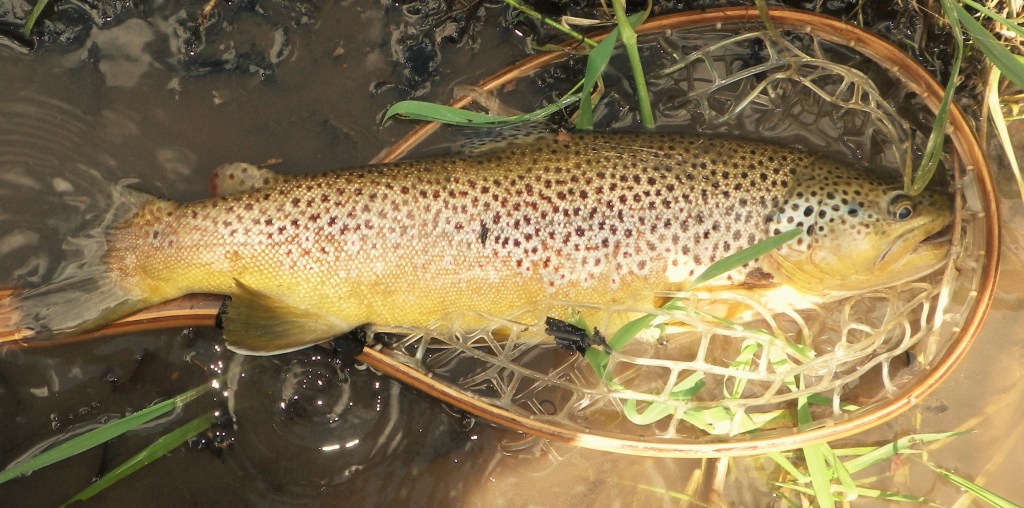
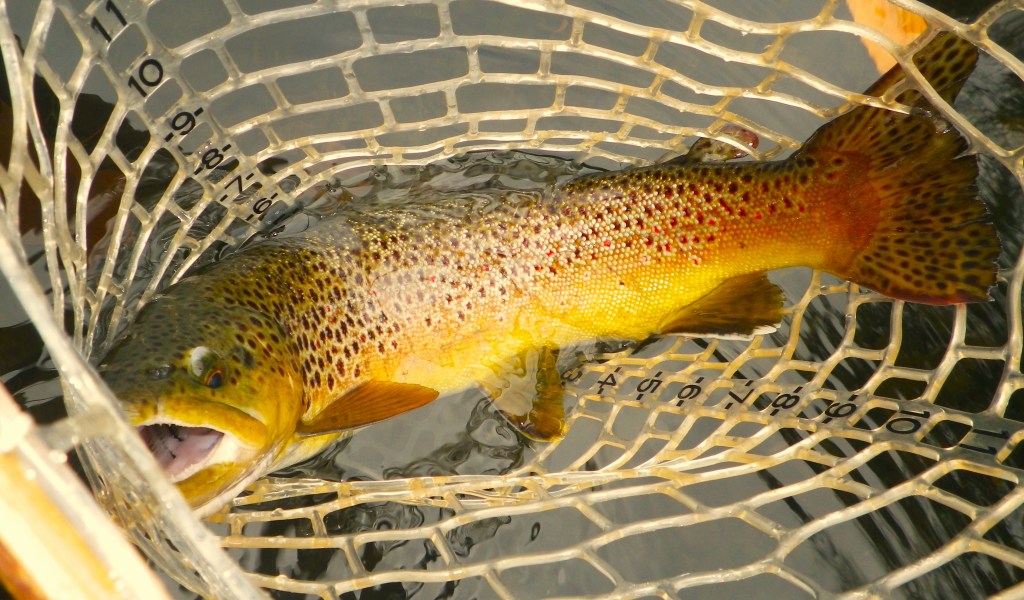
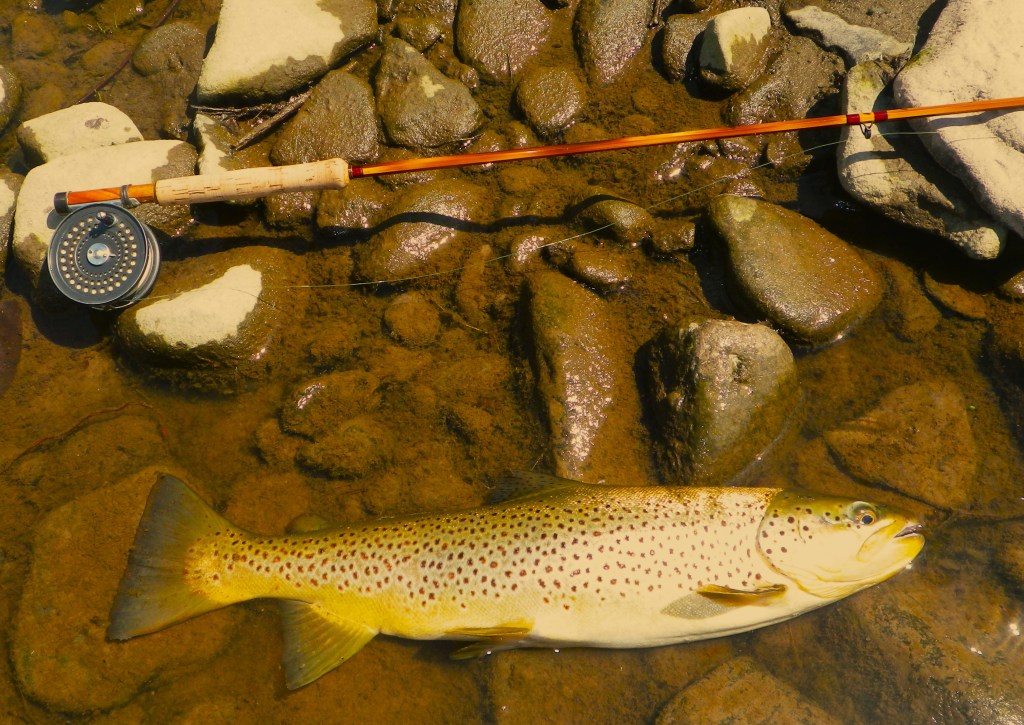
On a rainy September afternoon, we dueled once more, and the Leonard proved my successful foil! Heavily muscled and barely shy of two feet long, that brownie fought the old man and his old rod with all his cunning and might.
The Duel in the rain… (Photo courtesy John Apgar)…and the Prize!(Photo courtesy John Apgar)
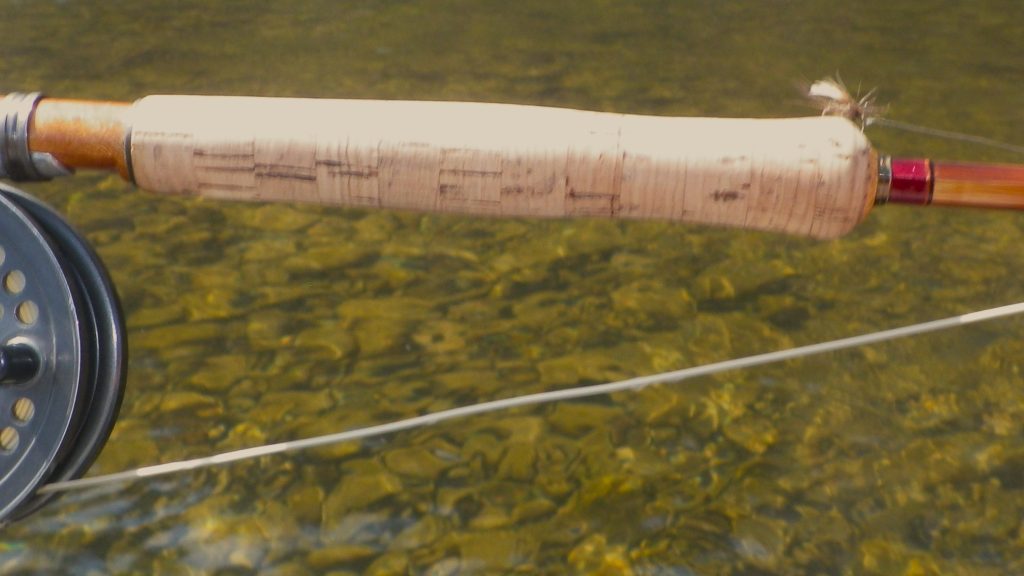
Rubbing the beeswax and lemon oil concoction along the shaft with my fingers, I could feel both the history and electricity of a truly venerable rod.
Once more, a vintage St. George will take it’s place in the locking reel seat come April, as we embark upon another glorious season. Indeed, one of Father Theodore’s famous namesakes will once more occupy the hook keeper. The pairing brought me luck this year!
I raise my cup and wish you all the best for a very Merry Christmas!
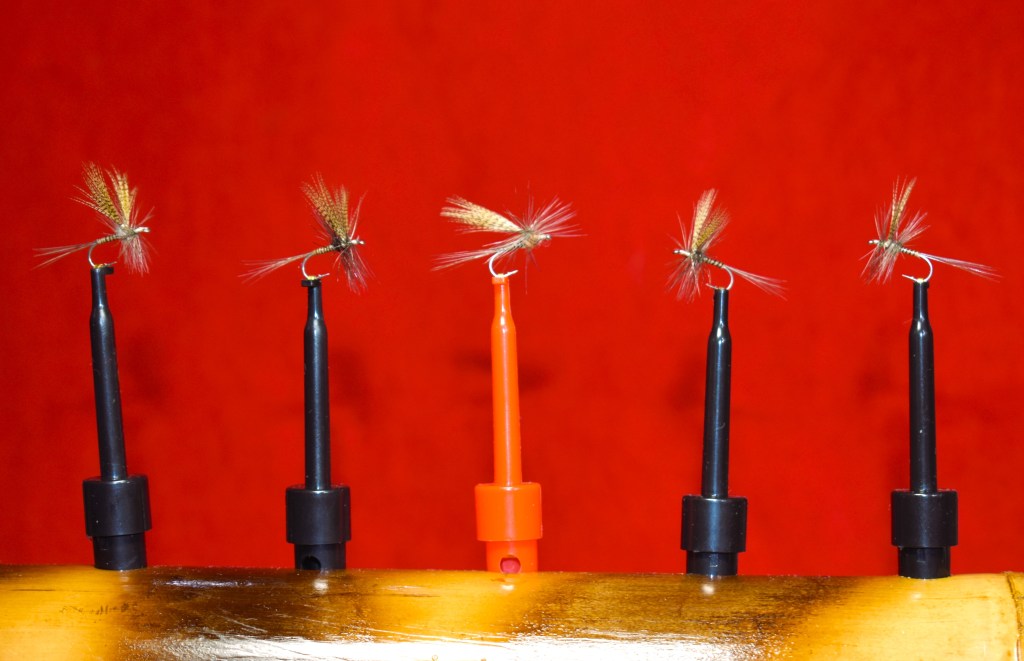
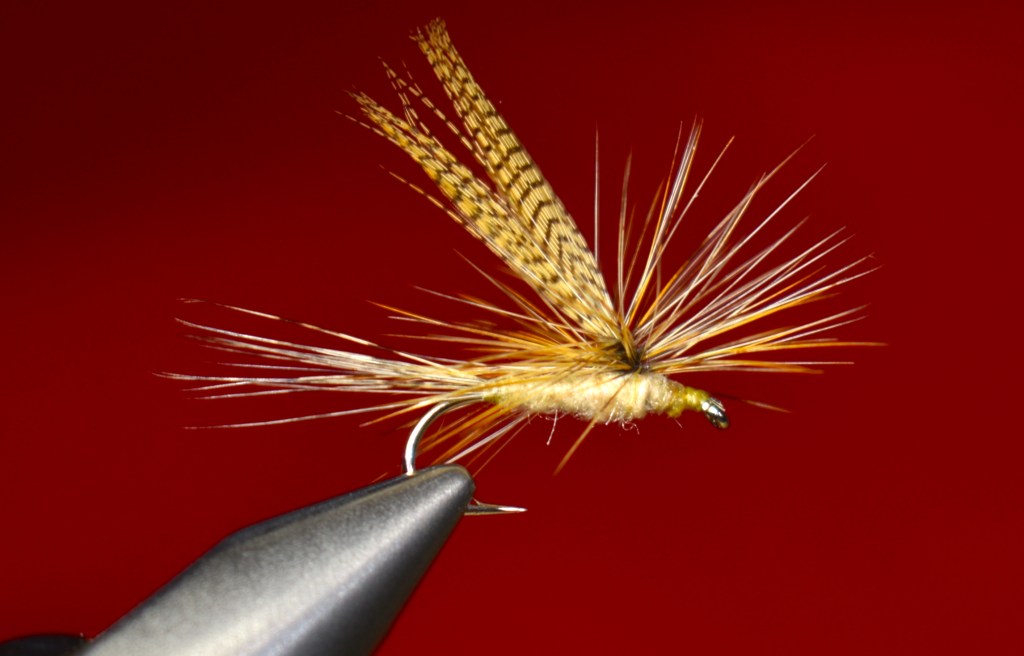
The Cree hackle catches light as I wind it round the base of the canted wing, bringing a smile and remembrances of moments on the water. Another pair of flies completed for a Christmas fly box.
I cannot tell when my friend will travel north; he never comes when I tell him the time is right. This year I am working my way through the seasonal hatches to cover all the bases. First came a pair of delicate Catskill ties, the first ones, Gordon Quills. My A.I. Hendrickson 100-Year Duns joined them, and this morning Translucence March Brown 100-Year Duns – those of the smiling Cree hackles! This box might have been filled by now, had I not continued to struggle with the cough.
December has been relatively mild, our only snow coming in little dustings windblown from the Great Lakes. If not for my bad reaction when chilled air enters my lungs, I would have hunted many days this month. Coughing fits would scare any deer within half a mile though, and I dare not risk it getting worse.
March Browns have made me think of May, when the forests have that first blush of brilliant green, and the heavy hatches of the quills and the Hendricksons have passed. These big pale yellow flies are fine fare for a hunting trout, making for joyful days for this stalking angler. It is great fun to tie a big dry fly on and stalk from run to pool. Once the hatch has started one needn’t look for the flies bouncing on the current, watching instead for boils or rises amid the tumult.
Many a fine brown, with wide shoulders and spotted flanks has come to net courtesy of these sporadic mayflies! I can see the action before me, the sun warming away the morning chill, and there where a rock or fallen limb breaks the faster current I turn when I hear the plunk of a rise nearby. The sound provides direction and my eyes, and decades of May days astream, pick out the locations. Often the first cast to land true brings a heavy bow in the rod, though sometimes a fish requires more seduction.
If the dun fails to excite him to the surface, there’s a wiggling CDC emergent morsel to turn his attention which follows.
My thoughts return to one old heavyweight who situated himself beside a sunken ball of broken branches, piled along a deep bank by spring floodwaters. He was careful in his perusal of the drifting fare, and I had to trim away half the wing of my emerger to suit his tastes. He bored down into that mass of wood and we found stalemate for a few moments! Luckily the tippet held and I turned his head at last to open water.
I hope these flies make memories like that for my dear friend!
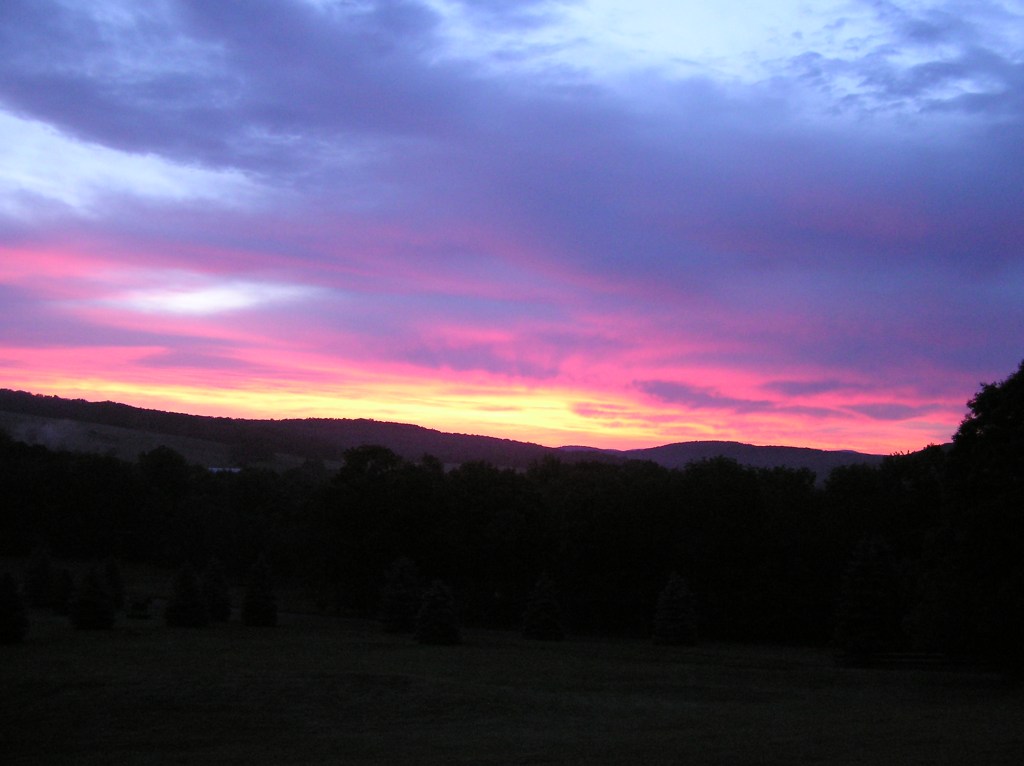
A beautiful spring morning sunrise at Pat Schuler’s Glenmorangie Lodge. A couple decades ago, our trip there was the highlight of the season. Always an early riser, I took this shot while tying flies in the great room and listening to the wild turkey’s calling through the open window, a fond yet simple memory.
Sitting in my small living room this morning, I watched the faint golden glow of sunrise tinge the air along the mountain tops toward the north. How I do love life in the Catskills! There are mountains surrounding this river valley village providing ever changing views through the seasons, and I enjoy them all.
I had Dana Lamb’s 1965 book “Woodsmoke and Watercress” in hand, fishing with him all down the Beaver Kill, and dreaming with him of salmon camps and the glorious days and nights on the Maine lakes. I took note of a special mention of one particular Beaver Kill pool, one that I haunt for a number of days both early and late in our Catskill seasons. That pool appears in several stories, enough so that I wonder if it may be the salutations of the great writer’s ghost I hear on the winds.
In and after the Golden Age, Lamb fished not only the abundant public waters of the region’s most storied river, but the private club held waters above Roscoe. Though I followed his ghost to his beloved Pigpen Pool, I have never shared the privilege of angling those hallowed club waters of the upper river. It is a pleasure though to realize that I may have indeed sat upon the same rock on a downstream riverbank, staring across the wide currents at a rise on another closely watched rock on the opposite riverbank, and listened to his voice in the wind.
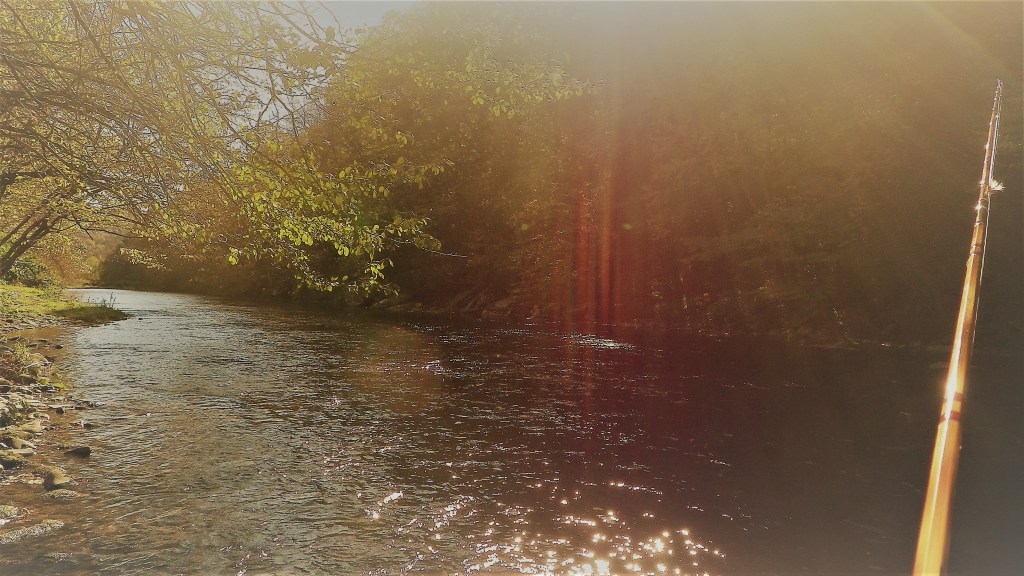
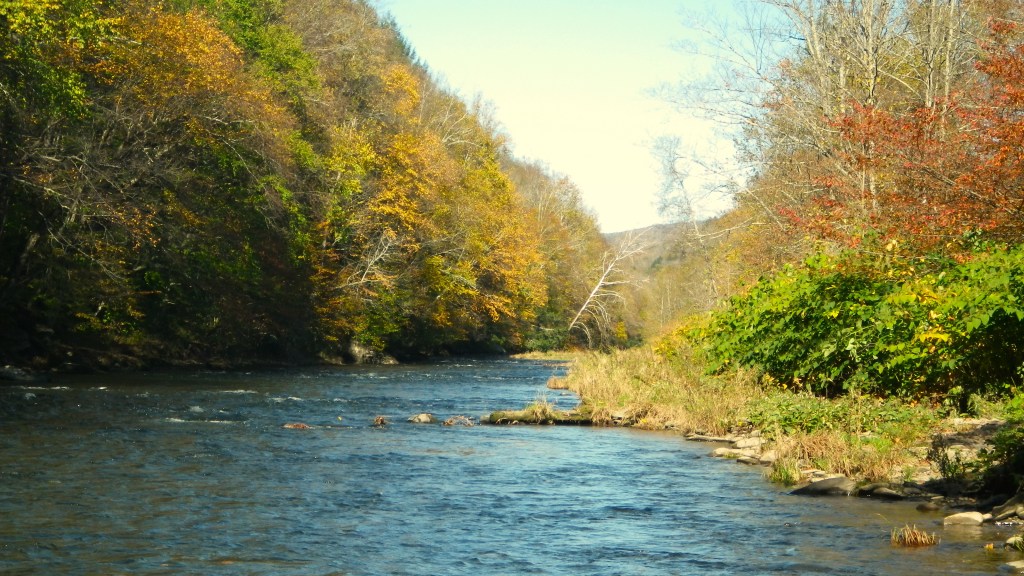
Autumn sunlight on Dana Lamb’s “Pigpen Pool”, October 2021
A single turn of silk and it all begins. As each material is positioned and lashed to the hook, the anticipation grows. This is more than just a fly, it is a door opened, tackle packed in the car, and the morning sunshine on the drive to the river.
The mind conjures that special quality of the light on a favored lie, and then my hand seems to feel the cork as it tightens for the cast. That simple fly is now an experience unto itself as it drifts downstream.
I have always cherished the connection to the fishing that my fly tying provides. As each turn of hackle settles into that magic whirl of barbs, I see the whirl of a take upon bright water and feel the heavy pull as a great fish turns and runs with every measure of the wild energy alive in his spotted form! As the silk traps the hackle and pulls it tight behind the hook’s eye, I thrill to the tightness of the line, the throbbing of the cane and the glorious symphony of a Hardy check o’er the murmur of bright water.
The cold months pass, and the compartments in the fly boxes are filled, yet there is more in there than the flies themselves. Beneath the tumbled hackles, tails and wings are the memories of rivers, pictures of those favorite runs bubbling in springtime’s heavy flows and of pools glowing with the soft glint of summer’s light along a riverbank dappled with shade.
The Winter Solstice arrives tonight at 10:27 PM, and tomorrow the days begin to lengthen gradually, achingly, at a pace which reminds me of a quiet approach across a silken pool amid the low flows of summer, with the wide rings of a soft rise in the distance. Many turns of silk lie ahead.
It is cold and quiet here in Crooked Eddy, with a fresh dusting of snow. North, East and West of Hancock the rivers are receding after some three inches of rain. But for the gift of warmer air from this storm travelling from the south, we could be covered in a heavy white blanket destined to endure until spring.
The Beaver Kill crested eight and a half feet above it’s normal level yesterday, well into it’s official flood stage. It’s peak flow has been halved this morning, though it will take some days before the familiar gentleness of a trout river returns.
As the rains came, I sat and worked a beeswax polish along the subtle tapers of two bamboo fly rods, my fingers remembering their feel when ignited by Nature’s magic and electricity. Though it has been winter since November’s dawn here in the Catskills, the seasons of practicality and the calendar will coincide in just two days. Christmas will follow closely, and my annual 100-day countdown ’till a hoped for dry fly season will commence on New Year’s Eve.
With less than two weeks remaining in this 2023, my log totals one hundred eight dozen flies tied, short of my typical production. Then again, this is the time of year I often tie flies for distant friends, so that total should rise, though surely I will not log the more than twenty dozen required to reach my mark.
Classic dries and Christmas Spirit all in one!
We had a little break on Saturday, taking advantage of welcome fifty-degree sunshine to drive north to listen to our friend Nate Gross play his incomparable guitar. A master of electric blues, rock and anything else one might want to hear when leading his band, he amazed alone with an acoustic guitar in the packed and cheery Norwich pub. It’s good to get some of that energy to help us through winter!
Today I’ll spend with Lamb and Schwiebert, and perhaps wrap a few hackles to begin to fill one of those boxes for my friends. I attempt to guess when they might arrive, that I might present them with the correct flies for that turn of the season. Quills and Hendricksons or March Browns and Sulfurs? Well, they don’t often come calling until well into May…
The two I am thinking of have the limestone waters at their doorsteps, though the fishing in that lovely valley has suffered over time. There is hope on the horizon, at least in the hearts of anglers, that the halcyon days on Falling Spring, Big Spring and the fair Letort might one day return. I hope it comes to pass!
The classic beauty of the Falling Spring Branch, which stole my heart decades ago!
Thoughts of limestone springs cannot help but invoke my longing for the promise of dry fly fishing which lurked there throughout the year. Winter midges, olives on the snow, and Ed Shenk’s smiling tales of fishing a sulfur hatch in every month of the year – such are the memories that tug at my emotions.
These days I winter here, and if the snow and ice fails to turn the mountain ridges hazardous too soon, I may walk there with a shotgun and a quick eye. After New Years, I begin to watch the parade of winter storms, seeking those faint promises of southerly flows and warming trends. If I catch one right, I hope to string up an old bamboo rod and swing a favorite fly along the rocky river bottom. Could this be the moment a big old warrior awakens to ease his hunger?
The spring sunshine feels good on my shoulders when the chilled breeze lessens. It is past Noon, and the April waters it is hoped will awaken soon. I walk twenty or thirty yards then stand and watch the wrinkled coverlet of the river’s surface. Moving ever upstream, I find no signs of life, simply glare and the vagaries of current. The scene is beautiful though it displays no promise.
After a few hours of this I finally see a subtle wink of light across the run, there where the current levels out a bit and bounces off the angled edge of a bankside boulder. I find a seat in the browned grass on the riverbank, just high enough that I may watch closely for another wink.
Waiting, I check the fly that has spent the past few hours taught against the nickel silver ring that serves as hook keeper: Gordon’s Quill awaits the season’s first cast.
Perhaps half an hour passes, and then I see that second wink of light, and the soft ripple beside the rock that lets me know that a trout lies there. There are wings on the surface of the run. Just a few, but clearly enough for this trout and this angler. I rise and step softly into the flow, study the currents and begin an approach to take advantage of their ability to mask my movements. The speed and direction of flow tells me to position myself upstream from my now conspicuous bankside rock, and I work slowly toward a spot that looks perfect.
The high spring flow pulls me up short of my mark, and I can feel my heart rate rising in my chest as I anchor my feet to find a steady hold amid the current, to feel confidence in old legs months removed from wading rocky river bottoms. Thus secured, I take the fly from it’s keeper and squeeze a tiny pinch of floatant onto my finger tips, then massage it gently into hackle, tail and wings. I have done these things many thousands of times, though here and now they feel new.
Pulling line from the well-worn spool of the reel, I pull the leader knot through the tiptop and drop the first ten feet of line on the water, wiggling the rod to feed more slack into the currents. The fly itself comes to hand where I blow away the water droplets and settle in to study the rolling surface along my particularly interesting rock…
There! A wink and a ripple are spied once more and my rod hand comes up as I trade the fly for a handful of trailing slack, the first of several to be loosed as my cast is extended toward it’s ultimate goal.
The fly alights and drifts down past my rock, once, twice and finally a third time. In an electric moment of expectation and joy, that third drift doesn’t make it all of the way past my rock, becoming another wink of light and a ripple before my eyes!
The arch of the bamboo meets the trout’s desire for freedom as he swings out away from the bank and into the full force of the run. My reel chatters in protest for the first time since autumn, and the new season begins at last!
Roughly two weeks remain in this year, and I have settled into my winter routine. It is expected at this time to take a look back at the year completed, something I believe most of us do. For anglers, particularly those of us of a certain age, we become more acutely aware there are fewer of those golden days upon bright water ahead of us than behind.
In two thousand twenty-three I was blessed to spend one hundred thirteen days upon the rivers of my heart. Yes, there are more days on the calendar between April and October, but there are days when the weather is simply unsuitable for fly fishing. In my travelling days, my standards were more liberal, due to the overall shortage of days on Catskill rivers I was able to manage. I have fished in forty mile-per-hour winds, with gusts to fifty, though common sense now governs such decisions.
Still throughout this past season, I have seen most of our hatches declining. I maintain hope that I am witnessing just the cyclic patterns of Nature, and not a lasting absence of some of our most treasured mayflies. The fishing itself, and in saying that I mean dry fly fishing, continues nonetheless. With diligent hunting, I share the magic and energy of a good number of large wild trout each season. For the most part, there is considerable effort involved, and it is the day-to-day rhythm of these efforts that I cherish. Time on the water reveals so much, intrigues the mind and nourishes the soul.
I was reading Dana Lamb’s first book this morning and was touched by his remembrances of decades of Catskill fishing. He sang a song of subtle regret for the loss of the wild trout that once thrilled anglers on the miles of the Beaver Kill, though he closed with a fresh memory of an enchanted evening where he found a good measure of that which he had lamented to be lost. Lamb lived from “the fourth day of 1900 until the sixth day of 1986” as penned by his children in the foreword to that book, so he truly lived and fished throughout the Golden Age. I believe that is one of the reasons I read his nine volumes each winter, to share in his love of bright water and truly appreciate his profound perspective.
When “On Trout Streams and Salmon Rivers” was published in 1963, Lamb wrote of the early days as well as the years after World War II, when growth and development greatly changed the rivers. He found hordes of fishermen “looking more for fish than fishing” during those years, and his perspective, sunlit by the treasured angling experienced during the Golden Age, lamented the loss of those halcyon days of sport.
I still find thousands of anglers on our Catskill rivers today, some travelling from throughout the world to angle here at mecca. While there are stretches of water well populated by the pale little trout from the hatcheries that Lamb feared had forever replaced the beautiful wild creatures he once angled for, we are blessed to have good populations of strong, colorful wild trout in these hallowed rivers. We have learned to be better stewards of Nature’s gifts and, though there is still great progress needed toward that goal, the rivers where American dry fly fishing was born still flourish.
Those of us who take the time to know these rivers understand that the gifts the rivers bestow are not all about quantity, but truly about quality in ways both tangible and intangible. I am thankful for all of those one hundred thirteen days, for whether fine trout were fished to and landed, or my casts fell upon silent currents, each day upon bright water offers a draught of the sublime.
Drawn to the porch by the cloudless sky, I found the bright ball of the sun already low o’er the top of Point Mountain. That last glow urged the thermometer to an unbelievable sixty-five degrees on this fifteenth of December.
I sat for those last few minutes, the last full rays of that sunshine warming my chest, and nary a cough escaped my lips.
There is still crusty snow on the shady side of my little clapboard house, but oh the pleasures of those brief moments of porch sitting!
My winter abode: I do my best to keep the most-used materials easily accessible, and the bamboo tower at my rightdoes a wonderful job of that! It was a welcome find at the Catskill Center’s Summerfest a few years back, and I could not do without it now.
The sun shines brightly in the winter sky, threatening to warm our mountain air enough to flirt with fifty degrees. Oh, how I wish I could slip away and swing a fly for a couple of hours! Alas, an old enemy – bronchitis – has me coughing and retching horribly with even a short walk in the winter air. I am a prisoner of memories…
There has been a great deal of observation and fly tying experimentation these past few seasons, committed as I have become to hunting the great wild trout of the rivers of my heart. If I let my mind wander a bit, the patterns that worked exceptional magic bring a smile, brightened by the memory of the moments that crystallized my resolve to continue my quest.
I called her a Little Dirty Yellow Hendrickson when I first found her bobbing down the currents on the Delaware.
Tied first as a Poster, she produced some mesmerizing moments during a lull in the seasonal hatches. I was angling on a favorite reach of bright water on such a day. There were barely enough flies to bring a few soft rises intermittently, and the timing and location made me feel certain they were sulfurs. None of my tried-and-true sulfurs drew any interest from a trout, and then I remembered that Delaware morning. I set to work on one devilishly inviting riseform and the ensuing battle left me breathless when I brought a heavily muscled two-foot brownie to the net!
The trout that proved the little dirty yellow fly legit!
That was not to be the end of my day, for the fly I have come to call the Lady H fooled another leviathan of like proportions come early afternoon. The lady has since earned her own fly box, which harbors an assortment of Posters, parachutes, CDC Duns and 100-Year Duns! She makes magic between the earlier Hendricksons and the March Browns, when long days on the river sometimes reveal few risers, thus the little Lady H has stolen this angler’s heart!
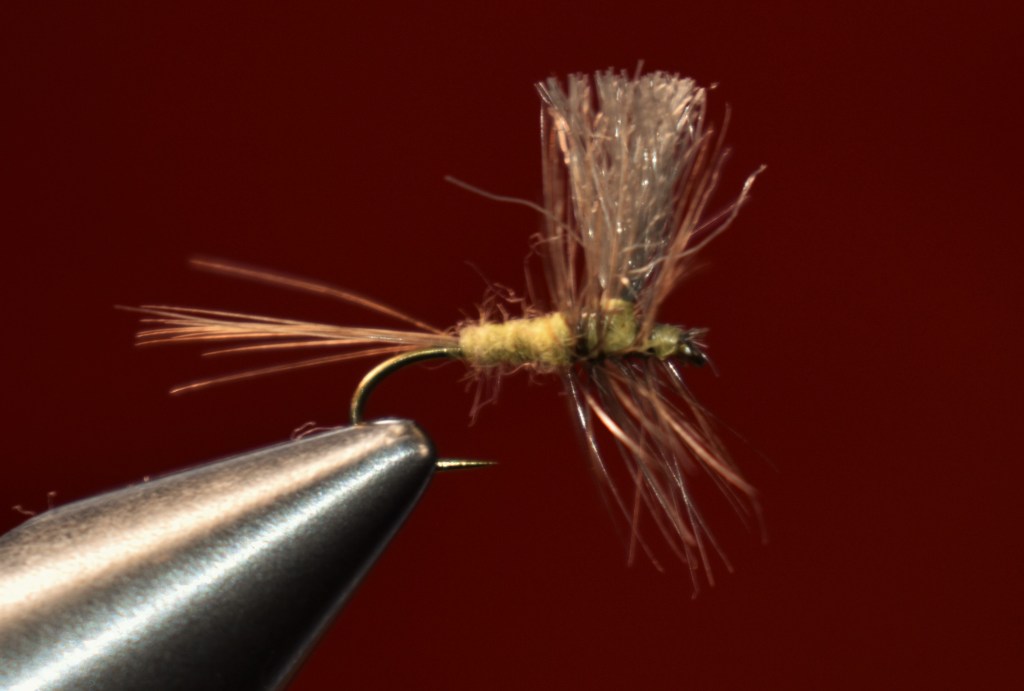
One of those first little olive 100-Year Duns, the flies that made magic!
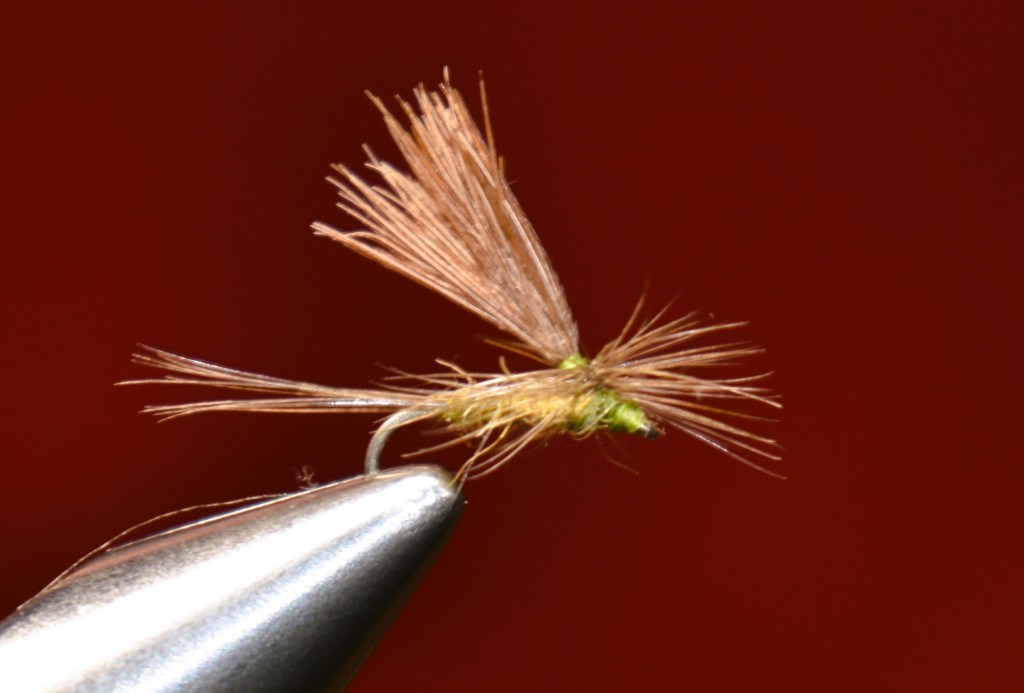
I recall showing some early 100-Year Duns to a friend who asked me why the wing was “pushed down like that”. I continually pay homage to the father, Theodore Gordon, for the inspiration to begin my journey tying the single canted wood duck wing. Though my signature fly began with the Green Drakes all those years ago, the expansion into all of the other primary Catskill hatches has revealed just how effective this style of fly can be. In particular, the small flies have been revolutionary.
Last year, late October, and my season finale proved to be perfection. I had tied three little 100-Year Duns on size 18 hooks, dubbed with my old favorite olive muskrat fur, and winged with widgeon. Late in the afternoon I stalked a low, clear flat and discovered a gentle dimple near a fallen branch in the edge of the shade. The fly was cast short, one time to assess the float, then offered to the full soft ring before me. Oh, she spun the Hardy LRH madly as she streaked to mid-river, my coveted T&T Hendrickson bowed mercilessly! Captured, she was a gorgeous apparition of gold and bronze, my final trophy for the dry fly season.
In April, I live and breathe for the Hendricksons, but even with a good hatch on the water, Nature can weave a mystery of deceit. It was not one of those days to find multiple risers, and when I finally found one good fish in a difficult lie, I gave my full attention. It took me some time to realize that, though there were plenty of plump Hendrickson duns dancing on the broken currents above that trout, I had failed to see even one vanish in the soft rings that betrayed my fish’s lie. There had been little flurries of smaller flies earlier in the day, but I was seeing only Hendricksons out there on that run.
My eyes fell upon the last of those little widgeon-winged olives tied last fall, and I smiled as I plucked it from my fly box. All hail the little 100-Year Duns!
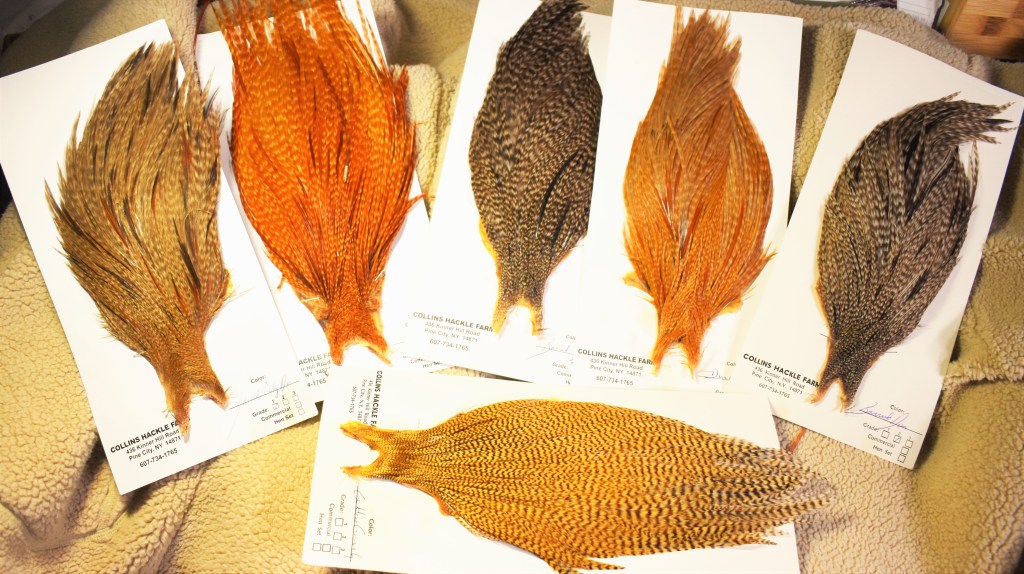
Some of Charlie Collins’ lovely, barred hackles, favorites for many of the flies I have designed.
I missed last week’s Zoom gathering of the Catskill Fly Tyers Guild, not by intent certainly, but as a result of battling the end of a nasty head cold and the onslaught of the bronchitis that used to plague me during my working years. To avoid another misstep due to weariness, I have been playing with some hackles and dubbing this morning, preparing for tomorrow eveningof .
Though our tying sessions are intended to be casual, our President likes to have some attention brought to a classic Catskill fly to begin these meetings and looks to someone to volunteer to pick a fly and demonstrate it. This opening interlude does help to keep our group aware of our mission and appreciation of the history of Catskill fly tying, and it does help make members aware of some of the lesser known patterns. I am a fan of this week’s fly myself, none other than the late John Atherton’s No. 4 dry fly.
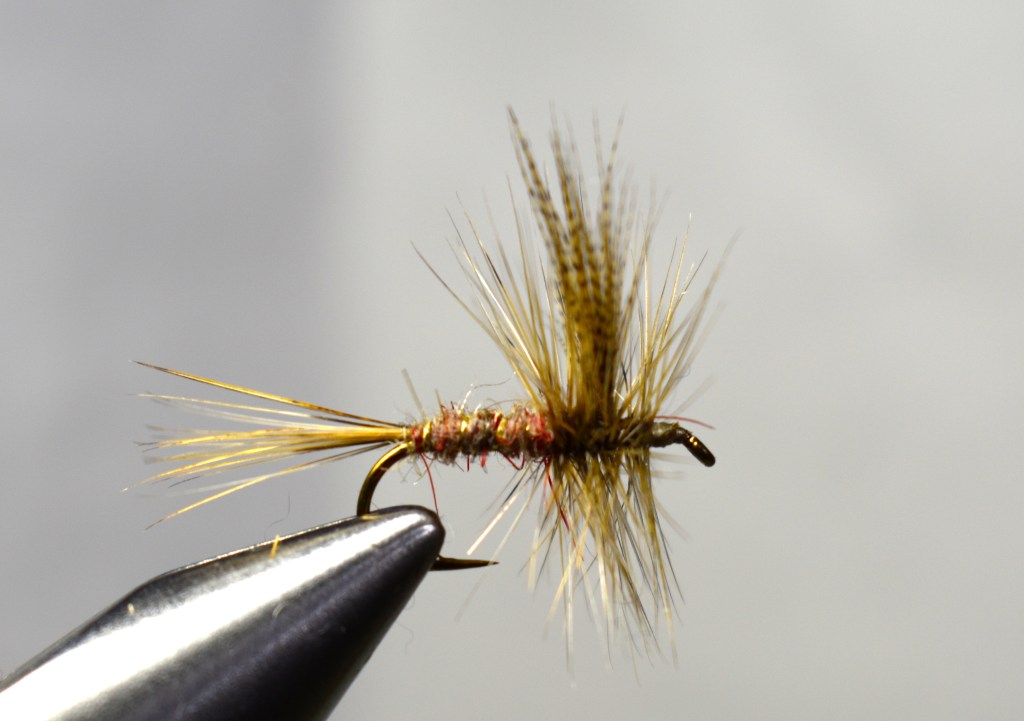
A rather dark rendition of an Atherton No. 4.
Some may think of the No. 4 as the artist/angler’s Hendrickson, for his blend of natural and dyed red seal fur, muskrat and hare’s ear was mixed to produce a “grayed, mixed pink” coloration. In truth, he intended it to be fished when a variety of pinkish, reddish hued flies were on the water, including some of the spinners. My initial blend from a winter or two ago proved to be darker than I believe Atherton intended, so this morning’s first task was to lighten it up a bit. I have a piece of beaver pelt dyed pink, so I cut a little in various shades, adding that and a bit more silvery gray muskrat underfur. It looks better to me now, more like the color his words conveyed, so I will see how the trout like it.
Jack Atheron’s ideas of color in nature fit with my own concepts, borne of decades of observation. Natural things are not cast in plain solid colors, there are mixed shades of blended and primary colors and iridescence mingled in Nature’s hues. I unknowingly agreed with Atherton’s impressionistic theories of fly color long before I secured a copy of his only angling book; “The Fly and the Fish”. Becoming well acquainted with his ideas in recent years, I now count him as an influence in my own tying and fly design.
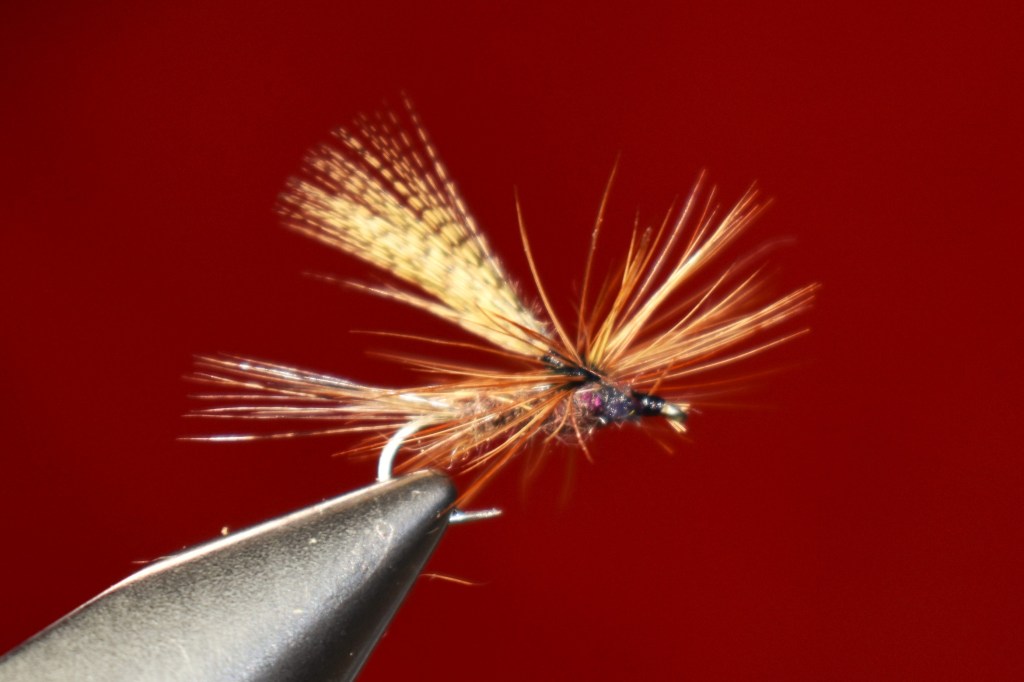
My A.I. Isonychia 100-Year Dundraws inspiration from Jack Atherton’s concepts and my own observations. It is one pattern in a series designed to incorporate the artist’s ideas with my own concentration upon matching insect coloration for specific hatches.
I tied an initial pair of Number Fours in my 100-Year Dun style during my preparation for tomorrow evening’s meeting. I experimented with a mix of Cree and barred medium dun hackles on the first fly, then turned back to Atherton’s recipe, using Cree and medium dun for the second. This style of tie is less suited to the use of two individual hackles than a Catskill fly, so I expect that my final version will be tied with a beautifully barred Dun Cree Collins cape. I will see how I like that choice when I tie some during the Zoom meeting.
I began re-reading “The Fly and the Fish” yesterday, eager to refresh my memory. I’m about halfway through, just coming to the patterns and his discussions concerning their creation and use. Winter is my reading season after all.









 Bright Waters Catskill