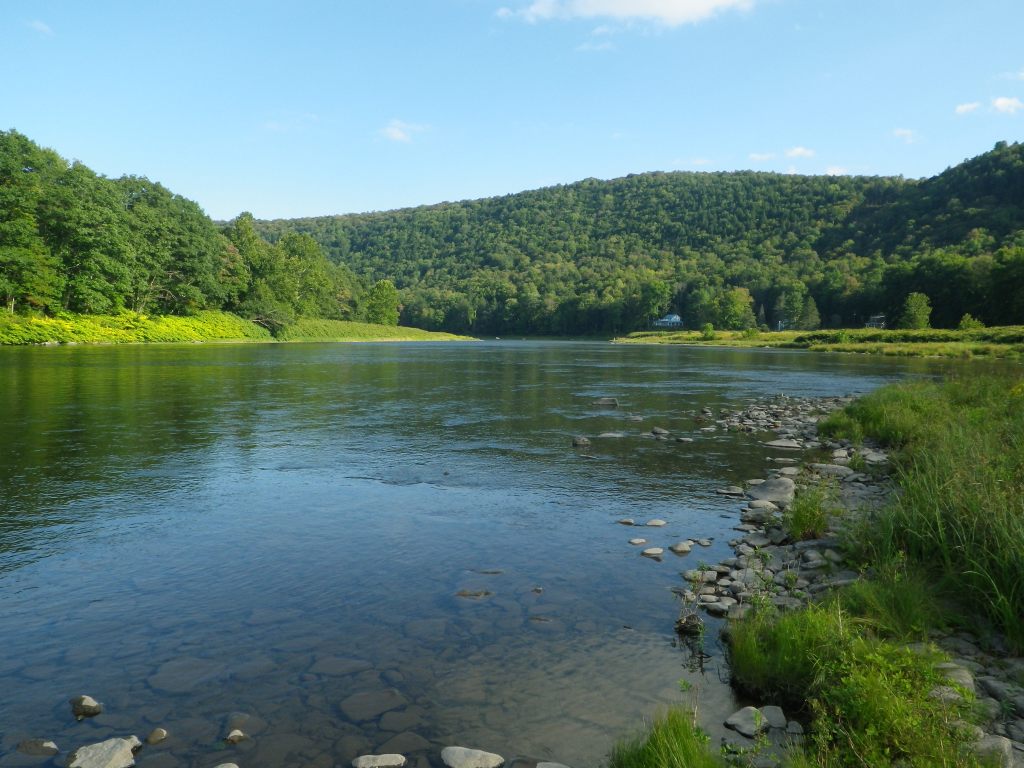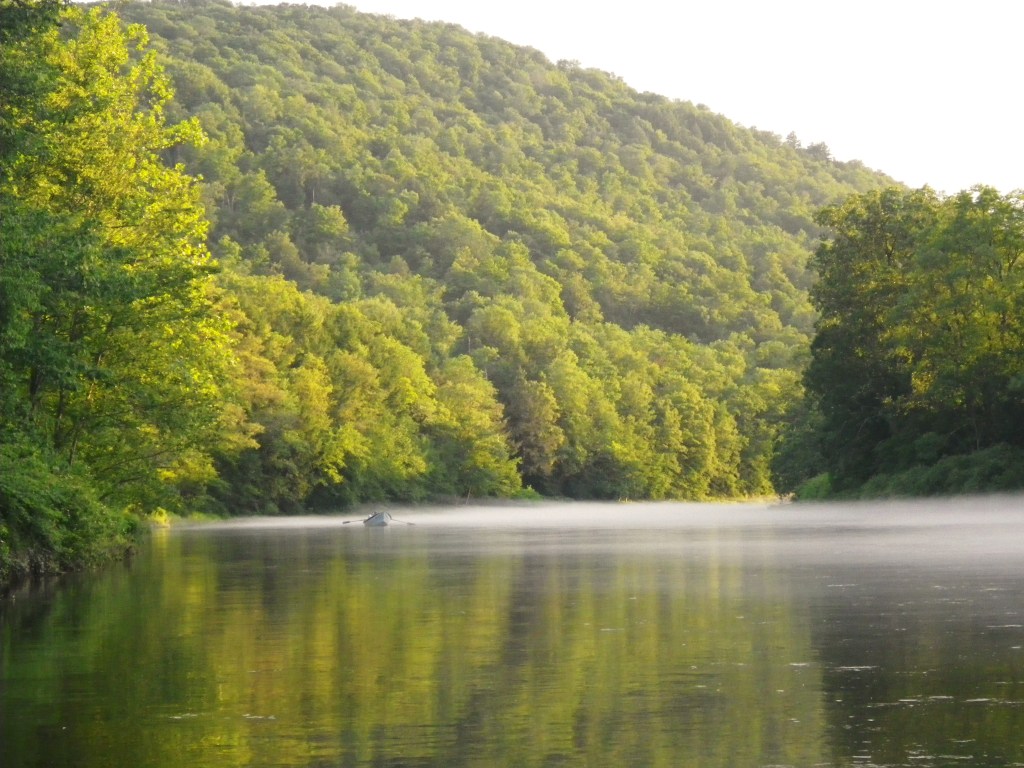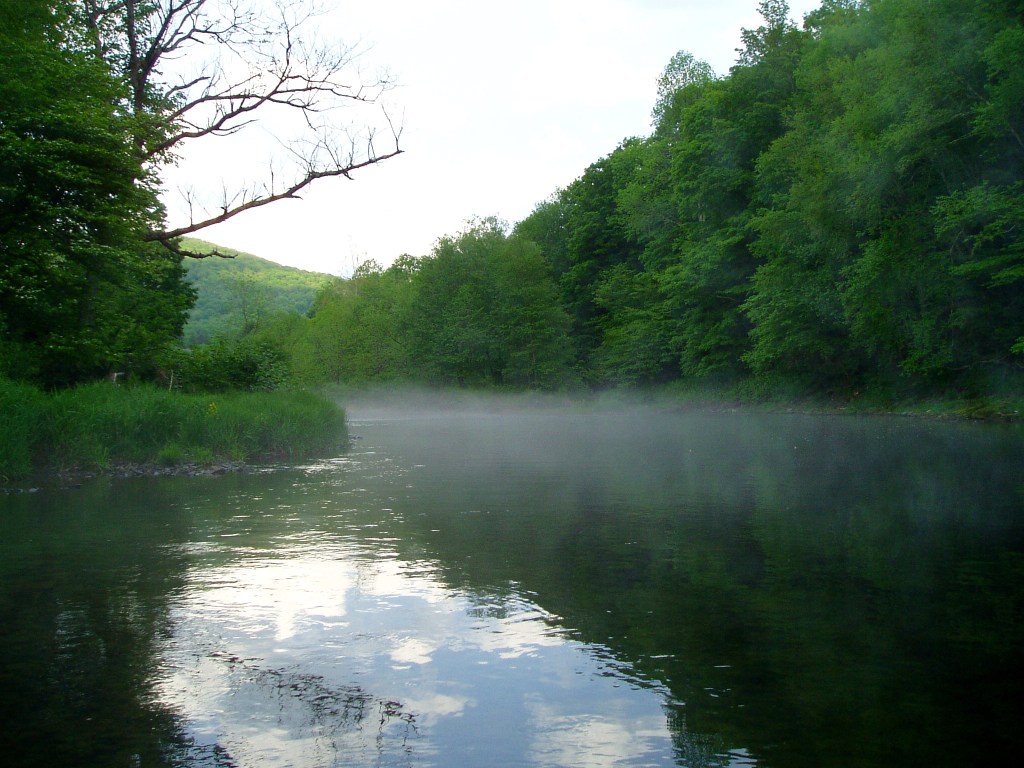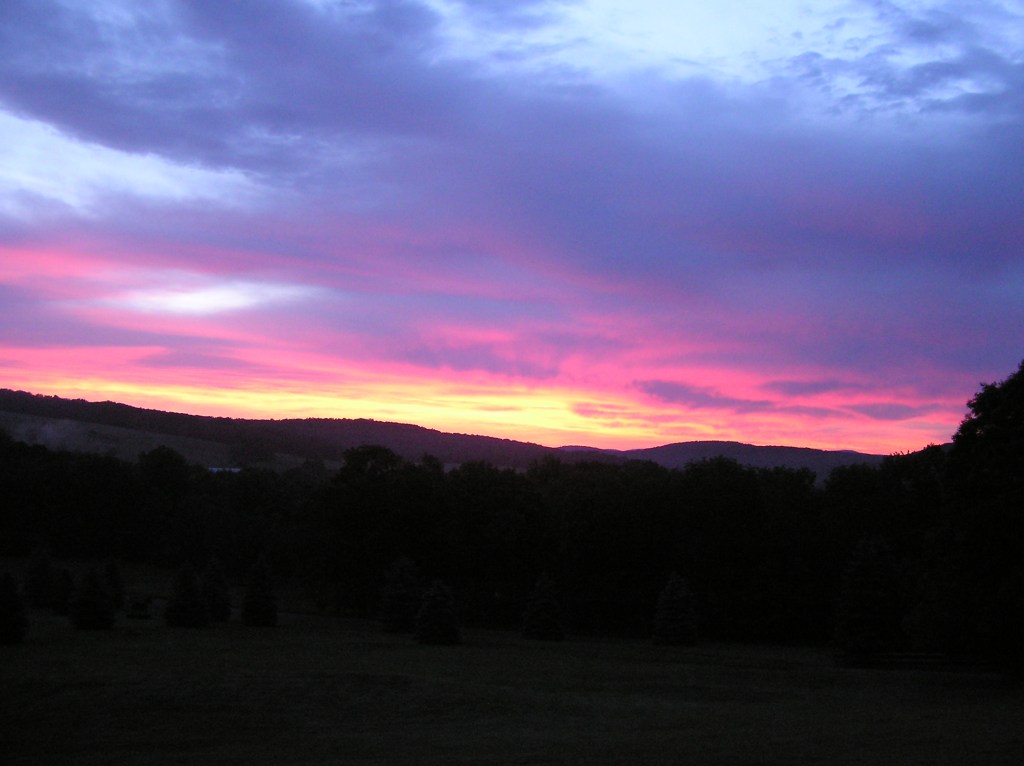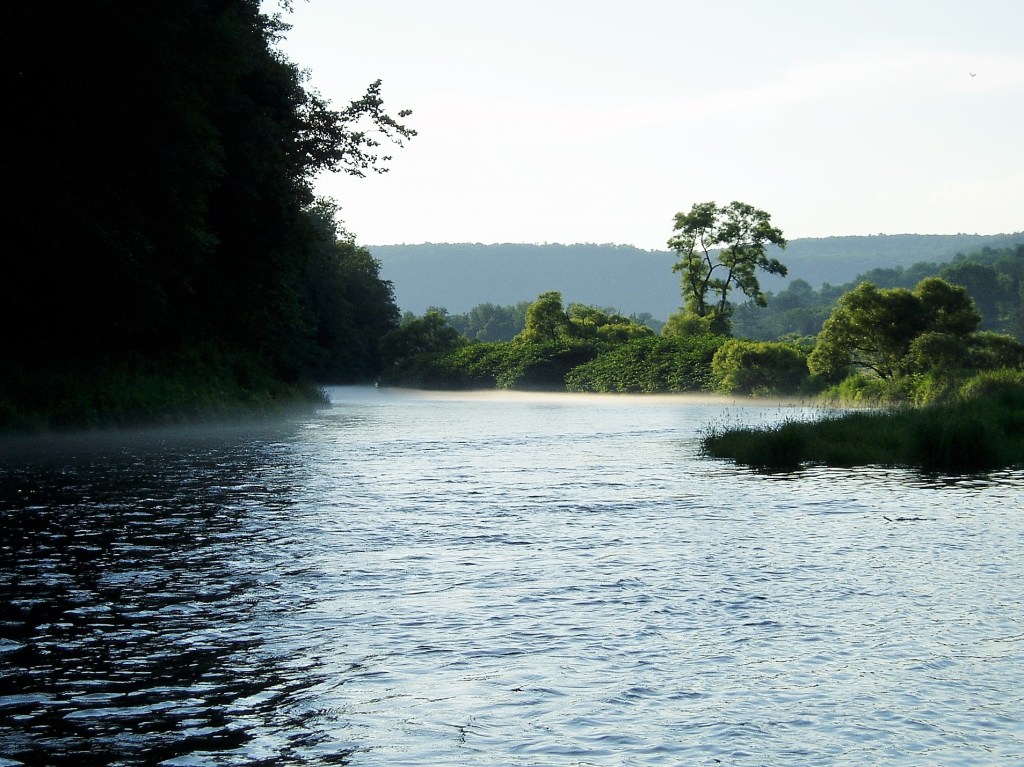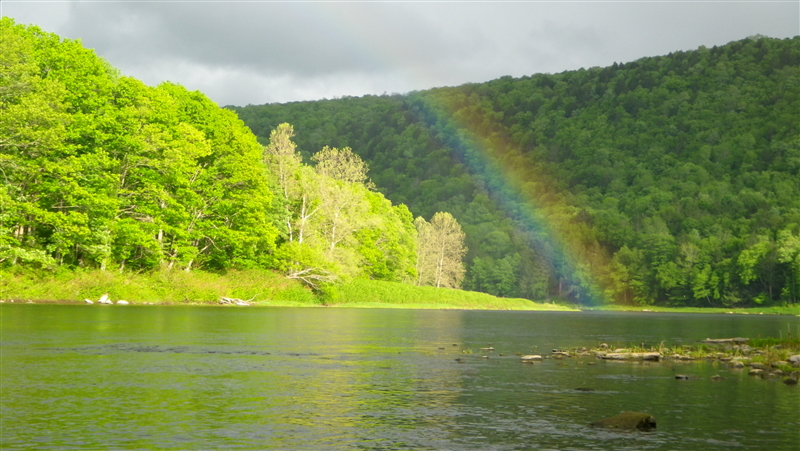
Rise early, not long behind the sun, and take the road to a favorite pool; for the ladies of the morning are waiting!
In the limestone country of Pennsylvania they were first called Caenis, the tiny ephemera the English had dubbed the white curse. It was George Harvey, Penn State’s great teacher of fly fishing, that identified them properly as Tricorythodes when he angled with these ladies of the morning on Falling Spring Branch. Harvey was teaching at Penn State’s Forestry School in nearby Mont Alto, Pennsylvania when he began frequenting the little spring creek and enjoying its wonderful morning spinner falls.
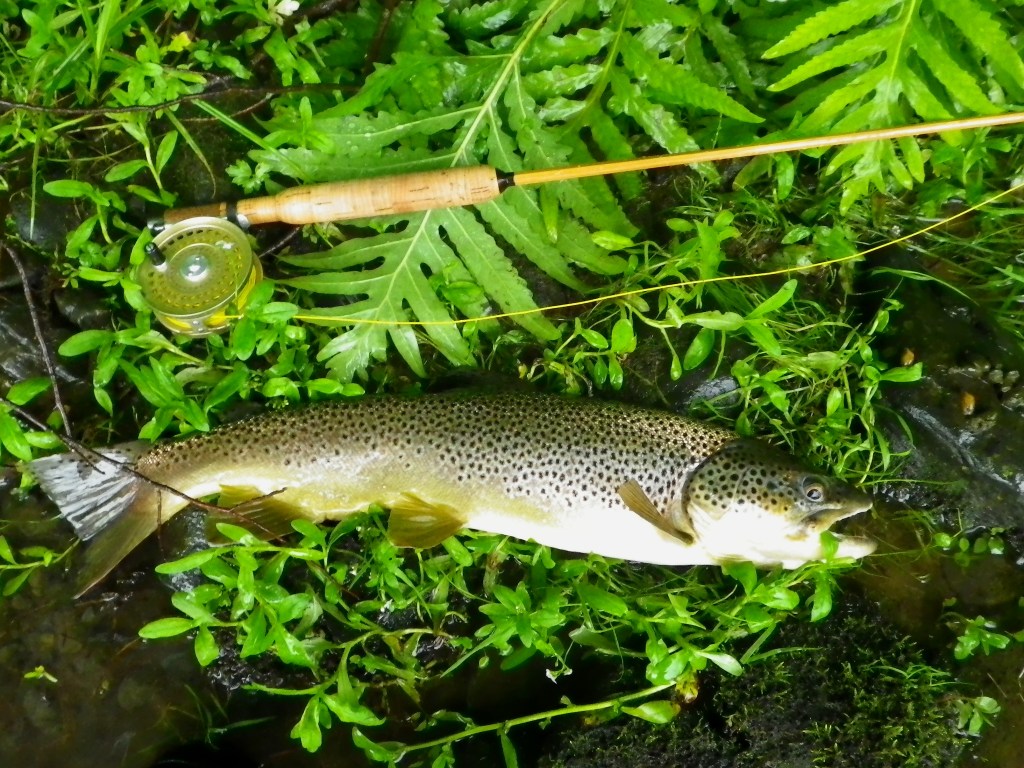
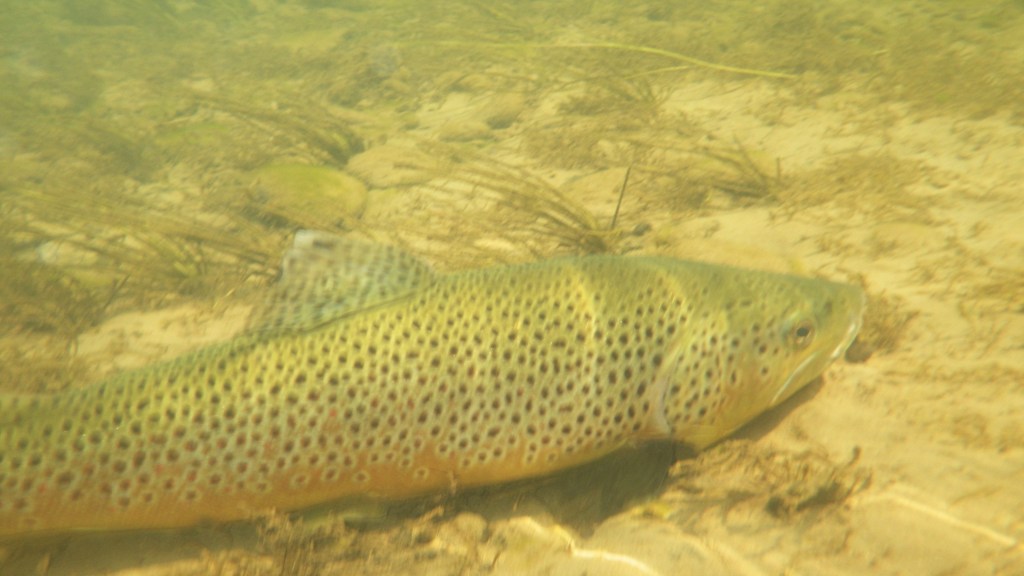
Years later the heavy emergences and mating flights had declined by the time I opened Falling Spring Outfitters, though there were still flies to tempt the stream’s wild rainbows and browns. I fished the tricos on calm, humid summer mornings from July through September.
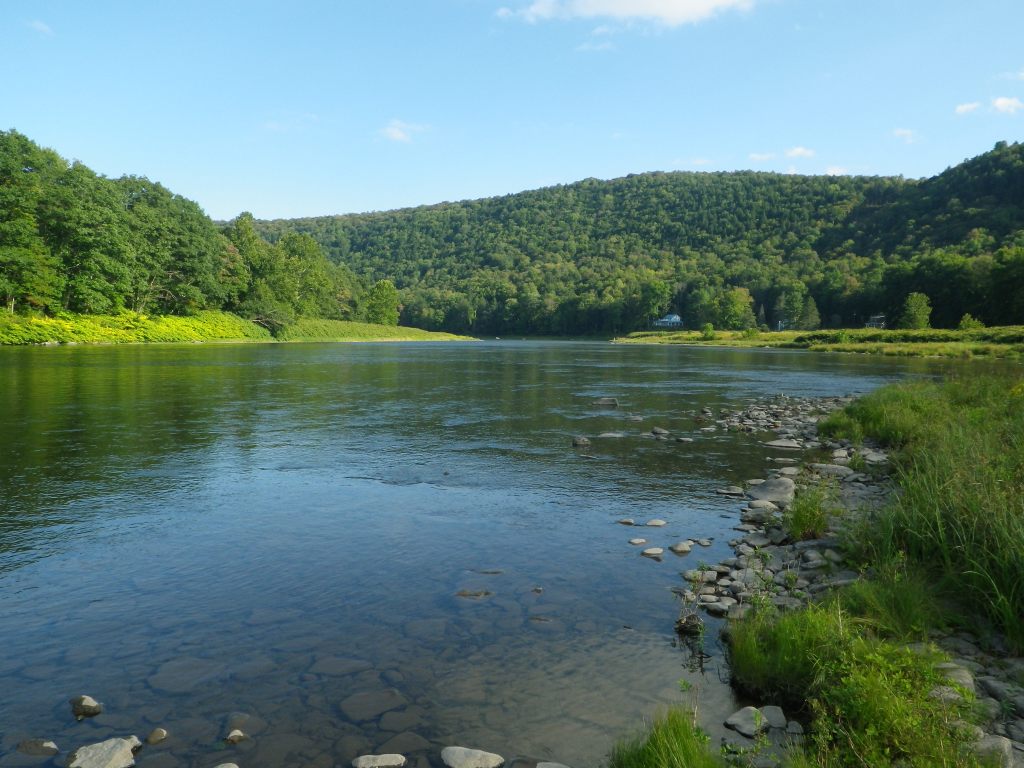
During more than two decades of visits to the Catskills I found spinners on the West Branch and the Mainstem Delaware, though even a light breeze on these larger waters prevented good swarms of mating spinners. Sometimes a few trout could be caught, but it was not an occasion to expect rising trout. Where I found larger masses of spinners one summer, I observed for two hours, not witnessing a single rise. I had been convinced that Catskill trout didn’t care for these tiny little mayflies, at least not in the numbers available to them.
In 1997 I fished Montana’s Bighorn River, finding swarms of trico spinners so thick they appeared as fog over the water. Other than a pod of fingerling browns sipping along a protected bank the morning I arrived, I was not to find the legendary trophies of the Bighorn eating tricos. Oh how I would love to see mating swarms like that on the Delaware!
The intense crowding on our Catskill rivers last summer lasted throughout the week all season long, and I became a morning angler as my best way to avoid them. When trout began sipping one morning I expected the tiny olives I had seen coming off in twos and threes as the sun burned off the mountain mist. Being ignored compelled me to hunker down and stare at the surface to solve the puzzle. Among little clusters of bubbles I found tricorythodes spinners in the drift. There weren’t a lot of them though, since they were the only insects I could find, I dug into my fly box and produced an Ed Shenk Double Trico.
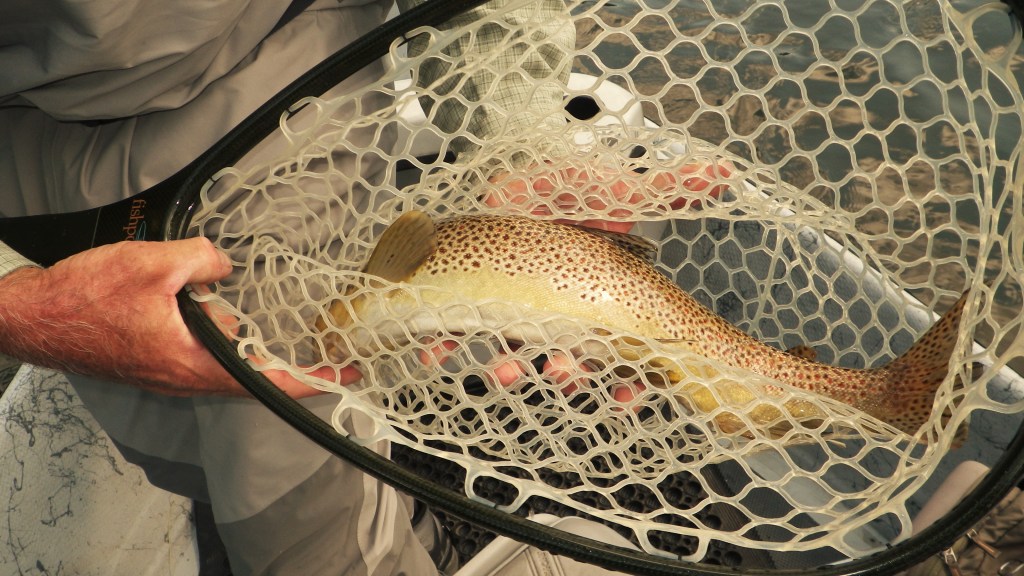
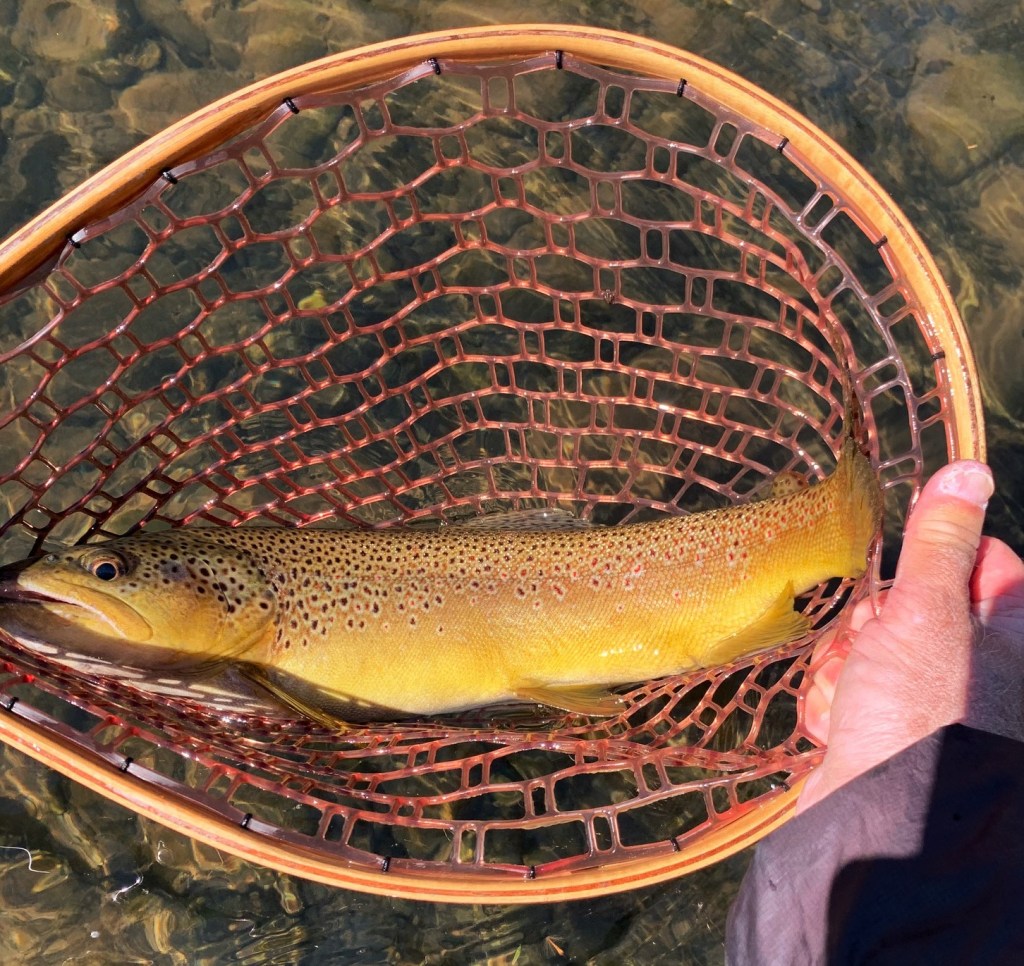
I had a great morning, landing several very nice brown trout. The later risers required me to rummage through the fly box again, fortunately finding a single size 24 spinner, as they refused the larger double pattern once the numbers of naturals began to peter out. The best brought to the net was a fine, fat nineteen incher, my new personal record on a size 24 trico imitation. As the summer wore on the trout I found taking tricos became increasingly selective, requiring 7X tippets and various patterns to dupe, just like those trout on Falling Spring twenty-five years ago.
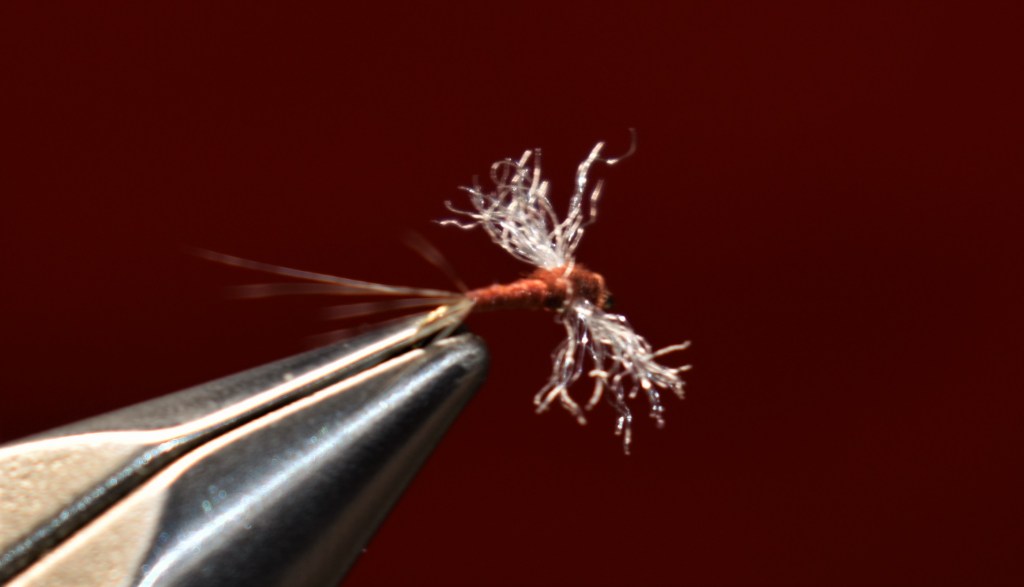
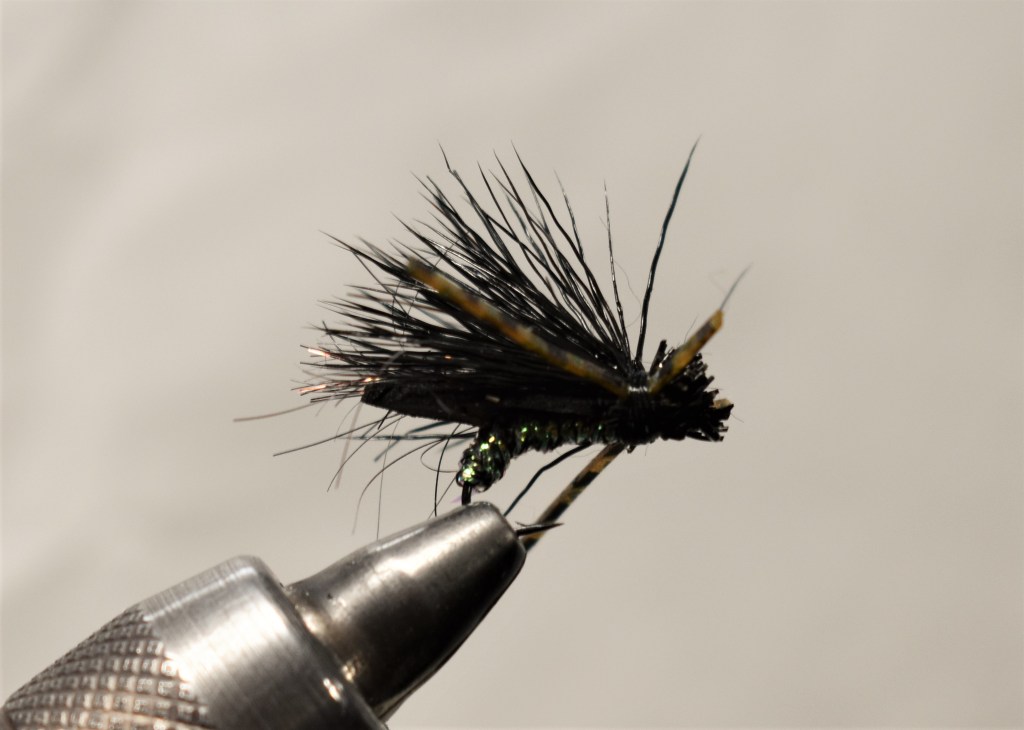
A Female Trico Spinner in Size 24: just enough to make a trout very, very selective!
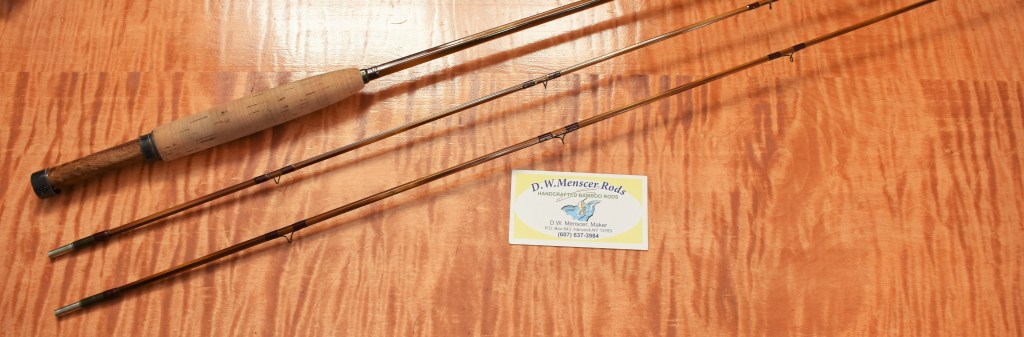
In the limestone country I fished the hatch with my short, light line graphite fly rods, 6 1/2 footers for 2 and 3 weight lines. Today on the much larger Catskill rivers, I opt for one of my favorite bamboo rods, casting either a 3 or 4 weight fly line. Depending upon the day I might choose my 7 1/2 foot Garrison taper with a DT3 line when the winds are expected to remain light and variable. If breezes are going to be a factor I rig up an eight foot 4 weight. Leaders are very long and their tippets fine. Size 24 dry flies require 7X, and a gentle hand to land wild trout of significant size. I love bamboo for its ability to make the perfect presentation whether I need to lay a size 22 or 24 dry fly down at 60 feet, or shoot a larger terrestrial out and under overhanging trees and brush.
I tied the first trico spinners of the winter this morning, half a dozen size 24’s and three of the Shenk Doubles, all females. For those unfamiliar, the female trico has a thin whitish abdomen and a chunky black thorax, the males being all black, except for the clear, sparkling wings. I have read and heard various tales recommending tying tricos in sizes 20 and 22 “for better hooking”. On Montana’s Bighorn some of the sages even called for size 18 spinners. Every trico spinner I have ever sampled has been a size 24 mayfly, period. When there are enough spinners on the water, trout can be snookered by Shenk’s Double: two abdomens, thoraxes and sets of spent wings tied on a size 18 hook. When flies are thin, you’ll need the 24.
I’ve been thinking too much of summer these past few days, wishing myself right on through spring it would seem. I love the Catskill summers. Spring offers all of the great hatches, and that special intensity that only a large number of sizable trout rising in congress can. Summer is more relaxed, though it has its own kind of intensity for those who love to stalk wild trout. It’s longer too, seeming to last forever, where the spring rush has been known to come and go in a month.
Terrestrial Time : The FallingSpring Branch… back when all was lovely and the wild trout abounded.
The snow has been falling steadily this afternoon, big flakes lying soft on the trees as I read and dream of warmer times. My book today is a favorite: Ed Shenk’s Fly Rod Trouting; a bible and my introduction to The Master and the history of his bright home water. Like Ed I grew to love terrestrial time on the limestoners, and everywhere!
The small waters with their open meadows required a different kind of stealth. One would creep along the banks, staying back until the chosen casting position was reached, and only then drifting slowly toward the edge. Experience told where the trout would lie in wait: deeper pockets among the weed beds, undercut banks, or edge water overhung with grasses, bushes or the occasional tree.
For me the Letort Cricket was my first choice, except in August when the hoppers came into play, particularly on those hot breezy afternoons. Ever the experimenter I tied a smaller version after a time, the equivalent of a size 18 Letort Cricket, my Baby with a peacock herl body and black Antron yarn for an underwing. That pattern became my favorite dry fly for many seasons. Light tackle was the common armament, one of a few 6 1/2 to 7 foot rods for 2, 3 or 4 weight lines, though I was never afraid to go lighter. When I was still fishing mostly graphite I ordered one of the Sage “ought” weight (line weight 0) rods and took it to Falling Spring on an August afternoon as soon as it arrived. An affectation? There was but one way to find out.
A 21″ Falling Spring brown trout, fooled by a Baby Cricket on my very first outing with my new Sage zero or “ought” weightrod.
I was sneaking through the Quarry Meadow when I spied a disturbance amid some shallow watercress. My eyes scanned carefully and made out the outline of a very large trout, lying between the leaves and just a yard from a snarl of fallen tree branches. “Oh, I know where you’re going if you’re hooked” I thought as I lifted a backcast high to avoid fouling in the meadow grass. The cricket dropped a foot above him and he tipped right up and took it. Within a second he was into those branches, and my zero was bent in a “u” shaped arc. Unbelievably I managed to extricate him not once, but three times from that tangle without a break in my 6X tippet. Once the net secured him I put the tape along his flank: twenty-one inches, my largest trout on a dainty fly rod casting no line weight at all!
There was another Quarry Meadow spot that years earlier proved more than challenging. The stream narrowed below a shallow gravelly flat, and deepened beneath the shade of an old spreading willow. Not only were there scattered rocks and watercress there, but the prime holding lie was right along the exposed roots of the grand old tree. The only cast that would reach the lie was a long, low pitch from a downstream wading position. It had to sail in there forty feet gently, and no more than two feet above the surface to clear the drooping branches and, when it did, the line would fall over a tangle of sunken branches. There were many tries that put a fly in the willow, or a couple of feet short. On those days the result would be a bulging wake headed deep into the tree roots, or streaking upstream into the weeds, if a trout was there at all. One day, it all came together perfectly.
I had tied a new hopper pattern, the final “keeper” version of a design I called the kick leg hopper, and I was out late that August afternoon to test it out. It was hot and breezy and I managed a couple of smaller rainbows as I worked my way up the meadow. When I reached the dreaded willow pool I stayed back and watched for a while. Things got serious when I saw a ring under there a foot away from the exposed roots. I checked the knot on my hopper and slipped into the water as quietly as possible, moving into casting position without pushing any waves up into the shade. This spot was one cast and done, and my fly alighted perfectly, gently and way up ahead of the lie. It seemed long moments for that fly to float the foot and a half it had to cover drag free, but a heavy bulge caused a quick reaction and a wicked bend in my 7 foot fly rod. That big boy tore up some weed beds, but I kept him out of the pile of sunken branches and finally brought him to the net; a heavy and beautifully colored brown better than twenty inches long.
The limestone summers are behind me now, though I still look forward to terrestrial time each summer. Timing for the best fishing varies considerably from year to year. Lacking the stability of the Cumberland Valley’s spring creeks, the freestone and tailwater rivers of the Catskills are affected by the seasonal variations in temperature and rainfall. Terrestrial time may come in June, July, August or September; or occupy a niche or two somewhere within that period. All depends upon Nature’s whims.
Here the stalking must be done within the river, and fishing fine and far off will be of utmost importance. Much of this fishing is native to placid flows, thus stealth demands an agonizingly slow approach. The impatient angler that rushes into the pool will find no trout where his flies land.
Perfection in presentation is the domain of the light line bamboo rod, and an eight footer casting a 3 or 4 weight line is ideal. Leaders are long, 14 to 16 feet, and the caster must manipulate this fine tackle to place small terrestrial patterns delicately with pinpoint accuracy. There are days I take one of my shorter light rods, but on those days my patience must be longer to make up for it.
Reaches of river must be learned throughout the season, not just for taking lies where trout rise to a hatch, but for the resting lies where comfort and security will draw good trout come summer. The reward for patience and stealth may be the uniqueness of solitude, as one may finally have a pool to himself, and there are other rewards.
A 24 1/2 inch wild Catskill brown trout, taken on a terrestrial in August 2019
Past five now, and I can barely see the fine snowflakes in the dimming light of a winter evening. The amber glow of the single malt in my glass reminds me of the amber light of late afternoon along a summertime river. Winter makes it easy to remember, and dream.
At best it will be sixty days until the dry fly season may be expected to begin, perhaps the hardest sixty days of the entire winter for the dedicated dry fly angler. Harder still, should that span prove insufficient for the snow and howling winds to diminish and give way to budding trees and greening grasses, and the first mayflies of the new spring. Hope waits amid the soft snowfall of a winter evening…
I was thinking about some of the classic Catskill dry flies I tied early in my career as a fly tier, patterns that struck me with their beauty and promise. Art Flick’s variants drew my attention along with the Hendrickson, Red Quill, March Brown and Light Cahill, and of course the Dette’s Coffin Fly. I still tie and fish many of them, though I have tied a simplified Coffin Fly these past few seasons, using a white turkey biot body. Today even Joe Fox of the Dette fly shop ties biot Coffin Flies. Clipping the white ribbing hackle is a painstaking process, and I could never do it quite like Mary Dette Clark.
The Dette Coffin Fly inimitably tied by Mary Dette ClarkMy own Biot Coffin Fly– Faster to tie and effective, though it certainly lacks the cache and museum quality beauty of Mary’s original classic tie. I fish these as I will not risk any of the half dozen Mary tied for me nearly thirty years ago!
I tied a couple of Flick’s big variants last winter, but I never got them wet, missing the Green Drake hatch, other than a couple of brief encounters with the advance guard. I decided that I was going to give them their due this spring, and I stripped and soaked some quills and prepared the ginger, grizzly and light ginger hackles to tie a few. There are days when the big brown trout cruise and ignore some of my favorite low floating duns, and I want to see if a new look at these Catskill classics might draw their interest.
A superb fly tier and Catskill Guild member, ‘Catskill’ John Bonasera, wrote an interesting article for the Guild’s newsletter last year concerning his repeated success fishing little used classic fly patterns. He has also found that it pays to show the trout on our hard fished rivers something different and made the point that old is new. There are a lot of great traditional flies that have been ignored by the majority of fly fishers for one, two, even three decades or more. The wild trout swimming in today’s Catskill rivers have likely never seen them. These flies became popular when they were first tied because they were effective, and they can be effective today.
I have fished hackled Catskill style dries on the Delaware and her branches for as long as I have fished these rivers, and I have caught a number of great fish on them. I have had guides float past and tell me I needed a low floater if I had any hope of catching one of the river’s trout. I just smile at them while they poke fun at my fly and my bamboo rod. They don’t know nearly as much as they think they do.
I recall a tough day floating the West Branch and Mainstem during the Hendrickson hatch the spring I was recovering from heart surgery. My young guide had worked hard but neither bugs nor the trout were cooperating and the gusty winds had played havoc with my presentations when we did find a fish or two rising. Later that afternoon I put away my boron rod and strung up a nine foot Edwards bamboo. When we finally found a small run with Hendrickson duns on the surface and a good trout rising, I knotted a Dette tied Light Hendrickson to my tippet and presented that classic with a classic. The nineteen inch brownie Kevin netted for me after a lightning run and spirited fight approved. I think Kevin was a little surprised that the fish had greedily taken that “old school” hackled fly.
I finally acquired a Coq-de-Leon saddle which is supposed to be suitably stiff for tying Hewitt’s skater spiders, and I’ll be tying a few of them for the coming season very soon. The advances in genetic dry fly hackle have made stiff, broad spade feathers on the edges of a dry fly cape a thing of the past. Hackle growers have bred their roosters to produce long web-free hackles in smaller sizes, and we are extremely lucky to have the results of their efforts, but you won’t find hackles for spiders.
I look forward to the chance to dance a skater spider across a still flat when the trout are hidden. I’ll bet those big flies will still bring large trout to the surface once I learn the technique my friend Ed Shenk called “the Skater’s Waltz”.
I had fished the stream once or twice with an ultralight spinning rod, the only trout worthy tackle I owned at the time, and seen a fly fisher catching the wild brown trout that made the reputation of the place. He fished carefully, with delicacy and supreme concentration, and the trout responded on a day when my Rooster Tails had failed utterly. That day I vowed to buy a fly rod!
Phil Darr was a friend from work, and we talked of hunting and fishing when we had our lunch breaks sometimes. Phil had fly fished a bit and directed me to an old tackle shop in North Baltimore where I could purchase a fly rod and the basic necessities of fly fishing for trout, without the fear of serving time in debtor’s prison. I had been in the Orvis shop in Ellicott City, and choked at the price of the three hundred dollar graphite fly rods they offered.
I procured an eight foot St. Croix rod and a 5 weight Cortland fly line, a basic fishing vest, leaders, tippet and a fly box, then embarked upon my search for trout flies. I spooled the line onto my old Martin fly reel and donned a pair of rubber hip boots and voila, I became a fly fisherman.
The local cable station had a channel that featured Scientific Anglers’ program entitled Fly Fishing Mastery, which I had watched on Saturday mornings even before I was so thoroughly equipped. The episodes with Doug Swisher helped me teach myself to cast once I got that real trout rod in my hands; others revealed the makeup of flowing streams and trout lies, and the marvelous insects that made it all work. They didn’t teach me just how slippery a rocky streambed was for a guy in rubber boots, something I learned abruptly on an early expedition to the Patapsco River, which handily flowed right through Ellicott City. Stream water is quite frigid in March.
I returned to the Gunpowder quickly, finding a little gunsmith and fishing shop nearby. Wally Vait was an impassioned angler who shared space with a gunsmithing friend, christening his realm On The Fly, my first fly shop. Wally freely imparted his knowledge of the Gunpowder and gave me my first glimpse of tying trout flies. His Gold Ribbed Hare’s Ear nymphs were distinctive and deadly, even for a newcomer. I bought them by the dozen. It was one of Wally’s GRHE’s that I drifted deep beneath a bankside boulder to take my first big trout, an eighteen and one-half inch monster that made me feel I had truly arrived that first season as a fly fisher.
Though I fished other Maryland trout streams, the Gunpowder was the best wild trout water of them all and truly my first love as a trout river. In those days the fishery was a rather new one. Local conservation minded anglers involved with Maryland Fly Anglers and the Maryland Chapter of Trout Unlimited had worked hard to forge an agreement with the City of Baltimore to maintain a minimum flow of cold water for the section of stream between their Prettyboy and Loch Raven Reservoirs. Once an agreement was achieved, they created artificial redds and planted brown trout eggs to jump start a viable wild trout fishery.
By the time I first visited the Gunpowder Falls the stream was entering its heyday of productivity. Reproduction was firmly established for the browns, as well as some wild brook trout that dropped down from the tributaries. During the early 1990’s the average browns I caught would be foot long fish, beautifully colored and difficult to catch. Despite the allure of Wally’s Hare’s Ears, dry fly fishing became my passion. The first original fly pattern I ever designed was a dry fly: a two bug special that fooled trout taking the ubiquitous midges and microcaddis. There were good caddis hatches in the spring, and the sulfurs of May and June brought out many anglers.
When my Uncle Al learned of my infatuation with fly fishing, he gave me an old split cane flyrod that belonged to my Grandfather. Wally put me in touch with a Southern Maryland Gunmaker who restored the rod to fishing condition, and I cast my first flies with bamboo on Gunpowder Falls. On a mild September afternoon I cast the big 9 foot H-I rod and brought a brace of nice brook trout to hand on a brown nymph I had tied myself.
Bamboo and Brookies
The nature of the fishing caused me to learn quickly, for the little river typically offered low, clear water, and very skittish trout. Presentation was learned early by necessity, and enhanced with reading and seeking out the great anglers of the day at every opportunity. Though much of the stream was easy to wade, the areas that held the larger trout were festooned with uneven rocks and logjams, usually in deeper, slower water, where even the small fish were challenging to catch, spawning a fascination with difficult trout that has lasted to this day.
For several seasons, rainbow trout began to spawn and grow in the upper mile or two below Prettyboy dam. Small, brilliantly colored parr marked bows were common, and they grew rapidly. I fondly recall the late autumn and winter fishing in that first mile, the reach I called The Canyon. Midge hatches were a regular event, along with tiny microcaddis imitated with size 22 to 24 dry flies, and the wild rainbows could be maddeningly selective. There were pods of football shaped rainbows in that water, fourteen to sixteen inches long, that sipped incessantly. I would stalk as close as possible to defeat the variable currents, pick out a particular fish, and work it thoroughly. Success was hard earned but there were always lessons, whether I released a good trout, or felt the pain of utter rejection.
The browns seemed less inclined to take advantage of the midge biomass, and I caught the Canyon dwelling browns nymphing, on my little olive caddis larva or a pheasant tail. On a typical winter day I would work the runs and pockets with my nymphs until I spotted the little rings of a midgeing rainbow. Once absorbed by the fishing I worked part time at that local Orvis shop, and added an eight and a half foot three weight rod to may quiver, so taken had I become by the midge magic! Sadly that amazing winter fishery would not endure.
After a few seasons the rainbows rather suddenly disappeared. Bows became a rare catch as it was the day I landed my largest Gunpowder trout. It was September, a weekday that allowed me some solitude there in The Canyon. By this time Ed Shenk’s LeTort Cricket had become my favorite dry fly, and I knotted one to my tippet in hope of changing my luck on a fishless day. There was a particularly tough spot in the Canyon, where a large tree had fallen atop some boulders, crossing the river at a pinch point. Over time, part of the tree had sunk, though much remained suspended across the boulders: fouled above and fouled below.
I had the long three weight that day, and stayed back to allow my casts to shoot the fly underneath the branches and through the low window crafted of wood and rock. The Cricket made it through on the second try, drifting down beneath Nature’s arch until it was intercepted. That light rod doubled over completely when I struck, and my heart jumped with excitement and fear. The heavy bow in the rod convinced that wonderful trout to swim downstream and away from the tangle, and I managed to keep the advantage he had given me. Shaking when I finally saw him in the net, I waded to the bank and laid my tape along his flaming crimson flank.
That twenty inch trout, my first to reach that hallowed threshold, was the last rainbow I was to catch on Gunpowder Falls. The following season I encountered two DNR biologists along that favored Canyon reach. They were searching for evidence as to the rainbow’s exodus, finding none. As far as I know they never found an answer to that puzzle. I asked frequently for news when I visited the fly shop.
Ed Shenk’s Hardy Featherweight and Letort Cricket
If the Canyon was my favorite fall and winter haunt, the area upstream and down from York Road was my spring and summer haven. There were more anglers there, as well as hikers frequenting the popular trails on either side of the river, but the sulfur and caddis hatches there offered wonderful dry fly fishing. I spent many beautiful April mornings there, with caddisflies swirling and darting around my head and shoulders, while lovely wild browns slashed at them escaping the water.
Come evening the sulfurs demanded my full attention. Walking back from a favorite pool, I can still see the last rays of sunlight filtering through the trees above a long riffle. My favorite sulfur memory came on a warm, gorgeous evening, when the heavy hatch brought every trout in the pool to the surface. At the peak of the emergence the spinners had gathered over the riffle and begun to fall. Trout were slashing in the riffle and I took a beautiful eighteen inch brown on my six and a half foot three weight rod, the rod I had built upon Ed Shenk’s recommendation, to fish his fair LeTort. The rises and slashes continued feverishly and I lost count of the trout hooked; some brought to hand, others played frantically until they leaped and shook the fly.
Twilight caught me fumbling, trying to change my dun for a spinner, but I managed it. Some trout would still take the dun, but others refused. There was one fish rising heavily where the riffle had cut a deeper trough near the bank. I could barely see his take, but when I lifted the little rod the reel screamed in the darkness and the rod bucked violently. The trout charged upstream, showing me only white water amid the gloom as he leaped again and again. Had he turned down and run into the boulder pool he could have easily broken my 6X tippet among the rocks, but he seemed to crave the energy of the fast water that had brought him sustenance.
He was larger than the first big brown, nineteen inches of quivering gold, there in the shallows with the glow of my flashlight upon the tape, and I thanked him as I gently turned the barbless hook from his jaw. He raced away when I pointed him toward midstream and the riffle he loved.
Sometimes life leads us away from the thing we love, and my infatuation with the limestone springs of Pennsylvania eventually led me away from the Gunpowder. I returned of course, though each season the visits were fewer. Rivers change, and even those we know well become less familiar with time away. Four or five trips a year didn’t bring the success enjoyed in those early halcyon days; much less one or two. At first I thought the decline was my own, perceived, due to my own scarcity of time on this water I had so completely adored. Sadly I saw the later posts on the fly shop’s website, anglers truly excited with a nine inch brown, and accustomed to working hard for six inchers.
Didymo was blamed, and the crowds of anglers. The rock snot was bad the last time I visited the Canyon in winter, but there was heavy fishing pressure thirty years ago. The average size of those lovely wild browns began to decline before the invasive algae took hold though. Kayaks and canoes, too much guided fishing bringing too many people to this small, gentle stream too often, too many feet upon the lifegiving gravel; everyone has their theories. Perhaps the reasons are as unknown as those behind the sudden disappearance of the stream’s wild rainbows.
There is better news these days from the winding strip of bright water known as Big Gunpowder Falls. The gentleman who owns the fly shop today is an advocate for the river, the Gunpowder Riverkeeper, and he has gathered enough support to win several victories for water quality and conservation. I hear that good fisherman are catching foot long browns once again. I am pleased to hear that the pendulum is swinging ahead.
The Gunpowder, and yes, I fell in love with the name even before I fished her, was a wonderful classroom, a treasured first love. I would not trade the memories, the experiences there. She gave me the gift of wild trout, of bright water and the joy of angling with the fly.
My own rendition of John Atherton’s iconic Catskill dry fly, the Atherton No. 3
I received a comment the other day mentioning John Atherton’s dry flies, another bit of fly fishing history that gentleman and I share an interest in. Atherton the artist conceptualized the color and lifelike appearance of trout flies with the paintings of the impressionists, an intriguing and insightful revelation presented in his classic “The Fly and The Fish” published in 1951.
I have been leafing through the book recently, thinking about some of the ideas that have bounced around in my own head, and some of the commonalities with John Atherton’s impressionistic style of fly tying. We both appreciate flies that give an appearance of motion, and share a preference for barred hackle. Translucency is important to the image of life concept, and so of course is color. Examining natural insects reveals a mixture of colors in their wings, legs, tails and bodies. Atherton blended multiple materials and various shades to achieve a natural effect, something I have done since my earliest beginnings as a fly tier.
I finally sat down late this morning to bring some of these thoughts together at the vise. I enjoy a great deal of fishing to hatches of the various yellow mayflies: the March Brown and Gray Fox, sulfurs, invarias, etc. so I set out to design my own tribute to John Atherton’s No. 3 dry fly.
During my quest for enhanced translucency, I have been working with a material I carried in my fly shop twenty-five years ago: Kreinik’s pure silk dubbing. I was pleased to find it still available, and have supplemented my own supply with additional colors. This morning I set out to blend some silk dubbing for Atherton’s No. 3. His original blend used natural seal’s fur in bright yellow and natural tones, thus I blended bright yellow silk with pale yellow, cream, and pale tan.
My silk blend and two of Charlie Collins’ gorgeous barred dry fly capes provide my own touches to honor the artistry of the late John Atherton.
The classic recipe calls for medium Cree hackle fibers for the tail, which I honored, though I modified Atherton’s choice of medium dun and ginger hackle in accordance with our shared love of barred feathers. From my store of Charlie Collins wonderful capes, I chose a subtly barred medium dun, and a striking barred ginger with both light and medium ginger tones. I really like the result, finished with the characteristic gold oval tinsel rib.
Come May I plan to offer these flies to some outsized and wary Catskill brown trout. They will be properly presented with a fine bamboo rod and a classic reel, and chosen when the time is right for something both classic, and decidedly different from the flies they are used to seeing. I believe it will prove very effective, as the original has been for many anglers.
I offer this fly to honor the tradition of a fine angler and artist who was called away much too early in life. The Fly and The Fish is an excellent book, one that belongs in every serious angler’s library, and I feel certain that John Atherton had much more to contribute to the sport he loved, had he not been called to fish around the bend so soon after its publication.
It was one of those seasons when the days turned suddenly hot in early June, and I had fished from midday on with little activity. Taking a break I walked back to the truck for a snack, and stretched to work the kinks from my neck and shoulders. I idled there awhile, changing tippets and sitting on the bumper. Past six I grabbed a chilled bottle from the cooler, picked up my rod, and walked back to the river.
The sun had passed beyond the high ridge to the west and left the river in shadow, but the surface remained still; waiting. I topped the bottle and let the first ice cold sip of the lager slide down my throat. If the trout had to wait, then I could wait too.
I savored the beer over half an hour, hopeful as a few small yellow mayflies began to appear on the surface. I was watching a glide of tricky currents across the river when the soft bulge appeared where one of those sulfur mays had floated. I downed the last sip and dipped the bottle into the current, rinsed and emptied it, and then tucked it into the back of my vest.
Easing into the flow, I worked slowly toward midstream as another bulge appeared. Testing my knot, I pulled enough line from the reel to make a cast to the near edge of the glide. I prefer that first pitch to be a foot or two short, particularly in difficult currents, to see how tippet and fly will behave before I drift my offering over the trout. Satisfied with my trial, I tugged another yard of line from the reel, cast slightly long for the reach cast required, shocked the rod gently and laid my sulfur three feet above the fish’s lie.
The glide appeared smooth, until close observation revealed tiny traces of conflicting flows, but I had planned the cast perfectly, and enough soft curves of tippet alighted above my fly to ensure the drift. The soft bulge in the surface replaced the fly, and I raised the rod into a lovely full arch.
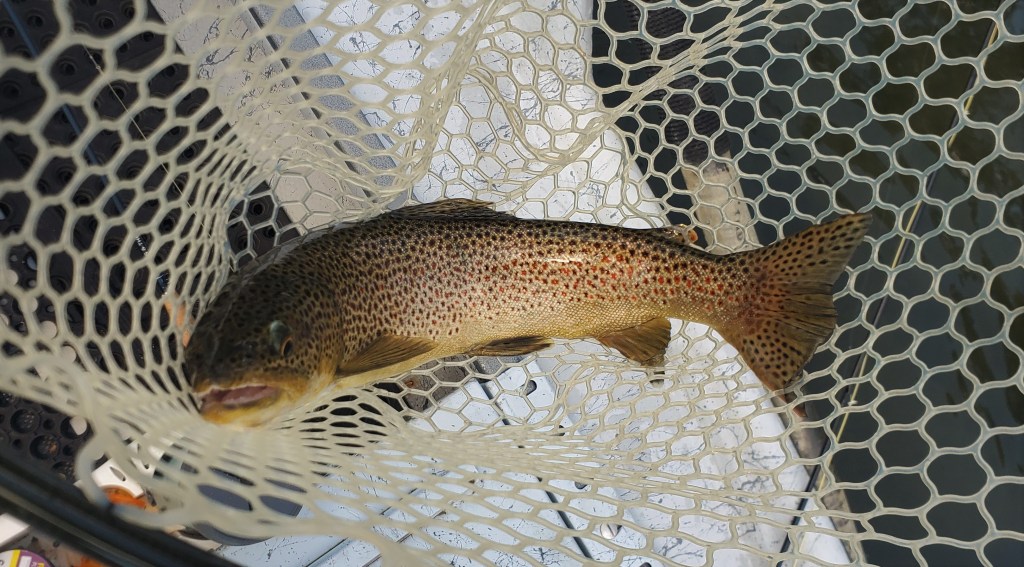
He ran immediately, the rod bucking heavily as he streaked downstream, and we danced as the mountain air began to cool. I countered his first run, his second then third, each time taking back a little more of the line than I’d ceded. In the net he was beautifully marked, bronze and golden flanks peppered with deep umber spots, and highlighted with a share of the bright red spots characteristic of a wild Catskill brown. The tape read twenty inches as I laid him briefly in the shallows near shore. I had only to turn his nose toward the main current and he kicked hard, down into the bouldered run at mid-river.
Looking again up stream I could see a few flies, but all rode the surface undisturbed, so I waded back to my grassy seat. I wondered if another trout might rise as the light gradually faded. Darkness comes quickly there, between the steep wall of the mountain on the west side and the heavy canopy of the old trees along my eastern bank. While I waited I exchanged the successful sulfur comparadun for a bright orange parachute, its Antron wing more visible in the failing light. In that last quarter hour the sulfurs were heavy, dancing on the water and in the air, and the quiet was finally broken by a slashing rise in a frothy black hole near the western bank.
I rose and worked upstream, more urgent now as the darkness made ready to take full possession of the river. Depth had left me with a longer cast, quartered upstream and across, and I strained to follow the little parachute fly as it bounced on the surface. Three casts untouched, and finally another slash for a moving mayfly gave me the trout’s position, my fourth cast bringing a solid rise and a powerful fish boring down into the heaviest flow. He went downstream when I managed to lift his head from the boulders in the crevice of the run, taking fly line and then backing as he sought the last glow in the sky.
I worked the rod, keeping him off balance and slowly regaining line. He bored once again for the run, but the pull had been working on him and he didn’t quite make it to those leader fouling rocks this time. Twins as the tape revealed, a pair of twenty inch bronze warriors, one in a glassy glide at the beginning of the hatch, and one slashing the froth at its end. I smiled in the darkness as the chill of nightfall made me shiver.
The memory sustains me as the snow falls once again…
It is beautifully clear this morning, with a lovely orange tinge in the south, blending to soft blue at sunrise. It is deathly cold here though: two degrees in Crooked Eddy. The Super Bowl lies behind us, and thoughts of the angler are wont to run to spring, but those thoughts seem frozen in place. There are no days above freezing in our ten day forecast.
I long for a break from the clutches of winter, one of those two or three day warmups with temperatures kissing fifty! Three such days betwixt milder nights would find me at the river’s edge, with a smile as broad as the horizon. We had a few little breaks from the icy oppression during my first two Catskill winters, and though I didn’t bring many trout to hand my soul was freshened and my spirits reborn.
February 3rd, 2020: Sunshine and warmth and no curse upon the land to diminish the joy!
I crawl back into the blankets of my memories as this ice age drones on, to soft afternoons where spring teased in February.
Walking in the shallow currents of the Little Juniata one February day, the sun flirting late in the afternoon, I came upon the glassy tail of a pool… with dimples! The leader lengthened and a tiny midge secured, I played the game with half a dozen sipping browns, hooked them all, and brought five to hand! They were cold and firm between my fingers, wild and alive, and they shared that with me.
Finding Spring Creek uncrowded on another February day, I plied her runs with my little olive shrimp. With the sun in my face I squinted to follow the leader as the little fly bounced along the bottom, pausing enough for my reaction: a bent rod, running line, and eventually an eighteen inch brownie wriggling in the mesh of my net. The limestone waters offered such gifts readily in winter.
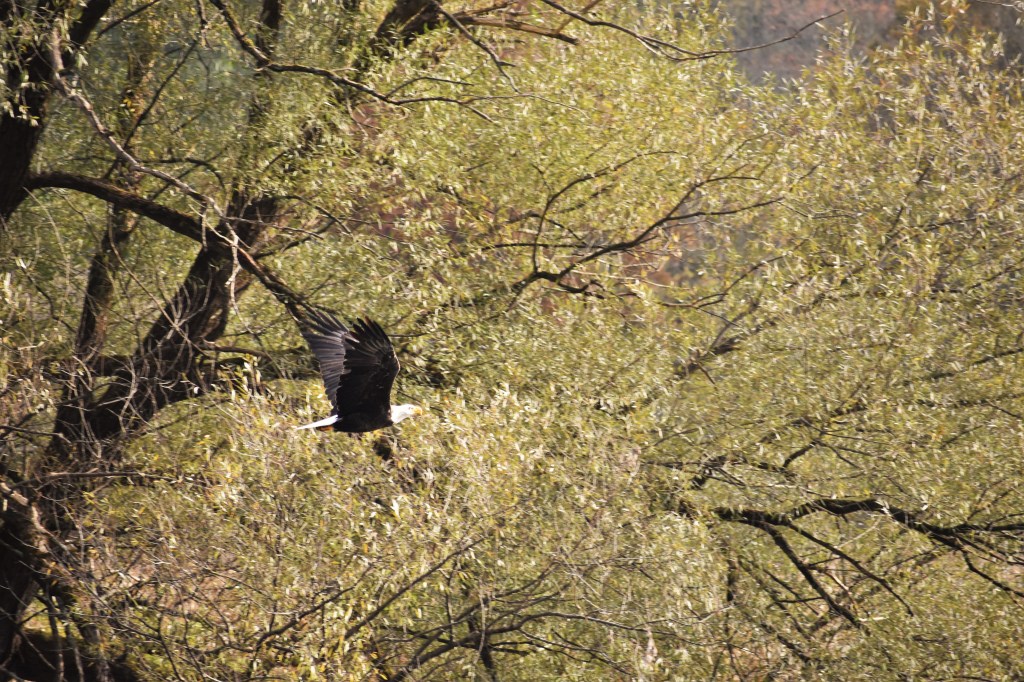
Our Catskill rivers have proven stingy, even when those lovely hints of spring part winter’s clouds, but their beauty and the freedom they provide are gift enough: walking shallow riffles as an eagle circles aloft, and the soft glow as the sun kisses the mountain tops goodbye.
There are moments in our fishing lives that we will never forget. Such moments are often not taken from a scene of victory.
There is a short run along the West Branch Delaware that has received a great deal of my angling attention over the years. The casual angler will not often see activity there, thus it receives a perfunctory cast or two in passing, though at times it is outright ignored. It is one of my favorite places.
I have taken many fine trout from this place, generally all of them requiring time and effort: stalking, study to identify the species and stage of various naturals, changing flies, and casting repeatedly. These fish do not come to hand easily, and some do not come to hand at all. There is one that stands clear in my memory, a great fish, a connoisseur of the tiny mayflies; a foe I have engaged many times over a period of several seasons.
The trout that lived along this inconsequential little run would take the flies nature offered them, tending toward a high degree of selectivity to a particular stage of only one of the insects currently occupying the drift. Over the years I fished there I took many brown trout of twenty inches or more on sulfurs, various olives, Blue Quills, Hendricksons, Gray Fox, Isonychia and at least four species of caddis. On a given day, those caught would invariably be taking only a certain stage of one bug, though it was not unusual to find at least two or three species of insects in the drift. A few were even more discriminating, like my friend The Connoisseur.
I can recall at least four epic battles with this fish, and a few pricks and misses after an hour or more of painstakingly careful angling. Many times when he appeared to be on the fin, he was simply untouchable, utterly ignoring every fly and presentation I offered. Of the times we engaged physically, or nearly so, he never accepted a fly larger than size 20.
That first encounter was taxing. For two hours I crouched in fast, frigid water under skies ready to unleash a storm of storms, fishing to this tiny, sporadic little ring in the fast and broken current near the top of the run. The fish had taken what I would learn was his favorite position behind one up thrust, angular chunk of rock, and would glide left and right behind it as he fed daintily. It took intense concentration just to see his rise, to identify that two inch diameter ring that dissipated as soon as it formed, as the wink of an eye.
There were olives beneath those stormy skies, dark little size 20 olives with grayish wings, tossed hither and yon by the flow that cascaded over and around his rock, but also a half drowned sulfur or caddis now and then, just to keep me guessing I suppose.
My fishing was methodical, working two or three patterns of olives, then the sulfur and caddis, before edging a step upstream or step out toward deeper water to change my angle of presentation slightly, to modify my drift.
My neck was aching, the arthritis firing through all my nerve endings bolstered by the chill and dampness, and I stretched a bit as I changed to a slim thread bodied CDC olive, moved a step and a half deeper into the run, and cast again. The take was quick: that tiny spurt of bubbles, the recognition that my spot of gray had vanished from the froth, and the rod rising into a horribly acute bend for my whisper of tippet. Then it was all line slashing for deep water, the reel spinning wildly, and a great powerful force streaking away and downstream, first with my fly line and then my backing.
I stopped him finally, or rather he chose to stop and turn sideways to the substantial current, and I regained what line he allowed, before charging down again. He came around then, running toward me as I tried to keep tension, reeling as fast as my pained body could muster. I felt him deep in the gut of the run then, shaking his head and darting left then right as I relaxed the pressure just a bit. Hope began just then, though this demon trout was not yet controllable. I had fly line back on my reel and was inching him closer, a turn at a time. I knew I couldn’t let him rest, despite my fear for the small hook and slender tippet, down there amid the rocks, and my pressure incited another lightning run downstream, my backing surrendered once again.
Those who angle the West Branch are familiar with the moss, the green veil that coats the bottom where the current slows. That was my adversary’s destination it seems, down and across the breadth of the river, leaving me with too long a line to have hope of pulling his head away from the bottom. That gooey moss has the habit of collecting on the leader during battles such as these, coalescing and sliding down in a ball against the fishes mouth. One turn of the head and the current will catch it and pull the hook as cleanly as any tool contrived by man, and so it did. I was left breathless, my heart pounding with eighty yards of lifeless line to retrieve. The fly was there, buried beneath that glob of slime.
We danced three more times over the next few seasons, and that great fish never changed his preferences or his tactics. Once more with the olive, a time with a thread and CDC sulfur, the last with a little sulfur spinner, each retrieved in its glob of moss. I saw him only once, his head at least, and he was indeed a brown trout like the other residents of my little sanctuary.
As I slid onto the big leather sofa that evening, thrilled and dejected, those emotions sharing equally all the space available in my exhausted brain, the television barked of the earth quake that had shaken the East Coast that afternoon. The announcer said it was felt in New York at about the right moment, the moment I recalled getting that one and only glimpse of my mythical trout. I had a quick vision of his head, there behind his favorite rock, that still lives in my memory. The head that appeared, lifted close to the surface with his nose out into the air for a split second, was half a foot wide between the eyes. I swear those eyes were twinkling, ready for our last battle.
I was enjoying a book by the late Frank Mele when the sun glared through my window and into my eyes. I decided to take a break, the sun being fleeting this time of year, and make myself a sandwich. Looking out the front door the sun on the porch looked so inviting that I had to walk out. The south end of the porch was bathed in warmth and brilliance, and I decided to lunch right there.
Forty-four degrees is a verifiable heat wave in the course of this winter, and I enjoyed the moment to the fullest. Leaning back, I sipped a small gift of the brewer’s art emblazoned Cold Snap, bringing thoughts of all the spring and summer evenings I have enjoyed sitting on that porch, the grill crackling and an icy beverage close at hand.
I have passed the week craving the fishing that I cannot have, though I’ve shared a bit of that passion electronically. The Catskill Fly Tyers Guild recently assembled an archive of angling books, those depicting the history, rivers, trout, fishers and fly tiers of the region. Upon distributing it to the members, the gentlemen who complied the list welcomed suggestions for other titles, and I have a few in my library deemed worthy of inclusion.
One of the committee members who compiled the archive is Edward Ostapczuk, a gentleman angler and sage of the Esopus most qualified to converse on Catskill fly fishing and its history, as he has been a part of it for five decades with rod and line, and pen. I knew a little of Ed from his regular column in the Guild’s Gazette, and from his fine book “Ramblings Of A Charmed Circle Flyfisher” published in 2012. We had corresponded briefly via a post on the Classic Flyrod Forum last winter, and I had hoped to meet him at Guild meetings come spring. All were of course cancelled due to the pandemic.
Messages between the angling archive committee members and myself gave birth to a number of emails from Ed. I heartily replied, and we have shared a few anecdotes, photos and flies these past few days. It has been as close to sitting down and talking fishing as I have gotten during this quarantine year, and a source of much enjoyment.
Ed has a special place in his fly box for the Dorato Hare’s Ear, a dry fly I had heard of, but never fished or researched. Memory seemed to be telling me I had seen a fly by that name in some pattern book, with white wings and a buggy Hare’s Ear fur body. Ostapczuk provided the history, as well as the recipe, and I learned that the DHE is a Catskill pattern in the truest sense, conceived and tied for these rivers by the late Bill Dorato.
I too have confidence in buggy looking flies, particularly for mountain stream fishing. Twenty years ago I had tied my Fox Squirrel Special with a buggy fox squirrel fur body, Cree hackle, and bright yellow calf hair wings. It was a great fish catcher and easy to spot with it’s yellow wings amid the frothy white water that brook trout are drawn to.
Broad Run: brook trout water, South Central Pennsylvania style.
I have tied the fly Catskill style, with a divided wood duck wing, and commercially packaged fox squirrel dubbing, but the spiky appearance of the Dorato Hare’s Ear inspired me to blend up some appropriate dubbing and tie some buggy Fox Squirrels.
The blend is heavy on the guard hairs from a fox squirrel skin, both the heavily barred fur from the back, and the reddish gingerbelly fur. Use less of the soft underfur, just enough for a binder, and a small amount of light brown Antron dubbing to lend some light reflections. A coffee bean grinder is a perfect dubbing blender, though you can do it by hand.
Squirrel has been a mainstay for my nymph blends for nearly thirty years, due to its wealth of short heavily barred guard hairs. The spiky appearance makes a very lifelike fly, and the natural mottling provided by those guard hairs looks like a lot of trout stream insects. Natural squirrel fur is great, and the availability of dyed colors make it even more versatile.
My Catskill Style Fox Squirrel is tied with the natural fox squirrel and Antron blend, natural Cree hackle, and wood duck flank. I believe that Cree is the most beautiful rooster hackle in existence, and I use traditional Cree (above) and some beautiful Collins Dun Crees for many of my Catskill dry flies. The resulting flies are lovely and I believe that the barred hackle imitates movement, and thus, life!The Fox Squirrel, Buggy Version as inspired by the Dorato Hare’s Ear.
Ed’s Gazette article tells me that Bill Dorato tied and fished his pattern as a caddis imitation, but it has proven to be a great all around dry fly whether caddis or mayflies are about. I can attest to the effectiveness of the Fox Squirrel and Fox Squirrel Special for the same reasons that Dorato’s fly has become a go to pattern for experienced Catskill anglers like Ed Ostapczuk. The combination of a spiky, mottled body and barred hackle combine to give a great impression of life!
I’ll be tying more of these in sizes 12 and 14 for the early spring hatches. Ed loves his Doratos in size 18, so I’ll tie a few smaller ones too. That way I can cover Hendricksons, Quill Gordons and Blue Quills with a single pattern.
A river walk at last, and I enjoy a few minutes of freedom from the confines of these old walls! I did get out yesterday, Groundhog Day, though just to shovel away the fourteen inch snowfall February’s debut gifted. The East Branch seems to disappear as it slows from the Hancock riffle, swallowed by the ice and snow entering Crooked Eddy. Back inside now the sun glimmers through the icicle hanging above my window. Where were you when I needed you?
Last year the great prognosticator, Punxatawney Phil promised an early spring, and we had snow to herald the second week of May. I truly hope he hasn’t established an overly generous frame of mind, less this years “six more weeks of winter” ends up lasting until July.
I have designs on July you see, and they most certainly do not include snow, ice, wind or anything similar. What they include are a box of tiny olives and terrestrials, a certain pentagonal cane rod hailing from Montana, and a very special reel crafted much farther away in the opposing direction.
Waiting For Summer…
It is summer, when the rivers become low, and clearer than the air, that the wild trout prowl and sip the little bits of nothing many anglers ignore. The late Art Flick tied his Blue Winged Olives with a hackle and a tail, allowing the whirl of hackle fibers to suggest the moving wings of these diminutive mayflies. I have great sport with them, tied in sizes 20 to 24.
The angle of the morning sun can be a boon to this fishing, as the trout will cruise in the flat, still eddies, their soft rises hidden in the mist. For a while each morning, the climbing sun illuminates the whirl of hackle on my miniature duns, letting me follow them downstream after a sixty-foot cast! I have learned to fish different reaches at different times of day, taking advantage of the low angle of the rising sun at morning, and the comfortable shade after midday and apogee.
A Catskill summer is truly sublime. The endurance of the Catskill winter is the price paid for those long, glorious days from June through September. That price is dear.
February makes me long for the limestone country, fond memories looking beyond the decline in it’s quaint little spring creeks, though it was that wholesale decline that convinced me to take hold of the dream, to retire to the Catskills and make a life surrounded by the rivers of my heart. Winter is a cruel mistress!
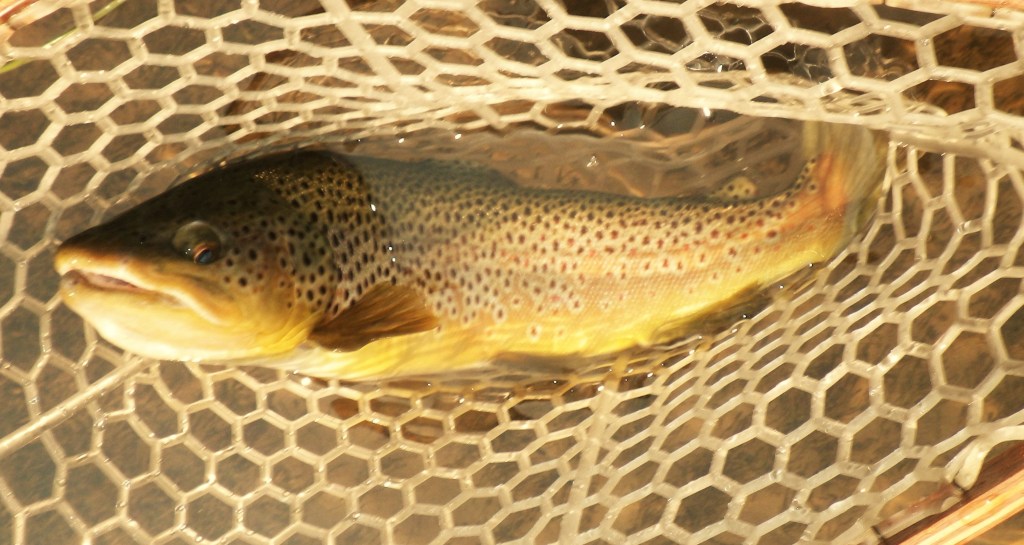
A February brown puts a bend in my 8642 Grangeramid the canyon stretch of Spring Creek, Bellefonte, PA (Photo courtesy Dr. Andrew Boryan)