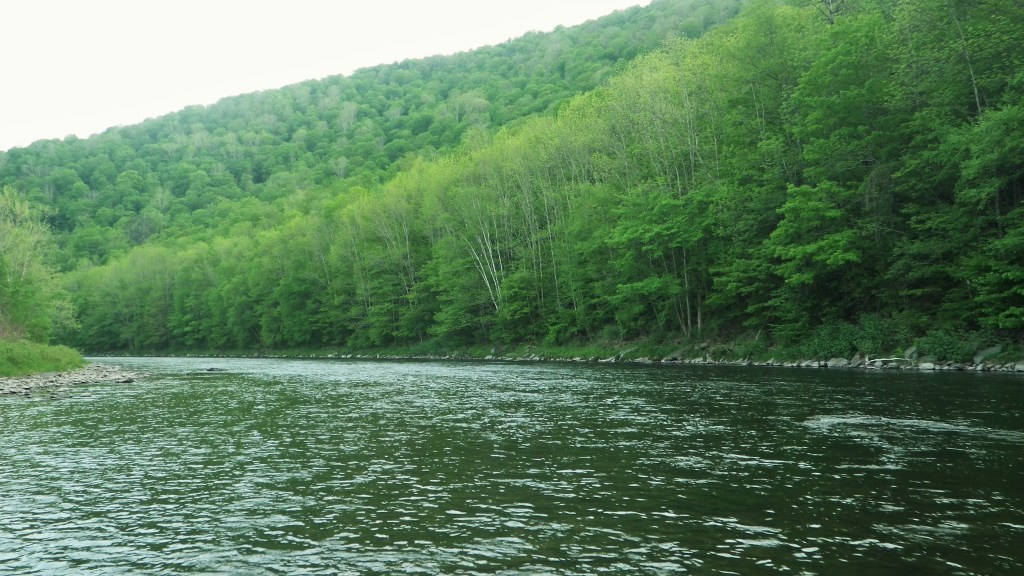
My winter fishing is about to take a terrible turn. Highs well below freezing already reign, and now ten to twenty inches of snow are expected tonight. I must retreat, retreat into the dream world of memory and anticipation…
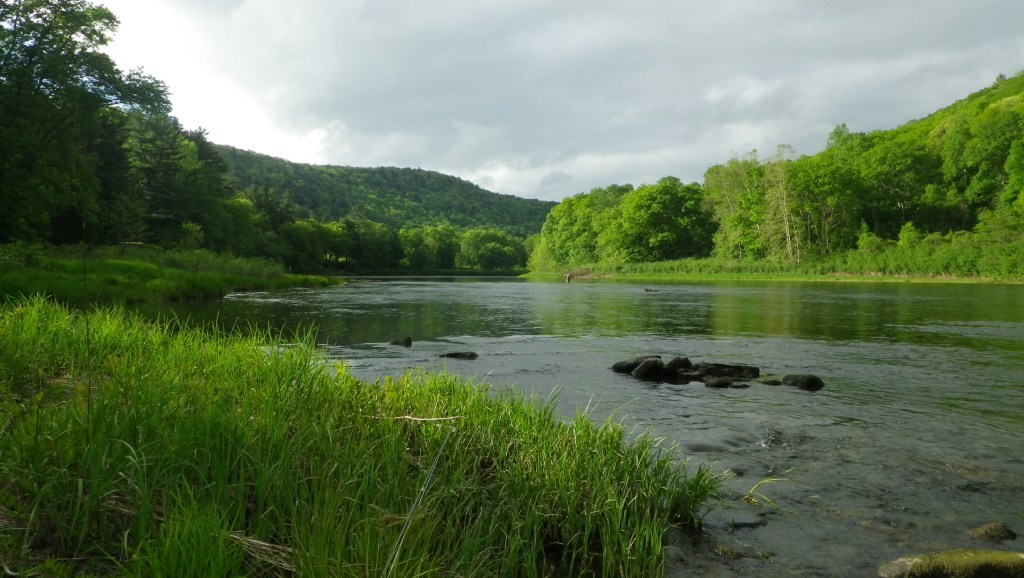
If I close my eyes I can feel the sun upon my chest, lying here in the sweet grass of the river bank, the only sounds the gentle music of birdsong and the river. My vest is laid out on the grass and my rod, propped against it, waits for the sound of rising trout: five strips of bamboo united to form a perfect pentagon. It is early afternoon and the sun feels wonderful as I doze in and out of consciousness.
A splash nearby nudges me awake, and I stretch before rising into a sitting position. There are sulfurs riding the soft current near the bank, just a few right now, but they bring another splash from a small trout eager to feed. I ease over to the edge and let my legs dangle in the water as I pull my vest over my shoulders. Within a few minutes there is a bulging rise fifty feet out.
Rising, I take the fly from the hook keeper, pull leader and line from the reel and out through the tip as I begin a short, careful stalk. Once I am in position I wait for another bulge in the flat water. It isn’t long in coming.
My false casts are few, off to the side and well downstream of my target, then the gentle turnover of my wrist sends the fly out to alight with a whisper… six inches of drift, a foot… and then the bulge takes it softly from the surface. The sun glints golden on the arc of varnished cane as I pull the rod up and back, the trout boils in a shower of spray, then turns and brings the click of the reel to a screaming crescendo!
I have lived that moment over and over, never once the same. The beauty, the poetry of the dry fly, makes my very spirit smile. Ah summer, the glory of a Catskill summer!
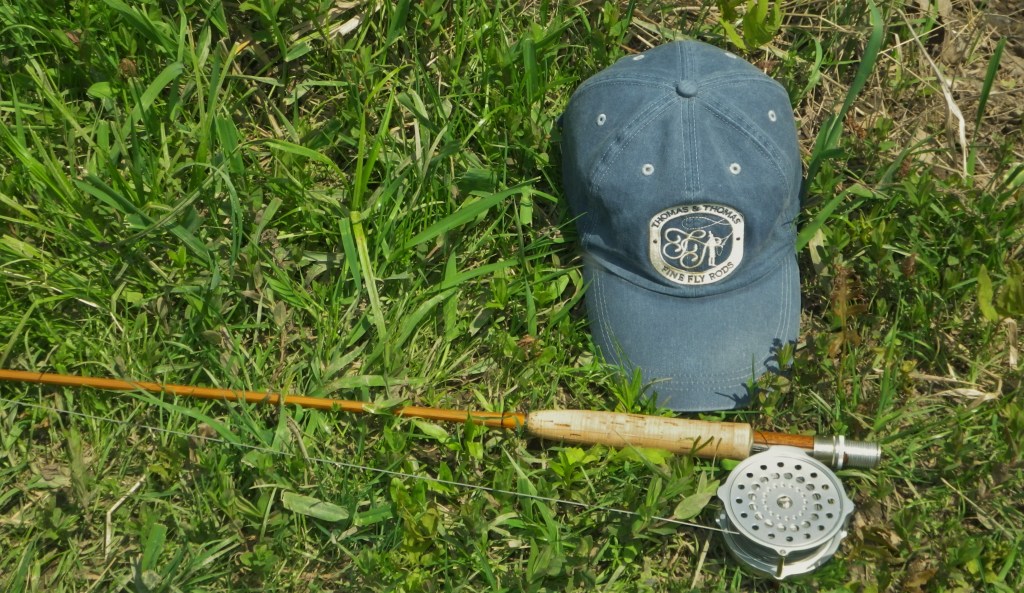
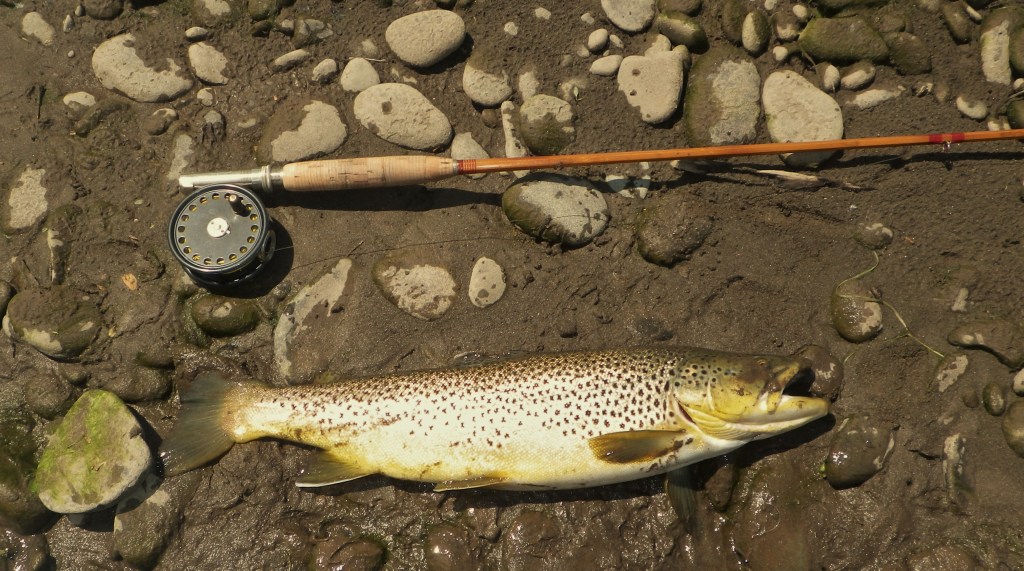
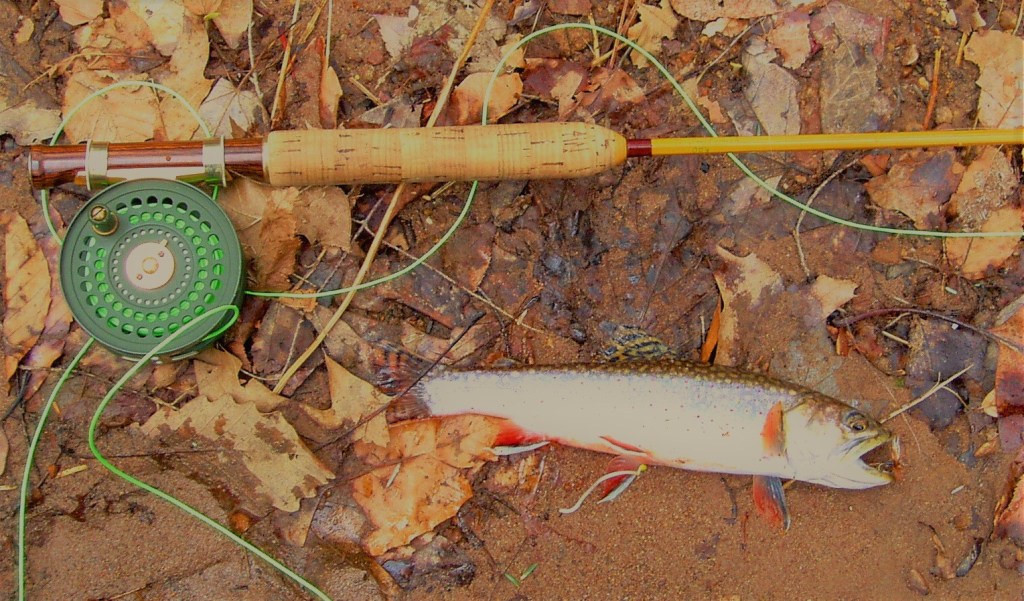
My SweetgrassPent waits for summer by my side. Eight feet for a four weight line, this sublime rod was designed and crafted for me by Jerry Kustich and Glenn Brackett of Sweetgrass Rods, masters of the craft.
The Pent waits there in the rod rack, for summer is only a dream right now. Autumn departs with a savage blow, leaving winter to offer respite.
I met Jerry Kustich several years ago at the Backwater Angler shop on Maryland’s Gunpowder Falls. I had just reviewed his latest book when Theaux, the shop owner, invited me to a bamboo day with Jerry taking center stage. I enjoyed our talk, and casting a number of the fine Sweetgrass Rods Jerry arrayed in the shop that day. Kustich had retired from full time rod making in Montana and moved, settling in northern Maryland, while still traveling to shops and angling shows as an ambassador for Sweetgrass. Catching up this summer, I was pleased to find he was still designing and building rods in concert with Glenn Brackett in Montana.
What began as a casual correspondence resulted in the beautiful Sweetgrass Mantra rod pictured above. Jerry has cultivated his interest in five strip bamboo fly rods for many years, producing prototypes that became the first ever Winston Pent. When the Booboys resigned from Winston, his interest continued as he and Glenn founded Sweetgrass Rods. From talking a few times over the ensuing years, Jerry knew I shared his interest in pentagonal rods, and designed and built the eight foot four weight to suit my desires, my ultimate summer dry fly rod for the Catskills. Glenn wrapped and finished the ferruled blank at the Sweetgrass shop in Montana, sending it on it’s second cross country trip to Hancock a week ago.
There is something different about a pent that can be hard to define: some describe it as a crispness, or a subtle touch of extra power compared to a traditional hexagonal rod. A well made pent isn’t stiff, the action is smooth, and tends to be more accurate, at least in my hand. Casting the rod before it’s trip west this summer, I learned that this Sweetgrass design is perfect for the pinpoint casts, whether close in or at distance, that my summer fishing demands. For tiny tricos and those exasperating size 28 flying ants, the rod allows me to drop down to a number three line for even greater delicacy!
Lovely finish and details are a trademark of the Sweetgrass shop: I love the burnt orange silks and bamboo winding check! The color reminds me of summer sunsets and autumn forests along the river.
Hopefully this blizzard will pass and there will be some winter sunshine and warmer days ahead. When the cabin fever gets to me I’ll take the rod from it’s tube, try a reel or two for balance, taking my time to find the perfect match of reel and line. A few casts on a calm, bright winter afternoon will help me close my eyes and dream again.
There is an unexpected glow in the corner of my window this morning, as the sun has come forth! The forecast wasn’t exciting, clouds for the duration, but I am beginning to reconsider!
There is snow on the way this week, with one local forecast calling for better than seven inches on Wednesday, with midweek highs in the twenties. That makes this morning’s unexpected sunshine even more welcome; and it has me thinking hard about rigging up a certain bamboo fly rod. River temperatures actually rose overnight, so I cannot help but feel the pull of bright water.
I wonder if it will remain until lunchtime, that specter of warmth and possibilities, for even as I write this another bank of heavy gray clouds has obscured much of it’s light. Perhaps this is only a flirtation.
I tend to be a bit preoccupied with sunshine for winter fishing. That attitude grew out of many winters experience on the Cumberland valley spring creeks. Operating a fly shop left me mornings and evenings to fish, at least for the warmer portions of the year, but winter brought darkness before closing time. I stalked the Falling Spring most mornings during the winter, expecting some activity as the water rarely got below fifty degrees. I learned over time that temperature wasn’t enough, sunshine was vital for finding active trout on an early winter morning. I realized that sunlight started oxygen production by the aquatic plants that remained through the winter and jump started the food chain.
One frosty January morning brought this into very clear focus. I had received a new demo rod, one of the very first Orvis Tridents, an eight and a half foot four weight, and I was anxious to try it out despite the twenty degree temperatures at dawn. When the sun hit the water there was vapor rising from the stream, adding an air of mystery. I tested that rod with my largest Falling Spring rainbow, a gorgeous, iridescent fish weighing five pounds! That trout was out feeding at eight o’clock on one of the coldest mornings we had that winter, because the food was active.
On my Catskill Rivers, my need for sunshine seems to be more about the mood and comfort of the fisherman, though I do take note of any areas with late season aquatic vegetation. It will take time to learn whether the same phenomena occurs here in our much colder rivers. Weed growth has been on the increase in the West Branch the past couple of seasons. If enough of it survives through the winter months, then sunlight will allow photosynthesis and oxygenation. Nymphs living in those isolated weed beds should respond with some increase in activity. The question is: will the trout take notice?
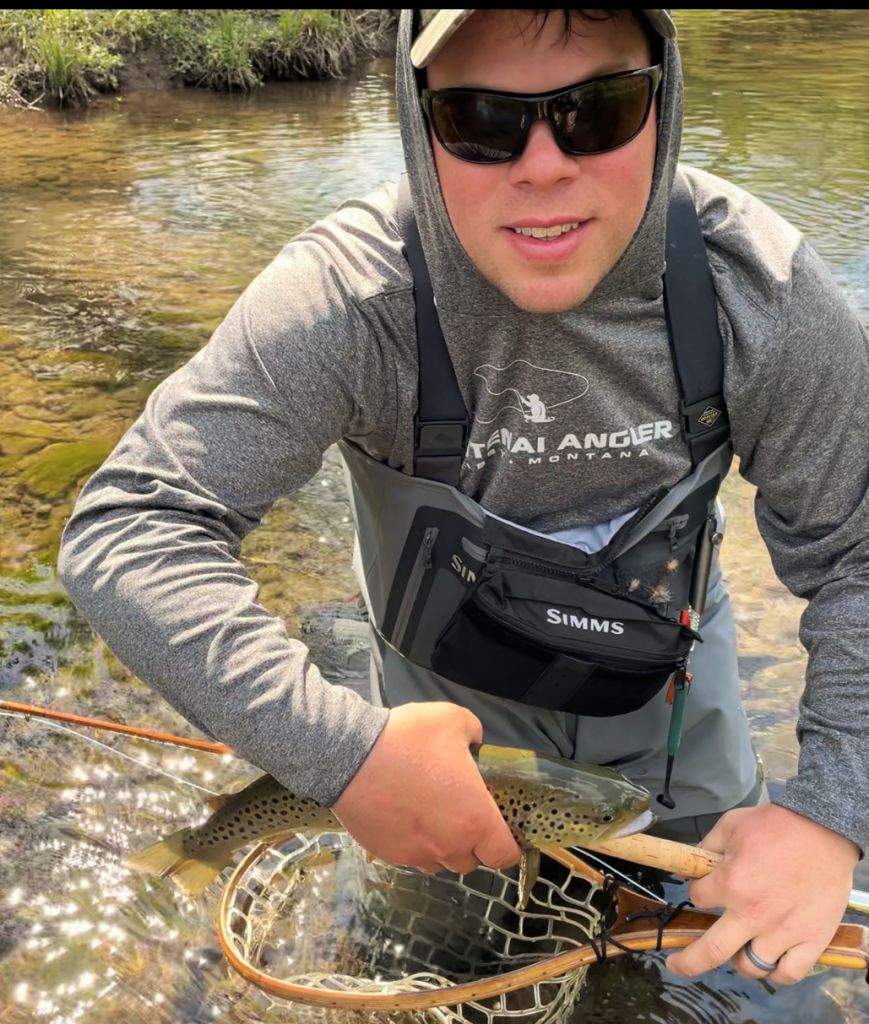
A heavy winter limestone rainbow from a Cumberland valley spring creek.
I certainly don’t go forth expecting a lot of activity when our rivers flow in the mid-thirties. I am there mostly to enjoy the time on the water, to add pages to the book of my life as an angler. If we are open to it, each day on a river will teach us something. I try to keep my mind open to possibilities. If we operate based solely on our past experience we limit the opportunities to learn something new.
Science tells us that a cold blooded fish doesn’t have to feed very often when the water it inhabits is closer to freezing than to its normal activity range, but it does feed a bit every so often. There is always some luck in fishing. Science has also shown that fish in artificially cold water, like big dam tailwaters, can acclimate to the cold water regime and remain active in a wider range of water temperatures. Knowing that helps me concentrate on every cast on a frigid Catskill river.
Maybe that little pool I have fished a dozen times without a strike has only one trout hanging out in the winter, a big old boy that keeps the smaller fish away. If I keep fishing that pool regardless, there is a chance I might be swinging a streamer down along the bottom on the one or two days a month that that brown goes hunting, thanks to a couple of degrees rise in the river temperature on a cold but sunny day!
Glorious sunshine, and pleasant air temperatures called me to the river at last. I had retreated for too long, waiting for La Nina’s promise, waiting as the season’s first snow chilled the landscape bringing naught but thoughts of winter.
The sun spends too little time on the water this time of year, retreating behind the ridges far too early in the day, with good pools deprived of that promising combination of the warmest air temperatures and direct radiation. Nevertheless, good water is good water, and I cast a long line and fished slowly, thoroughly; hope at the end of my line.
The fly swung deep, dancing above the boulders, not bouncing between them like the dead drifters’ wares, ever searching for an active trout.
I learned long ago the importance of movement within a trout fly. Static patterns offer a visual clue with their shape, but a fly that quivers with life sends a deeper message. This one I have toyed with a while, finding the right combination of materials and techniques to bring attraction with subtlety and essence of life. The fly has been nudged and bumped in cold water but not taken, so I tinkered some more, needing only to encounter that active trout. Half past Noon, the river in the thirties and already in shadow; cast and mend, cast and mend.
The take came with a jolt, and my line hand tugged back instinctively, the rod coming back into its lovely bend: the active trout has been found! Rod tip bucking, I played him in the current, relishing each surge, surprised by his vigor in the cold. Close at hand I could see his white mouth working, down there on the shaded river bottom as he tried to shake the fly, but the pull of the rod brought him closer, and finally to the net.
The warmth of elation wrapped round me, all that for such a simple act; the same joy felt as a child with that first secret tug at the other end of a line! Winter hasn’t got me yet.
I was searching for some obscure fly tying material the other day, I don’t recall now what it was, when I came across a small plastic box containing a single fly. The memories flooded back: a bright May afternoon in my fly shop twenty-five years ago, sitting back and enjoying one of many conversations with Ed Shenk. I had been reading his lovely book Fly Rod Trouting a few days earlier, and was curious about the Fledermouse streamer therein.
Ed was an innovative fly tier, and among his contributions was the trimmed fur chenille technique pioneered in his cressbug and minnow, two patterns in his famous series of “chewy flies”. Memory tells me it was the Fledermouse, a Western pattern that he tied with this dubbing loop technique, that began the experimentation that resulted in those iconic chewies. Happy to indulge my curiosity, Ed took his place at my vise and tied me a sample of the Fledermouse, the fly I kept in that box for twenty-five years.
Fledermouse: tied by Ed Shenk May 10, 1995 at Falling Spring Outfitters, Scotland, Pennsylvania
I have enthusiastically used Ed’s dubbing loop technique since he first taught it to me a few years before that day in the shop. It has added a dimension to my tying that leads to more lifelike and durable flies, all of which light the road back to the excitement of my formative days fishing the Cumberland Valley spring creeks, and learning from the Master.
Chance favored me again recently, when I received a message from a friend advising me that one of Ed’s classic Hardy reels was available. I acted immediately, and was able to secure this keepsake, a vintage Featherweight.
In Fly Rod Trouting, Ed tells the tale of Old George, the mammoth LeTort brown trout he hunted and battled over three seasons. The story of one encounter tells us he was using a Hardy Featherweight reel, and the photo of the Master and Old George indeed shows a small Hardy attached to his five foot fiberglass rod on that victorious day in 1964. When I received the reel, both pawls were flipped into play, doubling the tension of the “check”. Uncommon, but suitable I would say when hunting an 8 1/2 pound brown. Is the reel I bought the same reel that captured Old George? I will never know for certain, but the possibility will heighten my senses each time I fish it on the rivers of my heart!
On another search through my assorted papers and periodicals, I recovered Ed’s handwritten manuscript for an article I was honored to have typed for him, back in those halcyon fly shop days. If I recall, the article was published in American Angler sometime thereafter. To illustrate the effectiveness of terrestrial dry flies, the piece begins with the story of another LeTort leviathan, a trout near nine pounds captured on one of his trademark diminutive fly rods, and a size 14 LeTort Cricket. Reading his words brings a flood of emotions.
Instantly I am back on the hallowed LeTort, stalking the wariest brown trout I have ever encountered in her grassy meadows. In the early years, I would drive to Carlisle in darkness, and walk the stream at first light. At the time there was a huge midstream logjam in the lower part of the Barnyard Meadow that gradually accumulated floating masses of weeds around it’s edges, until it reached nearly from bank to bank. I cast my LeTort Cricket over top of one of those weed mats, and watched it drift slowly to the upstream edge, and start to circle in the eddy, then disappear. The fight was thrilling, as I somehow kept the big trout away from all of those logs, netting my first larger LeTort brown, an eighteen inch beauty!
Keepsakes: The late Ed Shenk’sHardy Featherweight, his handwritten manuscript for “Terrestrials From Top to Bottom”, and one of the commemorative LeTort Cricket’s he tied for the 2007 Pennsylvania Fly Fishing Museum Banquet. Ed passed away in April of this year after a lifetime of writing, tying, teachingand enriching the lives of fly fishermeneverywhere. Rest in peace Master of the LeTort.
I was working on an article for the Catskill Fly Tyer’s Guild, musing over fly fishermen and their passions for tackle and tradition when I thought of the Fledermouse, just recently recovered in a box of tying materials and small mementoes. While we are oft entranced by collectible vintage rods and reels, or the rarest of angling books in limited printings, sometimes the smallest things can trigger the most powerful memories; things like that single fly.
It was cloudy, though pleasant when I took my walk along the river late this morning. Rain and dreary skies were expected, but there is brilliant sunshine flooding the landscape as I write this. Had I known I would have planned for some fishing.
I like the sunny days during winter weather, always hopeful that a small rise in water temperature might activate a couple of trout. Yes, I know early December is still autumn, but when I try to don my wading boots and find them frozen solid, winter can’t help but come to mind. It was sunny when I geared up yesterday afternoon, so I didn’t expect to find my boots iced, assuming they had air dried enough to ignore the heavy frost overnight. So yes, I think of December fishing as winter.
Still trying to find the answer to winter fishing in my favorite rivers it seems. Logic and reason dictates that the slower, deeper runs at the head of pools should harbor any active trout, but if any are active, I haven’t found them! Our last rainfall event seemed to blow in from warmer climes, and the rise in river flow was accompanied by a rise in water temperature, despite the heavy cloud cover. Fishing one river that shot up from the thirties to the mid-forties produced two bumps on a streamer, and yesterday afternoon’s sunny odyssey produced a single strike.
Perhaps the problem is that my heart simply isn’t in it, not like it is when there are trout rising to hatching mayflies. Early in my fly fishing career I was a year round angler, fishing midges on top when there were rises, and nymphs or streamers when there were none. I put a lot of effort into fishing subsurface, and caught a lot of trout that way, though I never enjoyed chucking lead in the same way I lived for the dry fly.
As I have grown older, how I fish has become more important than how much I catch. I have cultivated my love for dry flies, bamboo rods and classic reels over time. I have not been a numbers fisherman for a very long time. Perhaps that is why the winter game is eluding me. I have developed my thinking, my approach, to hunting large, wild trout, and thus fish different places than I did when I simply tried to catch a bunch of fish. I generally don’t cover a lot of water. I fish select places slowly and carefully.
When most of the trout in a given river are inactive due to cold water and their lowered metabolisms, the chances for a strike, much less a hookup, are fewer and less frequent. If you are fishing the right spot at the right time, you may get a strike or two. Fish the wrong spot and you’ll get nothing but exercise. Perhaps I should look at those days when I do get a bump as small successes. I guess I’m just not that philosophical yet, though I am content to continue to fish my way.
I really don’t care to spend hours systematically high sticking little nymphs through the riffles and runs to try and pick up a few small trout. Been there, done that as they say; back when I was younger. I’d rather fish at my own pace, thoroughly working a fly tied to display a bit of flash and a whole lot of movement, in the quest to slip that fly in front of a big winter brownie and entice him to eat it.
A little flash beneath a lot of hen pheasant soft hackle feathers makes fora fly that breathes with life as it swings through the current.
I enjoy that winter sunshine whenever I can find it, and I think my approach is sound when it comes to targeting rising water temperatures. There is always an element of luck in fishing, and I figure that my turn ought to come around again.
The rain has subsided and I can see some blue sky outside the window above my tying desk. It has been a day of chores: packing leaky waders, some unused tackle that will help fund tackle that will be used, and a holiday gift for a friend. Trips to take care of the mailing, etcetera, and then some time to relax at the tying desk.
I passed a personal milestone this afternoon, as my output of trout flies for the year passed 170 dozen, the previous high mark set last year. I have an entire month to go before the New Year so I expect to reach a lofty new plateau, perhaps I’ll even crack 200 dozen! That will depend in part upon December’s weather.
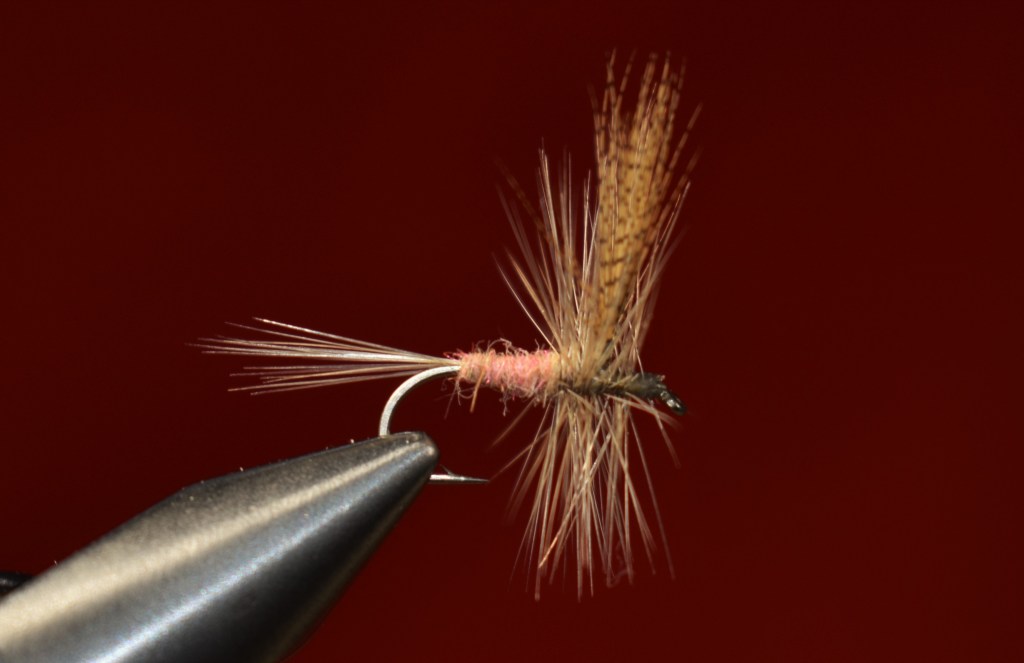
Since I was establishing a new high, there was no question that I had to tie dry flies. They make up more than 95% of the flies I tie. I felt it would be proper to tie my most productive fly for 2020 in that final batch, so most of today’s dozen were the two tone sulfurs that provided my most memorable days this season.
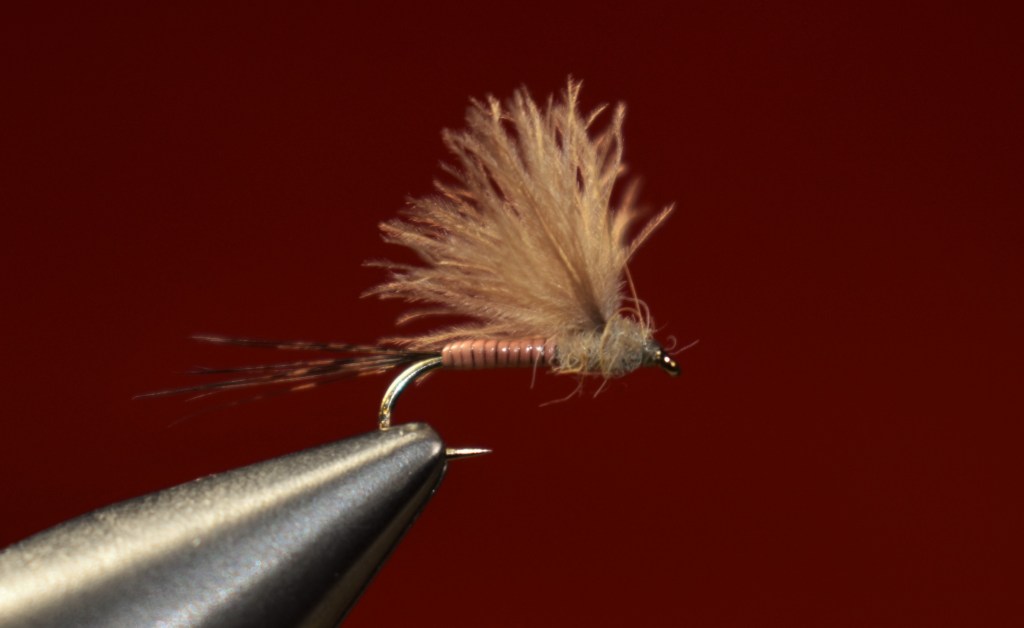
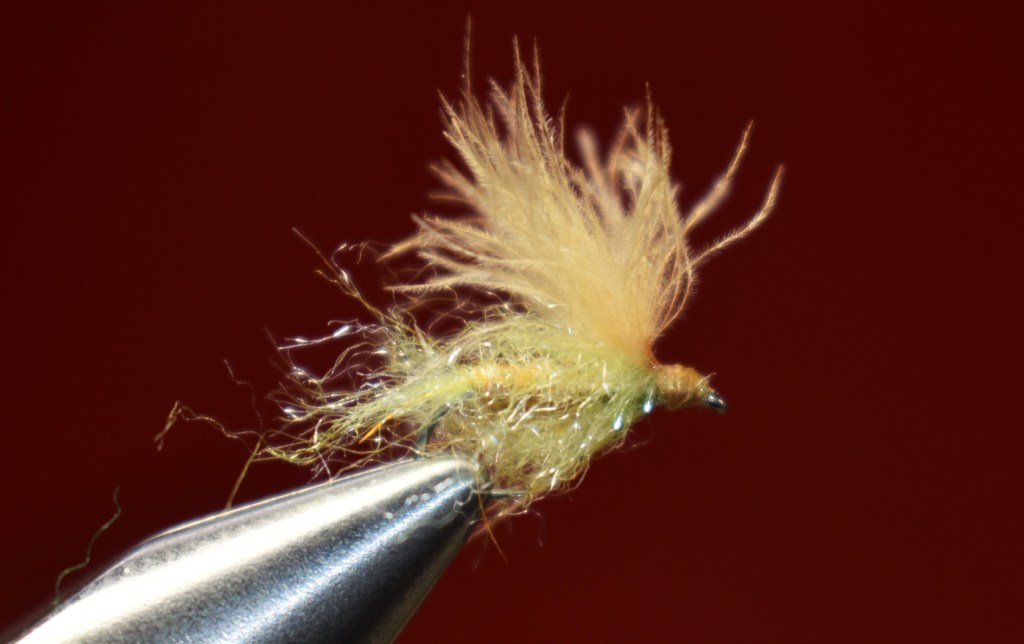
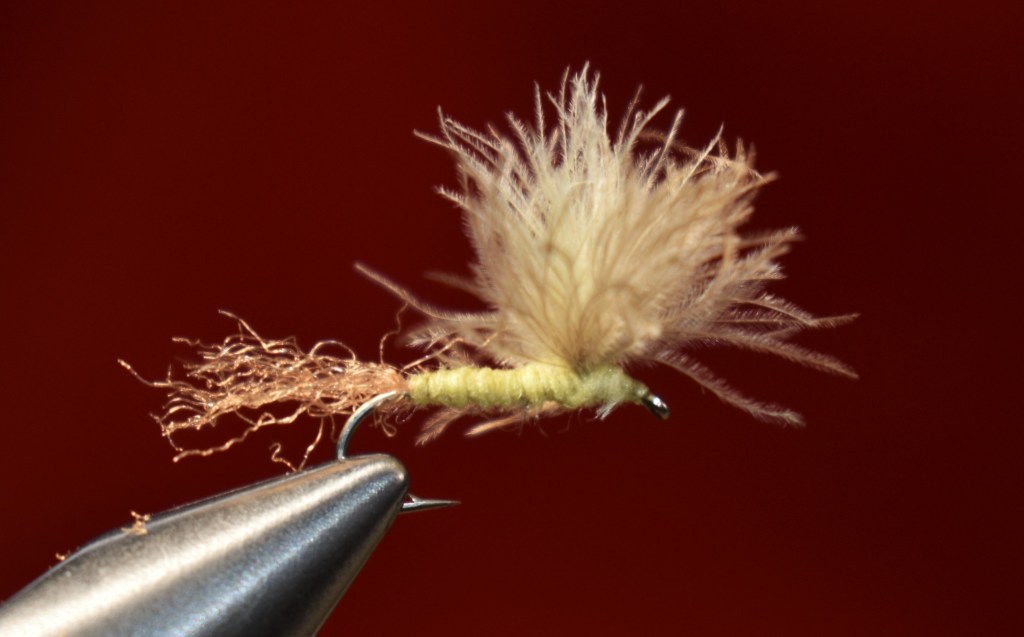
The pattern came about from observation as most do. I had captured some sulfur mayflies with a tinge of yellow in their pale dun wings, and tied a few imitations I thought might appeal to the trout. I paired two CDC puffs for the wing, light natural dun and pale yellow, formed the body with my blended silk dubbing, and added a sparse trailing shuck in a light reddish tan. Sulfurs proved to be a major hatch this spring, and the new pattern worked remarkably well.
I had hoped for a little fishing today, with a forecast high near sixty degrees, but rain and high winds made this a better day to take care of those chores. There are fewer reaches of river to fish tomorrow, as the season closes on several of our Catskill waters. I had a thought to fish a couple of spots I hadn’t fished this year, to make one brief visit to waters I had been forced to neglect in my preservation driven effort to avoid the crowds that increased the dangers of the Covid virus, but Mother Nature trounced my plan.
My tying desk still needs a cleanup, and there are certainly stores of materials that could be sorted. When you tie flies for thirty years you tend to accumulate a lot of feathers and fur. When you owned a fly shop as I did, you accumulate even more.
There’s some snow in the forecast for the middle of this week, and I can picture myself out on the river somewhere with the white flakes flying. It’s kind of fun. Thinking about it causes me to recall a morning on Falling Spring, many years ago. I was out fishing around eight o’clock, getting an hour or so on the stream before opening the fly shop for the day, and the wind was howling and the snow flying. A friend who lived nearby saw me on his way to work and stopped to ask me if there was any weather I wouldn’t fish in, laughing through his words. I told him I’d fish as long as the water wasn’t hard.
I have fished in some crazy weather, perhaps the worst of it on an early April trip to Elk Creek near Erie, Pennsylvania. I was fishing for steelhead, and the wind was gusting to 50 miles per hour. I was standing in a deep rocky chute that dumped into an unwadeable pool just a few yards downstream, when one of those 50 mph gusts hit me square in the chest. The wind pushed my torso back, back, right to the point of tipping backwards and possibly drowning. I hung there for what seemed like a very long time, and just as I started to lose my balance and topple backwards into the hole, the gust subsided. Close call. When I turned around and looked back toward Lake Erie, the sky was black. It was mid afternoon, but the storm headed my way was something I knew better than to mess with, so I reeled up and headed for the truck.
The water wasn’t hard that day, and if I remember correctly, the fishing was pretty good, but yea, it turned out there was weather that I wouldn’t fish in.
The story of Pennsylvania’s Big Spring is a story of politics, grass roots conservationists, the marvelous resiliency of Mother Nature, and the boastful pride of a State agency that could not leave well enough alone. In terms of the volume of spring water discharged, it is the Cumberland Valley’s largest spring creek, at one time the home of a State record brown trout, and a treasure that was manipulated by man for his own desires.
In the beginning of the twentieth century, none other than Theodore Gordon fished the stream and wrote of the tremendous head of wild brook trout the winding spring creek contained. It was said that trout of two pounds swam in numbers in the gin clear limestone water. The brook trout population declined as mills and private hatcheries changed Big Spring. Brown trout, once introduced, prospered there at the expense of the brookies, and it was a brown of some fifteen pounds that claimed that State record for several years.
In 1972, the Pennsylvania Fish Commission built a trout hatchery at the headwaters of the stream that was to be the end of a spectacular wild trout fishery. The hatchery was faulty from its inception and polluted the stream for nearly three decades in the name of “better fishing”. Local anglers and conservationists fought back and, bolstered by a 1995 study prepared and published by the late Dr. Jack Black and local biologist Gene Macri, the anglers and conservationists finally won. The hatchery was closed in November 2001 and later dismantled. Quietly at first, Mother nature began to heal Big Spring’s wounds.
During my first decade living in the Cumberland Valley, I fished Big Spring only a handful of times. Mush of it seemed barren, save for a cluster of hatchery escapees in “The Ditch” growing fat on the waste fish food and other organisms pumped out of the hatchery outfall. To me it was a very sad place.
Three years after the forced closure of the hatchery, I stopped along the stream one summer afternoon. The water looked better, there was bright gravel in spots amid the aquatic weedbeds, and I decided to explore a bit to see if the stream had begun to heal, or if it was simply a mirage born of hope. I was standing on the bank tying a Baby Cricket to my 6X tippet when I froze, gasping as a behemoth rainbow trout eased past along the edge of the stream at my feet. As the fish moved away, I flipped the fly out, moving nothing but my wrist. It fell short, but the trout continued idly away from the bank, finally allowing a pickup and a proper cast. The cricket landed to the right and a couple of feet ahead of the trout and he tipped up, as if in slow motion, and inhaled it.
My strike and the monster trout’s screeching run lasted perhaps a second before my CFO reel backlashed from the speed of the departing line, the balled up line stopping the spinning spool abruptly, as the trout snapped the tippet and escaped. Such was my introduction to the healing of Big Spring.
After that encounter, I began to fish the stream with intent, and began to find an increasing number of wild rainbow trout from parr marked fingerlings to wide flanked brutes well over twenty inches long. Oh, and I finally purchased a disc drag trout reel.
This is one of the early monsters that got away, a wild rainbow well in excess of twenty inches. He was kind enough to hunker down between weed beds after breaking me off and pose for photos.
During my early explorations I caught some beautiful rainbows, but landing the monsters did not come easy. Tackle was refined beyond the disc drag reel, to include somewhat longer, softer rods and fluorocarbon tippets. An eight and a half foot three weight outfit was common for lunker hunting, something with as much give as possible to protect the 5X and 6X tippets the clear water and wariness of these trout demanded.
Perfect presentations were often ignored, particularly with the dry flies I preferred. While the rainbows adapted beautifully to the improving water quality, their spectacular growth was attributed to the heavy biomass of crustaceans in the stream. There still weren’t a lot of winged insects available to the fish. A few sparse blue winged olives and some midges provided a rising trout or two very rarely until summer, when terrestrial insects improved the odds of tempting a resting bow to rise to the fly.
Throughout the winter months and into spring, subsurface fishing with the Limestone Shrimp I developed in 1993, and Ed Shenk’s classic Cressbug, produced most of the fish brought to net. These two flies represented the major forage base.
Mark’s Limestone Shrimp: In a departure from the myriad plastic shell back patterns, I developed a color matched three material blend of dubbings, used Antron yarn for the vein and tail, and ribbed the fly with clear monofilament. When the fly is saturated, the effect is very lifelike, with a transparency that mimics the Gammarus scudsthat are prolific in Pennsylvania’s spring creeks.
While fishing these two imitations with stealth and drift control allowed me to hook up with any number of heavy Big Spring rainbows, landing them was a brave new world. These fish were true heavyweights, spring creek rainbows with steelhead-like proportions, exceedingly strong and lighting fast when hooked. Big Spring offered large areas of heavy aquatic weeds, blowdowns, and large rocks and timbers from old stream improvement structures in it’s resume of escape cover. You can’t muscle a four or five pound, frantic, hard charging trout out of this cover with light tippet and small flies, you must learn to think ahead of them to play them away from disaster. More were lost than landed for a while, but slowly the odds tipped in my favor a bit more often.
There are some glorious memories of battles with Big Spring rainbows, including the first big boy brought to net on a dry fly. The Baby Cricket was my favorite Cumberland Valley dry fly throughout the summer, and I was fishing it on my 8′ 4″ Orvis two weight in early July 2007. I spotted a shimmer in a gravel bottomed pocket upstream and cast the little cricket just above it, allowing a drag free drift that was interrupted with a hard, quick take. The gentle flow through that pocket exploded into crystalline mist when I raised the rod, and a big trout bolted upstream toward a tangle of rocks and heavy water weeds!
I laid the rod down, pulling a full arch into the shaft, back and away from the snag, turning that bow just short of the edge. Each time he targeted a new obstruction, I flopped the rod to the opposite side to turn him, saving my fish by inches each time. The big downstream run came once I had turned him short of three or four of his nearby weed beds, and I let the light drag of the reel do its job until he headed for a new obstruction. Finally tiring him, I walked down and scooped him into my big catch and release net, laying him on top of one of those weed beds he so coveted for a quick photo before release.
The Babyeater, resting on a favorite weed bed.
I look back on the elation of that day and sadly realize that that breakthrough catch I believed heralded an amazing future for angling on Big Spring, instead heralded the beginning of the end. On April 5, 2008 I attended a symposium on the past and future of Big Spring at the Shippensburg University Foundation Conference Center. The mood was bright and I was impressed with the work that was underway to assess the stream and plan for it’s continued health. I remember leaving that presentation with a new, positive outlook on the Pennsylvania Fish & Boat Commission and their careful, scientific approach to determining what, if any, stream improvement would be undertaken for the future. I was to learn the hard way that this was simply the old enemy in new clothes.
The first stream improvement project appeared to do some good, invigorating a formerly barren reach and adding habitat, though at the expense of a few old favorite fishing spots. The project area attracted a lot of new fishing pressure, so I frequented it less as time passed, enjoying my favorite reaches elsewhere. The numbers of huge trout increased gradually as Nature continued her healing process away from the project waters and insect hatches began to appear. There were some sulfurs and caddis in spring and early summer and fishable hatches of early black and brown stoneflies that provided some early dry fly fishing in February and March.
On the first day of summer 2010, I landed the fish of a lifetime, a gorgeous wild rainbow better than two feet long and calculated to weigh more than ten pounds! That fish took a size 18 beetle and fought me for an eternity. Three years later to the day, I was stalking the gravel runs between the weeds when I spotted another gargantuan bow on station. The light bamboo rod delivered my special size 18 caddis dry above the leviathan, and he tipped up and inhaled it! To this day I find it hard to believe that lightning struck twice to begin those two summers, but it did: and I netted another massive wild rainbow of ten and a quarter pounds!
June 21st, 2013: 24 1/2″ in length, and an astounding 17 3/4″ in girth, a ten pound Big Spring rainbowon a 7 1/2′Dream Catcher bamboo rod, a well named article of fly tackle if there ever was one!
Today that lovely glide of bright gravel has been obliterated by the second PAF&BC “stream improvement” project. The reach downstream of the project water was also destroyed by the siltation from the work, performed with heavy earthmoving equipment in the stream. The growing population of trophy wild rainbow trout has been sacrificed to an impossible management plan which purposely destroyed them.
The Willow Pool was drowned by silt from the second major stream improvement projectperpetrated by the PAF&BC, as were all of the trout holding areas in the section of the Special Regulation area downstream of the project reach. Heavy equipment in the streamand a lack of filtering managed to wipe out a long reach once populated with wild, trophy rainbows.I waded bright gravel stream bottom throughout this water for several years, catching rainbows from fingerling to trophy size, until the construction silt migration rendered it unwadeableand nearly devoid of trout.
The sad fact behind this plan is that the Fish & Boat Commission wanted to be able to take credit for the Big Spring fishery, for the healing that Nature produced when they were forced to end their decades of pollution, and they could not. They formulated a plan to eliminate the wild rainbows that Nature had chosen to repopulate the stream in a thinly veiled, ludicrous effort to bring back the historic wild brook trout. The plan included “habitat improvements” that were unfavorable to rainbow trout spawning and, ultimately establishing catch and kill regulations for rainbows on this catch and release water. Public outcry stopped them short of catch and kill, but they allowed poaching and habitat destruction to take care of those politically incorrect rainbows.
I have always believed that the very special original genetic strain of brook trout indigenous to Big Spring was eliminated long ago. The loss of that unique genetic strain, changes in land use, the chemistry of the rainfall that ultimately feeds the spring source, soil chemistry and the myriad of physical habitat modifications that have occurred simply will not allow this fishery to regress by a century. The day will not come when two pound brook trout dimple the surface like rain at the evening rise, as Theodore Gordon once observed.
I believe that the agency was driven not by a desire to renew the heritage of Big Spring, but by their passion to save face, to be able to take credit for the comeback of a stream they had devastated for decades.
My fishing frequency declined as the stream and its wild rainbow fishery declined, in the wake of that second project. Eventually the loss of that wonderful fishery caused me to all but abandon my home waters, and formulate my plan to retire to the Catskills. Despite the efforts and accomplishments of a remarkable grass roots conservation effort, the legendary Cumberland Valley spring creeks have become faint shadows of their former selves. I have no doubt the state of those once bright waters today brings spectral tears to the eyes of the ghosts that still walk the water meadows.
One can only hope that reason might one day return to those entrusted with the preservation of our natural resources. These great waters can yet be saved, thought the political task far outweighs the physical effort required.
Though my passion runs to fishing for large, difficult trout with dry flies, bamboo rods and classic reels, much of my love for the outdoors is founded in the small moments. Some have been captured, and thus may be shared in photos, other shared only in words, and some so brief as to bring a smile, a hint of recognition before they are gone.
Early mornings tying flies by the open window at Glenmorangie Lodge: listening to the wild turkeysgobbling at sunrise, inhaling deep draughts of the mountain air as I fashioned dry flies for the day’s fishing: cherished memories of some of my favorite trips two decades ago!
Too many anglers fail to reap the best rewards of their sport, concerned solely with their fish count. They fish a handful of days per year at breakneck speed. Loud, brash and celebratory when counting fish, they turn sallow, disgruntled when the “bite” isn’t on. To take the fullest measure of the outdoor experience, one must learn to take what the river offers.
Favorite rod in hand, anticipating a memorable hatchfrom another season, and watching for that first rise! It didn’t happen that way on this day, but the feeling of those first steps into bright waterwas my keepsake for the day.
The company of friends is a great part of the angling experience. Not crowds mind you, but a favored companion can add new dimensions to the day…
A quiet afternoonat a “secret spot” on a long awaited outing with an old friend.A lovely calm evening on the float I barely lived to take, and the simple joy of feeling my own heart beating as the mayflies boiled from the riffle amid the splashes of feeding trout. The flurryof activity was brief, but the feeling remains with me forever!An unexpected visit…well met indeed!Sharing that moment of puzzlement over just what might tempt a maddeningly recalcitrant riserwhencatching myself doing the exact same thing upstream. Two friends who both recognize that many of the river’s gifts have no fins, enjoying the day though neither of us solved Nature’s sublime puzzle.Catching a fine wild trout, and walking upstream and giving that fly to your best friend, so you can watch him catch a bigger one!
Light is the master artist of the outdoors. How many cherished small moments are wrought by a simple glint of sunlight!
Light has its own special quality at each season of the year… Winter!Spring!Summer!Autumn!
Light is part of the essence of bright water. For those of us whose souls are touched by it, it is part of the essence of our being. In my minds eye the light shimmers and reveals the clues, the magic of Nature and the beauty of the shy trout.
Shimmer…
As I walked upriver yesterday afternoon, the chill of the Delaware’s late November flow made my toes tingle. I was alone on the river I believed, until I spotted the eagle high in the tree beside the landing: another fisher still casting his hopeful gaze upon the water. He remained, even as I reached the car and prepared for the short drive home, and I smiled and wished him well as I departed. Small moments…
I began my off season fly tying today, with the first session of a little annual ritual of mine: tying Hendricksons. It’s not that I have an urgent need for them you understand, for I have one of those Plano Stowaway storage boxes just for my Hendrickson patterns, and it is full. These are not vest size fly boxes, they are something like 7″ x 11″ and more than an inch and a half deep. Eighteen compartments stuffed to the top with everything from classic Catskill ties to a range of CDC emergers, cripples, and drowned duns; and yes, I am tying more. I do it every year.
There is something about the Hendrickson hatch, mainly that it is the first really heavy hatch of large mayflies each spring. It is without question the event that brings the big trout to the surface for the first time and kicks off my favorite time of year: dry fly season! My anticipation begins sometime in May, when the last of the current season’s Hendrickson duns have hatched, and the last of their spinners have been sipped by the happy trout of my Catskill rivers: only eleven more months until the next Hendrickson hatch!
The result of this obsession is, well, considering buying another Stowaway box to be marked Hendricksons since I can’t get any more flies in the first one. My mind is always working on fly designs. Nature’s little puzzles, and how to solve them with some new material or technique, are being sifted through and analyzed somewhere in the back room of my brain throughout the year. April is coming you know.
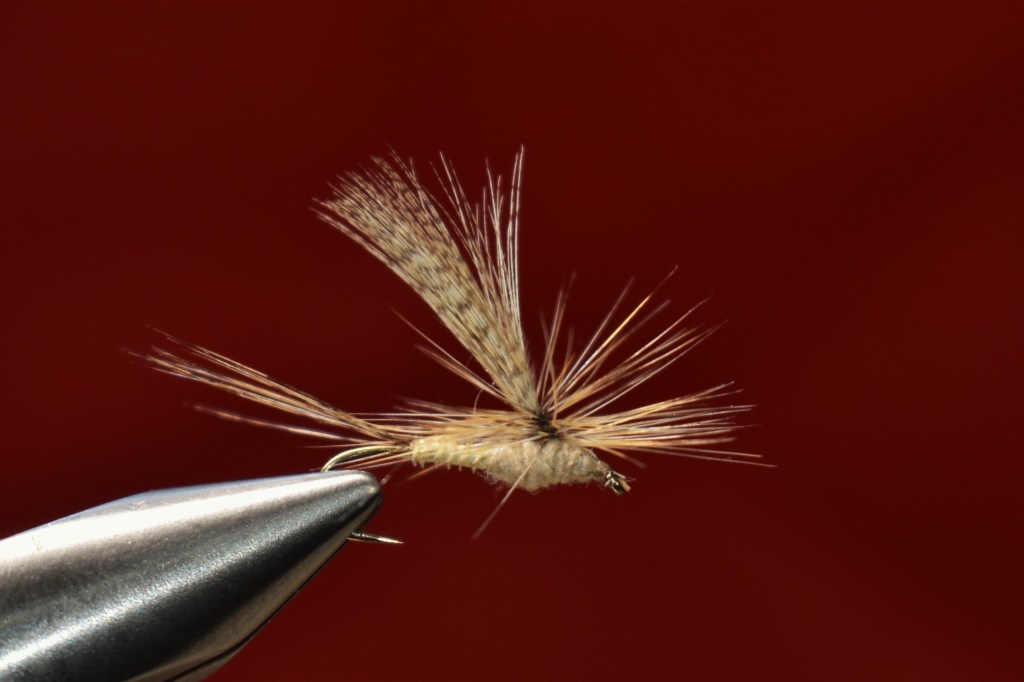
This afternoon’s obsession: big, brick red duns for the early hatchcome April: the Jave Quill 100-Year Dun is the new pattern; the dubbed CDC comparadun is an old standby, tied with a recent dubbing blend!
I don’t go crazy and tie dozens of them at a time. I work out ideas a few flies at a time. I have blended my own dubbings to match hatches for thirty years. I have a blend of pure Red Fox fur for classic Catskill Hendricksons, my original sparkle blend that I color matched to flies tied by Mary Dette, a blend I call pink enhanced, and the Beaverkill Hendrickson blend I used today.
This afternoon I was thinking about the jave quill prototype I tied some weeks ago, and I decided it was time to put a few by for spring. I tied three of those and three CDC comparaduns, half a dozen flies. That’s not a lot, but its an important first step toward wading into the roiling river next April, fighting to hold my position in the high, fast water, and searching the pool for hatching duns, and that first heavy rise.
As I work my way through the winter, there will be more of each of these flies added to the box. I’ll start pill bottles for a couple of my best friends, to make sure they have the right flies when they join me: fighting 1,000 cfs of current in an attempt to bring the first twenty inch or better brown trout to the net. I am hoping and praying that we will all be vaccinated and free from the scourge of Coronavirus well before I begin watching river temperatures on April 1st.
Sights like this one will haunt my dreams for the next five months!
If you look closely at the photo, you will begin to understand why I have tied so many different Hendrickson patterns over the years. Notice there are fully emerged duns sitting on the surface, some that are half way up and half way down below the film, others that are spent with wings apart or wings together, crumpled and crippled duns, nymphs with enough gas to float on the surface, but not enough to break open their shuck and emerge. There are size variations and color variations – and all of these permutations of the Hendrickson mayfly offer opportunities for selective feeding to our friend the trout. Believe me that the trout will take full advantage of them!
If you have fished the hatch on several occasions I have no doubt that you have enjoyed watching a fine fish rise repeatedly at close quarters, inhaling bug after bug while you employ your most artful presentation of exactly what you see on the water, and have your fly ignored. You pick up a bug or two, change patterns, and repeat the performance with the same result. Undaunted, you chose a size smaller fly, tie on a lighter and longer tippet, perhaps shift your casting position just a bit to offer an even more perfect drift… It is amazing how much time one can spend upon a single insufferable trout; and never catch it.
There are other days. Days when you grab a size 12 Catskill Hendrickson pattern, tie it to your 4X tippet, make a cast, and catch a trout. Another cast to a splash in the riffle before you brings another trout to hand; and so it goes. When you return tomorrow afternoon, smug in your uncanny prowess as an angler, and cast that same fly on the same riffle, you will likely find an experience similar to the one first mentioned. You end up with a size 18 Red Quill thorax tie with red eyeballs painted on the thread head and exactly three hackle fibers on each side of the perfectly shaped cut wing to mimic the naturals six legs, cast perfectly in the correct line of drift, while your trout leisurely sips duns an inch to either side of your fly!
The Hendricksons are special. They offer sublime challenge and reward, as well as abject failure and frustration. The hatch keeps us coming back each spring, armed with new patterns, new tackle, new ideas. Some work for us, on some days marvelously so, and some do not. Through it all we are enriched in our experiences, savoring both the banner days and the frustrating ones, for they are all part of the game.
Did I mention that I tied some Hendricksons today? Yep, April is coming!
The West Branchbends around the southern tip of Point Mountain as it flows into its last riffle before joining the East Branchat Junction Pool, where the Mainstem Delaware begins!
After a week of wind, cold and even snow, I finally returned to the river yesterday afternoon. Blue skies and sunshine greeted me, but not with that welcome warmth I cherish. Patches of snow still lingered along the banks, and there was ice in the backwaters outside the river’s flow.
The gage on the West Branch read forty degrees, four or five degrees warmer than the other rivers at hand, so I decided to prospect the last riffles in the hope that a couple of the Delaware rainbows that swam there in summer might have hung around. It was a vain hope, pure and simple, but it allowed me the excuse to walk the river once again on a day that looked and felt like winter.
Such a sudden transition as this month has wrought is a chore for my psyche to come to terms with. A week of summer like afternoons onstream, sitting on my porch in a dream state, savoring the last warming rays of sunshine and bidding goodbye to the day; then waking to snowflakes and heavy frost! I feel as if I was thrown from Nature’s bosom into an icy void!
So I walked, and cast, and walked some more, crunching the ice underfoot in my defiance.
A memory from winters past…
Winter fishing here is very different from my many years in limestone country. In small waters, trout do not move far as the seasons pass; they make no long migration for the spawn. Even when they chose not to sample the angler’s fly, they are often visible, breeding confidence that one is fishing over trout. In our wide Catskill rivers I am still learning my quarry’s winter habits.
When fishing becomes strictly a subsurface affair it loses more than its beauty and art, for that confidence departs when usually productive waters give no hint of a trout’s presence. Logic dictates that the rainbows, spring spawners, should still be on the feed, and the riffled waters provide oxygen and cover, as well as most of the food. My logic seems flawed, as the only rainbow I have landed in the past month lied in a low water tailout, and took a swung fly.
Brown trout are expected to be displaced, as so many migrate to the tributaries to spawn, but when do they return? It is nearly a month since the last good runoff event, with enough flow to allow some spawners to ascend some tributaries, and it seems some portion of them should have returned to their favored haunts, but I have no evidence.
It is intriguing to have to step back and learn these rivers all over again.
Over the past two winters I have targeted the clearer and warmer days, when afternoon sunlight raised the water temperature a degree or two. Warming water has the potential to activate a few dormant fish to feed. During the first winter, river flows were higher, and more water requires more radiant energy to warm it, so the temperature gains were very moderate. I took a few nice trout that winter, and felt I had improved my spare knowledge of winter angling on the Delaware system. I felt confident with the next winter’s lower flows, and the knowledge gained that first year, and proceeded to go fishless throughout. Was I fishing over dormant trout, or was I fishing in the wrong places? I have no evidence from which to draw a conclusion.
Part of the magic of fly fishing is the grand mystery. Science and time on the water solves bits and pieces, but the mystery remains. An honest angler with a lifetime of experience will be the first to admit they are still learning on the water.
There is to be more sunshine today, I’d best get ready for school.