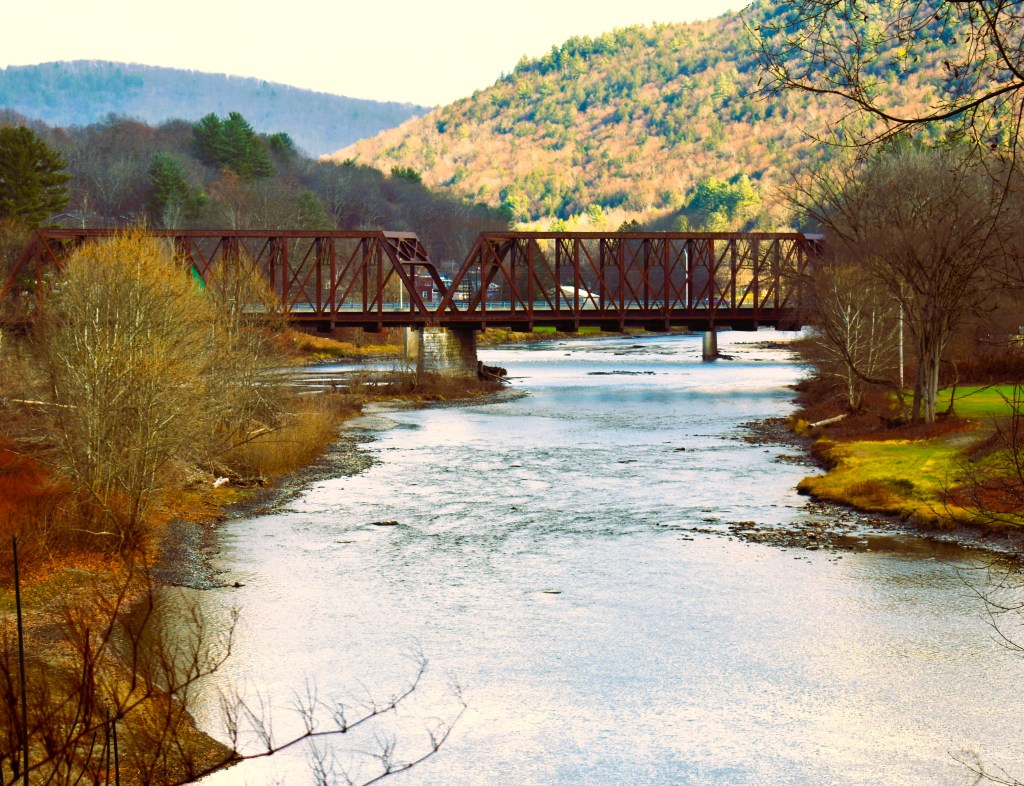
On To the Delaware

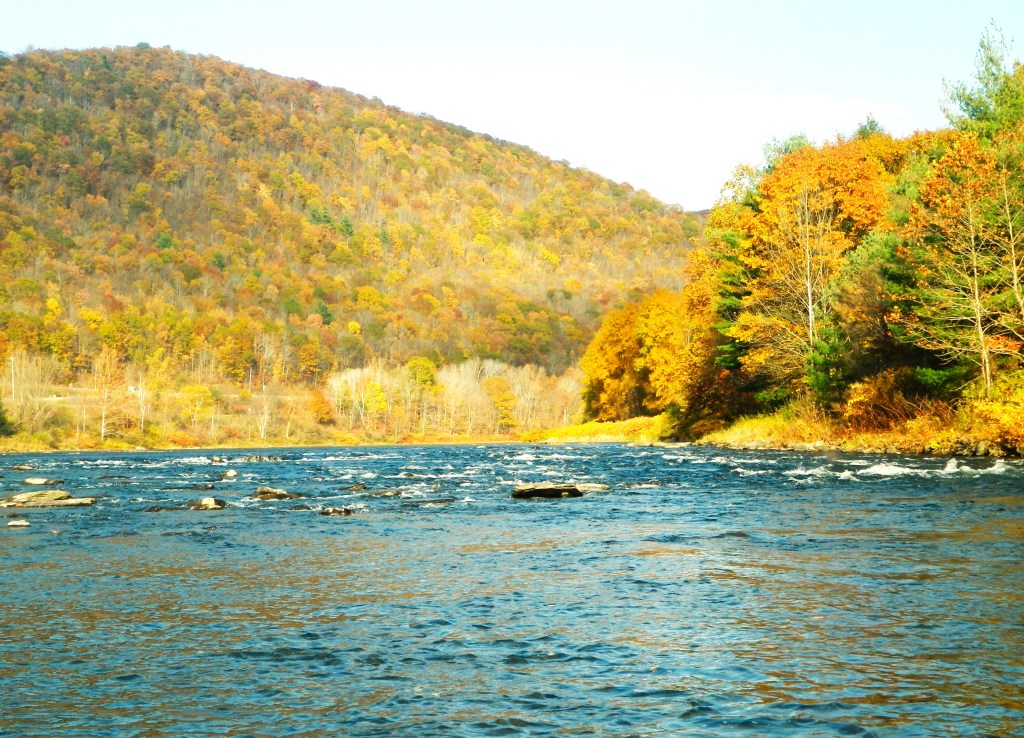
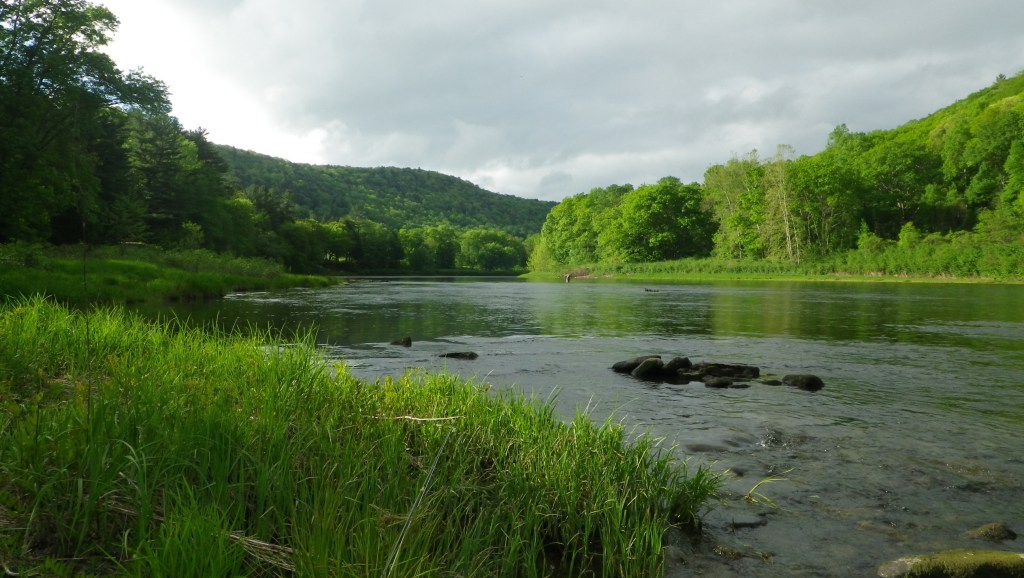
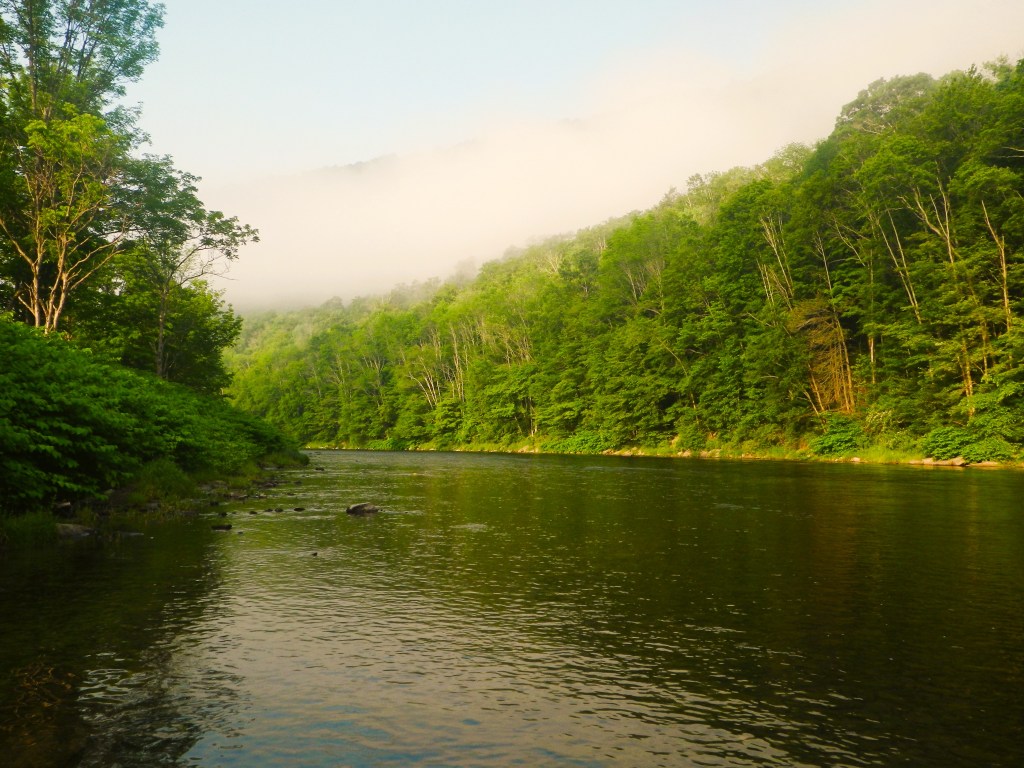
I seem always to be drawn back to the Delaware River come September. This year the water temperatures are cool with the weather moderating over the last half of August, and the flows low enough for very comfortable wading, yet sufficient to allow the trout to enjoy the great rivers’ variety of habitats.

After an easy, extended morning of tying flies, sneaking that fourteenth belated coat of Tru-Oil onto my second rod tip and catching up on some errands, I headed out early on a beautiful afternoon.

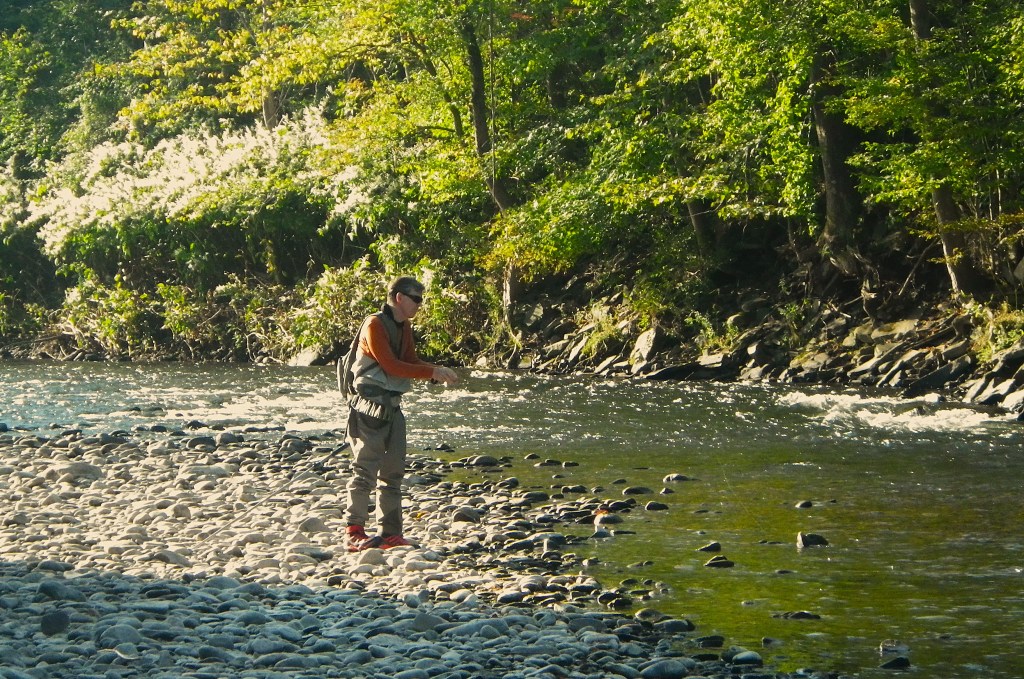
I found the Big D quiet with two anglers alone barely in sight downriver. I was looking forward to the afternoon, with that “winds, light and variable” forecast urging me on to wade out and take a closer look at a few bright specks drifting on the surface. Ah, baited! Those specks were not insects it seems, and no sooner did I arrive within reach of mid-river than the wind rose. It blew more than hard enough, and straight upstream, bringing a laugh. Indeed, the Red Gods got me again!

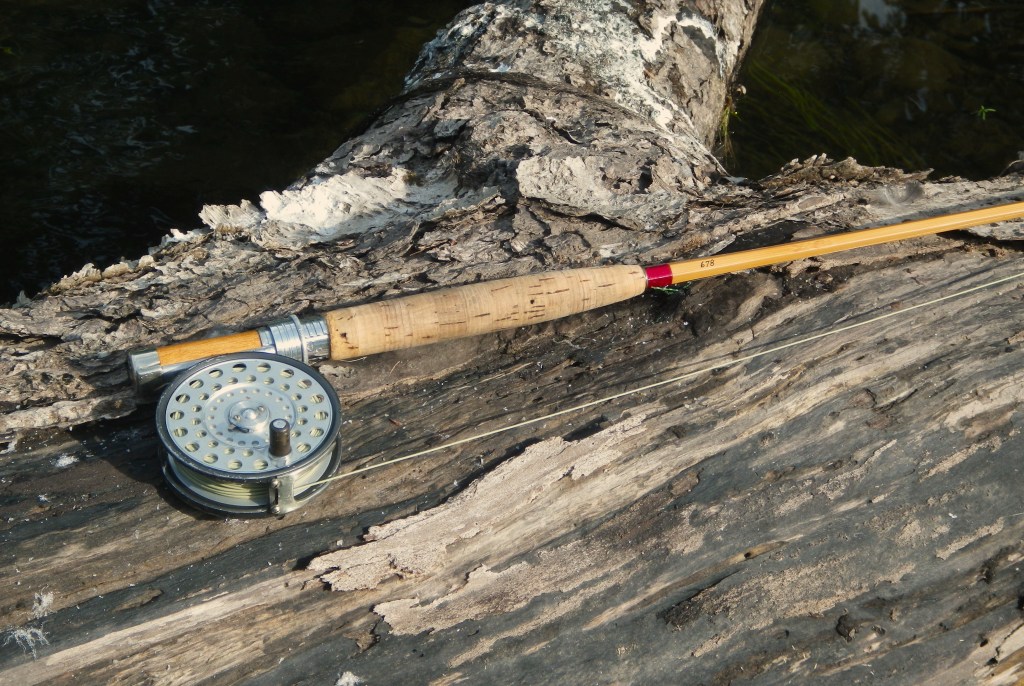
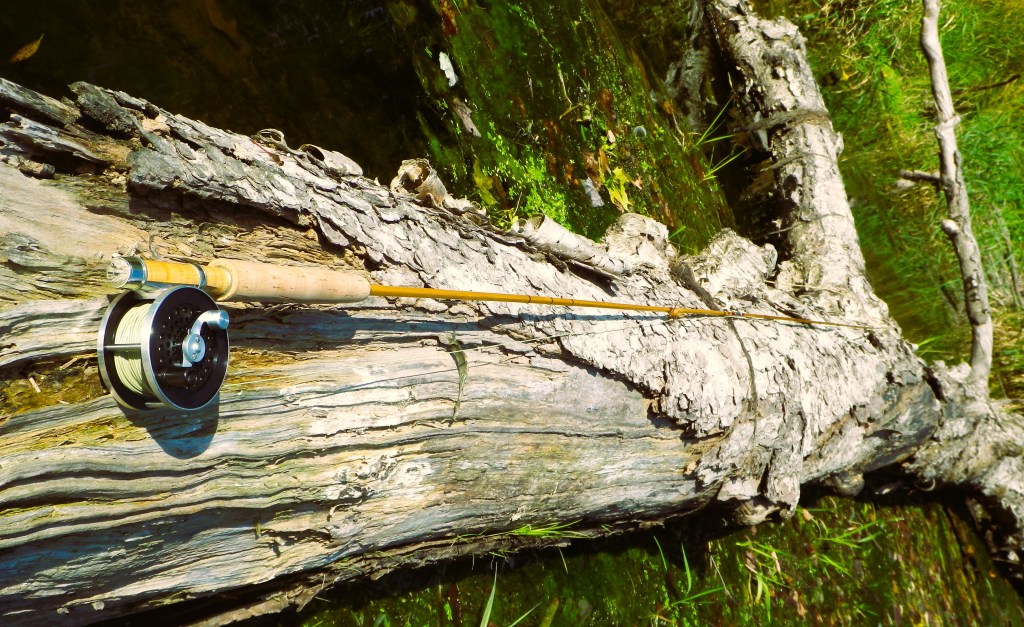
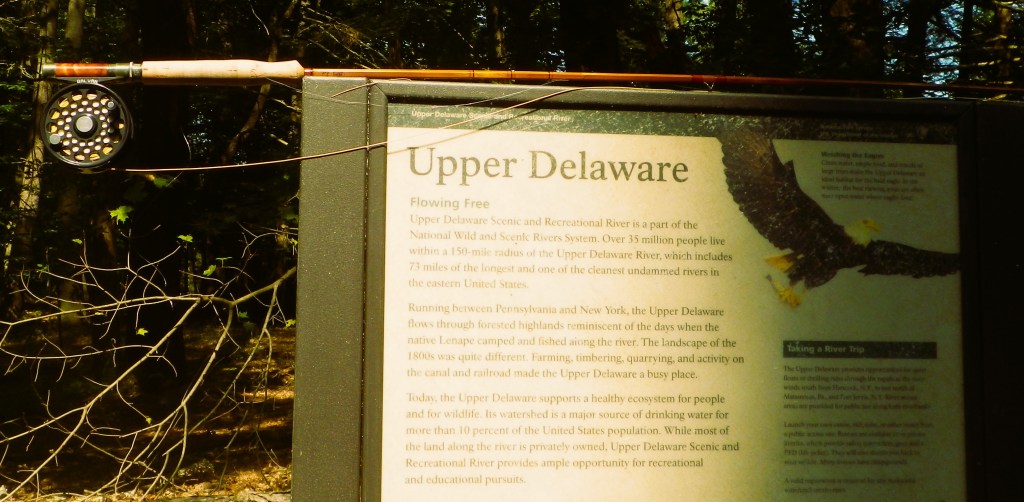
September on the Delaware brings out the big guns: my 8’6″ Tim Zietak Pent carries a lot of line to reach out for distant risers!

I waded in after a short recon of the rise-less and windswept river, with other realms in mind. A bend or two in the big river’s course can make all the difference when it comes to fishability. On the Delaware’s mainstem, a bend or two takes up a few miles, so wading is not the best way to find a quiet reach.

I noted just two cars when I donned my vest for the second time, meeting one of those fishermen on my walk in. “Shift change” I remarked as we passed and paused to talk. He was young, perhaps college age, and had been hard at it since morning he said. His efforts had been rewarded by a pair of rainbows, “on trico’s, this morning”, and I expressed surprise that he found enough of the tiny little spinners to bring a trout to the surface. He said the wind was still early and, though there weren’t many trikes, he found a couple of fish working once the spinners came down. I wished him well on his intended stop at the West Branch, and continued toward the river.

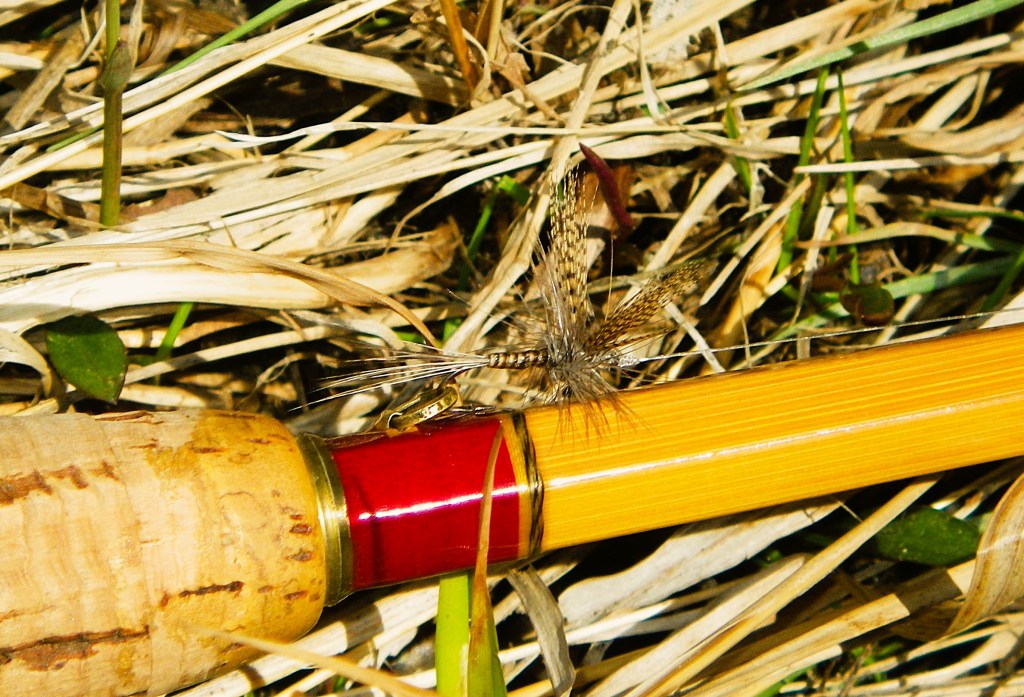
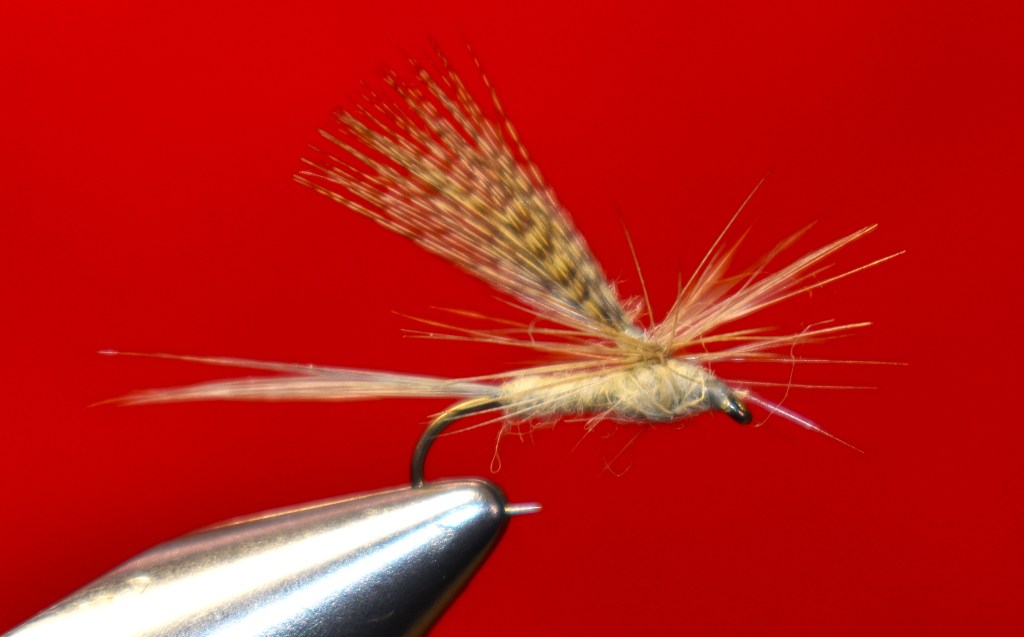
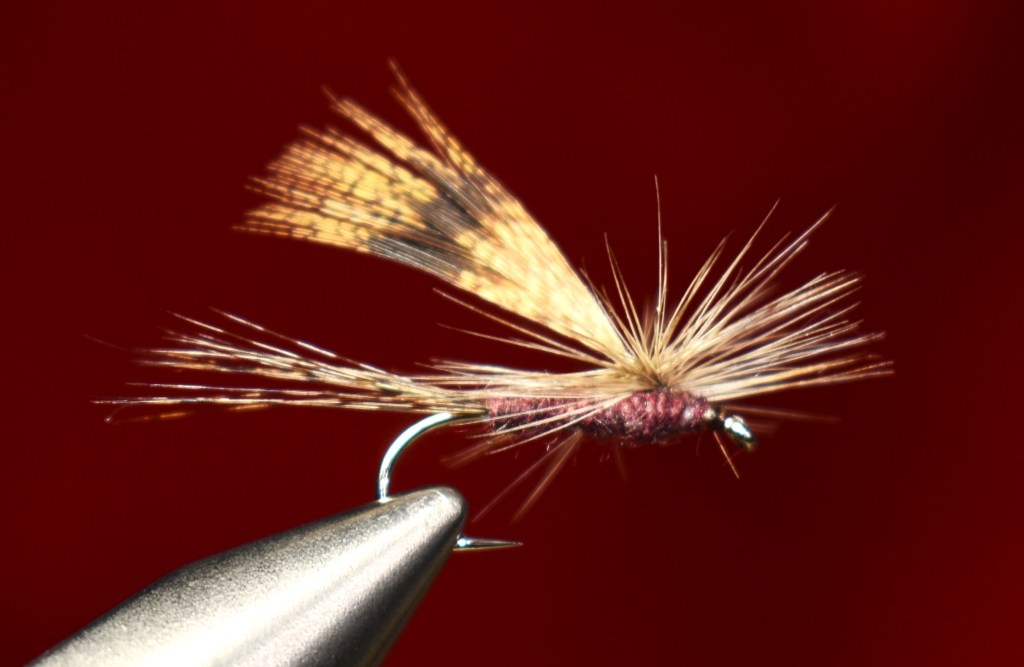
I plucked Mondays afternoon’s Translucence Isonychia from my fly patch and knotted it to four feet of fresh tippet, figuring that there just might be one or two around during the afternoon, and smiling at the memory of the Delaware rainbows’ fondness for them.

I took a good long walk along the riverbank, stopping along the way to search the surface for signs of life. The first one I saw was a rise too close as I waded in to very shallow water. I offered a few casts half-heartedly, expecting my entry had sent him on his way.

Killing time there, I watched for something to draw my fire. Downstream, in a little flat area between two threads of bouncier current, I finally spotted a single little white wink, the call sign of the Delaware bow.

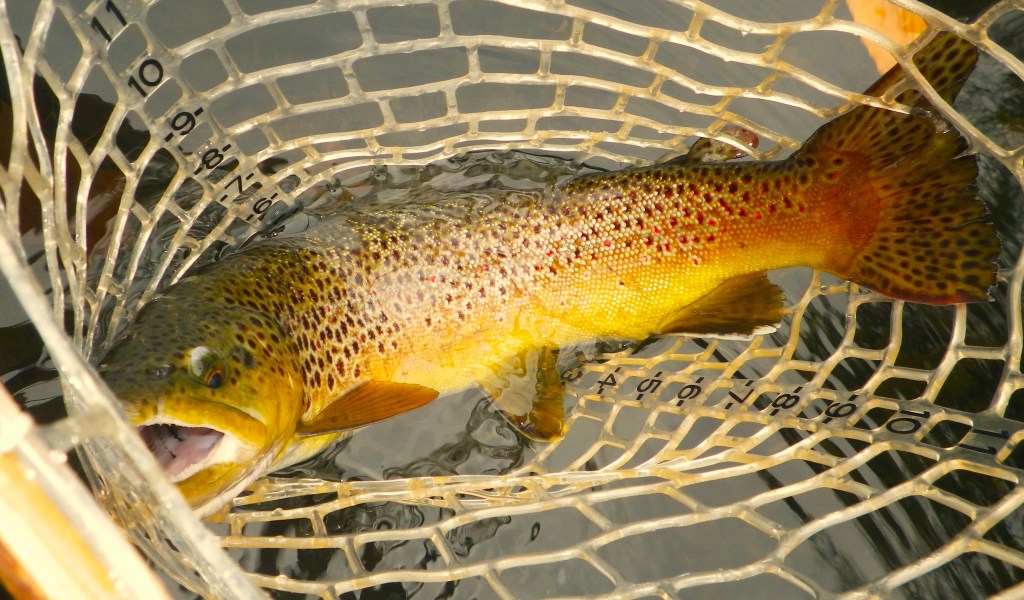
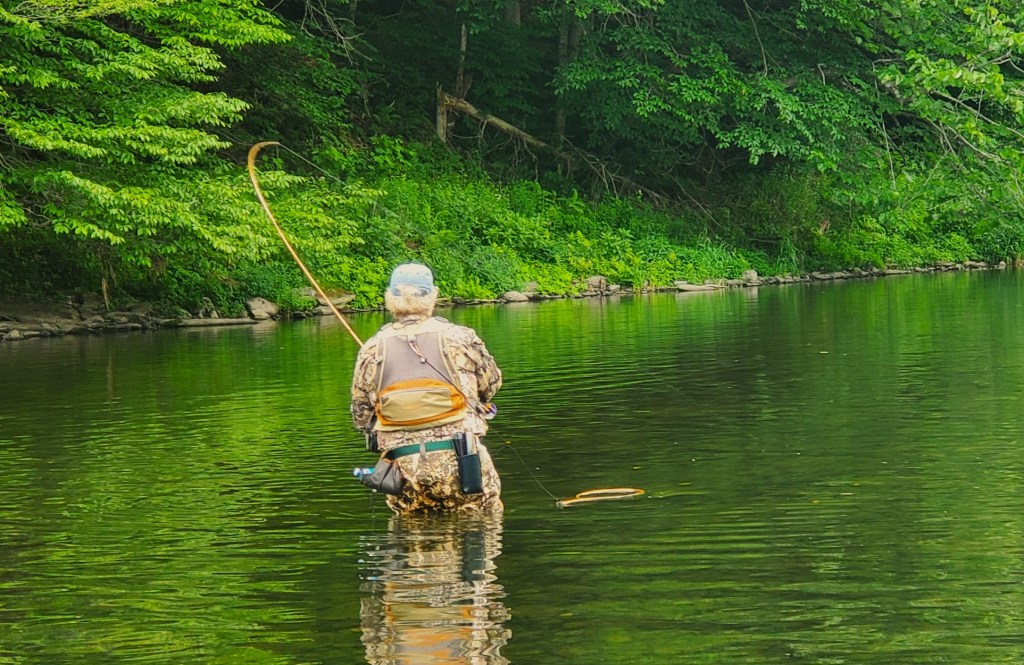
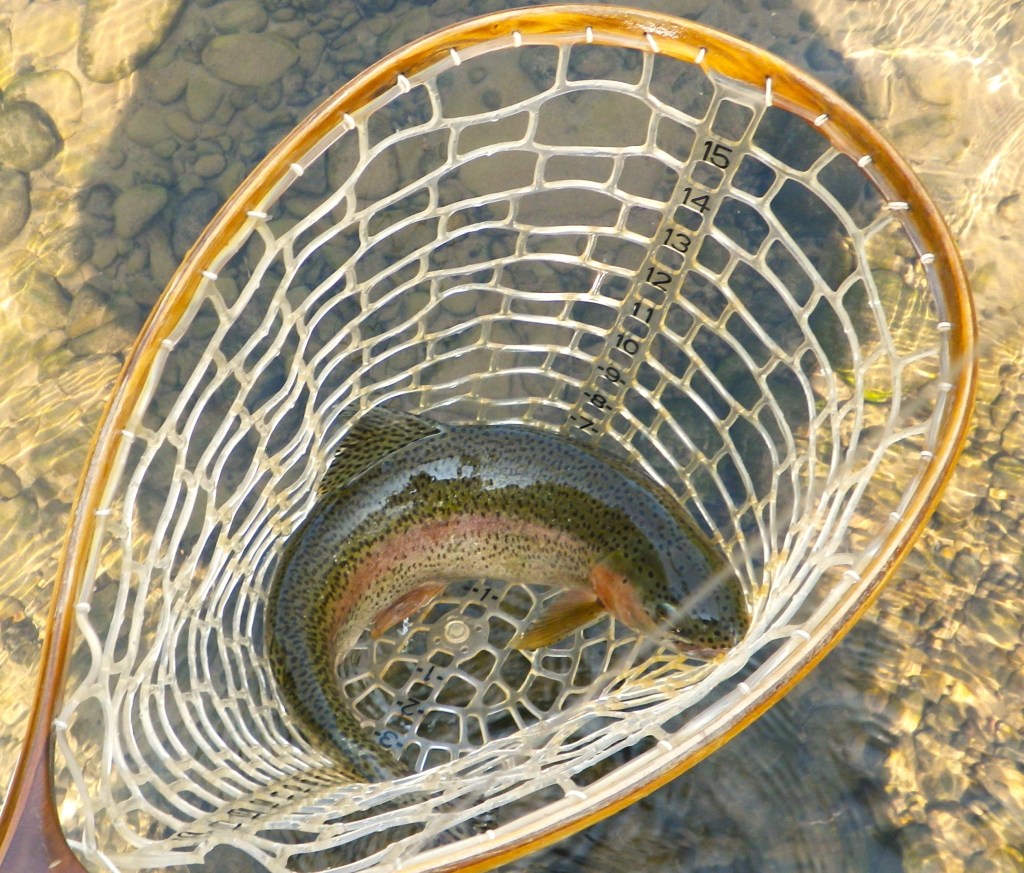
I took care in my approach with a target in sight, working out enough to clear the shoreline trees and bushes with a long back cast. Leaving myself a long, down and across stream shot, I pulled out line and let the big pent go to work. The canted wood duck wing of the 100-Year Dun was visible in the sunlight, and I mended and followed it down with the rod tip each time. I had a pretty good spot on the rise that had drawn me down there, but rainbows like to move around in this river, so I worked the area with successive drifts, working further with each pass. I didn’t get that little white wink, but the fly simply vanished in the middle of a perfect float, and the long shaft of flamed bamboo bowed heavily as I raised the rod to strike.

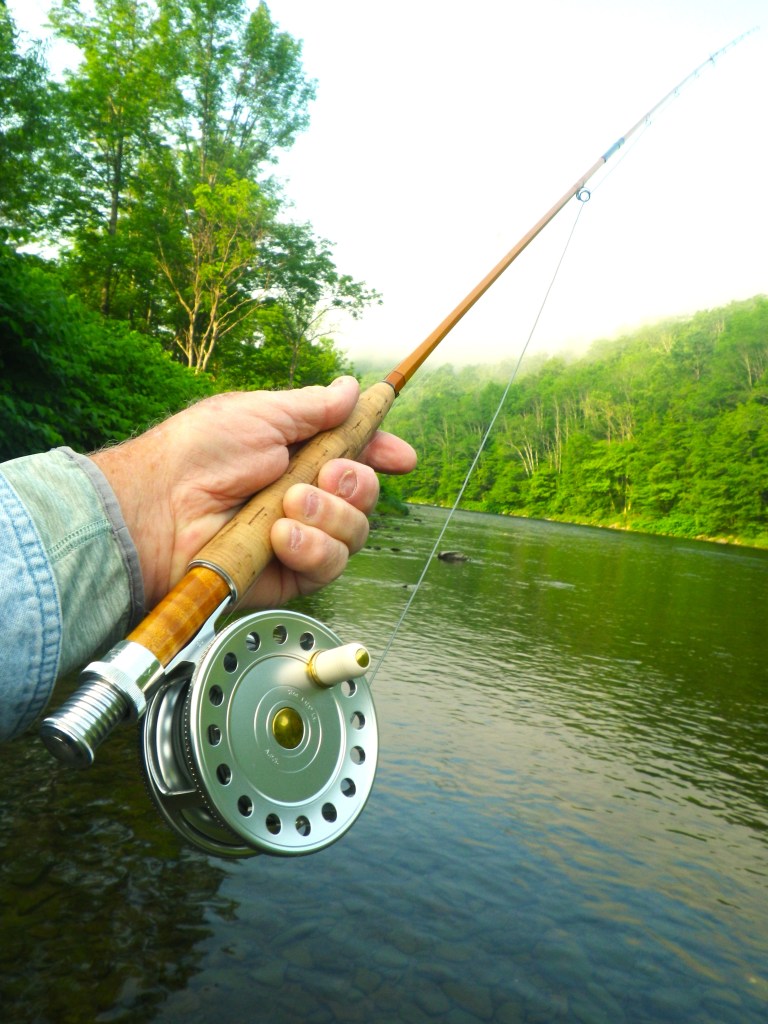
I had chosen a different line for the pent this time, one of my Airflo Tacticals mounted on a classic 1946 Hardy St. George. It proved to be the perfect choice. This was clearly a big rainbow, and he charged about wringing bright music out of that old English reel. Run after run after run, there was no quit in him.

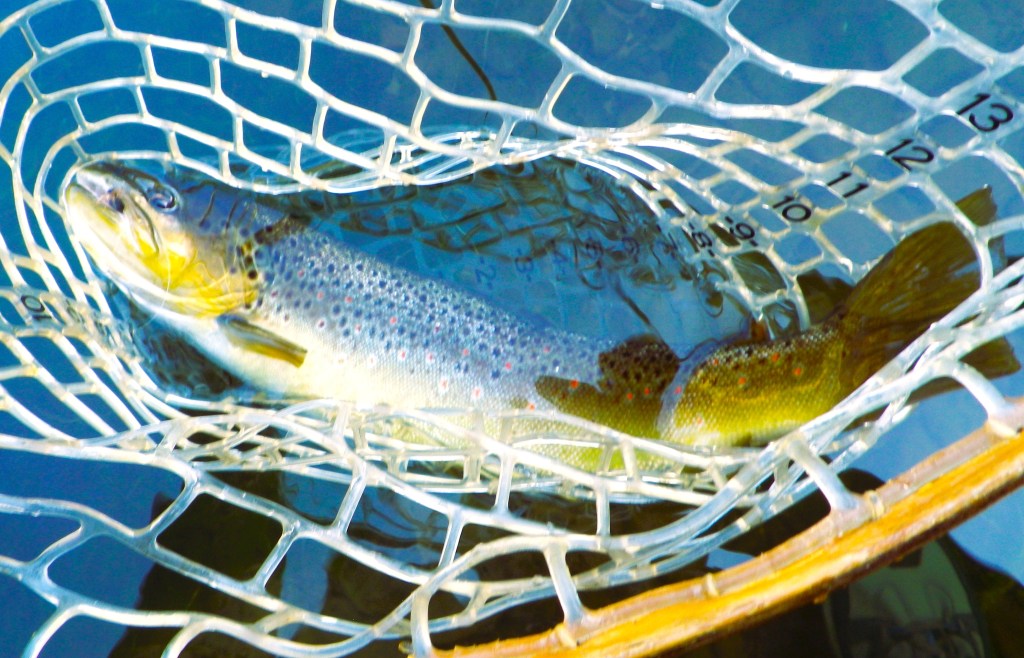
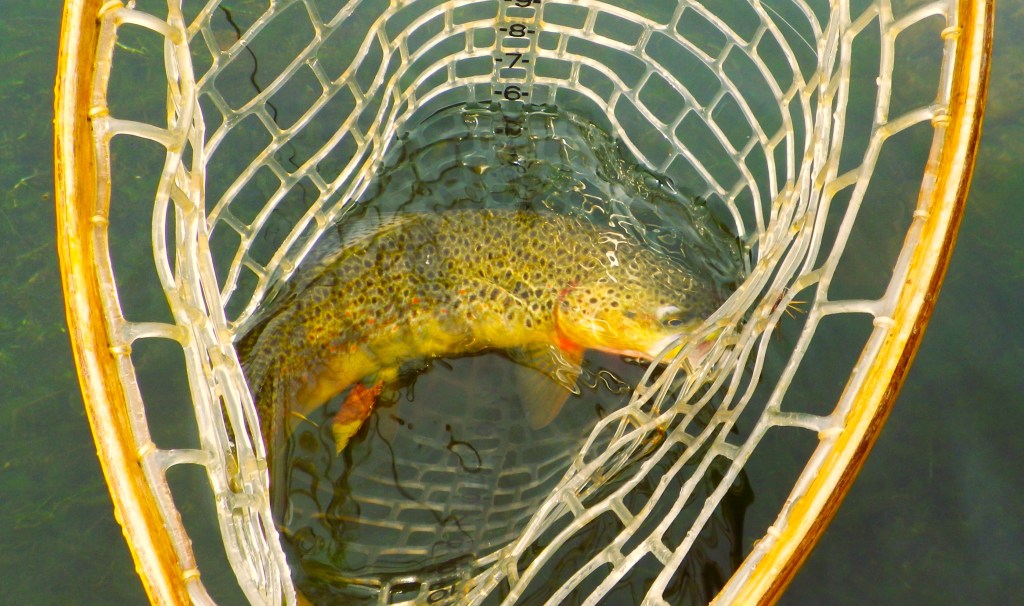
When I released him, I planned to hold him into the current a bit after such a long hard fight, but he shot away like he was ready for more!

Closing The Circle

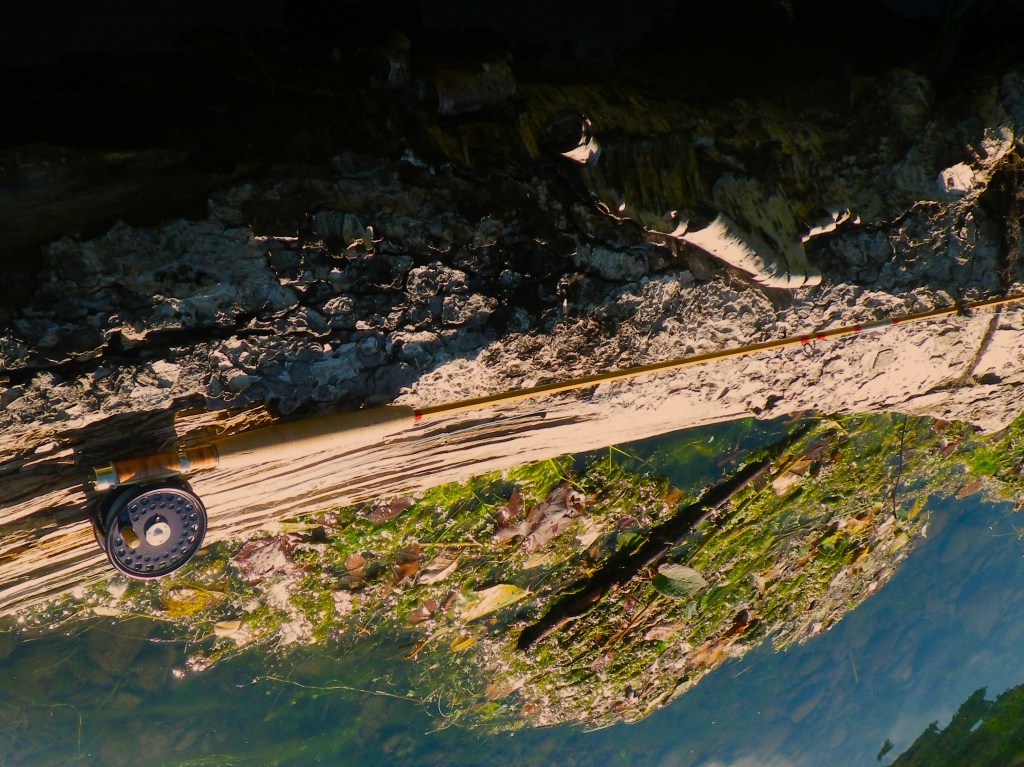
The Angler’s Rest Special bathed in morning light begins its first day upon bright water

It was Labor Day, and I do tend not to fish on Holidays and weekends, but after eight months of crafting a bamboo fly rod I could not wait to take it where it was meant to be. I enjoyed my solitude for most of the day, celebrating the craft I now have so much more personal an appreciation for.

The rod casts beautifully near and far, smoothly turning over fifteen feet of leader and my choice of dry fly. Indeed, combining a strong fast taper design with the milder properties of the Lo o bamboo has given me the ideal I imagined!

It was a gorgeous day, one to wade as slowly and cautiously as possible, as the river flows continue to drop. For several hours, there was little sign of activity, though I delighted in the casting, searching for a hidden ghost. Come afternoon though, I found early signs of trout stirring.

There seemed to be several, as their activity moved from simply finning near the surface to actually rising periodically. They seemed to cruise in one protected area. From distance, I could not make out what they might be taking, and there seemed nothing on the surface in mid-river. I had tied a pair of my Translucence Isonychia 100-Year Duns on Sunday afternoon, and I selected one to give these cruising trout a try.

Translucence Iso: The original silk blend was a darker claret shade, though I have since lightened it with hints of gray and tan

The cruisers frustrated me, showing no interest in the dun, and I deduced they must be after something just beneath. There was no sign of an emergence, though I spotted a very few duns at a distance which may have been the Isonychia I expected.

One trout finally took a station along the riverbank, and one cast was enough to take him! He fought the powerful arch of the bamboo with diligence and vigor, but the cane wins such battles. The first trout brought to hand with my Angler’s Rest Special posed reluctantly before release.

It was a moment to reflect on those long winter afternoons, planing the cane from quarter inch sawn and beveled strips to tapered rod sections measured in thousandths of an inch. I am supremely happy that I had the chance to make this rod, and that all the hours of effort have resulted in such pure joy!

Eight Months, Six Strips… A Catskill Odyssey

It seemed a workable task when the idea was first floated a year ago at the 30th Catskill Rodmakers Gathering: build a rod with this new Lo o bamboo.

I had just enjoyed my new friend Peer’s presentation on the properties and merits of this new material he has studied, and championed, and JA, my best friend in these Catskills, had mentioned some winter projects under his accepted role as steward of the Catskill Fly Fishing Center and Museum’s Catskill Rodmakers Workshop. The ability to build with the Lo o without the endless working with nodes, the weak spot within a culm of bamboo, seemed to mitigate the challenges of age, arthritis and carpal tunnel syndrome… ah the magic of late summer in the Catskills!

Dr. Peer Doering-Arges of Berlin, Germany casts his 7-foot Lo o bamboo rod into the skinny run feeding Ferdon’s Eddy

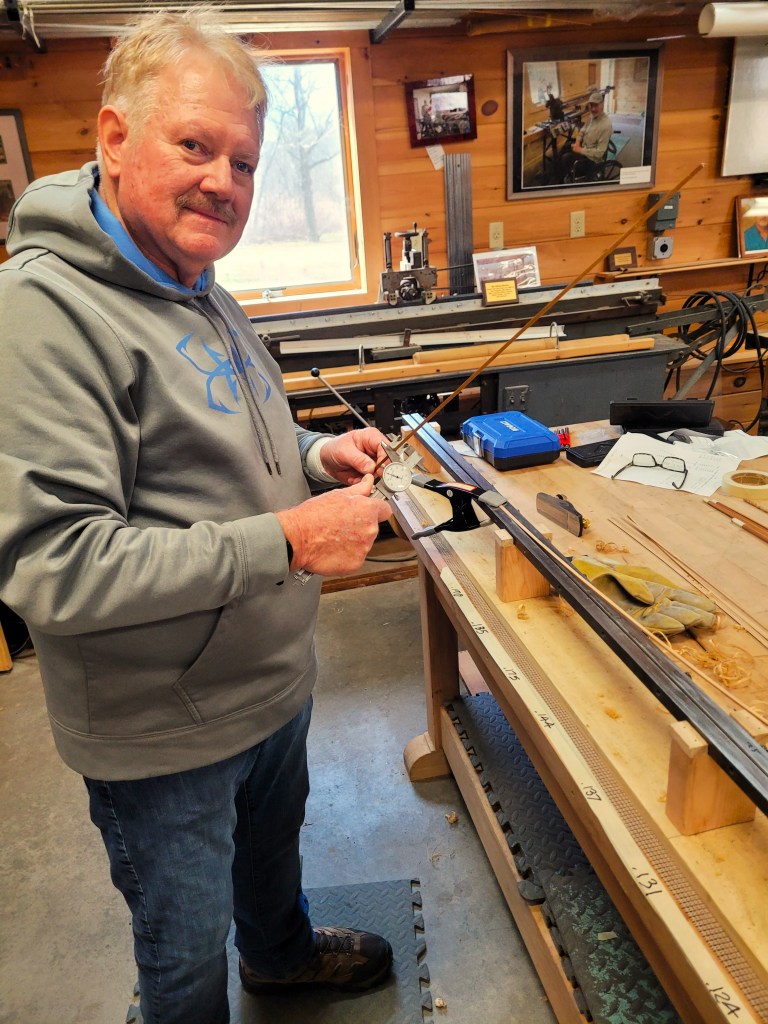
The internodes of Lo o were a gift from Dr. Doering-Arges, whose company I enjoyed fishing our drought ravaged Catskill rivers during his stay in Roscoe last September. JA and I had talked, and it was agreed that he would shepherd me through the processes of splitting, beveling, planing, glueing, binding, heat treating, sanding, ferruling and assembling my first hand-made bamboo fly rod. It all seemed quite perfect in the cool morning light of September.

Mother Nature had her way with our simple plans for working through a few winter weekends and producing my first bamboo rod in time for spring fishing. Snow and ice-covered roads made travel difficult, even as winter grudgingly transitioned into spring. Planing strips of bamboo from one-quarter inch triangles down to dimensions between 0.190″ and 0.035″ let me discover new pain centers in my aging hands and joints, and of course, a variety of trials and foibles reared their heads throughout the project. JA remained positive and encouraging throughout. My favorite classic fly reel is Hardy’s St. George, my friend and stalwart teacher should hereafter be known as St. John.

Begun on a snowy fourth of January, my rod lay complete save final hardening of the varnish on the twenty-eighth of August. I counted only the actual working shop time, not the travel back and forth, amassing some eighty hours of work over those eight months. On Friday, August 29th, I carried the rod, and half a dozen fly reels out into my yard at Crooked Eddy to realize what I, and the help and kindness of several good friends, had wrought.

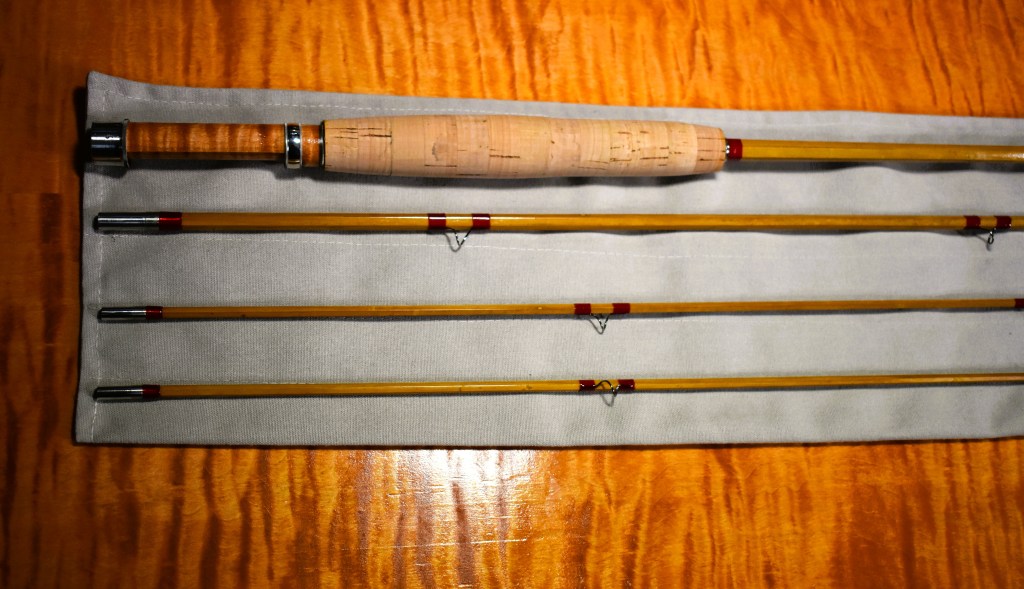
The Angler’s Rest Special: 7’9″ of blood, sweat, tears and Lo o bamboo.

I test cast my rod with double tapered lines made by 406 Fly Lines in Montana, a number four and a five. It liked them both. Two Wulff Bamboo Special fly lines came next, again a four and a five, then an Airflo Tactical Taper 5. The rod handled them all with a smooth, crisp action. The feel of these four familiar lines led me to the last trial, a Scientific Anglers Frequency Boost WF4F, a line made one-half size heavy, thus a four and a half weight line. While all the lines felt good, the half size line felt the best, and yesterday I visited the Dette fly shop and purchased another familiar line, a Cortland Finesse Trout II, a four-and-a-half weight forward with a longer 10-foot front taper that presents dry flies beautifully. That line has been spooled on a special St. George from Colorado’s South Creek Limited, and tomorrow the Angler’s Rest Special will meet bright water upon the rivers of my heart for the first time.

So many long-time friends have guided me as I considered and executed this project. Rodmakers Tom Smithwick and Tom Whittle, my Pennsylvania Two Toms, taught me to understand rod tapers and materials. The taper chosen was Tom Whittle’s 7’9″ three-piece five-weight, a crisp, powerful rod. Discussions with Peer and the Two Toms helped me to conceive how the new bamboo would modify the casting feel of the original taper. This new knowledge was broadened by an ambitious project undertaken by members of IBRA, the Italian Bamboo Rodmakers Association, to quantify the properties of traditional Tonkin cane (Arundinaria amabilis) and Lo o (Bambusa procera). Patient instruction and encouragement from John Apgar and Master Catskill Rodmaker Dennis Menscer lead me through the months of work, pain, setbacks and little triumphs.

Thanks and appreciation are due to the Catskill Fly Fishing Center & Museum for welcoming our group of winter rod crafters and allowing us to work surrounded by Catskill history. Should you consider taking this journey, sign up for a class with John at the Museum’s Catskill Rodmakers Workshop, and take a walk through history as we have!

With all that I learned, I believed that my rod would be crisp yet progressive in action and suited to either 4 or 5 lines, and that is exactly what I have. The time has come to fish, to cast a line on bright water and search for a fine wild trout to complete the circle…

First Light of Autumn

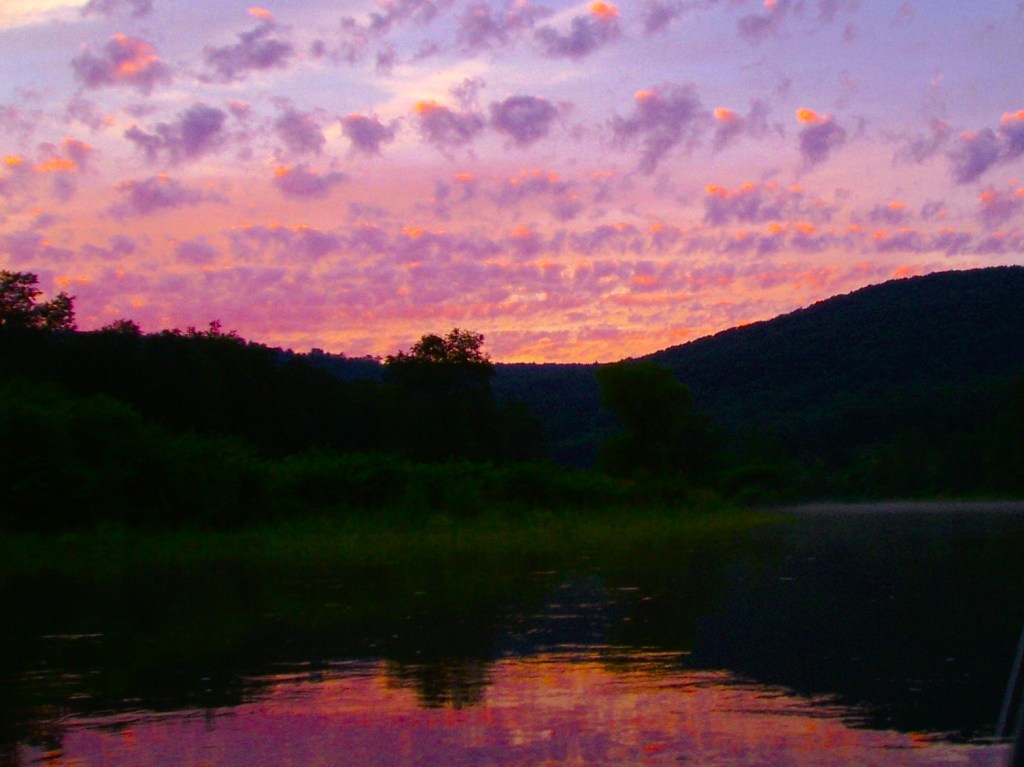
There have been hints of it this week, and then last evening I saw it clearly looking out my back window. Since boyhood I have noticed this change, this unique color to the light as afternoon nears evening, and it has always brought me pleasure.

There is no place to witness Nature’s spectrum like her waters, particularly her highland rivers where both that special light and mountain shadows play!

Nearly a month of summer remains, but I can feel the chill at daybreak. Trout have become even harder to find than they have been throughout the bulk of this difficult year. I saw a handful of flies the other day, larger mayflies which appeared grayish in the shadowy air… isonychia? Four or five of them lifted off from the soft, low water as I waded downstream to keep an appointment. No trout rose, though I know there must be a few along that reach… watching.

I had chosen a little rod to fish fine and far off, delighting in how handily seven feet of 50 year-old bamboo would send my fly 60 feet or more to my target. I had great fun with my fishing, amplified by the short rod, though it amplified mistakes in my timing as well! I rose two fine trout, touched neither one, as I tried to adjust my line handling and timing to the short rod.

Back in the Cumberland Valley, a seven-foot four weight was in my hand constantly, but fishing here upon the wide Catskill rivers I have become an eight-foot rod man. Does it make a difference? Why yes, more than you would think. That extra twelve inches moves a lot more slack line with a mend, or a hookset!

The cane rod I have spent the last eight months crafting is in between, at seven feet nine inches, a good length I think. A little more than seven-and-a-half. I have owned two rods of this length, though both have been traded – for eight-footers! This one will stay.

The seven-foot Orvis Superfine soaks up a little of autumn’s first light. My mentor, the great Ed Shenk, would approve!

Ed Shenk taught me to love short fly rods. He loved the challenge of fishing with rods from five to seven feet, his favorite a six-foot one-piece bamboo Thomas & Thomas dubbed The Gnat”. I have rods of 5’6″, 6′, 6’6″ and 7′, all of them up to the challenge of trophy trout, though seven feet is about as short as I will go on a larger river.

Today an eight-footer will get the call. I am leaning toward the three-weight, though there is some wind expected. They are saying five to ten m.p.h., but that’s what they said yesterday. Mother Nature doesn’t heed their predictions. A much cooler day with an afternoon sun to warm the air masses slowly might just bring some gusty shenanigans about the time a few of those gray mayflies could appear. Perhaps I will take the four…

Seasonal Remembrances

A beautiful but dry October along the East Branch Delaware, 2020

Thinking this morning about seasons and the gradual waning of another Catskill Summer. Just about a month remains until the autumnal equinox arrives on September 22nd. Long range forecasts seem to give us a 50-50 chance as far as September being either wetter or drier than normal with temperatures like to be a little on the warmer side. If the Red Gods gave me a vote, I would favor wetter and cooler for the benefit to our rivers and their wild trout.

During the decades when I haunted Pennsylvania’s Cumberland Valley, late summer was hopper time. On any given afternoon I could tie on a Letort Hopper and wander the meadow of my choice, with my chances of fishing success being pretty good. A warm wind blowing through the meadow raised my expectations!

I recall a shaded nook in the Quarry Meadow on my home water of Falling Spring. I had designed a new hopper pattern, one that I would later send with a friend to Montana for trials during his summer guiding season on the Ruby River, and I knew there was a good fish frequenting that little nook. The approach and casting were difficult as expected. Big limestone spring trout don’t just rise out in the middle of the stream after all. No, fish like that one had to be earned, and I was anxious to try my new hopper on him if I found him at home.

It was a hot, still afternoon, and I didn’t see a rise back up under that old boy’s hidey hole. Picture a collection of fallen tree limbs and rocks deep back under the shade of a leaning old willow, with drooping limbs that demanded a low cast to shoot the fly beneath and far up into the cover, a one cast situation.

I scanned the streambed before entering the water. Scaring an unseen 6″ trout on my approach would be enough to eliminate any chance at the fish I wanted. On the way, a little whisper of breeze passed through the willow, something dropped, and a soft rise appeared way back in there! I took my time and worked my way into position for my one shot. Taking a breath to calm my nerves, I worked out enough line with my 7-foot fly rod and shot that hopper up under the willow limbs and deep into the hot zone. One solid plop later I tightened and immediately laid the rod down close to the surface to extricate that brownie from the rocks and limbs before he knew what was coming.

He found himself out in the sunlight and proceeded to tear up the weed beds while I switched angles to fight him over clean gravel. On this day, the good guy won. That brown was close to 20 inches long when I laid him along the length of my net. I think my grin was at least that wide!

A summer morning on Falling Spring

Fishing early in the mornings and late in the evenings was typical during spring, summer and fall during the years I operated Falling Spring Outfitters. Winter was a morning fishing situation as darkness fell before I closed the shop at six each evening. On the edges of darkness, crickets were active, and a Letort Cricket often found itself tied to my leader. One summer evening stands out in memory.

I was working up through an upper meadow, carrying the 6’6″ three-weight rod I had built at Ed Shenk’s urging. A size 16 Letort Cricket was knotted to my 5X tippet. Late in the summer, the water weeds were everywhere, often so thick it was hard to tell the meadow from the stream along the edges trout loved to haunt. The weeds lined the channel except for one place where there was a small pocket of open water about the size of a dinner plate. I spotted a soft rise in that pocket in the twilight and sent my cricket in to do battle. When the soft rise came, I tightened, and the tiny rod doubled over as the water erupted!

I don’t know how I managed it, waist deep in the center of the channel, but I switched the fully loaded rod back and forth rapidly as the brown charged from one bank of weeds to the other, keeping him more or less in the open water of the channel. If you can imagine that channel being no more than ten feet wide and boiling like a cauldron with the trout’s frantic battling, you get the picture. The brown I finally brought to net was touching two feet long!

Falling Spring Branch at the last stone arch bridge at the head of the Greenway Meadow, a lovely, intimate spring creek.

Twenty-five years along those limestone springs taught me to be a hunter and stalker of trout, and summertime was the perfect time for the game. It is no wonder that I still love stalking the mists of early morning!

A scarred, wily old veteran of summer wars!

Where has summer gone?

West Branch Delaware River on a July evening.

Taking a breath yesterday along the river, I realized that the fourth week, the last full week of August is upon us. I could swear it was just a few days ago I thought about August first coming up, remembering a particularly wonderful day when I walked up a pod of large brown trout I had all to myself. The season flows along as the rivers, and such moments do not wait for anglers.

I am about to begin the last sanding of three sections of my bamboo fly rod. These have received twelve coats of Tru-Oil, with two more to go, and then their finishing will be complete. My second tip is lagging behind. Finish application began later as there was a little sweep to be straightened under heat before I began to work the oil into the bamboo. That same finish is being applied to the curly maple reel seat spacer. Next week I will be wrapping silk to mount the snake guides, then varnishing those wraps, again finishing in multiple coats. Diligence, and a little luck, should see the rod completed just in time for the Catskill Gathering.

It was snowy January when this rod project began, the culmination of more than a decade fishing bamboo, reaching back to the beginnings of dry fly angling in America. My original hope was to complete the rod in time for spring fishing, underestimating the time that would be required to learn enough about this craft I have flirted with, and planning for more winter hours to spend in the Catskill Rodmakers Workshop during the first three and a half months of the year.

Of course, fishing has taken up some of my time. I have logged seventy-four days upon the rivers of my heart, fewer than expected five months into the dry fly season. Many days lost to heavy rains and high water this season, particularly during what is taken for granted as the highlight of spring.

I spent some pleasant hours this week, early mornings busying myself with rod work before sunrise, then haunting the rivers in search of the all too hard to find hunters in the mist. With the bright waters so very low and clear, I reached for that special three-weight bamboo rod I cajoled Dennis Menscer into making for me. Two very fine and difficult wild browns succumbed to it’s delicate solicitations, gorgeous trout of twenty-three and twenty-four inches. Their memories may have to last me through this coming week, if I am to complete my rod on time…

Three for Two

Dennis Menscer’s incomparable Hollowbuilt 803 rests by the cool waters after winning the day

It has been refreshing these past two mornings, with temperatures in the fifties and that first breath of autumn’s preview. The rivers continue to drop, and I write this morning wishing the overnight rainfall we were promised had given them a freshening as these two mornings have given me. Maybe today the promise will be fulfilled…

There is a special rod that was conceived for extreme low water conditions such as this, a rod I asked simply to do the impossible. My idea was an eight-foot three weight, a taper to fish fine and far off with my battery of summer flies with the greatest delicacy, a rod that could handle trophy fish without risk to the fairy light tips such delicacy of presentation requires. Who else but the Catskills’ master rodmaker Dennis Menscer could accomplish this feat?

When Dennis presented me with the finished rod last February I was shaking, and not from the cold wind whipping snowflakes from the skies. The anticipation built all through spring until summer and it’s most demanding fishing conditions arrived. The rod passed the test last summer, bringing browns of twenty and twenty-one inches to hand and I was ecstatic with it’s combination of grace and power.

Yesterday presented greater challenges. A cool breeze came intermittently, with gusts to challenge so light a rod. The Red Gods played their games, and I missed two good fish as I tensed watching wind shortened drifts. The sun finally made a full appearance as midday approached, and the water grew quiet.

Fresh from it’s maker – pure magic!

A week ago, I had watched a few scattered rises, unable to find any trace of insect life on the surface. I glimpsed a brace of small mayflies flying above the river, too distant to even hope to identify. Later, at my tying bench, I considered the writings of the late Ed Van Put and his steadfast reliance upon the Adams dry fly any time he found trout rising over a miraculous angling career. I tied half a dozen of my poster style Adams dries, visible to my aging eyes at distance with the reflective properties of their pale gray Antron wing post. Standing in the river wishing for even one small rise in the diminished flow, I thought of Van Put and his Adams, and tied my little poster to my tippet. It seems Ed sent me a little of his Adams magic.

Cast near the bank I had been fishing without response, the tiny fly drifted perhaps a foot before the head of a large trout splashed up and devoured it! I was caught off guard, frantically wrangling loose line as the light rod assumed a deep, throbbing bend.

Oh, it was a wonderful show, that great brown running hard and pushing a bow wake in the shallow water once I turned him away from the deeper cover. Dennis’ perfect taper worked him hard yet protected the fine tips of the bamboo while the St. George regaled with it’s chorus!

So how does a three-weight bamboo fly rod handle two feet of wild Catskill brown trout? Perfectly if it’s Menscer’s masterpiece!

Downsizing?

August has been hard to figure out. For a terrestrial fisherman like myself, high summer is the time for Nature’s trout food to get bigger. Trouble is the water is shrinking and I have been sitting here at my bench this morning tying shrunken patterns.

Usually, I am fishing the larger versions of my stable of summer flies, with the exception of flying ants, but their productivity has trailed off. The trout tend to range at this time of year as water temperatures rise and flows decrease. That seems to be amplified due to the general lack of summer hatches. I have seen very few of the once prolific summer sulfurs, none of the little pale olives, and no tiny spinners. Common sense says the trout should be eager for a substantial meal, yet here I am tying miniaturized versions of my summer killers.

Rod work has gotten in the way of my fishing too, as I race to finish my bamboo flyrod project in time for the 31st Catskill Gathering just after Labor Day. Divided intentions don’t lead to the perfections of either quest.

Better weather is coming they say, with a week of true Catskill Summer weather ahead. Those kinds of days are conducive to longer angling outings, giving me a break from the heat as well as the trout. Sadly, there looks to be just a trace of rain in the ten-day forecast.

August: Of Fawn Attacks & Rodmaking

Hard to imagine it, but we have passed mid-August already. Despite a glorious beginning, the days turned hot, and rain came barely at all. As river flow declined, so too the fishing.

One event certainly commanded my attention. It was morning, crisp and cool, though not as early as I would have liked, as I stalked upriver in another hopeful search for a hunter. There was a sudden rustling in the brush, followed by gentle rippling of the water behind me, and I turned to see a young fawn in the shallows. Without warning, the little deer began bounding through the river straight toward me, veering just in time to pass me by four or five feet, running straight through the loops of fly line trailing in the water. Amazingly, the fawn avoided tangling it’s legs in the line and bounded quickly straight across to the far bank, vanishing amid the foliage of the forest’s edge. I didn’t check my watch for my heart rate… I didn’t need to!

The month has become zero hour for my rodmaking venture. Thanks to the vagaries of Mother Nature, the tasks spilled from winter through flooded spring and on into summer, and now the Catskill Gathering is just three weeks away!

Rod sections bask in the morning sunlight on Canazon’s Bench, Catskill Fly Fishing Center & Museum

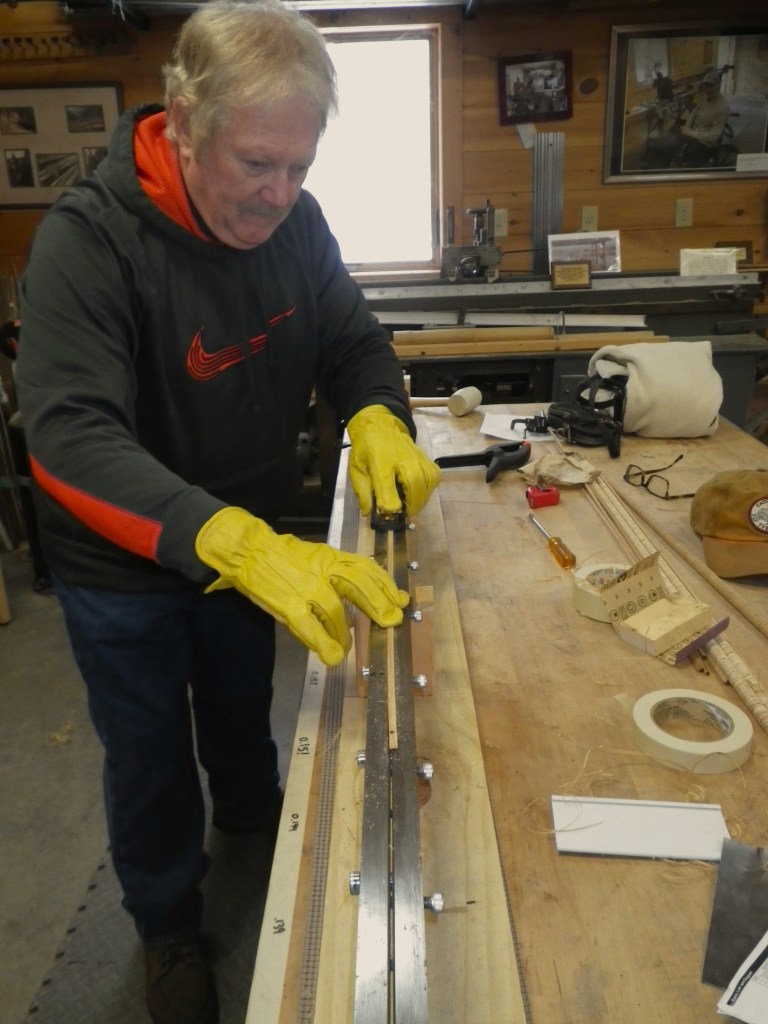
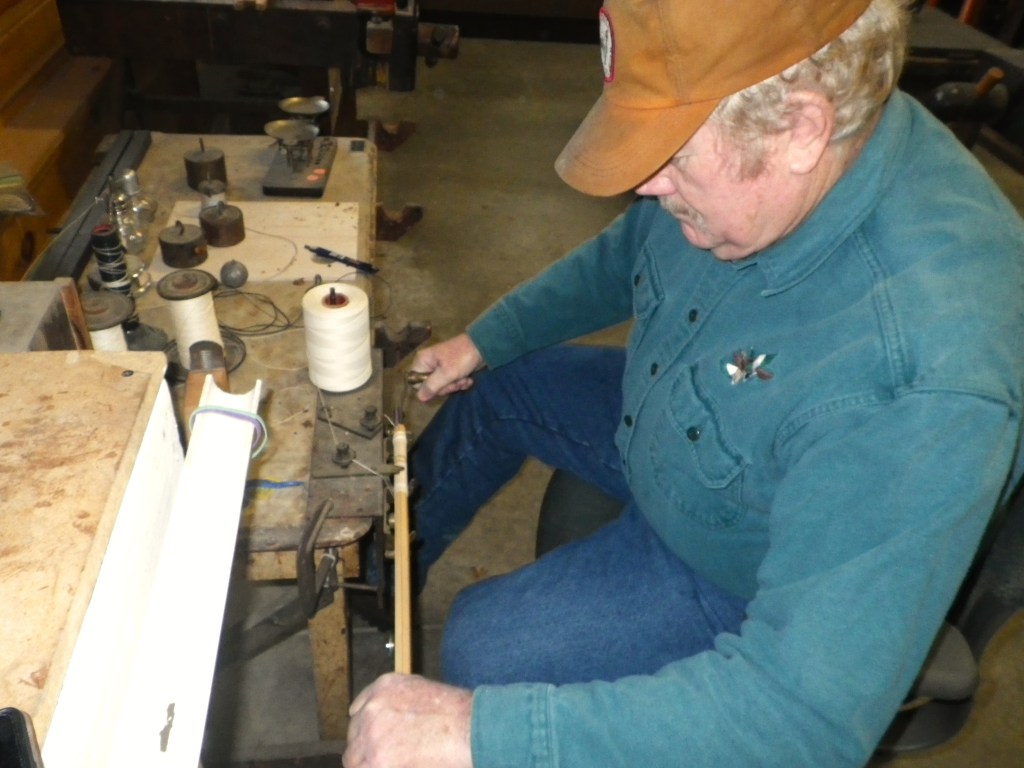
Last Saturday JA and I attacked the project anew, mounting ferrules and tiptops, after checking dimensions and cutting the four rod sections to their final lengths. I wrapped the epoxied ferrules with dental floss and headed home, with finishing to begin on Sunday morning.

The hand rubbed application of Tru-Oil gun stock finish produces a very nice rod finish and is more achievable for those of us who lack the proper work area for varnishing. A few days’ time is required, as JA recommends some fourteen coats. I realized when removing the dental floss on Sunday that we had both forgotten the straightening needed on one rod tip, so the finishing process began for three rod sections instead of four.

The first coat was applied Monday at five o’clock, then the second through the sixth coats working early mornings and evenings. Sanding was accomplished yesterday at the Catskill Rodmakers Workshop. I had stained the curly maple reel seat spacer to bring out the beauty of my favorite wood’s figuring, so the work began yesterday with epoxying the spacer onto the butt. Once cured, the preparation and basic construction of the custom cork grip proceeded with individual cork rings being selected and filed to enlarge the bored holes, fitting each to the tapered rod butt. Fitted and glued, the rings are fitted to the clamp and tightened.

A mess of glue! The excess is repeatedly wiped away and the clamp tightened until no gaps remain between rings.

This Saturday morning, I began the second phase of finishing (the first on that laggard, just straightened tip) which will include two coats with a light sanding between.

JA is featured fly tyer at the Museum today, so I’ll visit and give him some good old-fashioned encouragement by kibitzing and arguing that his beautifully tied Thunder Creek Streamers won’t float worth a damn. If you are in the region today, stop by and watch a master at work! I have seen JA tie these flies before and his work is not to be missed.

JA ponders the feather & fur solution to a sparse evening rise.

Hard At It

George Maurer’s “Queen of the Waters” taking a short break riverside.

Long hours and distance have been the main ingredients of my summer fishing. It is wholly a down year, with little in the way of summer hatches, the predictable low water conditions, and very few fish showing any evidence of their presence. I shared the water with an eagle yesterday, and even he looked a bit worn from extra hours of hunting. It was a week for fishing out of the way lies and changing tactics.

The trout should be hungry, but I believe many are ranging wider than normal due to the scarcity of flies. I think back to the morning I watched a little water snake get devoured in a terrific boil. Haven’t seen that before, not in more than three decades of wandering trout waters. Low water makes the approach all the more difficult, and casting distance and delicacy paramount.

It’s easy to get sloppy during a long, hot day, powering the rod too much for the distance so that the presentation suffers. I tend to do it when I get tired. Bamboo makes it somewhat easier to self-correct, but it still takes concentration to diagnose one’s failings and correct them. In tough conditions, you may get only one chance, and it is painful to blow that opportunity with a poor cast.

I went down to a three-weight outfit yesterday, a T&T graphite rod graced with a lovely little Hardy reel, and coached myself to ease up on the power. Faster, stiffer graphite rods tend to make casters punch them, and that really isn’t the answer to more distance.

I chose the three-weight to suit the conditions, and once I forced myself to maintain a light touch, I found what I was looking for – a chance to spin that little Hardy and make some of that special English chamber music!

Yesterday was sort of a training session for Dennis Menscer’s 8′ three-weight masterpiece to come on deck next week. There is no appreciable rain in our ten-day forecast, and the coolest day in that run is advertising a high temperature of 83. Fishing is not going to get easier.

A special rod with a special line on one of my favorite older St. George reels will come into its own during the week ahead.
When I get tired, I can take a break and look at it in the sunlight!

An old acquaintance could make an appearance as a backup too. Back in the day, Orvis was the last holdout to move to manufacturing fly rods with stiffer, faster actions and higher modulus material. The debuted their “PM-10″ rods in lighter line weights when I owned my fly shop, including an 8′-4” two weight that I eventually had to own. If the wind blows a bit hard for bamboo, that 842 might be reintroduced to the Catskills.

That thirty-year old 2 weight isn’t afraid of big fish, having bested this massive Big Spring rainbow