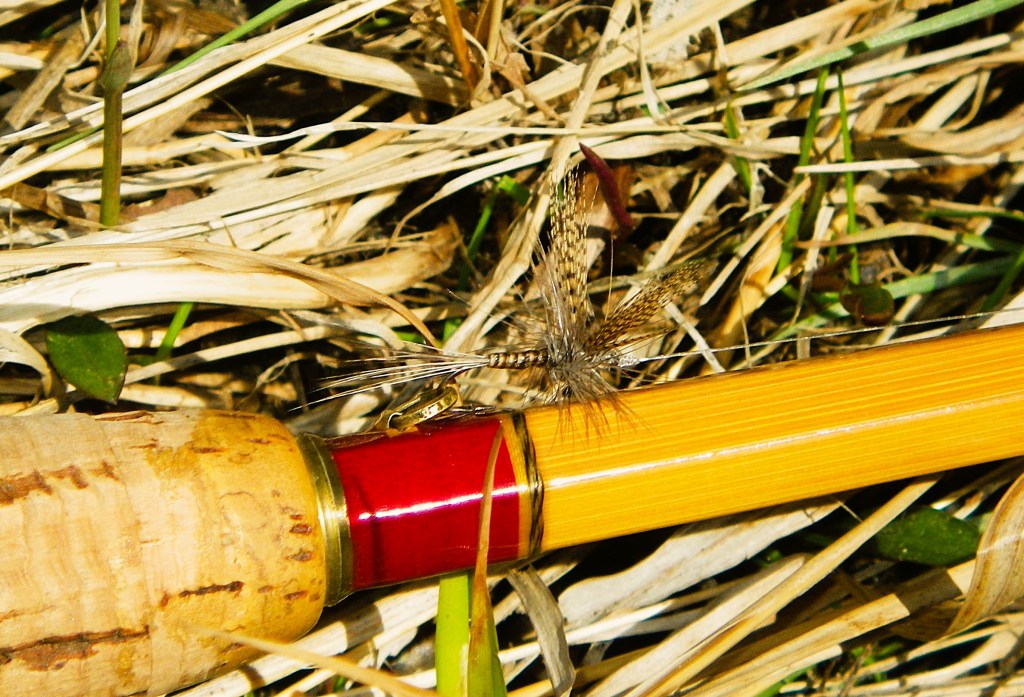
Having received the official invitation to the 76th dinner banquet of the Fly Fishers Club of Harrisburg, I settled down to tie them a dozen of my favorite 100-Year Duns as a small donation to the cause. My winter tying has been significantly reduced this year, tying flies here and there throughout these long weeks in twos and threes, so a full dozen at one sitting proved to be a little challenge for my concentration.
I started with the quill bodies of the Gordon patterns, tailing and then the quill before coating the bodies with a full coat of Hard As Hull polymer. That achieves a glossy overcoat and protection for the delicate peacock eye quills, but it is necessary to set them aside to allow hardening. I moved on to the Hendricksons, then the March Browns before scaling down for the Sulfurs. The finale included wings and hackles for the Gordon Quills.
I’ll miss the chance to attend again this year, the half a day drive and overnight stay being more than I care to undertake with the dry fly season on my doorstep. I’ll miss seeing some old friends whom I suspect still attend each year, and hearing tales of the state of fishing down in the Cumberland Valley.
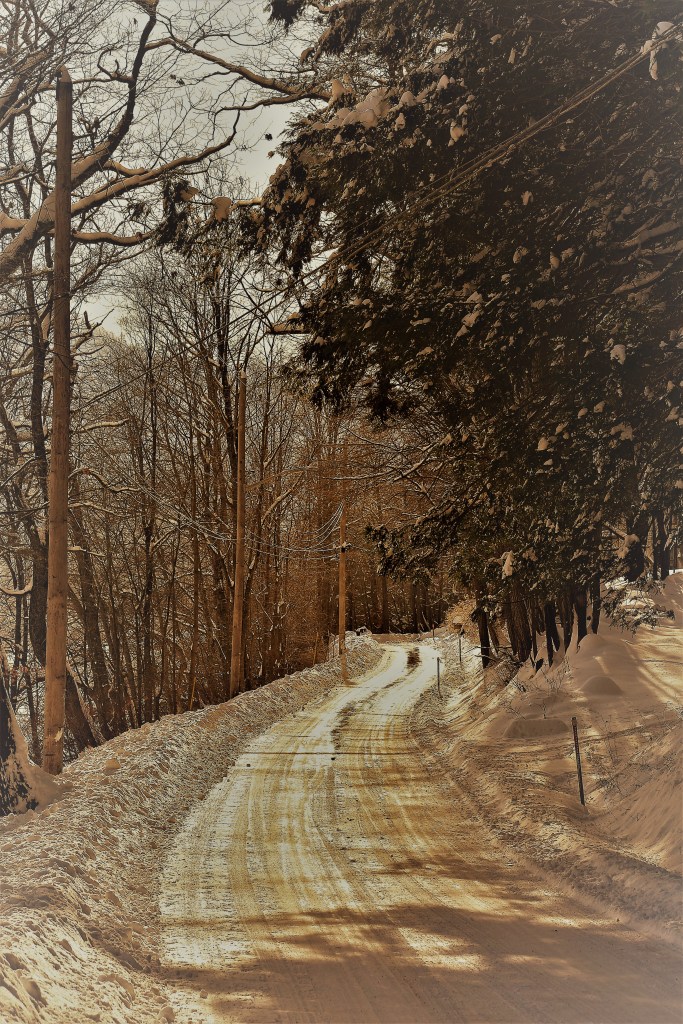
I hope the flies go to a dry fly fisherman of course, for I like to think they will bring a smile and some curiosity, along with a good share of luck when cast upon the waters of the winner’s choice. So may you take some fine wild trout wherever you fare with these duns tied here in Crooked Eddy, on a snowy Catskill afternoon!
My salutations to the Fly Fishers Club, with many fond memories of my decades there in the valley and the good times enjoyed at so many annual gatherings!
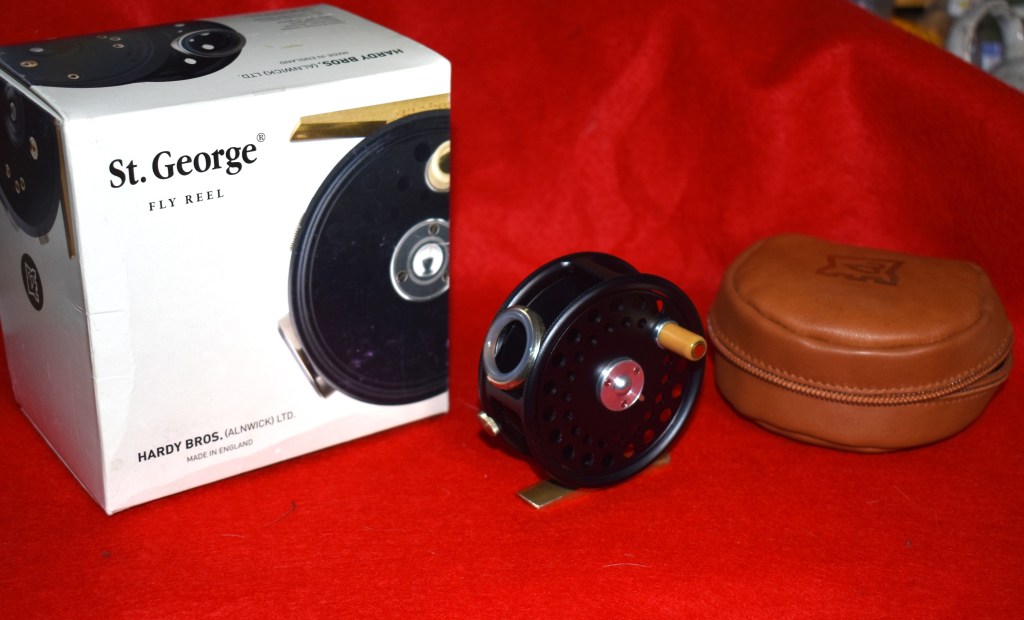
Just a drop of oil upon the spindle and the pawl, and this sleek St. George is ready for the rod I’m working to have ready this season. She’s never held a line nor reeled in a trout of any size, waiting patiently in her soft leather case and box, as more than twenty years have passed since the gents in Alnwick tucked her in and sent her off across the Atlantic. Such thoughts come freely with that little drop of oil.
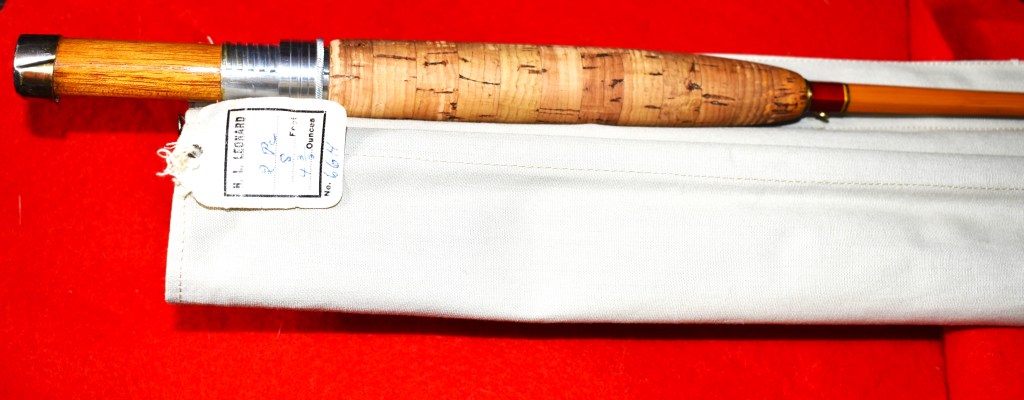
Now the Leonard rests in my hands and I can feel the surge of last May’s six pound brown pulling toward sanctuary in a fallen tree! It’s well more than sixty years since they slipped her into her shiny new tube in Central Valley, but she’s still proving to be up for every challenge. Ah, the memories that must lie within that slender shaft of cane! I know she’s already made some special ones for me.
It’s warm here in my tackle den, and there’s bright sunshine beyond the window, making it easy to sit back and dream. I know that its below freezing outside, but I cannot see the snow and ice from the high window above my tying bench, only that sunlight and blue sky!
My seventh season lies ahead, it’s number well associated with good luck, and that gives hope when the winter winds rattle the siding, and the ancient furnace fails to outperform Jack Frost. My thoughts wander through the hatches in my idle quandaries. Will it be a good year for Gordon’s Quills? I’ve tied so many in various styles. Perchance river levels will be perfect when the time of the Hendricksons arrives, their currents just better than fifty degrees on the cooler days so the hatches do not stutter, but spring forth and drive both trout and anglers to the heights of ecstasy!
There’s snow up high this year, to fill the reservoirs and melt slowly to recharge the aquifers and springs that begin the chain of bright water that envelopes those big brown trout on the Beaver Kill. Here’s hoping for a water year to follow last season’s drought!
Could the Green Drakes mount a return? I cannot imagine a more welcome event. Great duns drifting on a cloud filled afternoon, the rises as violent as some giants stoning the river!
These thoughts of what might be make it hard to concentrate too long on tying flies. I’d like to get some off to the Fly Fishers Club to salute their 76th year; and soon the Museum will be looking for filled boxes for their season’s first event. Winter does that to me each year, bringing distractions born of too many days apart from some bright river’s caress.
That sun’s got water dripping from the roof, and I can hear it ticking away the minutes of this drowsy afternoon. Likely some time will pass before sunshine once more greets the day, for a snowstorm is coming with a cold snap riding it’s tail.
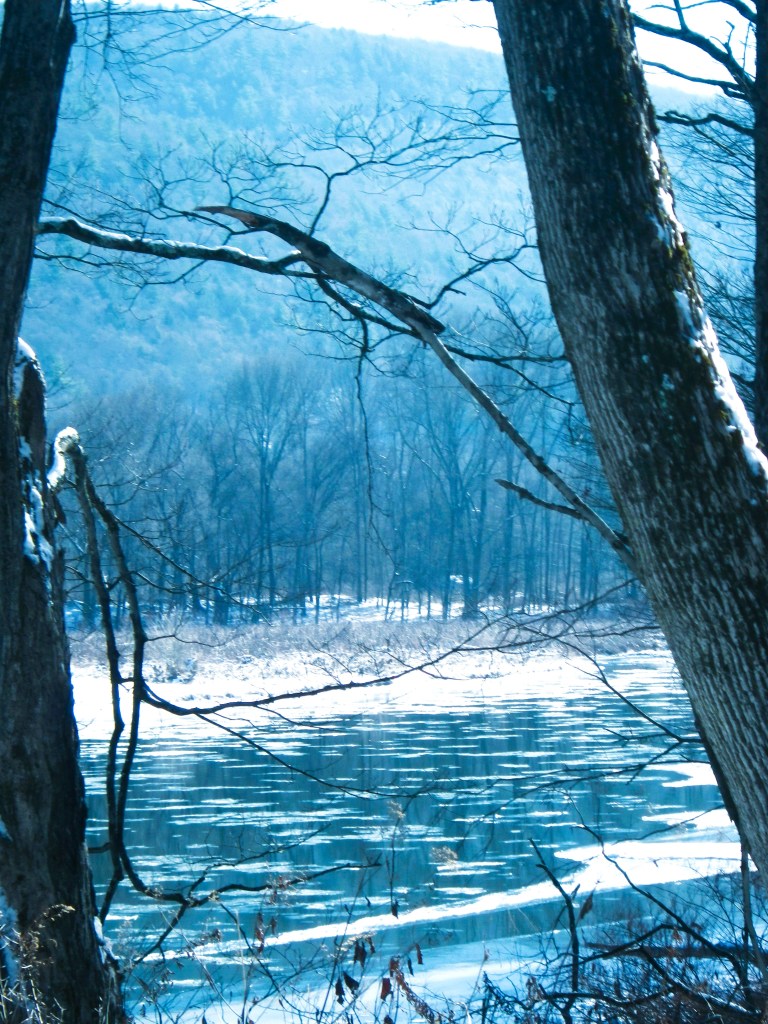
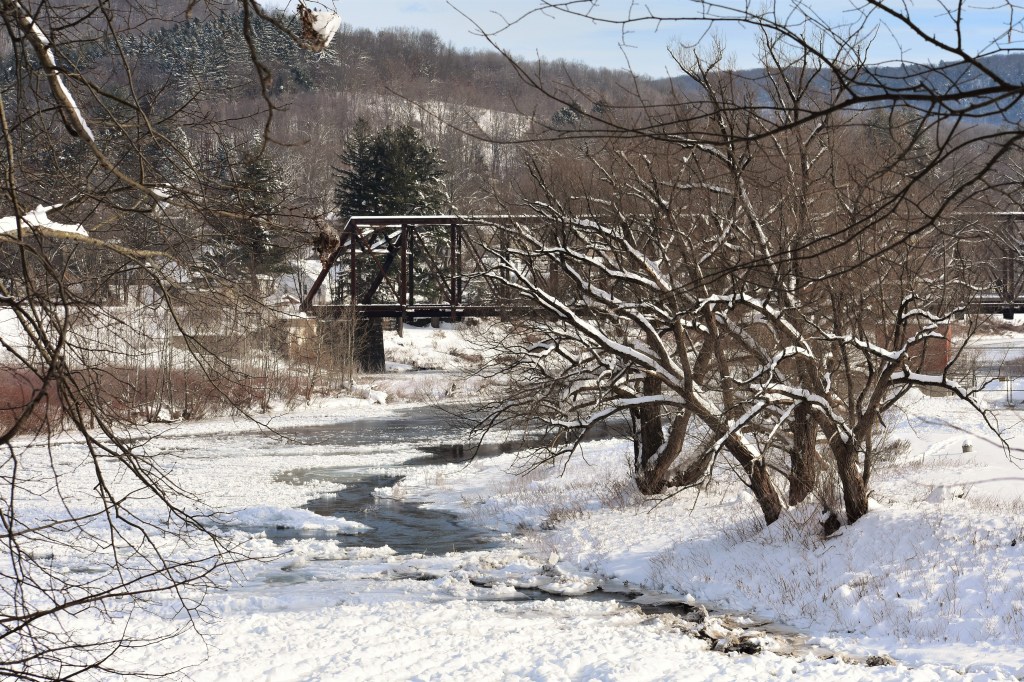
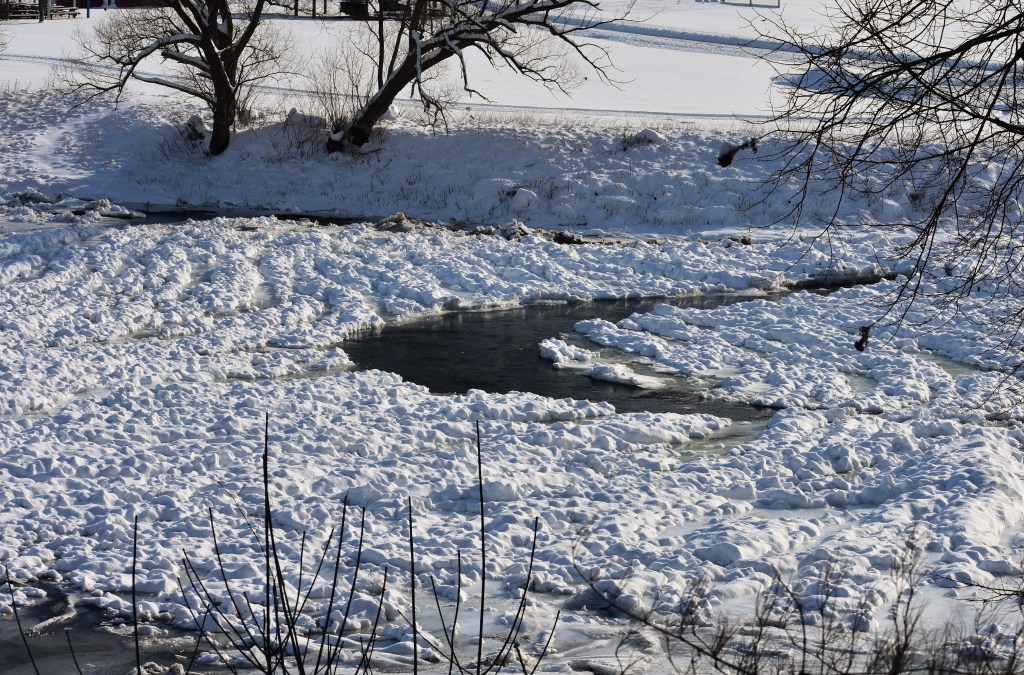
Another winter storm begins, and though it is just 52 days from my hoped for beginning of the dry fly season, it is becoming ever more difficult to believe in the promise. Each time I gaze at the rivers, locked in snow and ice week after week, doubt creeps into my thoughts.
The Farmer’s Almanac predicts a wet and snowy March, and the signs so far, halfway through February, do not defer. Whence will come the warmer air and the sunlight to release the rivers’ flow? Well, we shall see…
A prayer for spring: March 9th, 2024 on a wild trout stream somewhere in New Jersey (Photo courtesy Chuck Coronato)
Dana Lamb offered some relief this morning, precious moments of comfort and ease as we wandered together Where The Pools Are Bright and Deep. I have worked a little, planing my strips of bamboo, tying flies in twos and threes, wandering listlessly through this world of white, escaping whenever I can through the doorways held by the great writers of angling.
Just now, I look ahead to Flyfest, hoping that with winter dealing us another blow this weekend, she will smile and offer some consolation next week. That winter gathering of Catskill fly tyers is something I enjoy heartily.
Time for breakfast and hope, and Dana is waiting to share his memories…
Low water came early and the fishing to the big bugs, the oft championed bringers of leviathan, suffered the most. Warm bright days and low, clear water are not the recipe for catching scores of trophy trout. They were about most certainly, and indeed they fed, but confound a cruising trout that chases big struggling nymphs just beneath the surface when there are drifting duns up top.
Such days can become the dry fly man’s bane.
An old remedy, but not during the trails of Twenty- four!
It is quite the show to watch, this spectacle of cruising and busting flies unseen. I cast for hours to the splashes with emergers, crippled duns, soft hackles. Perhaps I should have simply thrown rocks. I have seen this before, often with the Green Drakes during low water springtime when the flies were more abundant. Bulges and explosions here and there, with never a dun disturbed.
I have wondered if perhaps those emerging nymphs swim and wriggle more frantically with the lack of steadier currents, for such days invariably occur in flat water. The trout are there, as are the mayflies, but duns drift unmolested day after day.
I truly thought a special soft hackle might tempt at least a fish or two, and I crafted them carefully: touch dubbed lightly with spiky, reflective blends of mottled fur, soft wavering barred tails of wood duck flank and partridge hackles specially chosen for color and pattern. My friend Tom who dearly loves and honors the English North Country traditions would doubtlessly have approved. Dead drifted on an upstream cast, swung gently down and across, or twitched through areas with activity, method was no matter. The trout said no!
The emerger that has solved so many impossible trout, though not the cruisers of Twenty-four…
The dry fly man’s bane? Perhaps, though his curse is so often his blessing!
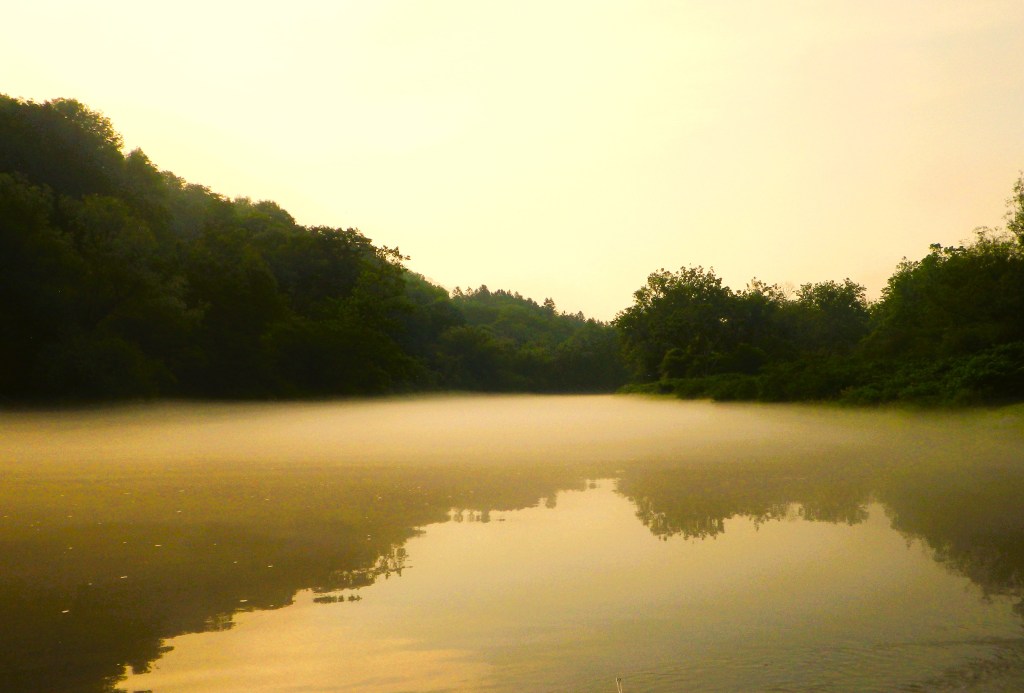
It is a summer’s morn, and the river slides silently past my feet. It takes time, this walking upstream in the quiet hours. I must push no wake before me and remain watchful lest I miss the clue that will make the day.
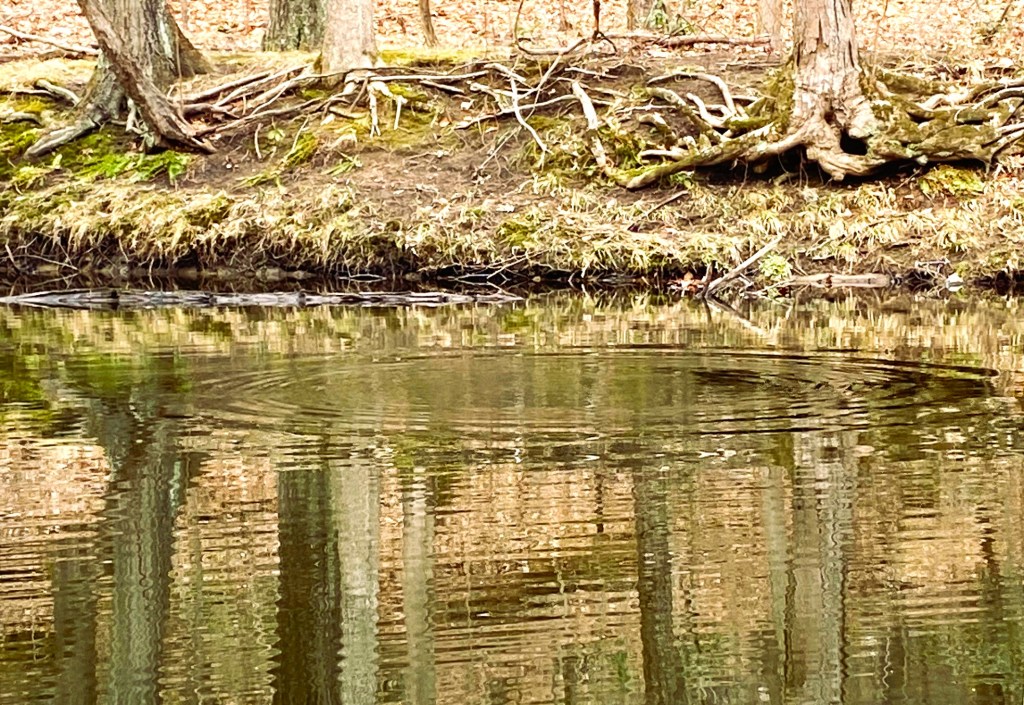
Easing toward a shoreline I pause and listen, for the mist obscures the surface. With patience, it begins to move with the warming air, and I catch glimpses of familiar bits of cover. It is then that my ears capture the subtle plop that means a trout is hunting too. I watch the film passing around me, for some mornings there are spinners adrift, and I must find them to know.
Per chance a cruiser has chosen the same haunt as I! The moving specter of the mist hides him well from my searching eyes if that is so. I wait as the light grows from a thin glowing rim above the mountain.
On those days when I can track the subtle rings of a cruising trout, I will choose a fly and play that game. The rules are plain: one rise, one cast, gentle and quick before he meanders away from the vanishing rings. More than one cast risks everything, for the mist hides all the other subtle clues to his direction!
Some mornings there are no rings to be found, and then, when the suns burns away the mist the nature of the hunt changes. Now I can see up, down and across the river, stalk what evidence of life should appear; and now there are choices to be made. Spinner, dun, ant or beetle? The height of the sun and how well it streams through the clouds and high fog help make my decision. If the coolness and the moisture has left the air, a terrestrial is more likely, more so if the breeze rises.
As the sun and it’s daylight takes full command, the character of the hunt changes. Rises are less likely, and the subtlest of movements will draw casts to the nearby cover. There! The cane arches and the fly is dropped softly above the submerged log, my hand flicking gentle turns of line upstream to lengthen the drift. The drama comes as the vortex forms – he is moving to the fly!
I live for the take, nerves ragged as the point of his arrow nears the fly, and finally, the dimple. Every muscle, every nerve tenses then, but I must hold. Half a breath and then the lithe shaft rises into that blissful arc!
Come February, three months into the season I recognize as the Angler’s Winter, I seek signs of hope. Throughout my life, February has been the month when the first taste of relief graces the landscape, the time when some flurry of warmer air brings a handful of days hinting of spring! The February warmup has been very real the further south I have resided, but here in the glory of these Catskill Mountains it is all but a false hope.
As March begins, the chains of winter must be shed, but no trout will rise
Rare certainly, but not impossible, a true February warmup has graced these Catskills once in my half dozen winters here. It was glorious, with temperatures flirting with fifty degrees over three days, ice-free rivers, and the chance to angle. No, the glory of a rise did not appear, but a limber cane rod and a slow swinging presentation brought a grand reward. So, I look forward with some trace of hope.
Ice secures all of my rivers, and there are no rumors of change. Flows are low once more, and I fear the specter of anchor ice. Our snowpack remains light, but it is lasting, and that bodes well for the river sources, mountain springs and tiny brooklets where the bright waters are born. Hope, with fear of despair.
Tomorrow will mark the sixty-day threshold, and if there is to be no opportune awakening during February, hope must endure onward to March!
Inspiration: A classic Mills Standard from the 1940’s, the working man’s version of the Leonard 50 DF
Watching the weather, for winter seeks to steal a prime opportunity to continue my rod crafting journey! Life and winter weather has altered my schedule more than once already, so I hope today will be the charm. The strips must be beveled, wrapped in binding cord and then heat treated to maximize the resiliency and burnish the color of the Lo o bamboo. If all may be accomplished today, then planing may begin during the next session!
Sixty-six days remain in winter’s allotment, just more than two months until the hope for spring becomes palpable.
I have been studying and questioning during the last few weeks, while waiting for another hands-on session with the cane. I corresponded with my friends Tom Whittle, the designer of the rod taper I will build, and Tom Smithwick, asking about their methods for heat treating bamboo. Through the Classic Flyrod Forum, I also corresponded with two rod makers in Europe who have made rods with Lo o bamboo. Each uses different equipment for their heat-treating ovens, and there is some variation in time and temperature, though fifteen minutes seems to be close to the mark for all. My friend Peer is the man who has studied and marketed this new material, and his apparatus are the most sophisticated, allowing him to monitor the moisture content of the bamboo during the two hours he typically heat-treats his Lo o strips. Peer suggested I maintain a temperature of 356 degrees Fahrenheit for a minimum of fifteen minutes. I will pay close attention to the temperature fluctuations of the heat-treating oven I use, and I expect to treat for about twenty minutes, adjusting that time empirically if the oven varies below 356F.
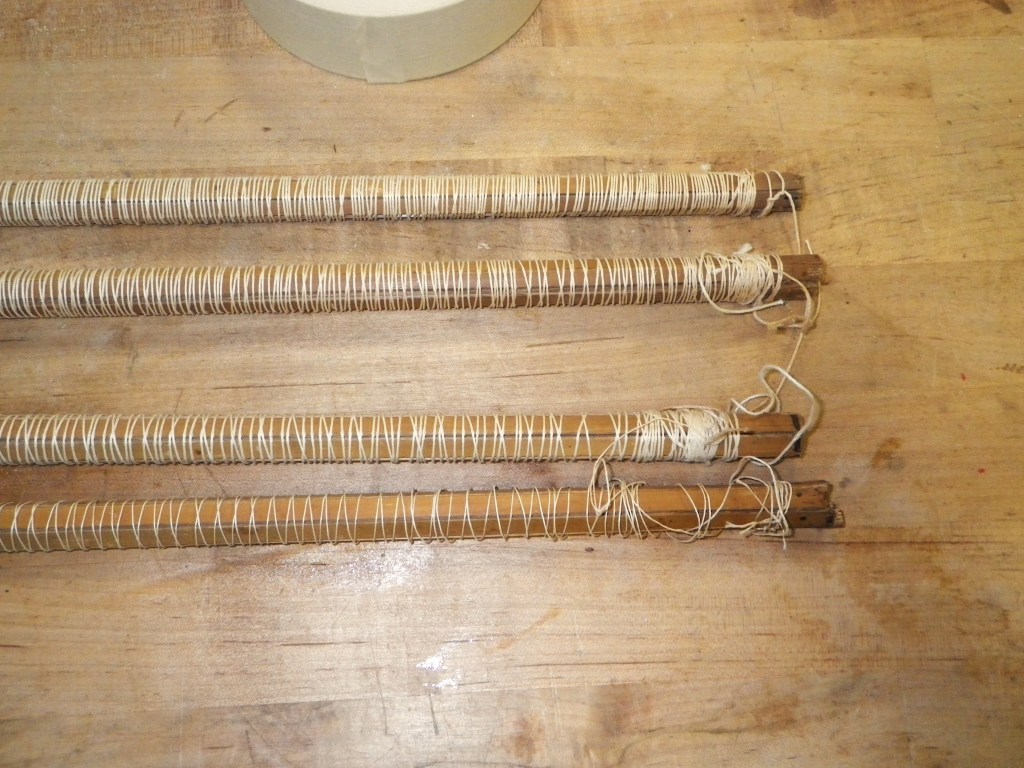
Friday January 31st with blowing rain in the Catskills. The new beveler seems not to like staying in alignment, cutting one side of the strip more than the other. After various attempts, we retire it and work with the older one-sided beveler. One pass and flip the strip for the other side. A longer operation, but it works just fine! With a couple of hours of work, 26 strips of Lo o bamboo are beveled to 60 degrees, all but the two spares bundled into octagonal sections which will be bound with string and then heat treated tomorrow.
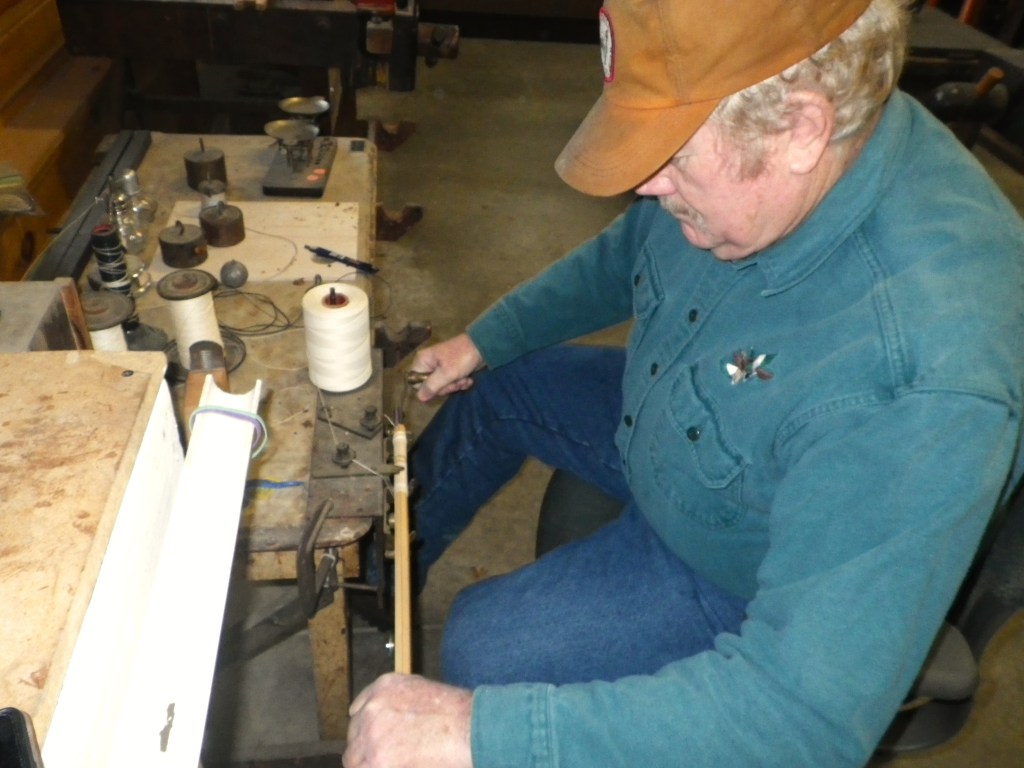
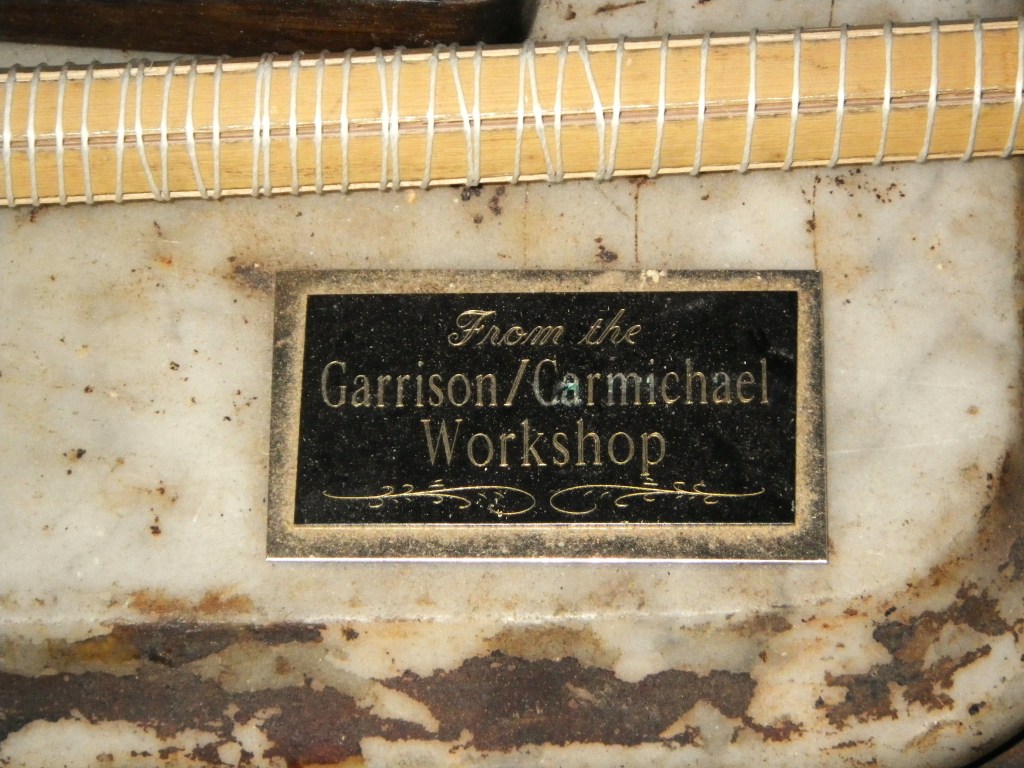
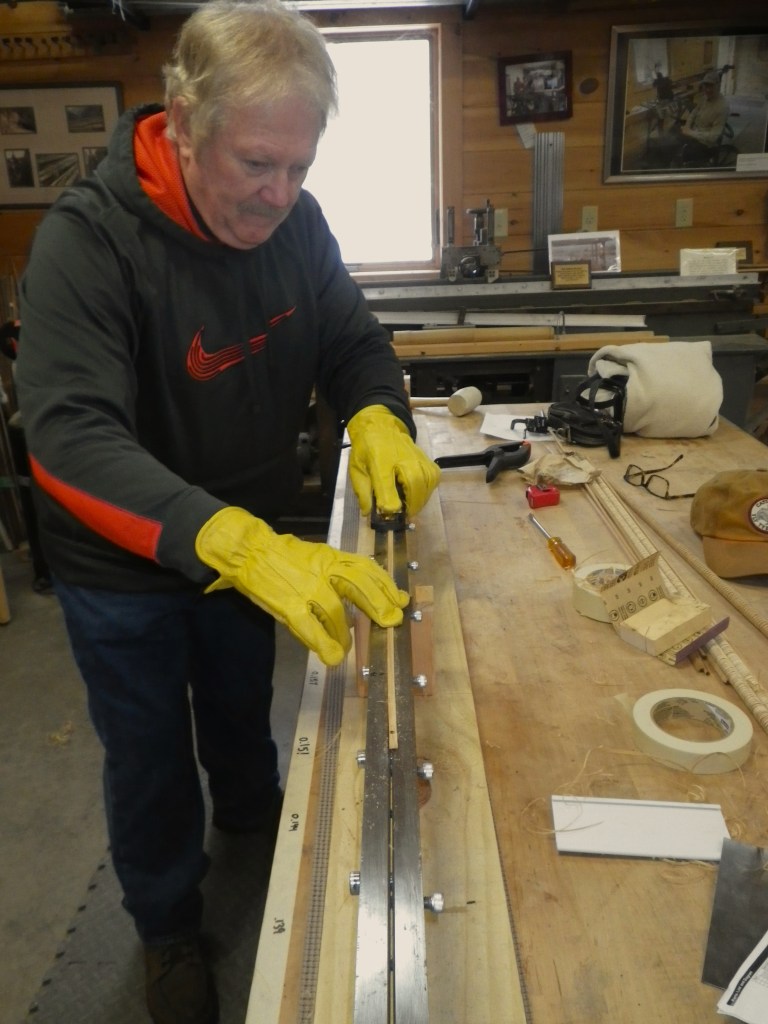
A little step back in time: I enjoyed the privilege of binding my beveled strips of bamboo on Everett Garrison’s string binder. I feel fairly certain this is the first time this binder has wound six strips of Lo o bamboo for fly rod sections. Catskill history meets the most recent innovation in the ancient craft of rod making!
February begins, and I sit down to bind the strips that will become my four rod sections, butt, mid-section and two tips, prior to heat treating them. A cold day, and the steam felt welcome as I removed the end piece of the heat-treating oven to turn the four bound sections end for end. The oven heats unevenly over it’s length, so turning them four times helps to obtain more even treatment. I make some small adjustments in the regimen, continually monitoring and adjusting the thermostat. In the end, the fragrant bamboo sections emerge a warm golden brown, with just a trace of steam as they are removed for the last time…
It is the second day of February, and it is five degrees here in Crooked Eddy. I am headed back to the rod shop today, still basking in the glow of this significant step in my personal history, gratefully realized within the confines of the living history of American fly fishing here in the Catskills. This morning the preparatory work lies behind, and the in-depth crafting of a bamboo fly rod will truly begin.
Today I will fix a beveled, heat-treated strip of cane in the planing form and begin the longest mile of the process: hand planing twenty-four strips to the complex taper designed by my friend Tom Whittle. This work will test the endurance of my old hands, my arthritic neck and shoulder. Pain will determine how much I will accomplish each day of hand-planing the bamboo.
A warm, golden brown…
Set up and adjustment take some time, learning to set the planing form and read the depth gage before I am ready to begin the heart of my journey. First, I add 0.020″ to the finished taper dimensions of my butt strips. Planing for the first time will be a learning experience, much of it tactile, so it makes sense to plane the strips down to this oversize dimension as a beginning. Once the butt is done, I will move on to the mid-section and tips, planing them oversize as well.
The Lo o bamboo planes smoothly, there being no nodes to vary the resistance. As I work my way down a few thousandths of an inch at a stroke, the curls come off in long spirals. Two passes with the plane and then turn the strip…
Despite the smoothness of the plane passes, it seems easy to get a tiny nick in the strip, something I do not feel occur as the stroke is made. The Lo o tends to ravel in thin strings, and JA considers my dilemma, noting that this bamboo is much stringier than Tonkin. I will contact my friends Tom and Peer and ask them about this, and if there is a solution to the problem, or if this is simply my lack of experience.
Planing to the 0.020″ oversize dimension now makes a great deal of sense, for it allows me to investigate my difficulty and find a solution. Mistakes are inevitable, the opportunity to learn from and repair them sublime!
Today I planed four strips of the two dozen required for my three-piece, two tip flyrod. This will be a long journey…
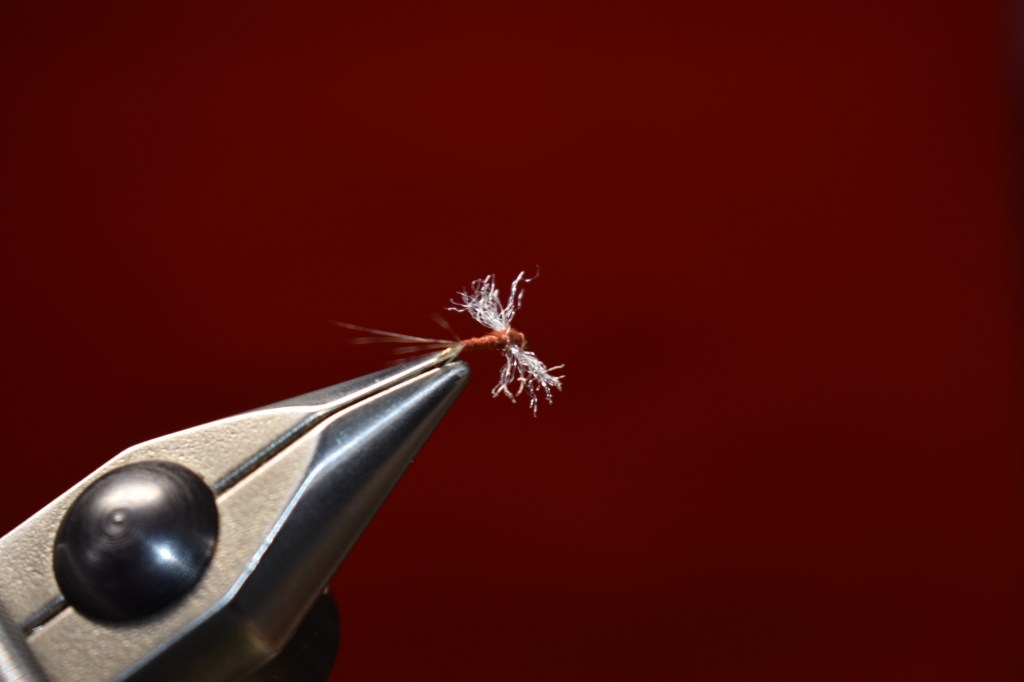
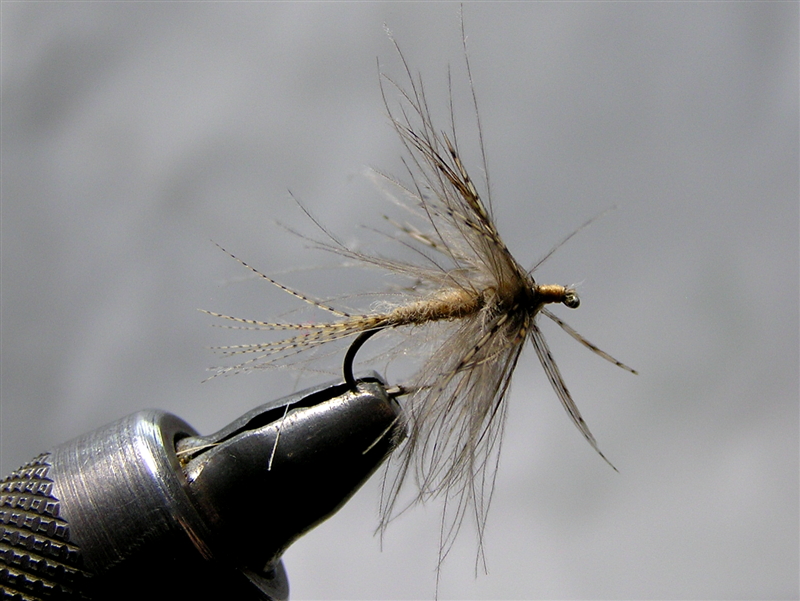
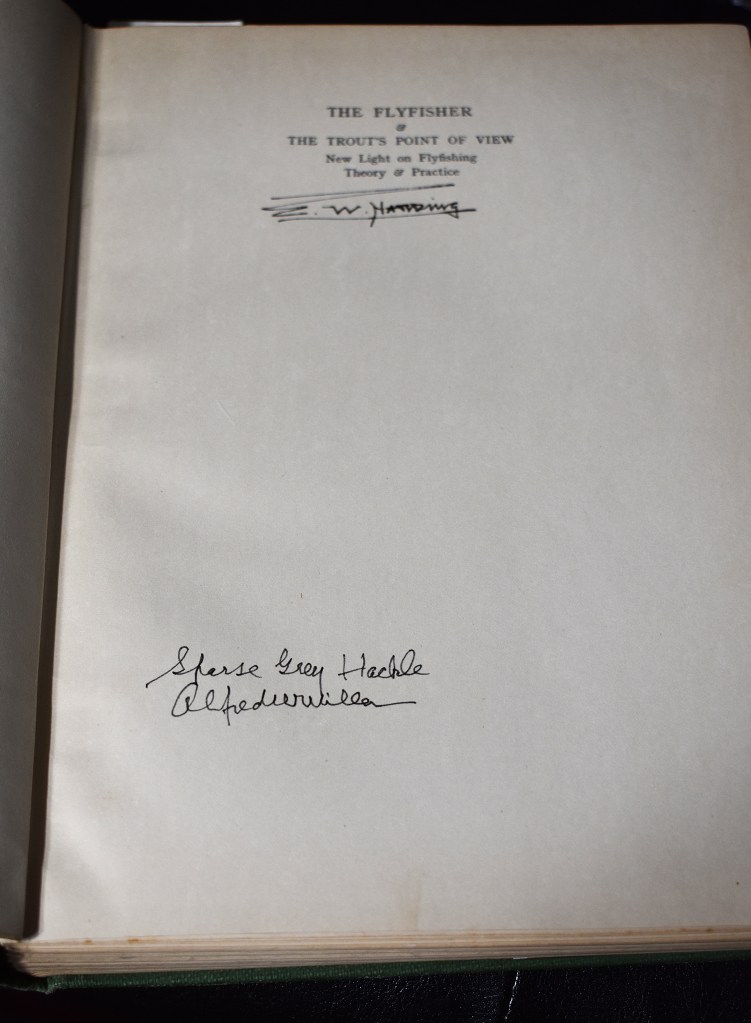
When the thought comes, it’s on to the vise! I was thinking of mayfly spinners this morning, spurred by the interesting discussion in Colonel E. W Harding’s “The Flyfisher & The Trout’s Point of View” (J. B. Lippincott Company, 1931) and a pattern tied a few seasons back came to mind. Memory indicated I had never taken the chance to try the fly, so I sat down and tied five of them for the new, shirt pocket trial box I have been working to fill.
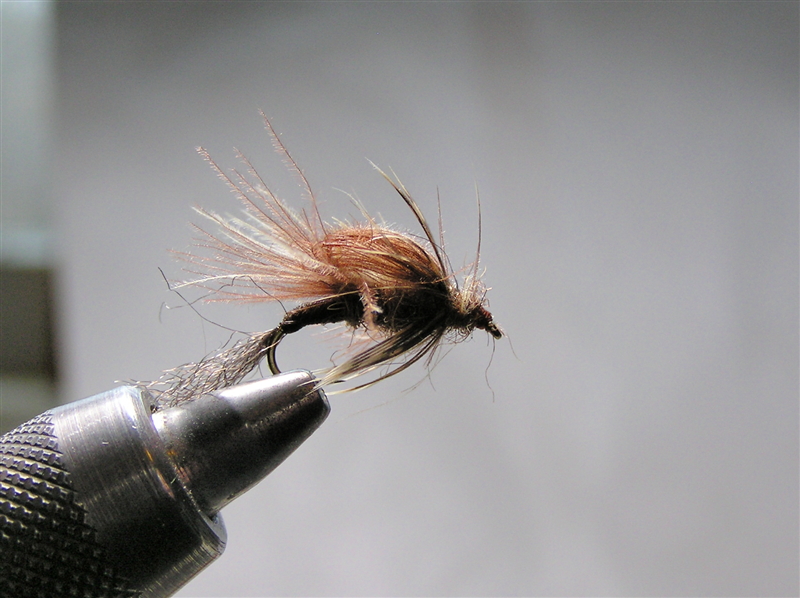
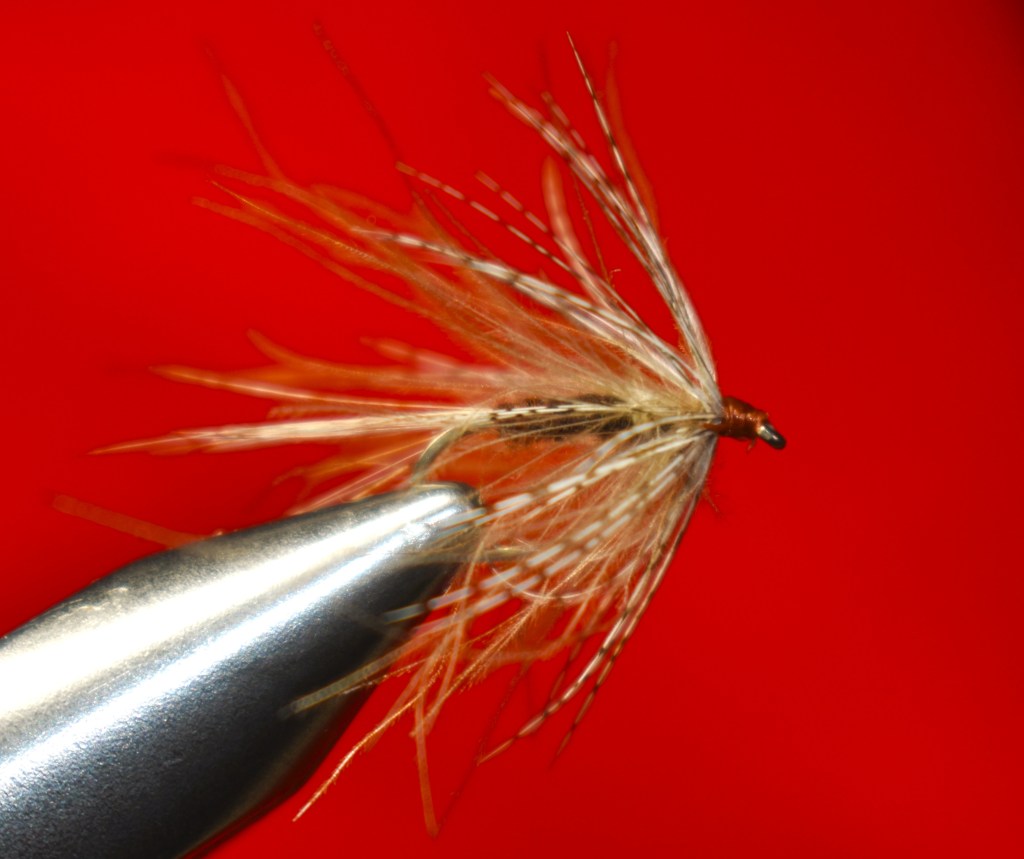
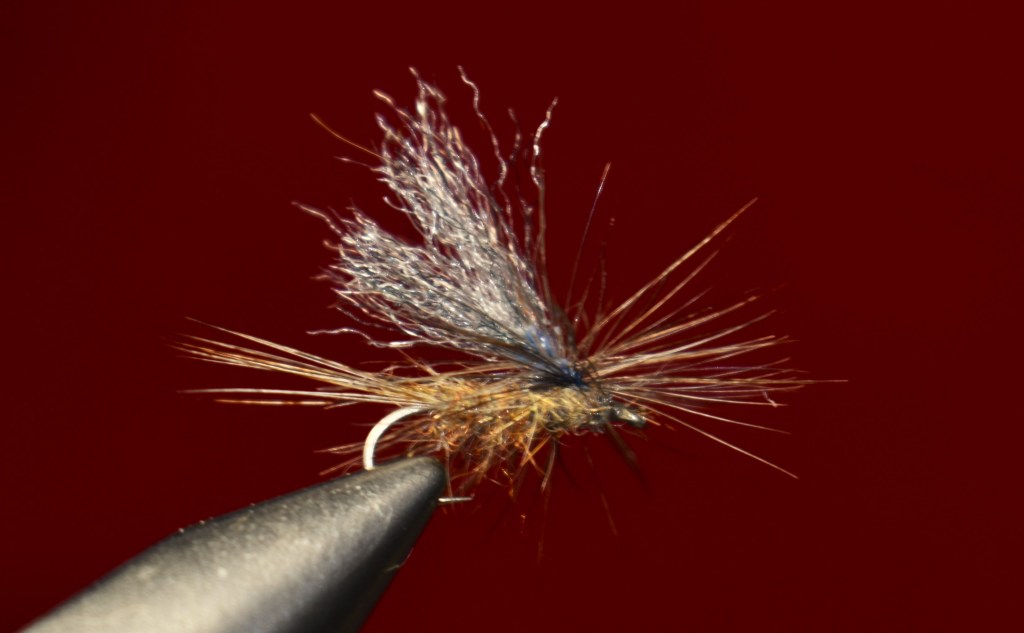
I have had any number of days when the heavily pressured wild browns of the West Branch Delaware targeted drowning duns and shunned the fully erect naturals and all imitations offered. Considering a new way to mimic those barely struggling flies more than two decades ago, I thought a type of dual soft hackle might be perfect. I tied wood duck flank tails and the tan abdomen of a Hendrickson on a size 14 dry fly hook, then wound a natural dun CDC feather for the thorax of the fly. A brown toned partridge feather wrapped in the classic soft hackle style finished the fly which proves itself when those difficult situations are encountered.
The Drowned Hendrickson2003.
Harding’s thoughts regarding the difficulty in taking trout feeding upon spinners brought this soft hackled spinner pattern back to mind, as a different method of offering that image of life so critical in convincing an experienced wild foe! Yes, there are times when a typical dubbed and synthetic winged spinner fly will take trout after trout, but memory also holds images of evenings when that was not the case. I often wondered if the naturals weren’t struggling slightly, their last moment of life being the trigger for the feeding trout.
I had tied a supply of these and placed them in a fly box, though seem to never have had that box in hand when a spinnerfall appeared. They are here somewhere, though less time was required to tie a few more than to search a hundred assorted fly boxes.
The sparse CDC fibers and the speckled partridge feather offer a little movement while drifting in the current, the CDC doing double duty for both attraction and flotation holding a cluster of air bubbles. This spring, the Soft Hackle Spinners will be close to my heart in that shirt pocket box and should get their opportunity to entice a burly wild brown, sipping amid the shadows as darkness falls!
Funny the things you can find in an old, used book. It seems old Sparse liked this volume too!
I confess that a great deal of my reading is focused upon volumes published during the Golden Age. Those who never journey through fly fishing’s history will never appreciate how much angling knowledge has been shared by those who preceded us. Much that modern anglers espouse as “new discoveries” has been contemplated for a century or more!
The lake effect squalls are visiting once more, and the swirling flakes mirror the chaos in my mind. Mid-winter, a stalemate season between those last gloriously fishless moments of autumn and a spring that seems still so very far away.
It is well past the time to get down to serious fly design, exploring new concepts and tinkering with past successes. In truth this becomes ever more difficult, for the breadth of my experimentation has created many possibilities, some which have yet to find their way to the water.
It is the nature of a tactical angler to strive toward the best choice of fly for each situation, and I work to that same formula when ensconced in the flow of bright water with sweet opportunity on the fin. So many fly boxes, with so very many patterns tied in a moment of inspiration, waiting for their own chance to meet the challenge of the trout.
It has become necessary these past few seasons to assign some priority to a new idea, a fresh design. Too many times have I turned to a proven favorite when the solution designed for this specific moment lies hidden from view in one of too many fly boxes. Decades of experience has taught many lessons, and one that is paramount is the fleeting nature of true opportunity. A stocked trout may rise happily for the duration of a hatch, but the champions of the evolved wild races of our Catskill browns and rainbows are oft as ephemeral as the mayflies themselves. A subtle bulge, a slight swirl in the edge of a current can be easy to miss when the main run before us displays half a dozen riseforms. Chances are we will get just one look, one moment to notice the signs of a trophy fish, scrutinize the currents at play, and make the cast.
There are exceptions to every rule, and once in a while we encounter a prime specimen quietly feeding off by itself. If we angle flawlessly, and the availability of the food form remains constant, we may fish to that rare specimen for a significant time. These are the rare chances to try new flies and fresh ideas, but with the full knowledge that the game may cease at any moment. That ticking clock plays upon our thoughts and inhibits our choices.
The sages of our sport have taught us the rule: that trout will select the most abundant, easily available bite of food to the exclusion of all others in the drift. That seems logical at first, at least until years of experience begin to erode one’s confidence in simple answers. There are thousands of anglers fishing our best rivers and streams, and the wild trout have developed genetically to this grand assault. Many individuals, often the longest lived and largest specimens, waive the rules of the sages, following their own very specialized instincts. These are precisely the fish that will best test our new ideas, but they rarely offer themselves for inspection for any significant amount of time, or in the readily apparent times and places.
I have taken to improving my organization, arming my Wheatleys with my prime patterns for solving the spring hatches, then keeping another simple compartment box in my vest for the experimental flies. Still, some new perchance even revolutionary ideas have remained untried. My hunter’s instinct gets in the way despite the wisdom of preparation.
The RQS Struggle Dun, conceived January 25, 2024 and still untried…
Since retirement, I have enjoyed the luxury of angling one hundred days or more each season. It is not enough. Dangerously high flows, winds of thirty miles per hour or more, and violent spring cold fronts all rob me of precious days afield while the desire burns bright! These are all part of the grand challenge of angling. It is truly the difficulties that make the brighter moments all the more precious in our memories.
Mid-season is a joyful time, when July brings long summer days of hunting trout, midday sulfurs, and the blessing of solitude on many reaches of Catskill bright water. There is of course a counterpoint, the middle of the angler’s winter.
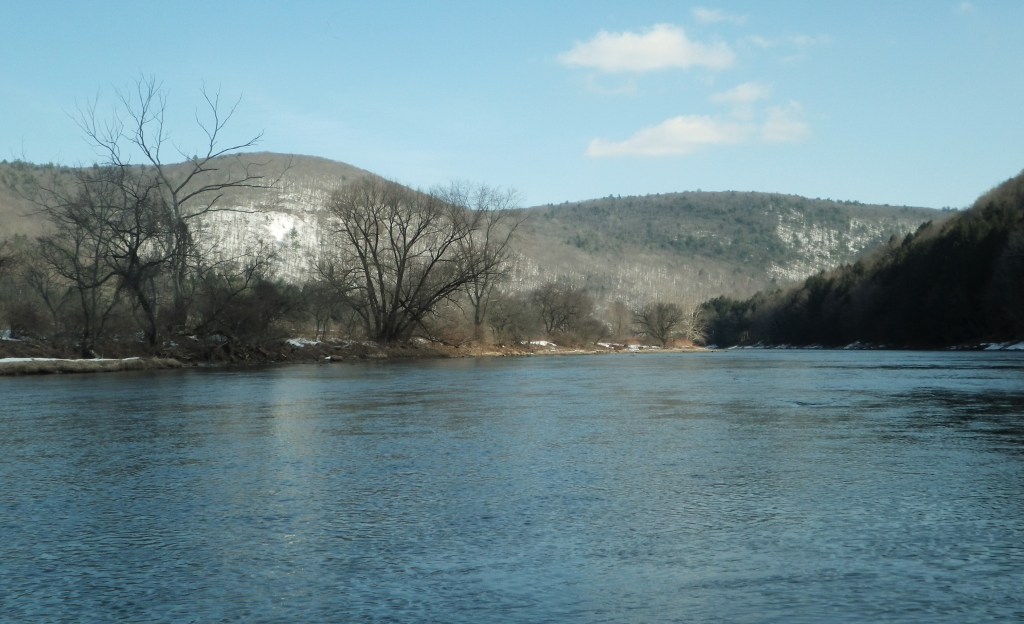
I count that off-season from my last day of fishing these Catskill rivers to that hoped for new beginning in early April. This year it is a span of one hundred thirty-eight days. Midnight shall mark the middle of my angler’s winter, and tomorrow the days of that second half shall begin to tick away.
I can feel it each year, as my concentration lapses, and I find it ever more difficult to fill the lingering hours of each day. Reading or tying a handful of flies sometimes soothes my frazzled nerves, but the rod work I hoped to usher me through the long months has stalled. I have busied myself with the business of the Fly Tyers Guild as best I could, looking forward to our little gatherings as beacons of hope. Spring will come; I have only to survive the days between the seasons of light.










 Bright Waters Catskill