I tried to fish today. Yes I knew the winds were forecast to be 15 to 25 mph, but I also know that there is an inch and a half of rain coming between tomorrow and tomorrow night. Rivers are already high, reservoirs a nearly full, so significant rainfall means there won’t be any fishing for a few days, perhaps more, so I took a chance that I could pick a reach of water that was protected from the strong southeast winds.
I ended up standing out in the middle of the river watching a couple of big fish smash the occasional bug and laughing, because the wind was blowing straight down the pipe at 30 to 35 mph every time I tried to cast. It became such a futile effort it was funny.
Walking along the road looking for activity the wind seemed manageable. Climbing in and waiting for one of those trout to rise again, still manageable. Spotting a rise, fixing my eye on the nearest rock on the bottom to mark the spot, trying to make an initial backcast and whoa; somebody turned on the fans! This isn’t the first time I have experienced this phenomena.
Its tough to finally have a few flies hatching and not be able to do anything about it. If we get the hard rain that is forecast there’s a chance the hatch will be over before its possible to get back on the water. Yes I have a boat but there are limits.
I made my second solo float on the West Branch yesterday. It was bright, warm and lovely to be out there. There were mayflies hatching in the afternoon and there were a few trout rising, but no where near what the weather would lead you to expect. I landed five browns and missed a couple. If you look at that in terms of miles covered I guess I found one rising trout per mile.
I shot a quick little video while I was anchored and looking for fish. I’ll share it, just because it was such a beautiful day. I think I will keep watching it myself; just to remember what that kind of day looks like.
It was thirty years ago when I wandered into my first fly shop. A gentleman by the name of Wally Vait was sharing space with another small sporting enterprise, the E&R Gunsmith, and he called his new business “On The Fly”. Wally helped me learn more about Maryland’s Big Gunpowder Falls, a growing new wild trout tailwater fishery in Baltimore County. It was there I found a few packets of Cul-de-canard or CDC feathers, and I have been tying CDC dry flies ever since. My very first truly original pattern used CDC to imitate the midges and microcaddis that trout ate readily in the upper reaches of the river, and it was an instant success. Pretty exciting stuff for a novice fly tier!
Even then the Gunpowder attracted a lot of fishing pressure. It was the home of a nice population of beautifully colored wild brown trout. It was a fairly small, clear water stream, and not often affected with high flows. Those wild browns and the few wild rainbows in that evolving fishery were difficult to catch, and I learned early on that CDC feathers offered movement and floatation. CDC flies caught fish better than standard flies on the river’s glassy pools.
When I moved to Pennsylvania to fish the limestone springs of the Cumberland Valley I encountered even more fishing pressure and difficult trout. Along the way I expanded my use of CDC in dry flies and used them to solve the puzzles of the legendary browns of the Letort and the wild Falling Spring Rainbows.
Fishing the Catskills for the past 27 years has exposed me to another world of challenging conditions. Our rivers are some of the most popular fisheries in the world. They are bug factories where trout thrive and grow to trophy size while feeding suspiciously and selectively on the multitude of natural insects. On all these rivers I have witnessed the effect of heavy fishing pressure, of trout exposed daily to great anglers and beginners, flawless presentations and extremely poor ones.
If you have ever watched closely as these wild trout feed on a good hatch of mayflies, you have seen them select only the naturals that were moving in their window. A good mayfly or caddis imitation that moves subtly in the microcurrents of the surface film is often the only way to catch these highly educated, selective fish.
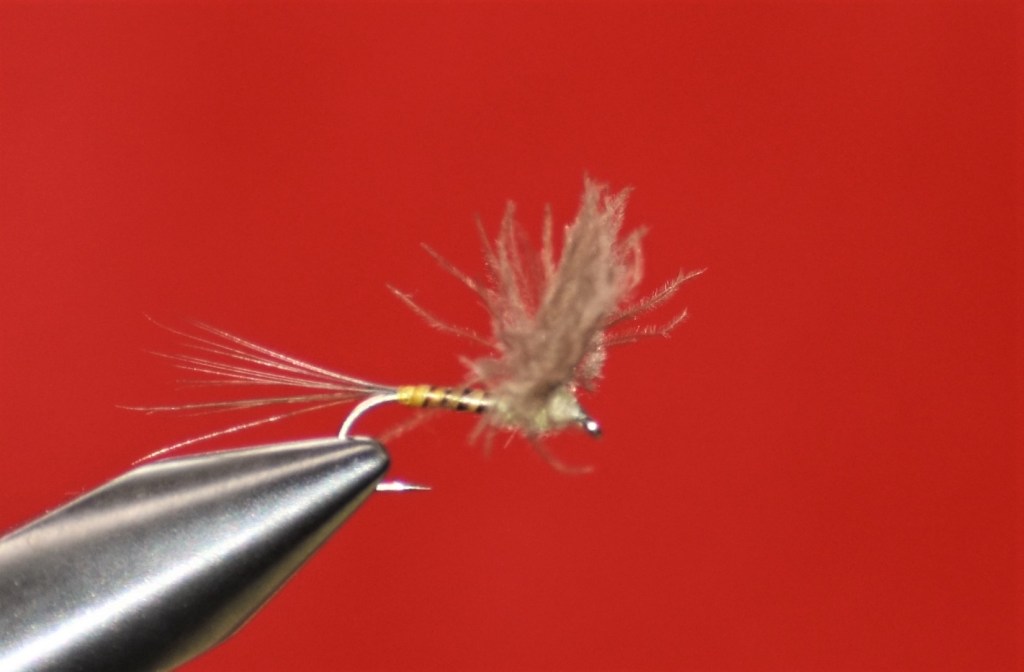
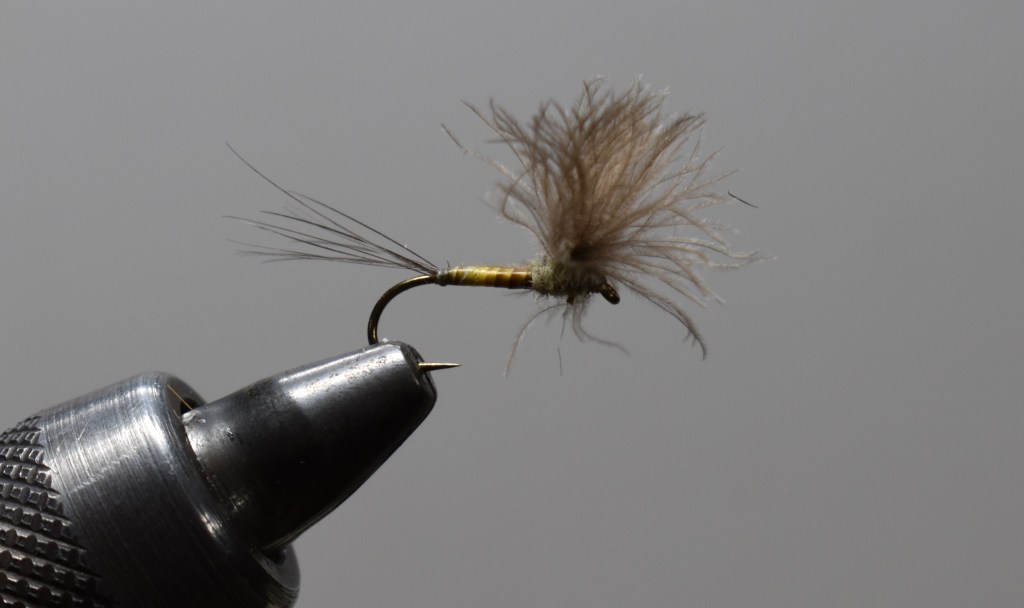
Cul-de-canard feathers are easy to tie with and extremely effective for educated selective trout. They look natural, move to imitate life, and provide good floatation in the film. For the first video in this series I will show you how to tie a CDC comparadun with a turkey biot “quill” type body, one of my go to patterns for many years.
One note for biot bodies. If you want maximum durability for your flies I suggest coating the biot body with Hard as Hull acrylic polymer head cement as soon as the body has been wrapped. Tie a three turn whip finish, clip the thread, and set the hook aside until the cement is completely dry. Tie several flies to the same point then, when dry, add the wings and thoraxes one fly at a time. I usually don’t bother with this step, but it will make the biot body tougher.
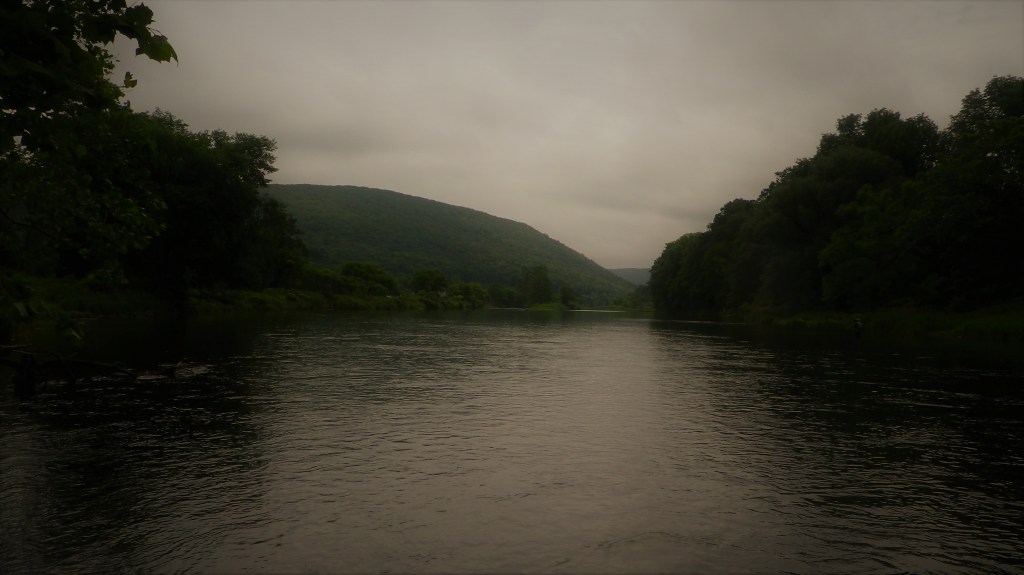
Saturday provided another all too brief glimpse of spring in the Catskills, as I floated solo on the West Branch of the Delaware. Putting out just before noon, I quickly shed my jacket and drifted in my shirtsleeves, enjoying the midday sun. It was a beautiful day, but our forecast for tonite and tomorrow might revisit the scene captured above.
Five days remain in April and I can’t help but wonder what May will bring?
I saw a great many flies on the water during my sojourn downriver, the vast majority among the tiniest of mayflies, too small to trifle with considering the long downstream casting required for drift boat fishing.
I did find a few rising fish. Some where happy to take my Blue Quill imitations, and some seemed dedicated to the abundance of the minutia. I can still see size 22 and 24 dry flies when wading, but from the high angle of the boat I cannot, not even when I scoff at the traditions I love and tie tiny parachutes with fluorescent chartreuse wing posts.
My solution then is to feed them the 18’s and 20’s I can see. That tactic left them cold, so I stuck with the Blue Quill. There seemed to be a few on the water sporadically during the afternoon, though catching mayflies out of a drift boat for identification is not my forte either. I need to find my old bug net!
I managed to land five brown trout, between my poster and parachute Paralep ties and a Quill Gordon Comparadun I tied on toward late afternoon. There were four more that seemed to be well hooked but escaped; one due to an abundance of pressure on my part allowing him to open up the hook. At least one appeared to have eaten the fly immediately (I didn’t see it fall) and I lifted much too late in disbelief. Add in a couple other misses and foibles and, combined with the fish that simply wouldn’t look at anything big enough to see, I had plenty of action.
The shirtsleeve session was repeated later in the afternoon, when the light breezes calmed and the sun broke through full and bright again. Those moments alone were worth making the float, having some trout to play with just made it all the better.
There are times you seek a friendly reach of water simply to quiet the noise within. Yesterday was such a day, rainy with banks of dark, foreboding clouds, and still the wintery feel we have become accustomed to this wayward spring. I didn’t expect activity, I simply needed the time on the water.
I had chosen an old friend, my Thomas & Thomas Paradigm, a 9 foot two piece rod for a five. Remember two piece fly rods? There was a time when the majority were built that way; until the industry decided we needed to fly everywhere to go fishing. It is a gentle old rod, with a smoothness and supple feel that belies it synthetic heart, and I was in the mood for some gentle casting.
Standing in the edge of the flow I surveyed the pool in front of me, its surface still racing with the urgency wet weather brings. I was surprised and heartened to see a trout rise toward the far shore, so I began to make my way to him. It was early but I could see a few mayflies in the drift. Assuming Quill Gordons I chose a dubbed comparadun. The Paradigm lofted the line beautifully and sent the fly on its way, short that first time as is my habit, testing the drift before presenting the fly over the fish.
Wading into position, the trout had risen twice more, moving and restless. I had made half a dozen casts to the places he had risen, long down and across stream casts that let the fly drift throughout the alley he was frequenting. I was retrieving the excess line when I felt the tug of life and found a spirited trout that decided my dry fly made an acceptable streamer. A lucky trout can be a gift, and it was on this gloomy afternoon.
Releasing a plump 15 inch brown from my net, I pondered the realization that this could be a much better day than I had any reason to expect. The water was still cold, in the low forties, and the insect activity still sparse, but nature goes about her plan.
That first fish rose again, and I offered him the fly. He accepted with a flourish, somewhat larger than the first, but won his freedom well short of the net, bringing a shock at the suddenness of his departure; and a smile.
I had to move 50yards upstream to work to another rise, forging through the fast thigh deep current, and working the muscles too long dormant through this interminable winter. Once in position, a second trout betrayed his presence, and I worked this closer fish first, then cast to the steadier feeder in the fast chute next to the far bank. There were few flies in this faster reach, some of those smaller than the Gordons, so I played the game.
Two Quill Gordons, different ties in 14 and 16, a proven Blue Quill parachute, and finally a size 20 Adams with a chartreuse post that I could easily track along the bank, these complete with a tippet change and various repositionings. No sale to either fish.
Back into the rush of current, I pushed further upstream where I had seen a white wink tight to the bank. The larger flies were back again, so I knotted a sparse, perfect Catskill Quill Gordon tied a day ago to my tippet. The trick was to place that fly an inch from the rocky bank, no more and no less, on a downstream cast with an upstream reach. My old friend was perfect for this game!
I had noticed that my nemesis downstream had not risen again, and was theorizing that the bank feeder I was now casting to might be the same trout moving up along that bank. Deep in thought, I reacted nearly too late when the little wink displaced my Gordon on the surface. The trout was hooked solidly though, and I felt his weight as he bulled his way into the heart of the river’s flow, and the Hardy sang.
The rod arched into a perfect bow, countering the thrusts and headshakes of the trout, finally overcoming both his strength and that of the rushing river. In the net he measured a respectable 19 inches, broad and deep in the chest.
The light rain had subsided by then, and I pulled down the hood of my jacket for the last time. There was another wink or two along that bank, though not with any regularity, and I whiled away some time fishing until I sensed the approach of evening.
Moving back downstream I saw a ring below the rock where the first of the earlier pair of risers had ignored my offerings. “So you’re back”, I thought.
I had changed to a CDC winged Quill Gordon, so I cast it down and across along the bubble line trailing that trace of current, the soft fibers of the wing dancing! My adversary simply couldn’t resist. Caught in the full force of the channel, this stocky 15 inch trout gave a good account of himself, coaxing a few notes from the Hardy, and resisting the net until the last. I found the fly in the hard side of his lip, twisted it free, and sent him on his way.
A dyed wild Turkey Biot body, natural dun CDCpuffs and splayed hackle fibers create a lively fly!
I eased my way downstream, knowing my fishing was completed, and noticing the sky was beginning grudgingly to clear. The air felt slightly warmer, though that could have been the exertion of my wading against the current. I stood for a while at the edge of the pool, giving thanks in my heart for a couple of hours of peace and joy.
Before I turned toward the car, I surveyed the water up and down one last time. There was a soft rise well down the pool which brought a smile; perhaps one last kiss? I waded down and across slowly, the river pushing at my heels. The CDC winged fly was still damp from the last trout, so I dug into my pocket for the floatant, and brushed the powdery crystals into the feather, bringing the fly back to life.
Another rise, and one last long cast, the loop unrolling slowly and laying the fly gently above my mark. The drift perfect, as was the moment, with the sun fighting through the breaking clouds for a brief twinkle on the water as the trout rose to take the fly. Lost in the bow of the soft rod, the music of both the Hardy and the river in my ears, I could stay that way forever.
Stormy weather; it seems to be the order of the season. We have been more fortunate than some, with tornadoes ravaging the south even now, but it has been a wild April. There is a week remaining in this unsettled month, and it doesn’t look pretty from a fishing perspective. More rain to swell spilling reservoirs, more cold and wind.
I have found a little fishing, a few brief hatches of Quill Gordons and even Hendricksons between the snow squalls and breakneck winds, but the rivers have become colder rather than warmer, and the trout are loth to rise.
The first hatch I encountered was on a bright day when the sun pushed the air temperature to 61 degrees, the day after a 2 1/2 inch snowfall and the last warm day this week. The river peaked at a measly 46 degrees late in the day, and the hatch was light. There were a few flies for an hour or so, and I watched the surface intently for any sign of a rise. High cold water and fast current are not conducive to surface feeding, but I was hopeful.
At last I saw it, a little popping rise; once, then twice. By the time the third rise came I was casting a long line to cover it, my dubbed body Quill Gordon knotted to the tippet. The fish had moved, none of his rises coming from the same lie, so I dropped the fly a bit further upstream on each cast. The Gordon intercepted it on his fourth and final rise.
The oxygen in that high, rapid flow invigorated him despite the forty something water, and he bored downstream and into my backing while I grinned and tried to keep my feet from slipping. There was plenty of weight and power in his fight, and I wanted this fish badly, having waited six months for the opportunity. My desire increased when he cleared the water for the first time.
I regained my backing and most of my fly line, he took it back, and so it flashed back and forth through my mind: sunlight on bright water, a straining rod, a spinning reel and then he was airborne again!
It was finished, he was done and I had drawn the leader butt through my rod tip, net in hand and ready, he wasn’t ten feet away. One last slow rolling jump, like a slow motion film clip, showing me his length and width and vibrant bronze color, and the hook pulled free. The first trophy of the season simply wasn’t to be.
The run was quiet after that, even as the sun warmed the water to its peak for the day, there was no more. The flies petered out as quickly as they had appeared. I waited, convinced that another trout would find a drowned dun drifting behind a rock and betray his interest, but it was not to be.
Since then I have stood in the river buffeted by 30 mph winds in 38 degree water while frozen snowflakes circled my head, ever hopeful for the flies to come again.
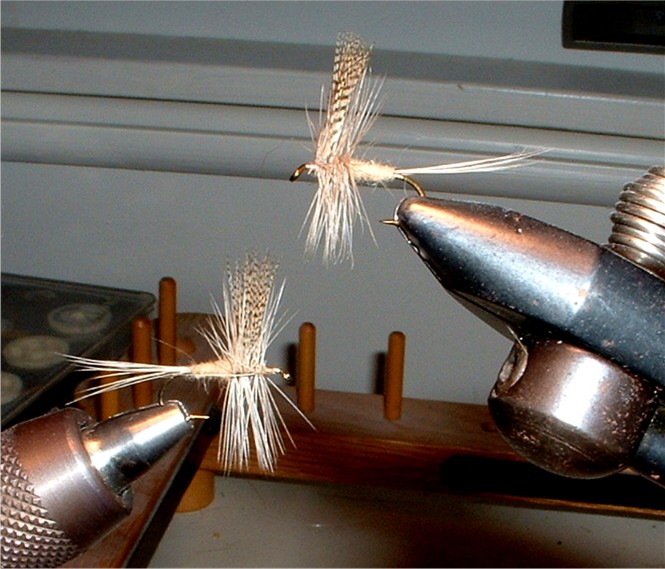
My Hendrickson (left) and a Dette Hendrickson (right) Variations in Catskill Style Mary’s tie has that un-mistakeable grace!
Spring continues on it’s rollercoaster; today promising cold, high winds and even thunderstorms. It is a good day to stay home. I have tied a few flies already this morning, and have ideas for a handful more, and there is always something to do around the house. It’s a funny little old house.
We found this place when I had nearly exhausted my prospects, my realtor mentioning it before the ink on the listing agreement was even dry. His agent hadn’t posted a sign when we swung by for the initial look see. Like anything in this world there were pros and cons.
I had been looking for a place outside of town but the more I considered the kind of life I wanted the idea of living right here in Hancock showed merit. We can walk to most of the places we visit on a regular basis. I like that. Exercise is where you find it, and walking around the village taking care of basic chores is good for us and pleasant.
There was plenty of exercise that first summer. The rivers blew out in August and stayed too high to wade right through into winter, so I had plenty of time to take care of projects. The first was rebuilding the porch. There were rotted posts to be replaced, and repairs to parts of the siding and decking. Working along I found that a main support beam was damaged in places, so I engineered a new beam to tie in behind the existing one.
Things went along like that, finding little problems and solving them, and I had a pleasant satisfied feeling when I applied the final coat of paint to the decking and sat back with an ice cold beer to grill some dinner on my porch.
When the rains came all day long, I took drives and rooted around in antique shops looking for a suitable fly tying desk. I found a nice little oak chest for the bedroom, a kitchen table and chairs with potential, and a few odds and ends but no desk. Running out of places to search I thought about building my own, and the local lumber yard told me about a custom hardwood shop in another town. They cut, glued and planed a gorgeous curly maple top for me. I squared the ends, attached some hardwood post legs, and sanded, stained and finished it. I was so pleased I kept showing people pictures of it on my phone. I got my love of wood from my father, and curly maple has always been my favorite.
The Tying Desk
As summer passed into early autumn I put a new floor in the kitchen and painted the walls. The place looked pretty good and was ready for the big move. The entire process made me feel really good, really alive. I found myself happy, realizing that my time was my own and I was working directly for something I had always dreamed of. Not like working for thirty years at a career at odds with my personal priorities, but working on the dream itself.
With all of the rain I spent a good deal of time mowing the lawn. To most folks that seems like a real chore, but I enjoyed it, and I still do. I feel a satisfaction every time I walk that mower around my yard. My yard. Having rented for decades I finally had a place of my own, and that meant a lot to me in my first summer of retirement.
There are still projects I want to get done. A lot of them involve sanding and wood finishing and have to be done outside, so they are very weather dependent. Last summer found me spending my time on the rivers and the outdoor projects got put on hold, not purposely but day by day they simply got pushed back. It was a gorgeous Catskill summer! I had missed too much fishing in 2018, nearly all of it, so I took advantage of all the nice days to enjoy the reason I moved here; the Catskill rivers.
Another Gorgeous Summer Day
Everything is just a matter of time. If we look for it, we can usually find the time to do the things that are important to us. During the fishing season, I tie flies early in the morning, when I have fresh inspiration from the previous day’s fishing and the anticipation of the day before me. That schedule works for me, so I often tie early in the morning during the winter too. I like to write early in the morning as well.
Between the unsettled weather and the complications of a major pandemic, there is too little time for fishing right now, and too much for a lot of other house bound tasks. Fishing has come in little bits and pieces: a handful of bugs for an hour, and maybe a single trout rising to give a little purpose to being out there. If we stay safe and healthy, there will be time for fishing to get better.
Days like this one are good for reading, tying and the ongoing project of organizing my fly tying room. I have thirty years worth of materials, stored in numerous plastic boxes. The things I use regularly are right at hand though: hooks, hackles, the dubbing blends I have worked up to match Catskill hatches, CDC feathers, etc. Every once in awhile though I get an idea for a pattern that gets me searching in all those boxes for some obscure material that I know I have…somewhere.
F.E. Thomas Bangor 8’6″ 3/2 Dry Fly Rod made in 1939
Sunshine and wind, its a bright blustery morning in the Catskills! I call this an improvement over yesterday’s 2 1/2 inches of fresh snow and dark foreboding skies. Now if that wind would just dial it down a bit…
I was outside playing the line game: trying a variety of fly lines on a classic rod, one of the “older gentlemen” I enjoy fishing. It was the history of fly fishing that drew me first to the Cumberland Valley and soon after to the Catskills, and I truly enjoy connecting with that history through a classic fly rod.
The line game passes the time outdoors, and it is productive when you seek to maximize the performance of an older rod. The Thomas I was working with dates from 1939, a lovely old Bangor. The simply appointed Bangor was Thomas’ lower grade rod, though the bamboo and craftsmanship is every bit as fine as the higher priced Specials and Browntones. That is one of the things I like most about both Thomas and Granger rods, the fact that the working man could afford one without accepting any compromise in quality or performance.
This Thomas is a 5 7/8 ounce, fast dry fly rod, and it is most effectively cast with a 6 weight line. The line game is a necessary function of the fact that these older rods were all designed to cast the braided silk fly lines available in those time periods. Silk lines were much smaller in diameter than modern plastic coated fly lines and thus the snakes and stripping guides on classic rods are much smaller than those found on modern rods, either bamboo or synthetic. The significantly larger diameter of modern lines means more air resistance too.
When I first acquired this Bangor, I tried a few DT5 lines which proved to be far too light. WF 6 and a WF7 line were next on the block, with the seven being a bit too much, though the rod cast that line just fine. Narrowed down to a six weight, the task becomes finding which six. I tried a couple of lines that worked but failed to make the Bangor “sing”. That’s my own term, appropriate as the effect is immediate when you hear a singer versus noise.
The last time I thought I had this rod ready to make music, I had decided that a DT6F 406 brand fly line I had was going to be the winner. These Montana made lines use modern materials and classic tapers and are favored by many anglers fishing cane. That 406 was a great line and the Thomas liked it, but it didn’t sing.
Today I tried a Wulff Triangle Taper line in WF6F, the line that makes my Wright & McGill Granger 9050 sing, and then a Scientific Anglers Mastery Expert Distance line in WF6F. Again, both cast very respectably, but the diameter seemed to be holding back the music. I moved to a Cortland Sylk in WF6F and think I may have found the answer, though I want to try a Sylk DT6 to be certain. The 20+ mph wind gusts make it harder to judge the rod’s performance.
To some people, this may sound like a lot of effort, particularly if you understand that all of these lines would cast to 60 or 70 feet on my Bangor. Its worth the effort though when you find “the line” for a classic rod. Fishing the larger Catskill Rivers most of the time, I like to have the ability to easily reach out and make a fine presentation at 80 feet comfortably, as there are times you simply cannot approach closer. If I need to exceed that, as can happen with early season high flows, I am relegated to graphite.
I won’t encourage anyone to go out and buy half a dozen new fly lines to experiment with a favorite bamboo rod, certainly not with lines hitting $100 and more these past few years. Thankfully the Cortland Sylk and original 444 peach colored lines, as well as the 406 lines are significantly more affordable. Borrow a line or two from a friend for a little backyard casting. You’ll like the music!
While enjoying a piece of cake and my afternoon coffee, I thumbed through a prestigious sporting magazine. Inside I found a lovely photo essay of mountain brook trout fishing, and it made me chuckle and shake my head.
The photographer had done a beautiful job, choosing the time and the scenes to take best advantage of the natural light, using his skills to capture the amazing colors of our Eastern native char. My spur of the moment shots with my pocket fishing camera aspire to beauty such as captured there.
Outdoor art to me is fulfilled by honestly capturing the beauty of nature, and this gentleman’s essay admirably accomplished that goal. The head shake was spawned by a small ancilliary photo, a ground level shot of three overly large graphite fly rods with heavy disc drag reels, not at all the tackle suited to 6″ brook trout.
This out of place photo was obviously included per someone’s artistic vision, probably an editor of some sort and not the photographer, and I felt it made a joke of an otherwise lovely exhibition. The best art captures reality; nature, light and mood, not foolishness.
It put me in mind of another foolish image, a video I watched recently of two guys fishing a tiny brookie stream, one either of them could easily straddle, with a 9′ graphite fly rod and sizeable nets. Each time they derricked a 5″ brookie out of the water on an unbending rod, they grabbed for those nets and caught the little trout in mid air. Perhaps being cooped up way too long during this crisis has made me overly critical, but this was just goofy.
The point of both these critiques is that you can’t really enjoy these little wild trout when terribly over-gunned. If media, either professional or amateur seeks to inspire people to sample the beauty and peace of a mountain trout stream, then their story should be authentic.
I don’t do too much brook trout fishing, seduced as I have been by the wide waters of the Delawares, but I should. I have the tackle for it. Mountain streams and small native trout cry out for a short, light bamboo rod and a tiny single action reel. Tom Smithwick’s 5 1/2 foot one piece rod was tailored for a 4 weight line, and it excels in tight quarters. The rod will also cast 40 to 50 feet without effort, particularly when used with Lee Wulff’s oval casting technique.
That light, lively sliver of cane comes alive with a 6″ trout, and it has handled trout three times that size with aplomb! I cannot help but think of Tom when I think of brook trout.
Mountain Perfection:The Smithwick One Piece 5 1/2′ 4 weight and CFO I
Tom’s rod is a study in perfection, the taper of his own design, and painstakingly crafted in the Garrison style with spiral node spacing and clear silk wraps. There is nothing so pure as a bamboo rod crafted in one piece. Eliminating the ferrule removes the dreaded “weight” that scares anglers weaned upon graphite away from the pleasure of cane.
For anyone who doesn’t care to invest in bamboo, there are many short, light graphite and fiberglass rods available that are excellent for mountain trouting. Generally anything 6 1/2 feet and shorter, casting a 2, 3 or 4 weight line will do. The more limber the rod the better. A small reel under 3 ounces suits such light tackle perfectly.
I always liked a 6′ base leader for this fishing, adding three feet of 5X tippet for the dry flies I fish in these waters. The trout are small but I prefer medium sized dry flies tied on size 14 and 16 hooks. I don’t want tiny trout to swallow the fly. The classic Royal Wulff is a great pattern, so too a 16 Letort Cricket. My favorite is a fly I call the Fox Squirrel Special. I tie my Fox Squirrel pattern with a bright yellow calf tail wing instead of the wood duck used on my Catskill tie. Easy to pick that fly out as it bounces through the white water on a mountain brook!
My Fox Squirrel in the Catskill Style Buggy fox squirrel dubbing, cree hackle and a wood duck flank wing
You can leave your vest and net at home too. Rod and reel, a small box of flies, spare leader, floatant and a spool of 5X tippet is all that you really need! This is shirt pocket tackle. Forgive my rant, but please leave the heavy tackle at home if you go for a walk up a mountain brook. You will enjoy yourself much more when sparsely, and properly equipped.
Shot in January, but it looks the same this morning, on the last day of the first month of Spring
They have given our new weather a name, Sadie, Winter Storm Sadie. But how can this be, for we are a month into spring? Whatever you call it, this is not the season of sunshine and soft dimples upon the surface of the river.
I recall another April some years ago: frozen boots on the porch of my cabin, and huddling on the bank of the West Branch collecting sleet on the folds of my rain jacket. It was a perfect story book day for a legendary hatch of Hendricksons, no one else seemed ready to brave Mother Nature’s little show, it would be only me and the trout when those first duns began to shiver on the surface! I alone shivered, for no duns appeared, and no trout rose as in those stories.
This reluctant spring is tougher than the others I have endured. There was that wonderful little span of warmth, teasing with the first few mayflies taking wing. We were clearly on the cusp of a wonderful early spring; but then that infernal groundhog betrayed. Still we live under a threat, hunkered down in fear of our fellow man and a silent enemy we cannot see. Unbelievable stress hangs heavy upon all of us, and there is no release.
All we can do is our best to relax. As anglers we continue to sit back, swirl the single malt in our glasses and retreat into the warmth of our memories.
Morning Mist
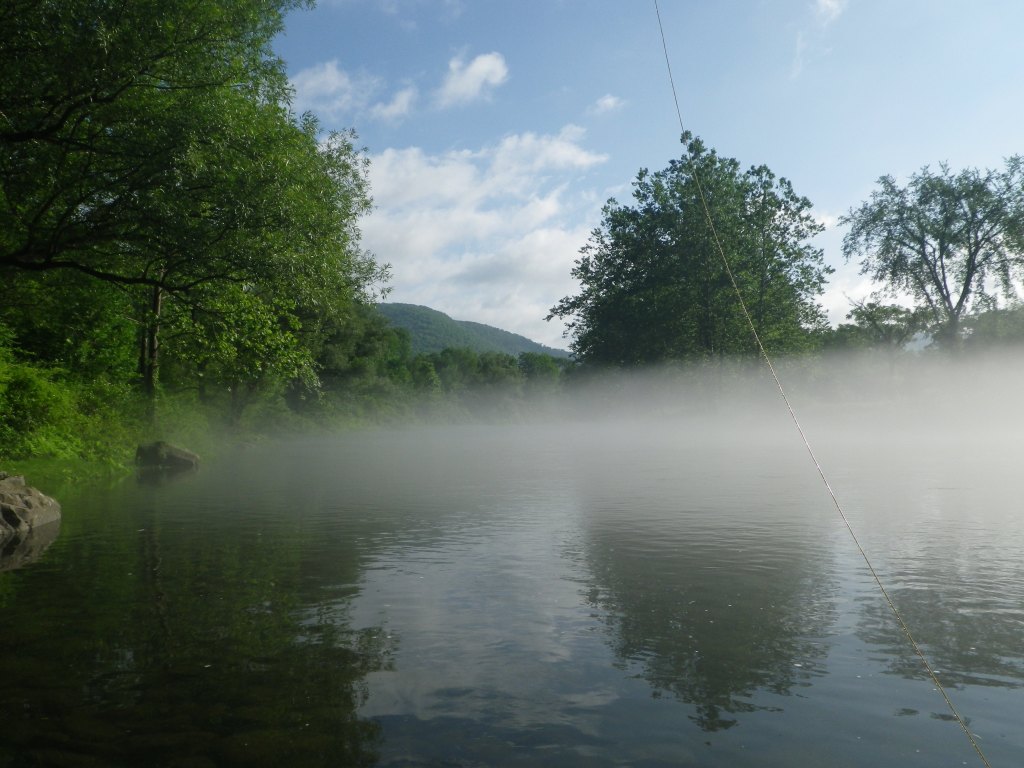
I have rousted myself early this morning, pulling my still damp waders on instead of lingering over hot coffee and breakfast. The lodge is quiet as I ease behind the wheel of my truck and head down to a favorite reach of the river. I park, assemble my rod and string the line through the guides, then begin the long walk.
Twenty minutes later I clamber down the rocky trail, keeping low behind the grass, and slip warily downstream along the bank. It is still, dim, the sun risen, though not yet able to burn through the mountain haze. I find my usual rock seat and settle in to watch.
I select a biot bodied rusty spinner from my fly box, a size 12 to offer enough of an enticement to one of the old browns I seek. It is comfortable here in early morning, with only the sound of the run for company.
When I feel it is time I rise and slip into the river, moving gently out from the bank. I stand for a few minutes, feeling the chill of the current around my legs, and scanning the surface for any sign of life. There are no flies evident in the drift, yet I am certain there are a few tidbits; there always are in this special place.
At last I see the quick wink and a tiny ring appears, then dissipates immediately. I have played this game with the trout that lives here more than once this season. I can feel the excitement build again, but I wait ten minutes until a second tiny ring appears and vanishes, and then I begin to cast.
Five, six casts are placed perfectly to my eye, but each time the spinner drifts down past the rocks un-assailed. I pause and continue with the waiting game, standing motionless until the ring appears again.
I lengthen my line by a foot, perhaps two, quicken my wrist to shock the rod, then drop the tip to the surface with more expediency. The leader falls gently, its long tippet in big, soft curls; and the fly drifts down…and vanishes in that tiny ring!
I raise the rod after half a breath and its tip pulls into a full bend. The trout churns the water with one explosive boil, then heads away into the swift current of the run. He battles hard, digging for the rocks and weeds on the bottom to wrench the offending hook from his jaw. Each time he dives I sweep the rod low and downstream, using the current to turn him away from the snags. I fear for the tippet, wishing I had brought a softer rod, but the hook has a good hold and maintains it under the pressure of the stiff graphite.
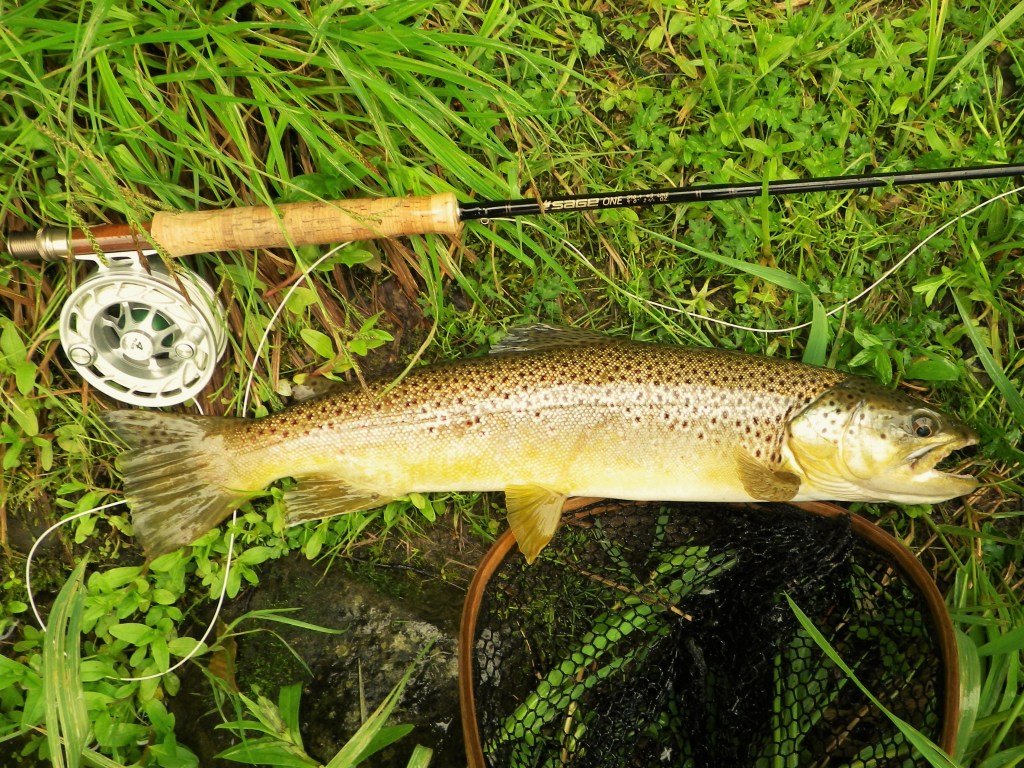
Finally it is done, and I lead him into my net. I walk him to the bank and snap a quick photo in the grass. This one has been an adversary for more than a month, so the photo, a little talisman of victory, will be appreciated in years to come. I thank him for sharing his breakfast and energy with me, and begin the long walk back for my own.







 Bright Waters Catskill