I fished the limestone springs of Pennsylvania's Cumberland Valley for a couple of decades, founded Falling Spring Outfitters, guided, tied and oh yes, fell in love with the Catskill Rivers I can now call home.
At sunrise this morning, winter’s final morning, I enjoyed the pink clouds gliding past the ridge to the northeast of our little village, knowing that I have passed through another Catskill winter.
When I began this odyssey, this fulfillment of a dream long savored, I did not know how long or short it might be. I still don’t. I recall the doctor saying the words, “it is your best chance for long term survival”. Though I was sedated, my mind was clear, calm, considering that I didn’t know if I would be leaving that room. I asked him what “long term” meant and he answered, a little flustered; “well, ten years”. I will pass the eighth anniversary of that conversation this week.
It took three of those precious ten years just to get to my minimum retirement age, to find this little house in Crooked Eddy, and take the necessary steps to make the dream a reality. My fifth full fishing season in the Catskills, the magic land that stole my heart decades ago, lies ahead.
Like any angler, I have my own visions and anticipations of what this season will bring, but none of us really know. Thirty years fishing these rivers has given me some insights and a wealth of memories, but an intrinsic part of the magic of Nature is the surprise of each new day along the rivers.
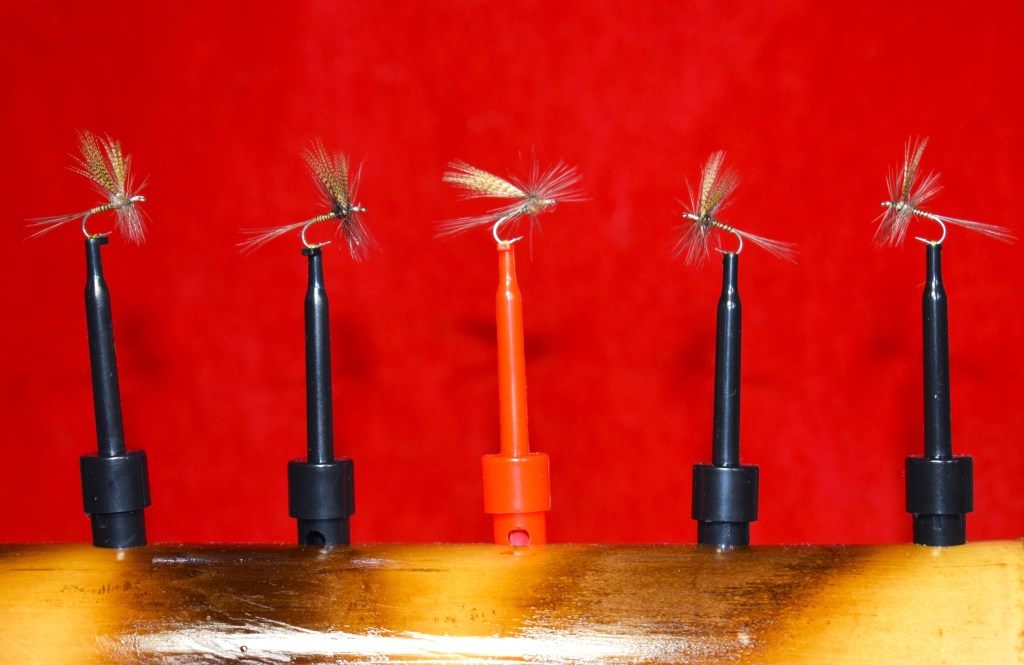
Freshly tied Quill Gordons, old and new, await the coming of spring.
Twenty-four days now until I can walk the riverbanks with purpose again, and still we seem to be dodging Nature’s attempts to elongate the wait. Storm Sage brought a great deal of wind and, I had thought, the winter’s heaviest fall of snow. Out to clear the porch and driveway of her gift, I measured seven inches in a flat area that appeared sans drifts, and ten in another where though windblown, there seemed to be a larger area of constant depth. Cold wind continued amid bright sunshine the day after, and yesterday grew positively balmy with lots of melting.
I feared the worst for our rivers, expecting more snow up high and the resultant high, cold, muddy flows that do nothing good for our wild trout or their environs. With showers this morning, I looked at the river gages with clenched teeth, happily finding a stable situation here on the east side of the Catskills, a bonus with spring just three days away.
Ordering a couple of old books yesterday afternoon I asked my favorite New Hampshire bookseller of his fate. “Thirty-six to forty inches” he replied, “we’re still digging out”. So once again, the Catskills has dodged a calamity ridden storm system, and I give thanks for both the replenishment of our aquifers and the absence of a springtime disaster.
Crooked Eddy on April 8th, 2022: no search for Gordon’s Quills on this day…
I don’t know if there is another storm brewing on the west coast, frigid air from Canada whipping it’s moisture into the next blizzard. I am honestly afraid to look this close to the season’s opener.
We have been fortunate this winter, the snow and rain received having generally maintained the historical average. The trout redds and the insects will benefit from the lack of floods and anchor ice that have marked the past couple of winters, and I have hope for a good season.
It is easy to sit back and dream of warm sunshine on my back and shoulders, a subtle bulge out in front, shimmering like all magic things do, as I lengthen my line and drop the dry fly smoothly above the center of the whirl. Will he take?
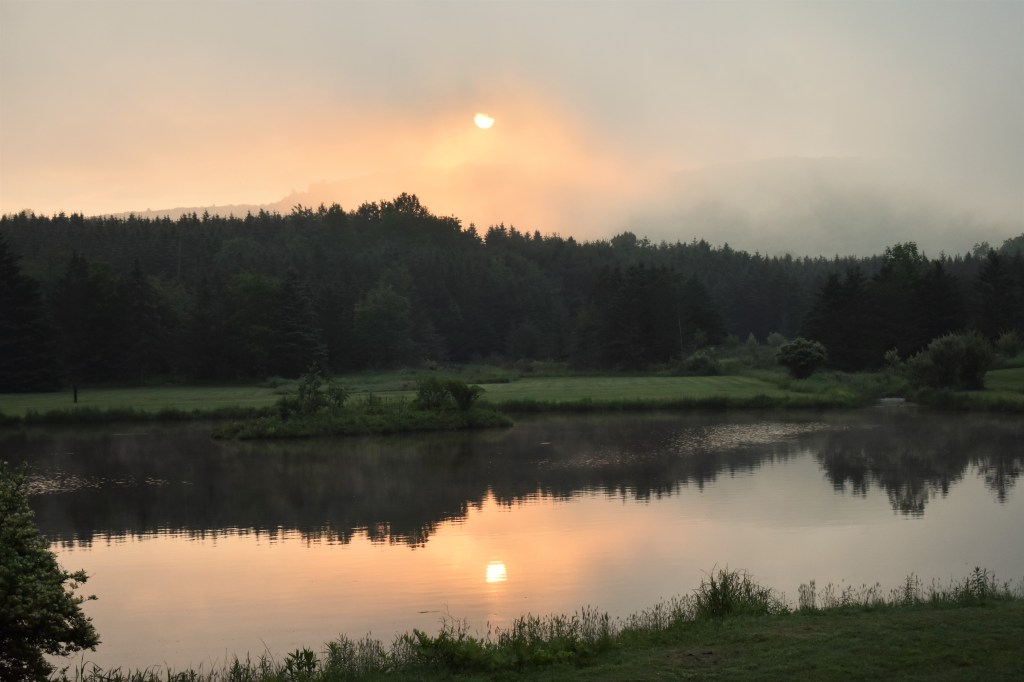
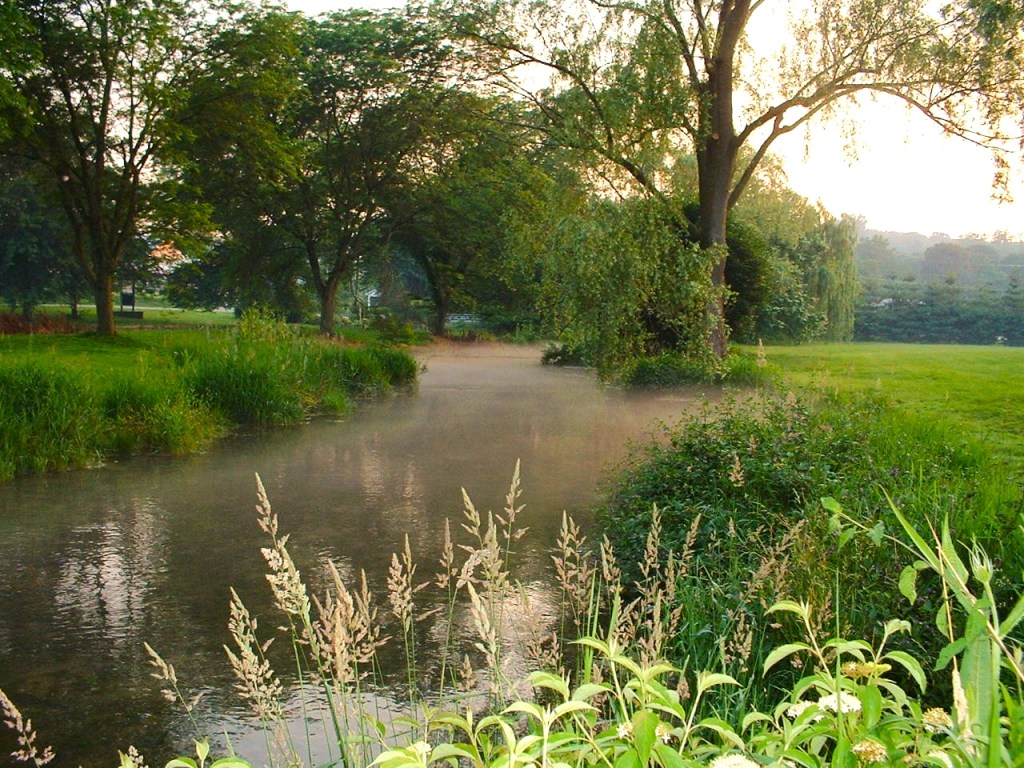
Falling Spring as evening approaches: the humidity causes the mist to rise from the cold spring water as anticipation builds for the sulfur hatch!
I have decided that this snowy day is perfect for tying sulfurs and daydreaming of warm air and bright water.
It was the late Charlie Fox who began referring to the little yellow orange mayflies that frequented the water meadows of the fair Letort and her neighboring streams as sulphurs, so far back in our concept of angling time. These lovely little mayflies were the featured performers on the Cumberland Valley limestone springs and Maryland’s Big Gunpowder Falls, my own first and favorite hatch as I entered the secret world of wild trout with the fly rod.
I still remember the magic of those calm, warm evenings along the Falling Spring, friends gathering early to speak in hushed, excited tones of the best patterns and the trout landed recently. The sulfurs have remained special to me throughout three decades of chasing wild trout in bright waters.
Here in the Catskills we get an extra dose of this magic, enjoying the classic evening hatches in May and June, with another two months of summertime technical fishing as the sulfur hatch continues on the tailwaters! Throughout the spring and summer, we are blessed with emergences of several species, fishing to trout rising to flies from size fourteen to twenty. Coloration varies, with some flies being best imitated with a true pale yellow dun, and others demanding that subtle mix of orange. I have seen these variations often in the same water during the same afternoon.
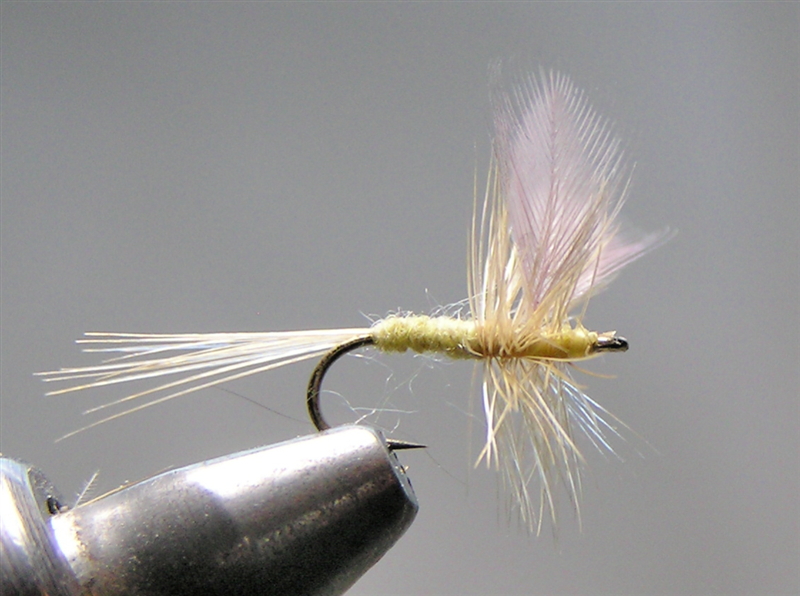
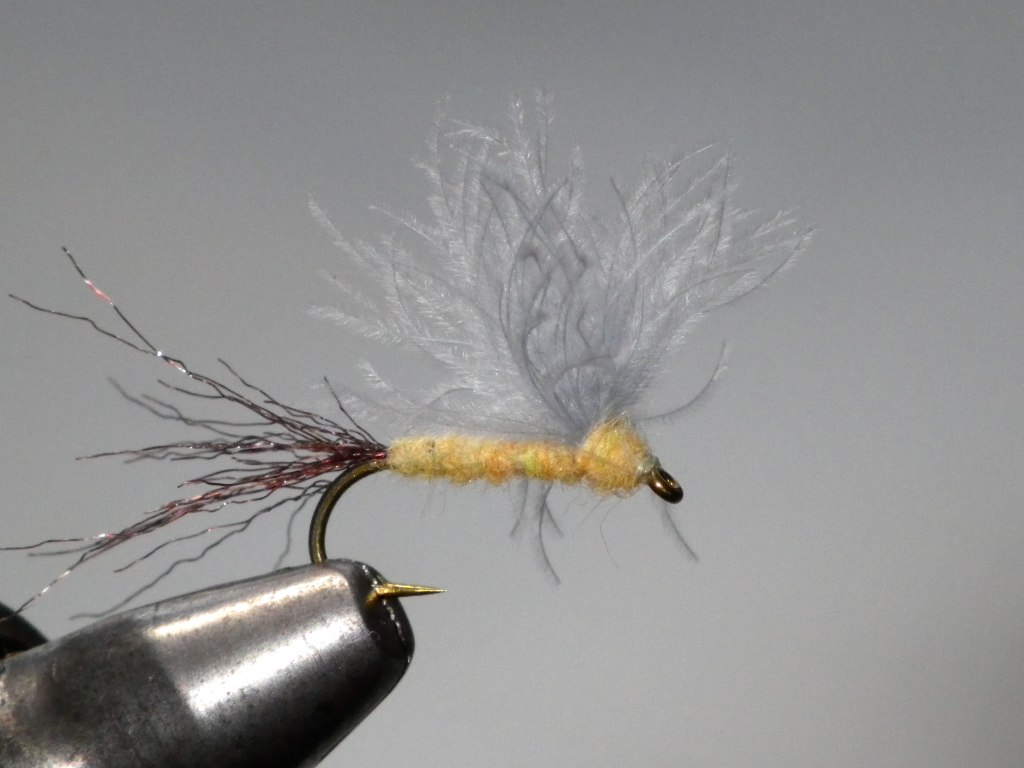
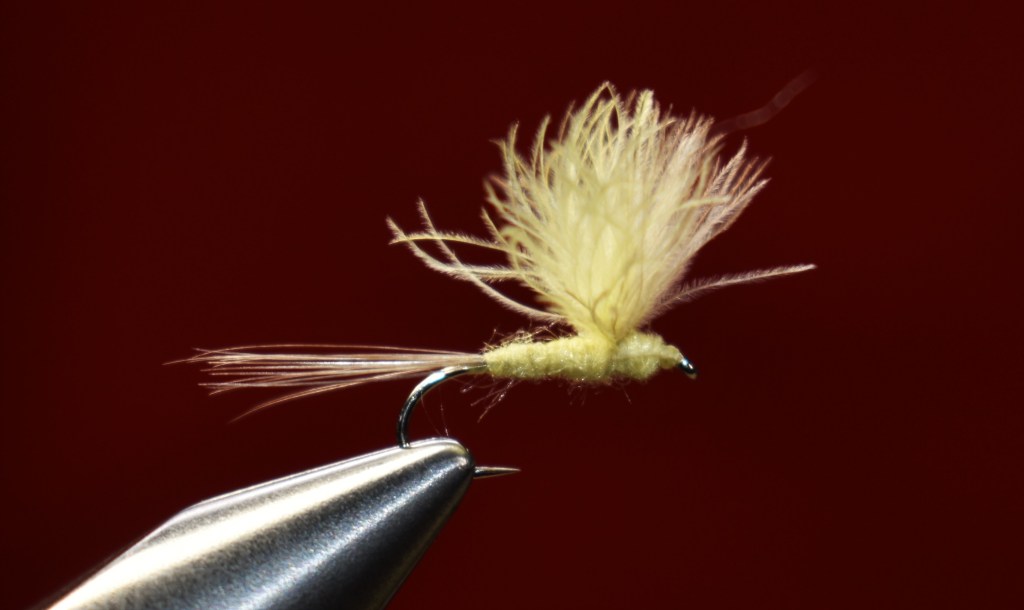
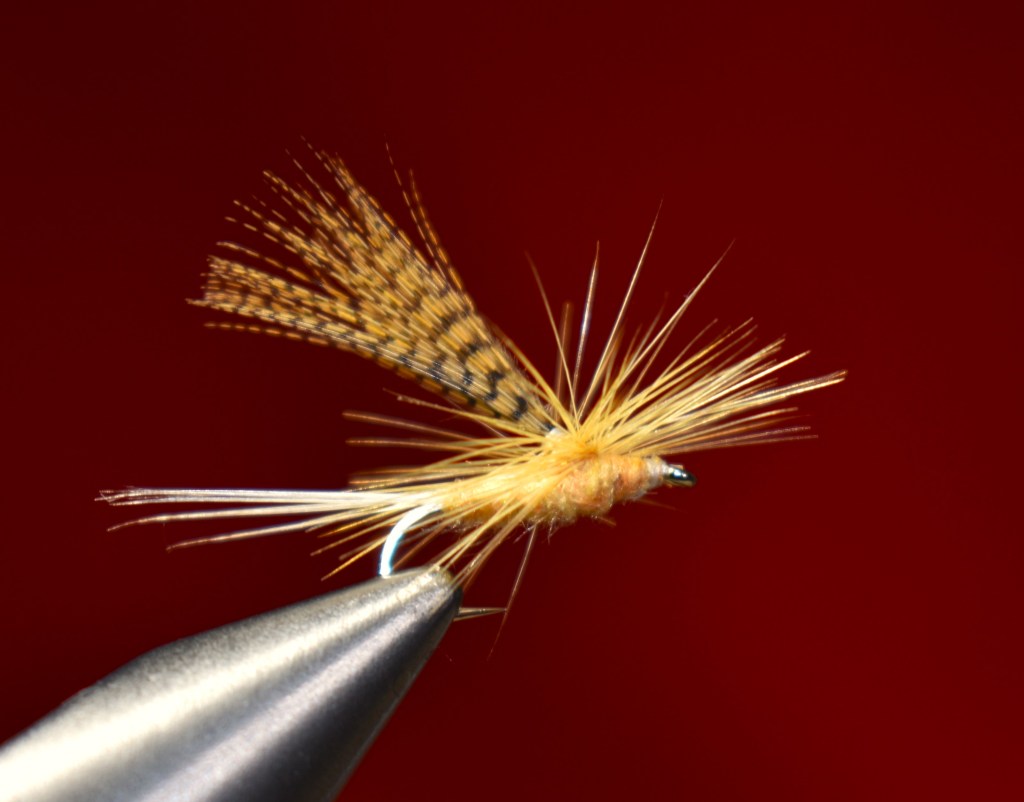
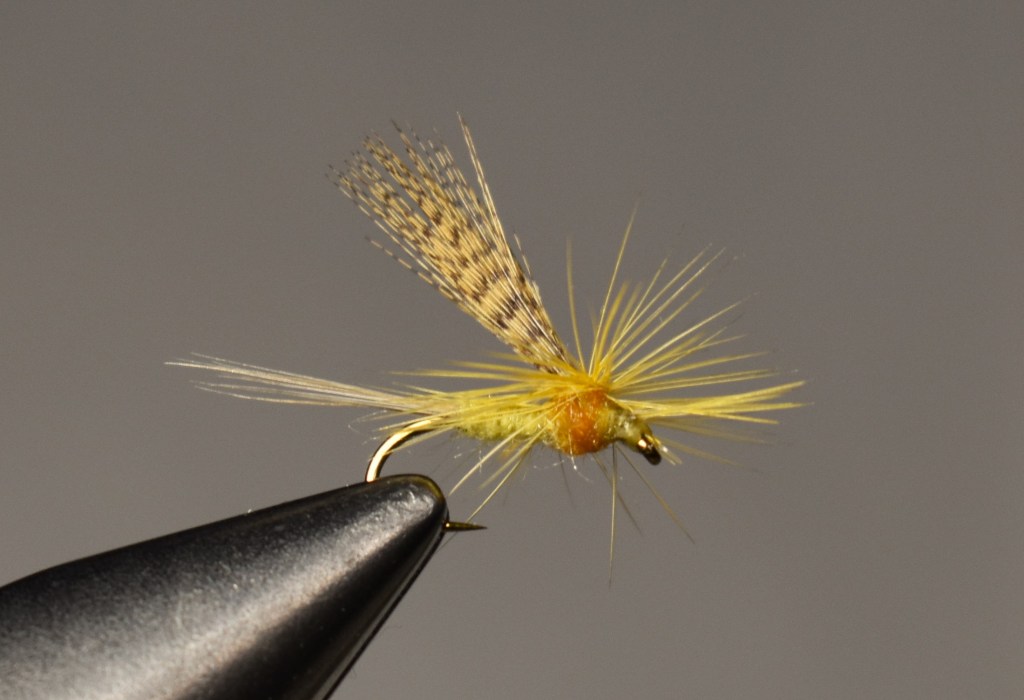
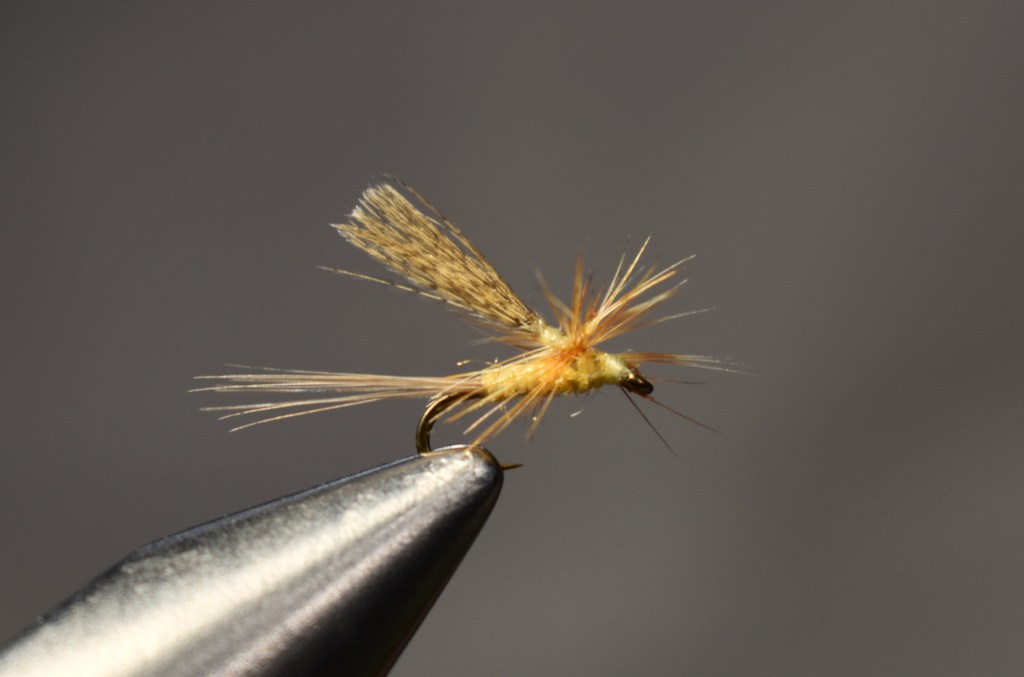
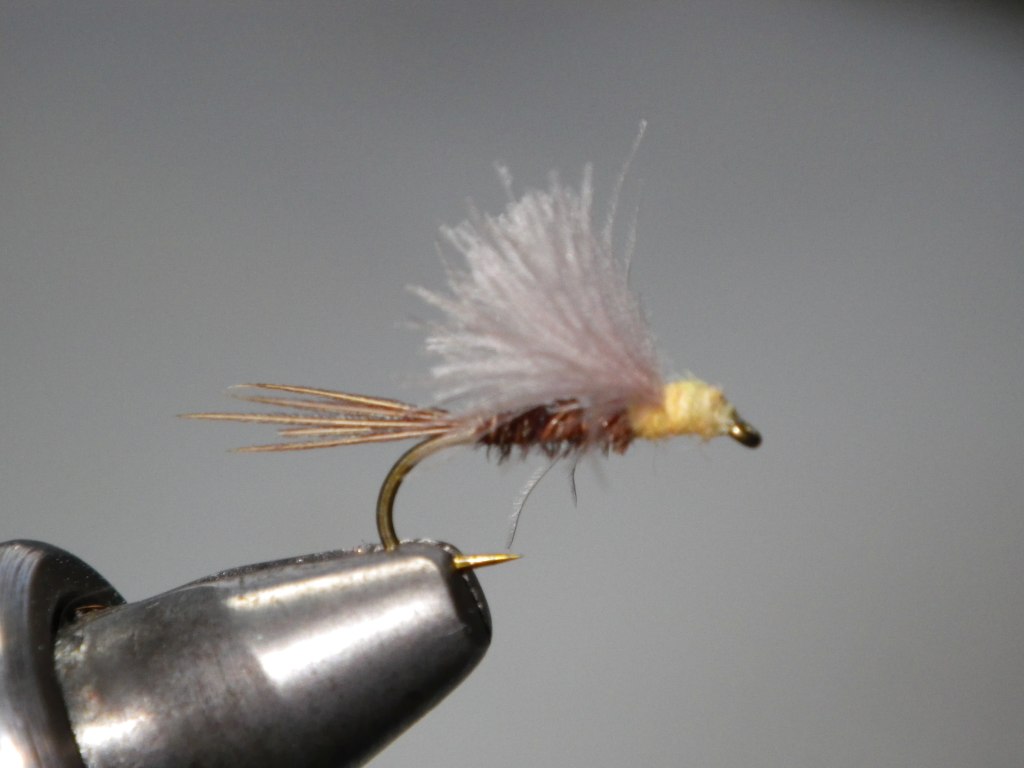
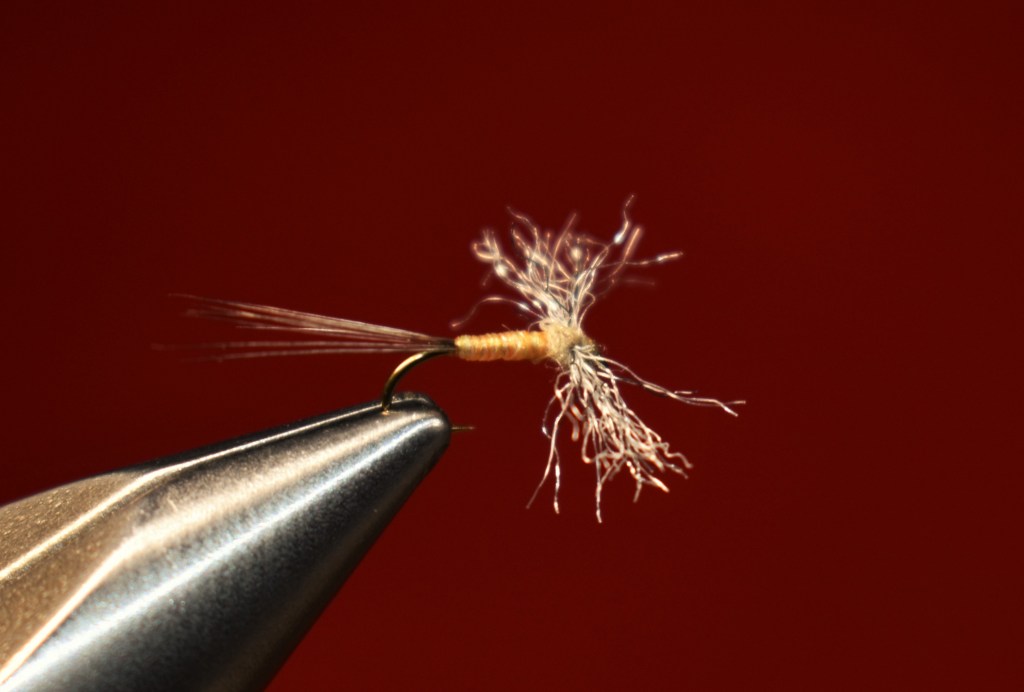
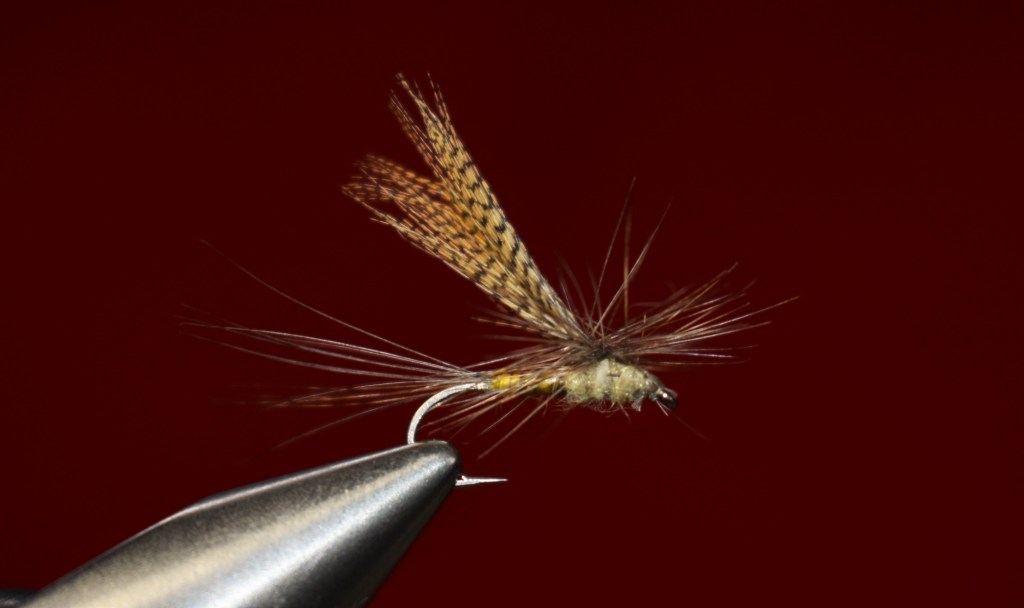
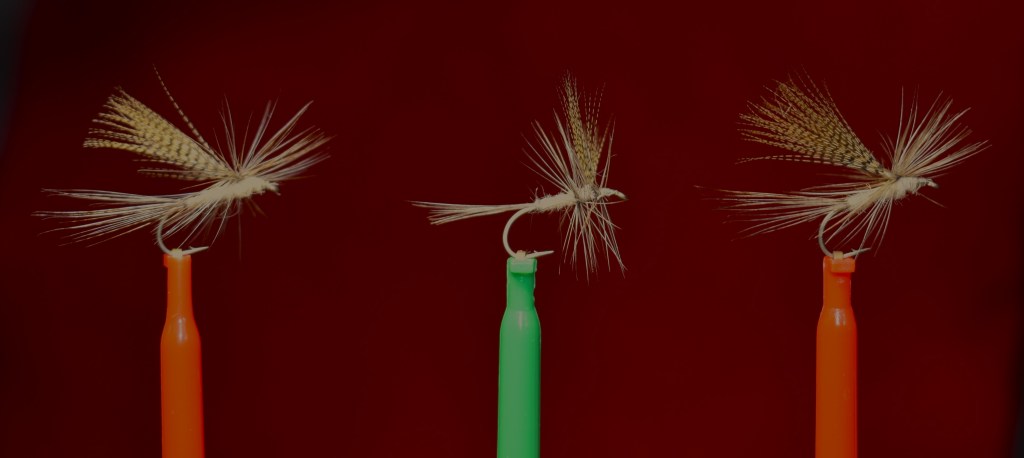
Sulfur patterns then and now, from an early hen wing through CDC dries to the Translucence flies and my tiniest 100-Year Dun.
I have always marveled at the variety and the subtleties of this hatch, and how much has changed in three decades of fishing it. That very first afternoon the Gunpowder browns were keyed upon yellow, ignoring the best imitation in my meager selection, a size 16 Light Cahill, and taking the Elk Hair Caddis that was the sole yellow bodied fly I owned.
Last summer I noted little flurries of orangish, size 16 duns coming down one edge of the riffle, while the full width of the river was covered with pale yellow eighteens! I took some fine brown trout by fishing my light orange sixteen 100-Year Dun along the tail of that particular thread of current, downstream in some difficult water.
The trout have become warier and more selective as the throng of anglers has increased season after season, so perfecting new patterns has become an ongoing challenge. Today’s sulfur hatch often requires a wide variety of flies, imitating variations of the phases and colors of the naturals. Presentation remains paramount, and that includes the ability to recognize and match those subtle variations an individual feeding trout keys upon.
I have heard and uttered the same lament: “this fly was killing them yesterday, but today they won’t touch it!” We must beware of settling into a comfortable routine. Experienced anglers know this, yet we still do it, for it is part of our human nature.
Trout learn to avoid the disturbances of heavy fishing pressure in different ways. Some will ignore even natural duns, selecting drowned emergers and cripples out of the main currents, while others may vacate the prime spots in the best runs and pools altogether. I have found good fish that may not have moved far, but have been blissfully left alone on a busy river because they settled for small pieces of very marginal looking water.
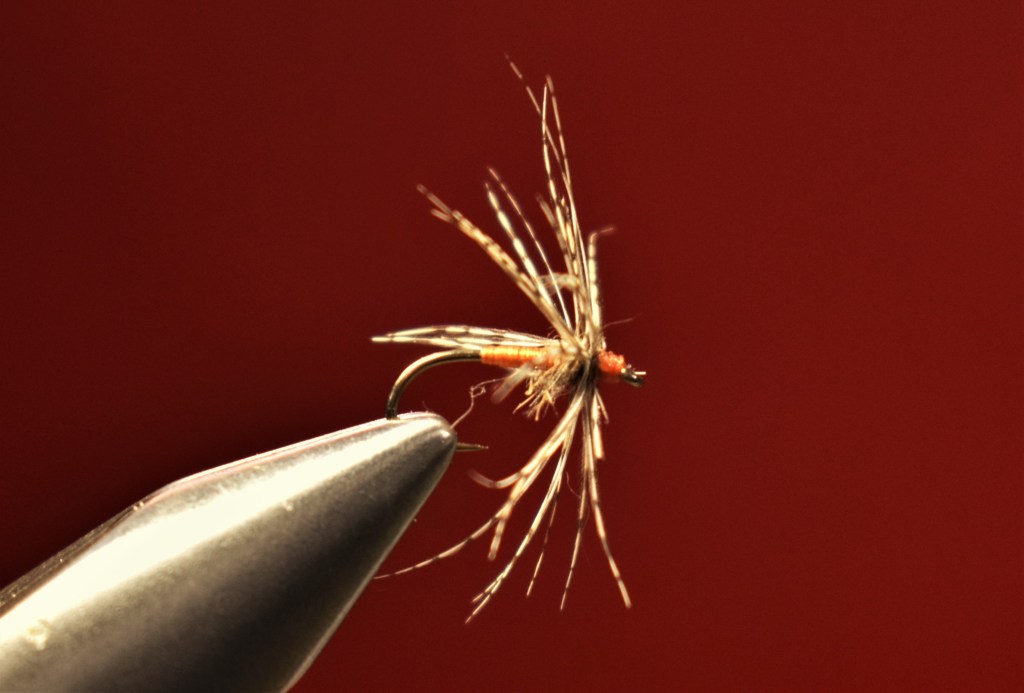
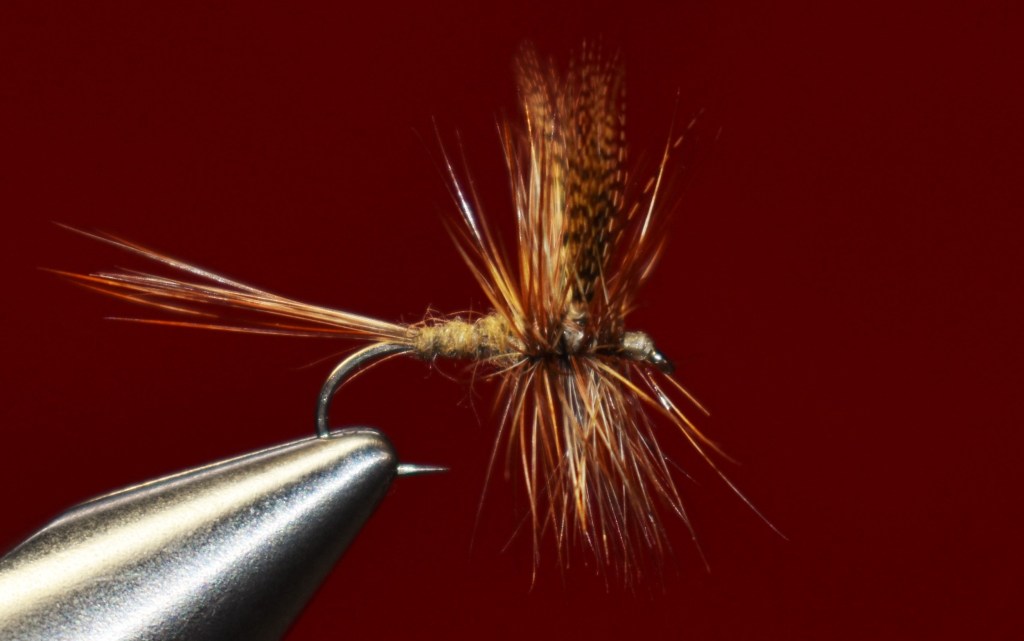
Emergers, cripples and spinners: Sometimes an old standard like the Partridge & Orange can fill in for either stage of a sulfur mayfly, and it may appeal to that difficult fish because it isn’t the same style of fly he has been ignoring for two hours.
Summer finds me carrying at least two sulfur boxes and a crisp eight-foot bamboo rod that fishes a four weight line. Such a rod can be the perfect foil for the variety of angling situations I can expect to encounter.
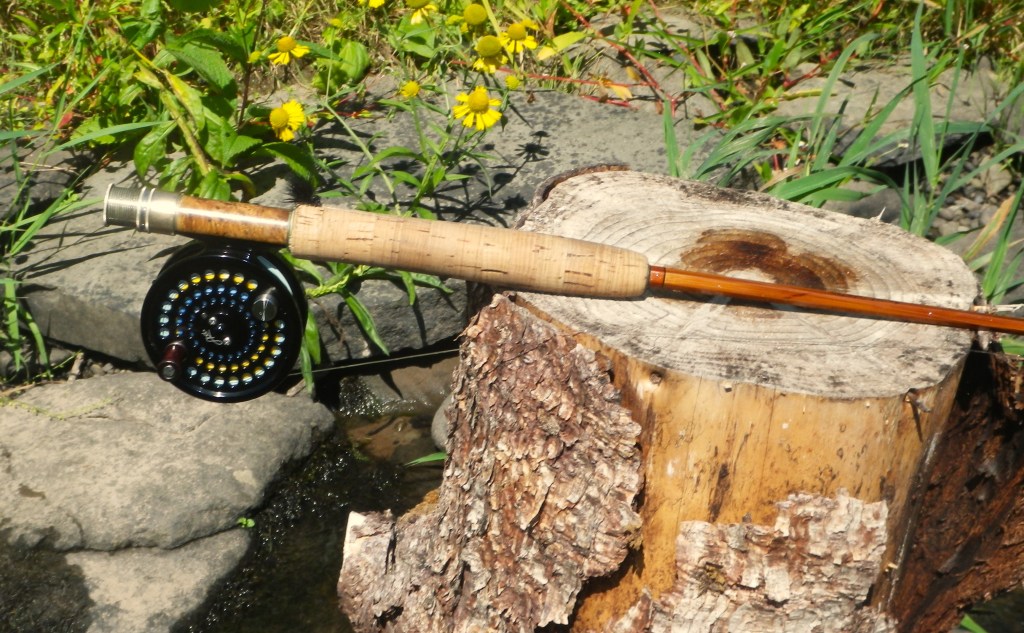
“A crisp eight-foot four weight”, the late George Maurer’s Queen of the Waters.
Trout can be found sipping sulfurs from bright riffles and runs to clear, slow pools, depending upon time and conditions and their individual preferences. From mid-May through August, I often encounter brief little appearances, perhaps no more than a dozen flies drifting downstream over a span of five or ten minutes. I might see one or two rises during these occasions. If I do, I pin down the trout’s location and get my fly to him as quickly and perfectly as possible!
Some of these moments garner more favor among my memories than some of the heaviest, sustained hatches.
One evening years ago, I sat on a riverbank sipping a chilled lager while hoping for a Green Drake hatch. As the evening progressed, I noted a few sulfurs drifting down through the run and, eventually, a soft dimpling rise near the far bank. I finished my beer, rinsed the bottle and placed it in the back of my vest, then slipped gently into the river.
A size 16 sulfur comparadun had replaced the drake on my leader when the first flies appeared, allowing me to take advantage of one of those ephemeral moments encountered along the rivers. I waded quickly but carefully into position and offered my sulfur to that bulging and dimpling trout with a long reach cast. He took it as softly as he had taken the naturals, then exploded when I lifted the rod. He turned out to be the first of a pair of beautiful wild browns the sulfur delivered that evening, each passing the twenty-inch mark on my net handle. There were no other risers, and no drakes encountered that night, though I stayed until darkness blanketed that little grove among the trees. Honestly though, I didn’t miss them.
We have passed the thirty-day milestone in the countdown to dry fly bliss as we sit upon the brink of the March blizzard my unsettled thoughts warned me about. Eight days from the vernal equinox and the thermometer reads 19 degrees here in Crooked Eddy.
The local forecast I trust the most calls for just more than ten inches of new snow between Monday afternoon and Wednesday morning, though by Friday they expect a high of 48 degrees. That spells high, cold, muddy water in my river oriented mind, something I was looking forward not to having as spring made it’s official debut. I don’t begrudge the mountains a little late snowpack, its just that I would rather it hang around and feed the springs slowly rather than vanish in a heavy rush of runoff.
Nature will bring us what she will.
I have slowed my fly tying during the past week. With my donation flies completed and my boxes fully stocked (some too fully), my attention has shifted. Welcome to that uncomfortable stage of winter when anticipation overcomes patience. I have done a little work around the house, worried about upcoming medical appointments, read a lot and fidgeted, with nothing able to hold my attention for any length of time. I need to go fishing!
My hand needs to wrap the cork of a favorite bamboo rod and my fingers are ready to tie the knot to join fly and tippet…
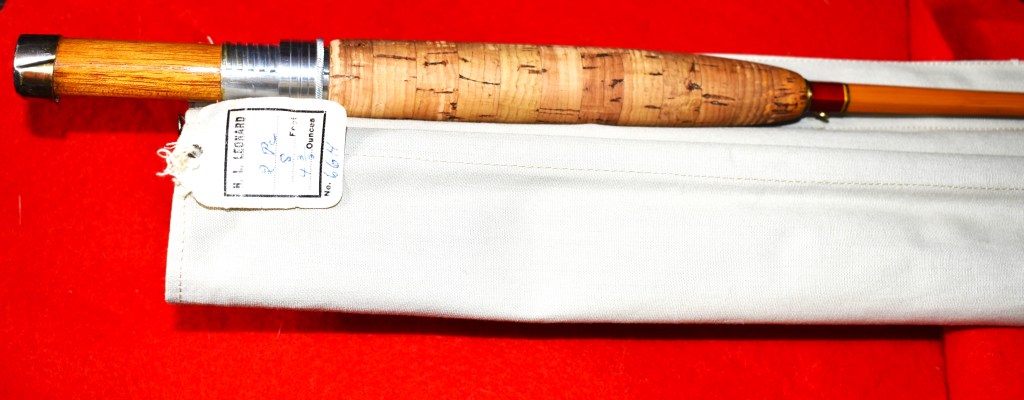
I wonder about the river conditions twenty-nine days from now. Will the winds do their worst, or will the season begin with fair, calm days? I’d like to begin with the Leonard and give a nod to Catskill tradition. The Leonard and a Quill Gordon dry fly on the Beaver Kill, yes, I like the image of that, the day overcast but with an hour of sunshine as evening draws near…
There he is, right in there tight, where the current slows, even back-eddiesa bit. All I have to do is put it in there gently a scant foot above him, with nary a ripple and loads of slack in the tippet…Oh, and make sure the speck that my eye starts tracking is my fly and not one of those real bugs!
Funny sometimes how our thoughts run during this tortuous time we call the off season. Just yesterday I was thinking about easing down the river, stalking bank feeders, that and the effects of those little faerie winds that drive anglers crazy.
Wind is of course always a major consideration when it comes down to presenting a fly. Here in the Catskills, it controls everything about fishing when it blows fairly hard: where we can fish, how we can fish, and at it’s worst, whether we are likely to catch any fish on a dry fly. Winds are major players in this game, whether blowing like a gale or whispering like soft breaths of a babe.
The prevailing winds for the day must be considered when we chose our location, along with river flow and the general wadability of the water where we hope to find rising fish. If the depth and current speed allows freedom of positioning, we can usually plan our approach so that the wind doesn’t defeat our casting. On our relatively large Catskill rivers though, we don’t often have that freedom during the prime insect weeks of spring. Even when the conditions do allow a reasonable casting angle to deal with the prevailing winds, it is often necessary to make casts from a distance. The Red Gods impose a rule in these situations, to the effect that the limit of wading shall remain at or just beyond our maximum casting range under the conditions.
As fly fishermen, we are firmly bound by this rule, whether we recognize it as a rule or not. Wet vests, waterlogged fly boxes and seepage over the top of waders are the warning signs allotted by the Red Gods, warnings often followed by a dunking, or worse if ignored. There is another insidious ingredient involved though. When we find that extra foot or two of casting range, steady ourselves in more current than we prefer, relax and make that perfect cast, the faerie winds are brought to bear. Gentle, capricious yet irresistible, they can be the most trying test of our angling temperament.
We know we must control the leader and the fly so that it drops gently with controlled slack. Anything less and our fly will drag and erase the possibility of taking what might be the trout of the season. An experienced caster and dry fly fishermen knows when everything feels right. Yet time after time, our fly falls short, seems to drift off track, or even curl back toward us with insufficient slack to make the drift. Faerie winds have wafted our fly away from it’s target!
Now the scientists among our ranks will blubber about back drafts, the prevailing breeze being unsettled and pushed away from the shoreline by the intrusion of riverbanks and vegetation disrupting the flow of air over open water, vectors and thermal inconsistencies… bullshit. The truth is that the faerie winds are the extra ace in the vest pockets of the Red Gods that plague us!
Faerie winds are invoked when the gods are not satisfied that we have labored half an hour against buffeting winds, slippery rocks, and current deeper and faster than our best wading technique can normally surmount, to somehow arrive in a position where the distance to the subtle ring against the bank is less than or equal to our best cast. We have not yet earned that trout in their estimation; thus, they invoke the final test.
Current, right to left, wind left to right; andyes, those are the beginnings of whitecaps blowing upstream!
Passing their final test is beyond difficult. Each cast softly wafted back toward us, half a foot from the line of drift that trout is lying in results in the tensing of the muscles in our necks, backs and casting arms. Five casts, ten with the identical result, and by then our technique has begun to noticeably deteriorate. We curse, apply more power to our casts, and our fly drops farther from the target. Fuming, more cursing, and then an attempt to slide one precariously anchored foot closer to that bank. We feel the gravel slipping out from under that foot, recoil, and nearly lose it. Okay… calm…
Stretch the neck, wriggle the shoulders, adjust the tippet by one size, or it’s length by six inches. Make another cast.
I am persistent in this ritual, some of you perhaps less so, some more. If we keep at it long enough, if we somehow manage to quell the frustration building between our ears, on some days we may actually pass the test. Either that, or the trout will stop rising.
Many of us live for those rarest of days, those when we finally conquer all of our foibles, physical and mental limitations, and make that perfect cast. The faerie winds are stilled, the leader uncoils perfectly and drops the fly in the exact position and line of drift, resulting in a perfect float. In a mix of amazement, celebration and gratitude we watch that float all the way into it’s envelopment by a brand new ring upon the surface, raise the rod with perfect timing, and feel the energy of a seven-inch chub!
So here we are, more or less walking down that last hallway toward spring and, well, we’re having one of those little cold snaps that feels like spring isn’t closer, but farther away. A couple of smaller winter storms have passed through the Catskills and another is on it’s way. The story sounds the same: we might get some accumulated snowfall, but maybe not.
We had most of our allotment of frigid cold and snow in December, an effective way for Mother Nature to beat us down and scold us that it is winter, and we need to forget about that fishing nonsense. Once we got through December though, there were a lot of warmer days, some nice enough to get out upon a river and wet a line. February found us wandering through a number of days in the forties, the kind that almost tempted me out to the water but fell short more often than not. That had the desired effect, for with March beginning I got that old anticipatory feeling again, the craving for an early spring.
I remember the last truly, early spring, back in 2011. There was a long run of sixty and seventy degree March weather down in the Cumberland Valley, and we heard stories about the trend spreading north.
March Madness 2011: Seventy degree shirtsleeve weather, an honest early spring, and prowling the Falling Spring to find a good brownie. That was a dozen years ago and was the last really early spring encountered. The landscape may have been bleak, but the fishing was good!
There were Grannoms and Hendricksons on Penns Creek that March and some Blue Quills and Quill Gordons reported in the Catskills. I came up fairly early in April that year and found some Hendricksons here and there. The result of the seasonal change coming several weeks ahead of schedule was a boom or bust season, with the accent on the bust. Hatches dribbled off over a month or more without anything more than a few isolated heavier emergences. Rising trout were not a common sight. If you happened upon more than one or two of those, you were in the minority, and the same theme continued right on through the entire season.
As much as I long for the commencement of the dry fly season, I cannot say that I would be willing to trade that truly early start for a generally substandard year again.
The ideal early spring to me is for things to get going during my target week and build from there. There are seasons when the water temperatures have remained cold and the spring bugs have not hatched until May, the dreaded late spring scenario. When that happens, the rest of the hatches seem to come on top of one another until we reach the finale one short month after the beginning. I have fished through a number of those seasons here, and I always end up feeling like I have missed something, no matter how fast and furious and good the fishing has been.
By the beginning of the fourth week in April, you expect it to happen. That is phase one of a late spring, since we should have been catching trout on dry flies for a week by then. Trouble is, that pretty sunshine may not be strong enough to overcome wind and lower air temperatures and warm that water up!
If I get my wish this year, I have at least a month to weather the cold snaps and dream about fly fishing. I don’t want to think about the possibility of waiting longer than that.
Its fly tying night again tonight, as our little band of Guild members tackles the Bradley Special. I have tied a few this week already, so I may do more watching and talking than tying tonight. These cold snaps tend to distract my concentration a bit, making for a few days of reading and fidgeting and sort of milling around going nowhere.
I did have an idea for a light version of my Catskill Adams yesterday, so I blended some dubbing and tied half a dozen of those flies. I have to make room in the main early season box for them so they get a chance when spring does come.
Scruffy, bushy and buggy, the Light Catskill Adams looks like it has promise for fishing faster water once Hendricksons and March Browns start showing. The lighter version uses Fox Squirrel like the original, but has more of the tan belly fur in the blend.
For now I guess, its just another chance to hunker down for the duration of this cold snap!
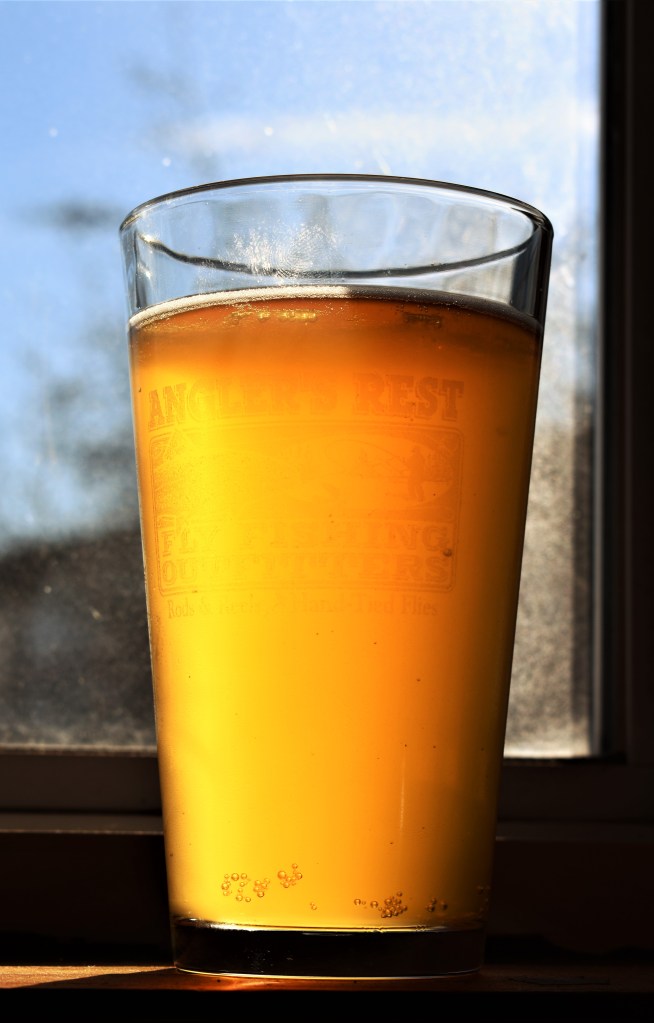
Cold Snap: My favorite beer, and I can only get it when the weather inspires the name.
I was sitting in the living room just now, reading a bit, when I realized it was getting on to five o’clock. Looking out, there was still plenty of light in the sky, part of the tangible change as the days lengthen gradually toward spring. It wasn’t that long ago that it was nearly dark at this time of day.
Though the days are actually growing longer, it seems somehow easier to pass them than it has all winter. Having the goal so much nearer is a factor in that perception, as is the continual march of the years. My paternal grandmother lived to be 96, and we used to talk about the passage of time, and its habit of quickening as we get older. I remember her saying that “the years passed like lightning”.
As an angler, I get the opportunity to move back and forth in time so to speak. When I tie a Catskill dry fly in the vintage style, or thread my fly line through the guides of a classic bamboo rod, I step back, perhaps fifty to one hundred years in thought and deed.
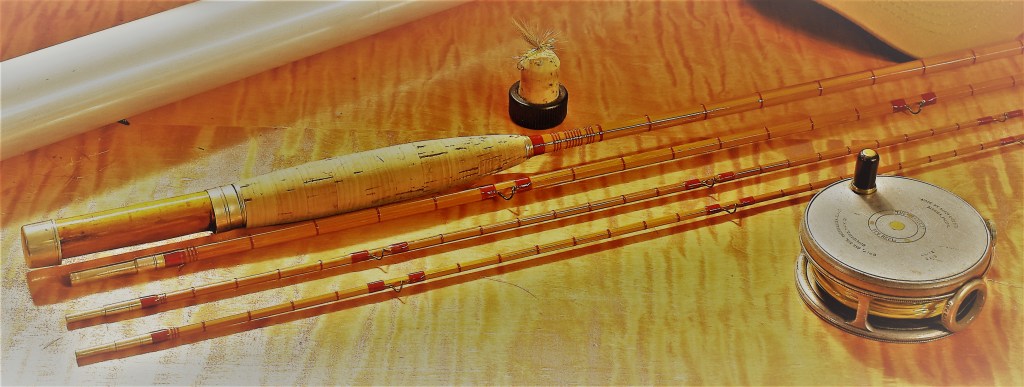
The F.E. Thomas rod was first wrapped and varnished in 1918, while the Hardy Perfect is a comparatively brand new product of the 1930’s. The fly is my own tie, quite recent, though inspired by Theodore Gordon more than a century ago.
When I cast one of these fine old rods, I bridge the gap in time as it bounces with the lively energy of a trout as it did when it was young; the rod is the conduit, a fragment of yesterday, the trout very much alive and running wild with the energy of today. This is but a part of the special magic that graces those of us who angle with vintage tackle, that chance to live in both the past and the present for those golden moments when a trout takes the fly.
Memory is one of the most cherished gifts of a life spent in angling, and there are times when I pause to notice the special beauty of the afternoon light upon the water and wonder if what I feel might be some connection to the past. Is there some of the life energy of a past owner of the vintage rod and reel I carry still there in the golden bamboo?
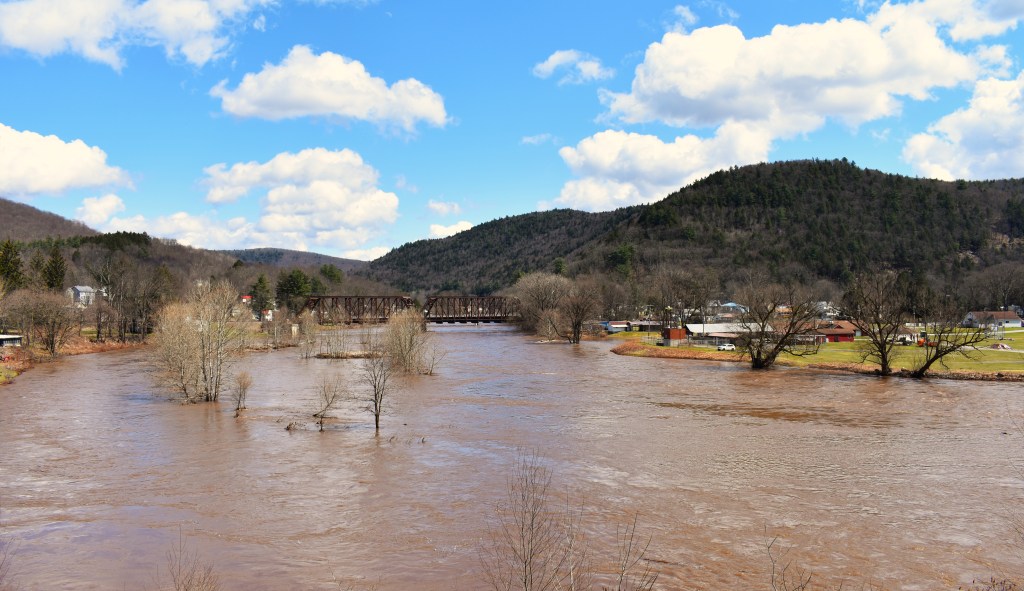
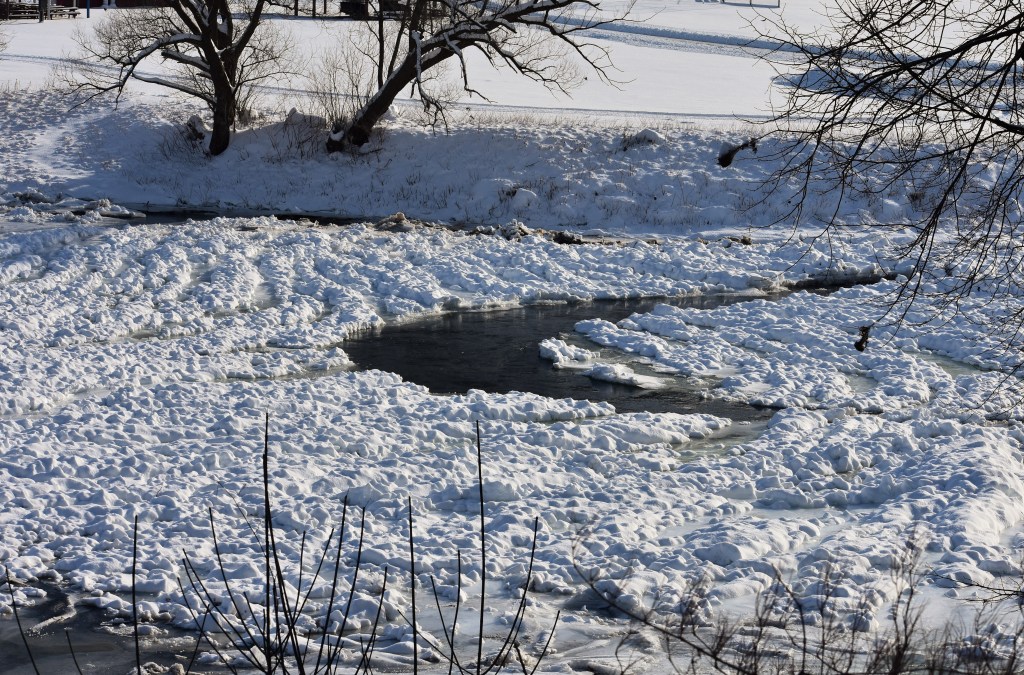
Ha! Fooled Ya! This thankfully is not the state of our rivers this year.
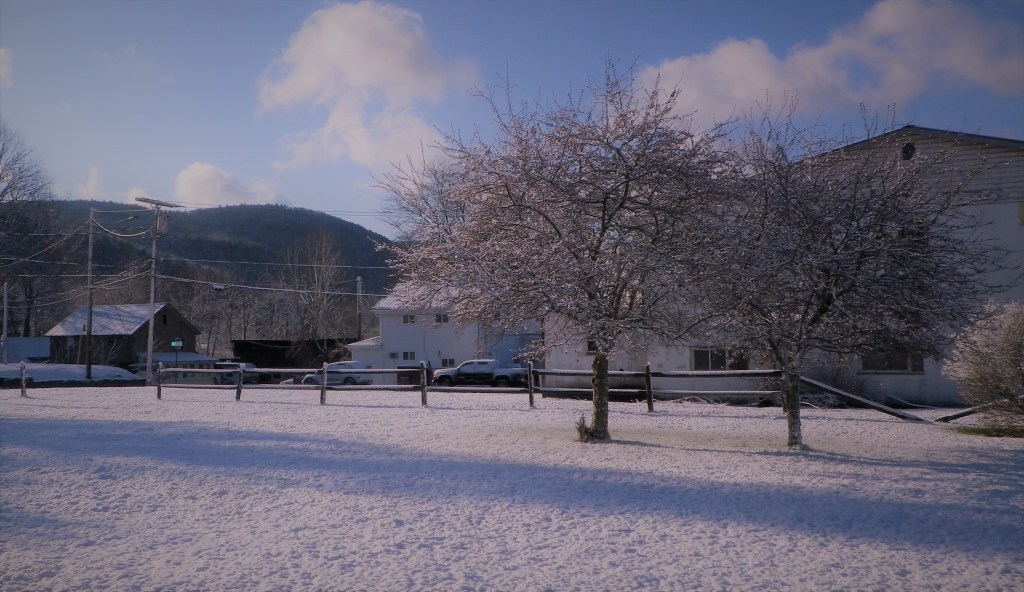
There are still a couple of inches of wet snow lying around the yard, but there is a little unexpected sunlight filtering through the clouds as it rises over the mountains to the southwest. A nice winter morning, all things considered.
It is finally March, the final push to get through another winter and take those first tentative steps into springtime. We are three dozen days short of that hopefully magical week when a few mayflies ought to be noticed fluttering on the chilled surface, a ring appearing beneath one that didn’t come from a falling raindrop.
April 12, 2021, 4:32 PM: the result of the first rise of the year, and having a Blue Winged Olive tied on a ready to be cast!
True, the middle of this week is expected to stay right near the freezing mark; I mean the run of warmer winter weather we have been having can ‘t be expected to just flow on into spring, now can it? Looking at my anchor box as I brushed the wet snow off the drift boat yesterday, I noted that the lid is going to need a new coat of varnish. Either that, or I may simply have to resign myself to abandoning the natural wood look I like and paint it black like the rest of the trailer.
I will have to get past this coming week before I get into that. Neither painting nor varnishing goes particularly well in freezing temperatures. When I do uncover the boat, I’ll do a careful inspection of the trailer. Two years ago, I had everything cleaned and ready to go, then found that the front bunk had pulled up from the frame, requiring a major re-build before I could take it fishing.
Just now, things look to be shaping up for wadable conditions when that countdown ticks to zero, though the weather here in the Catskills has a history of surprising me.
There are a bunch of things to do, things I have put off as winter wound slowly along. Small stuff mostly, digging out the boat bag and making sure the right fly boxes are in there, along with a few new leaders, floatant and tippet spools. I still use graphite rods when I float the rivers, and I like to get them out and put a little wax on the ferrules, check the fly lines on the appropriate reels. The old Granger 9050 still keeps pleading with me from it’s place in the rod rack. If I take an hour to install the bamboo rod holder I built some time ago on the front storage box, it can finally assume it’s role of boat rod. That fine old, bamboo will look good out in the spring sunshine!
The worry in the back of my mind as this month ticks past is the chance of a dreaded March blizzard. That happens some years, and I really don’t want to see another flood coming down through Crooked Eddy as April comes calling. It may have been a warm winter, but its still been a long one.
I’m still basking in the fun had at Fly Fest, while looking forward to the Angler’s Reunion at the end of this month, and then April first! It may not be opening day for legal fishing anymore, but its still an Opening Day tradition for a lot of old time Catskill anglers.
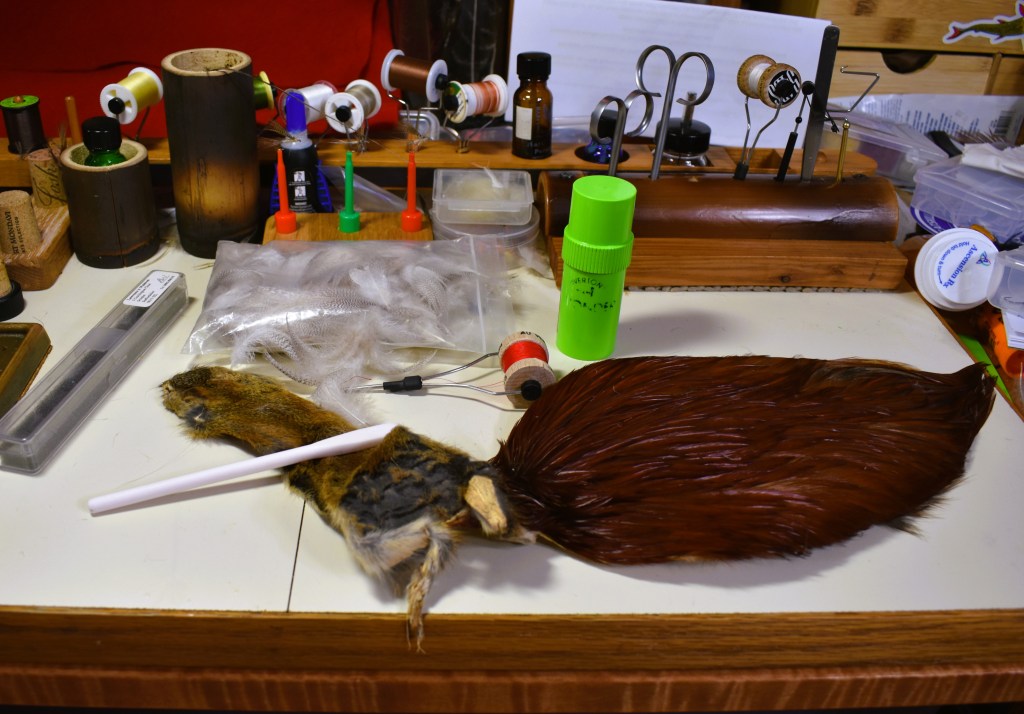
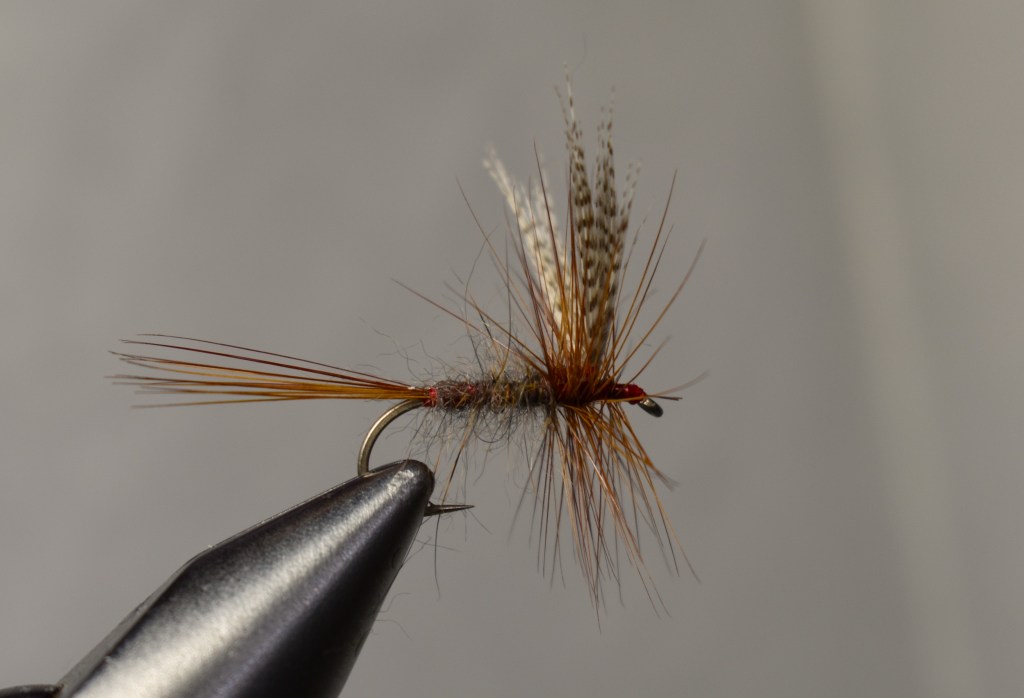
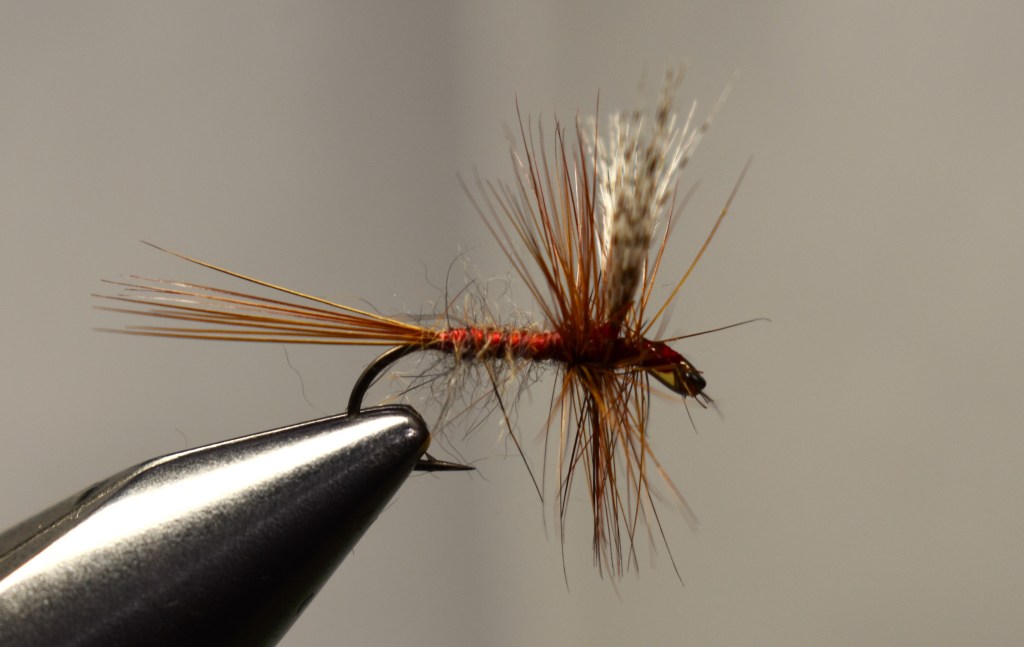
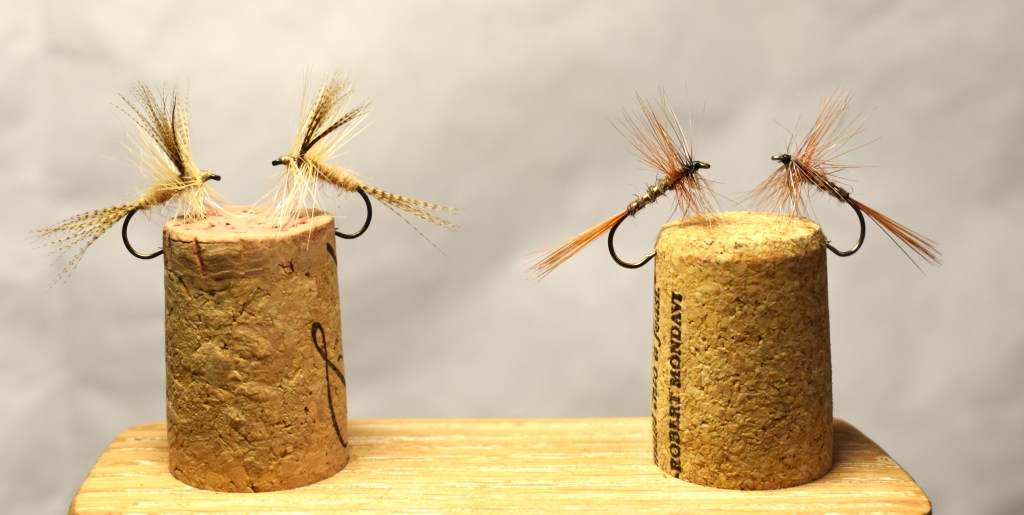
Considering the “Bradley Special“: A body of Red Squirrel spun on red silk, mallard for the wings, slightly flared, and hackle and tails from a Rhode Island Red rooster.
As the Catskill Fly Tyers Guild worked their magic in salute to Rueben Cross’ Catskill legacy through tying his signature fly the Cross Special, talk eventually got around to continuing our search through history for next week’s pattern. John suggested one of the more interesting and obscure dry flies, the Bradley Special.
Though I instantly recognized the name, it took a bit of searching through my library, to find some details in the late Eric Leiser’s wonderful book “The Dettes-A Catskill Legend”. The pattern is found in the notes and samples from the Dette fly shop, one of the custom patterns they tied to order for one William Bradley. The design seems to have originated with Bradley and angler William Chandler. It seems Mr. Bradley tried the patience of the Dettes with requests for many variations he liked for changing water conditions and times of the season, but the standard pattern is the fly that John had discussed with our group last night.
Of course, I grabbed a Red Squirrel skin and my Rhode Island Red cape and tied a pair. The Dette notes called for the fur from the back of the Red Squirrel spun between two strands of red silk which can be made easily with a dubbing loop and spinner. The result is quite full in the body, though it can be thinned out with care, clipping individual guard hairs and inserting them sparingly in the loop. An alternative, proffered by Tom Mason is a touch dubbing method, which produces a lovely sparse body and reveals plenty of red silk.
The Bradley Special tied with a fuller, dubbing loop body on the left, and with the touch dubbing technique on the right. A dubbing rake is a handy tool for the touch dubbing method, removing a slight amount of underfur and guard hairs with a single light stroke along the hide.
This recent concentration on older Catskill patterns, flies which have not retained their original popularity, piqued my interest and had me reading about and tying another old original that very much suits my style. Theodore Gordon had his name associated with another fly besides his venerable Quill Gordon. The fly he originally called the Golden Brown Spinner became popularly known as The Gordon, building a reputation among both trout and Atlantic salmon fishermen.
Mike Valla’s wonderful “The Founding Flies”, published a decade ago, includes a photo of Theodore Gordon’s tie. His Golden Brown Spinner reveals the canted single wing of wood duck flank that inspired my 100-Year Dun dry flies, prompting me to tie a few in that style this morning.
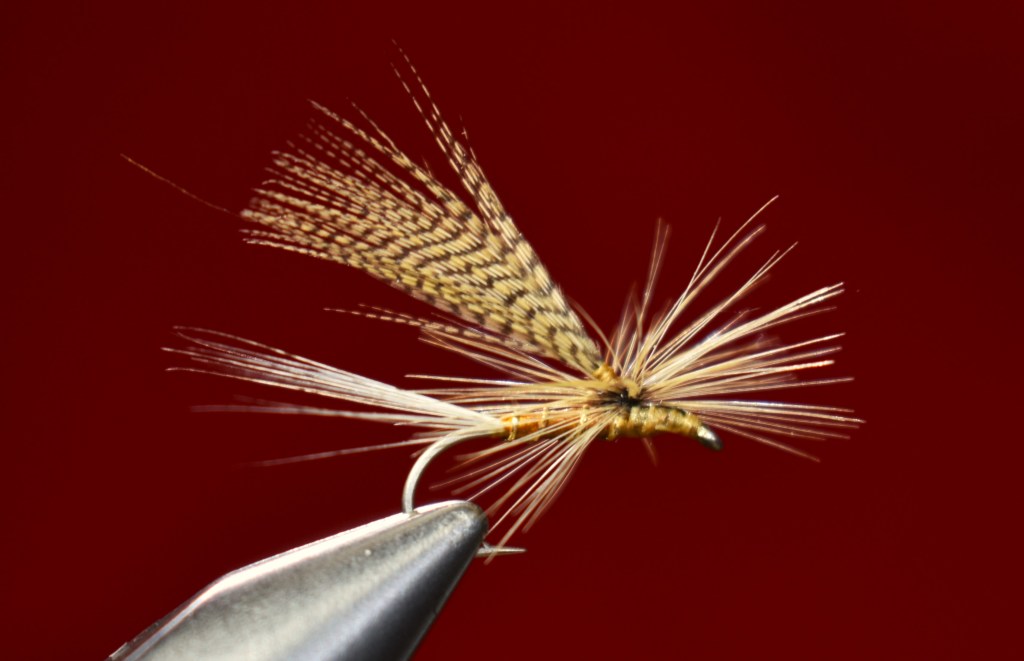
The Gordon 100-Year Dun: Tails and hackle of cream badger, gold floss ribbed with fine gold oval tinsel. I will be anxious to offer one to a rising trout come spring!
I take a little historical tour of flies each winter as I work my way through five or six months without the bliss of casting the dry fly on my Catskill rivers. Last year, I studied two flies from the eastern slopes of the Catskills. Ray Smith was a well known angler and guide on the Esopus Creek, and a prolific fly tyer. His Red Fox became his signature pattern.
Edward Ringwood Hewitt remains a legendary figure in fly fishing as an angler, author, fly designer and inventor, as well as for his remarkable achievements in stream habitat improvements and management. The Beaver Kill Red Fox was one of Hewitt’s secret flies that gained a strong reputation on the Beaver Kill after a lost fly was given to Harry Darbee for a sample. Harry and Walt Dette “tied them by the gross” for eager Beaver Kill anglers.
Smith’s Red Fox (left) and Hewitt’s Beaver Kill Red Fox were both tied from fur taken from the pelt of a red fox, but they are very different flies. Smith desired a light creamy fawn colored fly, choosing to mix the cream, white and reddish furs, while Hewitt clipped the dark grayunderfur for his bivisible hackled fly (ginger faced with medium dun).
I enjoy studying the history of this magical region I am fortunate to call home, and I enjoy tying the flies that helped create that magic for countless anglers. One advantage worth having in fishing our popular trout rivers is the ability to offer the fish something unique, a fly they have not seen day after day. Tying a few old classics in a couple of different sizes will give you that something different!
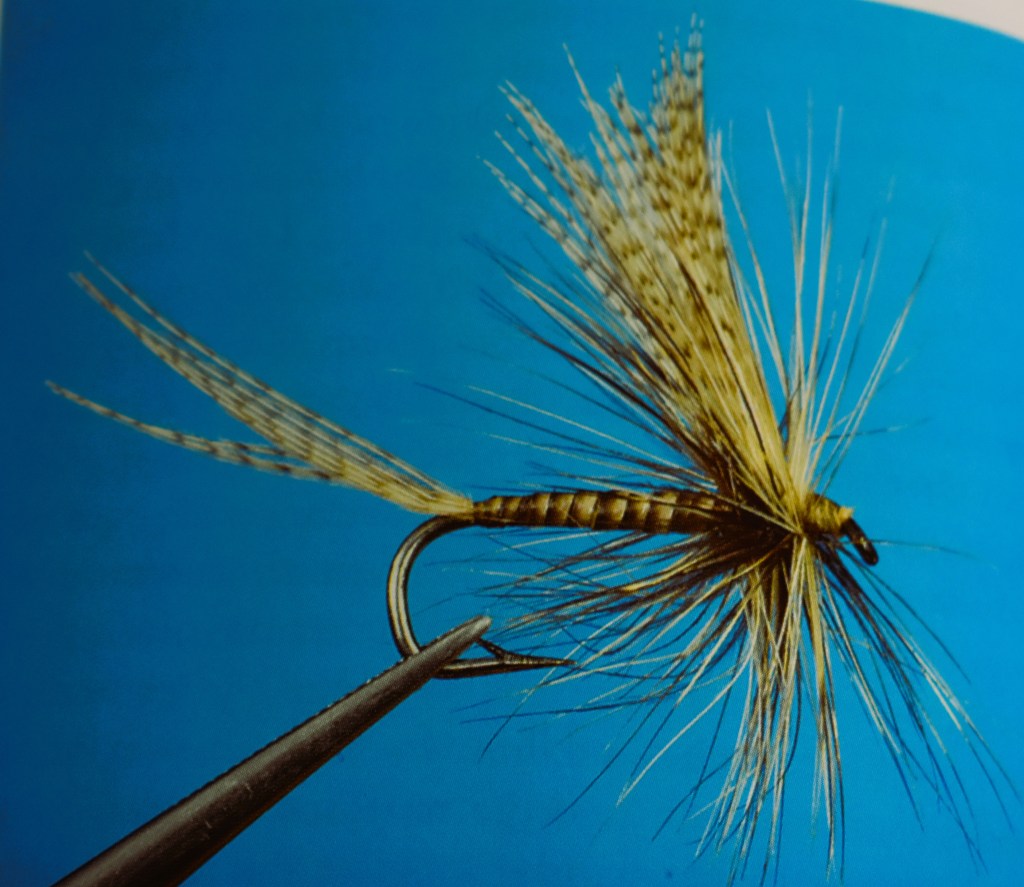
A Quill Gordon, tied by Theodore Gordon, from the collection of the Catskill Fly Fishing Center and Museum. Photo from “Tying Catskill Dry Flies” by Mike Valla, Copyright 2009 by Headwater Books.
We do not know how many fly fishermen had fished for or taken a trout with a dry fly in America by 1890, though it is certainly possible that some had. Not a dry fly tied specifically to be fished on the surface perhaps, but there were earlier recorded mentions of anglers whipping or false casting their wet flies so that they settled upon the surface to be taken by fish before sinking. A slight, consumptive recluse of a man, a man of breeding and education consigned to live alone, turned his attentions to the wild and beautiful rivers of the Catskill Mountains and to fishing of the fly for their trout. We shall be forever grateful.
Theodore Gordon inquired; he wrote, corresponded, he studied the works of others obsessed with this angling as something more than a simple matter of subsistence. His correspondence with one Frederick Halford, England’s Grand Master of the dry fly, brought him not only the celebrated Britisher’s thoughts and theories, but samples of his many dry flies. Gordon experimented with the English flies and, noting they were not well suited to the bright, tumbling waters of his adopted mountains, he modified them. Gordon used his knowledge of fly tying to create the first true American dry flies, imitating the insects he found along his beloved Neversink, Beaver Kill and other rivers; and thus, Gordon gets the blame for starting all of this madness!
In my own quest for imitation, I went back to Gordon, back to the fly pictured in the beginning of this post, viewed countless times over three decades of visits to the Catskill Fly Fishing Center and Museum, and with that fly I have fueled my own obsession.
My 100-Year Dun tied with a dyed wild turkey biot to imitate the spring mayfly we routinely name for Theodore Gordon’s signature fly, the Quill Gordon.
My own experiences long ago convinced me that fly design is the avenue to expand our enjoyment of angling and deal with the evolution of our wild trout. Fly fishers like to argue about many things, and among these are the far extremes touting pattern versus presentation. I often wonder why so many of us fall into one or the other of those camps.
I am a dry fly fisherman, and I began to design my own dry flies from the very beginning of my experiences with fly tying. I am a bold proponent of fly color, another heavily debated subject among anglers, and I will be the first to stand with the fellows in the presentation camp, though I doubt they will welcome me as a member. Presentation is everything, though in my mind fly design, color, movement and the overall image of life is a vital part of presentation.
Presentation encompasses both what we offer to a feeding trout and how it is offered. There, I have said it, clearly and bluntly. So why are we anglers so often arguing about two ends of the same stick?
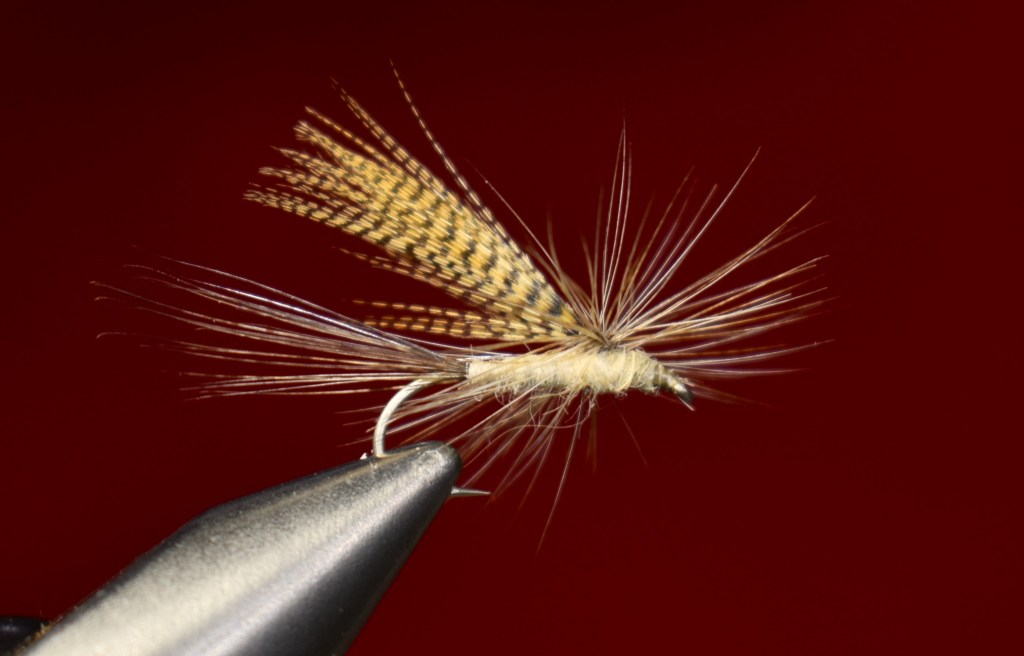
Yes, I did my thing with the classic Cross Special that has been occupying my thoughts as well as my fingers of late. I think I will call my 100-Year Dun version the CrisCross, for it isn’t an imitation of a specific mayfly.
Rather than choosing to believe that a few nondescript fly patterns are the ultimate dry flies, to be fished to the exclusion of all others, I maintain that many of these flies work well under certain conditions. There are elements of their design that provide the essential image of life that is the key to enticing a trout to take an artificial fly.
I tie some of my own patterns to take advantage of the characteristics I recognize in some of the patterns the one fly anglers tout. We tend to talk about the quality of bugginess in many of these flies: the Adams, the Gold-ribbed Hare’s Ear, etcetera. These flies have elements of design which imitate movement, and movement is life!’
There is nothing wrong with carrying a single box of flies stocked only with these patterns, and there is nothing wrong with carrying a half a dozen fly boxes with specific imitations of available insects tied in different styles and sizes, though some of us walking the latter path may suffer a bit with the weight of our fly vests.
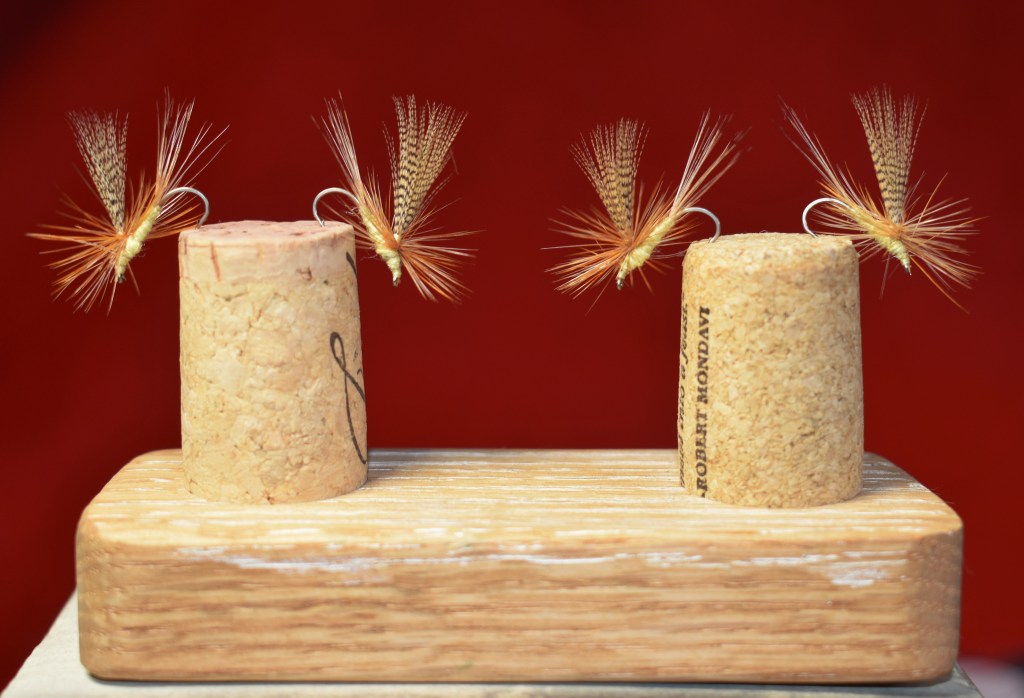
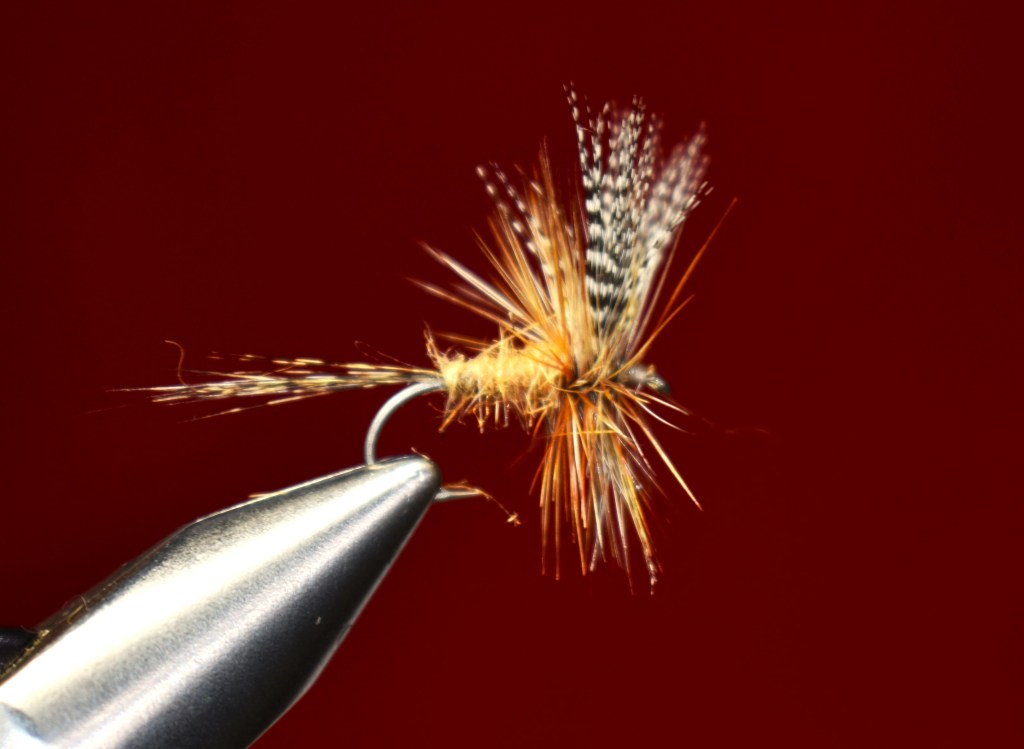
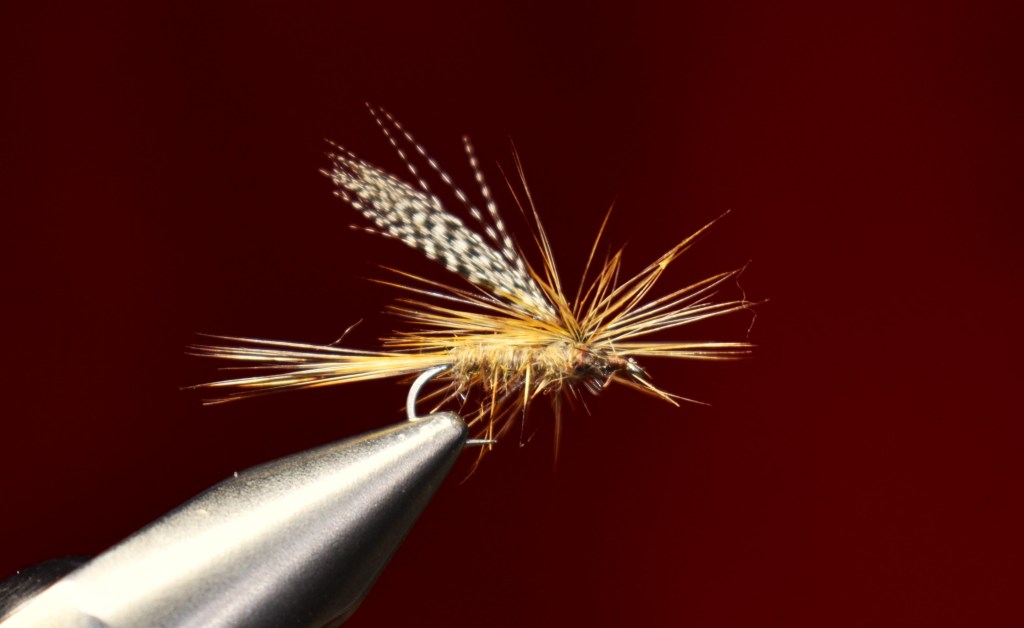
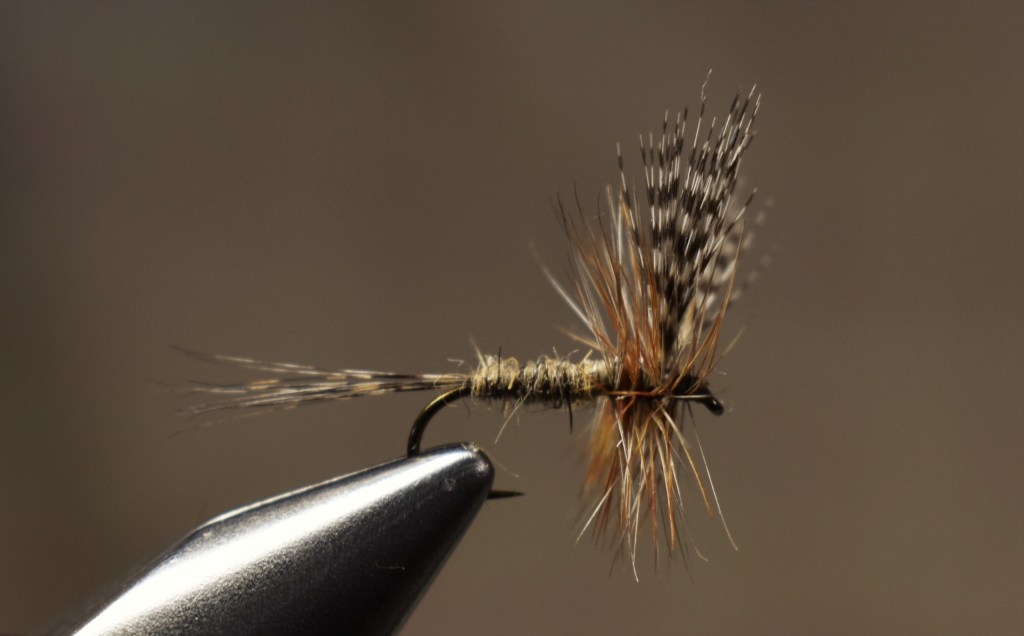
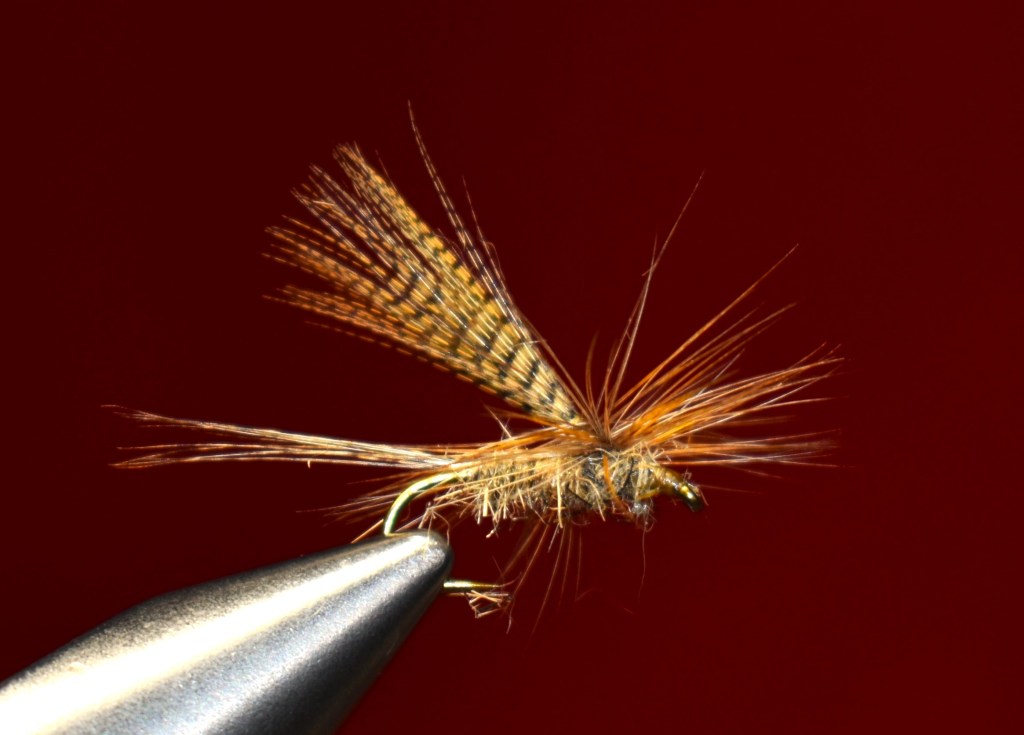
My ‘Catskill Adams’ tied as a 100-Year Dun and as a traditional Catskill dry, the CrisCross 100-Year Dun(top row), and my Fox Squirrel (bottom row) tied as both 100-Year Dun and a Catskill dry. None of these flies are specific hatch matchers, though all have that elusive quality of bugginess and a strong image of life.
I believe strongly that we learn to be better anglers by thinking and experimenting. Appreciate the tradition and learn the lessons it teaches. Spend as much time as possible on the water with your eyes and your mind open to Nature and inspiration.





 Bright Waters Catskill