Paying My Dues, and a Milestone

Its been a great week. I have enjoyed an up and down spring, thanks to absolutely crazy weather and doing my best to avoid human beings. When the medical experts say that you are a top candidate to die from Coronavirus, you take them very, deadly seriously.

I have missed visits from and fishing with my friends, and I have missed some great fishing, if you believe the stories anyway, in my quest to avoid the crowds. I admit that, by nature, I do my best to avoid crowded waters anyway, but this madness has put a whole new urgency into play. Its not just solitude in 2020, its survival.

I got off the river late last night, and found a voice mail on my phone from one of my friends. Seems he is planning upon coming to town to get in some fishing and hopes we can fish together. I have to figure out how to tell him that we could say high and catch up from thirty feet away I guess, but that fishing is not going to be in the cards.

Hi Henry! Great to hear from you! (He’s smiling around that rod, really)

I guess we are all doing the best we can to cope with this unprecedented situation. I have been coping on the rivers for the past five days.

Yesterday was my time to pay some dues for the terrific fishing I have enjoyed this week, but I hit a new milestone in the process.

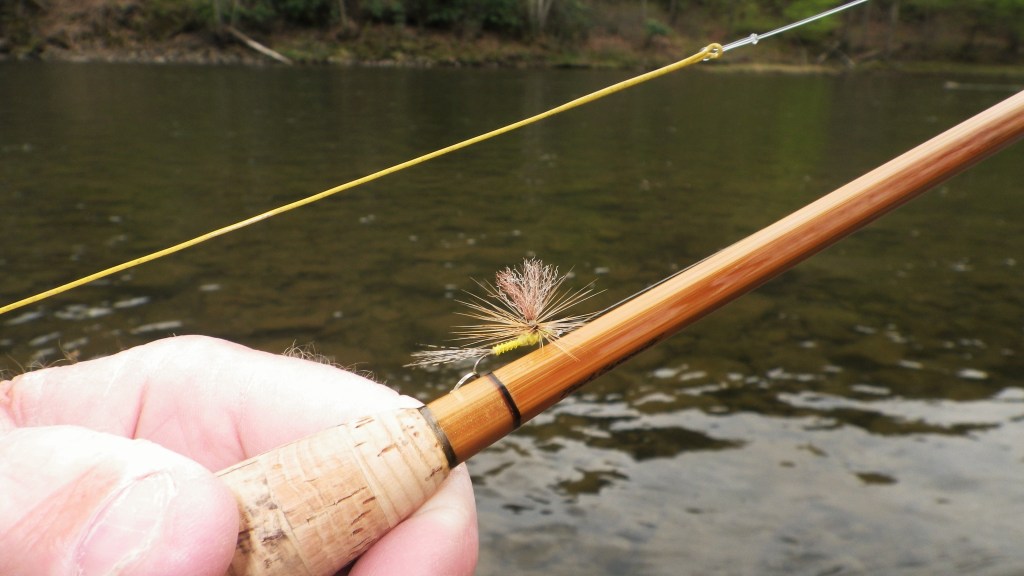
Driving to the river the sky was beautifully cloudy, and I was hoping for a really good bug day. I parked, rigged up my Menscer Hollowbuilt and walked down to see what the bright water had in store. Conditions looked great, and I hadn’t been standing on the bank any longer than required to check my leader and tippet and tie on a sulfur pattern; the fly that had been the special of the week. The sun peaked through a little as I scanned the surface, spotting three fish making gentle sips in the low, clear water.

I started slowly wading into a casting position to work the closest player when I heard voices coming from up river. Kayaks, and a lot of them. My urgency increased tenfold, knowing that I was going to get one chance instead of three and that it might be the only chance for several hours. The first cast alighted perfectly and drifted down unmolested, the second brought a tip up and a take, that I answered with a lift and a smil… groan. I felt that trout, a good one, for half a second before he was free. I drew my line in and found about an inch of my tippet remaining: a clean break just below the leader knot. That same spool of tippet that plagued me earlier in the week seems to have had another bad spot.

The 8 kayaks made sure to paddle over the best holding water, right where the other two rising trout had been. For good measure they spent some time stopping and milling around over the top of the deeper sanctuary water in that reach. Have a nice day!

A sipper finally appeared about an hour later, but not with the confident gentle rise that began the day. The sun was fully out by then, and all of the disturbance surely put them on edge. Oh and yes, the wind came up again. Nothing but frustration chasing cruisers throughout the afternoon. Find one, try to make the quick cast required before he vacated the area, and wham, another wind gust blows the fly off target and straightens out the leader.

One of those gusts hit me straight from the rod side hard, in mid cast, and wrapped my fly and tippet around the fly line. Untangling the mess, I found the dreaded cut, where the 5X fluorocarbon had tied around the line and cut the coating. I knew that I should repair it, that if I hooked a fish the strain would likely separate the coating from the core at that break and ruin a ninety dollar fly line. I passed the buck for a while, chasing a few more cruisers, then resigned to make the long walk back to switch out my tackle.

Half an hour later I had a fresh, cold bottle of water, an Atkins bar and my Thomas & Thomas Paradigm with the Hardy Marquis that has found a home in its reel seat. As I reached the river I heard a splash and voices. Kids and kayaks. One said hello, I said hello, then turned downriver hoping they would float on through before the sun got off the water. They reached my spot about the same time as I did. I tied on a new tippet, tested it twice, and sat down on the bank to watch the show. Kids being kids on a hot summer day on the river. After they passed I figured the place might just be finished for the evening, but one of the cruisers surfaced at a distance not too long after the kids had paddled into the distance. It was four o’clock.

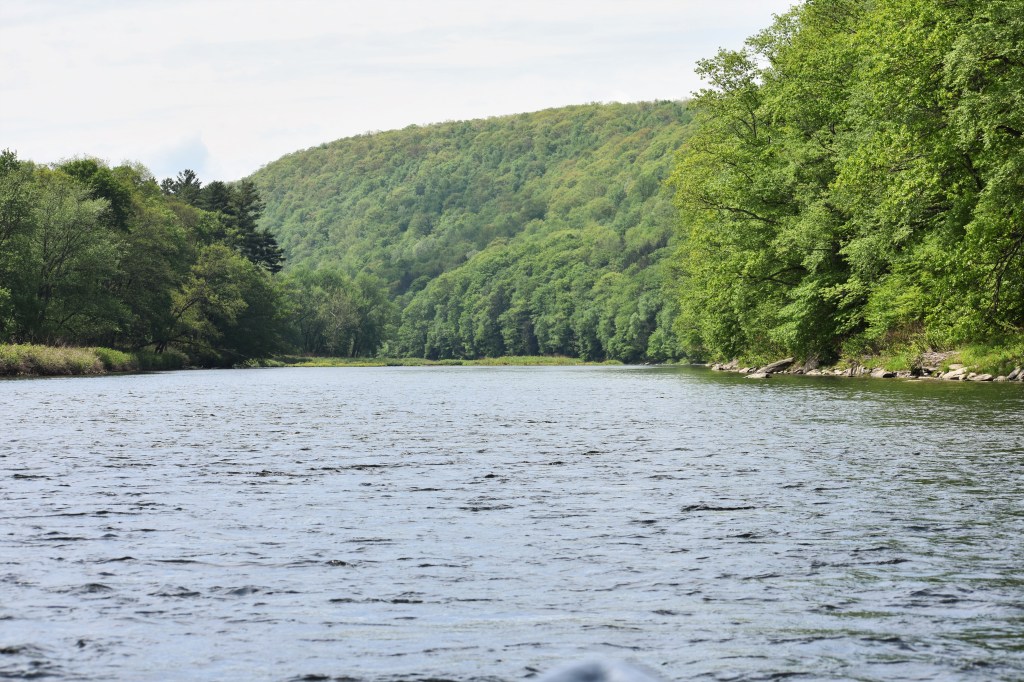
The shade was slowly building at the foot of the mountain and it was getting along past five o’clock when I gave up on any meaningful cruiser activity, but then I saw one big rise back in a shady pocket along the far bank. There were a few big mayflies, the advance scouts for the Green Drakes about, so I figured why not see if a trout that has been sunburned and chased by invading kayakers all day might risk a rise for enough of a meal to make it worthwhile. I chose a 100-year Dun.
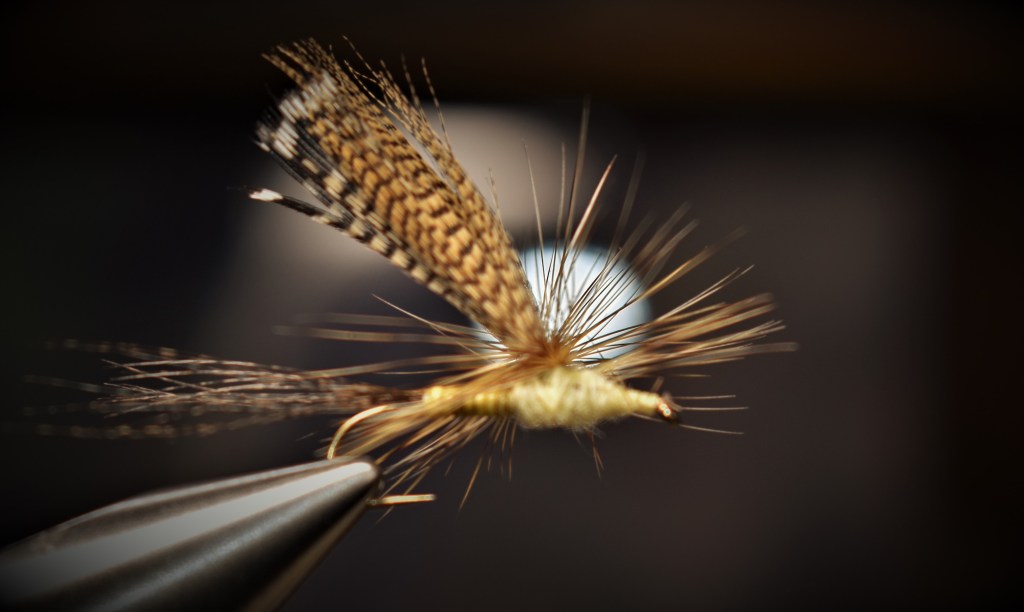
I made the stalk, delivered the fly, and the trout rose to meet it. He shook his head from side to side, characteristic for a big brown trout, then headed out, quartering downstream toward the middle of the river. Everything was going well and then it just stopped: fly free, fish gone, poof! I inspected the fly and it looked perfect, the hook wasn’t opened up, nothing to explain why its hold slipped. I didn’t know it then, but I was to lose another big, big fish on an idle cast just at dark, making a total of four for the day. Paying my dues, as I said.

I dried the fly, and fluffed the hackle, then wondered if I’d find another player as evening approached. I had seen the same gentle, bulging rise about a hundred yards down river four or five times over the course of the past hour. They weren’t frequent, but they were all in the same location. One fish was holding to his lie. I started the long, slow stalk downstream to check him out.

I guess that trout rose maybe three or four times during the 20 minutes it took me to stalk downstream the hundred yards to get within striking distance. He was in open water, but I was able to mark his position by the sunlight and shadows on the water as the sun drew closer to the summit of the ridgeline above the river. I saw a big bug drifting down the lazy current, met with that same big, soft bulging rise. I adjusted my position by a few careful steps, lofted the line in a backcast, and made a long reach cast just short of the trout’s territory to check the drift. If you drag the fly over a fish like that, he’s done.

Satisfied that I would get the float I wanted, I stripped another few feet of line from the reel and made my money cast, further out into the shade and right in line with the fish’s lie. It made up for a long tough afternoon when that beautiful bulge appeared where my fly had been.

The hookset was followed by a hard, screaming run right straight into my backing! No preliminaries, no handshake, just let me get the hell outta here. You gotta love a fish like that, and a classic reel with a palming rim. I used it. Multiple times.

This trout had weight, speed and power, and I began to wonder just what I had on the end of my line. Fish have surprised me before though, and they will again. One night years ago I cast a big spinner downstream into the remaining glare, watched a subtle ring appear, and held on while an unseen trout headed for the Atlantic. That turned out to be a 21″ brown trout, a beautiful wild fish, but the combination of the run and the darkness had me expecting, well, something more.

The trout held deep, staying in the shade when I finally had him close enough to see, so there were a couple of brief flashes, but nothing else; and then he was off to the races again, the Hardy wailing like a heavy metal ballad.

When I drew him close that final time, a big silvery brute of a Delaware rainbow made a tired turn at the surface before I slipped the net under him. Twenty-three inches, with a big deep body, a bow easily topping four pounds. I levered the big fly from his jaw, my heart still pounding as I admired my largest Delaware rainbow in 28 years of angling Catskill waters.

I wanted a picture badly, but the great fish was spent, and its said that rainbow trout shouldn’t be removed from the water for more than thirty seconds. There was no way I was going to risk killing that gorgeous milestone bow for my own vanity. I eased him from the net into my hands, held him pointed into the flow for a few moments, then tickled his belly to watch him dart away. The image will live in my memory as long as I live, and that will be just fine.
Wanderings… and An Epic Battle

Somehow I Have Trouble Calling It a March Brown

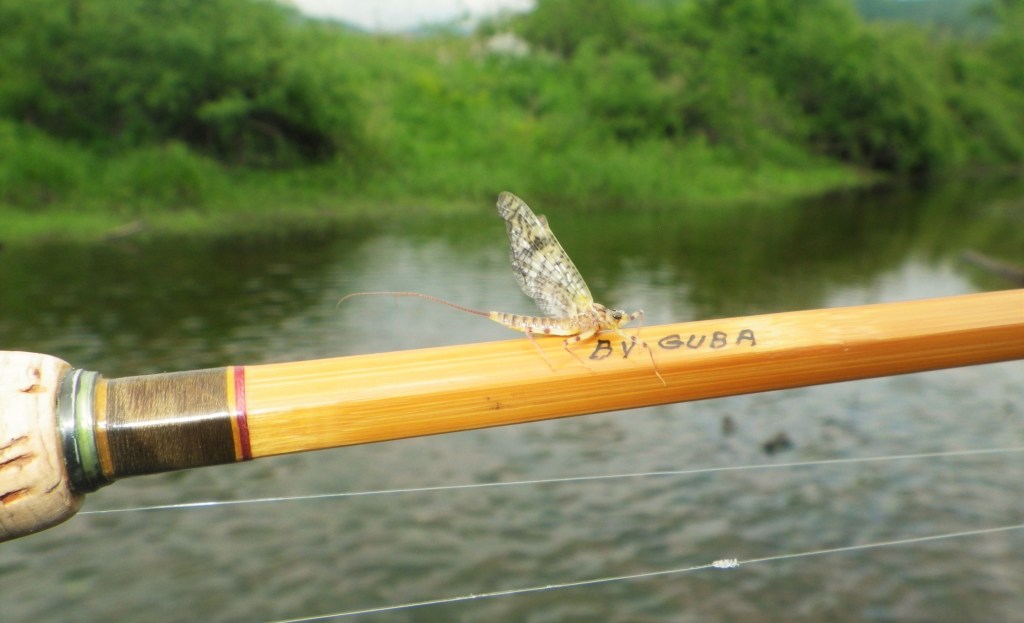
Funny how you can find so many different moods along the same river system. With the bigger fellows like the March Brown (Yellow?) on the water, one would expect the trout to be paying more attention to them, but that hasn’t been the case this week. In fact, where they were the only mayflies witnessed, rises have been pretty much non-existent. This is a big, meaty mayfly that likes significant current, though I have seen them drifting long distances on flat pools, even on the warmer days. Sure seems like an easy meal to me, particularly for a trout just hanging out.

The players have been the sulfurs, whether during a nice hatch, or with a very sporadic hit and miss appearance, the trout have been paying rapt attention to the little yellow mays. No sulfurs, no rising trout.

We have enjoyed a nice mix of weather this week: sunny days, both moody with shifting cloud banks and gut wrenchingly beautiful bluebird skies, and cool, overcast days with a hint of moisture in the air. If I had to pick one of those to peg for a no holds barred bug day it would definitely be the latter. Wrong again. Hard to figure out the fickle moods of a river and her wildlife, even after nearly twenty years of an intimate relationship. Of course, that is a big part of the magic in this game!

Yesterday began in a stunning tableau, the colors of the Catskills so vibrant I wished I could wrap myself up in them. The new green of the mountainsides was irradiated with the morning sunshine in a sky so vividly blue and cloudless, the rivers low and startlingly clear! I could pick out stones on the river bottom while driving down the highway. I was awestruck, and thankful, though I figured it was not going to be a bug day. Got one right for a change.

Mayflies were pretty scarce alright, and rising trout, well, one would show itself every once in a while. These were generally one time sips, not the kind of thing that makes it easy to target a fish, stalk it, and make that perfect cast. Did I mention the other dimension? The wind blew. Not the 5 to 10 mph gentle zephyrs that were forecast either, but the 15 mph and better, blow the budding leaves off the trees style winds. They arrived at exactly the same time as I spotted the first gentle little sip in the film.

I cannot count the number of times that has happened on a trout river. I might do better at least trying to estimate the number of times it hasn’t. In my mind I think of the Big Guy up there with his finger on the fan switch and a smile on his heavenly face, waiting for me to start my backcast. Suffice to say that there weren’t too many opportunities during the day, and wind blown leaders causing drag at the worst possible moment obliterated a few of those that were offered; except for one.

I was trying to cast to a one time sipper after a methodical approach when another round of gusts forced my hand and, just for a moment, let my temper get the best of me. I forced the cast in frustration, the fly blew 20 feet upstream of my target on a perfectly straight leader, and I cursed the wind once again. But then it calmed down for a moment, the planets aligned or whatever, and a different fish sipped something from the film. I elevated the line, turned my body to the left, and threw a perfect reach cast with my trusty replica Payne 102, laying that little CDC sulfur just above and in line with my target. Sip!

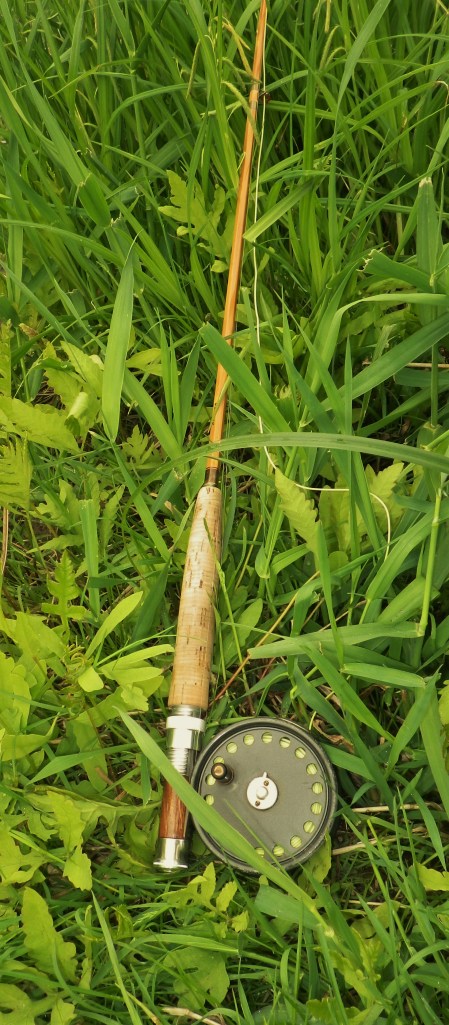
I raised the rod into a serious arc and the fish bucked and shot downstream at a quartering angle, while I wrestled with the slack fly line in my hand to keep it from tangling. It only took a second before he was on the reel, and another couple of seconds for him to run out all 90 feet of my fly line. There are boulders here, and the trout had reached one of the largest ones, intent I am certain upon rubbing the offending biting insect from his jaw. I put all the bend in that slender shaft of bamboo that I dared, the tip raised high to keep his head away from the boulder, using every ounce of strength in the 5X tippet.

I regained some line with pressure, lowering the rod to put the bend in the middle and butt instead of the tip when I could, and raising it again when he ran and turned for the bottom. I had most of my line back and could feel his power as he surged from side to side, then boiled the surface before he was off again. A good strong trout will make 2 or 3 runs, but this guy was something special.

Several times I pressured him to recover my line, drawing him toward the shallower side of the river, only to have him turn and run again, taking all of my hard won line with him in his search for another sharp edged rock. The fish had made half a dozen runs, and I was worried about the tippet. You never know just where the fly is in the fish’s mouth. Is the tippet rubbing against his teeth every time I reverse pressure?

I got him shallow for the fourth or fifth time and walked slowly over, easing my pressure and reeling up the remaining line and leader, net out and ready to bring to play, but he still wouldn’t have it. His runs were short now, 25 feet, another surface boil, then succumbing to the pressure as I led him back to the shallows. For the last time I pointed the rod at him and reeled the leader butt through the guides, turned the rod over, and took the net from under my rod arm, easing him toward me. I kept thinking about that thin tippet as I put the cane to work in a frightful bend and led him to the net.

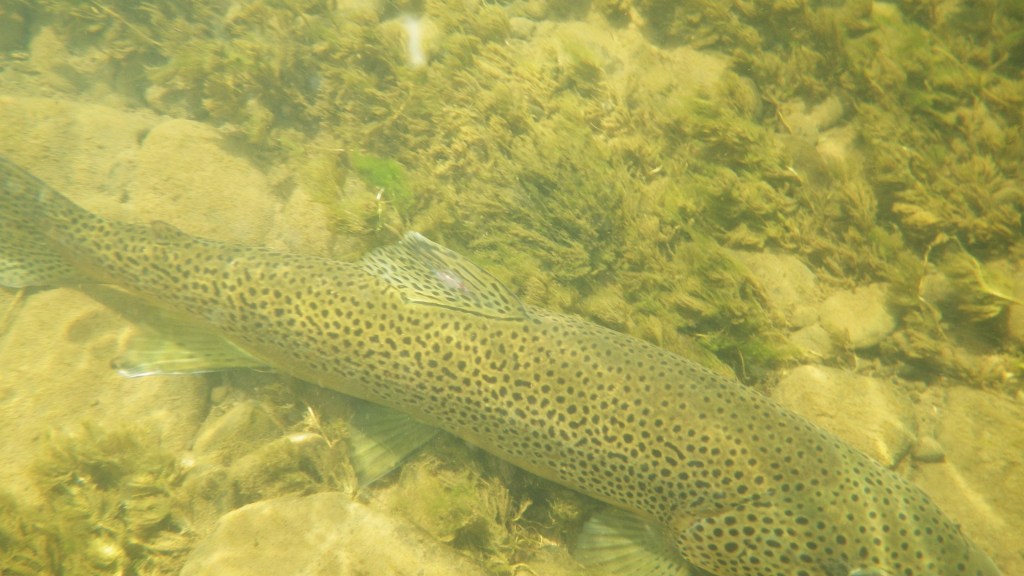
He was mine, finally, the little fly snugged into his hard outer lip right on the side of his mouth. Perfect. The brown measured better than 24 inches, but his size and weight were more impressive than his length: five and a half pounds is a conservative estimate. I was close to a grassy bank, but there was no way I was going to take that vanquished warrior out of the water. As I turned the net over to slip him back in the river I noticed he had torn it. He settled down to the bottom and we watched each other.

I took out my fishing camera and tried to take a couple of shots but the glare of that bright sun defeated me. Then I remembered the camera is waterproof, submersible. I slipped it an inch under the surface and did the best I could to line it up and took the shot. When I downloaded the photos last night I saw that I was too close to get his full length, but didn’t do too bad framing blind. Not fine art photography to be sure but hey, its clear that fish had shoulders.

Shoulders

June Fishing: Seems Like Spring

A 23″ Delaware Brown and the WWII vintage Hardy he inspired to song!

Funny how June began with a cold snap, and the fishing heated up significantly. Rivers that began to get too warm to fish well dropped like a stone in temperature thanks to a night near freezing and another deep into the forties. Thank you Red Gods!

Fifty degree water was a scarce commodity during April and early May, and yet I was standing in it on the first of June, thankful for my fleece lined khaki’s. Yesterday offered some sunshine and some dramatic clouds, and a lot more wind than I would have liked. I had planned to fish bamboo, but it was already blowing hard when I parked my jeep, so I reached for my old Thomas & Thomas Paradigm graphite. It proved to be the right choice for the day.

I have enjoyed afternoon long sulfur hatches on cool, rainy days a few times, but Monday’s mainly sunny weather seemed to agree with the little yellow mays. The hatch was pretty steady from one o’clock until after five, and a number of good trout were taking advantage of it. Wind always makes technical fishing dicey. It takes away a great deal of an angler’s control. Drag-free drifts require controlled slack in the leader and tippet, and an ill timed wind gust likes nothing better than to straighten the whole thing out and send your fly way off target. Dealing with gusty winds requires patience.

Between gusts, I fired a cast low to the water to intercept the first riser. The wind died suddenly and the fly landed closer than intended to the trout, so of course he took it a split second early and I missed him clean while trying to hang the line over the free finger of my rod hand. He wasn’t going to give me a second chance. Nothing to do but rebuke myself and re-position for another player.

With the breeze calmed for a bit I spotted a wide bulge in the surface with a little ring and just smiled to myself before sending my CDC comparadun on its way. One cast, two, three and there’s that bulge again, and a big bow in the Paradigm! It was instantly clear that this was a serious fish, as he ripped line to the Hardy’s lament. He gave me everything he had, refusing even at the end to come quietly to the net. When I saw him, I eased the pressure a bit lest the 5X tippet betray me again. The big boy measured a shade past twenty-four inches.

The wind kept things challenging, as if the wild browns of the Catskills weren’t suitably capable of challenging the angler. There are days when they bring us to our knees! As the sulfurs continued to emerge and drift down river, occasional flurries of the much larger Gray Foxes would join them. During one of these, a telltale heavy rise urged me to quickly change my fly, and put the improved Gray Fox emerger to the test. It took a few casts to get the perfect float on such a blustery day, but the brown rose confidently and engulfed the fly. He took off hard downstream coaxing the reel from a stutter to a scream.

In the net he measured a solid 21 inches, and I savored my good fortune before slipping him back into the flow.

My Gray Fox emerger

The devils returned for an hour or two, with fish rising a few times, then ceasing as I completed my approach. Low water fishing requires care and stealth, but I refuse to believe that we can ever be completely undetected by the trout. An ill timed wind gust resulting in a slapped down fly is another great equalizer, and one I endured more than once on the afternoon.

Finally another calmer spell allowed me to square up on a late feeder, but this one proved resistant. He showed no interest in the duns on the surface, so too the sparkle duns I offered, the closest thing to a cripple or emerger in my vest. I finally coaxed him into a take by using the wind-rippled surface to my advantage. I shortened my line and dropped my CDC sparkle dun well above him, letting it run out of float on the edge of his dinner table. A quick lift of the rod then an immediate drop, coupled with the release of the slack in my hand sunk the fly and allowed it to drift drag free again below the meniscus. Mr. brown trout couldn’t stand that tactic and grabbed the fly hard, charging away in haste.

A three fish day wouldn’t impress the fish counters, but with all three exceeding twenty inches I felt amply rewarded for an afternoon of challenging work on the stream.

Tuesday seemed perfect for another day long hatch, and I arrived early considering the anticipation of a banner day. Cloud cover was forecast to be constant, with calmer winds and a bit warmer temperatures, and I could almost see the legions of flies on the water as I walked down toward the river. Never try to predict Mother Nature.

I was on the water by half past Noon. It was cloudy and calm, and the river’s surface didn’t betray a single mayfly. Waiting, I uncoiled my thermometer and dropped it in: fifty-one degrees at one o’clock. Perhaps the rising temperature due to yesterday’s broken sunshine had sparked the early hatch?

After half an hour, I began to see an odd March Brown or two, but the first rise was a puzzling little waver in slack water along the far bank. I knew what that fish was about and hoped to be ready for him this time.

The approach took some time, but my target didn’t seem hurried. He was finding an occasional morsel out of the main current, his “rises” clearly the wavering of his dorsal fin breaking the glassy surface. I made a few perfunctory casts with a small sulfur dun, a handful having begun to show on the water. The trout of course paid no attention to my dry fly and continued his fin waving taunts. I smiled as I knotted one of the size 16 Klinkhammer style cripples I had tied that morning to the 5X tippet.

Patience always helps with a moving fish, and this fellow was roving a fair piece of real estate. My casts were delicate, courtesy of the Payne tapered bamboo rod and a supple DT line, and I made them only when the trout waved at me from a new location. Eventually my little half sunken fly and the brown arrived at the same location, and he sucked it down gently. I waited an extra tick then tightened in a slow, controlled lift and had him!

That old Hardy St. George was getting acquainted with trout a decade before I was born, but its as smooth as silk after so many years. After some head shaking and short pulls, the brown made his first run and coaxed a familiar melody from that vintage spring and pawl. We had a good time, that trout and I, the cane with a deep, throbbing bend throughout. I took my time with him, dutifully turning the rod upside down when the fish was closer to me to equalize the stress on the bamboo. A 21 inch Catskill brown can put a set in a fine cane rod if you aren’t paying attention to what you’re doing.

For a long while it appeared that one good fish would be the hallmark of my day. Flies came only in the barest of trickles, and only an occasional soft rise drew my attention. Most were not repeated. As the afternoon wore on, one fish rose half a dozen times, the last of those rises to my dry fly. He ate it late in the drift, just as I relaxed my attention, believing the fly was past the taking zone. My beleaguered hand let the line slip too as I raised the rod, and he charged straight at me barely hooked. By the time I recovered control of all that slack line, this smallish fish had run around a rock and pulled free of the hook. Yes, a one fish day to be sure.

It may have been half past four, and I had walked back in the direction of the jeep. I stopped along a favorite little run simply to savor the place and the moment of solitude. A splash brought me back to attention and I noticed a few sulfurs popping to the surface in slick, fast current. Covering the rise, I hooked what must have been the hardest pulling foot long brown trout in the river.

Slipping him back, I spotted another rise, then another, as the sulfur hatch finally made its appearance. In that last hour I caught three more trout, a pair of racehorse strong 20 inch beauties, and another. That final adversary was sipping beyond the seam on the other side of the fast slick before me, and I knew from experience what to expect.

I worked myself upstream and out into the channel to allow a long, downstream reach cast. Float time would be extended that way, but it wouldn’t be long, so the cast had to be accurate and drop the fly gently no more than a foot and a half above the rise. Presentations like that are what bamboo rods were made for: enough smooth power to get the distance required, feel and delicacy to deliver the fly perfectly.

He rose to my second cast, and boiled mightily when I raised the rod into a full arc, streaking down into the rush of current and bringing old St. George to full and vibrant song! There’s nothing quite so thrilling as a big fish in fast water, all of that oxygen charging every fiber with wild energy. There were two turns of fly line on the reel when he stopped, turning and thrashing the surface to foam. We battled there at a distance for a time, joined by a slender line and an arc of flamed bamboo.

Thrice regaining line, then losing it again, I worked him through the channel and to my side of the river. I backed toward the bank, urging him into calmer, shallower water in stages, giving line as needed, and taking what he allowed. At last I dipped the net and led him in.

I exhaled as I raised the rim, looking for the fly to disengage. He was a dark, beautiful brownie, deeply bronzed and heavily spotted. On impulse I took the two steps to the grassy bank and fumbled for my camera, laying the great fish gently along side the rod and saving the moment with a quick photo.

I waited for a while after I released him, eventually seeing a final rise upstream. I waded up and across to a casting position, though I knew my day was complete.

Looking Forward

Summer Haze

June 1st, Crooked Eddy, Hancock, NY, thirty-four degrees at sunrise. A hazy summer morning, no, nearly a frosty one!

I have been wondering where all of the rusty spinners have been hiding this spring, then I found a pair on the screen of my front porch door the other morning. Spies! Reporting back to the mating swarm this angler’s whereabouts that they might chose a different riffle. Nonsense of course, perhaps they are just a little lost.

I have caught one trout on a spinner, a fine 20″ brown in fact, though there was no real spinner fall. The rising fish I was working began to ignore my Hendrickson, and I searched the drift for answers. I saw one or two small spinners, perhaps even expired duns, as it was hard to say in their faded state, and changed my fly accordingly. Success. I may simply have been in the wrong place at the wrong time, but with so many frosty mornings and windy evenings I wonder how the next generation of Hendricksons, Blue Quills and Quill Gordons will fare?

I get to go fishing today, a pleasant thought on this chilly morn, and I am glad for the chill as it has come in the nick of time to cool our rivers. The Delaware and Beaverkill had reached and exceeded seventy degrees last week, not a condition we want to see in May. I’ll wear my fleece lined khakis and a sweater again, and the heavier wool socks and be glad of it. Catskill rivers should be cold in spring, and remain cool and productive throughout the summer.

I am still wondering at the paucity of insects since the Hendricksons completed their annual affair. I have worked hard to stay away from crowds, though I haven’t tried to avoid the hatches! I greet each day astream with the delicious thrill of anticipation: will this be the day the flies come heavily? It can happen like that, yes, but it can also continue at more of a trickle; a few flies at odd intervals throughout the day and evening, hunting trout in out of the way corners where they lie securely and sip the handful of mayflies that nature offers.

I love hunting trout, though I associate it more with a summer game, once the heavy hatches have come and gone for the year. Stalking with a terrestrial dry in the quiet places, or floating the riffles and tossing a big isonychia comparadun to the pockets and eddies along the bank, its all hunting, and it is all exhilarating.

I set up the perfect drift last summer, the oar handles slipped beneath my knees, the drift boat an ideal distance from the bank and floating straight downstream in a familiar riff, allowing me to sit and cast my isonychia, working the covert to flush out the bird. A brawler of a 22″brown trout liked the morsel I dropped in his pocket, sipped it gently, and we were both surprised when he boiled to the arc of my rod and streaked into the main current.

Many days I picked the perfect hour to slip into quiet pools and stalk, moving with agonizing stealth into casting position for each suspected lie. Sometimes a take would come, an explosion in the quiet water; sometimes no response, leading to another cast or two, knowing each drift has a little less of a chance of connecting than that critical first cast.

But wait, it is not yet summer, not at thirty-four degrees with the greatest of the hatches still in front of us. Ah yes, still spring, with the peak ahead, and the puzzle of timing to be solved.

Spoon fed salvation

Waiting In The Tail of The Riff

My fishing is coming back, slowly. The Red Gods are offering this angler salvation a spoonful at a time. Ah yes the caprices of Mother Nature!

I chanced a somewhat more favorable wind forecast on Wednesday and dropped the boat in the Delaware for a solo float. They are all solo floats this year, thanks to the need to avoid human contact. I tend toward being a loner on the river anyway, but it would be nice to share the day with a good friend.

That wind was supposed to be in the 5 to 10 mph range, but it did get up a bit stronger in the afternoon. Floating the Big D means rowing, so I expected to get a workout pulling through the big eddies. The extra breeze just upgraded my cardio.

I had hoped of course for a lot of insect activity, and rising fish. The sunny morning was gradually overtaken by clouds, just as forecast, but the activity never happened. The Delaware has a reputation of being moody, but it can really impress you when it smiles.

By early afternoon I was anchored in the tail of a riff just upstream of a famous pool, watching and waiting. There were a few caddis popping around on the surface, and eventually a few more of them brought a couple of those little spurt rises that said “rainbow”. I removed the X Caddis from the hook keeper on my rod and started casting to the familiar moving targets that are Delaware River rainbows. We found each other, that bow and I, and started to dance; he flying a couple of feet out of the river he calls home two or three times between drag pulling runs, while I countered with rod pressure and reeling. A nice bow, 16 or 17 inches, and a great way to start the day.

The caddis activity waned quickly, and, after another wait I lifted the anchor and moved on, rowing all the way through Lake Lenore against the breeze. Payment to the Red Gods for services rendered. There would be a lot of payment for that bow, and the foot long brown who bent my rod hours later while waiting in another riff.

I was tired by the time I caught sight of the Buckingham landing, better than two hours earlier than planned. I anchored and watched a lot of riffles, but there wasn’t anything else happening to put a bend in my rod, unless you count that chub. Lets not even talk about that.

Cell service is almost non-existent downriver, but I stopped along the shoreline in Buckingham pool and turned the phone on hopefully: one bar. I tried to text Cathy, but it came back with “message could not be sent”. Hooray for little black boxes. I slipped a little further down the bank where the hillside wasn’t looming over the top of me and tried again – message sent! Glad I avoided sitting there in the boat for a couple of hours.

Delaware River, Buckingham, Pennsylvania

My arms, back and shoulders thought it would be a great idea to go wade fishing the next day. I agreed. I headed out midday, bound for one of my favorite quiet stretches of water, another one of those places that had been bugless of late. It was one of those misty afternoons, a dozen degrees cooler than the previous couple of days, the kind fly fishers recognize as a good bug day. Hmm, well I guess I’ll see about that.

I made a long walk leisurely, stopping to watch each reach of river, seeing nothing moving but water itself. I settled in where I had had great fishing this time last year and waited for an hour.

The obligatory handful of caddis were the first things to show, and then, was that a mayfly? A slow, bulging rise put me on alert. I had wanted to fish bamboo, but the rain led me to select the Thomas & Thomas Paradigm. If I had to fish graphite, it was going to be with feel; as close to cane as possible. I moved into position to work to that rise and waited for another.

The trout rose, I lifted the line softly and the Paradigm painted the fly on the water sixty feet out. He rose to intercept my fly, took it, and the tension of a long stretch of slow fishing let me pull my hair trigger a half second too soon, and the fly right out of his mouth.

It took a while before I started to see a big mayfly or two drifting down: big, yellow, March Browns or Gray Foxes. To Hell with the DNA scientists, I thought, and tied on an East Branch Special I thought might pass for either. I’d found the pattern on the Sparse Gray Matter forum, credited to Art Patterson, brother in law of the late Al Carpenter, Sr., the long time owner and proprietor of Al’s Wild Trout in Shinhopple, and tied a few this winter.

The target had showed me that one big, slow bulge that got me into stealth mode, but his subsequent rises varied to more subtle sips. Still, he hadn’t risen until the big mayflies showed, so I was going to offer him a big mayfly. Seventy odd foot reach casts flowed out of the old Paradigm one after the other, as I prospected for the old boy between bursts of wind and flying mist, the gift of Mother Nature’s immaculate sense of timing.

I was nearly ready to change the fly, to offer a low floater, when he liked the drift enough to come up and eat that hackled dun. I paused half a breath, then tightened, and the rod arched as he porpoised right there in his lie. Before even starting to move, he was simply gone, the 5X tippet broken cleanly. I pulled the remaining tippet through my fingers to check for abrasions, finding none, then tugged gently below the leader knot and it broke again. Bad tippet, just my luck, or was I still paying dues for yesterday’s tail dancing rainbow?

I cut the leader back and retied it with four feet of 4X tippet, one size heavier; a little extra insurance for the larger dry flies.

The March Browns were as sporadic as their reputation, half a dozen coming over the course of 15 minutes time, then nothing for half an hour. A trout would rise once, 150 feet away, then no more. There was one near a submerged rock that ate something every once in a while, but he showed no interest in my flies.

There are times I feel certain that the “one time rises” in this area are really cruisers. A trout or two with enough appetite to cruise the flats and target the emerging nymphs of big sporadic mayflies, taking them as the reach the surface, or perhaps an inch beneath. Fishing to cruisers is a sport for the lucky in any case. But hey, that guy is still up near that rock…

Movement here is stealth mode only or the game is up. Impatience has no place in this water. I was finally back in the right position to play another round with the rock trout, still eating something every once in awhile. I decided that the light March Brown version of the 100-Year Dun was the ticket, as it sat on the water just like those stately fellows who drifted by much less often than I wanted. Mr. Rock Trout agreed.

Finally I got to hear the ratchetting music of the Hardy and feel the limber Paradigm throb and buck with a fine brownie. He came grudgingly to my net, a solid twenty inches (oh I’m gonna pay for this!). There had been a foot long brown earlier chasing down a big March Brown comparadun as it pulled under when I began to strip it back from a downstream cast; my version of a luck fish. Another two fish day, and I am thankful for it. They are not coming easily this season.

I did miss another riser before the river quieted completely and I began my walk out. One of those sampling kind of takes at the end of a downstream drift where drag just starts to flirt with the fly. They want it because it moved a little, but somehow they don’t, and indecision seems to let them kiss it gently on the surface, waiting for an expectant angler to pull it away just as I did.

Over anxious nerves, bad tippet, a little luck and the right fly at the right place a couple of times this day. Sounds like fishing doesn’t it?

Turning The Corner

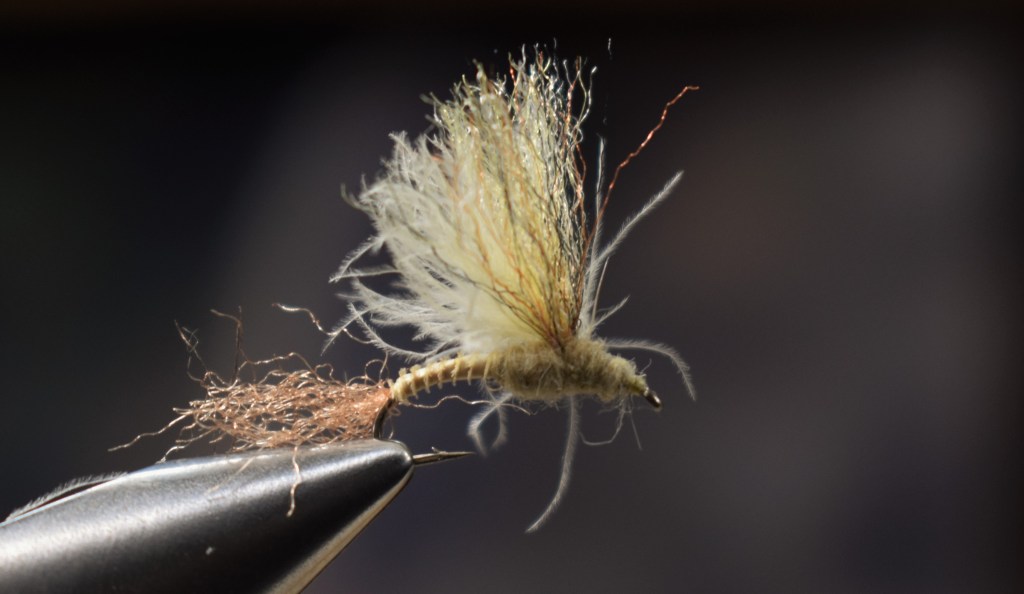
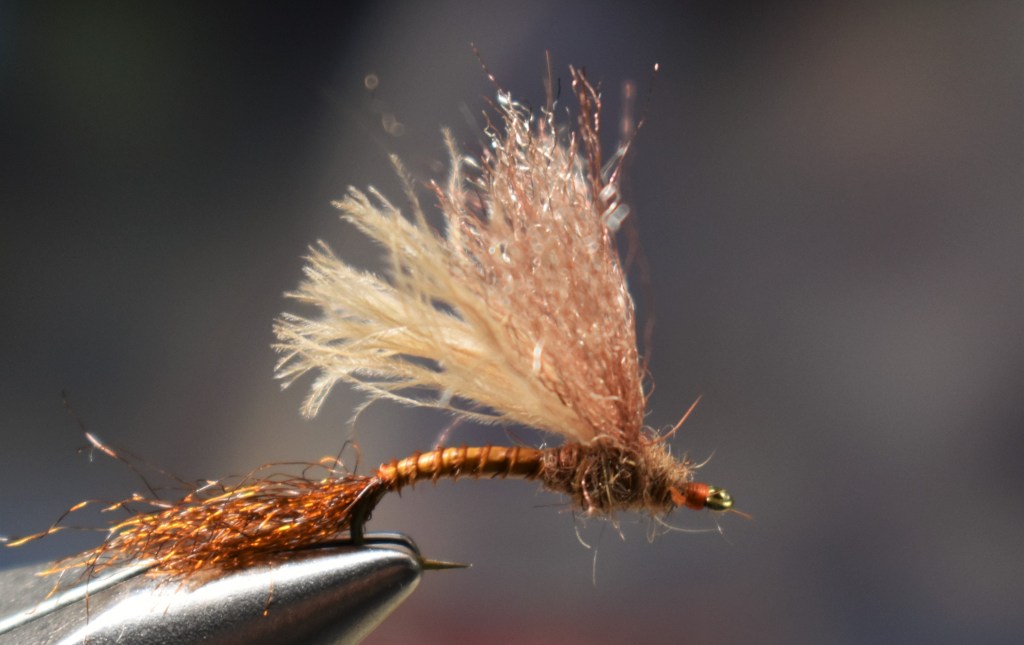
March Brown Emerger 2020

If you fish, you will have a run of “bad luck” though, if the truth be told, there is nothing truly bad about spending time on a trout river. I had a rather long week, one in which it seemed that wherever I wandered, I found no hatching flies and no rising trout. That is “bad luck” to a dry fly man, for we wait less than patiently for May, once the final hatches of October have brought our season to a close. May is expected to be the perfect month, so when one strings together a number of fishless days, those oh so precious May days, it can be perceived as the end of the world.

My salvation was of course a fly; not a completely new fly, but an improvement on an old standby. I had a report from a reliable source that good numbers of March Browns were on the water Monday afternoon on the Delaware. Fly shops you see had been reporting them on “all rivers” during that past week, in the optimistic way that fly shops do: some guy sees a big bug of some sort fluttering out there by itself and voila! The March Browns are hatching!

I have been broadening my use of Enrico Puglisi’s Trigger Point Fibers during the past couple of years, and I have found some merit in combining them with CDC on some of my favorite patterns. For years I have sandwiched light and dark colors of CDC feathers to replicate the darkly veined and blotched wings of some of our largest spring mayflies. Since the Trigger Point fibers incorporate both light and dark fibers in their color mixes, it was a natural thought progression to take advantage of that while reducing the bushiness of some of my multi-layer CDC wings. Hence, the improved version of my March Brown Emerger.

I had no foot access to the portion of the river where the heavier concentration of mayflies was showing, so I got as close as I could hoping for the typical upstream progression of many of our hatches. The problem with public river access is that it is, well, public. I waded out into a productive riffle with three trout rising irregularly as they picked off a sparse emergence of March Browns. I heard the small army of kayakers before I saw them. They piled into the river hollering as the young are wont to do, and my pent up frustration from a week of bugless fishing caused me to rush things, trying to catch all three trout before the inevitable advance of the plastic fleet.

I missed one of those fish twice as I kept taking my eye off my fly to look at the progress of the boaters bearing down upon me. On the third try he rolled up and, I thought, ate the fly solidly, and was off in a spirited run downstream into my backing. He wasn’t coming back up so I followed. When I reached him, I was dismayed to find my big fly in his side. He had rolled on it, refused it, and I had foul hooked him.

I removed the hook as gently as I could, and the indignant brown wasted no time in streaking back to deeper water. I started walking back to my original casting position rather dejectedly, and then the fleet was upon me.

I guess they tried to avoid disturbing me by going behind, but plastic kayaks don’t float on wet rocks. It is truly amazing just how much noise half a dozen people can make bouncing plastic hulls off of rock after rock, all the while splashing and stumbling. They tried, but just didn’t know any better, spoiling their own fun and mine by their good natured effort.

It took a couple of hours before another trout rose within 100 feet of that location. I scanned the water up and down river, and there was nothing encouraging. Every once in awhile a March Brown would pop up and bob along unmolested, and here and there a caddis would dance past.

Eventually one of those original fish began to sip or pop at, I thought, one of the caddisflies. Not feeding, just taking a bug now and then, every five to ten minutes. The fish was moving as Delaware trout like to do, so I couldn’t seem to put a cast over him, either that or he simply didn’t like any of the 4 or 5 patterns I offered. I was thinking about heading home for an early meal and had decided to dig out one more caddis pattern to try, when I heard the thunk of a solid rise close at hand. Looking up, I saw a couple of March Browns were hatching again, so I tied on the improved emerger.

It took five minutes for the thunker to rise again so I could spot him; a good fish. Two casts was enough, as that heavy thunk intercepted my fly and the game was on. You’ve gotta love a solid Delaware River trout in fast water. They come to play and they give it their all. Nineteen inches in the net, a beautifully colored brownie with deep bronze flanks peppered with black and red spots. Monkey, kindly remove yourself from my back!

There were no others, at least not until I started wading upstream and spotted a splash halfway back toward the landing. I waded out and gave him a try, but the sparse flurry of bugs has dissipated and he wasn’t coming up again. Time to grill the sausage and cook the pasta until evening.

I drove to several places after dinner. The crowds at some of them were ridiculous. I miss the old days when fly fishers would drive by an access that already had its complement of two cars. Now you see a dozen, sometimes two crammed in end to end, and all these guys playing line up in the river.

On my last try I found a pool that was empty and pulled off to the side of the road. I knew the river had hit 68 degrees on that hot, still afternoon, but I knew that the deeper half of this particular pool had been in shade for the past couple of hours and was well oxygenated. Still, there wasn’t much activity until nearly dark.

The first riser turned out to be a very well energized 9″ stockie, a NYS issue regulation brown trout, released quickly and none the worse for wear. It had to get a little darker before a couple of better rises began to appear. I tied on a size 16 Grannom X Caddis and took a very nicely colored eighteen inch brown who was even more energized than the little guy. The action passed quickly, as there simply weren’t a lot of bugs on the water. One more good rise, one quick cast and one heavy but brief hookup. That fish literally ripped himself right off the hook! A good one, though I’ll never know how good.

I tied some more March Brown Emergers this morning. Right now I am debating whether I should chance floating the big river with a 5 to 10 mph SSE wind.

A Peaceful Evening

Thoughts on a season just begun


Sixty-four years completed, and a season just begun. The calendar hints that this should be the peak, the great finale to spring, but in this strange Catskill spring it is only the beginning.

I have enjoyed some fishing, yes, some satisfaction and a little heartbreak, just the things that make angling a passion; but I have missed so much more. The company of friends adds much to the life of an angler, and all my fishing has been solitary by necessity this year.

I miss the visits with my friend Dennis, and the joy of sharing his knowledge and enthusiasm for the history of fly fishing, the bamboo rod, and the legacy of the Catskills. By now there should have been at least a couple of those afternoons in his rod shop, the ones where talking a bit lasts half the day, filled with intense interest, stories and laughter. We managed one breakfast last winter before the world turned upside down. It was just enough to make me miss our visits even more.

My best friend Mike finally retired as the curtain fell upon 2019. I looked forward to his visits, more frequent, and freed from the stress of schedules and responsibilities. I saw us fishing together because the fishing was good and the hatches full, rather then because the days suited our vacation schedules or work commitments. I am missing long days on the water, jawing at one another, catching trout, and sipping late beers on the porch when the day is through and the tackle put away. We should be sitting at the bench each morning and talking about the new fly just fashioned that’s sure to make that day a success!

John and I have renewed a friendship forged decades ago in conversations in my fly shop, and evenings along the gentle Falling Spring. I hoped we would have floated the river a time or two by now and met along a reach of water to share an early hatch and laugh at the crazy weather. I am anxious to cast the new bamboo rod he built, one he just got to fish a bit himself. I watched him planning strips and gluing them into a blank last September, and I am certain the result is beautiful.

I have been after my friend Andy to join me for some fishing in the Catskills for several years now. This was the year he was sure to set aside some time. As a young doctor he has been caught in the thick of the madness, burdened not only by trying to help the sick, but to keep himself and his young family safe. My heart and my hope goes out to him! May we somehow yet string up our Granger rods along the wide Delaware.

There are those I have met only through correspondence, whose words led me to speak of fishing, of showing them my rivers, once the madness is behind us. It will soon be summer and we seem to be teetering upon the brink of another disaster, rather than sighing with relief at the passing of the threat.

I contemplate the questions of the season before me, and I hope that we will find peace and safety. I look toward the day I can reunite with my friends, and walk the banks of some favorite reach of bright water, when I may once again live the full measure of my angling life.

Memorial Day

What A Difference A Week Makes

What a difference indeed. A week ago the mountainsides were brown, save the evergreens, and a few days of actual warmth and sunshine have transformed the Catskills. I love that “new leaf green” we get only in the first full blush of springtime, at times nearly chartreuse in the sunshine!

It simply doesn’t seem like it can be Memorial Day Weekend. There have been far too few days that looked or felt like spring. It was gorgeous all week and, even now the sun is trying to burn through the cloud cover as I sit here and listen to the morning rain on the metal roof, but Memorial Day? No that is still far off. It must be!

Memorial Day is the peak of the season, the hatches having all built to a crescendo, and then…the Drakes! I admit it, I am a card carrying member of The Cult of The Green Drake; but this year I am at a loss.

Caught! Not fully emerged…

Last season Memorial day came and went, and there were no Drakes. Memory flashed to 2018’s sustained high water and the fear that the hatch might be lost for the season. I was mired in the work of entering retirement and finding a home here in the Catskills, and I never had the chance to come and try to find the hatch in 2018. The fear rose again in my throat in 2019 but for naught, as the hatch did come, a good one, though weeks late. What might transpire this year?

The Green Drake is an unusual mayfly, in that it takes two years to complete its growth from egg to emerging dun. The timing of hatches seems to be governed by the degree day theory, that it takes a certain number of days at a certain minimum water temperature for a mayfly nymph to progress through its various instars to reach maturity and hatch into a mayfly dun. If this theory is correct then, the conditions during the past two years will set the timing for this season’s hatch. What might the puzzle of these past two unsettled years reveal?

My expectation is that the Drakes will arrive late. Witness that the crescendo is not yet upon us. We seem to be mired in the May lull between the Hendricksons and the March Browns, without the caddisflies to rescue those addicted to the dry fly. It is indeed a very strange spring.

I first fished Hendricksons on the 19th of April, the day after a 2 1/2 inch snowfall, with the river high and warming barely to the mid-forties. In my experience, that amounts to “an early spring”; a normal spring bringing the hatch during the fourth week of April. But then the rivers stayed in the forties for 5 weeks. The shad fly caddis typically overlap the Hendricksons a bit, yet I have seen only token representatives of the species. Are we early or late? I wish I knew.

My vest carries more than its normal load for the season. There are still Hendricksons and a few quills, black caddis, March Browns, spinners and shad flies, various sulfurs and a Gray Fox or two, always olives, and yes, even drakes. I still feel unprepared, like I am missing something. Ah yes, that other caddis box, the ones with Grannoms and some other obscure caddis I encounter once in a while. I must find another pocket for that box!

A day to relax, to avoid the crowded rivers and tie a few flies, adjust those fly boxes and fill a transition box to stay ready for whatever oddities Mother Nature may send bobbing down the current. It is a fine thing to have such a day indeed.

Defeated by the wind

The Wide Delaware

I was really looking forward to the chance to float the upper Mainstem yesterday, so I pushed aside my initial concerns when the wind forecast was 10 to 15 mph from the E/SE. I reasoned that, with the river flowing predominantly north-south along my chosen course, the winds would be mainly crosswinds and manageable. The weather forecasting in our region has shown itself to be remarkably accurate, particularly when compared to that in Southcentral Pennsylvania which was absolutely the worst.

I was hoping for the calm morning to continue as I tied a handful of flies for the trip until, just before leaving I looked up to.see the treetops waving in my yard. Still committed, I dropped the boat in on the lower East Branch and set off downriver. The gusts came straight upstream into my face, and I was confounded that I had to row to make headway downstream. A wiser man would have acted upon his first thought right there, spun the boat around, and allowed that wind to help row back upstream. Me, I really wanted to go fishing.

As I pushed on out of the last pool on the East Branch and into the riffles, that thought came again, stronger this time, as I still had to row in the faster water to make downstream progress. When I got to the top of Junction Pool, I could see a wall of whitecapped waves about one third of the way down the pool, The wind wasn’t just gusting then, it was blowing full on straight up the river at something more than 25 mph. I rowed as hard as I could downstream and the boat kept backing upstream.

I must have spent an hour there, trying again when the wind slacked a bit, only to have it hit me in the face again and blow me back upstream. Four attempts, four failures. Finally I relented and started the arduous trip back upriver into the East Branch.

I rowed where I could make a little headway, and I got out and pulled the boat upstream through the two long sections of riffles. At last I reached the tail of the pool and took a short break before pulling the anchor and rowing hard up the west bank where some upstream boulders directed the main flow of the current out toward midriver. When I reached the boulder field I had to row across to the east bank against the main current, then turn and follow the bank back to the landing.

To say I was exhausted would be a gross understatement. I had passed exhaustion half way back up that mile of river, stumbling in the riffles as I towed the boat upstream. I had put out around 9:45 that morning, and I climbed out of the boat, beached at the same landing around a quarter till two.

Mother Nature smacked me in the mouth this day, but the good news is I didn’t have any chest pains or any other signs from my heart. Retirement and living in the Catskills to enjoy my outdoor lifestyle seems to be agreeing with me; but I guarantee you I will treat any sort of southerly wind forecast with a lot more trepidation in the future.

Today the drift boat is staying in the driveway. The wind forecast is S/SE at 5 to 10 mph, but it is going to be warm and sunny. I know that the sun warms up the air and makes wind in these mountains, and it was close to freezing in Hancock this morning, headed for the mid seventies. Besides, this old body needs a day off after yesterday’s trial.

I plan to take a walk along some smaller water, a favorite bamboo rod in my hand, and see if I can find a few forgotten mayflies and some willing trout.

The Dreaded May Lull

The Last Day with bugs, and rain, and wind…
and now… Spring! Sunshine and barren water

It seems that, now that spring has finally arrived, we have been dumped into the throes of the notorious May lull. The lull is that fateful period between the hatches: beautiful days with nothing happening.

In a good year the Shad caddis hatch comes off between the Hendricksons and the March Browns and makes for some very interesting fishing. It seems that this isn’t going to be one of those years. I have seen the caddis, fully half a dozen per day, so there is no mystery why there are no trout rising.

The other day I fished three different rivers and saw one trout rise, one time. Today I walked better than four miles, up and down a favorite reach of water, with nary a dimple in the surface. I took a look at another popular river and found it exceedingly popular, but most of the anglers I saw were standing around and staring, not actually fishing. Such is the fate of the dedicated dry fly man!

Tomorrow I plan to drop the boat into the mainstem Delaware for the first time this season, and I hope to find some of those missing caddisflies. I would be marvelous to finish the day with a fall of Hendrickson spinners, something I have not encountered. I fear that several hard frosts and snow showers took their toll upon them. I pray I am wrong, as I would like to see a better hatch next spring should Mother Nature favor us with better conditions.

For the moment all I can do is to give thanks that my prayers for sunshine have been answered. The lull will end, it always does, and there will be flies and rises to bring smiles to all our faces. It is simply a matter of when and where. I cast my vote for tomorrow on the Delaware.