Daybreak Surprise

Too much, too fast! (April 2023)

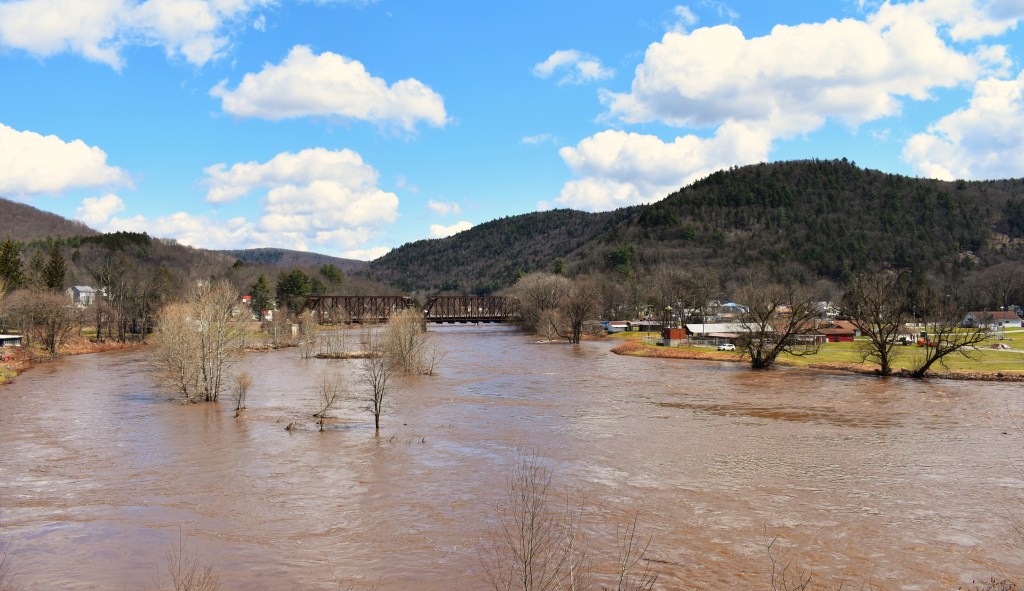
Watching the weather at five this morning I was pleased to see a storm-free forecast, even one promising very nice weather through the weekend. There was no sign of overnight rain here in Crooked Eddy, so I began thinking about which bamboo rod I would fish today: perhaps the Leonard 66… A casual check of river gages on my phone slammed that door shut quickly.

It seems that the heavy storms and flash flood warnings I saw just before retiring drifted more southerly than predicted, washing out both branches of the Delaware River. A quick look at the rivers above the reservoirs reveals they remain at low flows, so it doesn’t look like either reservoir will go into a refilling mode and impact the lower-than-normal releases NYC has mandated during this dry summer. None of the relief that cold water can provide seems to be on the table as we reach high summer, but there is far too much water in our tailwaters right now to even think about fishing.

No need to ponder rod choice, and there is no chance I will get a chance at one particular foe until sometime next week. Yes, I am pretty sure that I have had another encounter with the trout that shattered the tip of my lovely old Mills Standard.

Dropping a dry fly within six inches of the bank, I was rewarded with that soft, confident take my summer dreams are made of. I paused, then raised the vintage Thomas & Thomas into a full arch. In the same instant, I felt the power and heard the CFO screaming as line evaporated from it’s spool! I steadied my feet, palmed the reel, and finally turned him, then reeled just as fast as I could to regain the lost line and keep him under control. Well, perhaps control isn’t the right word.

I guessed the cover he was heading for once he turned, and I kept him short of that, settling into the part of the fight when the angler begins to get the upper hand, or so I believed. He passed in front of me at about twenty feet, giving me a good look at his length, and as soon as he slipped out of sight the hook came free. A moment’s leverage around an unseen rock I suspect, for the hook bend was opened up when I inspected the fly. Round two goes to that brown as well.

I really wasn’t expecting another chance at him so soon. Decades of experience have proven that some time must pass, days, weeks, even months, before I can expect to find such a fish in a taking mood. At least I walked away from this encounter with my vintage bamboo rod intact.

I am glad to have the rainfall, though I would have preferred it to fall over the watersheds above the Cannonsville and Pepacton reservoirs. Filling them up a bit would have caused the City to increase the releases for the second act of summer, providing better fishing along more miles of river. We will have better river flows once they recede a bit and clear, though it won’t be the frigid release water that stimulates good summer mayfly hatches. Ah, remember those?
The Gift of Rain

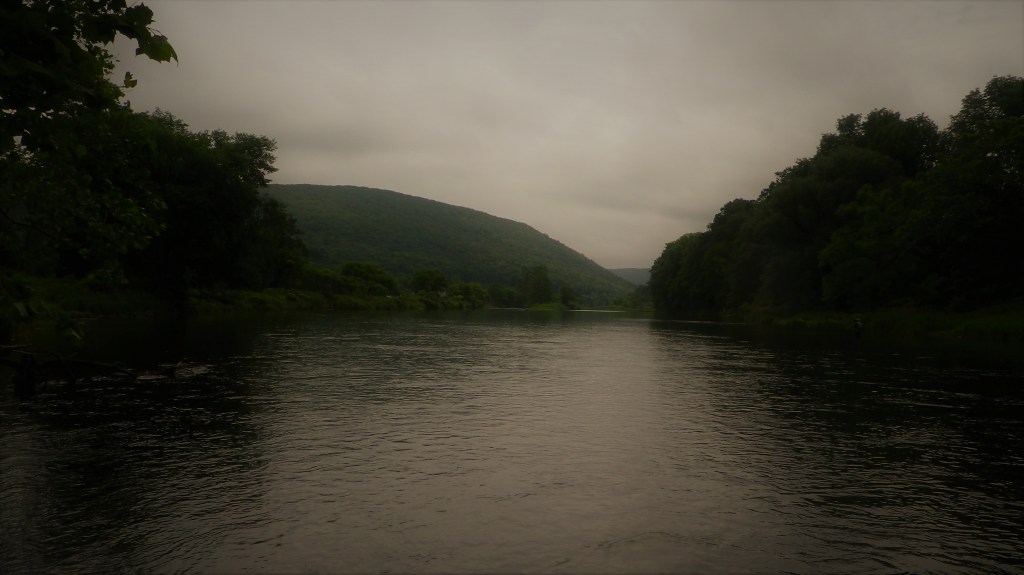
At last, the heavens opened and washed over our Catskill Mountains with a substantial gift of rainfall. Rivers rose rapidly to roily, un-wadable levels, covering acres of riverbeds which have too long baked in the summer sun. Between those aforesaid homeowner duties and this wonderful dousing, I have begun another week without fishing, though I offer no complaints, for our rivers are better off for this sorely needed gift of water.

It is early this morning, well before dawn, and I have studied the usual misleading forecasts with an eye to a few hours of hunting. One boasts ” a steady rain this morning and thunderstorms this afternoon” complete with hail and destruction, yet the likelihood of precipitation wavers among low percentages until Noon. There are times I think the weathermen are trying to scare us away from the outdoors.

River levels are still up, more like spring than summer, though I feel certain that their flows have cleared and offer safe wading. They have predicted stormy days so often this spring and summer when nary a drop of rain arrived, but Monday night’s predictions came true. What to do?

I am leading toward a drive, waders donned and tackle ready, it only takes one cast to take a spirited trout!

DNF

Did not fish, a simple, factual designation that has applied all too frequently to recent days. It is after eight on a lovely Catskill Summer morning, one that I hoped to join one of my best friends in a hunt for a wide flanked brownie or two, and I am waiting for the electrician.

It is hard for me to give up a day on the river, something I had to do for most of my life. These days, I sometimes take for granted that, if it’s a weekday, I am going to be fishing. I paid enough years of dues, so now is my time to explore my passion for dry flies and difficult trout. Homeowner responsibilities have gotten in the way.

I did sneak out for one morning last week, and it turned out I was very glad that I did.

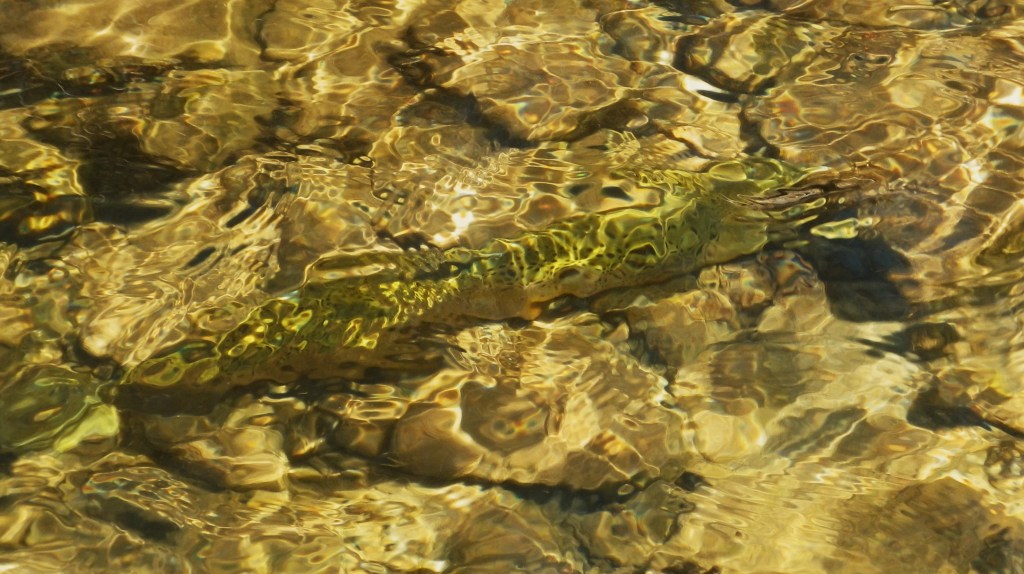
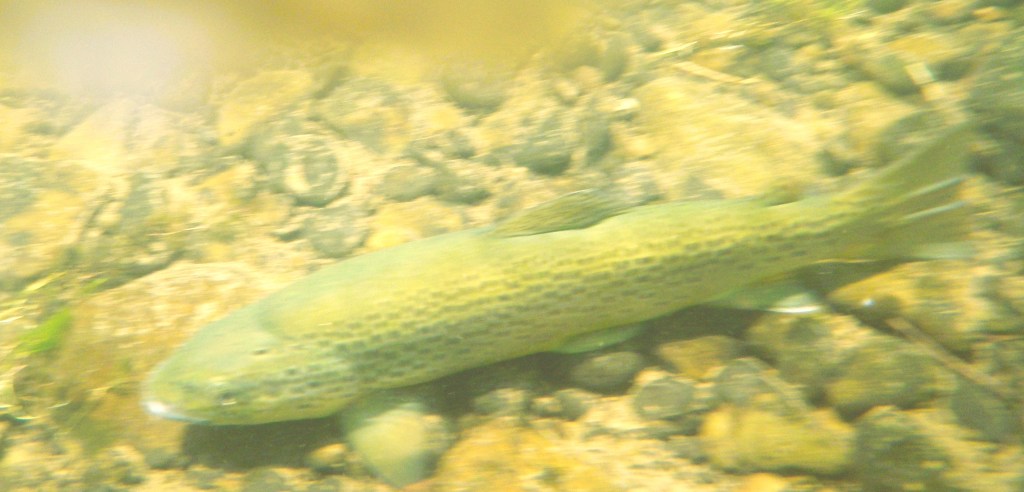
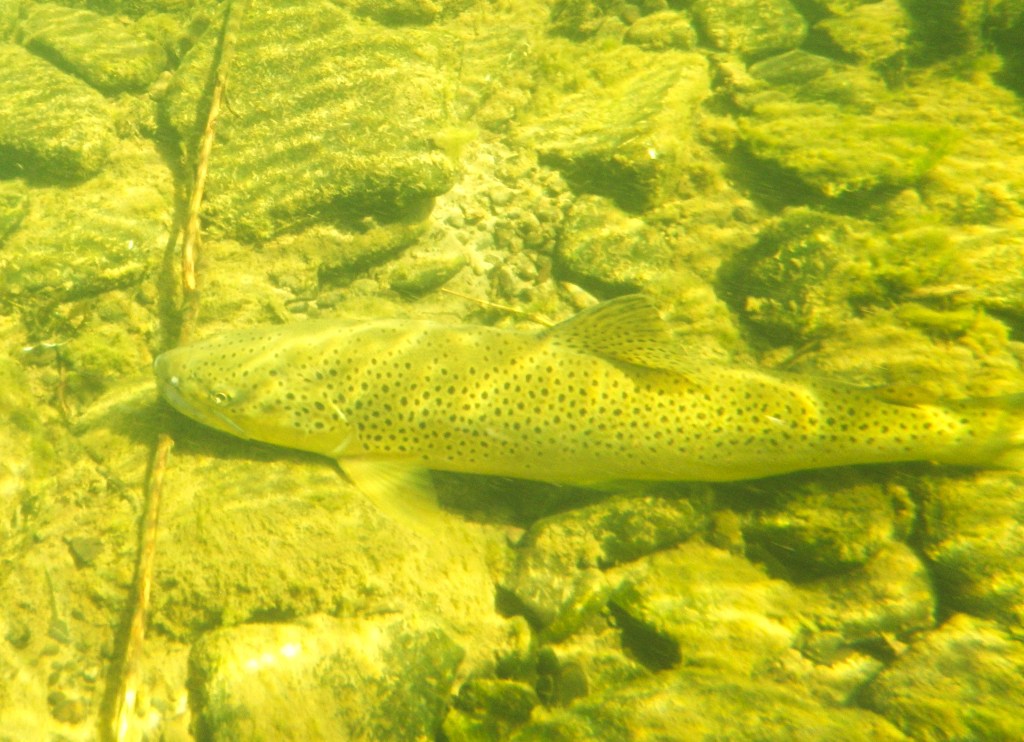
I ran into a couple of exceptionally fine wild brown trout, very quietly going about their own morning hunts for a meal. I had fished a pretty good reach of water without really noting any activity until my sixth sense kicked in upon the sight of a touch of motion in the current. It wasn’t much and could easily have been nothing but one of the river’s usual little hydraulic reactions to rocks and moving water, but it did get those hairs on the back of my neck twitching.

The cast had to touch the cover, and when it did and drifted ever so slowly for maybe half a foot, there was the take I had been looking for. Oh man, did that fish want to tie me up and break me off immediately, and it seemed for a long moment like he was going to succeed. We had that kind of standoff going, my rod loaded up and throbbing with energy without an inch of line moving one way or the other. This time, my pressure won the initial tug of war, and I got him a foot away from his sanctuary. I worked the rod down and to the side and turned his head a little more, and when he reversed direction, I was quicker. It was a long, hard battle after that, but it kept going my way. Two-foot fish are like that.

When he was unhooked and released, I took a breath and a swig of water. Too bad I didn’t have a dram of single malt to toast him, but that kind of celebration is made for the den after fishing, not on the river.

It wasn’t too many casts after I resumed the hunt that I connected with one of that brownie’s competitors. He rose once in a current line just off the edge of the bank, and I started casting gently a couple of feet upstream of his riseform. With no response, I figured him for a mover, and gradually expanded the scope of my casting, first upstream in that same line of drift, and then back down and closer to the edge. He took the fly with a subtle spurt of spray, and we started in. He was more the brash runner when he felt the hook, though he thought too late about turning back toward cover. By then I had him out into the river enough that I managed to check his runs for trouble. He was a beautiful brownie, just slightly smaller than his fellow hunter.

Clarity of Focus

Mid-July, and still no rain. Even the thunderstorms seem to be bypassing the region. Those that pass by have ranged from threatening to destructive – there were tornado warnings all over the map two nights ago. If only all of that moisture, energy and turmoil could spread itself across these parched mountains as a day or two of sustained gentle rainfall.

I have not fished since Monday, and that was a day the Red Gods won. Penance for the miraculous day I enjoyed last week. I found myself victim to the yips, overcome by anticipation born of that perfect day, and pulling the fly away from most every taker. I took a pair of feisty trout, but oh those that might have, should have been…

Hunting trout requires a clarity of focus. Each step, each decision, and of course each cast must be executed with delicacy and precision. The smallest imperfection robs the angler of an opportunity that will not be repeated. Thus, the supreme challenge and delight of the game befalls us. We humans are not, and most certainly I am not perfect. In this type of angling, we seek a few moments of perfection to share in and pay homage to the astounding perfection of Nature.

Allow one foot to slip momentarily on a cobble, and a soft pressure wave telegraphs the trout you are stalking, and likely others, that something intrudes. Place a cast a foot further upstream then ideal, and the unseen hunter is alerted instead of tempted.

My old hunting grounds offered no quarter

My old hunting grounds were my classroom, and they offered no quarter. The trophy rainbow is just to the right of the center of the photo. Line him, drop your cast too far above or too close and he is gone. The fly, the approach and the cast must be perfect the first time, for there is no second! Clarity of focus and execution are as simple as that. The trials of these wide, lovely Catskill rivers are far less obvious, but they are there and just as difficult, perhaps more so because they are hidden from the casual perspective.

The responsibilities of the homeowner have intruded, and still are, as I try to deal with issues stemming from my attempt to rescue us from this incessant heat wave. A perfect stalk, a perfect cast are not made of divided attentions.

Yesterday would have been a good day to stalk the rivers. The hot winds rose to herald the onslaught of more of those phantom severe storms, winds that can drive thousands of Nature’s insects into the water, and I was dealing with electrical problems. The severe storms failed to materialize, and though I am thankful for that, I would have loved to have the rain. One of those passing clouds must have nicked a corner of the Beaver Kill’s watershed, as that river got a tiny bump in flow yesterday morning, though insufficient to bar it’s temperature from exceeding 82 degrees. The flow dropped rapidly and is back to pitiful as I write.

Of course, this afternoon’s forecast has storms in it, though I expect nothing per this season’s experience. I have dreams of sneaking out to the river for an hour or two, at least if the winds come sans lightning and chaos again. There’s a special new fly just waiting.

I have yet to find a mountain stream to enjoy the wonderful little six-foot rod my friend Tom Smithwick gifted me, for they suffer too from the heat and drought. Give me the seventy-degree days and the gentle rains that make what I know as a Catskill Summer!

A Catskill Summer day (Photo courtesy H. Juang)

Summer Musings

The last cast of a summer’s day…

It is the weekend, Sunday in fact, and my projects have been completed. The lawn has been mowed, and the new air conditioner this recurring heat wave forced me to acquire has been installed and, well, cat proofed. I have tied a handful of that new jumbo-sized Light Touch Beetle whose debut turned into the morning of the season, since there was only a single fly remaining in my summer box. Oh, and I have been out casting rods.

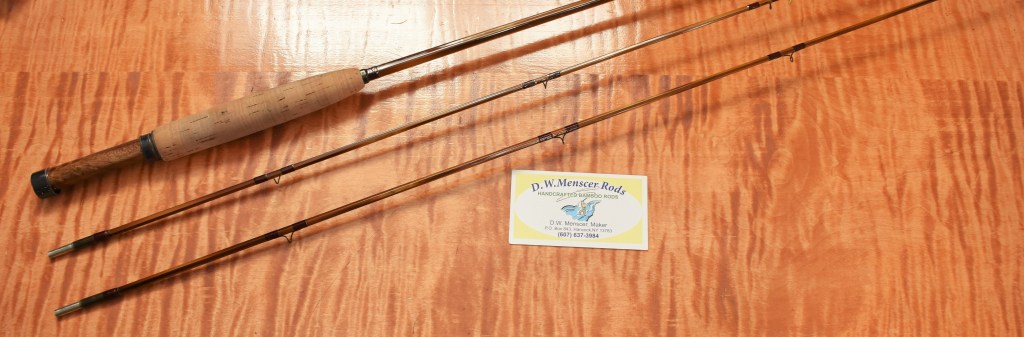
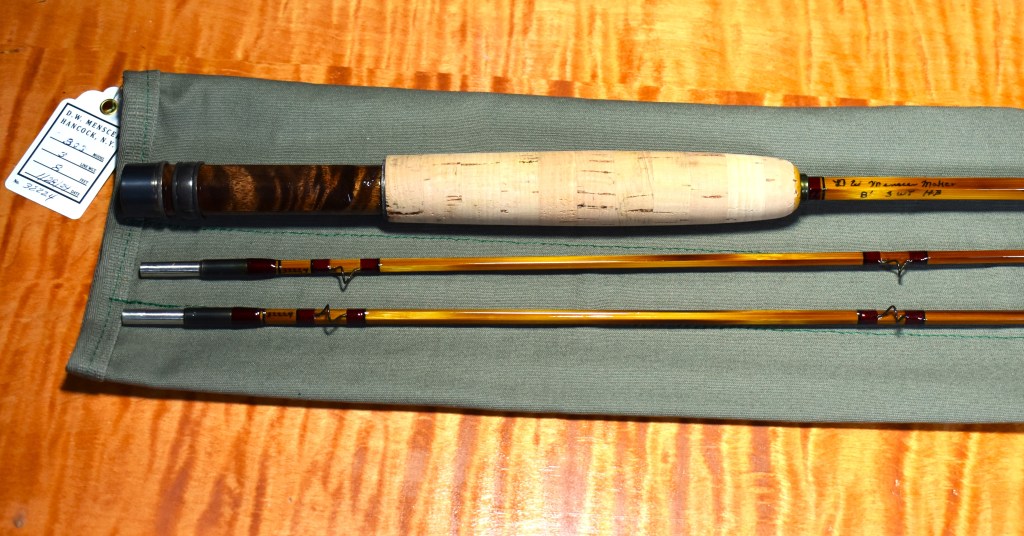
I decided to fish my 7′-6″ Dennis Menscer four weight tomorrow and wished to try a couple of reels and lines. That rod is a rarity for Dennis I believe, for it is made to an uncommonly faithful Jim Payne taper for the renowned Model 100. I cast one once, at the Catskill Cane Revival in April of 2019, and promptly ordered one. As a rule, Dennis’ tapers are his own. In the course of his restoration work, he related that he had removed the varnish and then miked two separate Payne 100 rods which were made some 35 years apart. He smiled when he told me he found no more than 0.0005″ between the two at any point. Five ten thousandths – that is consistency, and the taper makes this a very sweet casting trout rod. He was so impressed he decided to offer his own model, using Payne’s original taper exactly as his micrometer measured.

Mine was christened on the Beaver Kill, once cool temperatures and the blessing of regular rainfall returned the great river to fly fishers, with a beautifully wild twenty-inch brown trout which sidled up to my Isonychia dry fly. Alas, since often I gravitate to eight-foot rods fishing our large trout rivers, it has not been fished in a while.

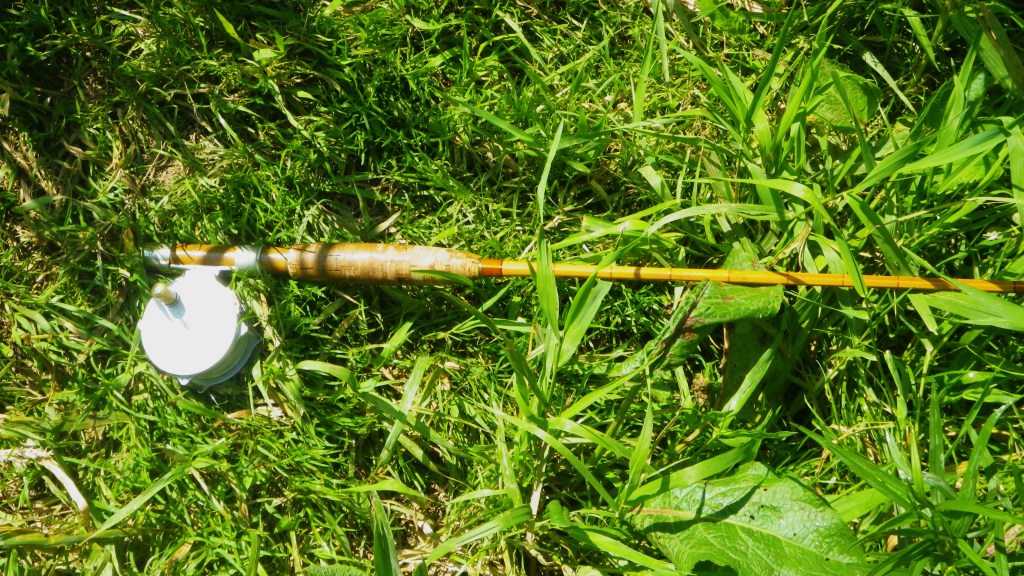
I was delighted to find that one of my vintage 3″ St. George reels, spooled with a 406 brand DT4 fly line is a perfect mate to this beautiful rod and it’s classic Catskill taper.

Lunchtime, and I can almost taste the fresh ham sandwich I’m thinking about. First, I’ll load these new beetles into my fly box, lest my sleepy head forget them in the morning…

The seven-six four

A Hunter’s Redemption

My much-adored Mills Standard, now broken and bloodied. It’s summer over, it rests in the skilled hands of Dennis Menscer for repair, that it might once again cast a long and lovely loop of line to a rising Catskill brown.

There are days when Nature’s signals are muted, but all her wild creatures heed the call.

I did not carry a cherished bamboo rod on this day, still reeling from the damage some wild Catskill brown had wreaked on my fifty. I carried another veteran, the rod that was my limestone springs companion, a slender eight-foot Winston boron rod.

I missed the bamboo, but I adjusted my casting to the very light, quick feel of the Winston, coaching myself to ease up on the power, less my casts strike the placid water with trout spooking force. I lost myself in the hunt, slipping softly through the early morning mist.

The day began in beauty and solitude, though the fishing seemed to tell me that the Red Gods intended to punish me once more. I hooked two, briefly, the hook pulling out quickly on both of them. The short moments of contact telegraphed size and strength, two more missed opportunities, and then solitude was sacrificed to the whims of the Red Gods.

I changed the fly, thinking that might perhaps change my luck, and it did. This season’s now months long low water had me thinking about another variation on the theme of the beetle imitation. I went back to a Cumberland Valley staple in construction, then modified it in concert with the use I had in mind. The Soft Touch Beetle was born, with a pair of them tied on a size 12 hook, for hungry hunters.

Dissecting bits of cover throughout some known trout lairs, the long beetle performed as designed, even when fired under and around cover and foliage with the quick flexing boron rod. The first take was soft and confident, and tightening quickly convinced me I was working with one of the trout lost on that disastrous day the Mills fell.

I urged him from the protection of his lair with the rod heavily bowed, so he ran against the drag down river and away. Ah, what’s this? The Winston wears a modern reel, one with a staunch drag that impeded his retreat, though I missed the sweet music of an old Hardy. Still, he tested every fiber of the rod before I swept the net beneath him.

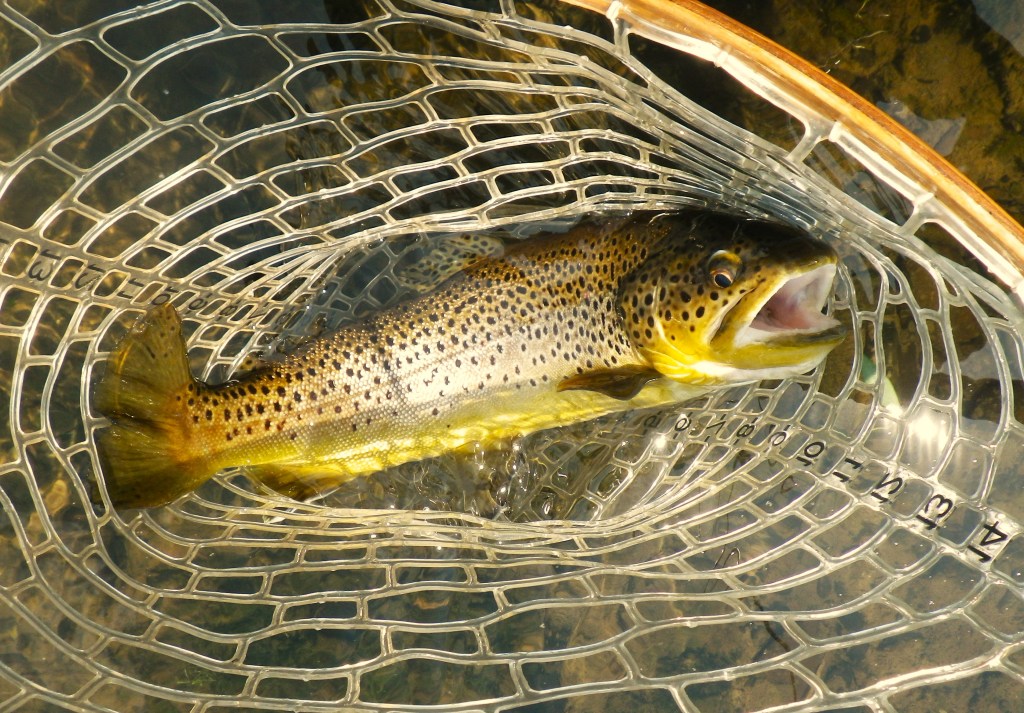
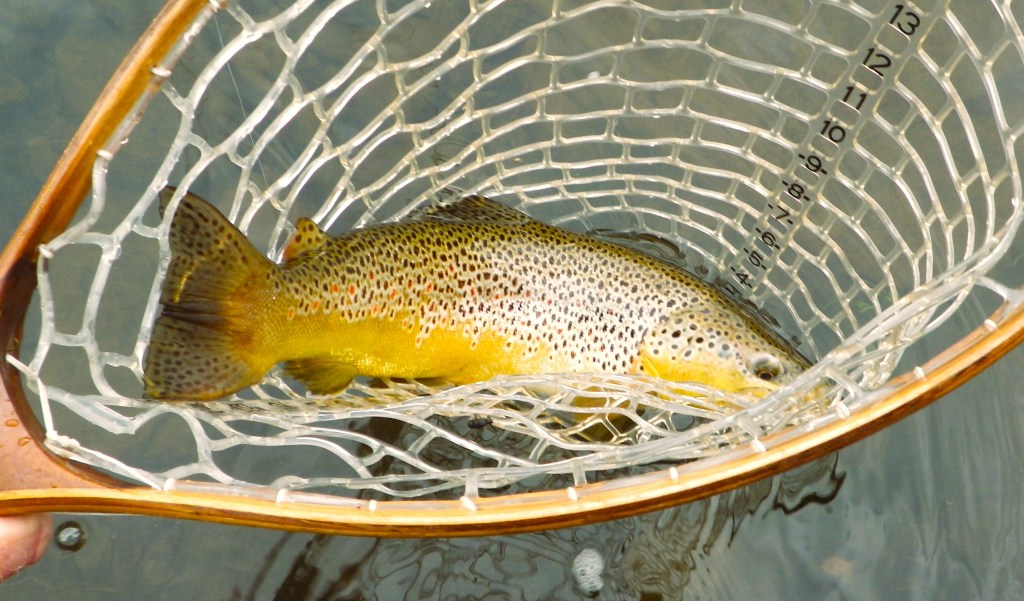
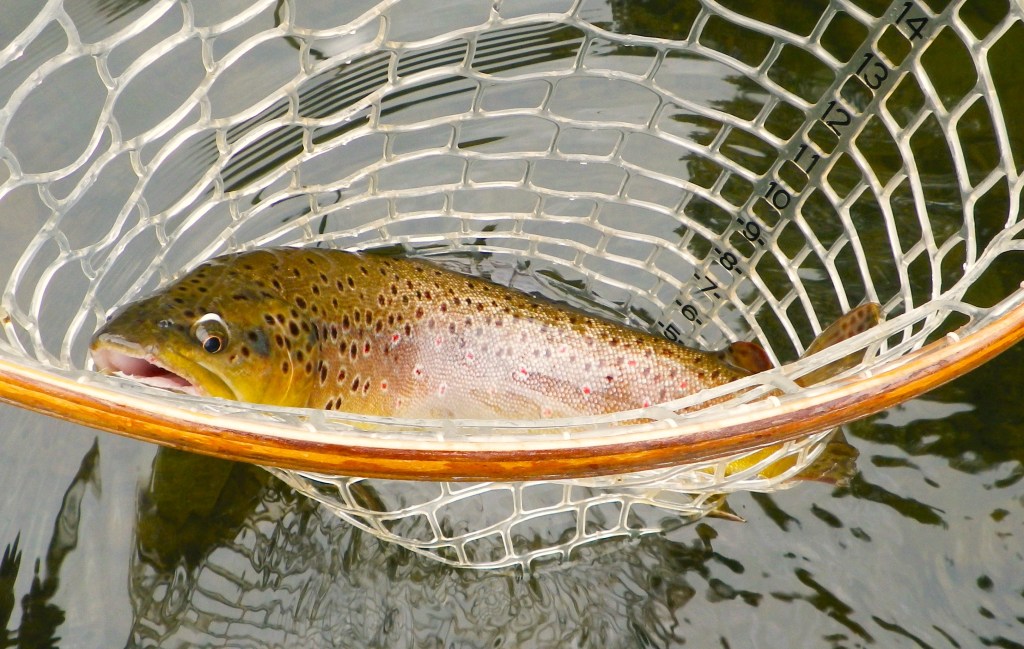
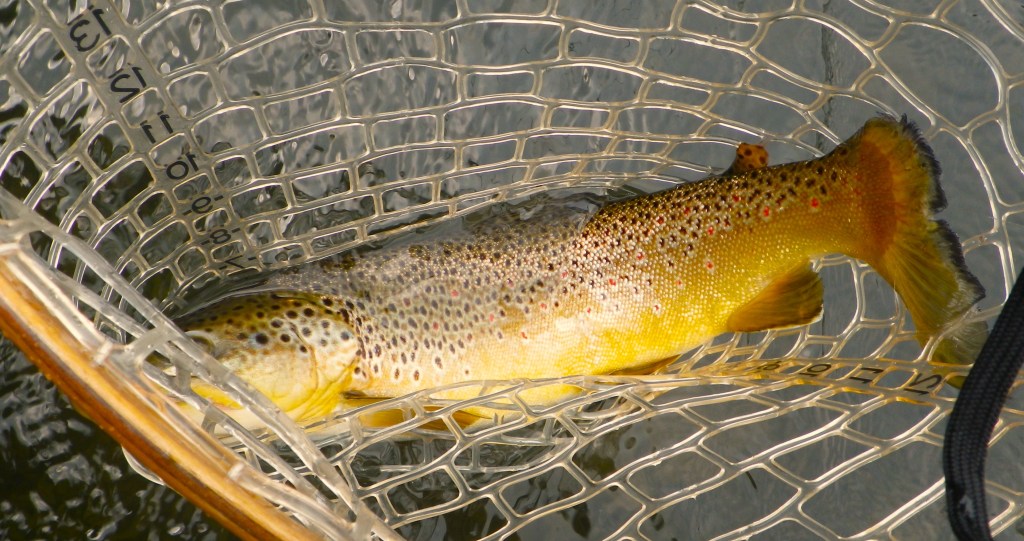
Straightened along the graduated midline of the mesh, his full two-foot length was confirmed; a little redemption for this hunter of the mists!

The beetle impressed on it’s first trial, so I fluffed and dried it’s hackles and continued. A fifteen-inch brownie found he was big enough to get that big beetle into his mouth, pulling so hard he fooled me until I got him close enough for a look. After taking a short break, a rise showed in that same location, and he took it again! I swear it was the same fish.

Returning to the hunt, I sent the Soft Touch to inspect one of those quizzical haunts where great boils have been noted from a distance, with nothing save a sprat or two ever being caught there. The soft, confident ring bulged the surface, and I was in it from the hookset. A hard charger, intent upon breaking my tackle, and it took every trick I had to keep him from the edge of destruction. Netted, he was a dark bronzed warrior, barely an inch shorter than that two-foot mark!

My new beetle was looking somewhat chewed, even after a rinse and dry. I massaged a bit of floatant into it’s herl and hackles and continued the hunt. Grabbed again, I felt one very hard pull before the fly came away, checked the hook and cast again.

The fishing was patient and surgical, and my concentration was rewarded once more. The next beetle eater leaped high when he felt the steel, then again and again he vaulted skyward, a brown that must have rubbed fins with a Delaware rainbow. A prodigious fighter, he too was eventually led to the net, and exceeded twenty inches.

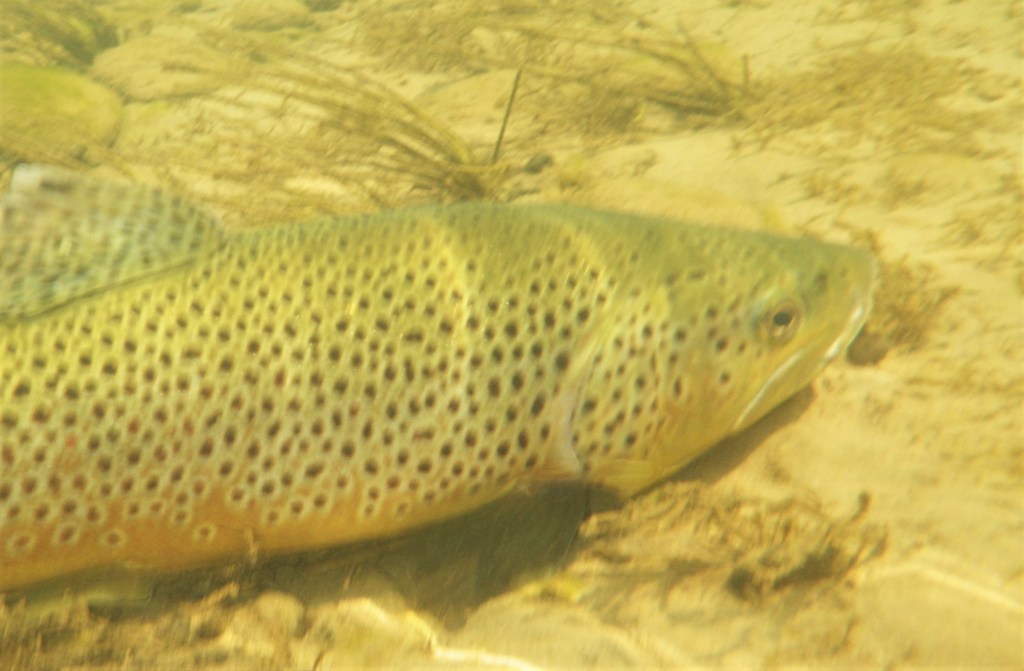
There was another, a two-foot trout I have never seen before. In the net I found that my reaction had been slow, for the fly had caught him in the skin beside a pectoral fin, as he spit the fraud before I struck. A spectacularly colored brown, I offered my apologies and released him. He cannot be counted, for he was not fairly caught, but it is a bit miraculous to have four trophy browns sip that same fly in less than four hours of fishing.

The energy of that amazing morning propelled me through an uncharacteristically long day. I fished nearly nine hours, something I have not done often in my golden years. Some more trout were caught, a few missed, though none like those that left a glow in my heart that morning. On my last cast with that poor chewed and bedraggled beetle, I saw a tiny wink at the end of a long, long cast to the shady bank. I reacted a bit hard, my nerves still firing with the energy of redemption and left the fly where it was. I felt nothing and assumed it had been one of the juvenile trout I had encountered later in the day along that last reach of water. Perhaps, perhaps not… it was a magic fly after all.

A Hell of a Day

As usual, our forecast called for winds and severe thunderstorms, their probability beginning around Noon and escalating from that point. It is 4:45PM as I write this, and I haven’t seen a drop of rain. It’s so hot that the winds actually feel wonderful.

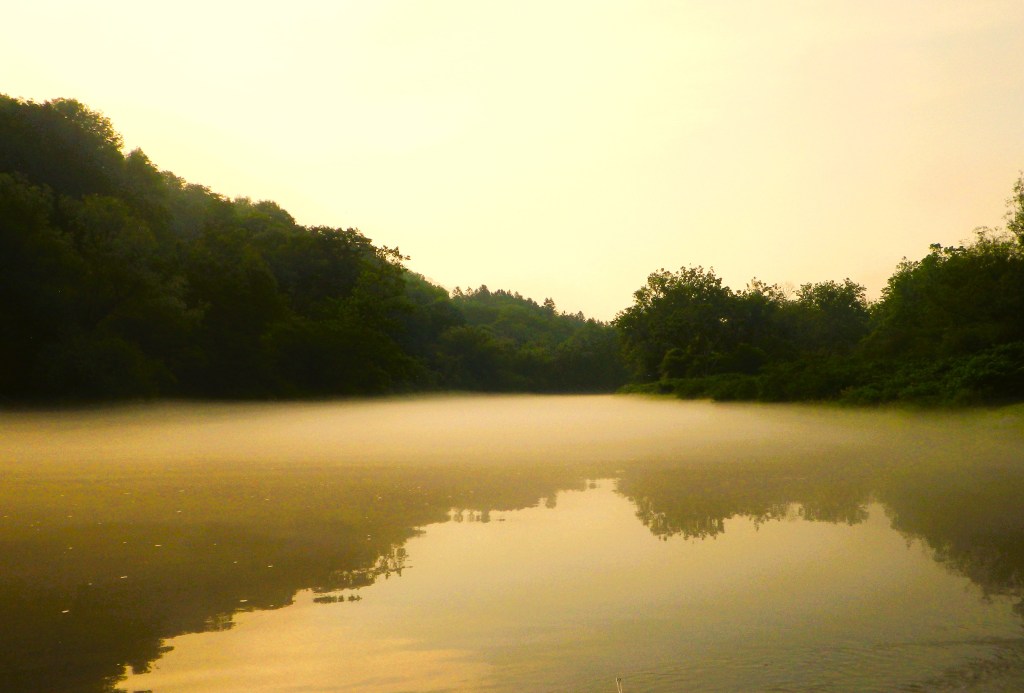
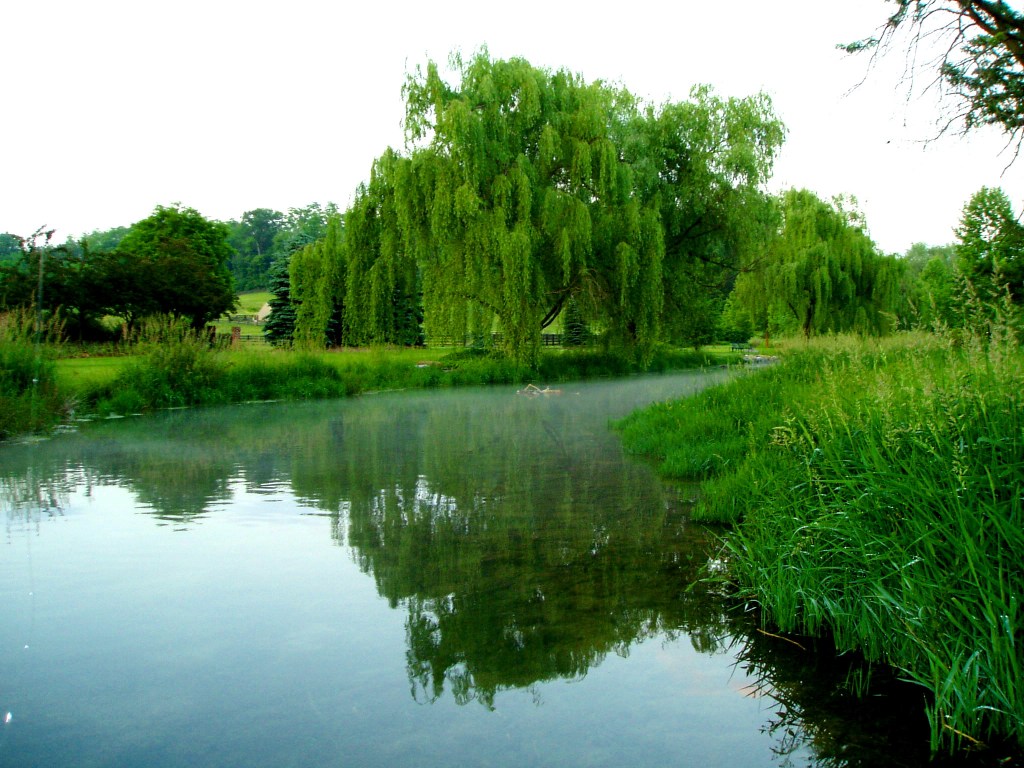
Summer thus far has featured a lot of this same scenario, and we simply adapt as best we can. I was on the river by 6:30 this morning, hunting the fog once more.

The first location I chose to fish featured a definitive lack of action, and as the morning marched on without the sun I expected burning off any of that heavy fog, I decided to walk out and try another place. I found action, but it turned out to be the kind of day the Red Gods savor: hell for the fisherman.

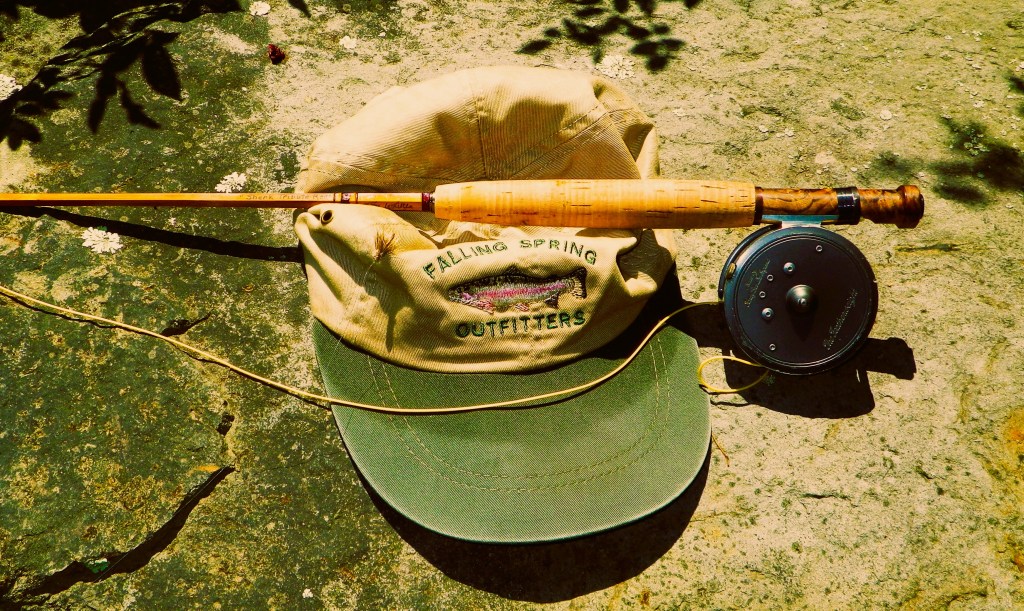
My Catskill Classic, a 1940’s vintage Mills Standard, the working man’s version of the iconic Leonard 50 DF.

I was fishing this morning with my working man’s 50 DF and it was casting beautifully with a number four weight-forward line. Since it was later in the morning now, I was placing my Adams Grizzly Beetle into every nook and cranny I recognized as capable of harboring a sizeable trout. When I laid the beetle gently down on the very edge of some bank side cover, that lovely spreading ring appeared and the brought the Mills to bear. This trout refused to let me turn him away from the cover. Though the eighty-year-old bamboo strained into a full parabolic curve, he just powered down into that cover, ignoring my pressure. In a second, he cut the tippet on that cover and I was flyless, and of course fishless. I just shook my head, as that was one serious brownie!

I fished on upriver after re-rigging, got myself back into that sweet casting rhythm again and started to fish at a high level once more. There were no takers.

I have been kicking around ideas for a new fly, and things took shape over the weekend. I had done some research last winter to see if there were any forest and woodland species of grasshoppers here in the Catskill region, and I designed a fly to imitate one of those species. The first trial on Monday brought no interest, so I went back to the vise and revised the pattern, tying a smaller, baby woodland hopper more appropriate for early July. The baby was the fly I tied on to fish back down the river.

When big brown trout are hunting a meal, they can be unpredictable. They will move, then linger for something between thirty seconds and thirty minutes in one location. Concentration and stealth are the keys to this kind of trout hunting. The little Woodland Hopper found one of those rest areas it seems, and when I shot the fly long and low into his comfort zone, he sidled up to take a look: there was that sweet ring again. I set up on him firmly and he exploded in a big boil and streaked away from his lair toward the main river channel, while I stripped line to keep up. He turned against my pressure, and the hook just popped free. That’s zero for two if you’re counting, though it was nice to get a take on the new pattern.

I kept working every lie and mass of cover as I waded down, my morning getting shorter with each step. I started to fish the next to last spot with long, soft downstream casts, easing down step by step behind my drift. When I got to the serious heart of the lie, I laid one perfectly above and let her drift. Ring number three, an even bigger explosion, and then the world came apart.

It took me a moment to recover from the shock before I could try to reconstruct the event in my mind. It seems that the trout really blew up when he felt the hook, but once more, it failed to hold. There was a lot of pressure on the rod, as this was one honking big fish. When the hook pulled out the rod recoiled, all forty-five feet of fly line and 15 feet of leader came flying back at me at high speed. The rod tip snapped at the ferrule and slid down the loose fly line. The line, leader and fly were a1l in one ball of tangles, and my fishing was brutally ended in an instant. It took me several minutes to untangle all of that after clipping off the fly.

Red Gods four, Mark nothing.

They do seem to like the Baby Woodland Hopper though…

Mmmm, hopper! Yum!

The Legacy

Ed Shenk – Master of the Letort

He reigns as the greatest icon in my journey into and through the magical world of difficult trout, for Ed Shenk was The Master, and the Letort Spring Run was the heralded queen of impossible trout waters that captivated me and taught me through many lessons, trials and errors. It is not coincidental that I think of him as summer graces the landscape, for summer was the prime season on the fabled Letort, and all of the limestone spring creeks of Pennsylvania’s Cumberland Valley.

Terrestrial fishing was born upon these waters, for they did not issue heavy hatches of mayflies during the past forty years or more. Their trout were secretive, taking full advantage of the lush beds of aquatic weeds, undercut banks and log jams. The essence of my own fascination with trout hunting lies veiled in the mists of humid summer mornings where the limestone waters meandered gently through my heart and mind.

And still I am called to hunt the mists…

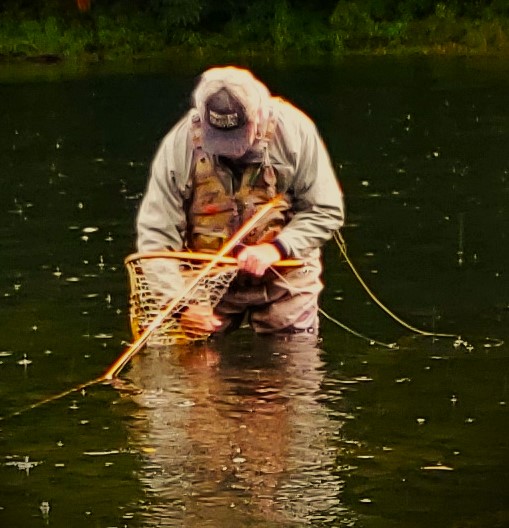
Sixty-nine degrees at dawn and 100 percent humidity bound the morning fog heavily along the river. I stalked in the silence and listened. Every once in a while, I heard the rush of a hunter, and began the slow approach in it’s direction. Closing on an area, I concentrated upon the feel as the flex of vintage cane propelled my fly out, to land lost in the mist. Eyes strained to gather clues from a wider patch of gray water as I imagined the drifts I could not see.

Nearing the place where my ears had told me to expect a hunter on the prowl, I searched in vain for any indication of movement. With low light and fog robbing me of the best of my senses of perception, I called upon the ethereal. One moment the fly was out there, unseen, and the next, I knew it had been taken. The arching bamboo transmitted powerful head shakes as I stripped line, the great fish barreling away from his hunting ground toward open water. I could hear his boils at the surface and see the flashes of white water, but the world beneath the surface remained opaque, reflecting the soft gray of the low-lying mist.

The spinning drag of the old CFO seemed amplified by the silence, and my heart beat faster with each ratcheting arpeggio.

I saw him clearly only once my stroke with the net pulled him from the mist shrouded water, the black fly prominently displayed on the point of his maw. He was beautiful!

Hours passed before the sun slowly burned through the cloud cover for the few minutes required to cause the surface hugging mist to vanish. I had taken another quality brown trout and continued hunting slowly, searching. A soft sound drew my attention to one small undercut. The cane flexed smoothly, and the little fly touched down less than an inch from the edge of riverbank and water. A spitting rise and I bowed the rod heavily as an unseen monster pulled the tip down hard. We froze there in that pose, the trout powering around some unseen rock or root, wrapping the leader in an instant before breaking the tippet cleanly.

The sun burned through once more and winked at me before retreating back through the clouds.

Summer Daze

How easily I have settled into summer. Morning hunts and hot, windy afternoons, three and four weight flyrods, yellow sulfurs and my armada of terrestrials – these are the things summer is made of. I love the taste of an ice-cold beer on the porch as supper crackles on the grill, the ballgame afterwards, and the feel of that special coolness when evening turns to twilight.

I’m taking a holiday today, a rest from the relentless pursuit of angling grace. Flies have been tied, and gear will be seen to before the cold one and the afternoon ballgame tear me away from fishing thoughts.

There is still another pattern lurking in my subconscious, one I have tried to find for quite a long time now. Perhaps it will finally take shape, but for now it’s essence remains ephemeral.

July

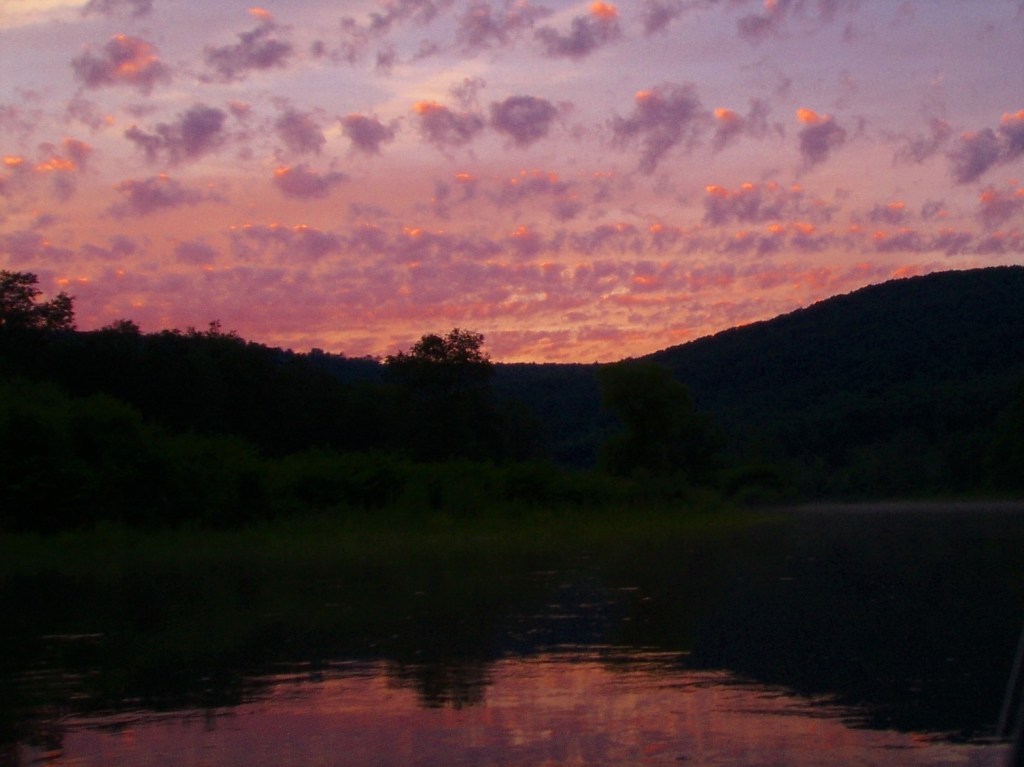
One of countless July evenings on the West Branch Delaware, where a gorgeous sky brings the angler’s day to an end.

July is finally here, and it comes with it’s sack of memories. For many of my traveling years, the July Fourth holiday marked the finale of my Catskill season. The summer sulfur hatch on the West Branch was the draw, along with the open pools devoid of spring’s crowds.

I remember fishing down at the Barking Dog Pool when there was a three-car parking lot offering a two-hundred-yard walk to reach the river. Come July, there were no other cars save mine. If I managed to encounter another angler somehow, the place seemed crowded.

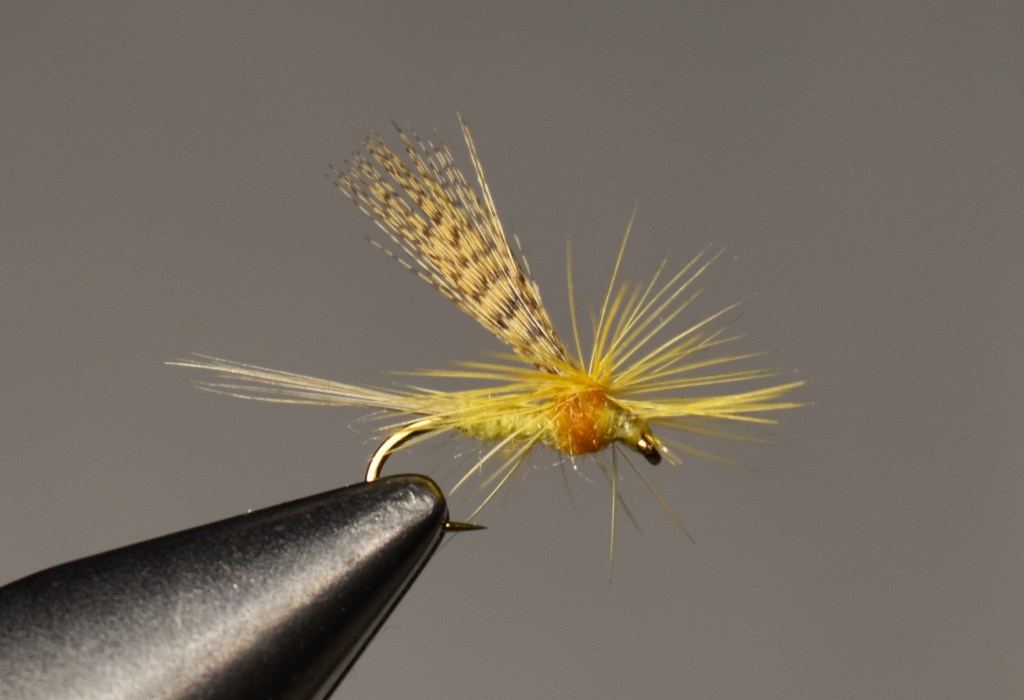
The wild browns were difficult even then, for the tiny sulfur duns would burst from the 47-degree water into the 90-degree air and dance all over the surface; miniature mayflies screaming eat me to the trout. I fished a lot of very simple flies to take the big brownies back then, thread bodies and CDC wings, with either 3 pale hackle fibers for a tail or a few strands of crinkled Antron yarn for a trailing shuck. The flies were light, the CDC wings buoyant, and their fibers offered just a bit of movement as the near weightless little flies bounced on the cold, bubbling current.

It was rare to see a drift boat on that upper reach of river back then, and I waded, immersed in the technical fishing for hours on end. Blissful summer before the long separation of August, September and on through autumn and winter.

Today one gets in line and takes his chances to fish that same water. There is a wader for every fish, and the boats come in flurries, their hurried oar strokes putting down the rising trout along the riverbank. There was a time when large trout frequented the shallows all along the eastern banks, sipping sulfurs. The huge parking lot and boat ramp took care of that activity, and today it can be nearly futile trying to find a rise along the heavily fished western bank. The sulfurs no longer come as they once did either.

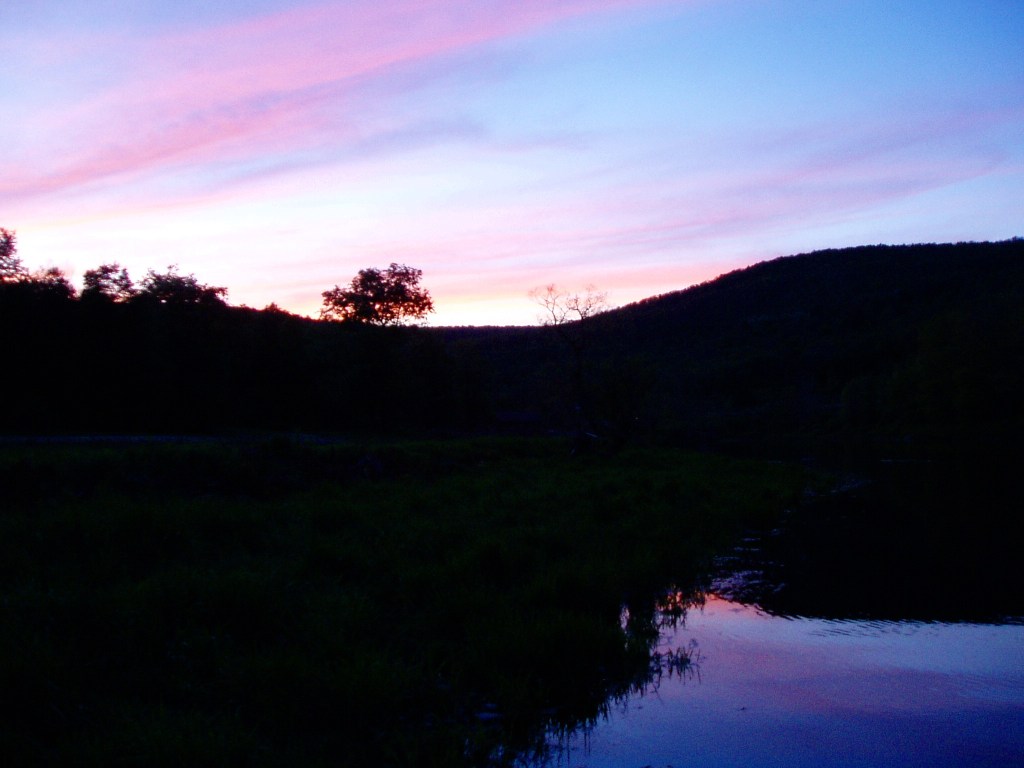
Sunset on ‘The Dog”

The challenge is different these days. There are still large wild trout swimming in the West Branch, and a hunter can find them, though much is wagered on luck to reward his efforts. The torrent of fishing guides know all of the old spots, and they often line up, anchor and wait their turn two or three boats deep. The trout adapt, and I have found them some days in the forsaken waters, too shallow, too lacking in cover to hold good trout and not worth the time of all those professionals.

The difficulty comes from the fact that trout will not stay long in nothing water. A bounty found today may be reaped once or twice, but they will not remain once fishermen discover them. There is always more empty water to be searched; with the feet, the eyes, and the heart.