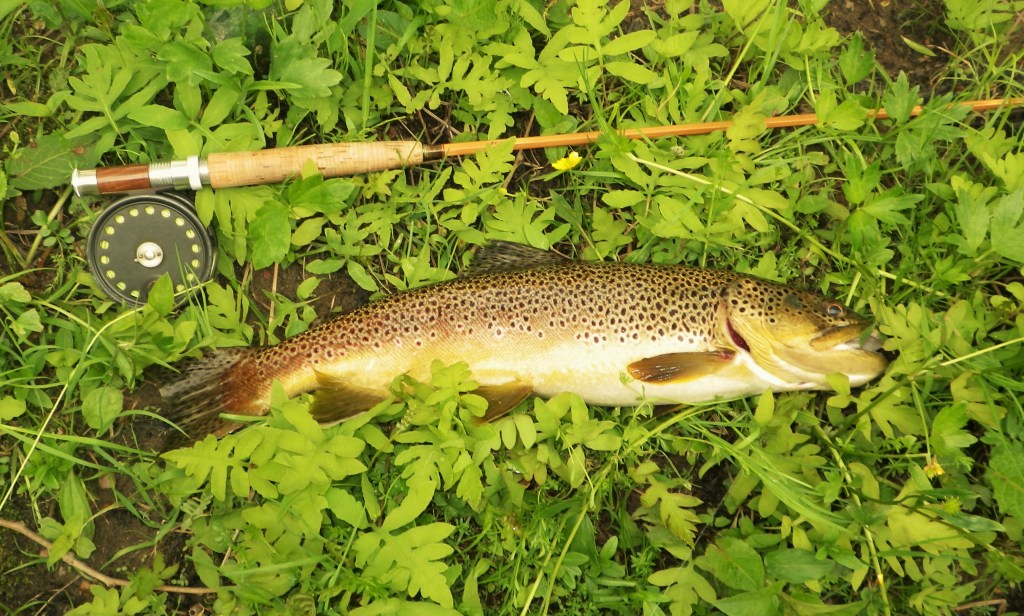
My 8040 Granger rod is back in action, thanks to Dennis Menscer. He crafted two new tips for me so I can keep fishing my old friendand doing battle with big Catskill trout!
It was really nice to take an old friend fishing today. I stopped by Dennis Menscer’s rod shop Saturday to pick up the two new tips he made for my wounded Granger flyrod, and I was more than anxious to get it back on the water. I decided to visit another old friend, a little out of the way pool that had been far too warm to fish all summer. It seemed like the perfect place to welcome my new old rod back.
The wind began to rise just as I waded into the low, clear current, but I knew the Granger had been designed for windy western waters and would let me put my flies on target. I selected a Grizzly Beetle to knot to the 6X tippet, figuring that the wind would deliver plenty of terrestrials as it blew ever harder. I saw one brief movement, a barely perceptible little vee in the slick surface, lofted my back cast and let the line unroll to drop the fly a couple of feet above the spot. I watched the hackle catching the morning light as I tracked the fly, lifting as it simply vanished. The trout reacted immediately to the arch of new and old bamboo as we began our dance.
The cane protected the fine tippet, absorbing each head shake and run, ultimately guiding my quarry to the waiting net. It was a beautiful wild brown trout, a bit better than eighteen inches, and colored up profusely in preparation for autumn. Welcome home.
A second trout stretched my leader only briefly an hour later, with just enough of a hard pull to let me know another nice fish had come calling before the fly came free. As the sun rose higher in the sky, the direct rays illuminated the entire river bottom, and I guessed that my fishing was done. Still I lingered a while, making a few more casts to drift a fly over each submerged boulder that the sunlight revealed. Its not that I expected another trout to take the fly, it was more of a long goodbye to my old friend.
It is 49 degrees this morning in Crooked Eddy. I closed up the windows in the house last night but neglected the two in my tying room. Suffice to say that my light sweatshirt feels a bit too light as I write, though it is invigorating. Next week’s forecast tells a tale of autumn, with daily highs in the sixties and low seventies, and nights in the forties and fifties. I wouldn’t be at all surprised to see a bit of red and gold appear on the mountainsides.
Fishing is changing too. The trico’s have been sputtering, though they might return in better numbers for a day here or there; another of those right place at the right moment scenarios. I have done best this week with little olives. My Olive Rusty Dun is my homage to the late great Art Flick, and a chance to use the beautiful rusty dun cape in my Charlie Collins collection. I love simple flies. Sparse, beautiful and effective, the Flick Blue Winged Olive is perfect for these dainty mayflies. I tie them as simple as possible, eschewing dubbing for a body of tying thread, my two ingredient duns maintain the slim profile of the naturals.
October’s low wateroffers a beautiful challenge!
Cool days and nights will finally bring our water temperatures back to hospitable levels, opening up a wealth of opportunities that summer denied. Small flies will continue to reign supreme, though it pays to have a couple of Isonychia and October Caddis in the vest for a change of pace!
I would love to see rain, as I enjoy the prospect of an early autumn float. I am not a boat dragger, and I don’t care to draw the ire of wading anglers trying to force the issue by drifting at low flows. To me that destroys the beauty of a quiet float and a hunt for autumn trout.
It is hard to believe that we are just more than two weeks from hunting season. I’m looking forward to the chance to walk the mountains again. My legs have grown used to walking against currents, so I must re-train them for the challenge of elevation. Friend John and I have been talking about all the young birds he has seen this summer, and vowed to uncase the shotguns and break some clays before its time to chase those grouse o’er the thickets and briars. My favorite months have always been May and October. Both quicken the pulse and enliven the senses, offering their own distinct flavors of exquisite natural beauty.
September is a time for summer goodbyes and anticipation for October, and the last great flash of light and color before the bare season comes. Farewell to verdant riverscapes, and a welcome hello to the uplands; a touch of melancholy at the loss of summer’s daily fishing, balanced with the heart racing promise of the gunning season.
I have never lived, never spent any time in a region devoid of seasons. I am quite certain I couldn’t bear it.
A Size 20 Olive Rusty Dun Flick Style, A Size 28 CDC Ant, and for comparison a Size 16 Sulfur.
It serves me right for thinking that the size 24 flying ants I tied last week would take care of those picky brown trout the next time I ran into an ant fall. They were at it again this afternoon, and my 24’s might as well have been rocks. Picking up one of the miniscule little winged critters, I held it next to my size 24 fly: the fly was twice as big as the ant. Prepare yourself with 24’s and get a fall of 28’s!
It was a gorgeous morning, and I had some fine fishing with that Olive Rusty Dun, taking three nice fish with long casts with the D.W. Menscer four weight. I enjoyed feeling their life energy merge with the life of the bamboo as they spun my little St. George reel to make some music. Summer has returned for a last hurrah, and the sun shone brightly in the clear Catskill skies. This is the time to truly savor it, to breathe in the full measure of these beautiful summer days every moment that I can.
It was an interesting day, starting with the three wild turkeys that decided to cross the road as I came around the bend. I hit the brakes, and the horn, just in case I couldn’t get stopped in time. I’m glad I have good brakes, as one bird turned around and stood there a moment, and one flew into the air about windshield high and sort of hovered there in the same place.
Stalking along in the river half an hour later, I kept hearing this funny little chirp from a lone tree on the bank. I was wondering if I was intruding on a young eagle’s fishing spot until another turkey burst out of that tree and hightailed it across the river in a thunder of wingbeats. I should have recognized that sharp little putt, but I haven’t been out hunting turkeys for a decade. Crazy day.
I had hoped for some solitude today, figuring with Labor Day behind us, all the visitors should be back at home. No such luck. I found another angler closing in on my destination from upstream. Turns out we are strangers who know each other, sort of. He had walked in on my fishing last summer at another reach of water and asked if I minded if he fished 50 yards or so upstream. I appreciated his courtesy and bade him wade on in, and we talked a bit as we fished.
Later on, after my old friend I don’t actually know had left, two guys came splashing across the river, chattering with every step. They stayed far enough away from me, but I wondered why two guys fishing ten feet apart had to holler to have a conversation. I was treated to their excessively loud chatter for the last couple of hours of my fishing. Those guys and the ensuing boat traffic set the mood perfectly for the frustration of the flying ants.
I’m not complaining, as I got a fine unexpected dose of solitude just yesterday. John met me on the river for a morning of fishing apart, our 2020 behavior adjustment to ensure our health, yet still be able to enjoy the other’s company. We visited with the eagles, caught some trout on little dry flies, and shared a beautiful spot in the mountains.
I do believe this is summer’s last kiss. I have a feeling that autumn will arrive very soon with winter hotter on it’s heels than any of us would like. I have no doubt I will have the river to myself then. There won’t be trout rising, or flying ants too small to imitate, but I’ll enjoy the solitude and the beauty of the river in winter. I can’t say just why I have that feeling, maybe its the lingering specter of the May snowfall and the lonely quarantine for the duration of the season that have given me a sense of foreboding.
I plan to wrap myself up in every day of summer’s last kiss, all the while hoping for a mild, beautiful October, with a spell of Indian Summer as its highlight. Dry fly fishing to the final hatches of the season is exquisite amid the vibrant splendor of October in the Catskills!
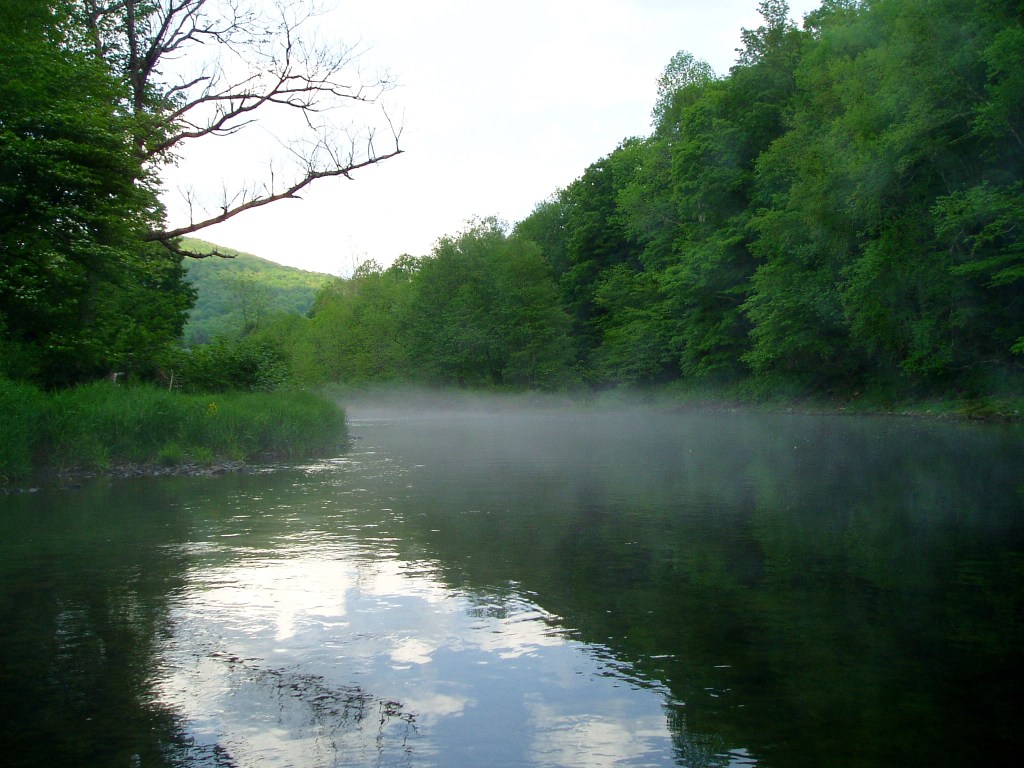
Evening Mist gathers on the West Branch as I wander in search of the rise…
I can feel it in the air and see it in the angle of sunlight: summer is waning, and her departure may be quick! This week promises afternoons in the mid-eighties, perchance a last gasp of summer’s warmth before the weekend brings a major drop in temperature. I won’t miss the heat, not after struggling through six weeks of it this year, though I will miss the promise of summer mornings along the river.
I threatened a week ago to haunt the banks at evening once again. I tried, once, finding the water still too warm on the wide Delaware, but I have not returned. The summer mornings still seduce me, tricos and terrestrials tease with the grand question: might I manage a twenty inch brown on a size 24 spinner? I handled a fine bronze flanked specimen of nineteen inches on a size 22 olive just the other day, but sweet as it was that is not the goal.
This game intrigues one to ponder the difficult, the whimsical, and the fleeting chances Nature provides. I have only once cast to a twenty inch trout that was taking trico spinners. There was a gremlin in the mix and I pricked him, breaking the bend from my tiny hook! I didn’t know, with my exasperation rising as he took three more times while I failed to hook him. I recall my laughter as I finally checked the fly: a perfect 24 spinner on a hook without a bend. Perhaps this last week of warmth will offer another chance.
Decades ago, summers filled with tricos and terrestrials were my balm, and it takes me back to younger days to recall those adventures.
Sight Fishing:A truly massive Big Spring rainbow hovers beside the sheltering weeds. He took my drifted fly but the hook pulled free before I could tame himand bring him to hand. Memory floods with battles won and lost!
All trials with the heat aside, it has been another wonderful summer. New waters have become close friends, and some old favorites have proved nearly barren. Perhaps autumn will again offer the grace of Indian Summer days along the rivers of my heart. There is always a sadness as the season draws closer to its end. That special golden afternoon light touches a chord in my soul, and the notes are both melancholy and sweet. It has been so since boyhood.
I didn’t want to do it, really I didn’t. I was tired, dog tired after a long day on the river. Sitting in the sunshine on my porch last evening I nearly fell asleep while the burgers were grilling. Man that sun felt good! The sunshine, a cold Summer Ale, and that lovely September light making the landscape glow; it was almost a perfect scenario to take a little nap, except I didn’t want to burn dinner. The last thing I wanted to do was to tie flies, flies I can’t even see!
I got caught again, caught on a roller coaster sort of day when I thought I was prepared. The sun came out bright yesterday, and the tricos fired up early. The trout got right into their routine. I offered an assortment of frauds but they happily fed on naturals and ignored them, until suddenly they were done. I finally caught a smallish fish on a beetle, as if that was going to save face after my tricos were ignored for an hour.
Some weather passed over the mountains and we got a few clouds, and then I began to see soft rises around the pool. I stared at the water, seeing nothing, then tried an ant, then a small beetle, then stared some more. The rises were regular, and there were a lot of them, and I still couldn’t see anything but bits of plant matter in the film. One little bubble encrusted blob seemed to move, but it washed through my grasping fingers. I thought I had seen a tinge of green.
Digging through the minimal selection of flies in my chest pack, I came up with a size 22 CDC olive and knotted it to the 6X tippet. The trout were cruising somewhat in the deep, flat water, so I did my best to make quick casts with Downsie’s Garrison four weight, trying to put that tiny fly in front of each cruiser. Eventually a trout and I synched up and he sucked it in.
I made that slow, calm gently tightening hookset that tiny flies require, something that’s hard to do after a couple of hours of being snubbed by feeding trout, and the gentle arch of the bamboo absorbed his surprised reaction. It was a nice fish, eighteen inches once I had enjoyed his runs and the notes of the old Hardy and led him into the net, that tiny speck of a fly tight in the side of his lip. One firm twist and he was ready to go.
There isn’t a heck of a lot of CDC in the wing of a fly that size, and once it gets full of fish slime its tough to keep it floating, particularly when you’re making a lot of downstream casts and stripping it back upstream, soaking it thoroughly each time. It was time to retire that fly.
I had tied a couple of size 22 Flick olives, pretty, dainty little flies with rusty dun hackles and olive 14/0 thread for the body. Art Flick is a Catskill legend: fly tier, author and cataloguer of hatches, guide, tavern owner and grouse hunter extraordinaire. He knew that there was no reason to sweat it out trying to build a lot of parts into a dry fly tied on a size 20 or smaller hook. His BWO pattern used a few hackle fibers for a tail, a lightly dubbed body, and a few turns of stiff cock’s hackle over the thorax to represent the wings and legs and to keep it afloat. Simplicity as art!
Even with relatively good daylight, I had to strain to find that little fly when it landed on the surface, a task that proved fruitless out past forty feet. When you can’t see your fly and track it right into the ring of a trout’s rise, the guessing game begins, and there are penalties when you guess wrong. Tighten up to a rise when you’re guessing, and you might hook that trout, but you might spook it and end the game.
I tracked that little fly right into a rise and tightened, happy to feel the lithe rod throbbing with life, and brought another eighteen inch brownie to the net. A little bit of breeze started, just to make the game more difficult, lest I have too much fun. The Red Gods seem committed to the idea that fly fishers shouldn’t be allowed to have too much fun. Still, I was able to fool an even better trout with that little Flick olive. That heavy nineteen incher gave a fine account of himself against the bend of the Garrison and the smooth old Hardy spring and pawl, and I was happy to admire him for a moment as I twisted the fly free, then sent him on his way.
My little invisible “hatch” ended when the wind decided to blow a bit harder, or at least the trout stopped rising to it, so I waited awhile for the next change. Things calmed down nicely in a few minutes and I began to see a few more rises upstream. I figured the wind should have loosed some terrestrials from their hold on the native vegetation, and the rises I saw supported my conclusion; some soft, some noticeably harder. Back to the Grizzly Beetle.
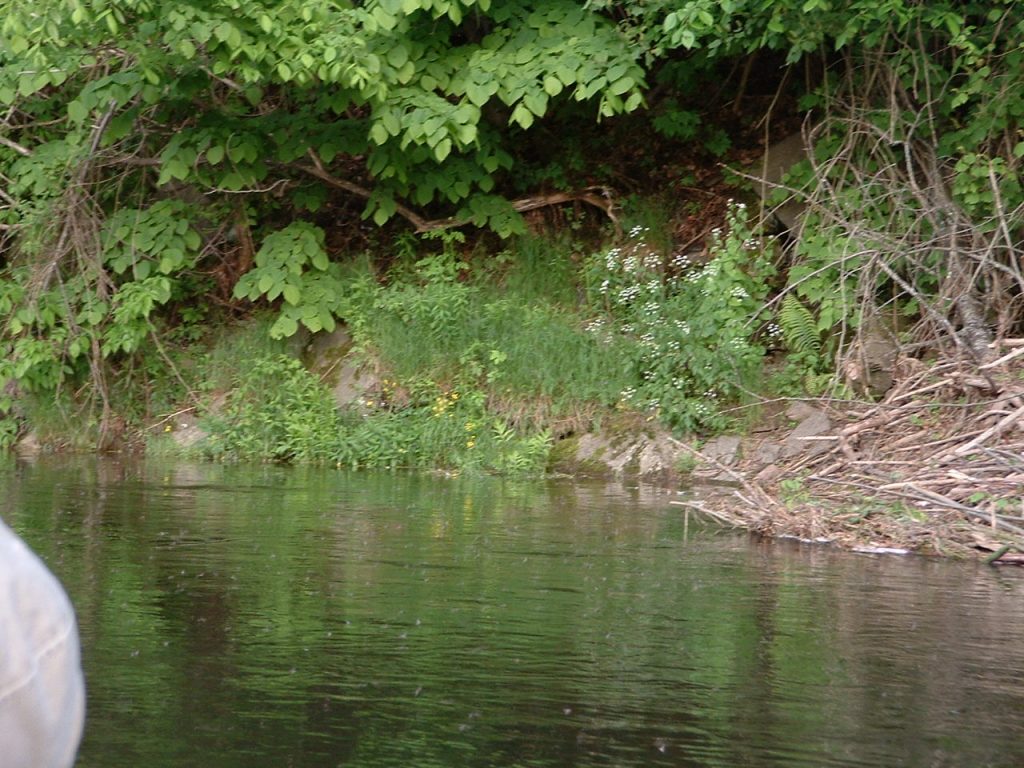
That subtle rise tight to the bank on the left just might be a big boy! The largest trout don’t always make the biggest rings and bulges. All of those little out of focus specks on the water are mayflies!
I love bank feeders, and I started looking hard for one. The picture above shows how hard they can be to spot, and it was taken at close range during a heavy hatch. A bank feeder sampling a hatch usually rises fairly regularly, not so those taking terrestrials. Ants, beetles, flies, etc. don’t show up in numbers, there is no steady parade past a trout’s holding lie. He has to be in the mood to take one when all the vagaries of nature come together and deliver one to his doorstep.
I didn’t spot any bank feeders. The rises I saw after the wind subsided were hit and miss rises, typical of terrestrial feeding trout in open water. They appear when they appear, when a morsel floats by close enough to draw the fish’s intertest, and you fish them by covering the area where you spot a rise. You have to concentrate, because you are casting to moving fish, and they aren’t always where you expect them to be. Sometimes you will see a trout turn and follow a fly downstream, looking it over. If it looks edible and floats clean, he just might take it. If it starts to drag, he’ll either blow up on it without taking, or simply turn away. I had a few of each of those adventures played out over the next hour.
The cloud cover became heavier as the afternoon progressed, and after the terrestrial bite ceased, it became beautifully calm. The pool morphed into a dark mirror as the slate colored clouds blanketed the sky, and those soft rises started up once again.
Within a few minutes there were a lot of fish rising, this time generally staying put rather than cruising. That told me there was a lot of something on the water. Naturally I tied the Flick olive back on and started casting, and naturally it was summarily ignored. Time to stare at the water again, and stare, and stare. The dark sky made it even harder to see them, but eventually I saw something and pinched it with a quick dip of my fingers. Flying ants, tiny black flying ants, and with more than a dozen trout rising steadily, there had to be a lot of them.
Not long ago I recalled the story of running into an ant fall on the river several years ago. The ants were a size 22 and my smallest imitations were size 20. The trout clearly recognized the “right” size from the wrong size that day. Of course I tied some size 22 flying ants and keep them with me all summer. This afternoon, my size 22 flying ants looked just a little bigger than the naturals, better imitated with a size 24. Like I said, I didn’t want to tie any size 24 ants last night. I was tired and I knew that if I tied them I would likely carry them around for five years before I saw another ant fall. I also knew that if I didn’t tie them, I would run into another fall today.
Gateway to the Delawareon a September afternoon, a dozen years ago
September already; ah but it seems it was just budding springtime! Three weeks of summer remain, though the cool, stormy skies and rushing winds on the river this morning certainly reminded me of autumn.
The fishing too seems to be in transition, as the late morning’s hot sun has been replaced by clouds and chilly winds this week, so too the risers to trico spinners have been few and far between. The terrestrials have not drawn the interest they have been for these many weeks either, so the trout and their stalkers wait for autumn hatches not yet ready to appear.
Perhaps it is time to switch tactics once again, to forsake the mornings and haunt the rivers later, as afternoon becomes evening. Caddis should begin to appear, and the bright little Hebe mayflies with their speckled wings. Olives too, as they seem to have deserted the river this summer. Fishing tailwaters bends us to man’s manipulation of the flows and thus the temperature, which has a lot to do with what flies we see. The rivers have cooled significantly, but not enough for the freestoners to be friendly trout habitat, just yet. It will take more rainfall, and more chilly nights to revive them.
One of those morning breezes caught my line yesterday, foiling my attempt to cast under an overhanging branch. I heard a derisive snort behind me and assumed I had a critic. Turning, I smiled to find a fawn munching steadily on the bank side vegetation and snorting between overstuffed mouthfuls.
It was a day of reluctant sippers and splashy refusals. The tricos were thin, there and gone so quickly, only a couple trout rose to them. With so few spinners on the water, the fish shied from the double they had accepted willingly last week. Finally changing to a size 24 single spinner, I was fast to one of those shy trout on the first cast. The sixteen inch brown flexed the seven foot bamboo fully as he thrashed about.
I’d taken a seventeen inch fish with the Grizzly Beetle early, and once the sparse tricos disappeared I went back to it. These wild browns were reticent though, following each drift several feet below their lies until the fly dragged, then popping it just before my pickup. The rises were few, the naturals certainly less active on a cool cloudy morning. Many trout take terrestrials readily when they are onthem, but are less responsive when few naturals are finding their way into the drift.
Standing on the river bank this morning I was musing about just how long it has been since I witnessed a hatch; not the one bug, two bug and finished kind, but an actual parade of hatching duns bouncing down the river with good fish eating them. I had to check my log as it has been more than two months since I stalked a pair of twenty-one inch browns sipping little olive duns as they rode the current slick before me (I got them both).
It has been a great summer, and I have taken many wonderful fish with a mix of dry flies, heavily favoring the terrestrials. But there’s a simple perfection in fishing a mayfly hatch that’s been missing.
I wonder if the Isonychia will show up this month, as I never encountered them during June? I’d love to see enough flow in the river to drop the boat in and float a few miles. I had a nice system last summer, getting on a parallel line down a riffle with the oars beneath my knees, casting toward the bank with a big, juicy Halo Isonychia. Things got interesting when a little bubble at my fly turned into a big, heavy brown trout streaking down river as I stomped on the anchor release while frantically clearing the fly line strewn across the floor of the boat!
Autumn brings the last dry fly fishing of the year, and it is always fleeting. You enjoy each moment you find with pleasant weather and rising trout, for you never know when the cold front that will end it all will blow through and turn Indian Summer into winter in the blink of an eye. Precious days, precious hours, every one of them lived to their fullest; the seasons of an angler are built upon them.
I was planning to fish this morning, hoping in fact for another round with the tricos that started my week in such fine fashion, but the rain that wakened me before five turned heavy. I rolled over and napped a bit, then found as expected it was to be another stormy day. The sun arrived later, but each time I thought about pulling on my waders and putting a rod in the car the wind would rise and the dark clouds gather.
I fished yesterday, a deliciously cool breezy day that felt more like late September than August. I trusted that the ten to fifteen mile winds would make a day of active terrestrial fishing, but things didn’t turn out that way. The only time I saw a sign of rising fish came at the peak of the wind storm, when casting accuracy and presentation were quite simply impossible. That mid afternoon blow was a lot more powerful than “ten to fifteen”. Perhaps adding those numbers would be closer to the mark. Picture fishing a quiet pool, with the wind blowing waves with whitecaps upstream!
Amid the ruckus I saw one spitting rise at a distance. The waves and floating debris made it tough to pick a target, so I made half a dozen casts to cover the area. On the last pitch I watched the tall hackle of my Grizzle Beetle bob into a trough between waves. It didn’t come back up. I tightened securely into a good fish and battled him while the wind tried to steal my hat. Leading him at last into the net I found a fine twenty-one inch wild brown, with my beetle way down in the back of his mouth.
I would have never known that trout had taken without that visible hackle collar. I trim the fibers on the bottom of the fly, but not the top, for visibility is a key to fishing terrestrials effectively. The problem with the typical black beetle or ant is that you cannot see what your fly is doing. If you can’t judge the quality of your drift, you can’t correct its flaws. The Grizz was an idea born of enhanced visibility and movement, and it’s making an impressive track record for itself.
The Pastoral Falling Spring Branch, in better days…
I had a chance to catch up with my friend Andy from Chambersburg last evening. Doctor B has been more than busy this season dealing with the impacts of Coronavirus, welcoming a fourth child, and becoming a riparian landowner. Stopping to catch his breath he told me of his hopes to restore his section of the Falling Spring. With all the young father and doctor tackles on a daily basis, I have no doubt he will succeed.
There was a time when I gave my heart fully to that little limestone stream. She holds many memories and it was hard to see her fall upon bad times over the past decade. I was looking back at old photos hoping to find a streamside shot of Andy’s new property before the decline, though I fear those images predate my digital age.
Seventy degree shirtsleeve weather in March, and one of my last big boys taken from the Spring: a 23 inch brown that fell for my Shenk Sculpin!
Limestone, ahh the images in my memory! I hunted the limestone springs for more than two decades, daily during my fly shop years. Winter wasn’t the end of fishing, it was simply the beginning of a new year. My best Falling Spring rainbow, five pounds of brilliant crimson flanked wild energy, came to hand late in January on a twenty degree morning, the water above the little riffle steaming as it mixed with the frigid air! Then as now, I dreamed of the past, when fly hatches were heavy and the dry fly was king; but numerous trophies came to Ed Shenk’s Sculpin and Minnow, and my own Limestone Shrimp.
To go back I would indeed have to go back in time. Should I miraculously acquire that skill, there would be many stops to make. Now though, there is hope. Andy related more news, that a large meadow downstream may get a new rehab. The Falling Spring faithful waited decades for that meadow’s face lift, and when it came our hopes were high. Tragically Mother Nature gave us a freak winter flood, undoing all that was accomplished. It would be serendipity indeed if restoration could wash over this reach once again.
The late Ed Shenk: friend, mentor, Fly Fishing Hall of Famer, and they guy responsible for a great morning’s fishing!
I wasn’t planning on doing any trico fishing this morning, terrestrials were my game, and I was nearly caught short. The trico box wasn’t in the little chest pack draped around my neck, and there was no spool of 7X tippet in there either. I wasn’t prepared, but the trout spread out in the river in front of me were sipping those confounded little spinners quite happily. I tried my smallest beetle – no. Then I knotted on an even smaller ant – no chance fella. Hmm, consternation…
There is a second small fly box in that chest pack, and I thought for a moment that there might be something in there I could use. My late friend Ed Shenk saved the day for me once again, as I dug around and came up with a single Shenk Double Trico!
Ed came to the rescue of frustrated fly fishers decades ago when he conceived and tied this pattern. Tricorythodes mayflies are a size 24, and it is very, very difficult to hook trout consistently on a size 24 hook. You can offset the point, you can make sure you hold your mouth just right, but its still pretty chancy, particularly when you find a good fish sipping the “White Curse”. Where trico populations are good, the spinner falls can be quite heavy, and Ed had observed trout sucking down clusters of spinners under these conditions. His solution was to tie two spinners on a single size 18 dry fly hook: one tail, two abdomens, wings and thoraxes, tied one behind the other.
The fly I snatched from that catch-all box this morning was a female Double Trico, with two white abdomens and two black thoraxes, and it worked like a charm!
I was armed with my Dennis Menscer four weight, seven and a half feet of flamed bamboo, rigged with a vintage 3″ Hardy St. George and an unknown English line. I have been looking for the right reel to fish with that rod and I finally found it in the old Hardy. I examined the line that was already spooled to find a long delicate taper, one that formed sweet loops when I tried it on my rod in the yard. No reason to change it out I decided, and this morning’s fishing proved it was the right decision.
That first riser, the one that ignored the beetle and the ant, came to the Double Trico perfectly. He didn’t care for the hook one bit though, and bucked against the slender arc of bamboo in an effort to rid himself of the thorn. I netted the fifteen inch brownie with a smile: a nice fish for a trico sipper.
The next one was laying in the shade of a tree, and the morning sun was glaring right into my right eye as I tried to place my fly in just the right line of drift. It took several tries, with the trout in the shade and that spotlight in my eye, but I finally got it right and the trout tipped up just as the first one had. He spun the Hardy a few times, bucked against the cane, but a net was clearly in his future. Brown number two was between sixteen and seventeen inches long, basically tying my best ever trico fish from back in my Falling Spring days.
I found another making a nice bulge back in the shade, and pulled more line from the reel. I was about to find out just how much I liked this mystery fly line. When you’re fishing to a nice trout sipping tricos, you have to make gentle presentations. When that cast has to go under a couple of low overhanging branches, and fifty feet back in the shade to alight without a ripple, the challenge increases. I had the perfect tool in my D.W. Menscer Payne 100, and that first shot back into no man’s land was perfection. Bulge, take, bent bamboo!
This fellow was primed to make some music on that vintage click and pawl! It was a good fight, with multiple runs and plenty of twists and turns, but he too found his way to my net. Eighteen and a half inches, nose to tail, a new trico record for me! Thank you Mr. Shenk, Mr. Menscer and Mr. Hardy.
Eventually the tricos thinned out I guess as the rises became irregular. Time to hunt I figured and knotted a Grizzly Beetle. There was one nice bulge deep in another shady spot, and I made the approach carefully. This was a one cast and done affair, but the rod and line felt like a part of my arm as I shot the little dark fly back into the shade beneath the branches.
You’ve gotta love that gentle bulge when it interrupts the silhouette of your fly drifting down the mirror and all hell breaks loose with the twitch of the rod. This one wasn’t coming out from under that tree if he could help it, but I put all the pressure the light rod and tippet allowed to keep him coming once I turned his head my way. He passed the snag and turned back toward it, but I swept the rod downstream and away, completing his turn with an extra curve that got him running down and away from danger. Yes my bronze and golden friend, I learned a few tricks about trout in cover many, many years ago!
In the net he measured twenty inches, the red spots on his bronze flank brilliant in the morning sunshine. There was one more that drew a cast with the Grizzly Beetle, a foot long aerialist that put on a spectacular show, out of the water four or five times in quick succession. I laughed as I held him in my hand and twisted the fly free.
My time was drawing short, and I worked my way down river, thinking of the short drive and a fresh deli sandwich for lunch. It was a perfect morning, the river quieter than it has been. I wrapped my self in the solitude as I waded slowly, thinking of my old friend and his special trico fly. I believe I’ll tie a few more, the one in my pack looks pretty ragged.
I have known Matt Supinski for twenty-five years, give or take, and I have continually marveled at the man’s talents in the world of angling. Fishing at his Gray Drake Lodge in 2012, Matt guided me to the steelhead of a lifetime, all during our stay sharing tidbits from his groundbreaking book Selectivity. The book was a marvel, and I was certain that it would be his magnum opus; at least until I opened the covers of last year’s The Brown Trout Atlantic Salmon Nexus. Matt is a brilliant angler, as well as a superb writer, and that is why I am excited about his forthcoming project: Hallowed Waters Journal.
Many of us who cherish classic angling have been put off by the over commercialization of our sport by the rank and file fly fishing magazines. Simply put, serious fly anglers don’t care to pay to read sales pitches for exotic destinations and the same old fly rods packaged with new paint and ever higher price tags.
Matt Supinski has taken a great stride forward into digital publishing, announcing a new online magazine that offers fly fishing in the soft light of evening along the stream. Regular features will pay homage to the classic people, flies, techniques and writings that formed the history of the sport, a legacy completely unknown to a majority of newcomers to fly fishing. Modern approaches to tactics and flies will likewise have a voice.
The Journal will cover fly fishing for trout, salmon and steelhead, the foundation species of our angling lifestyle. Regular features will explore the science vital to understanding these fish and their habitats, and conserving fisheries worldwide. There is a growing youth movement in our sport, and Hallowed Waters Journal will feature news and developments of interest to young anglers too. There is more, much more displayed in the preview.
The preview issue of Hallowed Waters Journal is online now. It may be found, along with the publication schedule and subscription information, at https://hallowedwaters.com/. There you will view a sampling of the content and stunning photography that has me excited about my own subscription.
The first issue launches in September, and I am looking forward to a bold, new experience in angling publications. Matt Supinski has a lifetime of worldwide angling experience and personal contacts to share. If you know the man as I do, you know his magazine will be a cut above anything we have seen in this genre.
Whiling away the morning chill: iso’s and Cahills for some evening fishing…
I can still feel the chill from the forty-eight degree dawn. Both windows stayed open in my tying room last night, and my vise still feels like an ice cube. Caught up in my own thoughts last evening, I kept thinking about the evening fishing I haven’t done. The mornings have been good to me, but I wasn’t thrilled by the deep, cold fog hanging over Crooked Eddy this morning. The fishing has been oriented to terrestrials, and the trout just don’t go looking for them early on a cold, foggy morning.
The extra mug of coffee tastes great, and I appreciate its warmth. Caribou calls this one Mahogany, and it has been my fly tying coffee for a number of years now. My morning output reflects what I expect to find, at least what I hope to find if I wander out on the Delaware after an early supper. A small handful of size 16 Cahills and a few downsized Halo Isonychia seemed enough to add to my shirt pocket box for a brief evening jaunt.
There’s something special about morning flies, always has been. I cannot count the number of days I have caught trout on a fly tied that morning, many of them large, difficult, and thus distinctly memorable trout. Maybe it’s the fisherman’s instinct, maybe a little ESP, but I often get a feeling that I should tie a particular pattern. Sometimes its a new variation, like the Trigger Point Dun Cahills; and sometimes its an old standby.
A heavy bodied 23″ brown taken on a size 16 dun & yellow sulfur CDC sparkle dun,tied that morning on a feeling the two color wing might appeal to the trout. One of four twenty inch or larger trout taken that day, three of them on that morning inspired sulfur. Intuition? A little magic? A bit of both I believe!
More than once I have wished I could call up that feeling at will. I mean, who doesn’t want a little extra magic to add to a day’s fishing? In truth it wouldn’t be nearly as special if it happened whenever I wanted it to.
Will one of this morning’s flies bring something extra to this evening’s fishing? I have no idea, though I do have a little faith!






 Bright Waters Catskill